
Market Overview
| Study Period | 2021 - 2031 |
|---|---|
| Forecast Data Period | 2026 - 2031 |
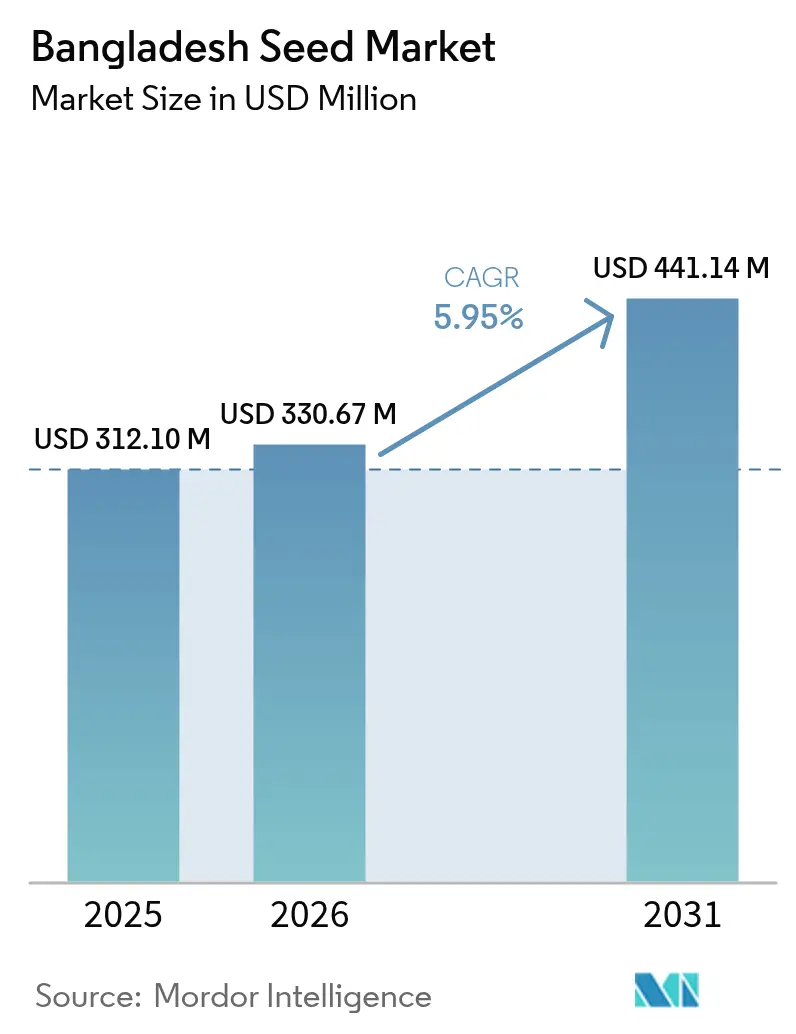
| Base Year Market Size (2025) | USD 312.10 Million |
| Market Size (2026) | USD 330.67 Million |
| Market Size (2031) | USD 441.14 Million |
| Growth Rate (2026 - 2031) | 5.95 % |
| Market Concentration | Medium |
Major Players *Disclaimer: Major Players sorted in no particular order Image © Mordor Intelligence. Reuse requires attribution under CC BY 4.0. | |
Bangladesh Seed Market Analysis by Mordor Intelligence
The Bangladesh seed market size is expected to grow from USD 312.10 million in 2025 to USD 330.67 million in 2026 and is forecast to reach USD 441.14 million by 2031 at 5.95% CAGR over 2026-2031. Rapid agricultural modernization and the increasing adoption of hybrids have driven up commercial seed demand. This growth trajectory reflects the country's strategic pivot toward agricultural modernization, supported by substantial government investment, including Tk 25,000 crore (USD 208 million) allocated for agricultural subsidies in FY2024-25. Strong research pipelines are delivering climate-resilient rice and vegetable varieties, while contract farming and digital marketplaces expand distribution reach. Global companies are deepening their local footprints through genomic breeding and advisory tools, yet infrastructure gaps and lengthy clearances for Genetically Modified Organisms (GMOs) temper near-term momentum. The Bangladesh seed market is therefore evolving through simultaneous technology pull and policy push forces that favor scale players willing to invest in storage, logistics, and regulatory engagement.
Key Report Takeaways
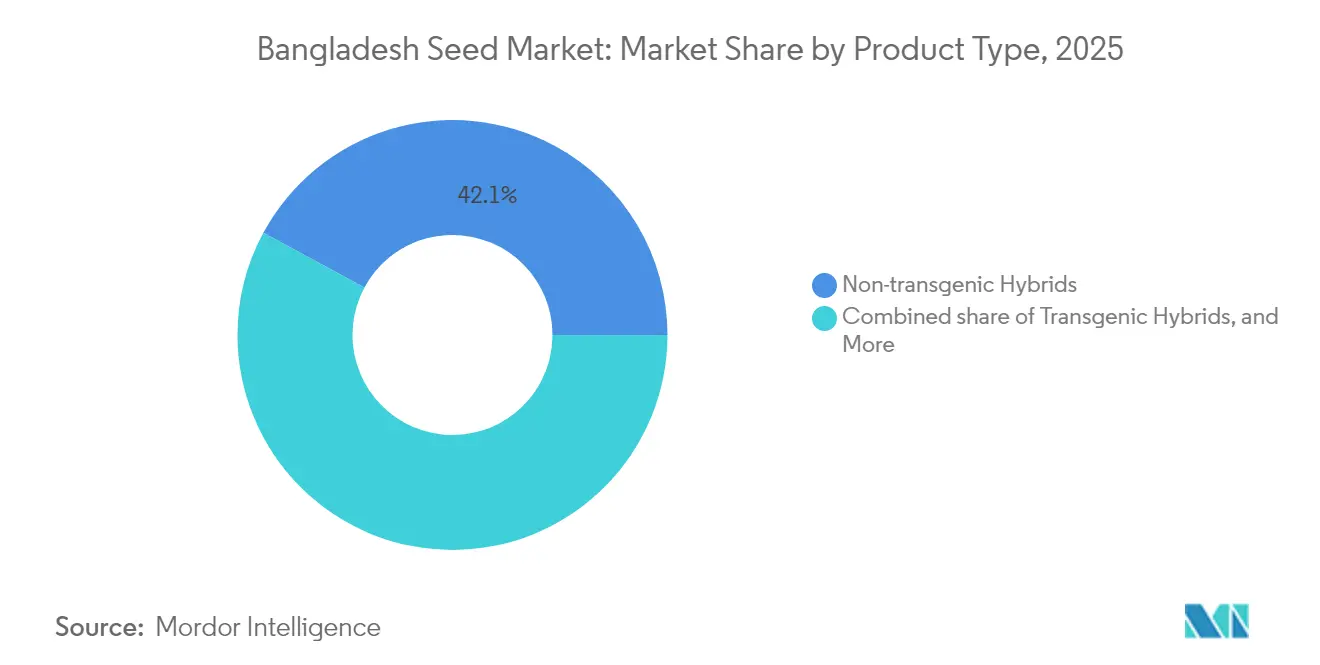
- By product type, non-transgenic hybrids held 42.12% of Bangladesh seed market share in 2025' while transgenic hybrids are forecast to grow at an 8.21% CAGR through 2031.
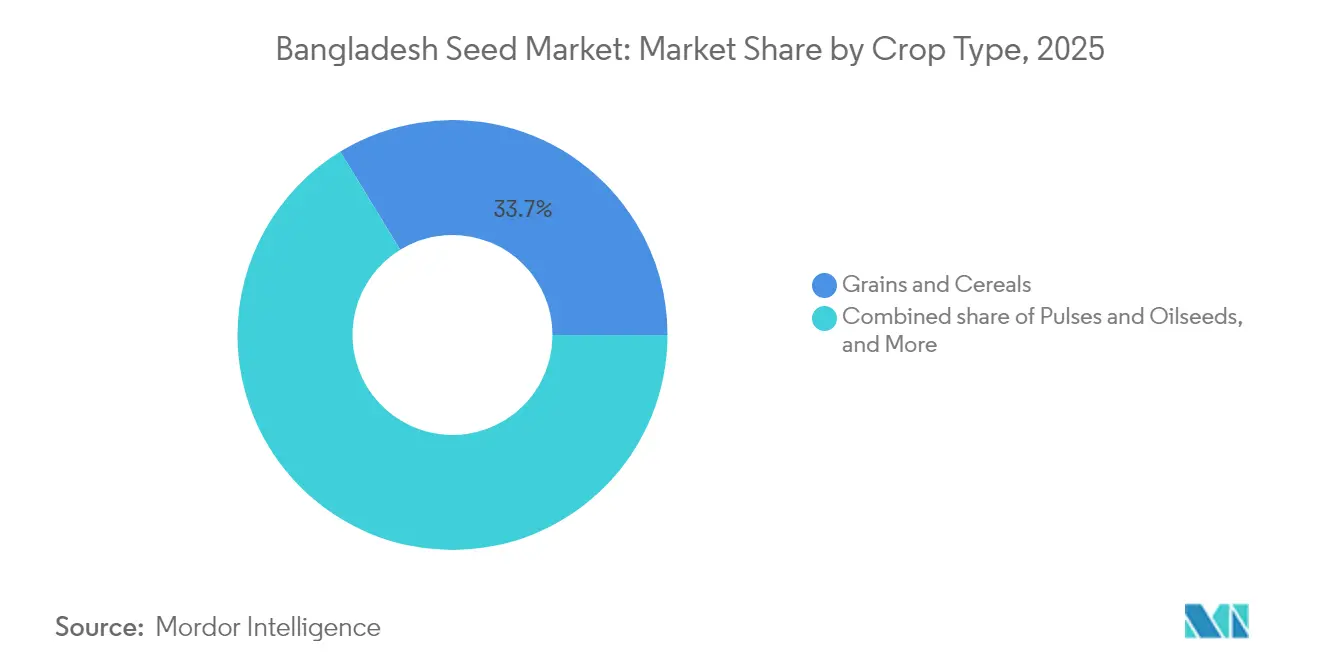
- By crop type, grains and cereals captured 33.74% of Bangladesh seed market size in 2025, and Vegetables are projected to expand at a 8.74% CAGR by 2031.
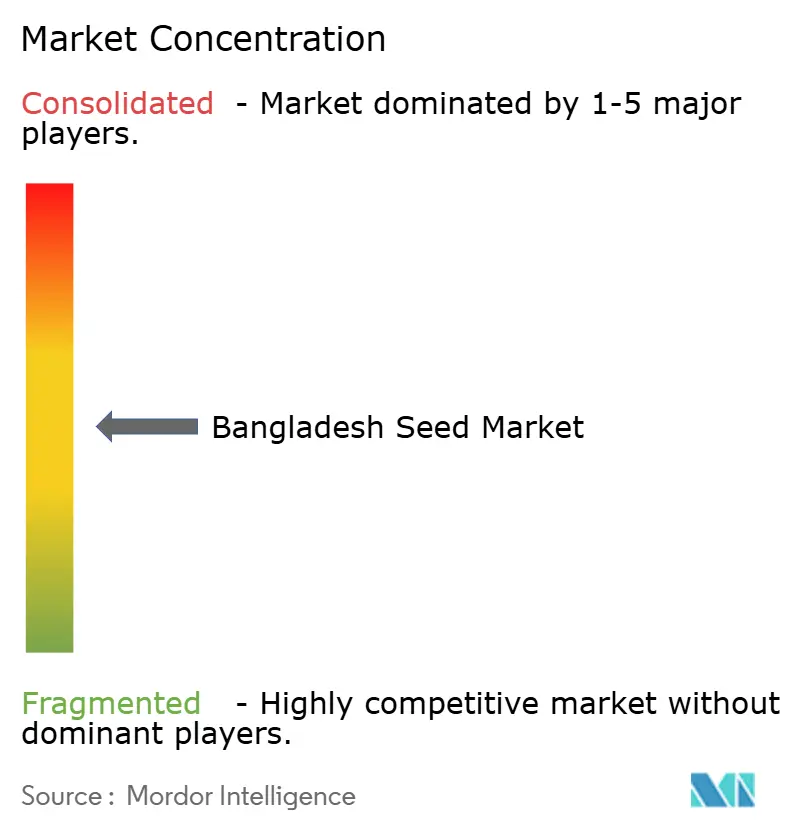
- The market structure is moderate, with Bayer AG, Corteva Inc., Syngenta Group, Lal Teer Seed Ltd. (Multimode Group), and Advanta Enterprises Ltd. (UPL Limited) present in the Bangladesh seed market as of 2024.
Note: Market size and forecast figures in this report are generated using Mordor Intelligence’s proprietary estimation framework, updated with the latest available data and insights as of 2026.
Bangladesh Seed Market Trends and Insights
Drivers Impact Analysis*
| Driver | (~) % Impact on CAGR Forecast | Geographic Relevance | Impact Timeline |
|---|---|---|---|
| Agricultural modernization surge | +1.8% | National, with early gains in the Dhaka, Chittagong, and Sylhet divisions | Medium term (2-4 years) |
| Expansion of contract farming networks | +1.2% | National, concentrated in rice and vegetable-producing regions | Long term (≥ 4 years) |
| Climate-resilient seed R&D incentives | +0.9% | National, with a focus on coastal and drought-prone areas | Long term (≥ 4 years) |
| Digital marketplace adoption | +0.7% | National, with urban and peri-urban early adoption | Short term (≤ 2 years) |
| Government subsidy alignment with Sustainable Development Goals (SDGs) | +1.1% | National, targeting smallholder farmers | Medium term (2-4 years) |
| Rising hybrid vegetable demand in peri-urban belts | +0.8% | Dhaka, Chittagong, and Sylhet metropolitan areas | Short term (≤ 2 years) |
| Source: Mordor Intelligence | |||
Agricultural Modernization Surge
Government mechanization programs that delivered 51,300 farm machines and collateral-free loans of USD 186 million in FY 2022-23 are lowering labor costs and boosting productivity, which lifts demand for certified seeds suited to precision planting. The Bangladesh Rice Research Institute has released more than 100 high-yield and stress-tolerant varieties, making the Bangladesh seed market a key beneficiary of public R&D in the year 2022. Modern machinery improves seed-to-soil contact and reduces wastage, encouraging farmers to invest in hybrids that promise 15-25% yield gains over saved seed. As adoption widens from flood-prone haor zones to coastal polders, seed companies experience a broadening customer base. These developments underpin steady expansion for hybrids and climate-resilient cultivars.
Expansion of Contract Farming Networks
Seed companies such as East-West Seed leverage guaranteed procurement contracts, technical coaching, and input credit to integrate growers into formal supply chains. International Rice Research Institute (IRRI) cluster-based Farmer Field Schools further institutionalize this model by organizing producers and standardizing agronomy practices [1]Source: International Rice Research Institute, “IRRI Drives Efforts to Scale up Agricultural Innovations in Bangladesh,” irri.org. Adoption is strongest for vegetables, where uniformity and timing are critical for urban markets. Contract frameworks reduce marketing risk, improve traceability, and build loyal grower relationships. Over the forecast horizon, Bangladesh seed market participants are anticipated to expand similar networks into hybrid rice and maize, helping smallholders overcome liquidity constraints and ensuring quality seeds reach remote communities.
Climate-Resilient Seed R&D Incentives
Frequent salinity intrusion, flash floods, and droughts have prompted the government to grant tax breaks and cost-sharing for research on firms developing tolerant varieties. Public institutions, such as the Bangladesh Agricultural Research Institute (BARI) and Bangladesh Institute of Nuclear Agriculture (BINA), collaborate with private breeders to utilize genomic selection and mutation breeding, thereby compressing breeding cycles and increasing success rates. IRRI’s dry direct-seeded rice pilots highlight how new genetics combine with altered crop management to conserve water and reduce carbon footprints. Multinational companies adopt quantitative genetics and UAV phenotyping for data-rich selection pipelines. These combined efforts enlarge the pipeline of Bangladesh-adapted hybrids with stable yields under climatic stress, positioning the Bangladesh seed market for resilient growth.
Digital Marketplace Adoption
Mobile applications, Unstructured Supplementary Service Data (USSD) services, and e-commerce portals have widened farmer access to genuine seeds and agronomic advice. Platforms like FarmRise reach more than 100,000 unique users each month, providing real-time pest alerts and cultivar suggestions [2]Source: Bayer CropScience Limited, “Annual Report 2023-24,” bayer.in. The Department of Agricultural Extension and Agricultural Information Services plans to launch joint digital dissemination initiatives, including special editions of Krishi Katha magazine with an 80,000-reader circulation, to promote the adoption of improved varieties and seed technologies in 2022.
Restraints Impact Analysis*
| Restraint | (~) % Impact on CAGR Forecast | Geographic Relevance | Impact Timeline |
|---|---|---|---|
| Limited cold-chain logistics for seed storage | -1.4% | National, acute in rural and remote areas | Medium term (2-4 years) |
| High price volatility of breeder seed | -0.9% | National, affecting all seed producers | Short term (≤ 2 years) |
| Informal seed trade dominance | -1.1% | National, concentrated in traditional farming areas | Long term (≥ 4 years) |
| Regulatory delays on GMO approvals | -0.8% | National, affecting biotechnology investments | Long term (≥ 4 years) |
| Source: Mordor Intelligence | |||
Limited Cold-Chain Logistics for Seed Storage
Most temperature-controlled facilities in Bangladesh serve potato and fish, not seed. Without specialized cold rooms, hybrid seed rapidly loses vigor in hot, humid conditions. The United States Department of Agriculture (USDA) notes that a lack of reliable storage raises import costs and restricts regional distribution, resulting in quality issues that erode farmer trust and slow repeat purchases [3]Source: USDA Foreign Agricultural Service, “Exporter Guide Annual,” usda.gov. Private firms must build greenfield depots, which inflate working capital requirements and lengthen payback periods. Unless cold chain investment accelerates, Bangladesh's seed market growth will remain below its potential in heat-sensitive crops, such as maize and certain vegetables. Government infrastructure development programs focus primarily on food storage rather than specialized seed storage requirements.
Informal Seed Trade Dominance
Saved seed and local exchange continue to supply more than 40% of planting material for cereals, limiting the commercial opportunity for certified products. Informal channels offer familiarity and zero cash cost but lack varietal purity, pest resistance, and traceability. The coexistence of dual systems complicates demand forecasting and hinders the diffusion of technology. Unless extension campaigns and price incentives can convert growers to formal channels, the Bangladesh seed market will continue to face leakage to unregulated alternatives. This parallel market structure reduces the addressable market size for formal seed companies and complicates the introduction of varieties and technology transfer. Informal trade networks operate without regulatory oversight, quality standards, or traceability systems required for modern seed commerce.
*Our forecasts treat driver/restraint impacts as directional, not additive. The impact forecasts reflect baseline growth, mix effects, and variable interactions.
Segment Analysis
By Product Type: Non-Transgenic Hybrids Solidify Lead
Non-transgenic hybrids held 42.12% Bangladesh seed market share in 2025, translating into the largest revenue stream within the Bangladesh seed market. Hybrid rice alone almost doubled its acreage during 2020-24, unlocking higher yields that compensate for seed repurchase costs. Similar momentum is visible in hybrid maize for feed mills and in tomato and cucumber hybrids for national supermarkets. These successes reinforce farmer confidence in hybrid technology while sidestepping GMO regulatory hurdles.
Transgenic hybrids are tracking an 8.21% CAGR, the highest among product types, yet they start from a small base due to protracted biosafety reviews. Following the Bt brinjal precedent, stacked insect-tolerant and herbicide-tolerant traits for cotton and maize await clearance. Multinationals and local firms are undertaking confined field trials and regulatory dossier preparation. Faster approvals would diversify the Bangladesh seed market size and provide new tools against pests like fall armyworm.



By Crop Type: Vegetables Accelerate Amid Grain Dominance
Grains and cereals accounted for 33.74% of Bangladesh seed market size in 2025, supported by year-round public procurement and policy support for rice self-sufficiency. Hybrid rice, hybrid maize, and improved wheat lines dominate rural seed usage. Farmers favor these crops for assured marketing channels and proven packages of practices. High-oleic sunflower and mustard also gain incremental share through edible oil import substitution programs.
Vegetables are growing at a 8.74% CAGR, making them the fastest-growing segment within the Bangladesh seed market. Protected cultivation and peri-urban demand spikes lift hybrid tomato, eggplant, and capsicum volumes, while export-grade mango rootstocks and onion bulbs widen product portfolios. Hybrid chili and okra reduce pesticide applications, aligning with food safety initiatives and enhancing marketability. As dietary diversification overlaps with export ambitions, vegetable seed suppliers secure premium margins and spur R&D investment.
Geography Analysis
Bangladesh functions as a single national market yet displays regional nuances that shape seed demand. Northern districts, such as Rangpur and Rajshahi, enjoy better road density and irrigation coverage, enabling the quicker adoption of hybrid rice and maize. Central zones surrounding Dhaka leverage their proximity to wholesale markets and cold rooms, thereby accelerating the use of vegetable hybrids. Southern coastal belts experience salinity and waterlogging, driving uptake of salt-tolerant rice and drought-resistant pulses.
Seed distribution hubs are concentrated in Dhaka and Chittagong, where major importers clear shipments through seaports and air cargo facilities. From these hubs, multi-modal logistics reach satellite warehouses in Sylhet, Mymensingh, and Khulna. Digital penetration above 70% in urban areas allows e-commerce platforms to bypass weak brick-and-mortar networks and deliver seed sachets directly to peri-urban farmers. International Rice Research Institute (IRRI) and Bangladesh Agricultural Research Institute (BARI) field trials in haor basins and polders create localized demonstration plots that speed the dissemination of stress-tolerant cultivars.
Policy-driven investments target climate-vulnerable coastlines, where embankment renovation and micro-credit unlock new arable land for adaptive varieties. Mobile Internet and agent banking facilitate micro-payments for input purchases, shrinking geographic disparities. Overall, convergence of infrastructure, research outreach, and digital access underpins balanced regional growth for the Bangladesh seed market.
Regulatory Landscape
Bangladesh seed production, marketing, and imports operate under the Seeds Act, 2018 and Seed Rules, 2020, with the National Seed Board (NSB) under the Ministry of Agriculture overseeing seed policy, variety release and registration, and licensing requirements. Notified crops face tighter controls, including mandatory variety registration and VCU testing, while non-notified crops follow relatively simplified pathways that support faster portfolio turnover in vegetables and other higher-value segments.
Seed dealer registration is required and typically runs on a multi-year validity cycle, while imports are screened through plant quarantine enforcement by the Plant Protection Wing of the Department of Agricultural Extension (DAE) under the Plant Quarantine Act, 2011. Quality oversight is reinforced through the Seed Certification Agency (SCA) for certified seed, and the public sector remains active via Bangladesh Agricultural Development Corporation (BADC) seed multiplication and distribution, which shapes how private firms plan product launches, inventory, and compliance timelines, particularly for biotechnology traits that face longer biosafety review cycles.
Competitive Landscape
The market structure is moderate, with Bayer AG, Corteva Inc., Syngenta Group, Lal Teer Seed Ltd. (Multimode Group), and Advanta Enterprises Ltd. (UPL Limited) maintaining portfolios in Bangladesh that emphasize hybrid rice, corn, and vegetables. Bayer’s genomic selection platform and UAV-based phenotyping reduce development cycles by up to two years, resulting in locally adapted hybrids that command price premiums. Corteva Inc. partners with public institutes to field-test drought-tolerant maize, while Syngenta rolls out integrated seed, crop protection, and training packages.
Regional specialists, such as East-West Seed International Ltd. and Sakata Seed Corporation, build loyalty through demonstration plots and small-pack sizes that cater to cash-constrained growers. Domestic firms, such as Lal Teer Seed Ltd. (Multimode group), leverage entrenched dealer networks and cultural familiarity to defend their share in open-pollinated rice and vegetables. Quality certification from the Bangladesh Standards and Testing Institution differentiates compliant companies in public tenders and export bids[4]Source: Bangladesh Standards and Testing Institution, “BSTI Certification Services,” bsti.gov.bd.
Strategic moves include East-West Seed’s expansion of contract farming clusters to 22 districts, and Lal Teer Seed Ltd. (Multimode group)’s investment in a cold storage facility that counters logistics bottlenecks in 2022. In October 2023, Bayer AG introduced a bundled service that combines hybrid rice seed, herbicide, and digital crop scouting for a subscription fee. Competition is therefore shifting from price to bundled value propositions, favoring players with R&D scale, advisory capacity, and cold chain assets.
Bangladesh Seed Industry Leaders
Bayer AG
Corteva inc.
Syngenta Group
Lal Teer Seed Ltd. (Multimode group)
Advanta Enterprises Ltd. (UPL Limited)
- *Disclaimer: Major Players sorted in no particular order

Market Opportunities and Future Outlook
Opportunity in Bangladesh continues to center on formalizing seed distribution and advisory, where digital channels and organized grower networks reduce reliance on informal trade that still supplies a large share of planting material in staples. In-market initiatives already visible include Bayer-backed FarmRise, which reported more than 100,000 unique users per month in company reporting, along with IRRI-linked cluster approaches with the Department of Agricultural Extension that pair seed sales with agronomy guidance and demand aggregation for hybrids and stress-tolerant varieties.
There is also a gap in post-harvest and quality infrastructure tailored to seeds. Most temperature-controlled capacity in Bangladesh is oriented to potato and fish rather than seed, which increases the value of dedicated cold rooms, warehousing, and last-mile handling for heat-sensitive hybrid maize and many vegetable seeds. Industry coordination provides a second scale pathway: in 2026 the Bangladesh Seed Association (BSA) advanced collaboration with the Bangladesh Agrochemical Manufacturers Association (BAMA) around local production and reduced import dependence for agricultural inputs, which can tighten availability of complementary inputs and improve package-of-practices adoption where seed performance depends on aligned crop protection and nutrient regimes.
Recent Industry Developments
- April 2026: iFarmer secured USD 1.5 million from Symbiotics to strengthen agricultural input supply chains and market linkages for smallholders. Improved financing and distribution reach supports more consistent access to branded seeds and bundled agronomy at the farm gate, particularly where informal channels dominate.
- July 2025: International Rice Research Institute (IRRI) initiated a nationwide scaling program with the Department of Agricultural Extension to promote climate-smart varieties and cluster farming models. The program institutionalizes demonstration and organized farmer groups, improving the conversion of public R&D outputs into higher adoption of improved and hybrid seed.
- June 2024: Bayer CropScience Limited partnered with ACI Ltd. to distribute Arize Dhani Gold hybrid rice for the Aman season in Bangladesh. The collaboration expands hybrid rice availability through an established local distribution network and reinforces the market shift toward packaged hybrid seed plus advisory for seasonal productivity and disease management.


Research Methodology Framework and Report Scope
Market Definition and Coverage
This market is defined as the value of seeds sold for crop cultivation in Bangladesh, covering commercial seed products used by farmers across major field and horticulture crops, measured at the point of sale within the country.
Scope exclusions: It does not count fertilizers, crop protection chemicals, farm machinery, or grain output value after harvest.
Segmentation Overview
- By Product Type
- Transgenic Hybrids
- Non-transgenic Hybrids
- Open-pollinated Varieties
- By Crop
- Row Crops
- Fiber Crops
- Cotton
- Other Fiber Crops
- Forage Crops
- Alfalfa
- Forage Corn
- Forage Sorghum
- Other Forage Crops
- Grains & Cereals
- Corn
- Rice
- Sorghum
- Wheat
- Other Grains and Cereals
- Oilseeds
- Canola, Rapeseed and Mustard
- Soybean
- Sunflower
- Other Oilseeds
- Pulses
- Fiber Crops
- Vegetables
- Brassicas
- Cabbage
- Carrot
- Cauliflower and Broccoli
- Other Brassicas
- Cucurbits
- Cucumber and Gherkin
- Pumpkin and Squash
- Other Cucurbits
- Roots and Bulbs
- Garlic
- Onion
- Potato
- Other Roots and Bulbs
- Solanaceae
- Chilli
- Eggplant
- Tomato
- Other Solanaceae
- Unclassified Vegetables
- Peas
- Spinach
- Other Unclassified Vegetables
- Brassicas
- Row Crops
Data Sources, Market Sizing, and Validation
Desk Research
Desk work started with building the demand context for Bangladesh cropping and seed use, then organizing a clean set of assumptions that can be checked later through expert calls. We leaned on public agriculture statistics and policy documents to understand cropped area and seasonality, seed replacement patterns, and the role of public distribution in sales.
Sources used included Bangladesh Bureau of Statistics releases for area and production context, agriculture ministry and seed regulatory notifications for the formal seed system, FAO data on crop production and area, customs and trade statistics for seed imports, and peer reviewed agronomy and seed-system studies. We also reviewed company annual reports, investor presentations, association websites, and reputed local press for pricing signals and product mix clues. Where needed, we selectively used paid subscriptions for company financials and intelligence, patent lookups, and shipment-level import and export checks. The desk sources listed are illustrative only, since many other references were used for data collection, validation, and clarification.
Primary Interviews and Surveys
We speak with seed producers, importers, distributors, dealers, agronomists, and agricultural officials across Bangladesh. Interviews and surveys test secondary data, clarify informal supply and seed replacement behavior, and refine assumptions on prices, hybrid adoption, and channel margins within the Bangladesh market. Re-contact is used when expert views do not explain a material variance.
Distribution of primary research fieldwork respondents
| Company type | Respondent position |
|---|---|
| Top tier: 26% | CXOs: 15% |
| Mid tier: 49% | Functional/Unit leaders: 30% |
| Smaller Players: 25% | Managers: 55% |
Market-Sizing & Forecasting
Sizing was built using a top-down and bottom-up approach, where the demand pool was first reconstructed from Bangladesh crop area and crop-wise seed rate logic, followed by realistic adoption and replacement rates for certified seed versus saved seed. Once this demand spine was set, it was converted into value using price ladders by product type (transgenic hybrids, non-transgenic hybrids, and open-pollinated varieties) and by major crop groups, and the totals were stress-tested with selected bottom-up approximations like supplier and channel roll-ups and sampled price checks.
Key inputs that shaped the model included cropped area trends and cropping intensity, hybrid penetration by crop, seed replacement rate and refresh cycles, import dependence for specific vegetable and row-crop seeds, and observed retail price bands by pack size and trait positioning. Forecasts were developed using scenario analysis supported by simple regression-style relationships between planted area, adoption progression, and pricing, and then moderated using expert views on policy changes, variety approvals, and distribution constraints. When bottom-up information was missing for smaller crops, gaps were handled through proportional allocation based on planted area and interviews on typical seed spend share, and then rebalanced to keep totals consistent.
Data Validation & Update Cycle
Outputs were cross-checked against independent signals such as seed import values, crop-wise production trends, and reported expansion or contraction in private distribution coverage, and any large variances were flagged for review. Before sign-off, assumptions that drive most of the value, like hybrid share and price progression, were rechecked through follow-up outreach, and then reviewed in more than one analyst pass so calculation errors and mis-scoped items are caught.
The model is refreshed annually, and interim updates are made when material events occur, such as major policy shifts on seed approvals, sharp currency moves affecting imported seed pricing, or clear changes in cropping patterns. Right before delivery, a fresh update pass is completed so the final numbers reflect the latest available data and validated expert feedback.
Mordor Intelligence's Seed Sector Analysis Bangladesh Market Size Compared With Other Published Estimates
It is normal to see different Bangladesh seed market numbers across publications because the market can be counted at different points in the value chain and with different product inclusions. The biggest drivers are usually how informal seed use is treated, whether farm-saved seed is assigned a value, and how hybrid pricing and import timing are converted into local currency.
Some external estimates appear to use a broader seed-system view that blends informal exchange and public distribution value into one figure. For Mordor Intelligence, the estimate is kept to commercial seed sales captured through the defined product types, and totals are reconciled against crop-area demand build-ups and channel validation so the value does not get inflated by non-market seed flows.
Benchmark comparison
| Source | Market Size | Gaps in Research Methodology |
|---|---|---|
| Mordor Intelligence | USD 312.10 M (2025) | |
| Global Consultancy A | USD 260.93 M (2024) | Uses an earlier base year and a different study window, and the published scope cues suggest a broader segmentation frame that can understate crop-specific hybrid price ladders when converted into a single national value. |
| Regional Consultancy B | USD 340.00 M (2024) | Often reflects an expanded crop and application coverage narrative, and the higher number can come from blending protected cultivation and informal seed-system value assumptions without consistently tying them back to priced commercial volumes. |
Seen together, the spread is mainly explained by year selection and what gets treated as a monetized seed sale versus a seed-system activity. By keeping the sizing anchored to clear demand drivers like crop area, replacement behavior, and observed price bands, the final figure stays traceable and can be repeated with the same steps when the next update is done.


Key Questions Answered in the Report
How large is the Bangladesh seed market in 2026 and what CAGR is projected to 2031?
The Bangladesh seed market stands at USD 330.67 million in 2026 and is forecast to grow at a 5.95% CAGR, reaching USD 441.14 million by 2031.
Which product type currently leads sales?
Non-transgenic hybrids dominate with 42.12% share in 2025 due to strong uptake of hybrid rice and vegetables.
Which crop segment is expanding the fastest?
Vegetables are advancing at a 8.74% CAGR on the back of peri-urban demand and export diversification.
What are the main barriers to faster seed adoption?
Limited cold storage for seed, high breeder seed price volatility, dominance of informal trade, and slow GMO approvals restrain expansion.
How are digital tools reshaping seed distribution?
Mobile advisory apps and e-commerce portals cut transaction costs and let companies reach farmers in remote areas, accelerating hybrid uptake.
Which companies hold notable positions in the market?
Bayer AG, Corteva Inc., Syngenta AG, BASF SE, East-West Seed International Ltd., and Lal Teer Seed Ltd. (Multimode group) are among the prominent suppliers.
Page last updated on:


 Your data is secure and never sold or shared.


