
Security Data Pipeline Market Size and Share
Market Overview
| Study Period | 2021 - 2032 |
|---|---|
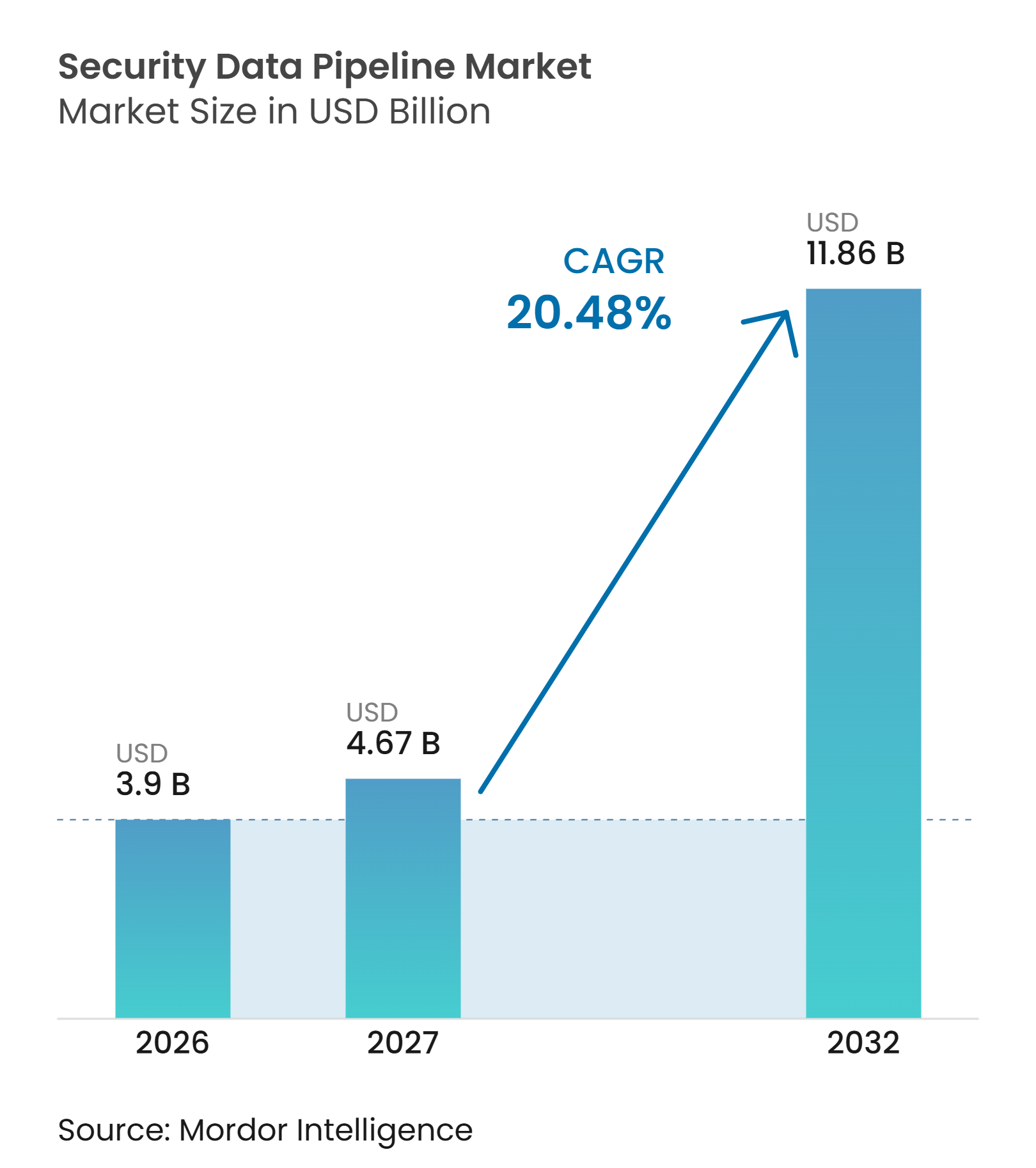
| Market Size (2027) | USD 4.67 Billion |
| Market Size (2032) | USD 11.86 Billion |
| Growth Rate (2027 - 2032) | 20.48 % |
| Fastest Growing Market | Asia-Pacific |
| Largest Market | North America |
| Market Concentration | Medium |
Major Players *Disclaimer: Major Players sorted in no particular order Image © Mordor Intelligence. Reuse requires attribution under CC BY 4.0. | |
Security Data Pipeline Market Analysis by Mordor Intelligence
The Security data pipeline market size was valued at USD 3.90 billion in 2026 and estimated to grow from USD 4.70 billion in 2027 to reach USD 11.86 billion by 2032, at a CAGR of 20.48% during the forecast period (2027-2032). The Security data pipeline market is gaining importance as security operations centers manage expanding volumes of logs from cloud platforms, applications, networks, connected devices, and AI workloads. Pipeline tools allow teams to filter, enrich, normalize, route, and retain this data before it reaches a security information and event management platform. This approach helps organizations control data handling costs while keeping high-priority security records available for detection and investigation. Vendor strategies increasingly combine pipeline capabilities with detection, analytics, and SIEM offerings, while regulatory requirements for logging, retention, and data residency continue to support demand across regulated sectors.
Key Report Takeaways
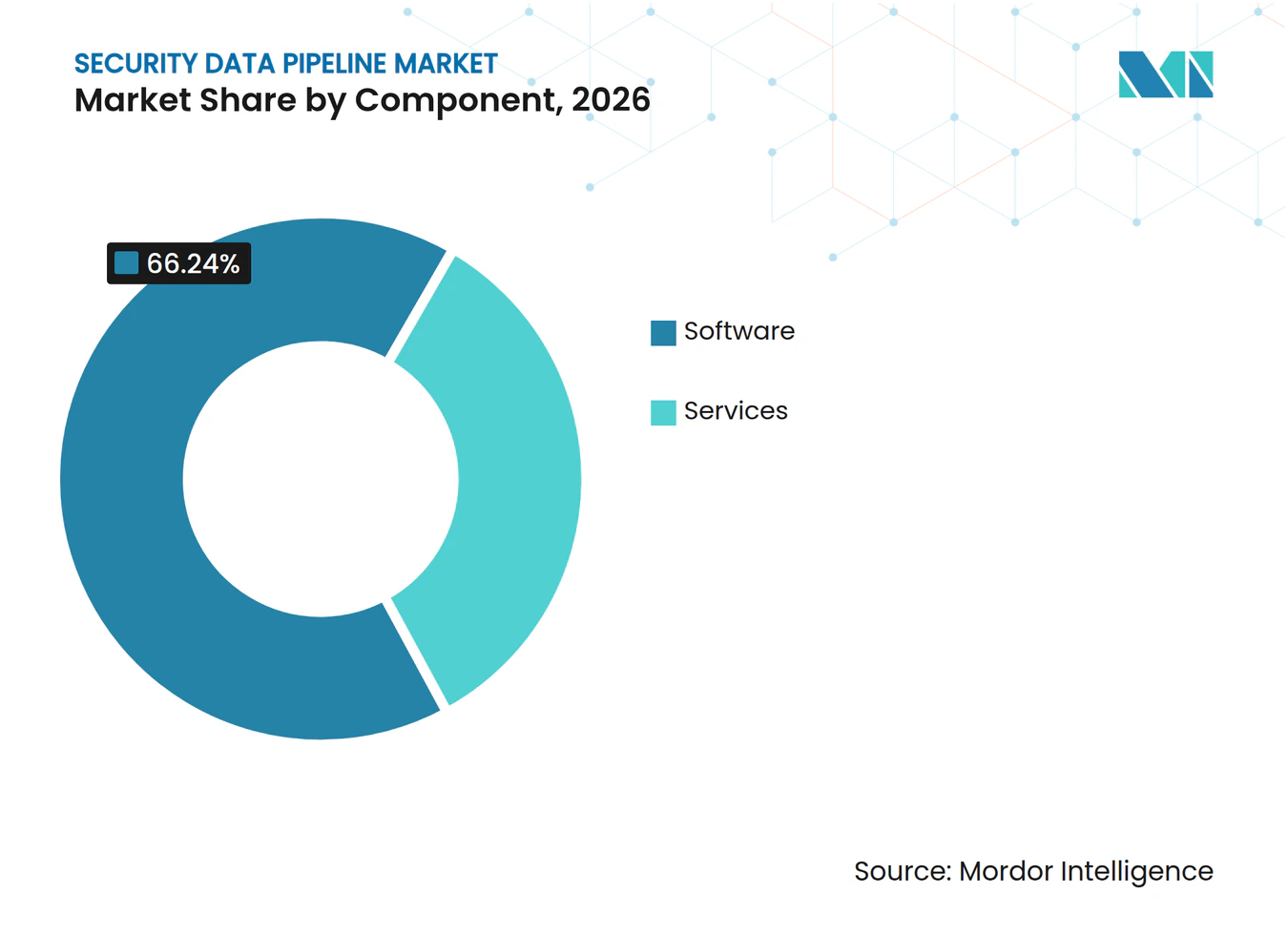
- By component, software held 66.24% of the Security data pipeline market share in 2026, while services are projected to expand at a 21.86% CAGR through 2032.
- By function, collection and ingestion accounted for 59.11% of the Security data pipeline market revenue in 2026, while in-stream detection is projected to grow at a 21.55% CAGR through 2032.
- By deployment, on-premises accounted for 70.12% of the Security data pipeline market revenue in 2026, while cloud deployment is projected to grow at a 22.14% CAGR through 2032.
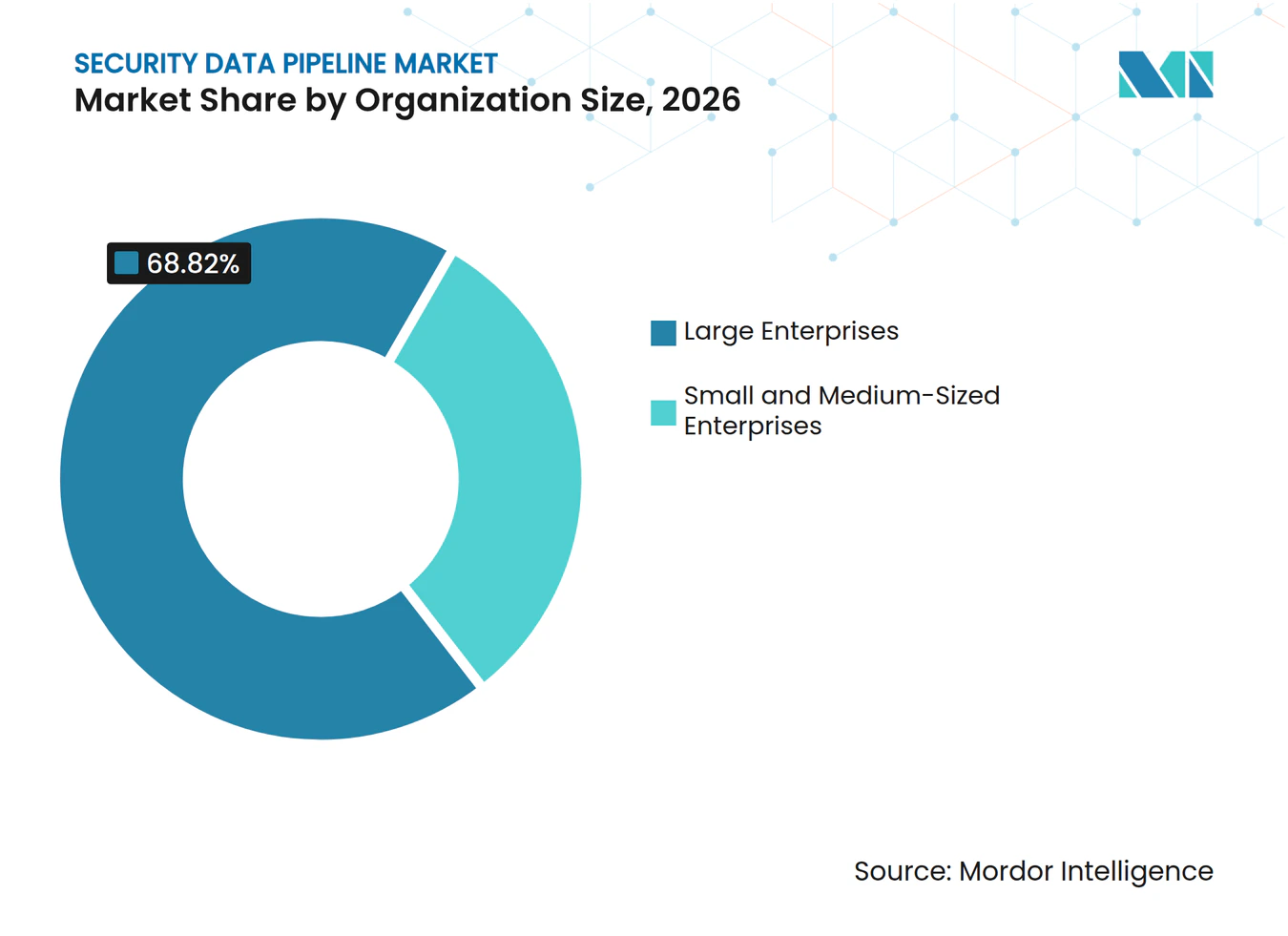
- By organization size, large enterprises held 68.82% of the Security data pipeline market revenue in 2026, while small and medium-sized enterprises are projected to grow at a 22.48% CAGR through 2032.
- By end user, BFSI held 28.16% of the Security data pipeline market revenue in 2026, while government and public administration are projected to grow at a 20.89% CAGR through 2032.
- By geography, North America held 36.41% of the Security data pipeline market revenue in 2026, while Asia-Pacific is projected to expand at a 21.26% CAGR through 2032.
Note: Market numbers in this report are based on Mordor Intelligence's proprietary estimation framework, which combines nine months of actuals with Q4 projections for base year 2026.
Market Trends and Insights
Drivers Impact Analysis of Security Data Pipeline Market*
| Driver | (~) % Impact on CAGR Forecast | Geographic Relevance | Impact Timeline |
|---|---|---|---|
| Escalating Security Telemetry Volumes | +5.8% | Global | Short term (≤ 2 years) |
| SIEM Ingestion-Cost Optimization | +4.6% | North America and Europe | Short term (≤ 2 years) |
| AI-Ready Security Data Quality Requirements | +3.2% | Global, with early gains in North America and Asia-Pacific | Medium term (2-4 years) |
| Hybrid and Multi-Cloud Security Operations | +2.9% | North America, Europe, Asia-Pacific | Medium term (2-4 years) |
| Regulatory Retention and Data Residency Controls | +2.1% | EU, India, Asia-Pacific core | Medium term (2-4 years) |
| Real-Time Detection and In-Stream Analytics | +1.4% | Global | Long term (≥ 4 years) |
| Source: Mordor Intelligence | |||
Escalating Security Telemetry Volumes
Security telemetry is expanding faster than many infrastructure budgets can accommodate, underscoring the need for controls before data enters a SIEM. IDC cited annual enterprise telemetry growth of 29%, and Cribl noted that this growth puts pressure on tools priced by data volume. Cloud migration, 5G deployment, IoT adoption, and the use of more security tools add new data sources without consistently removing older ones. AI workloads also add inference logs, token records, and API activity that require both operational and security oversight. The Security data pipeline market benefits from filtering and routing, which can preserve high-value records while reducing unnecessary ingestion. This makes pipeline deployment a practical part of maintaining security visibility as data volumes rise.
SIEM Ingestion-Cost Optimization
Volume-based SIEM pricing gives organizations a direct reason to reduce telemetry before it reaches costly storage and analytics systems. Security data pipeline products operate upstream, allowing teams to apply filtering, aggregation, and routing rules before a billing threshold is reached. IBM reported that the global average cost of a data breach was USD 4.44 million in 2025, linking security spending decisions to the need to preserve effective risk controls.[1] Organizations can redirect funds from low-value data storage toward triage, detection content, and response processes when the pipeline reduces unnecessary data movement. The Security data pipeline market, therefore, addresses both financial and operational concerns rather than serving as a narrow infrastructure purchase. Modular security architectures also reinforce the role of a separate control layer between data sources and downstream tools.
AI-Ready Security Data Quality Requirements
AI-supported detection and SOC assistants require consistent, enriched telemetry to produce usable results. Raw logs often use different formats, field names, and schemas, which can reduce the reliability of automated analysis. The Open Cybersecurity Schema Framework provides a common approach for normalizing security data across different sources. Cribl launched StreamAI in September 2026 with a model router designed to direct AI workloads to suitable models based on task and cost requirements. SANS found that 60% of organizations identify skills gaps as their main workforce challenge in its 2026 research. The Security data pipeline market can support teams that need cleaner data and more automated processing without adding equivalent specialist headcount.
Hybrid and Multi-Cloud Security Operations
Enterprises increasingly manage telemetry across on-premises networks, public cloud platforms, software-as-a-service applications, and operational technology environments. A pipeline can act as a policy layer that determines where each data stream is enriched, masked, routed, and retained. This is useful when data must be sent to a SIEM, a data lake, a managed security provider, or multiple destinations simultaneously. DataBahn describes pipeline tools as a way to reduce cloud egress and security data storage costs while retaining selected logs. Data residency requirements may also require that processing remain within a given jurisdiction rather than moving all telemetry to a centralized cloud service. These operating conditions expand the role of the Security data pipeline market in distributed security environments.
Restraints Impact Analysis of Security Data Pipeline Market*
| Restraint | (~) % Impact on CAGR Forecast | Geographic Relevance | Impact Timeline |
|---|---|---|---|
| Parser Maintenance and Schema-Drift Complexity | -1.8% | Global | Short term (≤ 2 years) |
| Migration Risk From Entrenched SIEM Workflows | -1.4% | North America and Europe | Medium term (2-4 years) |
| Shortage of Security Data Engineering Skills | -1.0% | Global | Medium term (2-4 years) |
| Vendor Consolidation and Neutrality Trade-Offs | -0.7% | North America and Europe | Long term (≥ 4 years) |
| Source: Mordor Intelligence | |||
Parser Maintenance and Schema-Drift Complexity
Parser maintenance can raise the operating burden of a security data pipeline when upstream sources change their formats. Field renames, new event types, and version changes can create gaps or malformed output if parsing rules are not updated. This problem becomes more difficult as organizations add more applications, security tools, cloud services, and software updates. Vendors such as Axoflow promote automated schema handling and code-free curation to simplify these tasks. However, automated parser adaptation still requires enterprise validation across varied log formats and operating conditions. The Security data pipeline market must address this maintenance requirement, as poor parsing can degrade detection quality and raise compliance concerns.
Migration Risk From Entrenched SIEM Workflows
Changing a SIEM workflow involves detection rules, analyst procedures, compliance dashboards, and incident response connections that may depend on existing data formats. Introducing a normalization layer can affect these components in ways that may not be clear before implementation. Many organizations use parallel operations while testing legacy and new pipelines against current and target security tools. This adds time and cost to deployments, especially in large organizations with established content and numerous integrations. The Security data pipeline market faces a slower sales cycle, in which buyers require detailed migration planning and proof that existing visibility will be maintained. These risks can be less severe for smaller deployments that begin with a new operating model.
*Our forecasts treat driver/restraint impacts as directional, not additive. The impact forecasts reflect baseline growth, mix effects, and variable interactions.
Security Data Pipeline Market Segment Analysis
By Component:
Software Retains Revenue Leadership While Services ExpandSoftware held 66.24% of the Security data pipeline market in 2026, reflecting the commercial value placed on routing policies, enrichment logic, and detection content. Buyers use the software layer to govern how records move from source systems to analysis, storage, or managed-service environments, while applying controls that align with their operating procedures. The category includes functions that filter low-value events, standardize fields, mask selected information, and direct each record to an appropriate destination. Software leadership indicates that buyers regard the pipeline as a core control point because its rules influence the quality, usability, and cost of data delivered to downstream tools. Broad integrations and flexible processing are important because security teams need consistent treatment across many sources without having to rebuild their existing operating model.
Services are projected to grow at a 21.86% CAGR through 2032, supported by the need for complex integration, migration, and managed operations. Professional services can cover implementation planning, parser development, source onboarding, SIEM migration support, testing, documentation, and ongoing pipeline management. These activities are difficult to standardize because every customer has a different combination of sources, schemas, controls, retention rules, and regulatory responsibilities. Cribl reported more than USD 300 million in annual recurring revenue, 1,500 enterprise customers, and 70 new integrations added in 2026. The service opportunity is strongest where customers need careful transition support to preserve detection coverage, reporting quality, and compliance processes as established workflows change.


By Function:
Collection Anchors Demand as In-Stream Detection GrowsCollection and ingestion accounted for 59.11% of revenue in 2026, making it the largest functional area in the Security data pipeline market. This position reflects the primary need to collect, inspect, and route telemetry before it is sent to costly analytics and storage platforms. Organizations use pipelines to manage data from endpoints, networks, applications, cloud services, identity systems, and other sources that produce records with different volumes and formats. The function can reduce duplication and ensure that relevant events reach the right analytics, storage, or managed service destination in a form that downstream teams can use. Collection and ingestion, therefore, provide the base for later filtering, normalization, transformation, and detection steps, rather than operating as an isolated data transport activity.
In-stream detection is projected to grow at a 21.55% CAGR through 2032 as teams place more detection logic before SIEM ingestion. Axoflow launched AxoDetect in September 2026 to let detection engineers run Sigma rules against OCSF-normalized data in the pipeline.[2] The approach can send alerts to a SIEM while retaining full records in a lower-cost storage layer, giving teams options for response, investigation, and long-term retention. Filtering and reduction control data costs, while normalization and transformation prepare information for analytics, AI tools, compliance reporting, and more consistent use across a security environment. Earlier processing can separate detection timing from SIEM ingestion timing and move the Security data pipeline industry beyond simple data movement toward a more active security role.
By Deployment:
On-Premises Remains Important as Cloud Use RisesOn-premises deployment accounted for 70.12% of revenue in 2026, indicating that many organizations still keep pipeline processing close to their existing security systems. This Security data pipeline market share reflects data residency requirements, egress costs, long-standing SIEM investments, and an operational preference for processing sensitive records within a controlled local environment. Security teams may select local processing when very high data volumes would otherwise require moving to a cloud-hosted pipeline and then back to an on-premises platform for analysis. It can also support environments where sensitive telemetry, customer data, operational records, or government information cannot leave a defined location. The continued role of local processing shows that cloud adoption does not remove the need for customer-managed engines, especially in regulated organizations with established workflows.
Cloud deployment is projected to expand at a 22.14% CAGR through 2032 as organizations modernize security operations and adopt cloud-native systems. Cloud delivery can simplify platform management, enable faster access to new integrations, and support teams operating across multiple distributed environments. Hybrid architectures combine a cloud control plane with customer-hosted processing engines, allowing organizations to retain sensitive telemetry in place while using centrally managed policies and administration. DataBahn identifies flexible routing and deployment choices as important for organizations managing security, IT operations, observability, and compliance data. The Security data pipeline market size for cloud deployments is supported by modernization projects that replace single-location security operations with distributed architectures while retaining local control where it is necessary.
By Organization Size:
Large Enterprises Lead While SMEs Gain AccessLarge enterprises held 68.82% of revenue in 2026 because they manage high telemetry volumes and operate complex security environments. These organizations can use multiple SIEMs, cloud services, business applications, security products, and operational systems simultaneously, with each source creating a separate stream that requires governance. Their data volumes create pressure to reduce unnecessary ingestion and to maintain consistent controls across destinations without limiting the visibility analysts need. Large teams also have established detection rules, reporting obligations, and incident-response procedures that require careful migration and thorough testing before a new layer is introduced. The Security data pipeline market serves this need through a structured control layer between large volumes of source data and the downstream tools used for security operations.
Small and medium-sized enterprises are projected to grow at a 22.48% CAGR through 2032 as managed delivery and AI-assisted configuration lower implementation barriers. Earlier deployments often required dedicated data engineering resources to create, validate, update, and maintain parsing and routing rules for a varied set of security sources. Packaged rules for common sources and software-as-a-service delivery can reduce the specialist effort required by smaller teams, while still improving data handling. SANS reported that skills gaps are a leading workforce challenge, which makes automation relevant for organizations without a large security engineering staff. Audit and reporting obligations give smaller organizations another reason to improve control over their security data, broadening demand beyond the large-enterprise cost optimization use case.

By End User:
BFSI Leads as Public-Sector Demand GrowsBFSI accounted for 28.16% of revenue in 2026, making it the leading end-user group in the Security data pipeline market. Financial institutions manage transaction records, fraud alerts, customer information, audit logs, identity activity, and application events that need secure handling and timely analysis. Regulatory obligations emphasize data retention, access control, governance, real-time monitoring, and records demonstrating how data was handled during an incident or audit. These requirements make the movement and treatment of security information an operational and board-level concern rather than a back-office technology decision. Thales reported that only 32% of financial services organizations had complete visibility into where their data was stored in 2026.
Government and public administration are projected to grow at a 20.89% CAGR through 2032 as cybersecurity investment supports modernization. The US Department of Defense allocated USD 14.3 billion to FY2026 cyberspace activities, including USD 9.1 billion for cybersecurity programs. Government organizations need to manage diverse systems, high-value data, and formal incident reporting requirements, which increases the importance of data routing, retention, and oversight. Healthcare and life sciences require auditable data flows that protect patient information in multi-cloud environments, while IT and telecommunications, manufacturing, energy, and retail add sources and operational needs. This wider end-user base gives the Security data pipeline market exposure to sectors with different compliance priorities, deployment needs, and levels of internal security capability.
Geography Analysis
North America Security Data Pipeline Market
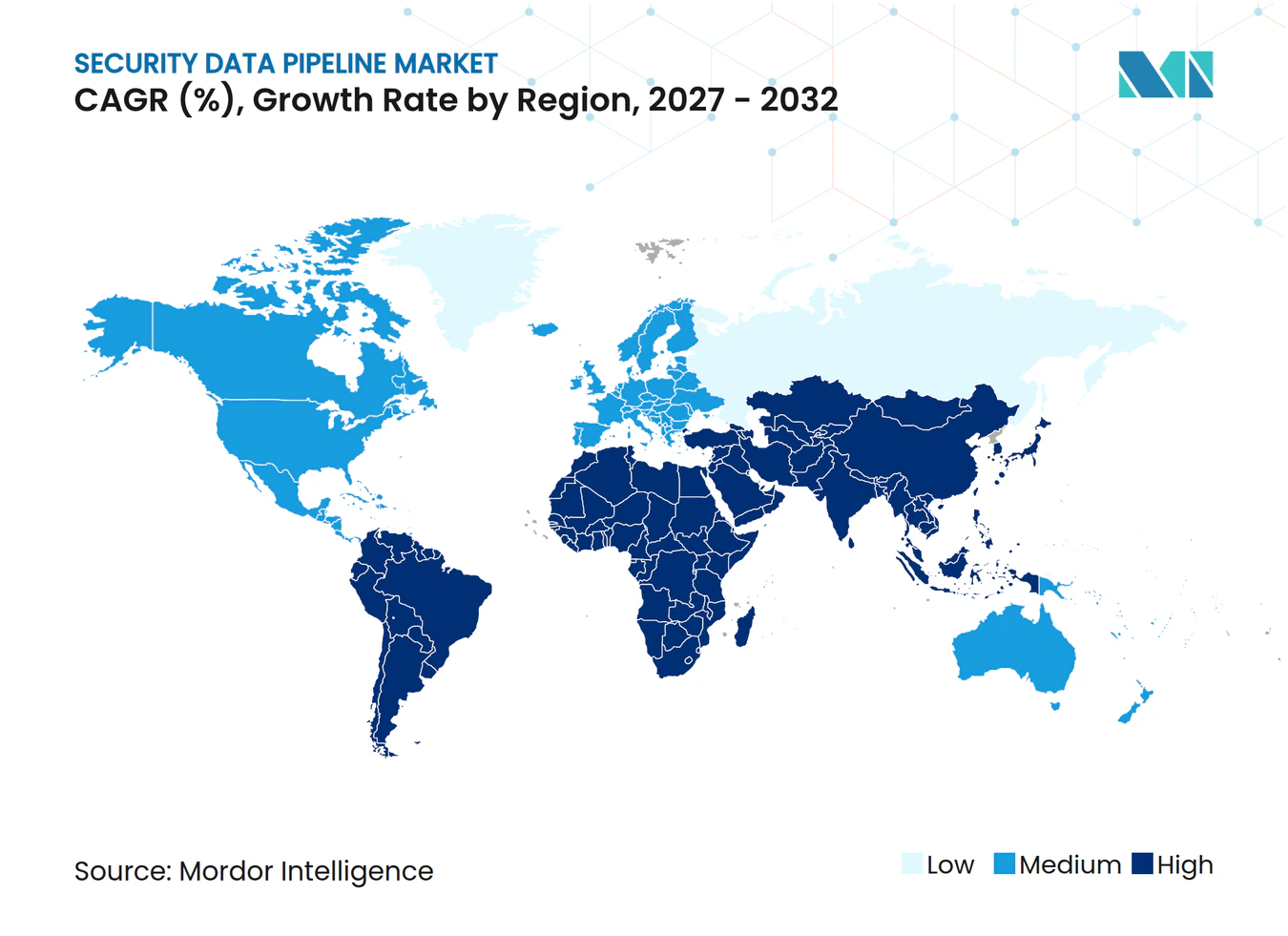
North America accounted for 36.41% of revenue in 2026, giving the region the largest share in the Security data pipeline market. The region has a high concentration of SIEM deployments, security-focused enterprises, large cloud environments, and buyers that must manage extensive volumes of operational and security data. The United States contributes much of this demand through large enterprise environments and public-sector cybersecurity programs, while Canada adds demand from financial services and government users. The US Department of Defense budgeted USD 14.3 billion for FY2026 cyberspace activities, and the Cybersecurity and Infrastructure Security Agency requested USD 2.4 billion for cyber operations, analytics systems, and data infrastructure.
Europe Security Data Pipeline Market
Europe is strongly shaped by requirements for operational resilience, incident logging, and the controlled handling of ICT risk data. The Digital Operational Resilience Act has applied to covered EU financial entities since January 17, 2025, and the NIS2 framework extends cybersecurity obligations across a wider range of critical entities.[3] The European Commission proposed targeted NIS2 amendments in January 2026 to reduce compliance complexity for 28,700 companies, including 6,200 micro and small enterprises. Germany, the United Kingdom, and France remain important markets because regulated organizations in these countries require controlled security data handling and documented technology risk procedures. These conditions encourage buyers to seek auditable routing, retention, and data residency controls in the Security data pipeline market.
APAC, MEA and South America Security Data Pipeline Market
Asia-Pacific is projected to grow at a 21.26% CAGR through 2032, the highest regional rate in the Security data pipeline market. Cloud adoption, digital payments, national cybersecurity rules, expanding technology infrastructure, and public interest in domestic AI capacity support regional demand. India is an important source of growth because the Reserve Bank of India issued cybersecurity and technology risk directions for commercial banks and non-banking financial companies in 2026. China, Japan, South Korea, and other regional economies add demand through cloud, 5G, industrial, and sovereign AI programs that generate new data and governance needs. South America, the Middle East, and Africa remain earlier-stage markets where adoption follows financial-sector regulation and enterprise IT modernization, with Brazil, Saudi Arabia, and South Africa representing more advanced procurement environments.
Competitive Landscape
Market Concentration
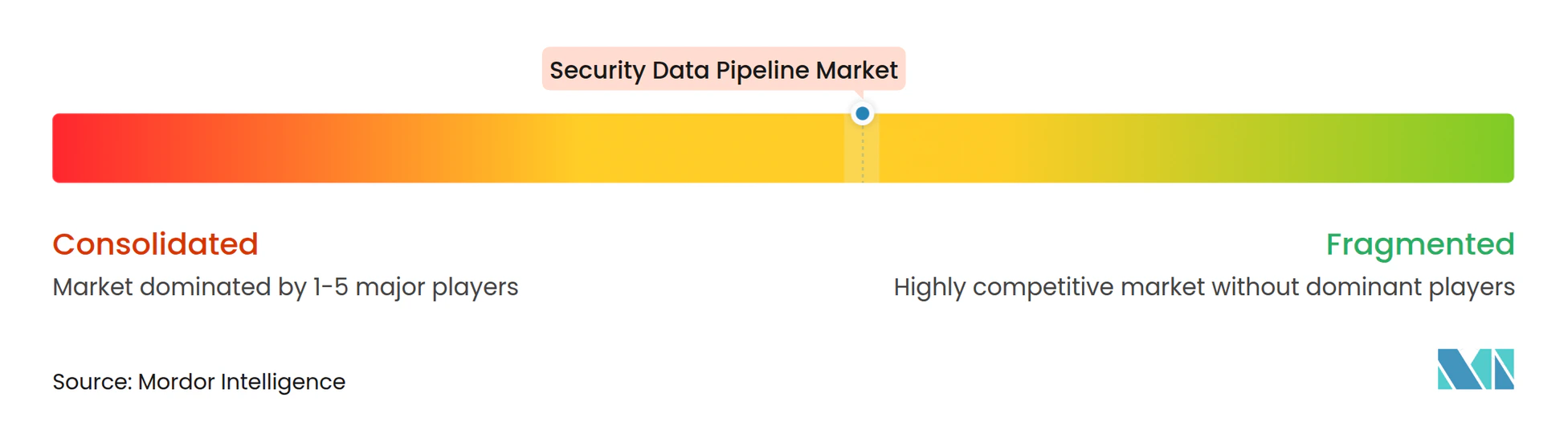
The Security data pipeline market remains moderately fragmented among specialist vendors, although larger platform providers are consolidating the category. Cribl holds the largest independent position, with more than USD 300 million in annual recurring revenue and 1,500 enterprise customers as of late 2026.[4] Axoflow, DataBahn, Tenzir, VirtualMetric, and Abstract Security compete through different approaches to data curation, schema handling, multi-destination routing, deployment flexibility, and analytics. Buyers evaluate connector coverage, rule management, data residency, scale, and integration with existing SIEM tools because these choices affect daily operations and the ability to change technology providers later.
CrowdStrike agreed to acquire Onum in August 2025, adding real-time filtering, enrichment, and routing capabilities to the Falcon Next-Gen SIEM. SentinelOne agreed to acquire Observo AI in September 2025 to add AI-native telemetry pipeline capabilities to its Singularity platform. These transactions show that SIEM and extended detection and response providers view pipeline controls as an important part of a broader security platform. Consolidation can offer tighter integration for customers, but it can also raise questions about support for tools outside the acquiring vendor’s platform and reduce the perception of routing neutrality. The Security data pipeline market, therefore, continues to include a trade-off between integrated platforms and independent routing options.
Cribl launched Cribl Detect in September 2026 as a SIEM offering that allows teams to run alerts, investigations, and analytics against data without duplicating it into a monolithic platform. The company also launched StreamAI in September 2026 to manage AI model routing and related operating costs. Axoflow provides fully air-gapped, on-premises deployment options for buyers with hard data residency requirements. Tenzir continues to develop its processing platform for enterprise-scale and multi-cloud data movement and analysis. Competitive strength depends on whether vendors can support new data sources, changing schemas, earlier detection, and compliance controls without adding undue operational work for customer teams.
Security Data Pipeline Industry Leaders
-
Axoflow, Inc.
-
Realm Security, Inc.
-
Abstract Security, Inc.
-
Cribl, Inc.
-
Mezmo, Inc.
- *Disclaimer: Major Players sorted in no particular order
Security Data Pipeline Market Companies Covered in this Report
- Cribl, Inc.
- DataBahn.ai, Inc.
- Axoflow, Inc.
- Tenzir GmbH
- VirtualMetric B.V.
- Abstract Security, Inc.
- Monad, Inc.
- Realm Security, Inc.
- Datable, Inc.
- Query.AI, Inc.
- Fleak, Inc.
- SEGARK GmbH
- Panther Labs, Inc.
- observIQ, Inc.
- Tarsal, Inc.
- Onum, Inc.
- Observo AI, Inc.
- Mezmo, Inc.
- Logz.io, Inc.
- StreamSets, Inc.
Recent Industry Developments in Security Data Pipeline Market
- September 2026: Cribl launched Cribl Detect, a full SIEM product built on its open telemetry platform, priced up to 50% below existing SIEM alternatives and directly entering the USD 8.2 billion SIEM market. The launch incorporates threat-detection technology from Cribl's July 2026 acquisition of CardinalOps and is designed to let security teams run alerts, investigations, and analytics against data wherever it resides, without duplicating it into a monolithic vendor stack.
- September 2026: Cribl launched StreamAI, an enterprise AI gateway with an embedded model router built into its open data platform. StreamAI routes AI prompts and workloads to the right model at the right cost, offering free inference for customers using automatic data routing to benchmarked AI models, directly addressing runaway token costs from AI workloads operating on security telemetry.
- September 2026: Axoflow launched AxoDetect in early access at Splunk .conf26, enabling detection engineers to run Sigma rules in-stream on OCSF-normalized data before SIEM ingest. Alerts route to the SIEM while full-fidelity logs land in AxoLake, a low-cost storage tier, positioning the platform as a direct alternative to SIEM-first detection workflows.
- September 2026: Tenzir released node v6.17.0, introducing parallel Kafka operators, HTTP-based sink parallelization, and Microsoft Defender KQL query sources with per-tenant identity federation across Azure Entra tenants. The release also adds Azure Log Analytics integration and ClickHouse pushdown, expanding the platform's enterprise-scale multi-cloud ingest capacity.
Global Security Data Pipeline Market Report Scope
The Security Data Pipeline Market comprises software platforms and services that collect, ingest, process, normalize, enrich, route, optimize, and manage security telemetry generated across enterprise IT, cloud, network, endpoint, application, and security environments. These solutions help organizations improve security data quality, reduce data ingestion costs, enhance security analytics performance, and support real-time threat detection and response workflows. The market includes security data ingestion platforms, telemetry management solutions, stream processing technologies, security data transformation tools, and related professional and managed services. Security data pipelines serve as a foundational layer for modern SIEM, XDR, SOAR, security analytics, and AI-driven security operations architectures.
The Security Data Pipeline Market Report is Segmented by Component (Software, and Services), Function (Collection and Ingestion, Filtering and Reduction, Normalization and Transformation, In-Stream Detection, and Other Functions), Deployment (On-Premises, and Cloud), Organization Size (Large Enterprises, and Small and Medium-Sized Enterprises), End User (Banking, Financial Services, and Insurance [BFSI], Government and Public Administration, Healthcare and Life Sciences, IT and Telecommunication, Industrial Manufacturing, Energy and Utilities, Retail and E-Commerce, and Other End Users), and Geography (North America, South America, Europe, Asia-Pacific, Middle East, and Africa). The Market Forecasts are Provided in Terms of Value (USD).
Segmentation Overview
| Software |
| Services |
| Collection and Ingestion |
| Filtering and Reduction |
| Normalization and Transformation |
| In-Stream Detection |
| Other Functions |
| On-Premises |
| Cloud |
| Large Enterprises |
| Small and Medium-Sized Enterprises |
| Banking, Financial Services, and Insurance (BFSI) |
| Government and Public Administration |
| Healthcare and Life Sciences |
| IT and Telecommunication |
| Industrial Manufacturing |
| Energy and Utilities |
| Retail and E-Commerce |
| Other End Users |
| North America | United States |
| Canada | |
| South America | Brazil |
| Argentina | |
| Mexico | |
| Rest of South America | |
| Europe | Germany |
| United Kingdom | |
| France | |
| Italy | |
| Russia | |
| Rest of Europe | |
| Asia-Pacific | China |
| Japan | |
| India | |
| South Korea | |
| Rest of Asia-Pacific | |
| Middle East | Saudi Arabia |
| United Arab Emirates | |
| Rest of Middle East | |
| Africa | South Africa |
| Nigeria | |
| Rest of Africa |
| By Component | Software | |
| Services | ||
| By Function | Collection and Ingestion | |
| Filtering and Reduction | ||
| Normalization and Transformation | ||
| In-Stream Detection | ||
| Other Functions | ||
| By Deployment | On-Premises | |
| Cloud | ||
| By Organization Size | Large Enterprises | |
| Small and Medium-Sized Enterprises | ||
| By End User | Banking, Financial Services, and Insurance (BFSI) | |
| Government and Public Administration | ||
| Healthcare and Life Sciences | ||
| IT and Telecommunication | ||
| Industrial Manufacturing | ||
| Energy and Utilities | ||
| Retail and E-Commerce | ||
| Other End Users | ||
| By Geography | North America | United States |
| Canada | ||
| South America | Brazil | |
| Argentina | ||
| Mexico | ||
| Rest of South America | ||
| Europe | Germany | |
| United Kingdom | ||
| France | ||
| Italy | ||
| Russia | ||
| Rest of Europe | ||
| Asia-Pacific | China | |
| Japan | ||
| India | ||
| South Korea | ||
| Rest of Asia-Pacific | ||
| Middle East | Saudi Arabia | |
| United Arab Emirates | ||
| Rest of Middle East | ||
| Africa | South Africa | |
| Nigeria | ||
| Rest of Africa | ||
Key Questions Answered in the Report
What is the size of the security data pipeline market?
The Security data pipeline market is valued at USD 3.90 billion in 2026 and is projected to reach USD 11.86 billion by 2032, growing at a 20.48% CAGR from 2027 to 2032. This growth reflects the rising need to manage security data before it reaches SIEM, storage, and analytics platforms.
What is driving demand for security data pipeline platforms?
Rising telemetry volumes, SIEM ingestion-cost control, AI-ready data quality needs, hybrid operations, data residency requirements, and formal retention obligations are supporting adoption across security teams.
Which component leads revenue in this field?
Software leads with 66.24% of revenue in 2026, while services are projected to grow at a 21.86% CAGR through 2032 as organizations need implementation, migration, parser, integration, and operating support.
Why are enterprises using security data pipelines before a SIEM?
They use them to filter, enrich, normalize, and route data before it reaches downstream tools, helping control costs, retain high-value records, support multiple destinations, and maintain consistent handling rules.
Which deployment approach is expanding fastest?
Cloud deployment is projected to grow at a 22.14% CAGR through 2032, although on-premises systems held 70.12% of revenue in 2026 because data residency and existing SIEM investments remain important.
Which region is expected to grow fastest?
Asia-Pacific is projected to grow at a 21.26% CAGR through 2032, supported by cloud adoption, digital payments, national cybersecurity requirements, expanding technology infrastructure, and governance needs across regulated organizations.