
Managed SIEM and Security Log Monitoring Services Market Size and Share
Market Overview
| Study Period | 2021 - 2032 |
|---|---|
| Market Size (2027) | USD 8.26 Billion |
| Market Size (2032) | USD 15.86 Billion |
| Growth Rate (2027 - 2032) | 13.94 % |
| Fastest Growing Market | Asia-Pacific |
| Largest Market | North America |
| Market Concentration | Medium |
Major Players *Disclaimer: Major Players sorted in no particular order Image © Mordor Intelligence. Reuse requires attribution under CC BY 4.0. | |
Managed SIEM and Security Log Monitoring Services Market Analysis by Mordor Intelligence
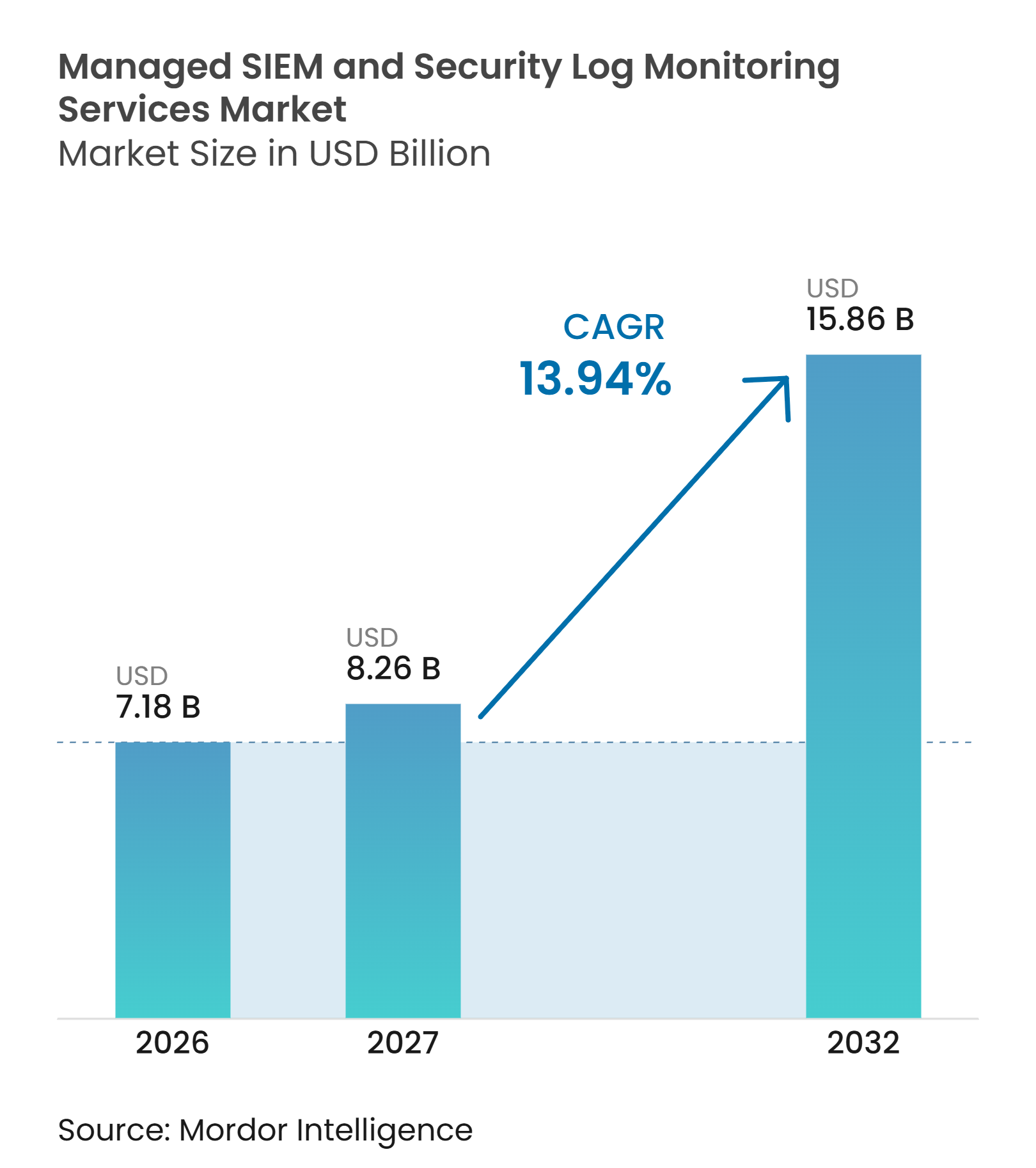
The Managed SIEM and Security Log Monitoring Services Market size is projected to expand from USD 7.18 billion in 2026 and USD 8.26 billion in 2027 to USD 15.86 billion by 2032, registering a CAGR of 13.94% between 2027 to 2032. Organizations are shifting security operations from licensed platforms and internal analyst teams to managed detection, correlation, and response services. Automated attacks are increasing alert volumes faster than many internal teams can review them, which raises demand for continuous monitoring and defined response commitments. Compliance obligations, staffing gaps, cloud expansion, and new pricing approaches are reinforcing one another across the Managed SIEM services market. Providers are responding with automated investigation functions, lower-cost storage, and co-managed service options that preserve customer control over data and escalation decisions. These changes favor suppliers in the Managed SIEM services market that can support regulated workloads while reducing operational pressure on internal security teams.
Key Report Takeaways
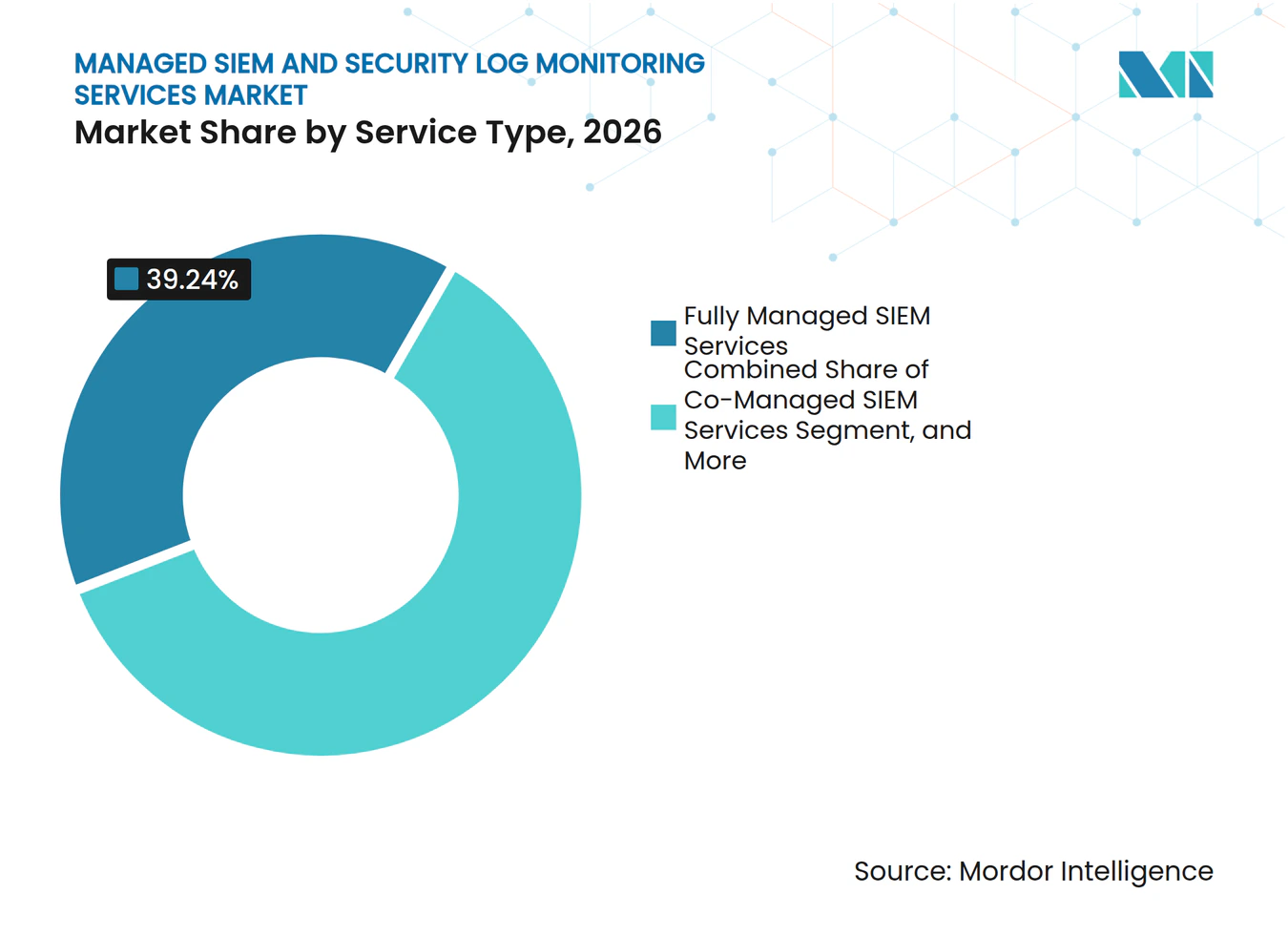
- By service type, fully managed SIEM services held 39.24% of the managed SIEM and security log monitoring services market share in 2026, while co-managed SIEM services are projected to expand at a CAGR of 14.23% through 2032.
- By deployment mode, cloud accounted for 59.36% of the market in 2026 and is expected to expand at a CAGR of 14.11% through 2032.
- By application, log management and reporting held 34.22% of the market in 2026, while IoT and OT security monitoring are projected to expand at a CAGR of 14.56% through 2032.
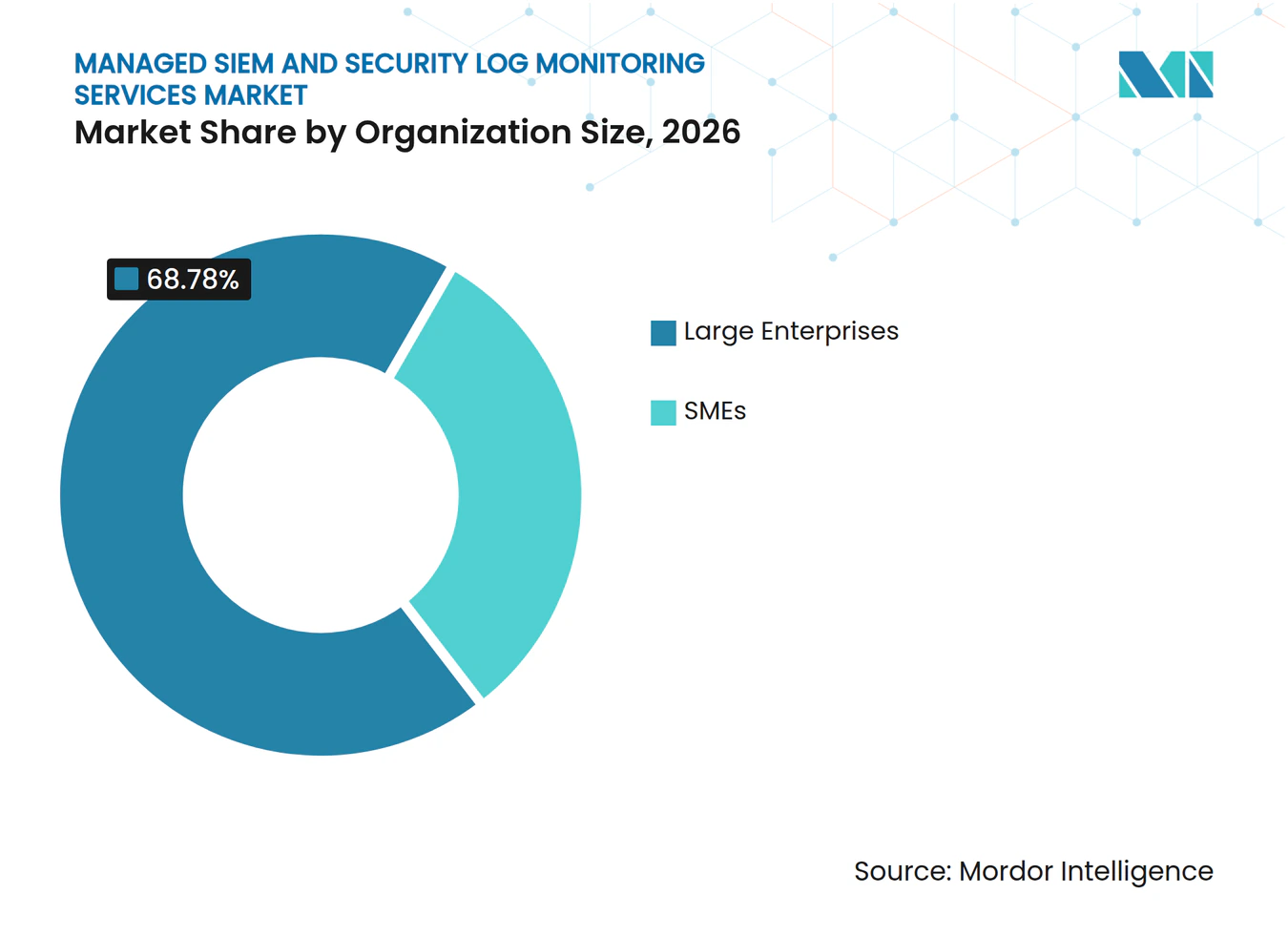
- By organization size, large enterprises accounted for 68.78% of the market in 2026, while SMEs are projected to expand at a CAGR of 14.44% through 2032.
- By end-user industry, BFSI held 23.42% of the Managed SIEM services market share in 2026, while energy and utilities are projected to expand at a CAGR of 14.28% through 2032.
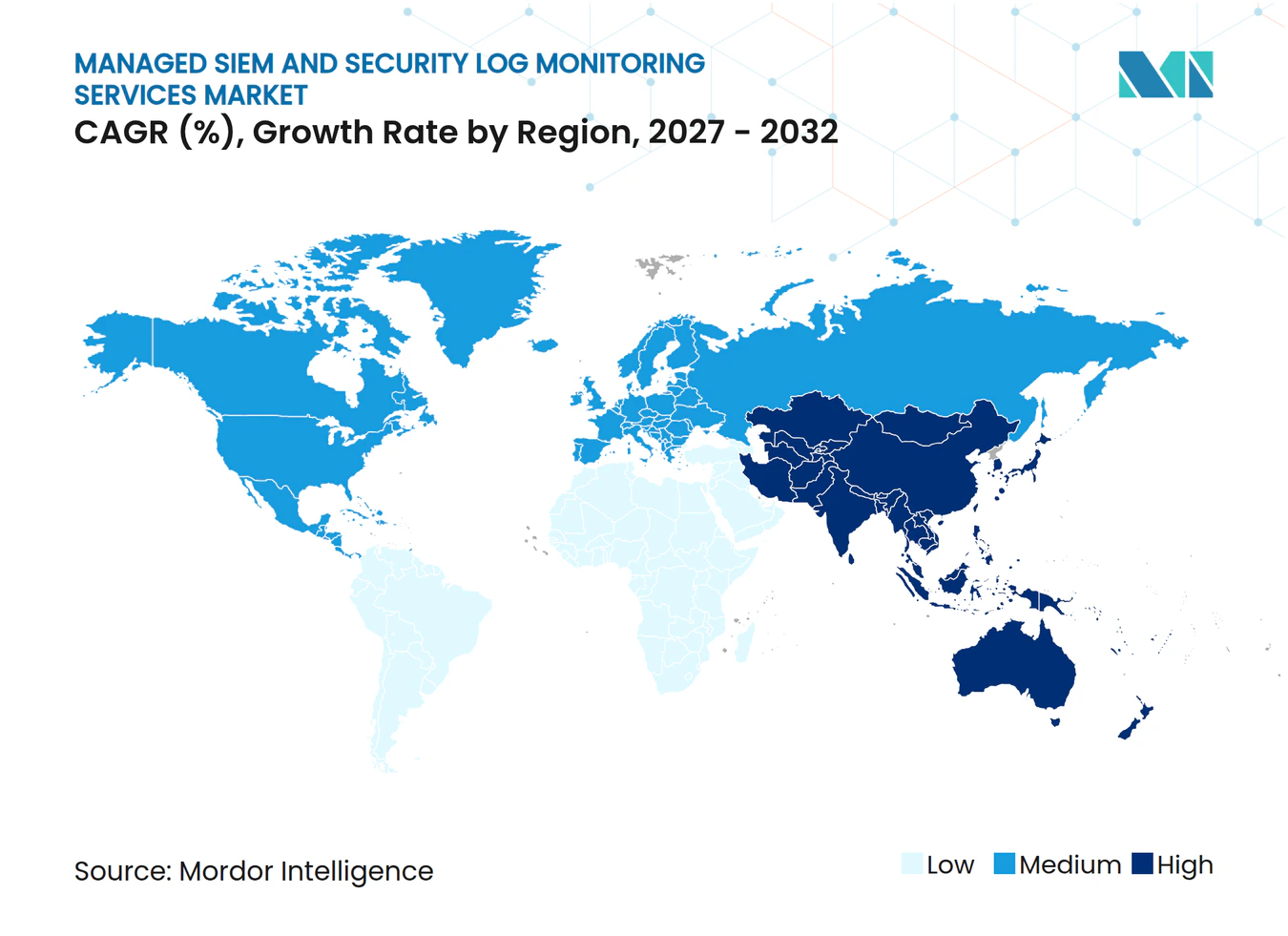
- By geography, North America accounted for 44.29% of the market in 2026, while Asia-Pacific is projected to expand at a CAGR of 14.59% through 2032.
Note: Market numbers in this report are based on Mordor Intelligence's proprietary estimation framework, which combines nine months of actuals with Q4 projections for base year 2026.
Market Trends and Insights
Drivers Impact Analysis of Managed SIEM and Security Log Monitoring Services Market*
| Driver | (~) % Impact on CAGR Forecast | Geographic Relevance | Impact Timeline |
|---|---|---|---|
| Escalating Cyber Threat Sophistication | +4.0% | Global | Short term (≤ 2 years) |
| Cybersecurity Talent Shortages | +3.0% | Global | Short term (≤ 2 years) |
| Regulatory Logging and Audit Requirements | +2.5% | North America and EU, with spillover to Asia-Pacific and Middle East and Africa | Medium term (2-4 years) |
| Cloud and Hybrid Attack-Surface Expansion | +2.0% | Global | Medium term (2-4 years) |
| AI-Enabled SOC Automation and XDR Convergence | +1.5% | Global | Medium term (2-4 years) |
| Usage-Based Pricing and Co-Managed SOC Adoption | +1.0% | North America, Asia-Pacific, and emerging Europe | Long term (≥ 4 years) |
| Source: Mordor Intelligence | |||
Escalating Cyber Threat Sophistication Accelerates SIEM Demand
AI-supported phishing, malware variation, and credential attacks are increasing the volume and speed of security alerts. Red Canary reported that the enterprise attack surface widened 41% during the prior 12 months, while 73% of security leaders said the time from detecting to resolving an attack had increased. These conditions raise demand in the managed SIEM and security log monitoring services market for service-level commitments covering detection and response. Buyers are testing providers on their ability to identify AI-generated tactics and unfamiliar attack chains. This assessment is placing more weight on behavioral analysis than on known signatures alone. Red Canary also found that 54% of organizations use AI for SIEM management, making AI-supported log monitoring an expected capability rather than a narrow differentiator.[1]
Cybersecurity Talent Shortages Drive Managed Service Outsourcing
Persistent staffing gaps are leading organizations to seek continuous monitoring from external providers. ISC2 reported that 59% of respondents had critical or significant skills needs in 2025, compared with 44% in 2024. The study also found that 95% of respondents had at least 1 skills need and 72% believed staff reductions significantly increased breach risk. ISACA reported that 55% of cybersecurity teams were understaffed, 65% had unfilled positions, and 20% used MSSPs or external SOC providers to address skills deficits.[2] Organizations without sufficient analysts also lack the capacity to tune detection rules, maintain data pipelines, and respond to incidents. This supports demand for fully managed and co-managed delivery in the Managed SIEM services market.
Regulatory Logging and Audit Requirements Create Compliance-Led Demand
Tighter logging and monitoring rules are creating a durable demand base for the managed SIEM and security log monitoring services market. The EU Commission Implementing Regulation 2024/2690 sets technical and methodological requirements for cybersecurity risk management under NIS2.[3] DORA Regulatory Technical Standards 2024/1772 require financial entities to maintain records that support ICT risk management and incident handling. In the United States, SEC Item 106 requires annual disclosure of cybersecurity risk management and governance, while material incidents must be disclosed on Form 8-K within 4 business days after a materiality determination. These requirements increase the value of jurisdiction-specific retention schedules, structured incident timelines, and audit-ready evidence. ISO/IEC 27001, PCI-DSS, and sector rules further reinforce logging and monitoring as required controls.
Cloud and Hybrid Attack-Surface Expansion Strains In-House Log Management
Cloud workloads, SaaS applications, and remote endpoints have created a more fragmented log environment. A 2025 joint advisory led by the US Department of Defense identified cloud-platform logging as a priority and noted that organizations may misconfigure or fail to ingest cloud logs into SIEM platforms. Missing cloud control plane, SaaS authentication, and API activity can leave important gaps in an internal security program. Managed providers address these gaps through connector engineering and multi-cloud log normalization. Microsoft launched Sentinel Data Lake in July 2025 with a 2-tier architecture that separates active analytics from lower-cost long-term retention. Longer retention at lower storage cost can strengthen the compliance offer in the Managed SIEM services market.
Restraints Impact Analysis of Managed SIEM and Security Log Monitoring Services Market*
| Restraint | (~) % Impact on CAGR Forecast | Geographic Relevance | Impact Timeline |
|---|---|---|---|
| SIEM Integration and Tuning Complexity | -1.5% | Global | Short term (≤ 2 years) |
| Data Sovereignty and Third-Party Control Concerns | -1.0% | EU, core Asia-Pacific, with spillover to Middle East and Africa | Medium term (2-4 years) |
| Long-Term Log Retention and Ingest Cost Pressure | -0.7% | Global | Short term (≤ 2 years) |
| MSSP Liability and Incident-Response Boundary Risk | -0.5% | North America and EU | Long term (≥ 4 years) |
| Source: Mordor Intelligence | |||
SIEM Integration and Tuning Complexity Lengthens Procurement Timelines
Managed SIEM onboarding can be challenging when an enterprise operates on-premises systems, multiple cloud platforms, OT networks, and third-party SaaS applications. A SANS SOC Survey found that many SOCs ingested data into SIEM platforms without a structured retrieval or management plan. This gap can result in alert noise, inadequate detection coverage, and a backlog of unvalidated rules. Providers must evaluate log-source coverage, address inconsistent event schemas, and calibrate detections to the customer’s operating environment. These activities can create temporary coverage gaps and delay full service effectiveness. Structured data-quality checks, phased source migration, and baseline tuning can reduce implementation challenges; however, complex customer environments remain a barrier to the managed SIEM and security log monitoring services market.
Data Sovereignty and Third-Party Control Concerns Constrain Cloud-Based Delivery
Data-localization rules can limit how a provider stores, processes, and transfers customer logs. India's CERT-In Directions require covered entities to retain ICT system logs for 180 days within Indian jurisdiction and report specified incidents within 6 hours of noticing them. EU compliance requirements also place emphasis on evidence, integrity, and incident records, while Gulf markets can restrict international log routing. Providers may need regional nodes or local partnerships instead of a small number of centralized processing hubs. This adds cost and can narrow the addressable customer base for the managed SIEM and security log monitoring services market when providers lack a regional footprint. Buyers may also question incident-response authority and chain of custody when a third party holds sensitive security data.
*Our forecasts treat driver/restraint impacts as directional, not additive. The impact forecasts reflect baseline growth, mix effects, and variable interactions.
Managed SIEM and Security Log Monitoring Services Market Segment Analysis
By Service Type:
Co-Managed Models Gain Ground as Hybrid Governance MaturesFully managed SIEM services accounted for 39.24% of the service-type segment in 2026. This model places detection engineering, analyst operations, incident response, and regulatory reporting under 1 provider contract. It has particular relevance for organizations with limited internal security expertise and demanding compliance obligations. The managed SIEM and security log monitoring services market size for co-managed SIEM services is projected to expand at a CAGR of 14.23% through 2032. Co-managed arrangements allow customers to retain control over threat intelligence and escalation decisions while outsourcing Tier 1 and Tier 2 analyst work.
Security leaders can retain direct access to raw logs and detection rules without recreating a full internal SOC. Managed log monitoring, reporting, threat intelligence, and security analytics are increasingly bundled in multi-service contracts that can raise contract value without an equivalent increase in provider headcount across the managed SIEM and security log monitoring services market. Expel launched Managed SIEM for Microsoft Sentinel and Splunk Enterprise Security in March 2026 as a co-managed add-on to its MDR service. The offering covers detection strategy, custom logic, tuning, ingestion-cost management, and direct alert feeds, while pricing is based on attack surfaces and log sources. Securonix introduced Sam in February 2026 with role-based authority levels that support different combinations of automation and human oversight.



By Deployment Mode:
Cloud Leads While Hybrid Deployment Retains a Clear RoleCloud deployments accounted for 59.36% of the managed SIEM and security log monitoring services market in 2026 and are projected to expand at a CAGR of 14.11% through 2032. Multi-tenant delivery can reduce infrastructure costs for each customer. API-based connectors can simplify onboarding for SaaS and cloud-native data sources. Elastic storage can also follow telemetry volume without large upfront capacity commitments. These characteristics make cloud delivery well-suited to many managed security services.
Microsoft's Sentinel Data Lake provides separate tiers for active analytics and longer-term storage. This design can support longer historical searches, improve retention economics, and allow providers to update detection content, intelligence feeds, and automated investigations across their customer base. On-premises and hybrid models remain important where data-localization rules apply or OT data must remain inside the facility. Fortinet released FortiSIEM 7.5 in January 2026 with agentic investigation features and data-sovereignty controls for regional processing and storage. Hybrid deployment keeps cloud-based management and reporting available while retaining local collection or processing for sensitive data in the managed SIEM and security log monitoring services market.
By Application:
Log Management Anchors Revenue While IoT and OT Monitoring ExpandsLog management and reporting accounted for 34.22% of the application segment in 2026. Regulated buyers often begin with managed log monitoring to meet audit requirements. Compliance-led purchasing means that logging obligations can precede the use of more advanced threat intelligence use cases. Threat intelligence, security analytics, incident response, and forensics are then added as customer programs mature. This pattern supports low churn in the managed SIEM and security log monitoring services market because changing providers during an audit cycle can disrupt evidence continuity.
IoT and OT security monitoring is projected to expand at a CAGR of 14.56% through 2032. Industrial, energy, utility, and critical infrastructure operators need visibility into IT and OT telemetry. A 2025 IEEE study described the need for unified data collection across OT field networks and IT monitoring systems to detect multistage attacks. Germany's Federal Office for Information Security issued recommendations in March 2025 on OT monitoring in substation automation that advise routing industrial intrusion-detection alerts to a central location. NERC CIP-015 also requires network security monitoring for electric utility bulk power systems in North America.
By Organization Size:
Large Enterprises Lead While SMEs Become the Growth FocusLarge enterprises accounted for 68.78% of demand in 2026. Their large log environments, complex compliance duties, and ability to commit to multiyear contracts support this position. These customers often use co-managed or fully managed SOC services alongside internal security teams. They also require tailored detection engineering, dedicated intelligence feeds, and 24/7 coverage across distributed IT environments. Managed services can extend coverage from business hours to continuous operations without requiring internal follow-the-sun staffing.
SMEs are projected to expand at a CAGR of 14.44% through 2032. Usage-based pricing and products designed for smaller organizations are lowering the entry barrier to enterprise-grade monitoring. Huntress made Managed SIEM generally available in April 2025 with per-data-source pricing, compliance reporting, retention for up to 7 years, and provider-operated SOC support. Staffing constraints have a strong effect on smaller organizations because they may struggle to attract experienced security personnel. Managed services can supply rule maintenance, alert triage, and incident response that these organizations cannot sustain internally at a competitive cost, expanding access within the managed SIEM and security log monitoring services market.

By End-User Industry:
BFSI Holds the Largest Position While Energy and Utilities Advance FastestBFSI accounted for 23.42% of the managed SIEM and security log monitoring services market in 2026. The segment faces overlapping compliance obligations from PCI-DSS v4.0, DORA, and national banking rules. PCI-DSS v4.0 Requirement 10.4.1.1 made automated daily log reviews effective on March 31, 2025. This requirement reduced the practicality of manual review for payment processors and card issuers. The Reserve Bank of India issued its Cybersecurity Technology Risk, Resilience, and Assurance Framework Directions for commercial banks on July 31, 2026, requiring 24/7 SOC staffing and 6-hour incident reporting through the DAKSH platform.
Energy and utilities are projected to expand at a CAGR of 14.28% through 2032. The sector needs to combine IT and OT monitoring while meeting a higher level of critical-infrastructure oversight. Government and defense, healthcare and life sciences, and IT and telecommunications also retain substantial positions because breach exposure and compliance needs are high. Manufacturing and industrial companies, along with retail and e-commerce businesses, are adopting managed monitoring as cyber-insurance and supply-chain requirements strengthen. The Managed SIEM services industry serves these varied needs through sector-specific detection content and reporting, while alert volume and false-positive management sustain demand for specialist tuning.
Geography Analysis
North America Managed SIEM and Security Log Monitoring Services Market
North America accounted for 44.29% of the market in 2026, supported by a mature procurement environment and a dense base of financial, healthcare, government, and technology organizations that sustains the managed SIEM and security log monitoring services market. SEC Item 106 disclosures in Form 10-K have made cybersecurity governance and related audit trails relevant to investor-facing reporting. The United States remains the regional anchor, while Canada benefits from federal cybersecurity programs and healthcare compliance needs. Mexico is seeing incremental adoption through cross-border manufacturing and financial-sector requirements.
APAC Managed SIEM and Security Log Monitoring Services Market
Asia-Pacific is projected to expand at a CAGR of 14.59% through 2032. India's 180-day in-country log-retention and 6-hour incident-reporting rules create direct demand for services with local storage and reporting capabilities. Japan's privacy obligations and rising security awareness support SOC demand, while South Korea's financial-sector digitalization strengthens security spending. Regional demand is also supported by investment in data-residency capabilities. Arctic Wolf expanded into Japan and Singapore in 2025 and signed a Strategic Collaboration Agreement with Amazon Web Services in October 2025 to scale its Aurora platform and AI-powered SOC.
EMEA and South America Managed SIEM and Security Log Monitoring Services Market
Europe is the second-largest geography because NIS2 and DORA require organizations to document security-log coverage and incident management. Unisys received a 4-year European Commission cybersecurity professional services framework contract in October 2025 for 71 EU institutions and agencies. South America is smaller but expanding as Brazilian and Argentine financial institutions respond to local data-protection and cyber-insurance requirements. Middle East and Africa demand is increasing through government, telecom, and BFSI investment in centralized visibility and regulatory reporting. ZainTECH launched AI-powered managed SecOps across UAE, KSA, and Jordan in August 2025 with in-country log handling.
Competitive Landscape
Market Concentration
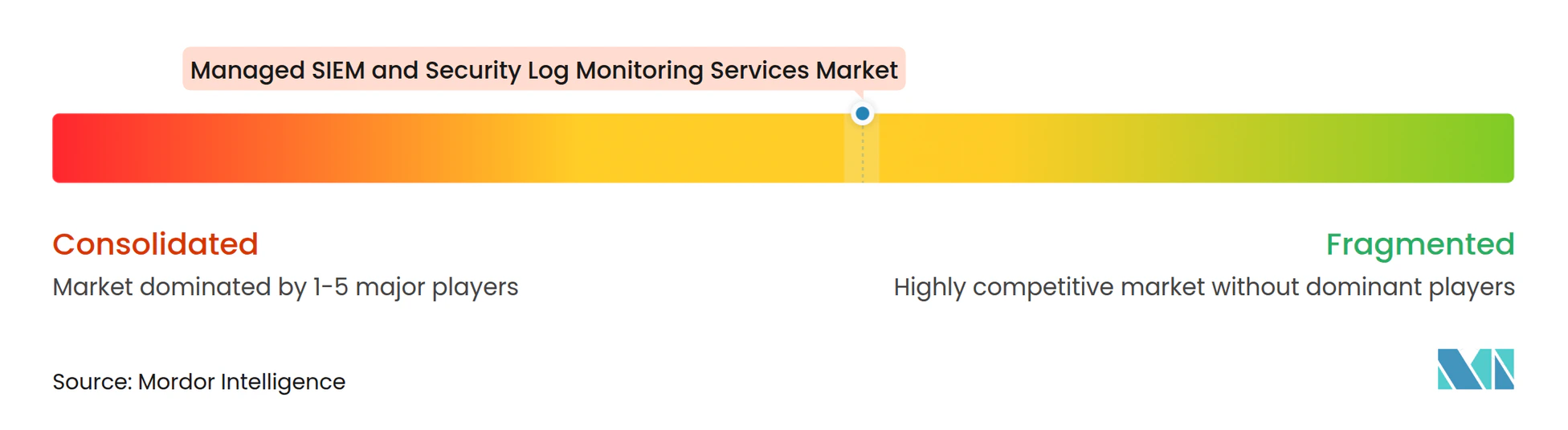
The Managed SIEM services market has moderate concentration among leading integrated providers, while the broader supplier base remains fragmented. Microsoft, Cisco, through Splunk, Palo Alto Networks, and IBM compete with pure-play MSSPs such as Arctic Wolf, Secureworks under Sophos, ReliaQuest, and regional specialists. Providers are combining SIEM, SOAR, XDR, and MDR functions into unified managed platforms. A broader service scope can support longer contracts and higher annual contract values than stand-alone log-management services. Buyers also assess detection engineering, intelligence quality, and participation in frameworks such as MITRE ATT&CK and ISAC information exchange across the Managed SIEM services market.
Sophos completed its acquisition of Secureworks for USD 859 million in February 2025. The transaction combined Taegis XDR, Counter Threat Unit intelligence, and SIEM capabilities with Sophos's security operations portfolio. LevelBlue completed its Trustwave acquisition in August 2025, combining the OTX threat-intelligence platform with Trustwave's Fusion Security Operations Platform and SpiderLabs capabilities. These transactions underscore the importance of scale, intelligence breadth, and platform coverage while raising pressure on smaller providers.
Securonix introduced Sam in February 2026 to quantify AI-completed analyst work and provide board-level measures across detection, investigation, and response. Palo Alto Networks absorbed IBM QRadar SaaS customers into Cortex XSIAM during 2024, with the SaaS versions ending by April 2026. Co-managed services for regulated mid-market customers and OT and IoT telemetry monitoring remain openings where local processing and customer control are important. The Managed SIEM services industry also has an opening in SME offerings that pair predictable per-source pricing with built-in compliance reporting.
Managed SIEM and Security Log Monitoring Services Industry Leaders
-
IBM Corporation
-
Secureworks Corp.
-
AT&T Inc.
-
Verizon Communications Inc.
-
Arctic Wolf Networks, Inc.
- *Disclaimer: Major Players sorted in no particular order
Managed SIEM and Security Log Monitoring Services Market Companies Covered in this Report
- International Business Machines Corporation
- Secureworks Corp.
- AT&T Inc.
- Verizon Communications Inc.
- Arctic Wolf Networks, Inc.
- NTT Corporation
- Trustwave Holdings, Inc.
- Rapid7, Inc.
- Optiv Security Inc.
- Microsoft Corporation
- Cisco Systems, Inc.
- Palo Alto Networks, Inc.
- Fortinet, Inc.
- Capgemini SE
- Wipro Limited
- Unisys Corporation
- Securonix, Inc.
- Sumo Logic, Inc.
- ReliaQuest Holdings, LLC
- CyberProof Inc.
Recent Industry Developments in Managed SIEM and Security Log Monitoring Services Market
- September 2026: Arctic Wolf launched Aurora MDR Connect, an MSP-exclusive tier of its Aurora Managed Detection and Response service, powered by the Aurora Superintelligence Platform and Aurora Agentic SOC. The platform processes over 10 trillion security events weekly and conducts over 200,000 investigations weekly, enabling MSPs to deliver 24/7 detection, investigation, and pre-authorized response to mid-market customers without internal SOC buildout.
- September 2026: Wipro and CrowdStrike launched the CISO Command Center, integrating CrowdStrike's Falcon platform with Wipro's consulting-led cybersecurity strategy to unify endpoint security, cloud security, exposure management, and AI security under a modern SOC. The initiative operationalizes Wipro's CyberShield and CyberTransform services, hosted across 8 global Cyber Defense Centers, around a risk-led operating model.
- August 2026: Optiv launched Optiv Agentic Security Operations at Black Hat USA 2026, replacing its legacy MDR platform with an AI-first managed security operations model powered by Google Security Operations. The service integrates with Wiz for cloud runtime context, attack-path mapping, and real-time cloud detection and response across client environments, shifting the service from reactive alert processing to proactive risk remediation.
- March 2026: Expel launched Managed SIEM for Microsoft Sentinel and Splunk Enterprise Security as a co-managed add-on to its MDR service. The offering covers detection strategy, custom detection logic authoring and tuning, data-ingestion cost optimization, and direct alert feeds into Expel's response workflows, with pricing based on the number of attack surfaces and log sources.
Global Managed SIEM and Security Log Monitoring Services Market Report Scope
The Managed SIEM and Security Log Monitoring Services Market comprises outsourced, 24/7 security services in which a third-party provider deploys, operates, and maintains SIEM technology to collect, correlate, analyze, and respond to security events and log data across an organization’s IT environment, covering endpoints, networks, cloud platforms, SaaS applications, identity systems, and security devices.
The Managed SIEM and Security Log Monitoring Services Market Report is Segmented by Service Type (Fully Managed SIEM Services, Co-Managed SIEM Services, Managed Log Monitoring and Reporting, and Managed Threat Intelligence and Security Analytics), Deployment Mode (Cloud, On-Premises, and Hybrid), Application (Log Management and Reporting, Threat Intelligence, Security Analytics, Incident Response and Forensics, and IoT and OT Security Monitoring), Organization Size (Large Enterprises and Small and Medium-Sized Enterprises), End-User Industry (Banking, Financial Services and Insurance, Government and Defense, Healthcare and Life Sciences, Information Technology and Telecommunications, Manufacturing and Industrial, Retail and E-Commerce, Energy and Utilities, and Other End-User Industries), and Geography (North America, South America, Europe, Asia-Pacific, and Middle East and Africa). The Market Forecasts Are Provided in Terms of Value (USD).
Segmentation Overview
| Fully Managed SIEM Services |
| Co-Managed SIEM Services |
| Managed Log Monitoring and Reporting |
| Managed Threat Intelligence and Security Analytics |
| Cloud |
| On-Premises |
| Hybrid |
| Log Management and Reporting |
| Threat Intelligence |
| Security Analytics |
| Incident Response and Forensics |
| IoT and OT Security Monitoring |
| Large Enterprises |
| Small and Medium-Sized Enterprises |
| Banking, Financial Services and Insurance |
| Government and Defense |
| Healthcare and Life Sciences |
| Information Technology and Telecommunications |
| Manufacturing and Industrial |
| Retail and E-Commerce |
| Energy and Utilities |
| Other End-User Industries |
| North America | United States |
| Canada | |
| Mexico | |
| South America | Brazil |
| Argentina | |
| Rest of South America | |
| Europe | United Kingdom |
| Germany | |
| France | |
| Italy | |
| Rest of Europe | |
| Asia-Pacific | China |
| India | |
| Japan | |
| South Korea | |
| Rest of Asia-Pacific | |
| Middle East and Africa | Saudi Arabia |
| United Arab Emirates | |
| South Africa | |
| Egypt | |
| Rest of Middle East and Africa |
| By Service Type | Fully Managed SIEM Services | |
| Co-Managed SIEM Services | ||
| Managed Log Monitoring and Reporting | ||
| Managed Threat Intelligence and Security Analytics | ||
| By Deployment Mode | Cloud | |
| On-Premises | ||
| Hybrid | ||
| By Application | Log Management and Reporting | |
| Threat Intelligence | ||
| Security Analytics | ||
| Incident Response and Forensics | ||
| IoT and OT Security Monitoring | ||
| By Organization Size | Large Enterprises | |
| Small and Medium-Sized Enterprises | ||
| By End-User Industry | Banking, Financial Services and Insurance | |
| Government and Defense | ||
| Healthcare and Life Sciences | ||
| Information Technology and Telecommunications | ||
| Manufacturing and Industrial | ||
| Retail and E-Commerce | ||
| Energy and Utilities | ||
| Other End-User Industries | ||
| By Geography | North America | United States |
| Canada | ||
| Mexico | ||
| South America | Brazil | |
| Argentina | ||
| Rest of South America | ||
| Europe | United Kingdom | |
| Germany | ||
| France | ||
| Italy | ||
| Rest of Europe | ||
| Asia-Pacific | China | |
| India | ||
| Japan | ||
| South Korea | ||
| Rest of Asia-Pacific | ||
| Middle East and Africa | Saudi Arabia | |
| United Arab Emirates | ||
| South Africa | ||
| Egypt | ||
| Rest of Middle East and Africa | ||
Key Questions Answered in the Report
What is the size of the Managed SIEM and Security Log Monitoring Services Market?
The Managed SIEM and Security Log Monitoring Services Market is projected to expand from USD 7.18 billion in 2026 and USD 8.26 billion in 2027 to USD 15.86 billion by 2032, at a CAGR of 13.94%.
What is driving demand for managed SIEM services?
Rising alert volumes, staffing shortages, cloud expansion, and compliance requirements are increasing the need for externally delivered monitoring and response.
Which managed SIEM service type is expanding fastest?
Co-managed SIEM services are projected to expand at a CAGR of 14.23% through 2032 because customers can retain governance while outsourcing analyst work.
Which deployment mode leads managed SIEM adoption?
Cloud deployment led with 59.36% of demand in 2026 and is projected to expand at a CAGR of 14.11% through 2032.
Which end-user sector has the largest demand for managed SIEM services?
BFSI held 23.42% of demand in 2026 because financial institutions face intensive logging, audit, and incident-reporting requirements.
Which region is expanding fastest for managed SIEM services?
Asia-Pacific is projected to expand at a CAGR of 14.59% through 2032, supported by digital infrastructure investment and data-residency requirements.