
Managed Security Data Lake Services Market Size and Share
Market Overview
| Study Period | 2021 - 2032 |
|---|---|
| Market Size (2027) | USD 1.63 Billion |
| Market Size (2032) | USD 4.47 Billion |
| Growth Rate (2027 - 2032) | 22.36 % |
| Fastest Growing Market | Asia-Pacific |
| Largest Market | North America |
| Market Concentration | Medium |
Major Players *Disclaimer: Major Players sorted in no particular order Image © Mordor Intelligence. Reuse requires attribution under CC BY 4.0. | |
Managed Security Data Lake Services Market Analysis by Mordor Intelligence
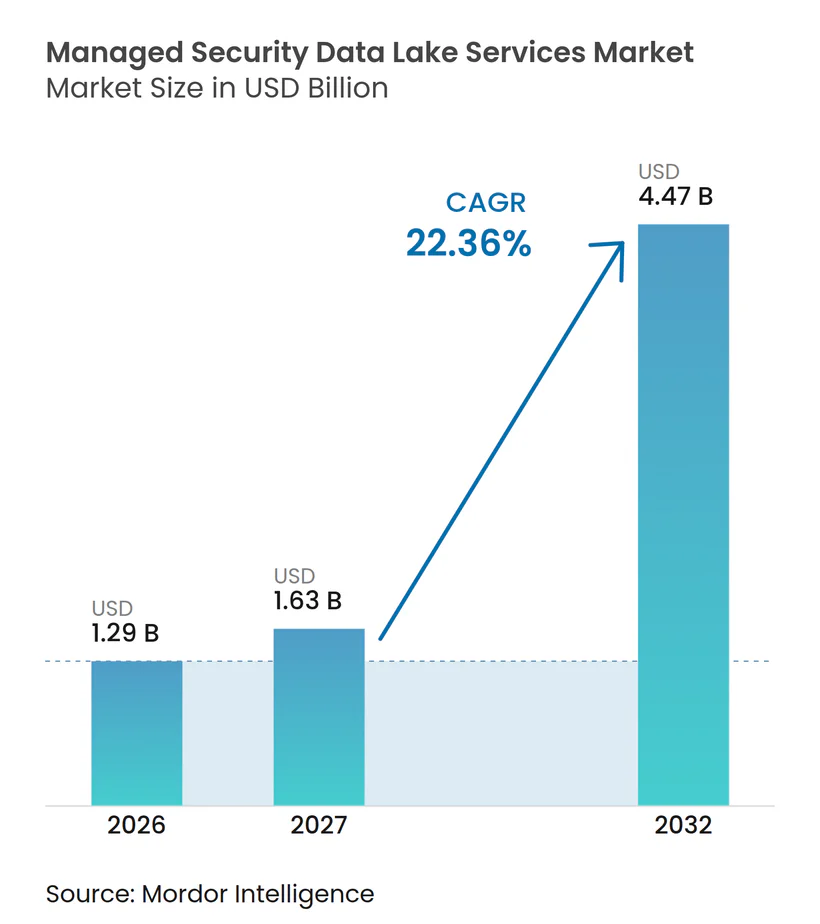
The managed security data lake services market size is projected to expand from USD 1.29 billion in 2026 and USD 1.63 billion in 2027 to USD 4.47 billion by 2032, growing at a CAGR of 22.36% from 2027 to 2032. Demand is moving beyond traditional SIEM-led models because enterprises need a less costly way to retain large volumes of security telemetry for investigation, compliance, and analytics. Rising attack activity is making long-term retention a business priority, especially when an investigation needs to reconstruct activity across endpoint, cloud, identity, and network systems. Providers are also adjusting their offerings as buyers increasingly separate data lake ownership from responsibility for operating it. This creates room for managed detection engineering, data normalization, and investigation support alongside storage and ingestion services. Regulatory requirements and cloud economics support adoption, while data residency rules and variable cloud consumption charges remain important constraints.
Key Report Takeaways
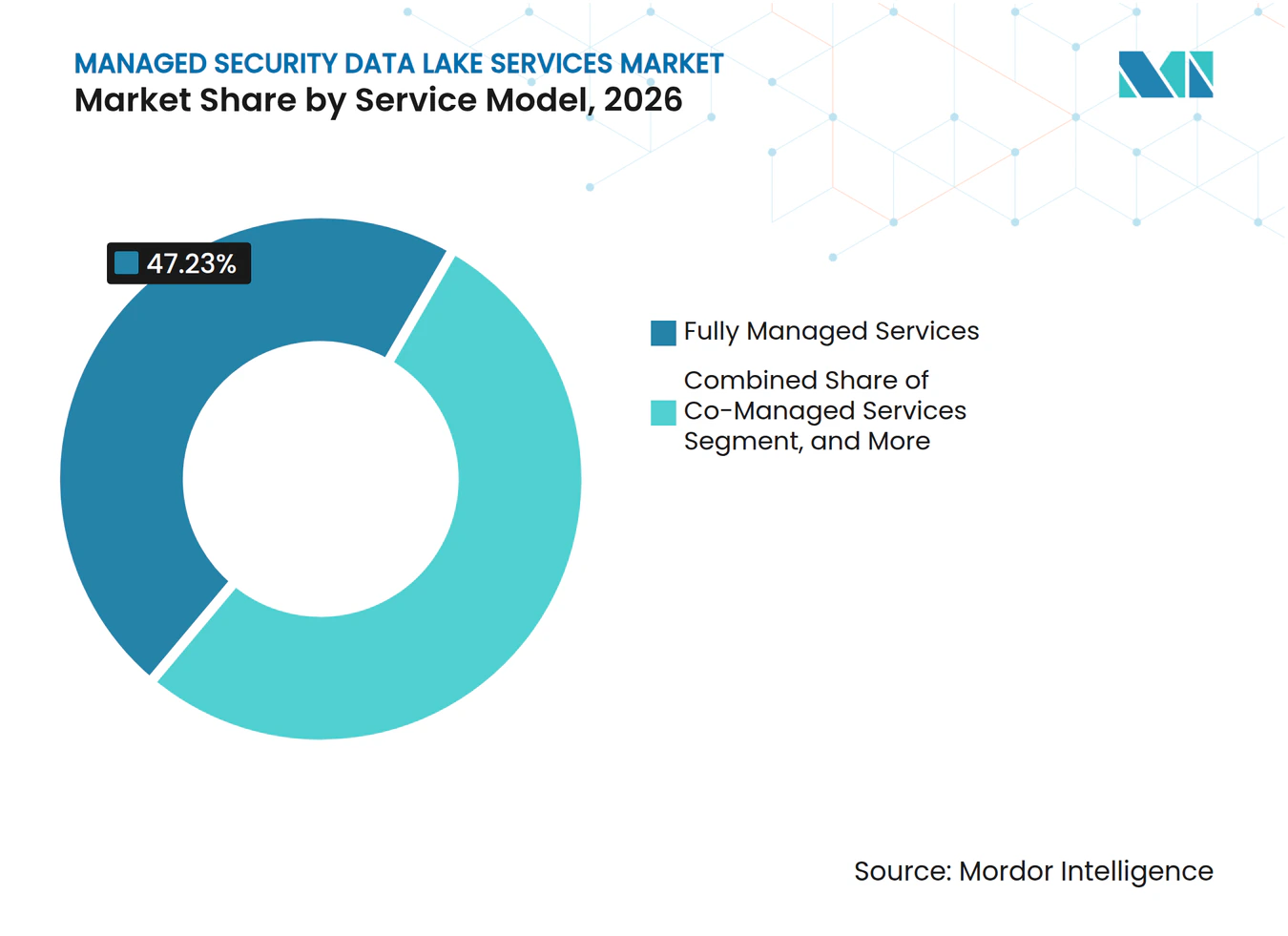
- By service model, fully managed services held 47.23% of the managed security data lake services market share in 2026, while customer-controlled data lake with provider-managed operations is projected to expand at a CAGR of 23.81% through 2032.
- By service component, data ingestion and connector management led in 2026, while security analytics and detection engineering is projected to expand at a CAGR of 23.92% through 2032.
- By security data source, endpoint, and extended detection and response telemetry held 29.31% of the managed security data lake services market share in 2026, while cloud infrastructure and cloud control plane logs are expected to expand at a CAGR of 24.92% 2032.
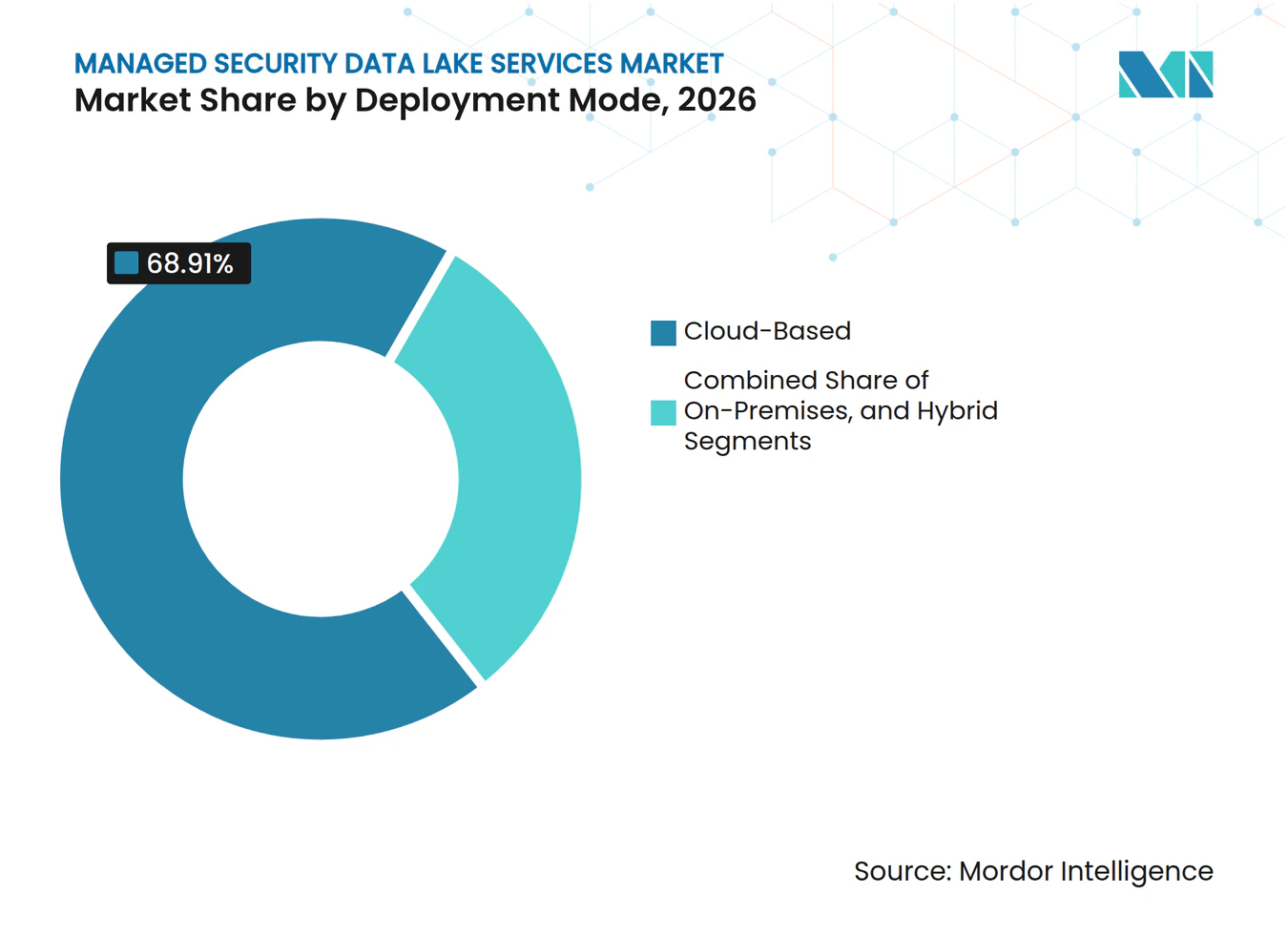
- By deployment mode, cloud-based deployment accounted for 68.91% share in 2026 and is projected to maintain the fastest CAGR of 25.67% through 2032.
- By end user industry, BFSI accounted for 26.69% of demand in 2026, while IT and telecommunications is projected to expand at a CAGR of 24.86% through 2032.
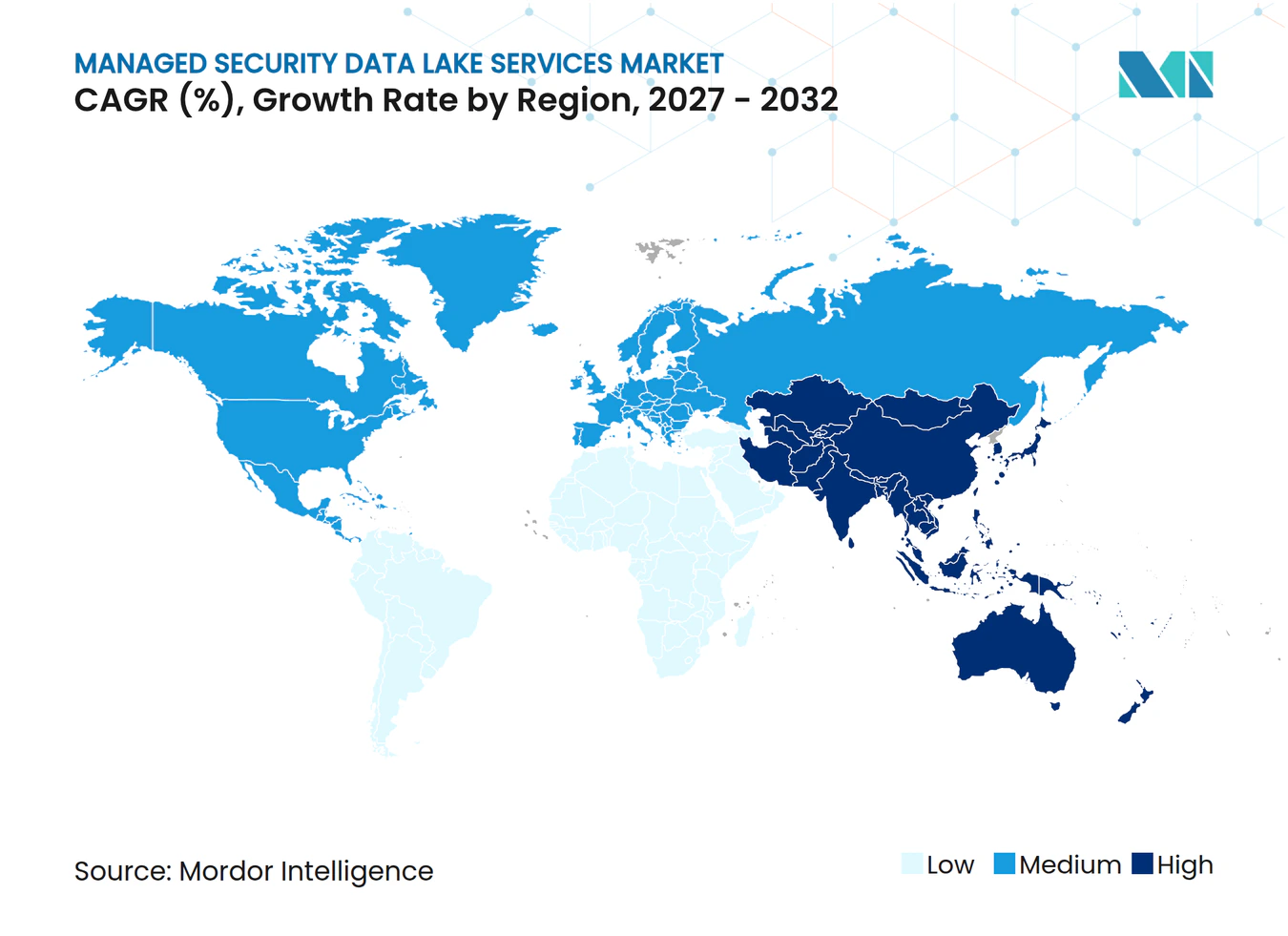
- By geography, North America held 38.64% of the managed security data lake services market share in 2026, while Asia-Pacific is projected to expand at a CAGR of 25.86% through 2032.
Note: Market numbers in this report are based on Mordor Intelligence's proprietary estimation framework, which combines nine months of actuals with Q4 projections for base year 2026.
Market Trends and Insights
Drivers Impact Analysis of Managed Security Data Lake Services Market*
| Driver | (~) % Impact on CAGR Forecast | Geographic Relevance | Impact Timeline |
|---|---|---|---|
| Escalating Cyberattack Frequency and Sophistication | +4.8% | Global | Short term (≤ 2 years) |
| Hybrid and Multicloud Security Complexity | +4.2% | Global, concentrated in North America and Asia-Pacific core | Short term (≤ 2 years) |
| Regulatory Pressure for Continuous Monitoring and Evidence Retention | +3.6% | North America and Europe, with spillover to Asia-Pacific and the Middle East | Medium term (2-4 years) |
| Cybersecurity Skills Shortages and 24/7 SOC Requirements | +3.1% | Global, acute in North America, Europe, and Asia-Pacific | Medium term (2-4 years) |
| Open Security Schemas and Cross-Tool Data Interoperability | +2.4% | Global, with early adoption in North America and Europe | Medium term (2-4 years) |
| Lower-Cost Long-Term Retention for AI-Assisted Investigation | +1.9% | Global | Long term (≥ 4 years) |
| Source: Mordor Intelligence | |||
Escalating Cyberattack Frequency and Sophistication
The managed security data lake services market benefits from the need to retain detailed security records after attacks become more frequent and difficult to investigate. Check Point reported that organizations faced 2,803 weekly cyberattacks in September 2026, 48% above the previous year, with the increase linked to phishing and GenAI data exposure.[1] This level of activity raises the value of a service that can collect and preserve telemetry without forcing every customer to operate the platform alone. Google Cloud reported that median attacker dwell time rose from 11 days to 14 days, while cyberespionage cases had a 122-day median dwell time. Longer investigations require historical data that remains searchable after the original event. Providers can therefore compete on the ability to normalize records across different sources and support retroactive investigation over extended retention periods.
Hybrid and Multicloud Security Complexity
The managed security data lake services market is supported by the difficulty of monitoring workloads distributed across cloud and on-premises environments. Fortinet found that 88% of organizations operate hybrid or multicloud environments and 81% run critical workloads across 2 or more cloud providers.[2] Separate cloud services generate records in different formats, which makes it harder for security teams to create a reliable view of activity. The same report found that 69% of organizations identified tool sprawl and visibility gaps as a leading barrier to cloud security effectiveness. A managed provider can address this issue by collecting data from AWS, Azure, Google Cloud, SaaS systems, endpoints, and on-premises tools into a shared data layer. Prebuilt connectors and consistent mappings reduce the time required to make a new data source useful.
Regulatory Pressure for Continuous Monitoring and Evidence Retention
The managed security data lake services market is also shaped by regulatory expectations for ongoing monitoring, documented controls, and timely reporting. The European Commission describes the Digital Operational Resilience Act as a framework that strengthens digital operational resilience in the financial sector. These requirements make a complete and retrievable evidence trail more important for regulated organizations. NIS2 broadens cybersecurity obligations for critical sectors and requires risk-management measures, incident reporting, and accountability from management bodies. A centralized security data lake can support these needs when it retains data in a consistent format across business systems. The approach can also reduce the need to maintain several isolated compliance repositories.
Cybersecurity Skills Shortages and 24/7 SOC Requirements
The shortage of security skills increases demand for operational support in the managed security data lake services market. ISC2 reported that 59% of respondents identified critical or significant cybersecurity skills needs in 2025, while 95% reported at least 1 team-level skills gap. Operating a data lake requires more than storage administration because teams also need to maintain connectors, tune detections, manage schemas, and investigate incidents. ISC2 identified AI, cloud security, and security engineering as among the most important skill gaps, which closely align with the capabilities needed to run these environments. Managed offerings allow customers to access these skills without building a large internal team. The commercial value lies in 24/7 monitoring and ongoing detection engineering rather than basic infrastructure operations alone.
Restraints Impact Analysis of Managed Security Data Lake Services Market*
| Restraint | (~) % Impact on CAGR Forecast | Geographic Relevance | Impact Timeline |
|---|---|---|---|
| Data Residency and Sovereignty Constraints | -2.1% | Europe, China, the Middle East, and Southeast Asia, with spillover to India | Medium term (2-4 years) |
| Customer Concerns Over Outsourced Data and Operational Control | -1.7% | Global, most acute in government and public sector organizations | Medium term (2-4 years) |
| Telemetry Quality, Schema Drift, and Integration Complexity | -1.2% | Global | Short term (≤ 2 years) |
| Unpredictable Storage, Query, and Egress Costs | -0.8% | Global, most acute in high-volume enterprise deployments | Long term (≥ 4 years) |
| Source: Mordor Intelligence | |||
Data Residency and Sovereignty Constraints
Data residency requirements can restrict expansion in the managed security data lake services market because telemetry may contain personal data, network information, and vulnerability details. The European Commission’s Cloud Sovereignty Framework sets out 8 sovereignty objectives that cover data and AI, legal and jurisdictional, operational, and other forms of sovereignty. These requirements affect where providers store, process, and query security records. A provider without suitable regional infrastructure can be excluded from sensitive government and financial services work. The constraint is not limited to storage location because identity services, encryption management, and support operations can also affect compliance assessments. The managed security data lake services market needs geographically distributed delivery models that keep data and operating controls within relevant jurisdictions.
Customer Concerns Over Outsourced Data and Operational Control
Customer concerns about handing operational control to a third party can slow purchases of some managed security data lake services. Security telemetry may include privileged access records, vulnerability findings, and threat intelligence that customers consider highly sensitive. Buyers in government, financial services, healthcare, and energy often require enforceable control rather than contractual assurance alone. This preference supports customer-controlled data lake architectures, where the customer owns the storage account and a provider delivers operations, analytics, and detection engineering. The model can limit the provider’s revenue from storage and ingestion while increasing the importance of higher-value operating services. It also requires precise boundaries of responsibility for access, retention, encryption, and investigation.
*Our forecasts treat driver/restraint impacts as directional, not additive. The impact forecasts reflect baseline growth, mix effects, and variable interactions.
Managed Security Data Lake Services Market Segment Analysis
By Service Model:
Fully Managed Services Lead While Customer-Controlled Models ExpandFully managed services captured 47.23% of the managed security data lake services market share in 2026. The result reflects a large group of buyers who do not have sufficient in-house capacity for schema management, connector maintenance, and detection engineering. These buyers are often mid-sized enterprises or regulated organizations facing short compliance deadlines. BFSI and healthcare customers may favor this approach because building an internal practice can require a long implementation period. The provider assumes responsibility for daily ingestion, normalization, governance, and service delivery. Co-managed services appeal more strongly to larger organizations with existing security engineering teams and established SIEM investments. They can keep selected responsibilities while obtaining help with a complex migration. Consulting-led managed services remain important for early-stage deployments where the organization needs an operating design before data collection begins.
Customer-controlled data lake with provider-managed operations is projected to expand at a CAGR of 23.81% from 2027 to 2032. The fastest pace reflects greater maturity in enterprise cloud programs rather than a rejection of managed operations. AWS Security Lake, Microsoft Sentinel data lake, and Google Security Operations give customers more options to retain ownership of the underlying data environment. Databricks introduced Data Intelligence for Cybersecurity in September 2025, providing OCSF-normalized aggregation across cloud, endpoint, SaaS, and legacy sources in a customer-owned lakehouse.[3] This design allows the customer to control data storage while using external specialists for operations and analytics. It gives providers an opening to sell modular detection engineering and investigation support. The managed security data lake services market will need service models that work with customer-owned cloud storage if providers are to participate in this expanding buyer group.



By Service Component:
Ingestion Leads While Detection Engineering AcceleratesData ingestion and connector management were the largest service components in 2026. This position reflects the effort required to bring cloud logs, endpoint events, operational technology records, identity data, and network telemetry into a usable shared environment. The collection must be reliable before organizations can depend on the data for investigations or as evidence of compliance. The OCSF project expanded version 1.8.0 in March 2026 with support for AI-workload schemas, privilege-analysis objects with MITRE ATT&CK mapping, and packet-level network events. These additions increase the range of data that providers must handle while reducing some custom mapping work for compatible sources. Implementation and migration services remain relevant because many customers must move away from separate monitoring systems. Platform and product management also support recurring revenue, as policies, permissions, integrations, and configurations require regular maintenance.
Security analytics and detection engineering are projected to expand at a CAGR of 23.92% from 2027 to 2032. Customers increasingly expect managed services to identify and explain suspicious activity, not merely retain records for later use. This work depends on high-quality normalized data and detection rules that are adjusted as attacker behavior changes. Palo Alto Networks reported that 87% of intrusions crossed multiple attack surfaces in its 2026 incident response analysis.[4] That finding shows why correlation across sources is essential for security operations. Threat hunting and incident investigation also benefit from records that can be searched over long periods. Providers that demonstrate faster detection and response can support higher-value service agreements. The managed security data lake services market will therefore place more emphasis on operational expertise and analytic outcomes than on raw data volume alone.
By Security Data Source:
Endpoint Data Remains Important as Cloud Logs IncreaseEndpoint and extended detection and response telemetry held 29.31% share in 2026. Endpoint records provide detailed information about processes, files, connections, users, and device activity. Palo Alto Networks found that 48% of intrusions involved browser-based activity and 87% crossed several attack surfaces. Endpoint data, therefore, often forms a key part of the investigation chain even when the initial compromise begins elsewhere. Network, firewall, and DNS telemetry remain important for detecting lateral movement and possible data removal. Identity, access, and authentication data have gained strategic importance as attackers increasingly misuse valid credentials. Providers need to preserve context across these records rather than treat them as separate feeds. This makes consistent correlation and time alignment central to the value of the service.
Cloud infrastructure and cloud control plane logs are expected to register a CAGR of 24.92% through 2032. The change follows the continuing spread of hybrid and multicloud architectures, which create more activity in cloud accounts, permissions, APIs, and administrative control planes. Fortinet reported that 66% of organizations did not have strong confidence in their ability to detect and respond to cloud threats in real time. SaaS, collaboration, and email records are also becoming more important as business activity moves through browser-based platforms. Check Point reported that ClickFix attacks increased 500% in 2025, reinforcing the need to examine browser and collaboration activity alongside endpoint records. Application, API, DevSecOps, operational technology, and industrial control system data present areas where connector maturity often trails the underlying risk. Providers that develop effective connectors for these sources can create a stronger position in specialized customer environments.
By Deployment Mode:
Cloud-Based Architectures Set the DirectionCloud-based deployment held 68.91% share in 2026. This lead reflects the ability of cloud object storage to retain large volumes of telemetry data without the capital requirements of comparable on-premises infrastructure. Cloud deployment can also separate storage from compute, allowing different analytics tools to operate on a shared copy of the data. This reduces duplication when teams maintain separate platforms for different forms of analysis. Microsoft stated that Sentinel data lake offers more than 350 native connectors and supports multiple analytic engines. These capabilities improve the practical case for a cloud-native data layer. The approach is especially useful for customers who need long retention without retaining large amounts of high-cost analytics data. It also provides providers with a platform to deliver managed analytics and investigative services.
On-premises deployment remains relevant where regulations or internal policies limit the movement of sensitive records to cloud systems. Government, defense, and selected financial services organizations can require this model for specific data classes. Hybrid deployment allows customers to keep sensitive information on-premises while moving less sensitive telemetry to cloud storage. In several countries, this is likely to remain a durable architecture rather than only a temporary migration stage. Cloud-based deployment combines the largest current position with the fastest expected trajectory through 2032. The managed security data lake services market must therefore support cloud economics while preserving options for hybrid and local delivery. Providers that can manage policy, retention, and investigations across these modes will be better positioned for complex regulated accounts. The result is a market where deployment flexibility remains important even as cloud-based designs become more prevalent.

By End User Industry:
BFSI Leads Demand While Telecommunications AcceleratesBFSI accounted for 26.69% of demand in the managed security data lake services market in 2026. Financial institutions manage regulated data, face sophisticated attacks, and must maintain evidence for internal governance and external oversight. Their environments can include cloud trading systems, core banking platforms, SaaS applications, branch networks, and identity services. This creates a particularly large need to ingest and normalize diverse records. DORA and other reporting requirements further increase the need for a centralized audit trail and durable historical records. The sector also has the resources to adopt specialist managed services when it lacks sufficient internal operating capacity. Its demand supports services that combine data governance, detection content, compliance reporting, and incident investigation. Healthcare, government, industrial manufacturing, retail, and e-commerce have distinct needs based on ransomware exposure, operational technology risk, national mandates, and payment data protection.
The IT and telecommunications industry is projected to expand at a CAGR of 24.86% from 2027 to 2032. Telecom operators hold large data sets that include DNS records, BGP routing activity, subscriber identity events, and call detail records. The rollout of 5G infrastructure has expanded the systems that require ongoing monitoring. These companies also need to manage attacks that can affect large customer bases and critical communications services. The managed security data lake services market gives them a way to retain and analyze high-volume data across network and enterprise systems. Healthcare and life sciences organizations also face a strong need for improved operations because ransomware can disrupt patient care and research activity. Government and public sector customers require services that can fit national security rules and data residency expectations. Industrial manufacturing customers increasingly need coverage across IT and operational technology environments.
Geography Analysis
North America Managed Security Data Lake Services Market
North America held 38.64% share in 2026. The region has a large base of financial services, healthcare, technology, and government organizations with complex data environments, supported by U.S. disclosure requirements, federal cloud compliance needs, and adoption of cloud platforms. ISC2 found that only 34% of organizations reported having the right cybersecurity staffing level, supporting demand for outsourced monitoring, engineering, and investigations. Canada’s financial and energy sectors drive demand, while Mexico benefits from manufacturing digitalization and cross-border supply chain security requirements.
Europe and South America Managed Security Data Lake Services Market
Europe’s DORA and NIS2 obligations raise demand for continuous monitoring, evidence retention, and incident reporting. The United Kingdom, Germany, France, Italy, and the Netherlands are important demand centers, particularly among BFSI organizations that need centralized audit records. The European Commission’s Cloud Sovereignty Framework creates a structured assessment approach that can disadvantage providers without suitable European delivery capabilities. It affects infrastructure choices as well as service governance. South America is an emerging part of the managed security data lake services market, led by Brazil and Argentina, although uneven cloud infrastructure and budget constraints can limit near-term adoption.
APAC and MEA Managed Security Data Lake Services Market
Asia-Pacific is projected to expand at a CAGR of 25.86% through 2032. Japan values domestic data storage and Japanese-language security operations, while India and South Korea benefit from the digitalization of financial services and infrastructure monitoring requirements. S&J Corporation introduced CSIRT-Pro in September 2026 as a domestic service designed to keep customer logs in Japan. Australia’s demand is supported by information security compliance requirements; China’s MLPS 2.0 rules favor domestic providers; and the Middle East centers on Saudi Arabia and the UAE. Radware reported a 485% increase in Web DDoS attacks in Asia-Pacific during 2025, while Africa remains in the early stages, with activity in South Africa, Nigeria, and Egypt.
Competitive Landscape
Market Concentration
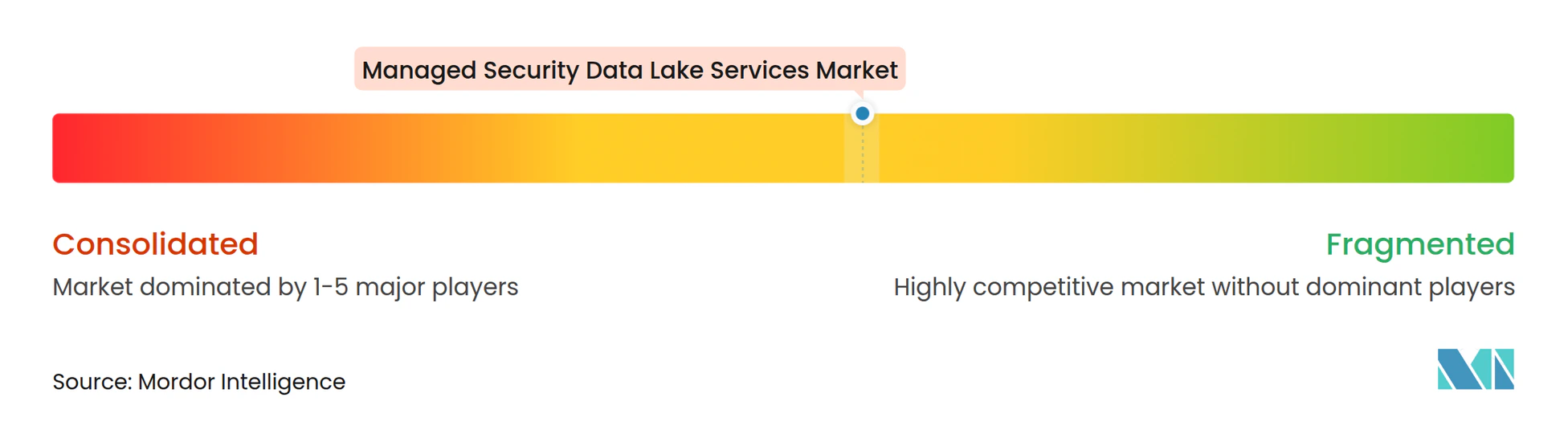
The managed security data lake services market has a moderately concentrated top tier and a fragmented group of regional managed security service providers. Global systems integrators such as Accenture, IBM Consulting, Deloitte, and Capgemini compete through transformation and advisory-led delivery. Cybersecurity platform vendors, including CrowdStrike, Palo Alto Networks, SentinelOne, and Microsoft, combine security data capabilities with larger platform subscriptions, while AWS, Microsoft, and Google provide native cloud infrastructure and related analytics services. Platform vendors emphasize first-party telemetry, while systems integrators promote vendor-neutral data integration, leaving buyers to balance flexibility and platform depth. The managed security data lake services market remains competitive because these provider groups compete for the same enterprise log-consolidation budgets using different delivery models.
CrowdStrike and IBM expanded their strategic collaboration in March 2026 to integrate Charlotte AI with IBM’s Autonomous Threat Operations Machine. The arrangement combines CrowdStrike platform data with IBM Consulting’s managed threat detection and response services. Palo Alto Networks and Google Cloud announced a multiyear agreement in December 2025 that combines Prisma AIRS AI security, Google Cloud infrastructure, and pre-integrated services. Splunk made its SOAR service available on Google Cloud in February 2026, supporting workflow automation in customer Google Cloud environments. These partnerships combine platform telemetry, cloud infrastructure, and service delivery.
Competition also centers on co-managed, OCSF-compatible architectures with sector-specific detection content. Providers that compete only on data volume or price per gigabyte face pressure because basic ingestion and storage are easier to reproduce. Detection libraries for operational technology, SaaS-heavy retail environments, or identity-focused financial services can create a more defensible position. The ITU support for OCSF may make compatibility a common customer requirement and reduce the value of proprietary schema advantages. Analytics quality, retention depth, vertical operating knowledge, and clear customer outcomes will become more important differentiators as emerging firms such as Expel and Red Canary target mid-market customers.
Managed Security Data Lake Services Industry Leaders
-
Accenture plc
-
Amazon Web Services, Inc.
-
Atos SE
-
Capgemini SE
-
Cisco Systems, Inc.
- *Disclaimer: Major Players sorted in no particular order
Managed Security Data Lake Services Market Companies Covered in this Report
- Accenture plc
- Amazon Web Services, Inc.
- Atos SE
- Capgemini SE
- Cisco Systems, Inc.
- CrowdStrike Holdings, Inc.
- CyberProof, Inc.
- Deloitte Touche Tohmatsu Limited
- Expel, Inc.
- Google LLC
- Hewlett Packard Enterprise Company
- IBM Corporation
- Infosys Limited
- Microsoft Corporation
- NTT DATA Group Corporation
- Orange SA
- Palo Alto Networks, Inc.
- Rapid7, Inc.
- Red Canary, Inc.
- Secureworks Corp.
- SentinelOne, Inc.
- Splunk LLC
- Tata Consultancy Services Limited
- Trend Micro Incorporated
- Trustwave Holdings, Inc.
- Verizon Communications Inc.
- Wipro Limited
- Zscaler, Inc.
Recent Industry Developments in Managed Security Data Lake Services Market
- June 2026: Splunk, a Cisco company, announced its intent to acquire WideField Security Inc., an identity lifecycle security firm headquartered in Santa Clara, California. WideField's technology normalizes identity telemetry to provide deterministic identity data as the foundation for AI-driven agentic SOC workflows, accelerating Splunk's vision of autonomous security operations within managed security data lake environments.
- March 2026: CrowdStrike Holdings and IBM expanded their strategic collaboration to integrate CrowdStrike Charlotte AI with IBM's Autonomous Threat Operations Machine (ATOM) for coordinated, machine-speed investigation and automated containment across endpoint, identity, and cloud environments. The expansion also extends the CrowdStrike Falcon platform into IBM Consulting's managed threat detection and response services and global X-Force Cyber Range experiences.
- February 2026: Splunk Security Orchestration, Automation, and Response (SOAR) became available as a SaaS service on Google Cloud, enabling SOC analysts and incident response teams to orchestrate workflows and automate response tasks across multi-cloud environments. Splunk SOAR integrates with Splunk Enterprise Security on Google Cloud, creating an end-to-end managed security operations experience within customer Google Cloud estates.
- December 2025: Palo Alto Networks and Google Cloud announced a landmark multi-year strategic partnership combining Prisma AIRS AI security with Google Cloud infrastructure, covering end-to-end AI workload security from code to cloud on Vertex AI, AI-native firewalls for hybrid multicloud environments, Prisma SASE for distributed access, and pre-integrated security solutions on the Google Cloud Marketplace.
Global Managed Security Data Lake Services Market Report Scope
Managed security data lake services market provides design, implementation, operation, and optimization of centralized platforms that ingest, normalize, store, secure, and analyze large volumes of security telemetry from endpoints, networks, cloud, identity, and application sources. These services enable scalable long-term retention, threat hunting, investigations, AI-driven analytics, and compliance reporting while reducing the operational burden on internal teams.
The Managed Security Data Lake Services Market Report is Segmented by Service Model (Fully Managed Services, Co-Managed Services, Consulting-Led Managed Services, and Customer-Controlled Data Lake with Provider-Managed Operations), Service Component (Consulting and Architecture Design, Implementation and Migration, Data Ingestion and Connector Management, Data Normalization and Schema Management, Platform and Product Management, Security Analytics and Detection Engineering, Threat Hunting and Incident Investigation, and Other Service Components), Security Data Source (Cloud Infrastructure and Cloud Control Plane Logs, Endpoint and Extended Detection and Response Telemetry, Network, Firewall, and DNS Telemetry, Identity, Access, and Authentication Data, SaaS, Collaboration, and Email Security Data, Application, API, and DevSecOps Data, Operational Technology and Industrial Control System Data, and Other Security Data Sources), Deployment Mode (Cloud-Based, On-Premises, and Hybrid), End User Industry (Banking, Financial Services and Insurance (BFSI), IT and Telecommunications, Healthcare and Life Sciences, Government and Public Sector, Industrial Manufacturing, Retail and E-Commerce, and Other End-User Industries), and Geography (North America, South America, Europe, Asia-Pacific, Middle East, and Africa). The Market Forecasts are Provided in Terms of Value (USD).
Segmentation Overview
| Fully Managed Services |
| Co-Managed Services |
| Consulting-Led Managed Services |
| Customer-Controlled Data Lake with Provider-Managed Operations |
| Consulting and Architecture Design |
| Implementation and Migration |
| Data Ingestion and Connector Management |
| Data Normalization and Schema Management |
| Platform and Product Management |
| Security Analytics and Detection Engineering |
| Threat Hunting and Incident Investigation |
| Other Service Components |
| Cloud Infrastructure and Cloud Control Plane Logs |
| Endpoint and Extended Detection and Response Telemetry |
| Network, Firewall, and DNS Telemetry |
| Identity, Access, and Authentication Data |
| SaaS, Collaboration, and Email Security Data |
| Application, API, and DevSecOps Data |
| Operational Technology and Industrial Control System Data |
| Other Security Data Sources |
| Cloud-Based |
| On-Premises |
| Hybrid |
| Banking, Financial Services and Insurance (BFSI) |
| IT and Telecommunications |
| Healthcare and Life Sciences |
| Government and Public Sector |
| Industrial Manufacturing |
| Retail and E-Commerce |
| Other End-User Industries |
| North America | United States |
| Canada | |
| Mexico | |
| South America | Brazil |
| Argentina | |
| Rest of South America | |
| Europe | United Kingdom |
| Germany | |
| France | |
| Italy | |
| Rest of Europe | |
| Asia-Pacific | China |
| Japan | |
| India | |
| South Korea | |
| Australia | |
| Rest of Asia-Pacific | |
| Middle East | Saudi Arabia |
| United Arab Emirates | |
| Rest of Middle East | |
| Africa | South Africa |
| Nigeria | |
| Rest of Africa |
| By Service Model | Fully Managed Services | |
| Co-Managed Services | ||
| Consulting-Led Managed Services | ||
| Customer-Controlled Data Lake with Provider-Managed Operations | ||
| By Service Component | Consulting and Architecture Design | |
| Implementation and Migration | ||
| Data Ingestion and Connector Management | ||
| Data Normalization and Schema Management | ||
| Platform and Product Management | ||
| Security Analytics and Detection Engineering | ||
| Threat Hunting and Incident Investigation | ||
| Other Service Components | ||
| By Security Data Source | Cloud Infrastructure and Cloud Control Plane Logs | |
| Endpoint and Extended Detection and Response Telemetry | ||
| Network, Firewall, and DNS Telemetry | ||
| Identity, Access, and Authentication Data | ||
| SaaS, Collaboration, and Email Security Data | ||
| Application, API, and DevSecOps Data | ||
| Operational Technology and Industrial Control System Data | ||
| Other Security Data Sources | ||
| By Deployment Mode | Cloud-Based | |
| On-Premises | ||
| Hybrid | ||
| By End User Industry | Banking, Financial Services and Insurance (BFSI) | |
| IT and Telecommunications | ||
| Healthcare and Life Sciences | ||
| Government and Public Sector | ||
| Industrial Manufacturing | ||
| Retail and E-Commerce | ||
| Other End-User Industries | ||
| By Geography | North America | United States |
| Canada | ||
| Mexico | ||
| South America | Brazil | |
| Argentina | ||
| Rest of South America | ||
| Europe | United Kingdom | |
| Germany | ||
| France | ||
| Italy | ||
| Rest of Europe | ||
| Asia-Pacific | China | |
| Japan | ||
| India | ||
| South Korea | ||
| Australia | ||
| Rest of Asia-Pacific | ||
| Middle East | Saudi Arabia | |
| United Arab Emirates | ||
| Rest of Middle East | ||
| Africa | South Africa | |
| Nigeria | ||
| Rest of Africa | ||
Key Questions Answered in the Report
What is the managed security data lake services market size?
The managed security data lake services market size is projected to expand from USD 1.29 billion in 2026 and USD 1.63 billion in 2027 to USD 4.47 billion by 2032, growing at a CAGR of 22.36% from 2027 to 2032.
What is driving demand for managed security data lake services?
Rising attack activity, multicloud complexity, retention requirements, and security skills shortages are increasing demand for managed ingestion, normalization, detection engineering, and investigation services.
Which service model leads managed security data lake services?
Fully managed services lead with 47.23% share in 2026, while customer-controlled data lake with provider-managed operations is projected to expand at a CAGR of 23.81% through 2032.
Why is cloud-based deployment important for security data lakes?
Cloud-based deployment held 68.91% share in 2026 because it supports elastic retention, multiple analytics tools, and lower infrastructure commitments for high-volume telemetry.
Which end user sector has the largest demand for managed security data lake services?
BFSI led demand with 26.69% share in 2026 because financial institutions need monitoring, evidence retention, data governance, and investigation capabilities across complex environments.
Which region is expected to expand fastest for these services?
Asia-Pacific is projected to expand at a CAGR of 25.86% through 2032, supported by financial services digitization, critical infrastructure monitoring needs, and local data residency requirements.