
Screen Print Label Market Size and Share
Market Overview
| Study Period | 2020 - 2031 |
|---|---|
| Market Size (2026) | USD 2.51 Billion |
| Market Size (2031) | USD 2.83 Billion |
| Growth Rate (2026 - 2031) | 2.53 % |
| Fastest Growing Market | Asia Pacific |
| Largest Market | North America |
| Market Concentration | Low |
Major Players *Disclaimer: Major Players sorted in no particular order Image © Mordor Intelligence. Reuse requires attribution under CC BY 4.0. | |
Screen Print Label Market Analysis by Mordor Intelligence
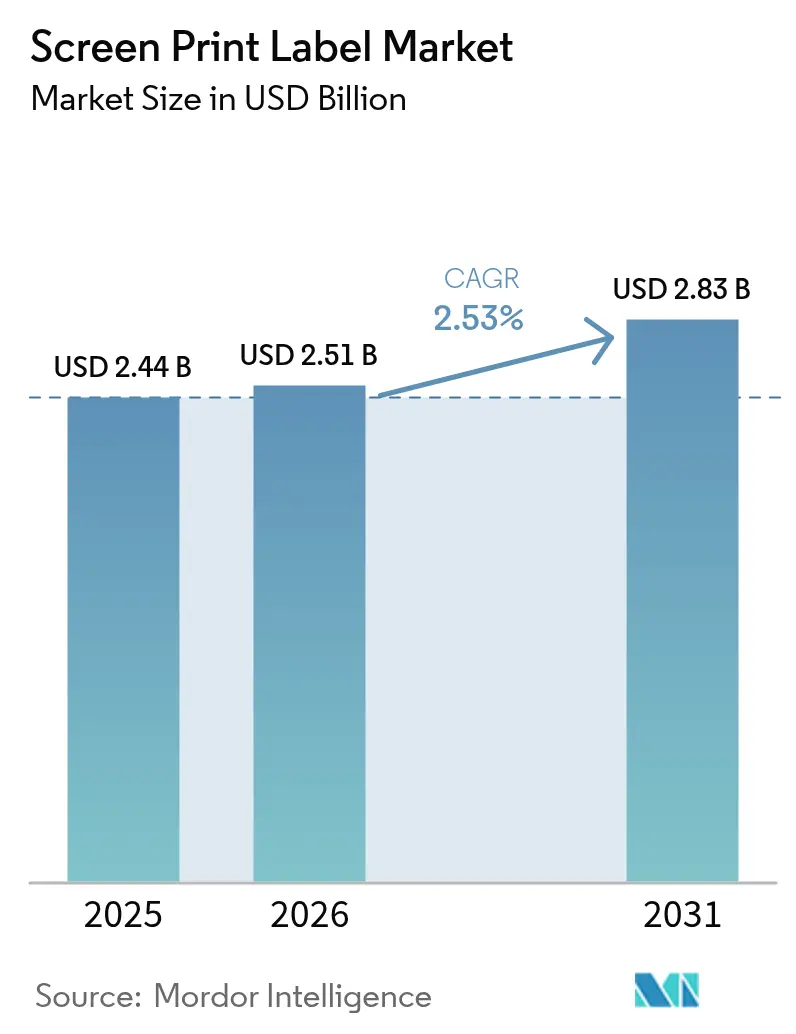
Screen print label market size in 2026 is estimated at USD 2.51 billion, growing from 2025 value of USD 2.44 billion with 2031 projections showing USD 2.83 billion, growing at 2.53% CAGR over 2026-2031. Converters are moving away from commodity shrink-sleeve runs toward high-margin smart labels and heat-resistant constructions that sell at 20-40% premiums over standard paper. E-commerce shipping, electric vehicle battery identification, and stricter ISTA 3L humidity-cycle rules are driving investments in UV-LED screen presses that print conductive inks and embed near-field communication antennas. California’s Rule 1130 VOC cap and Asia-Pacific traceability mandates further shift demand toward durable, solvent-free inks and humidity-tolerant substrates. Consolidation is underway, yet the top five suppliers still account for only about one-third of sales, so pricing power remains limited. Capital requirements of USD 800,000-1.2 million for rotary presses, plus volatile petrochemical feedstock prices, temper near-term capacity additions.
Key Report Takeaways
- By type, shrink sleeves led with 38.12% of the screen print label market share in 2025 and are expected to expand at a 3.38% CAGR through 2031.
- By end user, cosmetics and personal care posted the fastest growth rate of 4.38%, while food retained the largest revenue share of 28.10% in 2025.
- By printing ink, UV-curable systems held 39.85% of the 2025 screen print label market share, whereas water-based inks are projected to advance at a 4.20% CAGR through 2031.
- By substrate, plastic films captured 45.98% revenue in 2025, with paper growing at a 3.62% CAGR on recycling mandates.
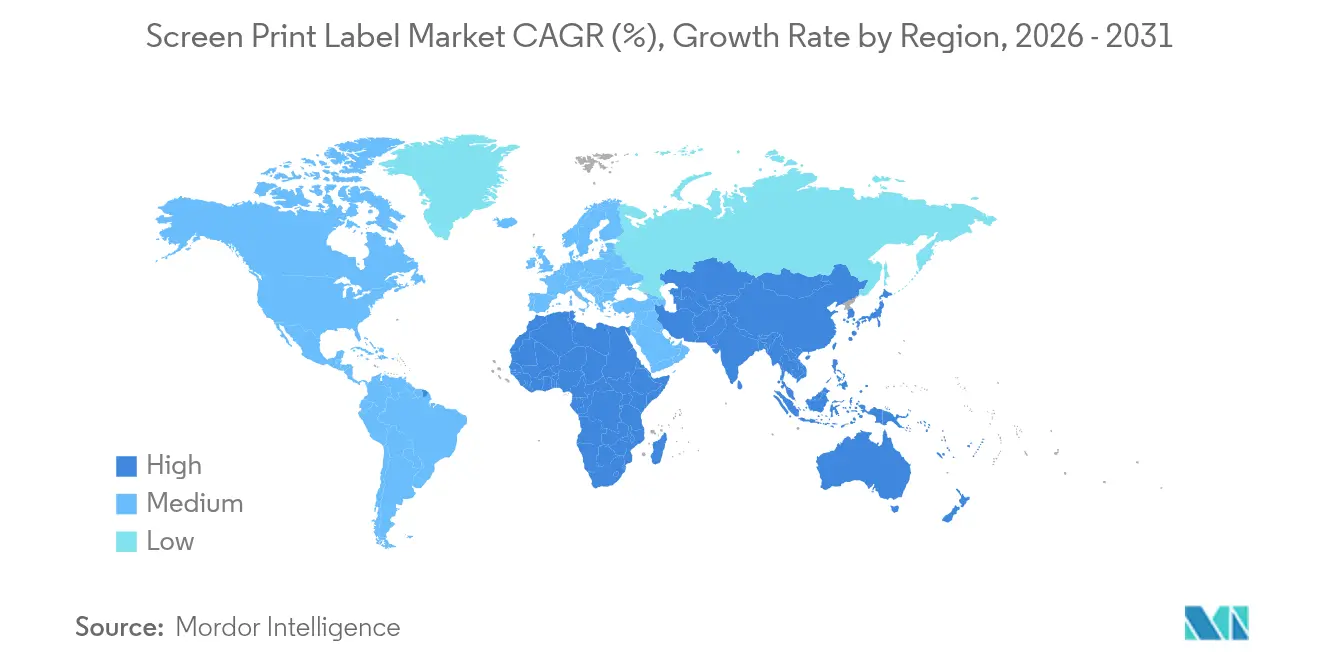
- By geography, North America accounted for 39.70% of 2025 revenue, while the Asia-Pacific region is forecast to grow at a 4.98% CAGR through 2031.
Note: Market size and forecast figures in this report are generated using Mordor Intelligence’s proprietary estimation framework, updated with the latest available data and insights as of 2026.
Market Trends and Insights
Drivers Impact Analysis of Screen Print Label Market*
| Driver | (~) % Impact on CAGR Forecast | Geographic Relevance | Impact Timeline |
|---|---|---|---|
| Rising Demand for Durable Branding Solutions in Fast-Moving Consumer Goods | +0.8% | Global, with concentration in North America and Europe | Medium term (2-4 years) |
| Growth of E-Commerce Requiring Robust Packaging Labels | +0.7% | Global, led by North America and Asia-Pacific | Short term (≤ 2 years) |
| Advancements in UV-LED Screen Printing Equipment | +0.6% | North America, Europe, and Asia-Pacific manufacturing hubs | Medium term (2-4 years) |
| Proliferation of Smart Label Features Integrating RFID and QR Codes | +0.5% | Asia-Pacific core, spillover to North America and Europe | Long term (≥ 4 years) |
| Sustainability Push Toward Solvent-Free Screen Printing Inks | +0.4% | Europe and North America, early adoption in select Asia-Pacific markets | Medium term (2-4 years) |
| Increasing Adoption of Heat-Resistant Labels in Electric Vehicle Batteries | +0.3% | Asia-Pacific and Europe, emerging in North America | Long term (≥ 4 years) |
| Source: Mordor Intelligence | |||
Durable Branding for Fast-Moving Consumer Goods
Brand owners mandate labels that survive xenon-arc exposure, repeated abrasion, and refill-pack cycles. Unilever requires color stability within Delta E 2.0 after 2,000 hours of light aging, which water-based screen inks achieve through high titanium dioxide loading. Procter and Gamble’s 50-double-rub threshold under ASTM D5264 keeps solvent-based digital inks off qualified lists. As Europe shifts to refillable packs, labels must also withstand 15-20 hot-wash cycles without delaminating.
Robust Labels for E-Commerce Fulfillment
Amazon’s 2024 packaging rules require labels that remain intact after 48 hours of water immersion, directing fulfillment centers toward polyester screen constructions with acrylic adhesives. ISTA 3L drop tests add 40-60 G shock loads, so converters raise adhesive coverage to 85% of the footprint. [1]International Safe Transit Association, “ISTA 3L Test Procedure,” ista.org FedEx specifies a minimum peel adhesion of 16 oz/in after 72 hours, which solvent-acrylic screen inks exceed by up to 35%. [2]FedEx Corporation, “Labeling Specifications,” fedex.com
Advancements in UV-LED Screen Printing Equipment
New UV-LED arrays deliver 15 W/cm² at 395 nm, curing 25 µm ink films at 80 m/min and reducing energy use by up to 85%. Lower peak web temperatures allow direct printing on polylactic-acid films that distort above 55 °C. Lamp life exceeds 20,000 hours, cutting annual downtime from 120 hours to under 15 hours and lifting overall equipment effectiveness.
Smart-Label Integration with RFID and QR Codes
Screen printing deposits conductive silver traces for near-field antennas, saving USD 0.08-0.12 per unit versus inlay attachment. GS1’s Digital Link standard packs batch data inside a single QR symbol, but a resolution of 600 dpi within a 15 mm square is essential.[3]GS1, “Digital Link Standard,” gs1.org China’s GB 38507-2020 rule requires QR codes on all packaged food by late 2025, creating hundreds of millions of square meters of extra demand.
Restraints Impact Analysis of Screen Print Label Market*
| Restraint | (~) % Impact on CAGR Forecast | Geographic Relevance | Impact Timeline |
|---|---|---|---|
| High cost of multicolor screen-printing setups | -0.5% | Global, especially emerging markets | Short term (≤ 2 years) |
| Competition from digital inkjet label printing | -0.6% | North America and Europe, rising in Asia | Medium term (2-4 years) |
| Volatile petrochemical input prices | -0.4% | Import-dependent regions | Short term (≤ 2 years) |
| VOC rules on screen-printing operations | -0.3% | Europe and North America | Long term (≥ 4 years) |
| Source: Mordor Intelligence | |||
High Cost of Multicolor Screen-Printing Setups
Rotary equipment needs USD 800,000-1.2 million upfront, four to five times the ticket price of an entry-level digital press. Make-ready still takes 45-90 minutes, delaying short runs and increasing scrap. Emerging-market converters, therefore, delay capacity additions until interest rates ease or orders shift to longer repeats.
Competition from Digital Inkjet Label Printing
Inkjet systems now reach 1,200 × 1,200 dpi at 13.5 m²/h with an ink outlay of USD 0.18-0.22 per m², which is lower than the screen’s USD 0.28-0.35 for runs under 5,000 linear meters. Piezo heads last up to 10 liters, stretching replacement cycles and narrowing the cost gap. HP’s Indigo 25K meets 97% Pantone accuracy. Yet, rub resistance remains 30-40% lower than that of UV-screen films, so screen printing still dominates shrink sleeves and heat-transfer graphics that require 200% elongation.
*Our forecasts treat driver/restraint impacts as directional, not additive. The impact forecasts reflect baseline growth, mix effects, and variable interactions.
Screen Print Label Market Segment Analysis
By Type:
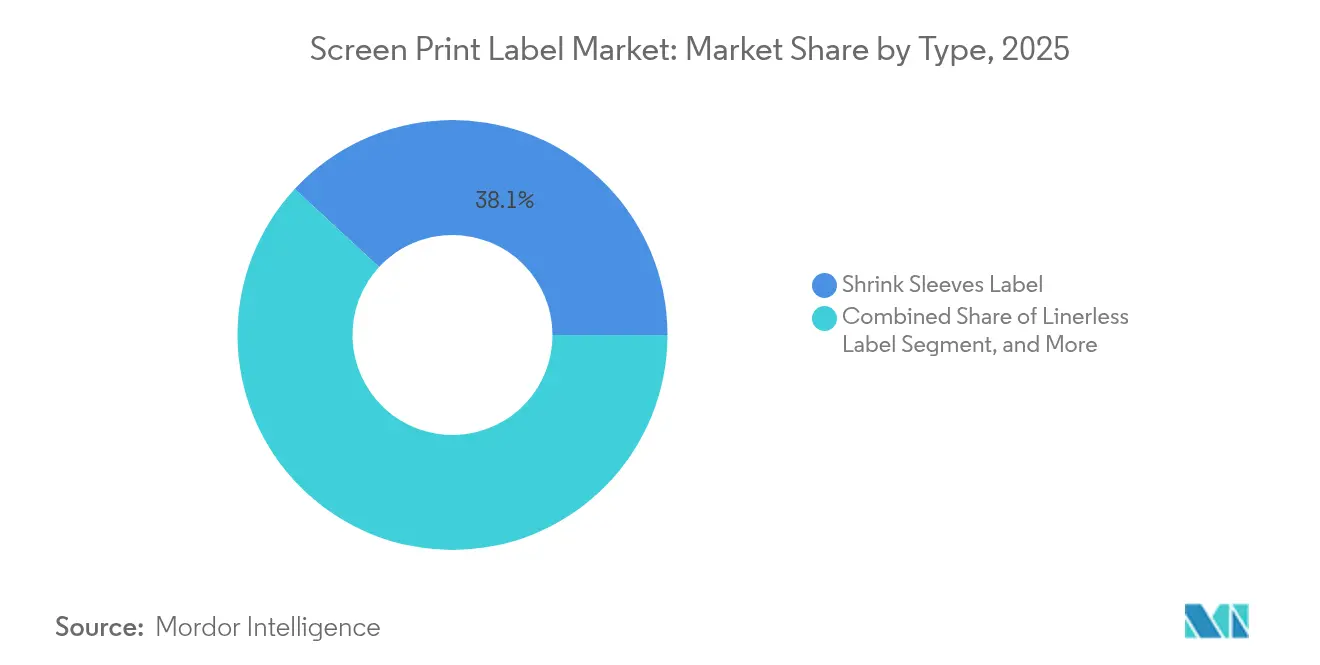
Shrink Sleeves Dominate Through Full-Body BrandingShrink sleeves accounted for 38.12% of 2025 revenue and are expected to advance at a 3.38% CAGR, helping the screen print label market outpace commodity pressure-sensitive formats. The segment benefits from 360-degree graphic coverage, steam tunnel shrinkage of up to 78%, and compatibility with irregular container designs. Energy-efficient films such as Pentalabel Boost cut steam use by 30%, shaving USD 0.008-0.012 per container. Linerless solutions lag in share but appeal to logistics customers seeking waste-free workflows. Wet-glued labels cling to legacy glass-bottle lines in beer, yet this niche is shrinking as cans gain traction. Heat-transfer decals for apparel and in-mold options for durable goods complete the mix, each serving specialized requirements that sustain price premiums.
Sustainability and authentication extend the growth runway. Screen-printed holographic foils deter counterfeiters in the spirits and cosmetics industries, while washable inks enable the use of returnable packaging loops. Craft beverage brands exploit raised varnish and tactile effects that digital cannot replicate at production speed. Although shrink-film recycling remains a hurdle, mono-material polyethylene sleeves and delaminating adhesives promise end-of-life gains that align with retailer targets.



By End User:
Cosmetics Outpaces Food in Premium PositioningFood brands held 28.10% of 2025 sales as allergen and tamper-evidence rules kept volumes high, but cosmetics and personal care is set for the fastest 4.38% CAGR. Prestige lines demand metallic inks, soft-touch varnish, and chemical endurance that only UV-screen builds provide. L’Oréal now specifies ink cross-link density above 85% to survive 30-day immersion in oily formulations. Upcoming FDA healthy-claim labels add more variable data, a task that hybrid screen-digital workflows solve without color drift.
Beverage applications enjoy mid-teens share as craft breweries order textured labels that reinforce artisanal cues. Pharmaceutical serialization utilizes two-dimensional codes at 600 dpi, whereas industrial applications require labels that withstand exposure to mineral spirits. Fashion labels grow modestly as fast-fashion brands adopt direct-to-garment printing; yet, luxury houses still favor woven satin with screen-printed logos for their brand heritage.
By Printing Ink Type:
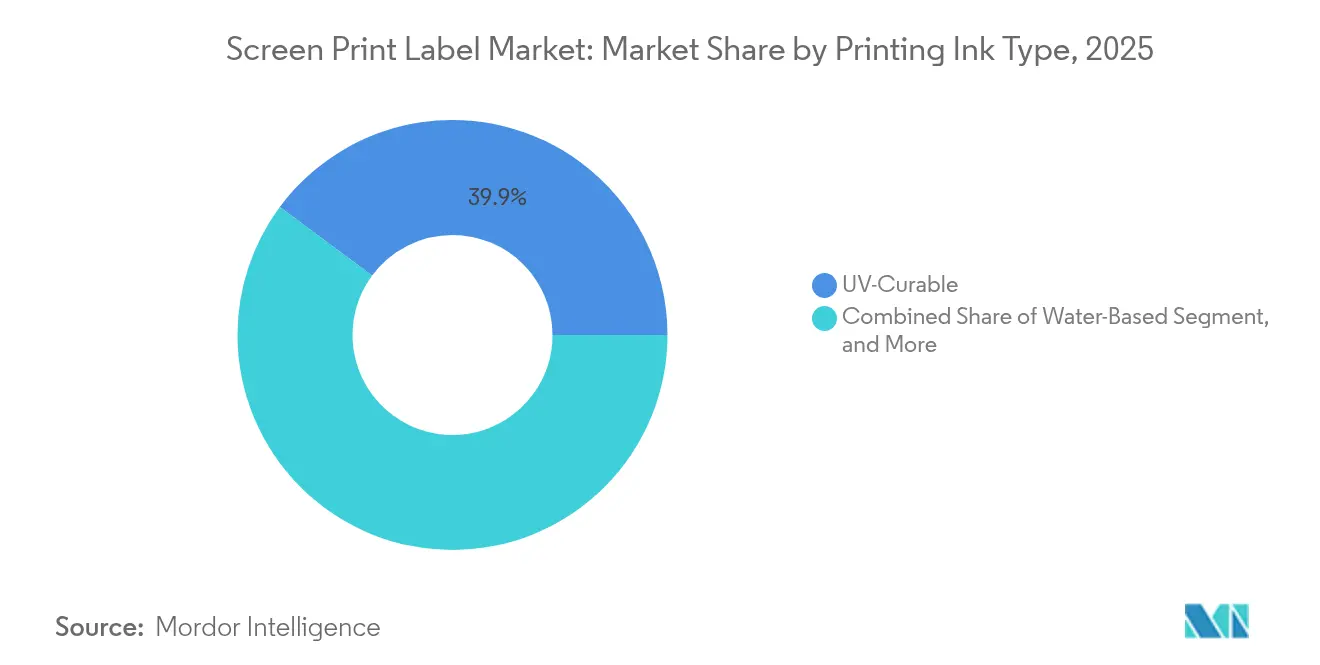
Water-Based Gains on Regulatory TailwindsUV-curable inks accounted for 39.85% of 2025 revenue, thanks to their instant curing and high chemical resistance. Water-based chemistries, advancing at a 4.20% CAGR, comply with California’s 250 g⁄L VOC ceiling and European green-deal targets. Hybrid systems, such as AquaGrip, merge water rheology with UV crosslinking to deliver a 22 oz/in peel on polyethylene at under 200 g/L VOC.
Solvent lines remain necessary for low-surface-energy polypropylene unless corona-treated, while silicone and conductive silver inks address niche heat-transfer and RFID needs. Advances in nano-silica reinforcement extend abrasion life to 250 double rubs, giving converters fresh talking points for premium segments.
By Substrate Material:
Paper Advances on Circular-Economy RulesPlastic films kept a 45.98% share in 2025, driven by the 120-180% elongation that shrink sleeves require. Paper prices rise by 3.75% due to Forest Stewardship Council mandates and kerbside recyclability requirements. Mondi’s EcoWicket paper survives injection-molding yet recovers 95% fiber in municipal streams. Film producers respond with alkali-soluble adhesives, such as CleanFlake, that detach during bottle washes, thereby boosting the purity of recycled PET above 94%. Specialty glass and metal labels carry ceramic or epoxy inks for dishwasher and salt-spray endurance, while polylactic-acid, stone-paper, and bio-polymer substrates open new compostable paths.
Geography Analysis
North America Screen Print Label Market
North America accounted for 39.70% of 2025 revenue, driven by the Drug Supply Chain Security Act serialization, which spurred double-digit reprint demand. United States converters invested up to USD 220 million in UV-LED capacity, winning craft beverage and specialty food contracts that crave metallic inks and tactile finishes. Canada’s bilingual label law increased information density, a benefit for opaque screen inks. Mexico’s electronics maquiladoras specified polyimide labels rated for 260 °C reflow, reinforcing regional demand.
Europe Screen Print Label Market
Europe accounted for roughly one-quarter of sales. The Packaging and Packaging Waste Regulation mandates 65% recycled content in labels by 2030, prompting converters to shift toward mono-material builds. Germany’s VerpackG fees on non-recyclables and the United Kingdom’s UKCA symbol changeover fueled short-run orders that favored screen printing. Security holograms for authenticating the origin of olive oil and wine remain a resilient niche.
APAC and MEA Screen Print Label Market
The Asia-Pacific region is expected to post a 4.98% CAGR through 2031 due to China’s late-2025 QR-code deadline, which will affect billions of packaged food units. India’s IS 17142:2024 adhesion rule accelerates the adoption of wet glue in humid coastal corridors. Japanese tax credits for solvent-free presses, South Korean deposit fees on label waste, and Australian ISO 22000 export standards further expand regional uptake. Middle East and African growth hovers near mid-single digits, with Saudi localization rules and South African local-content thresholds prompting domestic press installations.

Regulatory Landscape
Screen print label production is increasingly shaped by packaging waste and labeling harmonization policies that link label choices to recyclability and consumer sorting outcomes. In the European Union, the Packaging and Packaging Waste Regulation, Regulation (EU) 2025/40, entered into force on 11 February 2025 and is generally applicable from 12 August 2026. This raises the emphasis on label material and ink/adhesive compatibility with recycling streams as brand owners align packaging to design-for-recycling requirements.
Implementation details also affect label content and format. The PPWR includes provisions for harmonized labeling, including Commission implementing acts to set a harmonized label and related specifications by 12 August 2026, with transition timing for certain pictogram-based sorting labels extending further (with some mandatory compliance timelines running to 12 August 2028). In the United States, FDA uniform compliance dates for food labeling regulations published between 1 January 2025 and 31 December 2026 affect the cadence of label redesign cycles. That timing supports converter demand for coordinated updates, version control, and mixed technology workflows where durable screen layers are paired with variable information.
Value Chain Analysis
The value chain begins with upstream suppliers of substrates (paper and plastic films), ink systems (UV-curable, water-based, solvent-based, and specialty conductive inks), and adhesives/liners, followed by prepress and plate/screen preparation. Label converters and printers run rotary and flatbed screen presses, increasingly alongside UV-LED curing and hybrid screen-digital finishing to deliver tactile effects, high-opacity whites, and abrasion or chemical resistance. Hardware OEMs for presses and curing systems, along with specialty material suppliers (for films, release liners, and wash-off or alkali-soluble adhesives), influence performance and qualification against end-user tests such as abrasion, humidity-cycle, and adhesion specifications.
On the downstream side, converters sell through direct contracts to brand owners and through packaging partners serving food, beverages, cosmetics, pharmaceuticals, logistics, and industrial customers, with distribution increasingly aligned to omnichannel fulfillment requirements. Supply-chain orchestration is tightening through connected procurement and shared specifications between retailers, packers, and printers to standardize SKUs and reduce rework. Regional delivery expectations also push converters to keep inventory and production closer to end markets. In practice, cloud-connected workflow approaches cited in connected label supply-chain practices and productivity-focused internal platform deployments at converters point to software and process integration working alongside materials and press capacity.
Competitive Landscape
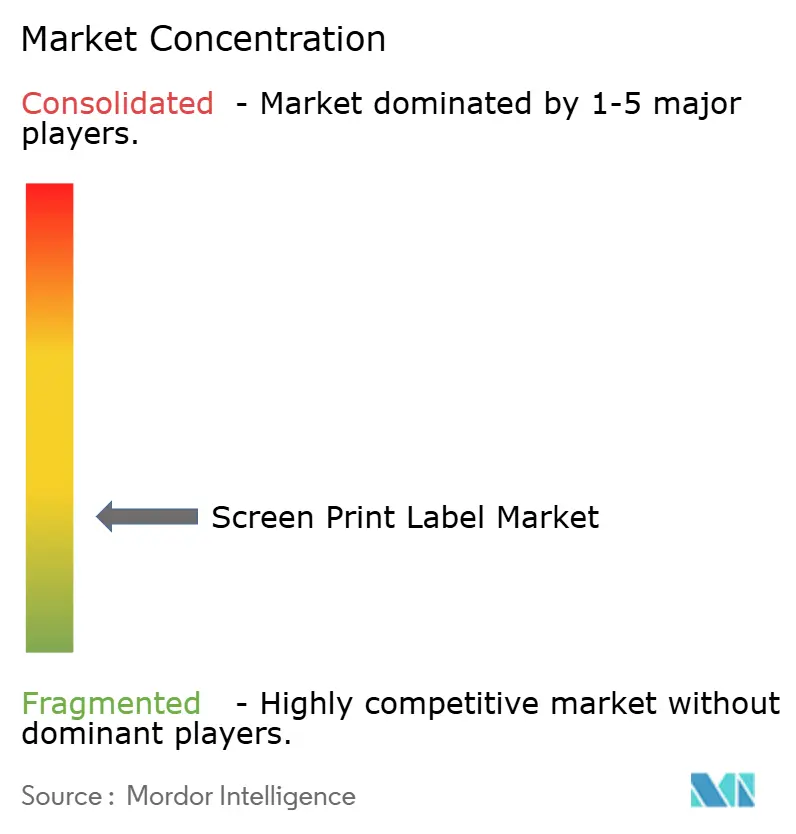
The screen print label market remains moderately fragmented, with the five largest suppliers controlling just 28-32% of sales, leaving room for regional specialists. CCL Industries acquired Tapp Technologies to bring NFC chip embedding in-house, reducing lead times to under a week and eliminating external mark-ups.
Energy-saving UV-LED retrofits and conductive-ink antenna printing differentiate leaders that target heat-sensitive substrates and smart-packaging use cases. White-space opportunities include electric vehicle battery labels that require UL 969 approval across -40 °C to 150 °C temperature cycles.
Sustainability is a strong wedge for challengers. Avery Dennison’s CleanFlake adhesive raises the purity of recycled PET to 94-96%, earning resin premiums that offset higher label costs. Patent filings concentrate on silver-nanoparticle inks with sub-0.5 Ω⁄sq resistance for contactless payments. Hybrid workflows pair digital variable data with screen stations for spot colors, reducing make-ready time to 20 minutes. California’s VOC rule forces solvent shops to either retrofit their ink recirculation systems for USD 400,000-600,000 or exit the state market.
Screen Print Label Industry Leaders
Fort Dearborn Company
Autajon Group
CCL Industries Inc.
Mondi PLC
Ahistrom Munksjo Oyj
- *Disclaimer: Major Players sorted in no particular order
Screen Print Label Market Companies Covered in this Report
- 3M Company
- Ahlstrom-Munksjo Oyj
- Autajon Group
- Avery Dennison Corporation
- Brady Corporation
- CCL Industries Inc.
- Constantia Flexibles Group GmbH
- Coveris Group
- Fort Dearborn Company
- Fuji Seal International Inc.
- Gallus Ferd. Rüesch AG
- Huhtamaki Oyj
- Inland Label and Marketing Services LLC
- Lintec Corporation
- Mondi plc
- Multi-Color Corporation
- R.R. Donnelley and Sons Company
- SATO Holdings Corporation
- TSC Auto ID Technology Co. Ltd.
- UPM Raflatac (UPM-Kymmene Corporation)
- Xeikon (Flint Group)

Market Opportunities and Future Outlook
White-space growth is most pronounced where screen printing delivers measurable functional advantages over purely digital output, especially in smart and durable constructions. Compliance and traceability programs that increase the density of machine-readable information create room for hybrid builds. In these setups, screen stations provide high-opacity, abrasion-resistant layers and conductive features, while digital units handle variable codes. China’s GB 38507-2020 packaged-food QR code requirement by late 2025 and GS1 Digital Link adoption increase the need for high-resolution, scannable symbols on substrates that must survive humidity and handling. That demand aligns with the market shift toward UV-LED screen capabilities and specialized ink sets.
In 2026, converter investment patterns also point to capacity expansion focused on rapid turnaround and hybridization, which supports demand for premium effects and durability layers that screen processes are often used to deliver. Online Labels Group expanded digital printing capacity at its Kansas City facility in April 2026 to support 1 to 2 day turnarounds. In parallel, multiple installations of SCREEN Truepress inkjet equipment in 2026 (Impact Labelling in Ireland and PDQ Labels in Australia) indicate broader adoption of mixed-technology production lines where screen processes keep roles for tactile finishes, heavy ink laydown, and specialty layers. Sustainability-driven redesign further expands opportunities for screen printers that can qualify solvent-free or lower-VOC ink systems and compatible adhesive-substrate combinations that protect recyclate quality, as brand owners respond to EU PPWR requirements and recycling-oriented label specifications.
Recent Industry Developments in Screen Print Label Market
- June 2026: CCL Industries completed the acquisition of Sleever International Company SA, adding shrink sleeve label manufacturing, extruded films, and application equipment to its platform. The acquisition strengthens CCL's position in full-body decoration formats where screen printing remains important for durable, high-opacity and specialty effects. It also expands the integrated offering across materials and application capabilities.
- September 2025: North American beverage groups adopted alkali-soluble CleanFlake adhesives on PET shrink sleeves to align with recycled-content and recyclability objectives. This increased the use of sleeve constructions that can be removed during recycling, supporting brand conversions to full-body graphics. It also reinforced demand for screen-printed sleeve aesthetics where abrasion resistance and opacity are differentiators.
- October 2024: CCL Industries completed the acquisition of Tapp Technologies, bringing NFC chip embedding in-house. This improved lead times for smart-label programs and strengthened the case for screen-printed conductive features. It also supported integrated authentication and engagement elements within premium label constructions.


Screen Print Label Market Report Scope and Research Methodology
Market Definition and Coverage
The screen print label market, for this methodology, covers printed label products where the design is transferred using a screen printing process and sold as finished labels to end users across industries.
Scope exclusions: We exclude non-screen label printing methods (such as purely digital or thermal label output) and in-house, non-commercial label making that is not sold in the market.
Segments Covered in This Report
- By Type
- Shrink Sleeves Label
- Linerless Label
- Wet-Glued Label
- Other Types
- By End User
- Fashion and Apparels
- Food
- Beverages
- Cosmetics and Personal Care
- Other End Users
- By Printing Ink Type
- Solvent-Based
- Water-Based
- UV-Curable
- Silicone Ink
- Other Printing Ink Types
- By Substrate Material
- Paper
- Plastic Films
- Glass
- Metal
- Fabric
- Other Substrates
- By Geography
- North America
- United States
- Canada
- Mexico
- South America
- Brazil
- Argentina
- Rest of South America
- Europe
- Germany
- United Kingdom
- France
- Italy
- Spain
- Rest of Europe
- Asia Pacific
- China
- Japan
- India
- South Korea
- Australia and New Zealand
- Rest of Asia Pacific
- Middle East and Africa
- Middle East
- Saudi Arabia
- United Arab Emirates
- Turkey
- Rest of Middle East
- Africa
- South Africa
- Egypt
- Nigeria
- Rest of Africa
- Middle East
- North America
Data Sources, Market Sizing, and Validation
Desk Research
Desk research was used to map the value chain and to set realistic demand signals before the model was built. We relied on public sources such as the US Census Bureau and Bureau of Labor Statistics for printing-related output and wage indicators, UN Comtrade for trade-direction checks on printed products, and sources such as the US International Trade Commission for tariff and import context.
We also reviewed packaging and label association publications, peer-reviewed papers on screen inks and curing methods, and company filings and investor decks to understand capacity additions, pricing pressure, and exposure to apparel, industrial, and compliance labeling end markets. Where it helped, paid subscriptions covering company financials and patent filings were used to cross-check revenue mix statements and technology adoption signals. The sources listed here are illustrative only, and many other public sources were also used for data collection, validation, and clarification.
Primary Interviews and Surveys
Primary work was done through expert interviews and structured surveys with label converters, screen printing equipment and consumables stakeholders, distributors, and procurement or packaging roles at end-user firms. We covered APAC, EMEA, and the Americas so regional differences in apparel and industrial labeling demand, compliance labeling needs, and price movements could be checked against model assumptions, and then used to adjust the underlying drivers.
Distribution of primary research fieldwork respondents
| Company type | Respondent position | Region |
|---|---|---|
| Top tier: 39% | CXOs: 14% | APAC: 52% |
| Mid tier: 46% | Functional/Unit leaders: 38% | EMEA: 29% |
| Smaller Players: 15% | Managers: 48% | Americas: 19% |
Market-Sizing & Forecasting
Market size was first reconstructed using a top-down approach where printing and label demand pools were built from end-use output signals and then filtered to screen-printable label adoption. To keep totals realistic, the model was then checked with selective bottom-up approximations, such as sampled converter revenues, channel feedback on order volumes, and a price-per-label-area proxy applied to estimated volume ranges.
Key inputs included apparel and footwear production trends, industrial and safety labeling demand signals, resin and specialty ink price movement, average label order sizes by end use, and the mix shift between durable and standard labels. Forecasts were produced using scenario analysis supported by trend inputs and expert views on substrate shifts, automation in converters, and compliance labeling requirements, and then smoothed to avoid unrealistic jumps. Where bottom-up data was missing for smaller converters, gaps were handled through region-level normalization using capacity-utilization discussion points from interviews and public production indicators.
Data Validation & Update Cycle
Outputs were validated through triangulation across independent signals, then tested for variance by region, end-use exposure, and price assumptions so outliers were not carried into the final numbers. When a mismatch appeared, we rechecked units, currency timing, and implied label volumes per end market, and we re-contacted select respondents if the change was material.
Each report goes through multi-step analyst review before sign-off, and the model is refreshed annually with interim updates when there are meaningful events such as major capacity additions, sharp input-cost swings, or regulation changes affecting label requirements. Before delivery, a final pass is completed so clients receive the latest updated view available at that time.
Mordor Intelligence's Screen Print Label Market Size Measured Against Other Published Estimates
Published market sizes can vary even when the topic name looks the same, since firms may count different label types, use different year labels, or apply different price and volume logic. Differences also show up when some studies include adjacent printing methods or use aggressive growth cases that are not checked against end-use indicators.
The main gap comes from whether non-screen label printing and adjacent decorated components are blended into the total, and in Mordor Intelligence the count is limited to finished labels produced using a screen process and then validated using end-use output signals and interview-based adoption shares before totals are finalized.
Benchmark comparison
| Source | Market Size | Gaps in Research Methodology |
|---|---|---|
| Mordor Intelligence | USD 2.51 B (2026) | |
| Regional Publisher A | USD 3.99 B (2025) | Uses a different base year and appears to apply a broader demand build that can pull in adjacent label formats and higher growth assumptions over a longer horizon, which can lift the starting value versus a screen-only definition. |
| Global Consultancy B | USD 4.50 B (2025) | The published snapshot shows mixed year labeling and a faster forecast period, and the sizing likely leans more on generalized growth rates, with less visible cross-checking to end-use output and screen-print adoption rates by region. |
The comparison shows that the spread is mostly explained by scope choices, year selection, and how pricing and adoption are carried forward. By keeping inputs tied to observable end-use activity, price movement, and interview-validated adoption shares, our model stays traceable and repeatable even when public data is limited.


Key Questions Answered in the Report
What is the current value of the screen print label market?
The screen print label market size is USD 2.51 billion in 2026 and is projected to reach USD 2.83 billion by 2031.
Which application type leads sales?
Shrink sleeves hold 38.12% of 2025 revenue and maintain the largest stake thanks to full-body graphics and 360-degree branding.
Why are UV-LED presses gaining traction?
They cut energy use by up to 85%, cure inks at higher web speeds, and allow printing on heat-sensitive and compostable films.
What region will grow the fastest?
Asia-Pacific posts a 4.98% CAGR through 2031, driven by China’s mandatory QR-code traceability and cost-competitive labor.
How do digital presses affect the sector?
Inkjet equipment undercuts screen printing on short runs, yet lower abrasion resistance keeps screen processes dominant in durable and shrink applications.
Which regulation most influences sustainability choices?
California’s Rule 1130 VOC cap and the European Packaging and Packaging Waste Regulation push converters toward water-based inks and recyclable substrates.
Page last updated on:





