
Saudi Arabia Tiles Market Size and Share
Market Overview
| Study Period | 2020 - 2031 |
|---|---|
| Forecast Data Period | 2026 - 2031 |
| Base Year Market Size (2025) | USD 122.73 Billion |
| Market Size (2026) | USD 129.13 Billion |
| Market Size (2031) | USD 166.52 Billion |
| Growth Rate (2026 - 2031) | 5.22 % |
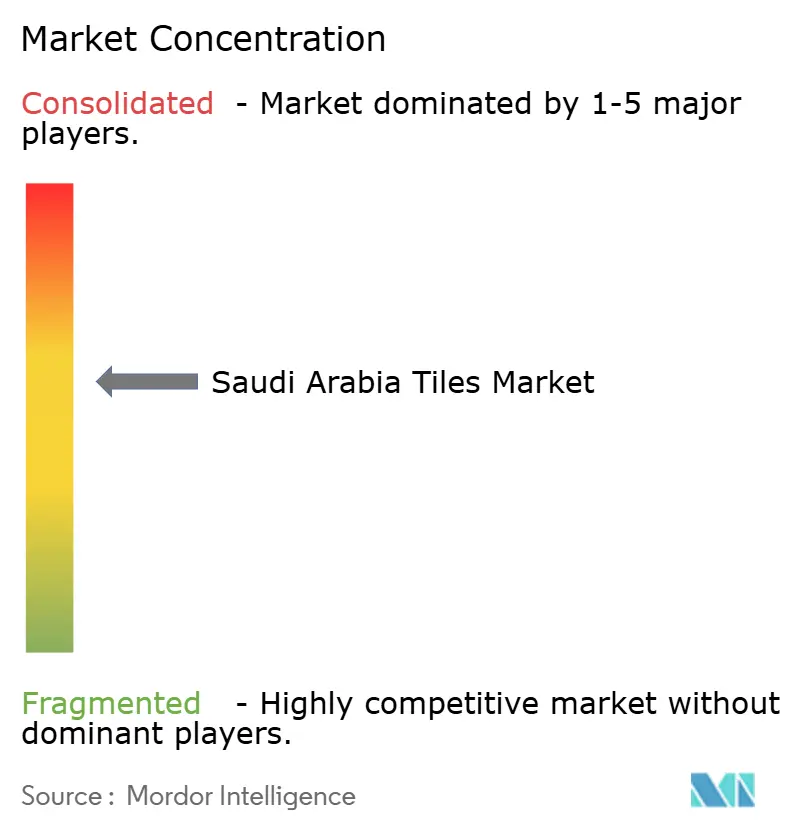
| Market Concentration | Medium |
Major Players *Disclaimer: Major Players sorted in no particular order Image © Mordor Intelligence. Reuse requires attribution under CC BY 4.0. | |
Saudi Arabia Tiles Market Analysis by Mordor Intelligence
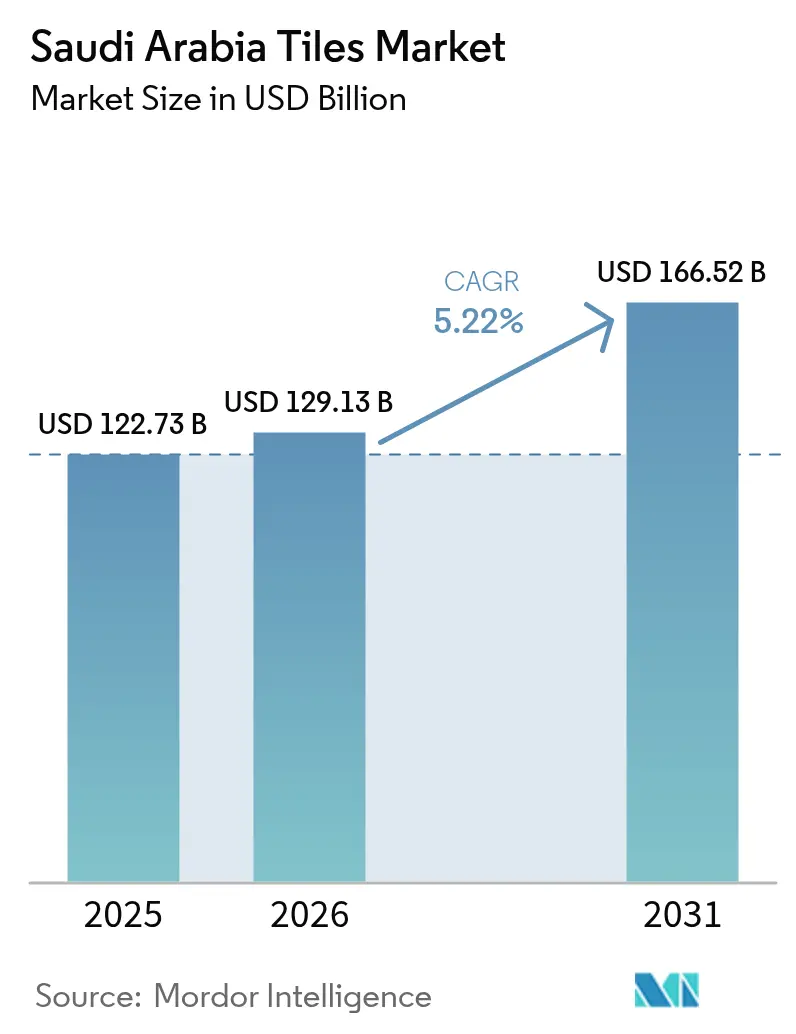
Saudi Arabia Tiles Market size in 2026 is estimated at USD 129.13 billion, growing from 2025 value of USD 122.73 billion with 2031 projections showing USD 166.52 billion, growing at 5.22% CAGR over 2026-2031. The trajectory mirrors the construction momentum unleashed by Vision 2030 housing targets, a surge of giga-projects, and mortgage reforms that widened home-ownership access across the Kingdom. Demand tilts decisively toward ceramic and porcelain categories because durable surfaces meet Saudi Building Code performance requirements and aesthetic expectations for premium residential and commercial projects. Logistics upgrades—new rail corridors, automated warehouses, and multimodal freight hubs—shorten delivery lead times and reduce breakage, thereby strengthening domestic and import-driven supply chains. Competitive intensity stays moderate as the top five suppliers hold about 65% of total sales, yet more than 30 smaller brands retain price-sensitive niches, fueling product innovation and segmented marketing strategies[1].
Key Report Takeaways
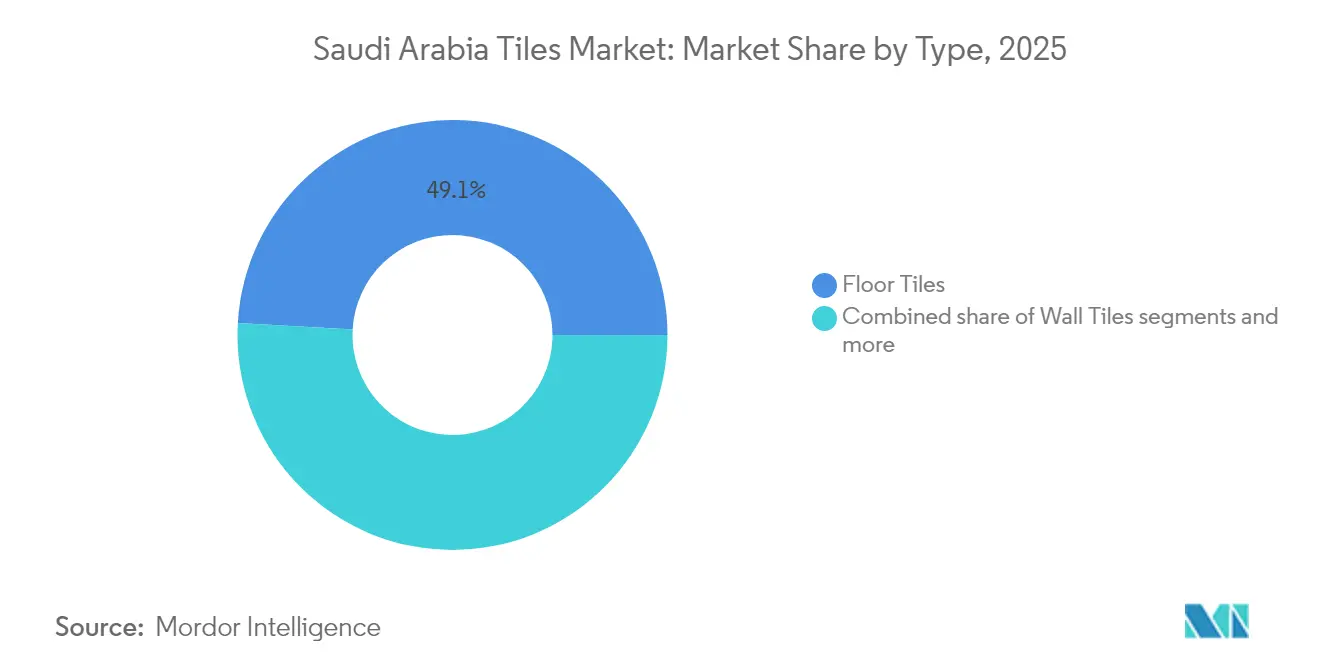
- By type, floor tiles led with 49.12% of the Saudi Arabia Tiles Market share in 2025, whereas roof tiles are expanding at the fastest 8.54% CAGR to 2031.
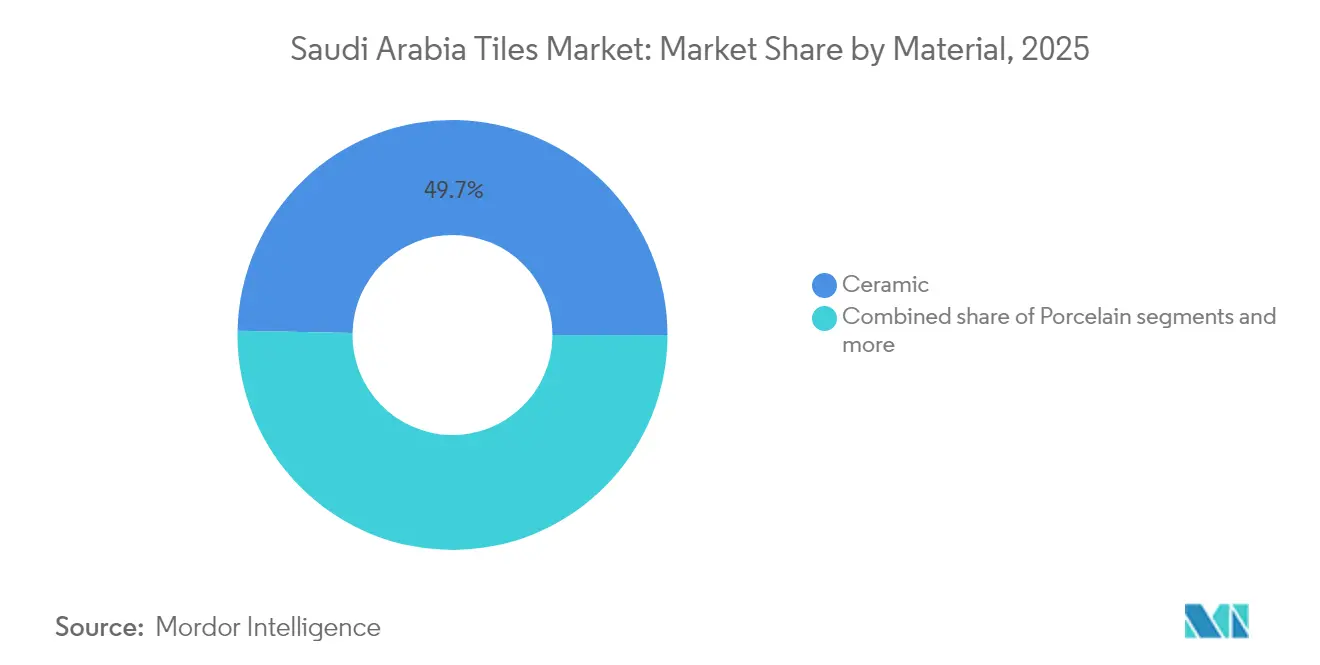
- By material, ceramic occupied 49.68% of the Saudi Arabia Tiles Market size in 2025, while porcelain shows a 7.61% CAGR through 2031.
- By end user, the residential segment accounted for a 57.05% share of the Saudi Arabia Tiles Market size in 2025, yet commercial applications are accelerating at an 8.42% CAGR toward 2031.
- By geography, the Central Region captured 33.10% of Saudi Arabia's tile market share in 2025, and the Northern Region is projected to surge at a 10.52% CAGR up to 2031.
Note: Market size and forecast figures in this report are generated using Mordor Intelligence’s proprietary estimation framework, updated with the latest available data and insights as of 2026.
Saudi Arabia Tiles Market Trends and Insights
Drivers Impact Analysis*
| Driver | (~) % Impact on CAGR Forecast | Geographic Relevance | Impact Timeline |
|---|---|---|---|
| Surging residential construction under Vision 2030 | +1.8% | National, highest in Central & Western regions | Medium term (2-4 years) |
| Government-backed giga-projects (NEOM, Red Sea, Diriyah, Qiddiya) | +1.5% | Northern & Western regions | Long term (≥ 4 years) |
| Preference shift toward ceramic & porcelain tiles | +1.2% | National, premium cities | Short term (≤ 2 years) |
| Improved retail & logistics infrastructure | +0.8% | Nationwide, early gains in Riyadh, Jeddah, Dammam | Medium term (2-4 years) |
| Localization incentives (“Made in Saudi”) boosting domestic output | +1.0% | Nationwide, strong uptake in industrial zones | Medium term (2–4 years) |
| Growing demand for high-albedo tiles that reduce cooling loads | +0.9% | Central & Western regions with high solar exposure | Long term (≥ 4 years) |
| Source: Mordor Intelligence | |||
Surging Residential Construction Under Vision 2030
Vision 2030’s Sakani program delivered 374,000 housing units in 2024, each averaging 120 m² of tile-covered areas across kitchens, bathrooms, and living spaces. Mortgage rules that broadened borrower eligibility raised the home-ownership rate by 47% compared with 2024, injecting sustained demand into the Saudi Arabia Tiles Market[2]. Developers specify material lifespans of at least 25 years, favoring ceramic and porcelain formats that demonstrate low water absorption and thermal-shock resistance. Riyadh, Jeddah, and King Abdullah Economic City account for most approved building permits, concentrating distribution flows into these zones. Suppliers leverage localized warehousing to maintain just-in-time inventory levels, mitigating stock-outs on fast-moving SKUs.
Government-Backed Giga-Projects Pipeline
NEOM’s USD 500 billion megacity is slated to consume more than 15 million m² of tiles across residential, commercial, and infrastructural footprints by 2030 [3]. The Red Sea Project’s hospitality cluster requires slip-resistant and high-albedo roof tiles that cut cooling loads by up to 30% versus conventional materials. Qiddiya and Diriyah Gate enlarge premium demand pools for decorative porcelain mosaics, while remote project sites prioritize suppliers with agile logistics and on-site storage capabilities. Tile makers respond by adding capacity for large-format slabs and photovoltaic-integrated roof systems, aligning with Saudi green-building mandates. This multi-regional pipeline locks in long-range order books and stabilizes factory utilization rates.
Preference Shift Toward Ceramic & Porcelain Tiles
Porcelain’s moisture-absorption rate below 0.5% delivers durability in Saudi Arabia’s heat and sandstorm conditions. Digital printing enables ceramic tiles to mimic marble or wood at 40–60% lower installed cost, accelerating adoption among middle-income homeowners. Large-format sizes such as 600×600 mm reduce grout lines, boosting aesthetic appeal and ease of cleaning. Premium buyers increasingly select rectified edges and 3D textures, reinforcing the migration away from vinyl and carpet. Local manufacturers scale up porcelain kilns to reclaim import share, while importers reposition as specification partners on luxury projects.
Improved Retail & Logistics Infrastructure
Saudi Arabia invested USD 147 billion in logistics upgrades that now include specialized tile distribution centers equipped with automated stacking cranes and climate-controlled storage. Freight rail links connecting Dammam, Riyadh, and Jeddah cut transit time by 35%, trimming breakage rates by 22% and lowering landed costs on imported products. Regional distributors integrate e-commerce platforms that allow contractors to schedule just-in-time deliveries to urban job sites, minimizing project delays. Smaller producers leverage third-party warehousing to expand geographic reach without heavy capital outlays. The Saudi Railway Company's freight services now handle 2.3 million tons of construction materials annually, including tiles, compared to 800,000 tons in 2023. Collectively, these enhancements elevate service levels, widen product variety, and underpin the Saudi Arabia Tiles Market growth trajectory.
Restraints Impact Analysis*
| Restraint | (~) % Impact on CAGR Forecast | Geographic Relevance | Impact Timeline |
|---|---|---|---|
| Volatile natural-gas & raw-material prices | −0.9% | National manufacturing hubs | Short term (≤ 2 years) |
| Rising competition from resilient flooring (LVT, SPC) | −0.6% | Urban commercial areas | Medium term (2-4 years) |
| Water-scarcity constraints on ceramic production processes | -0.5% | Drought-prone industrial regions | Medium term (2–4 years) |
| Import dependence for specialty glazes & pigments | -0.4% | National, with concentration in design-centric segments | Short term (≤ 2 years) |
| Source: Mordor Intelligence | |||
Volatile Natural-Gas & Raw-Material Prices
Ceramic kilns account for the majority of manufacturing energy use, exposing producers to significant cost swings when natural gas prices fluctuate sharply each quarter. Key raw materials like feldspar, clay, and silica sand saw notable price increases in 2024 due to export limits and global shipping disruptions. Larger tile manufacturers have mitigated some of this volatility by hedging energy inputs and installing regenerative burners to improve efficiency. In contrast, smaller firms struggle to absorb rising costs, facing tighter margins and limited flexibility. Some facilities are experimenting with solar-assisted kiln pre-heating, which can reduce gas usage by up to one-fifth. Although many companies rely on price pass-through to maintain revenue, extended procurement timelines and higher interest rates are creating added pressure on working capital.
Rising Competition from Resilient Flooring
Luxury vinyl tile (LVT) and stone plastic composite (SPC) have gained significant traction in commercial interiors, especially among developers seeking faster project turnaround due to their shorter installation times. Advancements in digital printing and surface embossing have enhanced their appearance, allowing these materials to closely mimic natural stone and wood finishes. This has positioned them as viable alternatives to entry-level ceramic tiles in design-driven projects. However, ceramic still holds a strong advantage in areas with high moisture exposure and where Class A fire-rating compliance is essential. To stay competitive, tile manufacturers are introducing thin-body porcelain slabs that reduce installation time significantly. Additionally, industry-led installer training and warranty programs are helping to reinforce confidence in ceramic solutions, limiting market share loss to resilient flooring options.
*Our forecasts treat driver/restraint impacts as directional, not additive. The impact forecasts reflect baseline growth, mix effects, and variable interactions.
Segment Analysis
By Type: Performance Gap Drives Roof-Tile Upswing
The roof-tile sub-segment is the Saudi Arabia Tiles Market’s fastest riser, posting an 8.54% CAGR to 2031 as cool-roof mandates set solar-reflectance index (SRI) benchmarks above 78. Floor tiles occupy 49.12% of the Saudi Arabia Tiles Market share thanks to sustained residential construction, while wall tiles secure decorative equity in bathrooms and feature walls. Large-format flooring slabs (≥1200×600 mm) enhance installation speed and create open-plan aesthetics valued in modern villas. Roof-tile makers integrate reflective pigments and photovoltaic laminates, turning rooftops into passive energy assets. Distributors profile SKUs by climate zone, recognizing coastal versus inland thermal loads that influence product mix. Contractors adopt mechanized hoisting rigs to install lighter concrete-based roof tiles that cut structural loads. Insurance providers endorse high-albedo roofs because they lower cooling costs and extend membrane life, creating an ecosystem pull for the sub-segment.
The floor-tile category continues to dominate absolute volume yet faces price pressures from import-heavy SKUs. Market leaders use digital glazing lines to personalize patterns without delaying cycle times, maintaining margins. Wall-tile demand benefits from hospitality fit-outs in Makkah and Madinah, where decorative mosaics support premium room rates. Simultaneously, emerging DIY channels in Riyadh’s retail corridors introduce click-system ceramic planks that allow homeowner installation with minimal tools. Cross-promotion campaigns pair grout additives with antibacterial properties, elevating customer lifetime value. Episodic buying cycles for renovation projects create opportunity windows for promotions tied to Islamic holidays and marriage seasons.

By Material: Porcelain’s Premium Proposition
Ceramic slots 49.68% of the Saudi Arabia Tiles Market size in 2025, yet porcelain accelerates at a 7.61% CAGR courtesy of its sub-0.5% porosity and color-body composition that masks surface wear. Digital roll-printing facilitates hyper-realistic Carrara marble and travertine visuals, capturing the luxury segment without marble’s maintenance liabilities. Producers advocate porcelain for exterior cladding in coastal cities, emphasizing salt-spray resistance. Retailers consolidate merchandising displays around “performance zones,” enabling consumers to compare scratch, stain, and slip metrics across materials. Natural stone and mosaic tiles pivot toward niche spa resorts and palace restorations, preserving heritage aesthetics. Bio-based composite tiles—made from rice husk ash and recycled glass—enter pilot projects that aim for LEED and Mostadam certifications.
Investments in vertical kilns and fast-fire technology reduce porcelain firing times to under 40 minutes, boosting capacity utilization and mitigating energy cost exposure. Color-through porcelain formats command 20–30% price premiums, improving revenue mix even during cyclical slowdowns. Importers from Spain and Italy deepen Saudi distribution partnerships, but local porcelain output climbs as players secure low-interest SIDF loans. Glaze suppliers localize production of metallic and pearlescent finishes, cutting lead times by 45%. Product education campaigns teach contractors optimal thinset usage, lessening callbacks linked to hollow-sound tile debonding.
By End User: Commercial Schemes Gain Velocity
Residential customers accounted for 57.05% share of the Saudi Arabia Tiles Market in 2025, primarily driven by mortgage incentives and government-funded housing clusters. Yet commercial demand is projected to outpace at 8.42% CAGR through 2031 as hospitality, retail, and mixed-use hubs proliferate under economic diversification blueprints. Hotels and resorts alone will require an estimated 8 million m² of tiles each year, specifying large-format porcelain for lobby grandeur and anti-slip ceramic for wet areas. Shopping-mall developers favor high-traffic-rated porcelain and matte textures that minimize glare. Corporate campuses, anchored by international tenants, choose ventilated façade tile systems that raise energy efficiency by 11%.
Residential renovation cycles shorten as young households upgrade starter units within five years, underpinning repeat demand for mid-price ceramic SKUs. E-commerce platforms deliver visualization apps that allow homeowners to preview tile layouts in augmented reality, lifting conversion rates. Commercial project owners negotiate performance guarantees that bundle tiles with installation and maintenance services, shifting the supply chain toward turnkey models. Facility managers document total-cost-of-ownership savings from porcelain’s scratch resistance, reinforcing material preference over resilient flooring in heavy-traffic zones.
Geography Analysis
Riyadh-anchored Central Region held a 33.10% Saudi Arabia Tiles Market share in 2025 on the back of robust public-sector spending, New Murabba’s cultural district, and administrative expansions. Construction permits in the region climbed 28% year on year, supporting sustained demand across floor, wall, and roof tiles. Contractors benefit from proximity to large factories and distribution centers that maintain buffer inventory, shortening procurement cycles. Retail showrooms in Riyadh display augmented reality booths, improving consumer engagement and raising upselling potential. Western Region followed closely at 32.25%, leveraging Jeddah’s port logistics, religious tourism inflows into Makkah and Madinah, and premium coastal developments along the Red Sea. Developers in the Red Sea Project specify enhanced slip resistance and color stability to withstand saline air and UV exposure. Tile import volumes through Jeddah Islamic Port hit 1.8 million tons in 2024, positioning the region as the primary entry point for European and Asian products. Retailers enjoy short lead times on exotic designs, widening style selection for upscale villas.
Eastern Region captured 18.05% share, driven by industrial city expansions in Jubail and Dammam that demand chemical-resistant floor tiles for petrochemical and logistics facilities. The area benefits from abundant silica deposits, lowering raw-material transport costs for nearby tile plants. Heavy-duty thickness formats (≥20 mm) find traction in outdoor pedestrian areas subject to forklift traffic and oil spills. Manufacturers co-locate glaze mills near Qatif clay quarries, securing stable feedstock supply. Northern Region projects the fastest 10.52% CAGR as NEOM’s entirely new urban footprint necessitates mass procurement of façade, pavement, and interior tiles. Supply chains undergo transformation, with modular warehouses and inland container depots mitigating the long haul from Jeddah. Southern Region keeps a modest 5.80% share, yet infrastructure rollouts along the Yemen border and agriculture hub investments sustain baseline demand.
Regulatory Landscape
Ceramic tiles placed on the Saudi market fall under the Saudi Standards, Metrology and Quality Organization (SASO) Technical Regulation for Building Materials, Part 4 (Bricks, Tiles, Ceramics, Sanitary Ware and Related Products). Market access depends on conformity assessment through the SABER platform, including registration and the issuance of Certificates of Conformity, with the Saudi Quality Mark (SQM) pathway commonly used for ongoing compliance. The referenced standards include SASO-ISO 13006 and SASO-ISO 10545-1, covering classification, characteristics, marking, and sampling and acceptance.
On the trade side, importers operate under the Zakat, Tax and Customs Authority (ZATCA) Integrated Customs Tariff framework, which moved to an updated GCC-aligned integrated tariff schedule effective January 1, 2025. The tariff schedule also saw further amendments in November 2025 (Decision No. 1447-88-7), reinforcing the need to monitor HS-code level duty treatment for building-material inputs and finished tiles to reduce clearance delays and unexpected landed-cost changes.
Value Chain Analysis
The value chain starts with mineral inputs (clays, feldspar, silica) and specialty chemicals (glazes and pigments), then moves through body preparation, pressing, drying, glazing, and kiln firing. Because energy intensity drives production costs, natural-gas pricing and kiln efficiency remain key cost levers. After manufacturing, finished tiles go through factory QA and conformity workflows aligned with SASO requirements, with SABER-based product registration and certification acting as a gate before tiles can be distributed to projects and retail channels.
Downstream, volumes are supplied via regional distributors, branded showrooms, tile-specialist retailers, and project-specification sales to contractors and developers. Entry logistics center on major gateways such as Jeddah and Dammam, where customs clearance is linked to the certification documentation. For large projects, procurement is increasingly direct to specifiers with tighter delivery windows. Government procurement and participation in mega-projects are also influenced by local content preference rules under Ministry of Finance regulations, raising the commercial value of domestic manufacturing, local warehousing, and Saudi-based service capabilities such as technical support, installer training, and warranty-backed delivery.
Competitive Landscape
The Saudi Arabia tiles market is moderately concentrated, with a few dominant players accounting for the majority of national sales, while a long tail of over 30 local and import-driven competitors adds pricing complexity and innovation pressure. Saudi Ceramic Company maintains market leadership, benefiting from end-to-end manufacturing integration and a widespread distribution footprint. RAK Ceramics follows, leveraging its strong presence in large-scale construction projects and its ability to meet strict specification standards. These top players emphasize vertical integration, ensuring control over raw material sourcing, production, and final delivery to strengthen margins and improve reliability. This approach helps mitigate supply chain risks and enhances responsiveness to large-scale demand. However, fragmentation among smaller players continues to shape the competitive landscape.
Technology adoption is becoming a key competitive differentiator across the market. Leading manufacturers are investing in advanced digital printing, automation, and energy-efficient kiln technologies to reduce costs and improve consistency. These upgrades support faster product innovation cycles and allow for greater customization. Efficiency in production also enables companies to handle more complex orders and meet evolving design trends. Additionally, there's growing interest in smart production systems that support sustainable operations and quality tracking. These advancements are helping major players stay ahead in a market facing increased import competition[4].
Market opportunities are emerging in niche and high-performance segments. Specialized categories like photovoltaic roof tiles and heavy-duty commercial flooring are creating new growth paths that require technical capabilities and R&D investment. Smaller players are disrupting the luxury residential segment by offering eco-friendly materials and tailored design options. These offerings appeal to environmentally conscious consumers and premium developments. Meanwhile, established players are under pressure to manage costs amid volatile raw material prices and aggressive imports. As a result, innovation, differentiation, and supply chain agility are becoming critical to long-term market positioning.
Saudi Arabia Tiles Industry Leaders
-
Saudi Ceramic Company
-
RAK Ceramics (KSA operations)
-
Future Ceramics
-
Arabian Tile Co. (ARTIC)
-
Alfanar Ceramics
- *Disclaimer: Major Players sorted in no particular order
Market Opportunities and Future Outlook
Near-term opportunities concentrate in compliance-led and performance-led product lines that map to Saudi Building Code expectations and SASO conformity requirements. These include higher-spec porcelain, large-format slabs, and roof tiles aligned with cool-roof performance benchmarks, with SRI thresholds referenced in project specifications. Manufacturers and importers that pair tiles with documented testing, SABER readiness, and dependable project logistics can access more specification-driven demand in giga-project and institutional procurement, where approvals and traceability receive closer scrutiny.
Industrial programs and capital access are also shaping localization-focused whitespace around capability upgrades. Saudi Ceramic Company disclosed outstanding Saudi Industrial Development Fund (SIDF) loans of SAR 204.1 million as of December 31, 2025 (up from SAR 114.3 million in 2024), indicating active development financing to support manufacturing scale in the Kingdom. Alongside the shift toward premium porcelain and digitally printed aesthetics, this financing-backed upgrade cycle supports additional opportunities in locally produced, standards-compliant collections that substitute imports while aligning with local content preferences in public and strategic projects.
Recent Industry Developments
- April 2026: Saudi Ceramic Company announced board approval to reassess the remaining useful lives of its property, plant, and equipment. The change alters depreciation assumptions used in 2026 financial reporting and points to tighter asset and cost management around capital-intensive tile operations.
- February 2026: RAK Ceramics selected SAP SE to implement an enterprise-wide, cloud-based digital transformation using RISE with SAP across its global entities. A unified operating platform is designed to support faster planning, order fulfillment, and inventory visibility, which are relevant for supplying specification-driven projects and multi-site distribution in Saudi Arabia.
- September 2024: Saudi Ceramic Company announced a USD 85 million capacity expansion at its Riyadh facility, adding 15 million square meters of annual production capacity focused on large-format porcelain tiles. The project included advanced digital printing and automated handling, strengthening local supply for Vision 2030-linked construction programs and premium specification demand.
Research Methodology Framework and Report Scope
Market Definition and Coverage
This market covers the value of tiles sold and used within Saudi Arabia for construction and renovation. It is counted across common formats and materials used for interior and exterior surfaces. The sizing is done in current USD and reflects demand tied to building activity and replacement cycles.
Scope exclusions: installation labor, adhesives and grouts, tools, and broader flooring products that are not tiles are excluded.
Segmentation Overview
- By Type
- Floor Tiles
- Wall Tiles
- Roof Tiles
- By Material
- Ceramic
- Porcelain
- Natural Stone & Mosaic
- Others
- By End User
- Residential
- Commercial
- By Geography
- Central Region (Riyadh)
- Western Region (Makkah & Madinah)
- Eastern Region (Dammam & Al-Khobar)
- Northern Region
- Southern Region
Data Sources, Market Sizing, and Validation
Desk Research
Desk research starts with public construction and trade signals that can be checked year over year, and then mapped to tile consumption. We review official datasets such as the General Authority for Statistics (Saudi Arabia), UN Comtrade trade tables, Saudi Standards, Metrology and Quality Organization publications, and Saudi Building Code references to understand demand drivers and product acceptance. For project momentum, we also scan public tender and project pipeline announcements, plus company annual reports and investor decks where volumes, capacity changes, or pricing commentary are discussed.
To reduce guesswork around supplier presence and capacity footprints, we also use paid subscriptions focused on company financials and intelligence, plus an import and export shipment-level database for directional checks on inbound tile flows. Academic papers and patents are used selectively to confirm material shifts, such as porcelain share changes and performance preferences in hot climates. This list of desk research sources is not exhaustive, and many other public sources were also reviewed to collect data, validate assumptions, and clarify unclear points.
Primary Interviews and Surveys
Primary work is used to convert public signals into realistic sell-in and sell-through assumptions, especially where channel margins, mix, and discounting can move the value outcome. We interview and survey manufacturers, importers, distributors, retailers, contractors, and large project buyers to confirm price bands, mix shifts (ceramic versus porcelain), and the timing of demand across the main construction hubs in Saudi Arabia.
Findings from these discussions are then used to tighten variables that are hard to observe from public sources alone, such as mid-year price resets, stock clearing behavior, and the share of demand coming from replacement versus new builds.
Distribution of primary research fieldwork respondents
| Company type | Respondent position |
|---|---|
| Top tier: 34% | CXOs: 22% |
| Mid tier: 44% | Functional/Unit leaders: 22% |
| Smaller Players: 22% | Managers: 56% |
Market-Sizing & Forecasting
The core model uses a top-down approach, where construction activity and trade patterns are used to reconstruct the tile demand pool, then the value is built by applying realistic price bands. In practice, inputs like residential completions, non-residential project progress, import volumes by tile type, and replacement intensity help explain why demand rises or softens in a given year. Price is shaped using reported raw material and energy cost direction, freight conditions, and observed mix shifts between ceramic and porcelain.
After totals are formed, they are cross-checked with selective bottom-up approximations, such as supplier and distributor roll-ups, channel checks on average selling prices, and sampled volume-to-ASP calculations for key routes to market. Where bottom-up coverage is incomplete, gaps are handled using informed share estimates by channel and region, then validated through follow-up calls. Forecasts are developed using scenario analysis, where housing plans, mega-project timing, and price normalization paths are tested under conservative and base cases, and then aligned to what primary respondents consider achievable over the period.
Data Validation & Update Cycle
Outputs are validated through several checks so that big jumps are explained and small drifts are not missed. We compare results against independent signals such as import momentum, construction permitting trends, and project pipeline movement, then investigate variances that break expected relationships like volume growth versus price movement.
Before sign-off, the model and assumptions go through multi-step analyst review, and respondents are re-contacted when key inputs change or when outliers appear in price or volume. Reports are refreshed annually, and interim updates are made when material events occur, such as major policy shifts, sharp currency moves, or sudden changes in construction starts. Right before delivery, a fresh review pass is completed so clients receive the most current view available.
Mordor Intelligence's Saudi Arabia Tiles Market Size Versus Other Published Estimates
Published market sizes for tiles in Saudi Arabia often do not match each other, even when they look like they cover the same topic. Differences usually come from what is counted as tiles, whether the estimate reflects sales into the country versus consumption within the country, and how prices are averaged across projects and retail channels.
By tracking import volumes, construction activity proxies, and pricing resets, Mordor Intelligence keeps the estimate tied to tiles consumed in Saudi Arabia and avoids mixing in installation services or broader flooring categories, which tends to be the main reason totals drift across sources.
Benchmark comparison
| Source | Market Size | Gaps in Research Methodology |
|---|---|---|
| Mordor Intelligence | USD 122.73 B (2025) | |
| Industry Association A | USD 1.95 B (2025) | Often limited to ceramic tile shipments reported by a subset of members, which can undercount imports and exclude non-ceramic materials, thereby shrinking the value total. |
| Trade Journal B | USD 3.40 B (2026) | Typically focuses on manufacturer and importer revenue at list prices, with lighter adjustment for discounts, channel margins, and mix shifts between ceramic and porcelain, which can skew the value. |
The spread in the table is mainly explained by scope boundaries and pricing treatment, not by a single growth assumption. When the demand pool is anchored to construction and replacement signals, and when price bands are validated through channel feedback, the resulting market size becomes easier to trace and repeat year over year.
Key Questions Answered in the Report
How large is the Saudi Arabia Tiles Market in 2026?
The market is valued at USD 129.13 billion in 2026 and is forecast to reach USD 166.52 billion by 2031.
Which tile type is growing the fastest?
Roof tiles post the highest 8.54% CAGR thanks to energy-efficient cool-roof mandates.
Why is porcelain gaining share over ceramic?
Porcelain delivers sub-0.5% water-absorption, superior durability, and premium aesthetics, pushing its 7.61% CAGR.
Which region leads in tile demand?
Riyadh-anchored Central Region commands 33.10% market share due to active public-sector construction.
Who are the leading manufacturers?
Saudi Ceramic Company, RAK Ceramics, Future Ceramics, Alfanar Ceramics, and Arabian Tile Company are the leading manufacturers.