
Market Overview
| Study Period | 2020 - 2031 |
|---|---|
| Forecast Data Period | 2026 - 2031 |
| Base Year Market Size (2025) | USD 5.46 Billion |
| Market Size (2026) | USD 5.76 Billion |
| Market Size (2031) | USD 7.54 Billion |
| Growth Rate (2026 - 2031) | 5.54 % |
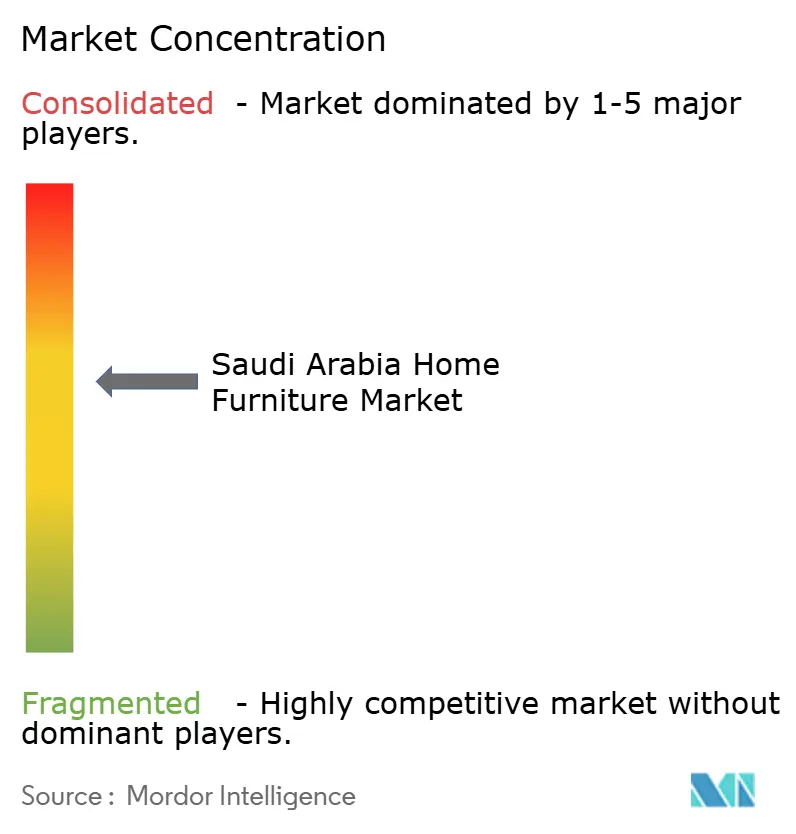
| Market Concentration | Medium |
Major Players *Disclaimer: Major Players sorted in no particular order Image © Mordor Intelligence. Reuse requires attribution under CC BY 4.0. | |
Saudi Arabia Home Furniture Market Analysis by Mordor Intelligence
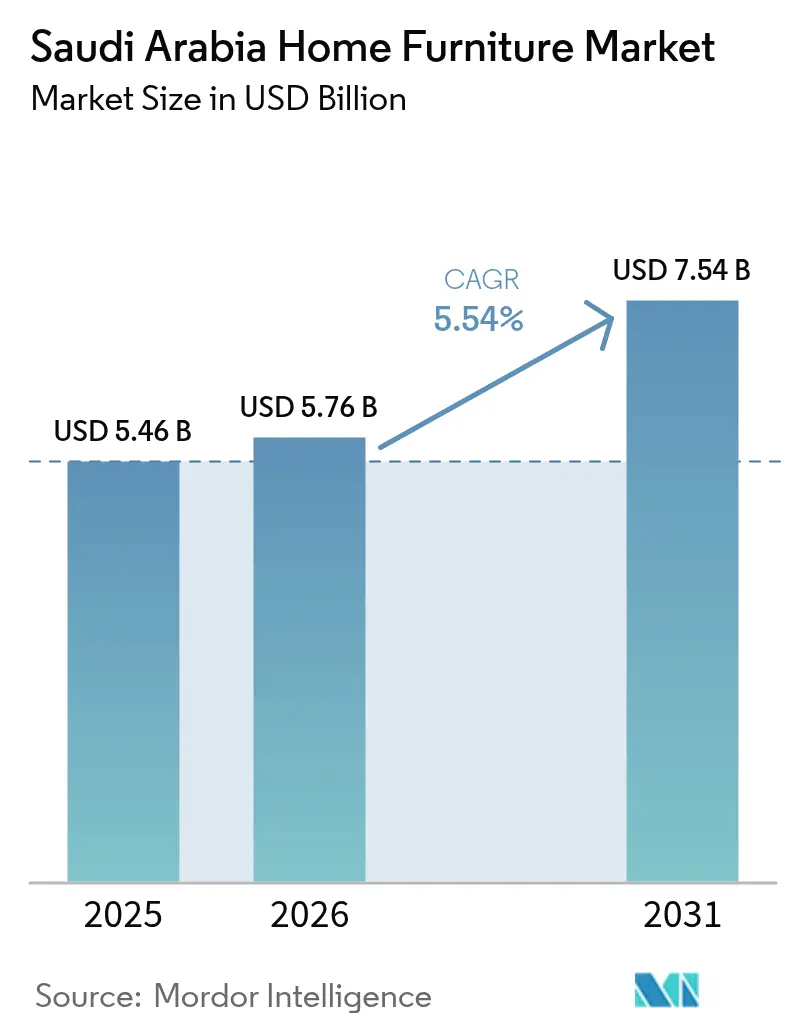
The Saudi Arabia home furniture market size is expected to grow from USD 5.46 billion in 2025 to USD 5.76 billion in 2026 and is forecast to reach USD 7.54 billion by 2031 at 5.54% CAGR over 2026-2031. Sustained residential construction linked to Vision 2030 is triggering bulk purchases of complete room sets, while premiumization trends accelerate as disposable incomes rise. Specialty retail dominates today’s sales but digital channels are expanding quickly, encouraged by 99% internet penetration and mobile-centric shopping habits. Material innovation is gathering pace because extreme summer heat forces suppliers to develop UV-resistant outdoor furniture and climate-robust plastics. Competitive intensity is heightened by localization incentives that reward domestic production through financing and procurement preferences.
Key Report Takeaways
- By product category, Living Room and Dining Room Furniture held 29.01% of Saudi Arabia home furniture market share in 2025, whereas Kitchen Furniture is forecast to expand at a 6.39% CAGR through 2031.
- By material, wood products captured 66.02% share of the Saudi Arabia home furniture market size in 2025, while plastic & polymer furniture is poised for 5.74% CAGR to 2031.
- By price range, the mid-range segment commanded 52.88% share of the Saudi Arabia home furniture market size in 2025; premium furniture is projected to grow at 6.03% CAGR to 2031.
- By distribution channel, specialty furniture stores led with 44.92% revenue share in 2025, yet online sales represent the fastest trajectory with a 7.05% CAGR through 2031.
- By geography, the Western Region accounted for 27.31% of Saudi Arabia home furniture market share in 2025, whereas the Central Region is advancing at the highest 6.61% CAGR toward 2031.
Note: Market size and forecast figures in this report are generated using Mordor Intelligence’s proprietary estimation framework, updated with the latest available data and insights as of 2026.
Market Trends and Insights
Drivers Impact Analysis of Saudi Arabia Home Furniture Market*
| Driver | (~) % Impact on CAGR Forecast | Geographic Relevance | Impact Timeline |
|---|---|---|---|
| Vision 2030-driven residential real-estate boom | +1.8% | National, concentrated in Riyadh, Jeddah, NEOM | Long term (≥ 4 years) |
| Rising disposable income and shifting lifestyle preferences | +1.2% | Urban centers, Western and Central regions | Medium term (2-4 years) |
| Expansion of e-commerce and last-mile delivery networks | +0.9% | National, with early gains in Riyadh, Jeddah, Dammam | Short term (≤ 2 years) |
| Hospitality build-out for tourism and religious pilgrimages | +0.7% | Western Region (Makkah, Madinah), Red Sea coastal areas | Medium term (2-4 years) |
| Modular, multi-functional designs suiting high expat churn | +0.5% | Eastern Province, Riyadh business districts | Short term (≤ 2 years) |
| "Made-in-Saudi" localization incentives for furniture plants | +0.4% | Industrial zones in Central and Eastern regions | Long term (≥ 4 years) |
| Source: Mordor Intelligence | |||
Vision 2030-Driven Residential Real Estate Boom
Housing commitments underpin the Saudi Arabia home furniture market, with one million new homes scheduled before 2030 and ROSHN alone targeting 400,000 units. Transaction data show Riyadh villas representing 53.3% of residential sales, creating outsized demand for large living-room sets and bespoke interiors. The New Murabba downtown plan adds 104,000 apartments, while NEOM’s The Line anticipates nine million occupants whose initial fit-outs will be phased over a decade. New homeowners typically furnish entire dwellings within 12-18 months, locking in several spending waves for sofas, beds, cabinets, and kitchen systems. Mega-project timetables thus act as reliable demand indicators for manufacturers and retailers.
Rising Disposable Income and Shifting Lifestyle Preferences
Consumer spending is growing at a 6.4% compound pace to 2028, and millennials 27% of the population, display strong preferences for both traditional majlis-style pieces and sleek modern lines[1]. Luxury demand is moving beyond Riyadh into secondary cities, supported by 85% smartphone-based research and widespread buy-now-pay-later adoption. Multi-functional living arrangements are commonplace, with 80% of households expecting furniture to accommodate work, study, and entertainment. Local brands now integrate wireless chargers, USB ports, and app-enabled lighting into tables and wardrobes, bridging technology and décor. These shifts enlarge margins for suppliers that can meet quality aspirations without abandoning heritage design cues.
Expansion of E-Commerce and Last-Mile Delivery Networks
Digital furniture revenue tripled for IKEA Saudi Arabia between 2021 and 2024 after stores were re-engineered as fulfillment hubs[2]. National e-retail penetration could reach 46% by 2030 as logistics partners introduce temperature-controlled warehousing and AI route optimization. Tamara’s “Split in 6” option has removed sticker-shock for mid-range buyers and lifted average order value by double digits. Augmented-reality room planners have cut product return rates because shoppers preview scale and color before checkout. Persistent challenges include 40% delivery failure in remote zones, yet drone pilot programs and parcel lockers are showing early promise in shrinking last-mile costs.
Hospitality Build-Out for Tourism and Religious Pilgrimages
Saudi Arabia plans 362,000 additional hotel keys by 2030, underpinning more than USD 110 billion in hospitality investment[3]. Hotel room revenue climbed 3.5% year-on-year to USD 5.6 billion during the first ten months of 2024, with weekday occupancy in Riyadh averaging 70%. Religious tourism remains pivotal: Makkah and Madinah together welcome over 17 million pilgrims annually, demanding resilient, easy-to-clean furniture for high-turnover accommodations. Mega-resort projects such as the Red Sea Development will require marine-grade outdoor pieces and premium beachfront suites. Supplier showings at the 2024 Riyadh Hotel and Hospitality Expo doubled compared with 2023, signaling broad procurement cycles ahead.
Restraints Impact Analysis of Saudi Arabia Home Furniture Market*
| Restraint | (~) % Impact on CAGR Forecast | Geographic Relevance | Impact Timeline |
|---|---|---|---|
| Price-sensitive mid-income consumer segment | -0.8% | National, pronounced in secondary cities | Medium term (2-4 years) |
| Import-linked logistics cost volatility | -0.6% | National, affecting port cities primarily | Short term (≤ 2 years) |
| Limited professional interior-design penetration beyond Tier-1 cities | -0.4% | Secondary and tertiary cities | Long term (≥ 4 years) |
| Extreme-heat durability challenges for outdoor SKUs | -0.3% | National, intensified in central desert regions | Medium term (2-4 years) |
| Source: Mordor Intelligence | |||
Price-Sensitive Mid-Income Consumer Segment
Half of Saudi shoppers have trimmed discretionary expenditure and frequently delay furniture purchases until discounts emerge. The tendency is sharper in smaller cities where household budgets are tighter and upscale showrooms rare. Ready-to-assemble items built from particle board now out-sell solid wood within the economy tier because they halve upfront price. Retailers offset margin erosion through value engineering, payment plans, and bundled delivery services. Over the medium term, modest wage growth may temper this restraint but cost transparency will remain central to conversion.
Import-Linked Logistics Cost Volatility
Furniture imports still dominate supply, and tariffs raised in 2020 raised landed costs, while fuel price fluctuations pushed shipping charges up 20% between 2022 and 2024. Port congestion can add three weeks to customs clearance, complicating project timelines for hotels and residential towers. Businesses holding minimal inventory face stock-outs whenever container availability contracts, forcing emergency airfreight that erodes profit. Currency swings against the U.S. dollar further muddy budgeting for Italian and Chinese furnishings. Government efforts to scale domestic capacity through the Saudi Industrial Development Fund are aimed at reducing this volatility but will take years to mature.
*Our forecasts treat driver/restraint impacts as directional, not additive. The impact forecasts reflect baseline growth, mix effects, and variable interactions.
Saudi Arabia Home Furniture Market Segment Analysis
By Product:
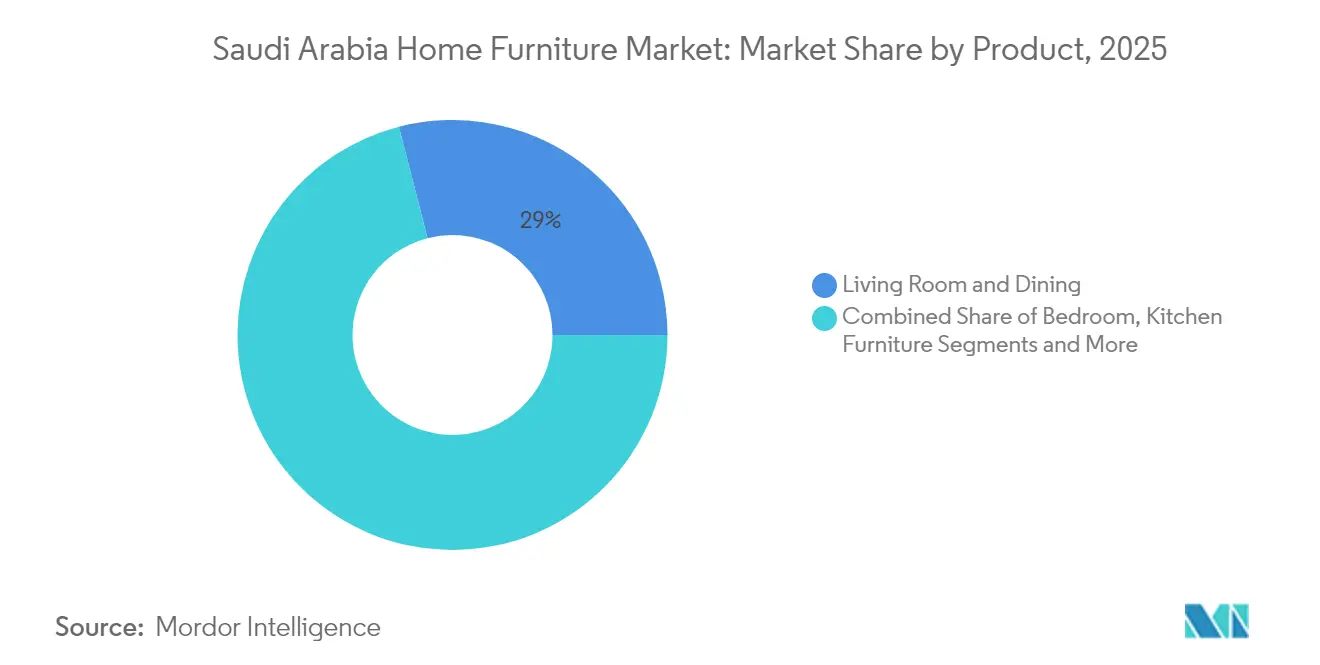
Social Spaces Sustain Largest Slice of DemandLiving Room and Dining Room Furniture retained 29.01% of Saudi Arabia home furniture market share in 2025, anchored by cultural traditions of extended family gatherings. Premium sofas, sectional seating, and carved wood tables dominate villa purchases, while compact apartment layouts in Jeddah spur interest in modular dining sets that double as work desks. Kitchen Furniture is projected to post the highest 6.39% CAGR through 2031, reflecting Vision 2030 standards that promote modern cooking and entertaining spaces. Suppliers such as IKEA have deployed mobile design studios so shoppers in peripheral cities can configure cabinets on-site, accelerating penetration. Bedroom and home-office pieces also advance steadily as hospitality projects and remote-work patterns reorder consumer priorities.
Kitchen Furniture continues to surge because mass-market chains now bundle appliances with cabinetry, making one-invoice packages attractive to new homeowners. Outdoor furniture remains a niche yet fast-emerging segment, with demand rising from resort projects lining the Red Sea coast and municipal greening initiatives that add public seating. Suppliers are experimenting with powder-coated aluminium and weather-proof wicker to counter 120°F summer peaks. Bathroom vanities and storage gain less publicity but underpin replacement cycles whenever households upgrade plumbing fixtures. Together, these categories illustrate the breadth of Saudi Arabia home furniture market requirements.

By Material:
Wood Dominance Faces Climate-Driven SubstitutionWood products represented 66.02% of Saudi Arabia home furniture market size in 2025 thanks to perceived durability, warm aesthetics, and easy customization. Yet supply chains lean heavily on imported oak, beech, and teak because domestic forests are sparse; this reliance magnifies exposure to shipping delays and FX shifts. Plastic and polymer furniture is gaining 5.74% CAGR because UV-stable resins offer longevity on balconies and patios that experience relentless sun exposure. Metal frames appear in commercial offices and hospitality back-of-house areas where strength and hygiene trump visual softness. Engineered wood boards such as MDF support the booming ready-to-assemble niche by reducing weight and freight expense.
Innovations are growing at the junction of sustainability and performance: composite boards infused with recycled plastics now tolerate extreme heat better than raw plywood. Luxury resorts experiment with bamboo and rattan to showcase eco-branding, though these materials remain supply-constrained. Fire-safety regulations embedded in the Saudi Building Code have nudged high-rise developers toward flame-retardant laminates and powder-coated steel. Suppliers that certify products under GREENGUARD or FSC standards secure bidding advantages on government projects that prioritize low-VOC finishes. As sourcing diversifies, transparency about origin and testing becomes a decisive purchase factor for institutional buyers.
By Price Range:
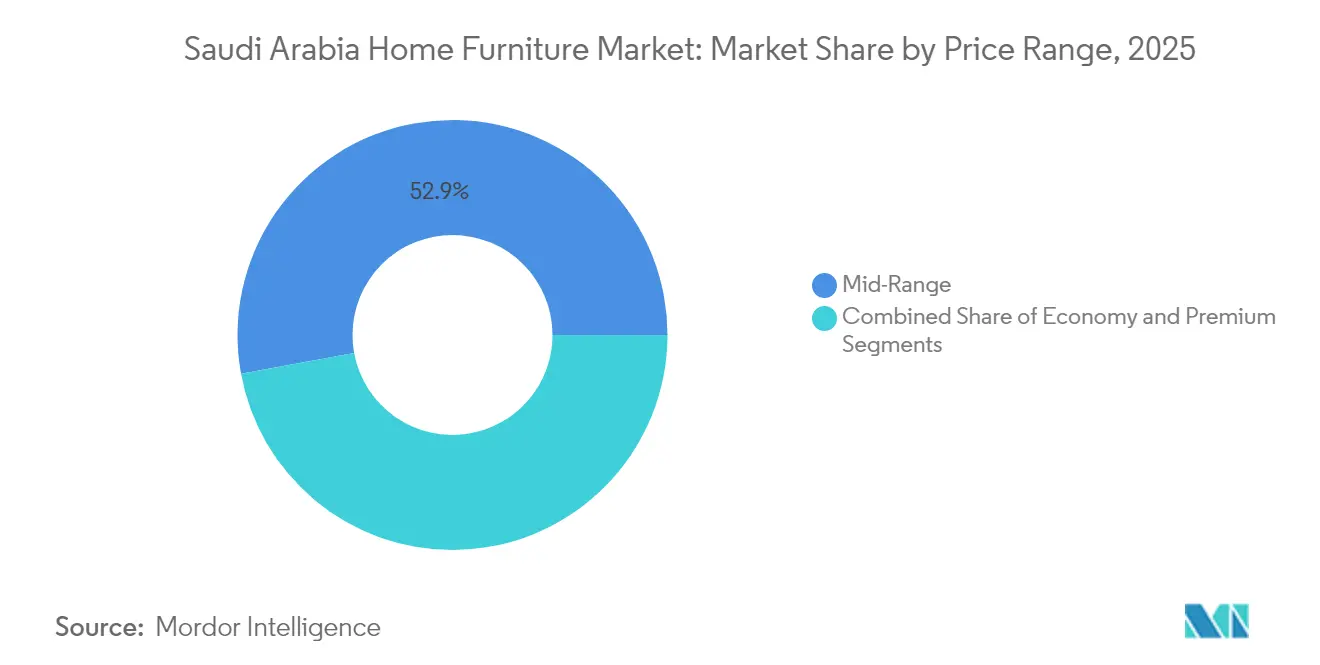
Mid-Market Dominance, Premium UpswingMid-range collections absorbed 52.88% share of Saudi Arabia home furniture market size in 2025, reflecting mainstream budgets backed by subsidized mortgages and government homeowner loans. Retailers position these lines as durable yet affordable, using rubber-wood cores with veneer finishes to balance longevity with price. Premium furniture is expected to grow 6.03% CAGR as wealthy millennials pursue heritage-inspired designs and resort operators commission luxury suites across the Kingdom. At the top end, imported Italian leather sofas and Scandinavian minimalist pieces fetch 30-50% higher margins than mass-produced equivalents. Economy pieces, often flat-packed, retain loyal buyers in student and expatriate segments that value portability.
Financial innovation underpins wider affordability: instalment plans and BNPL services smooth cash-flow, cutting cart abandonment online by up to 15%. Promotional bundles that include delivery, assembly, and extended warranty reduce total cost-of-ownership concerns for cautious households. Growth in co-living and serviced-apartment models pushes landlords toward durable premium SKUs that lower lifecycle costs despite higher initial outlay. Meanwhile, public-sector housing initiatives specify mid-range quality benchmarks to ensure livability without inflating project budgets. The resulting three-tier price ladder sustains healthy inventory turnover across retailer formats.
By Distribution Channel:
Showrooms Refocus as Omnichannel HubsSpecialty furniture stores delivered 44.92% of 2025 sales and continue to anchor discovery, tactile evaluation, and personalized design consultations. Operators now overlay digital appointment scheduling and VR walk-throughs that shorten in-store dwell time while boosting conversion. Online marketplaces are sprinting ahead at 7.05% CAGR and could command one-third of sales by decade-end as mobile checkout becomes frictionless. Home-improvement hypermarkets serve a convenience niche, especially for self-install bookcases, closet systems, and outdoor chairs. Department stores and mass discounters contribute supplementary volume in secondary towns where standalone showrooms are scarce.
Partnerships blur former channel boundaries: Livspace collaborates with big-box retailers so consumers can obtain design, materials, and furniture under one roof. Warehouses adjacent to major highways now double as click-and-collect points, slashing last-mile costs for bulky items. Influencer-led live-shopping events on social media unleash flash sales that liquidate inventory within hours. Saudi Building Code compliance pushes commercial buyers toward distributors that maintain certified documentation on flame-spread ratings and structural loads. As consumer expectations converge around speed, transparency, and service, every channel races to perfect an integrated experience.
Geography Analysis
The Western Region, encompassing Makkah and Madinah, controlled 27.31% of Saudi Arabia home furniture market share in 2025 as religious tourism accelerated hotel construction and apartment refurbishments. Average daily room rates climbed 5% in Madinah, which translated into bulk orders for bedroom suites and lobby seating tailored to rapid guest turnover. The Red Sea Project also stimulates upscale outdoor and marine-grade furnishing demand as beachfront villas break ground. Coastal humidity shapes material choices toward stainless steel and treated hardwoods that resist corrosion. Retailers allocate Ramadan promotions to this region because pilgrim footfall peaks translate into spill-over residential purchases.
The Central Region, led by Riyadh and Qassim, is forecast to post the fastest 6.61% CAGR owing to New Murabba’s 104,000 planned homes and a doubling of Riyadh’s population by 2030. Villa layouts dominate Riyadh, driving sales of large U-shaped sectional sofas and eight-seat dining tables. Qassim benefits from agricultural diversification programs that lift disposable income and retail penetration. Logistics corridors radiating from Riyadh diminish delivery lead-times, supporting same-week installation services demanded by upmarket consumers. Government greening projects that will plant 7.5 million trees also kindle public-space furniture opportunities across parks and boulevards.
Eastern, Southern, and Northern regions combined account for the remaining share but present distinct nuances. Industrial cities in the Eastern Province, such as Dammam, buy durable office furniture for petrochemical and logistics companies, while expatriate compounds opt for modular furnishings that facilitate frequent moves. The Southern highlands of Asir and Jazan are emerging as tourism magnets; IKEA’s 2024 store debuts in Abha and Jazan recorded double-digit first-quarter footfall, evidence of latent demand. NEOM spill-over boosts Tabuk and Al-Jawf, though infrastructure gaps still hinder rapid fulfillment. Climate extremes, dry desert interiors versus humid coasts, require suppliers to segment SKUs carefully by region, reinforcing the complexity but also the resilience of Saudi Arabia home furniture market dynamics.
Value Chain Analysis
The Saudi Arabia home furniture value chain starts with upstream inputs (wood and engineered boards, metals, plastics and polymers, upholstery fabrics and foams, adhesives, finishes, and hardware) supplied through a mix of imports and local distributors. Domestic manufacturing is concentrated in industrial cities and clusters across Riyadh, Dammam (Eastern Province), Al-Kharj, Qassim, Hail, and the Northern Borders, with local producers including Jeraisy Furniture Factory (Riyadh 2nd Industrial City), Matanah Furniture Factory (Al-Kharj), and Almutlaq Furniture (Dammam 1st Industrial City). As the base widens, more producers move into in-house cutting, laminating, coating, and assembly to reduce exposure to import lead-time volatility and quality variation across suppliers.
Midstream logistics and distribution depend on warehousing, trucking, and port-linked clearance for both imported raw materials and finished goods, which then feed specialty furniture stores, home centers, and fast-growing online channels. These routes require bulky-item delivery and installation capability, especially for new-home fit-outs and hospitality projects. National Industrial Development and Logistics Program (NIDLP) initiatives and MODON industrial real estate support help firms localize and scale furniture production capacity. On the logistics side, Ministry of Transport and Logistic Services corridor initiatives and Saudi Ports Authority (Mawani) throughput capacity of over 18.6 million TEUs annually shape cost and service levels for import-dependent categories, while retailers increasingly use stores as fulfillment nodes and click-and-collect points to shorten delivery lead times.
Competitive Landscape
International, regional, and domestic manufacturers shape a moderately concentrated arena in which the top five players hold roughly half the revenue share. IKEA Saudi Arabia, franchised by Alsulaiman Group, retains category leadership after re-configuring showrooms into omnichannel experience centers and applying Lean Management to cut delivery lead-times by 30%. Home Centre, anchored by Landmark Group, intensifies store upgrades featuring digital kiosks and private-label assortment expansions. Pottery Barn leverages Alshaya’s retail muscle to position premium California coastal aesthetics toward affluent Saudis in Riyadh’s Diplomatic Quarter. Local champion Saudi Modern Factory uses SIDF loans to scale capacity for metal office desks and hospitality wardrobes meeting ISO 9001 standards.
Competitive differentiation increasingly hinges on technology. Retailers deploy AR visualization that overlays furniture scale in a customer’s room using a smartphone, reducing product returns and increasing basket size. Inventory algorithms forecast demand surges tied to public-sector salary disbursement dates, allowing dynamic pricing and promotion. Sustainability remains white space; few brands can certify cradle-to-grave traceability, yet Vision 2030 environmental pillars are pushing tenders to add eco-score weightings. Localization provides both shield and sword: the Made in Saudi emblem attracts patriotic shoppers, but meeting local content thresholds can be capital-intensive for smaller importers. Mergers and distribution alliances are expected as firms chase economies of scale and geographic fill-in.
High-profile corporate actions illustrate momentum. Bentley Home inaugurated flagship boutiques in Riyadh and Jeddah in December 2024, signaling confidence in Saudi luxury appetite. Ashley Furniture entered Buraydah the same month, evidencing penetration of secondary cities. Sedar Global Interiors forged alliances with Armani/Casa and Versace Home to supply turnkey packages for Red Sea resorts. Meanwhile, online pure-play Noon.com enhanced its furniture catalogue by onboarding local manufacturers under fulfilled-by-Noon logistics, promising one-day delivery in Riyadh. Collectively, these moves underscore the relentless evolution of Saudi Arabia home furniture market competition.
Saudi Arabia Home Furniture Industry Leaders
-
IKEA Saudi
-
Home Centre
-
Almutlaq Furniture
-
Al-Rugaib Furniture
-
Pottery Barn KSA
- *Disclaimer: Major Players sorted in no particular order
Saudi Arabia Home Furniture Market Companies Covered in this Report
- IKEA Saudi
- Home Centre (Landmark Group)
- Almutlaq Furniture
- Al-Rugaib Furniture
- Pottery Barn (Alshaya)
- Arabian Furniture & Interiors (Abdul Latif Jameel)
- Saudi Modern Factory Co.
- Pan Emirates
- Al-Hufoof Furniture
- Rooms To Go KSA
- B&B Italia Riyadh
- Natuzzi Editions KSA
- IDdesign Saudi
- The One
- Qouse Furniture
- Saudi German Interiors
- Al-Jedaie Office Furniture
- Al-Shati Modern Furniture
- BoConcept KSA
- Al-Mobilya Factory
Market Opportunities and Future Outlook
Vision 2030 is driving large-scale residential delivery and creates a clear opening for suppliers that can bundle end-to-end furnishing packages (design-to-install) for developers and new homeowners. This is especially relevant for kitchens, wardrobes, and full-room sets bought within the first 12 to 18 months of occupancy.
The Housing Program aims for 70% homeownership by 2030, supporting demand for standardized, repeatable furnishing solutions that can be deployed across master-planned communities, including ROSHN-led developments and major urban projects such as New Murabba. This environment favors retailers and manufacturers that combine modular designs with on-site measurement, digital configuration, and dependable installation networks across Riyadh, Jeddah, and expanding secondary cities. Localization and compliance requirements also create room for domestic manufacturing scale and compliant import-to-local assembly models. As of November 2025, Saudi Arabia had 1,298 licensed furniture factories with SAR 13.3 billion in investment and 73,211 employees, suggesting a broader local base for private label production and project tenders. SASO market-access rules, including mandatory registration on the SABER platform and applicable technical regulations such as SASO 2663/2019 for fire-retardant requirements for upholstered wooden furniture, raise the value of certified supply chains and documented materials testing for both imported and locally produced items. Parallel investments in industrial warehousing and production support this shift, including Emirates Stallions Group securing a long-term MODON warehouse agreement (13,000 sq m, operational by Q3 2025) and Saudi Emaar Furniture and Design expanding capacity with a new 34,000 sq m facility using German manufacturing technology and AI-driven planning, which should help tighten replenishment cycles and improve localized customization.
Recent Industry Developments in Saudi Arabia Home Furniture Market
- March 2026: IKEA (via its Saudi franchise operator) communicated a major expansion plan for operations in Riyadh under the Vision 2030 framework. The announcement highlighted a step-up in local footprint and employment intent, reinforcing the strategic role of large-format retailers as omnichannel hubs for big-ticket furniture and home-furnishing demand in the Kingdom.
- May 2025: Emirates Stallions Group, through its Vision Furniture and Decoration Factory subsidiary, signed a 16-year agreement with MODON for 13,000 square meters of warehouse space in Saudi Arabia, targeted to be operational by Q3 2025. The added storage and distribution capacity supports higher service levels for bulky inventory and improves readiness for project-based procurement cycles.
- November 2024: IKEA Alsulaiman opened a store in Madinah, taking its customer meeting points in Saudi Arabia to 11. The added presence in a high-footfall religious tourism region strengthens access to in-person planning and fulfillment for both residential upgrades and hospitality-linked demand.
Saudi Arabia Home Furniture Market Report Scope and Research Methodology
Market Definition and Coverage
For this study, the Saudi Arabia home furniture market covers furniture bought for residential use, across key rooms in the home, and sold through offline and online retail formats in the country.
Scope exclusions: This sizing does not count home decor, furnishings like carpets and curtains, or non-furniture home improvement items.
Segments Covered in This Report
- By Product
- Living Room & Dining Room Furniture
- Bedroom Furniture
- Kitchen Furniture
- Home Office Furniture
- Bathroom Furniture
- Outdoor Furniture
- Other Furniture
- By Material
- Wood
- Metal
- Plastic & Polymer
- Others
- By Price Range
- Economy
- Mid-Range
- Premium
- By Distribution Channel
- Home Centers
- Specialty Furniture Stores (including exclusive brand outlets and local stores from the unorganized sector)
- Online
- Other Distribution Channels (includes hypermarkets, supermarkets, teleshopping, departmental stores, etc.)
- By Geography
- Central Region (Riyadh & Qassim)
- Western Region (Makkah & Madinah)
- Eastern Region (Dammam, Khobar)
- Southern Region (Asir, Jazan, Najran)
- Northern Region (Tabuk, Al-Jawf, Hail)
Data Sources, Market Sizing, and Validation
Desk Research
Desk research was used to set the market boundary, align definitions, and build a clean demand context before the model was finalized. We referenced public data points such as Saudi General Authority for Statistics releases, Saudi Customs trade statistics, World Bank and IMF macro indicators, UN Comtrade product-level flows, and selected peer-reviewed housing and consumer-spend literature where available.
To translate these signals into furniture demand, additional secondary inputs were taken from company annual reports and investor materials, retailer and association websites, and widely cited press coverage on housing programs and retail expansion. Where helpful, we also used paid subscriptions for company financials and intelligence, news and financials, and import-export shipment-level checks to keep the directional trends consistent. The sources listed here are illustrative, and many other public and proprietary references were used to collect data, validate assumptions, and clarify gaps.
Primary Interviews and Surveys
Primary work focused on verifying what is being purchased for homes, how price points are moving, and how channel mix is shifting between modern retail and online. We spoke with manufacturers, distributors, retailers, and material and logistics participants, then cross-checked the view with industry advisors and category managers who see room-wise demand patterns in Saudi Arabia.
Distribution of primary research fieldwork respondents
| Company type | Respondent position |
|---|---|
| Top tier: 31% | CXOs: 12% |
| Mid tier: 47% | Functional/Unit leaders: 33% |
| Smaller Players: 22% | Managers: 55% |
Market-Sizing & Forecasting
The core sizing started from a top-down rebuild of the addressable home-furniture spend pool in Saudi Arabia. We used household formation, housing completions, and replacement cycles to shape the annual demand base. That demand was then converted into value using room-wise purchase intensity and an average selling price logic that reflects product mix and retail discounting patterns.
To keep totals realistic, results were corroborated using selective bottom-up approximations. Examples include sampling channel-level sales splits, checking implied units from imported furniture flows, and sanity-testing category shares across living room, bedroom, dining, and kitchen furniture. Where direct visibility was limited, especially in smaller, unorganized outlets, we handled gaps through conservative share assumptions that were re-checked in interviews.
For forecasting, we ran scenario analysis around housing delivery pace and consumer spending sensitivity, then smoothed year-to-year using recent trend signals. Inputs that mattered most included residential construction handovers, population and household growth, online penetration in furniture retail, promotional intensity affecting realized prices, and import dependence that influences landed costs and final retail pricing.
Data Validation & Update Cycle
Validation was done through stepwise checks so the model stayed tied to observable signals. We compared implied market totals against independent indicators such as household consumption direction, housing activity, import trends for furniture categories, and retailer expansion news, then flagged outliers for a second pass.
If a large variance showed up by room type or channel, we re-contacted sources to confirm whether the move came from a pricing shift, an inventory cycle, or a one-time demand spike. Before sign-off, the work is reviewed across analysts so assumptions and formulas are consistent. The report is refreshed annually, with interim updates when material events change demand or pricing. Right before delivery, a final update pass is completed so clients receive the latest view available.
Mordor Intelligence's Saudi Arabia Home Furniture Market Estimate Compared With Other Published Estimates
Published market numbers for Saudi Arabia home furniture often do not match because the scope line is drawn differently, and because pricing and channel assumptions are handled in different ways. Differences also come from whether the estimate is anchored on household demand signals or is extended from a broader furniture and home furnishing total.
The table shows a noticeable spread for the 2025 value. In Mordor Intelligence's model, the number reflects home furniture only across living room, dining, bedroom, kitchen, and other furniture types, including sales through home centers, flagship stores, specialty stores, online stores, and other channels. This avoids counting decor and adjacent home furnishing items that can inflate totals.
Benchmark comparison
| Source | Market Size | Gaps in Research Methodology |
|---|---|---|
| Mordor Intelligence | USD 5.46 B (2025) | |
| Industry Publisher A | USD 6.60 B (2025) | This figure appears to use a broader interpretation of home furniture and room products, and it can be more sensitive to how bundled categories and materials are counted, which lifts the value versus a furniture-only boundary. |
| Consultancy Brief B | USD 4.76 B (2025) | The lower value is consistent with a narrower counted set, where selected room categories, informal retail, or online-led sales may be underrepresented, and price realization can be assumed more conservatively. |
Across the sources, the main drivers behind the difference are what gets classified as furniture, how channels are treated, and what happens to average selling prices when promotions and mix are considered. By tying the sizing to clear room-wise demand signals, channel coverage, and repeatable price assumptions, the outcome becomes easier to trace and to update when housing activity or retail conditions change.
Key Questions Answered in the Report
What is the current size of the Saudi Arabia home furniture market?
The market is valued at USD 5.76 billion in 2026 and is set to reach USD 7.54 billion by 2031.
Which product category holds the largest share in Saudi Arabia?
Living Room and Dining Room Furniture leads with 29.01% share owing to cultural focus on hospitality spaces.
How fast are online furniture sales growing in the Kingdom?
Online channels are expanding at a 7.05% CAGR, supported by near-universal internet access and BNPL services.
Which region is witnessing the quickest market growth?
The Central Region, anchored by Riyadh, shows the fastest 6.61% CAGR driven by mega-projects like New Murabba.
What is driving premium furniture demand?
Rising disposable income, lifestyle upgrades, and luxury resort developments are pushing premium segment growth at 6.03% CAGR.