
Rum Market Size and Share
Market Overview
| Study Period | 2021 - 2031 |
|---|---|
| Market Size (2026) | USD 37.53 Billion |
| Market Size (2031) | USD 44.49 Billion |
| Growth Rate (2026 - 2031) | 3.46 % |
| Fastest Growing Market | South America |
| Largest Market | Asia Pacific |
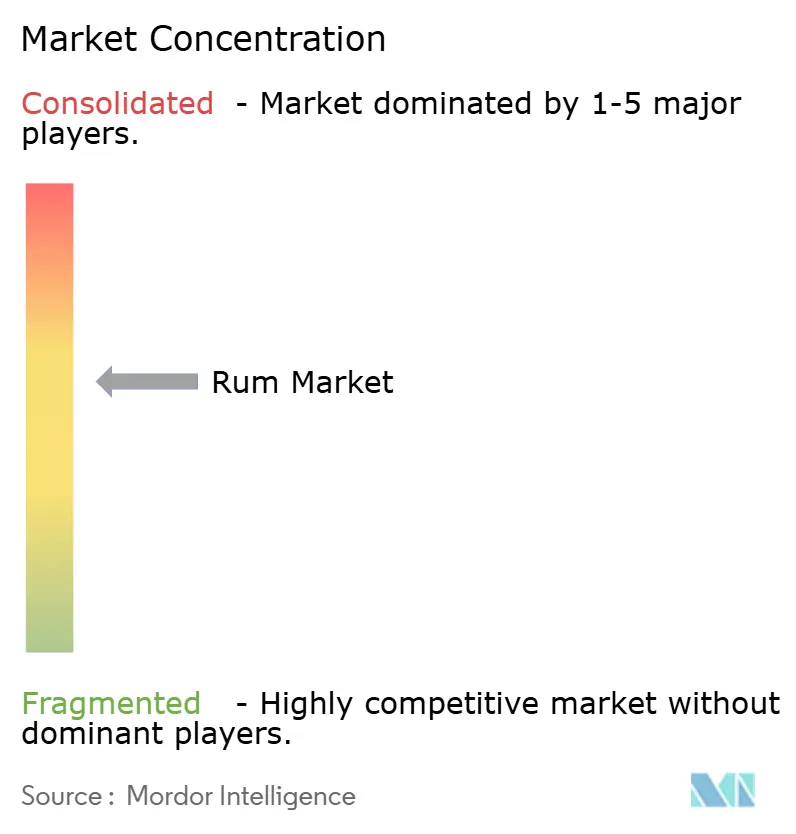
| Market Concentration | Medium |
Major Players *Disclaimer: Major Players sorted in no particular order Image © Mordor Intelligence. Reuse requires attribution under CC BY 4.0. | |
Rum Market Analysis by Mordor Intelligence
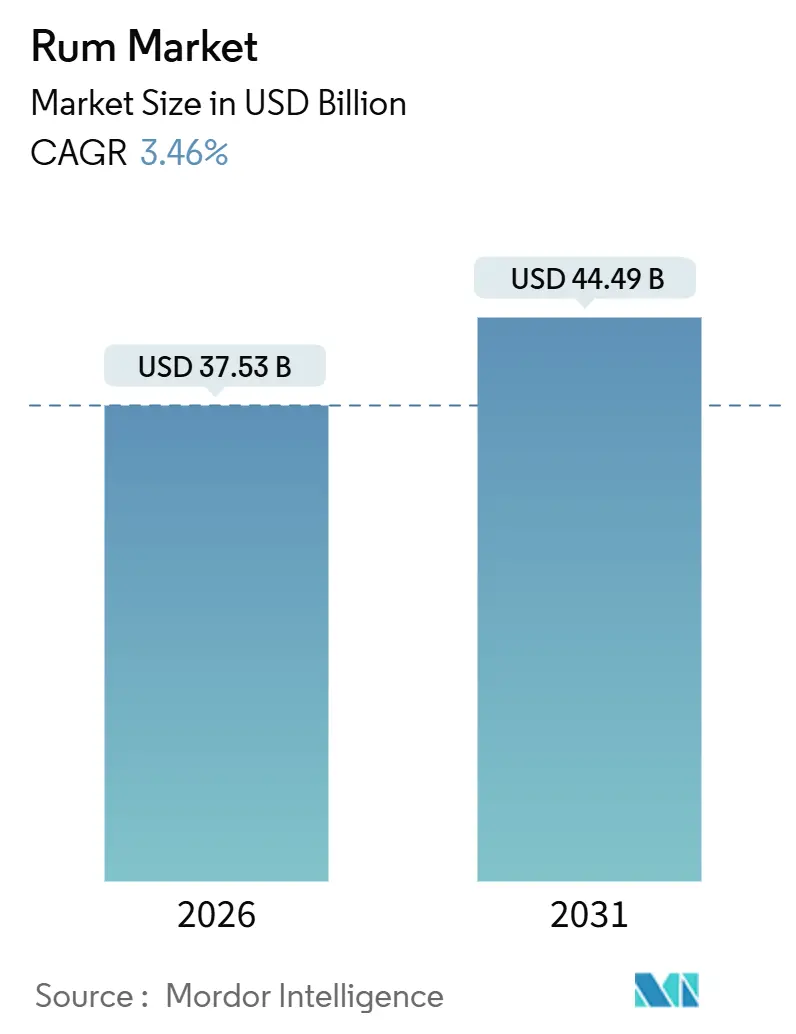
The global rum market size was valued at USD 37.53 billion in 2026 and is projected to grow to USD 44.49 billion by 2031, registering a Compound Annual Growth Rate (CAGR) of 3.46%. The market is witnessing a noticeable shift toward premium and aged rum varieties, driven by distillers adopting advanced maturation techniques traditionally used in whiskey and bourbon production. At the same time, flavor innovations are playing a crucial role in keeping entry-level price tiers appealing to younger consumers. Despite facing regulatory challenges in key consumer markets that are slowing growth, the market benefits from several positive factors. These include the rapid recovery of the on-trade segment, the growing popularity of cocktail culture, and an increasing female consumer base, all of which are helping to offset these challenges. Craft producers are gaining traction by focusing on provenance and providing transparent aging statements, which resonate with consumers seeking authenticity in their purchases. Additionally, multinational brand owners are optimizing their portfolios by reducing low-margin Stock Keeping Units (SKUs) and redirecting investments toward higher-margin acquisitions, signaling a strategic emphasis on super-premium price categories.
Key Report Takeaways
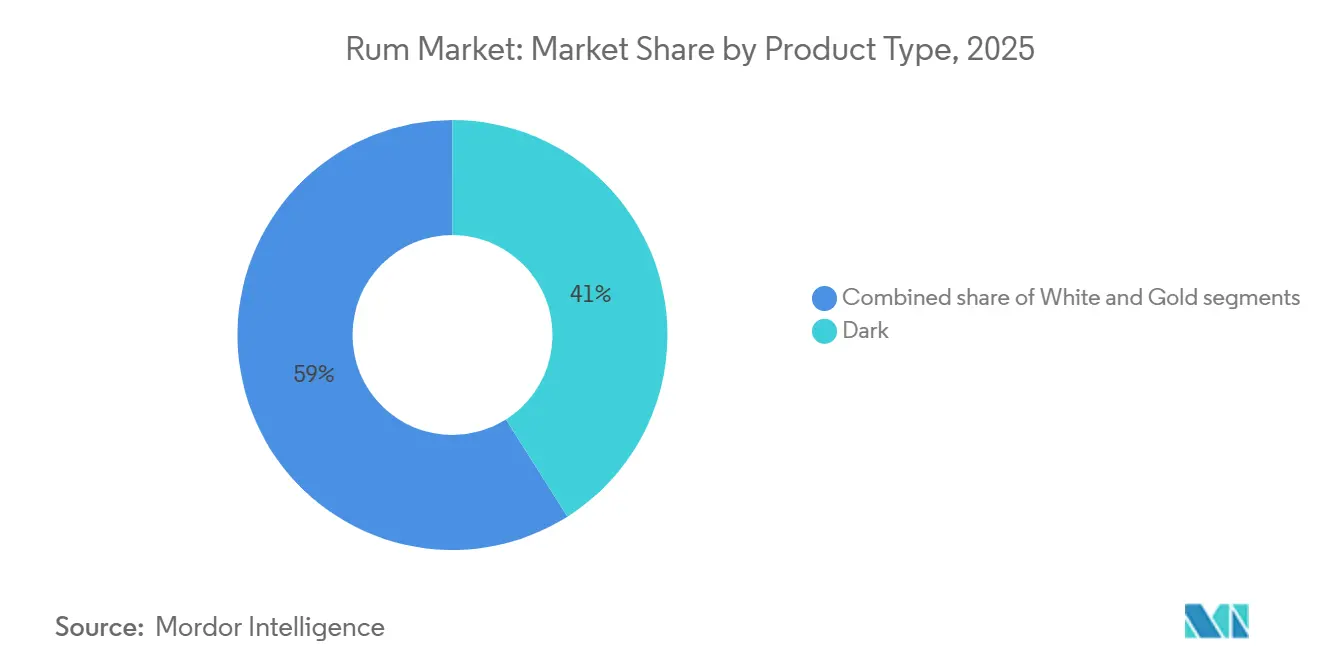
- By product type, dark rum led with 41.02% of global rum market share in 2025; gold rum is forecast to post a 3.81% CAGR to 2031.
- By end user, male consumers represented 61.83% of 2025 demand; the female segment is growing at a 4.13% CAGR to 2031.
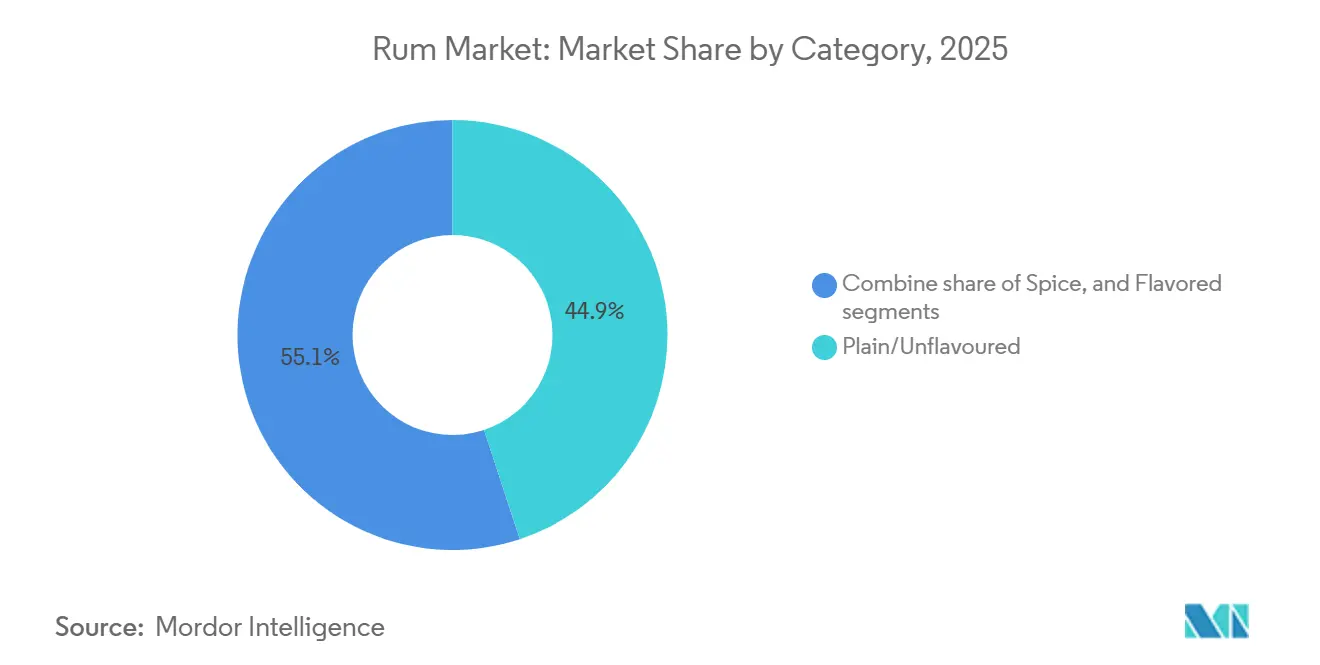
- By category, plain or unflavoured variants held 44.92% of 2025 volume, whereas spiced rum is expanding at a 4.02% CAGR to 2031.
- By distribution channel, the off-trade segment accounted for 77.53% of the global rum market size in 2025, while the on-trade channel is advancing at a 4.92% CAGR through 2031.
- By geography, Asia-Pacific captured 39.11% of 2025 volume; South America is projected to expand at a 4.32% CAGR through 2031.
Note: Market size and forecast figures in this report are generated using Mordor Intelligence’s proprietary estimation framework, updated with the latest available data and insights as of January 2026.
Market Trends and Insights
Drivers Impact Analysis of Rum Market*
| Driver | (~) % Impact on CAGR Forecast | Geographic Relevance | Impact Timeline |
|---|---|---|---|
| Rising premium and aged rum consumption in developed markets | +0.8% | North America and Europe | Long term (≥ 4 years) |
| Growing flavored and spiced rum innovations across major brands | +0.6% | Global, with concentration in North America and Europe | Medium term (2-4 years) |
| Expanding global cocktail and mixology culture in bars and restaurants | +0.7% | Global, led by urban centers in North America, Europe, Asia-Pacific | Medium term (2-4 years) |
| Increasing craft and artisanal rum distilleries worldwide | +0.5% | North America, Europe, South America | Long term (≥ 4 years) |
| Strong brand storytelling around heritage, origin, and authenticity | +0.4% | Global | Long term (≥ 4 years) |
| Product portfolio expansion by large spirits manufacturers | +0.5% | Global | Medium term (2-4 years) |
| Source: Mordor Intelligence | |||
Rising premium and aged rum consumption in developed markets
Consumers in the United States, United Kingdom, and Germany are increasingly moving away from traditional white mixing rums in favor of aged rum expressions priced above USD 40 per 750-milliliter bottle. This shift aligns with a broader premiumization trend, similar to the one observed in the whiskey market approximately a decade ago. A significant example is Diageo Public Limited Company’s acquisition of Don Papa in 2024, a Filipino single-island rum priced about 50 percent higher than standard gold variants, appealing to collectors who value its unique origin and craftsmanship. Retail data shows that aged rums with eight-year or twelve-year age statements now account for approximately 18 percent of spirits-aisle facings in premium liquor stores. This reflects strong consumer interest in barrel-finishing techniques influenced by Scotch whisky and bourbon production methods. Craft distilleries, such as Koloa Rum in Hawaii and Devon Rum Company in the United Kingdom, are also capitalizing on this trend by using locally sourced sugarcane or molasses to justify higher price points and drive additional revenue through on-site tasting rooms. While the premiumization trend is expected to persist as younger, affluent consumers increasingly prioritize quality over quantity, potential economic challenges in 2026 may slow the growth of these high-value purchases.
Growing flavored and spiced rum innovations across major brands
Flavor innovation has become a significant factor in driving volume growth, with brands introducing new variants that combine culinary spices, tropical fruits, and savory notes to differentiate themselves in competitive retail markets. In 2024, Captain Morgan launched Sweet Chili Lime, aiming to attract consumers seeking a combination of heat and citrus complexity in ready-to-drink formats. Similarly, Bacardi expanded its Tropical range in 2025 by adding passionfruit and guava options. Cruzan Rum's flavored portfolio, which includes mango, pineapple, and coconut variants, accounted for 34 percent of the brand's total volume in 2025, demonstrating how flavor extensions can revitalize established trademarks. Spiced rums featuring flavors such as vanilla, cinnamon, and ginger have become particularly popular among mixologists creating seasonal cocktails, as these profiles reduce the need for additional modifiers at the bar. However, maintaining authenticity remains a challenge for brands, as those relying on artificial flavorings risk facing criticism from consumers who increasingly demand natural extracts and transparency in ingredient labeling.
Expanding global cocktail and mixology culture in bars and restaurants
The recovery of on-trade venues, including bars, restaurants, and other alcohol-serving establishments, following the pandemic has strengthened rum's position in the craft cocktail segment. Bartenders are revisiting classic cocktails such as the mojito, daiquiri, and piña colada, while also introducing modern variations that emphasize aged and spiced rum varieties. According to Bacardi’s 2025 Cocktail Trends Report, the mojito ranked as the most-ordered rum cocktail globally, followed by the piña colada and daiquiri. The report further highlighted that 42 percent of bartenders are using innovative culinary ingredients, such as miso, smoked paprika, and fermented honey, to craft unique rum-based beverages. This trend is driving higher per-serve pricing, with premium cocktails featuring aged rum typically priced between USD 16 and USD 22 in major metropolitan bars, compared to USD 8 to USD 12 for standard well-spirit options. Additionally, rum tourism is experiencing growth, with distilleries in Barbados, Jamaica, and Martinique offering guided tasting sessions and barrel-aging workshops that enhance brand engagement and create supplementary revenue streams. The compound annual growth rate (CAGR) of 4.92 percent for the on-trade channel reflects this upward trend, although challenges such as workforce shortages and rising ingredient costs continue to impact bar operations.
Increasing craft and artisanal rum distilleries worldwide
Craft rum production has grown beyond its traditional Caribbean origins, with new distilleries emerging in the United States, Europe, and South America. These producers are setting themselves apart through transparent sourcing practices, small-batch aging, and direct-to-consumer business models, which resonate with consumers looking for authenticity and local provenance. Companies such as Newport Craft Brewing in Rhode Island and Middle West Spirits in Ohio have made significant investments in pot-still facilities and barrel-aging warehouses. Their goal is to attract a premium segment of consumers who associate higher quality with locally crafted products. In Colombia, distilleries like Dictador, La Hechicera, and Ron Santísima Trinidad are reviving traditional recipes and enhancing their offerings by aging rum in former bourbon and sherry casks, directly challenging the dominance of Caribbean imports. Favorable regulatory frameworks in certain regions further support this growth. For instance, the Alcohol Wholesaler Registration Scheme in the United Kingdom requires supply chain traceability but does not restrict production scale, allowing micro-distilleries to compete effectively in retail and hospitality channels. However, the segment also faces challenges such as potential market fragmentation, as the increasing variety of products may lead retailers to streamline their offerings and prioritize brands with stronger distribution networks.
Restraints Impact Analysis of Rum Market*
| Restraint | (~) % Impact on CAGR Forecast | Geographic Relevance | Impact Timeline |
|---|---|---|---|
| Stringent alcohol advertising and promotion restrictions in many countries | -0.5% | Europe, Asia-Pacific, Middle East and Africa | Long term (≥ 4 years) |
| High excise duties and complex alcohol taxation structures | -0.6% | Global, with acute impact in Europe and Asia-Pacific | Medium term (2-4 years) |
| Negative health perceptions around high-strength spirits consumption | -0.4% | Global, led by developed markets in North America and Europe | Long term (≥ 4 years) |
| Supply chain disruptions affecting packaging and logistics reliability | -0.3% | Global | Short term (≤ 2 years) |
| Source: Mordor Intelligence | |||
Stringent alcohol advertising and promotion restrictions in many countries
Regulatory frameworks for alcohol marketing have become more stringent across various jurisdictions, limiting brands' ability to engage with consumers through digital, broadcast, and point-of-sale channels. In Ireland, the Public Health (Alcohol) Act 2018 requires health warnings on labels, restricts advertising near schools and public transport, and prohibits sponsorship of sporting events. These measures have led rum brands to redirect marketing budgets toward trade partnerships and experiential activations [1]Source: Irish Revenue Commissioner, “Excise Duty rates,” revenue.ie. Thailand enforces one of the strictest alcohol advertising regulations globally, banning all broadcast and print promotions and mandating that health warnings cover 30 percent of label space. This significantly hampers brand-building efforts in a market where rum competes with locally produced spirits [2]Source: World Health Organization, “Mental Health, Brain Health and Substance Use,” who.int. In India, direct alcohol advertising is prohibited, pushing brands to rely on surrogate campaigns promoting music festivals, glassware, or mineral water under the same trademark. This approach dilutes brand messaging and complicates attribution. These restrictions disproportionately affect new entrants and craft distilleries, which often lack the resources to invest in alternative marketing channels. As a result, established multinational brands with extensive trade relationships continue to maintain a competitive advantage.
High excise duties and complex alcohol taxation structures
Excise taxation continues to be the most significant cost burden for rum producers and distributors, as the rates vary considerably across different markets and are often subject to sudden increases. These abrupt changes can compress profit margins and discourage long-term investments in the industry. In recent years, countries such as the United Kingdom and Ireland have made adjustments to their duties on spirits, which has influenced pricing strategies and affected retail competitiveness. In India, the Goods and Services Tax (GST) framework, combined with substantial state-level excise duties, has resulted in locally produced rum becoming significantly more expensive for consumers. Similarly, in Australia, the periodic indexing of excise duties to inflation has further reduced affordability for mid-segment consumers [3]Source: Australian Taxation Office, “Excise duty rates for alcohol,” ato.gov.au. These evolving tax policies across various jurisdictions have increased the complexity of compliance for multinational rum producers. Companies are required to manage diverse rate structures, handle regulatory filings, and meet audit requirements across multiple international markets, adding to the operational challenges they face.
*Our forecasts treat driver/restraint impacts as directional, not additive. The impact forecasts reflect baseline growth, mix effects, and variable interactions.
Rum Market Segment Analysis
By Product Type:
Aged Expressions Drive PremiumizationGold rum is projected to grow at a compound annual growth rate (CAGR) of 3.81% through 2031, marking the fastest growth rate among all product types. This growth is primarily driven by producers adopting barrel-finishing techniques and emphasizing age-statement marketing to appeal to consumers who are transitioning from white mixing rums to more premium options. Dark rum, which accounted for 41.02% of the 2025 volume, is strongly supported by Caribbean heritage brands such as Angostura, Mount Gay, and Appleton Estate. These brands focus on traditional pot-still distillation methods and extended aging processes in ex-bourbon casks, which enhance the flavor profile and premium positioning of their products.
White rum, which has traditionally been the foundation for high-volume cocktails like mojitos and daiquiris, is facing increasing margin pressures. This is due to bars and restaurants shifting their focus toward premium offerings that can justify higher per-drink pricing. In line with this trend, Diageo's decision in 2024 to divest Pampero and Cacique, two brands heavily focused on white rum, reflects a strategic move away from low-margin segments. Instead, the company is prioritizing aged rum portfolios that deliver higher gross profit per case, aligning with the growing consumer demand for premium and aged spirits.



By End User:
Female Segment Reshapes Marketing and Product DevelopmentThe female consumer segment is projected to grow at a compound annual growth rate (CAGR) of 4.13% through 2031, representing the fastest growth rate among end-user categories. This expansion is being driven by brands actively reformulating their products, redesigning packaging, and utilizing social media campaigns to challenge the traditionally masculine image associated with rum. Historically, rum has been linked to naval heritage, Caribbean culture, and high-proof sipping traditions, which have contributed to its strong appeal among male consumers. In 2025, men accounted for 61.83% of the total volume, reflecting this longstanding association.
However, this dominance is gradually diminishing as brands increasingly recognize the revenue potential of female consumers. Women in this segment tend to prioritize attributes such as flavor variety, lower alcohol by volume (ABV), and aesthetically pleasing packaging. To cater to these preferences, brands have introduced products like Captain Morgan's Sweet Chili Lime and Bacardi's Tropical range, launched in 2024 and 2025 respectively. These offerings feature pastel-colored packaging, fruit-forward flavor profiles, and sub-30% ABV formulations, providing an approachable entry point for female drinkers into the rum category.
By Category:
Spiced Variants Capture Mixology MomentumSpiced rum is projected to grow at a compound annual growth rate (CAGR) of 4.02% through 2031, surpassing the growth of plain or unflavored variants, which accounted for 44.92% of the 2025 volume. This growth is primarily driven by the preferences of bartenders and home consumers who are looking for more complex flavor profiles without the higher cost and time commitment associated with aged rum expressions. Spiced rum formulations commonly include ingredients such as vanilla, cinnamon, nutmeg, and ginger. These botanicals are layered onto white or gold rum bases to create versatile spirits that are well-suited for mixing. These products not only enhance classic cocktails but also support seasonal menu rotations, making them a popular choice in both professional and home settings. Captain Morgan Spiced, the leading brand in this category, held an estimated 28% share of global spiced rum volume in 2025. The brand's success can be attributed to its widespread distribution network, consistent flavor profiles, and competitive promotional pricing strategies, which have helped it maintain a dominant position on retail shelves.
Flavored rum, which includes fruit-infused options such as coconut, pineapple, mango, and passionfruit, appeals to consumers who prioritize sweetness and tropical flavor associations over the traditional characteristics of rum. Cruzan's flavored rum portfolio, which features 12 distinct variants, represented a significant portion of the brand's 2025 volume. This diverse range of offerings enables retailers to provide variety to their customers without requiring excessive shelf space for individual stock-keeping units (SKUs). This approach allows retailers to cater to a broader range of consumer preferences while optimizing their inventory management.
By Distribution Channel:
On-Trade Rebound Signals Experiential ShiftOn-trade venues are expected to grow at a compound annual growth rate (CAGR) of 4.92% through 2031, marking the fastest growth among distribution channels. This growth is driven by bars, restaurants, and hotels reclaiming market share lost during pandemic-related closures. These establishments are focusing on creating experiential formats to enhance customer engagement and justify premium pricing. Off-trade channels accounted for 77.53% of the 2025 volume, reflecting consumers' established habit of purchasing spirits from retail stores for home consumption. However, this dominance is gradually declining as younger consumers increasingly prioritize social experiences and craft cocktails over traditional at-home mixing. Within the off-trade segment, specialty liquor stores stand out by offering knowledgeable staff, curated product selections, and tasting events that replicate the engagement typically found in on-trade venues. In contrast, other off-trade channels, such as supermarkets and convenience stores, primarily compete by focusing on price and promotional strategies.
The recovery of on-trade channels is particularly evident in urban areas, where cocktail bars, rum-focused speakeasies, and tiki lounges have expanded significantly since 2024. These venues provide consumers with multi-sensory experiences that combine craft cocktails, live music, and immersive décor, creating a unique and engaging atmosphere. Bacardi's 2025 Cocktail Trends Report highlights that experiential cocktails, which incorporate elements such as smoke, fire, or tableside preparation, are the fastest-growing serve format in premium on-trade establishments. Rum-based cocktails account for 38% of this category, underscoring their substantial role in driving this trend.
Geography Analysis
APAC Rum Market
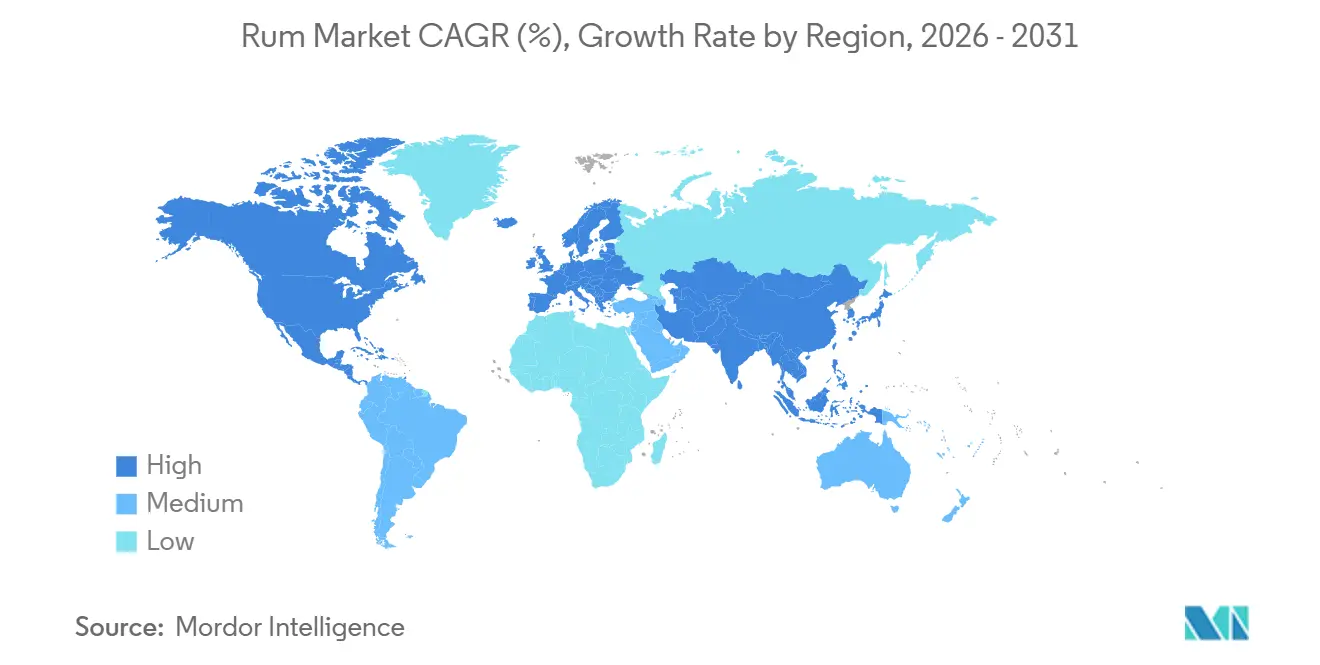
In 2025, the Asia-Pacific region accounted for 39.11% of the market volume, making it the largest regional segment. This leadership is driven by the Philippines, where Tanduay Distillers produces over 20 million cases annually and dominates domestic consumption through competitive pricing and extensive retail distribution. India represents the second-largest market in the region, with McDowell's No.1 Rum holding an estimated 40% market share despite regulatory challenges that require separate state-level registrations and excise filings. In China, the rum market remains underdeveloped due to consumer preferences for baijiu and whiskey. However, premiumization trends and the growing adoption of cocktail culture in tier-1 cities such as Shanghai and Beijing are creating opportunities for Caribbean and craft rum brands. Indonesia and Thailand face regulatory challenges, including strict advertising restrictions and high excise duties, which limit market growth and favor locally produced spirits.
South America Rum Market
South America is projected to grow at a compound annual growth rate (CAGR) of 4.32% through 2031, making it the fastest-growing regional segment. This growth is fueled by Colombia's craft rum resurgence and Brazil's gradual shift from cachaça to premium aged imports. In Colombia, heritage distilleries such as Dictador, La Hechicera, and Ron Santísima Trinidad are revitalizing traditional recipes, aging rums in ex-bourbon and ex-sherry casks, and exporting to North America and Europe at competitive price points against Caribbean brands. In Brazil, the rum market is constrained by cachaça's cultural dominance and regulatory protections. However, urban consumers in cities like São Paulo and Rio de Janeiro are increasingly embracing imported rums as symbols of sophistication and global connectivity.
North America and EMEA Rum Market
North America, Europe, and the Middle East and Africa collectively account for the remaining market share, with each region showcasing distinct growth drivers and competitive dynamics. The United States is the largest single-country market, where craft distilleries in states like Hawaii, Rhode Island, and Ohio are challenging Caribbean imports by emphasizing local provenance and transparent aging practices. In Canada, provincial liquor-control boards influence the market by limiting distribution and enforcing minimum pricing, though premiumization trends align with those observed in the United States. In Mexico, rum competes with tequila and mezcal for consumer spending, with coastal resort areas driving on-trade consumption through all-inclusive hotel packages and beach-bar offerings. In Europe, the largest markets include the United Kingdom, Germany, Spain, and France, which exhibit mature demand profiles with growth concentrated in premium aged rums and craft innovations. The United Kingdom's Alcohol Wholesaler Registration Scheme enforces traceability requirements that benefit established brands with strong compliance infrastructure, while craft distilleries such as Devon Rum Company have successfully navigated these regulations to access retail and on-trade channels. The Middle East and Africa face regulatory and cultural barriers, with alcohol sales restricted or prohibited in several countries. However, South Africa, the United Arab Emirates, and Turkey represent pockets of demand where expatriate communities and tourism drive consumption.

Regulatory Landscape
Rum is regulated primarily through spirits standards of identity, labeling rules, and excise regimes that vary by market and can shape product formulation and the claims brands can make. In the United States, the Alcohol and Tobacco Tax and Trade Bureau (TTB) enforces 27 CFR Part 5, including formula and label approvals, and allows limited use of flavoring and blending materials within defined thresholds. This framework affects how flavored and spiced rum innovations are brought to market.
In Europe, Regulation (EU) 2019/787 sets common definitions for spirits and provides a legal framework for protecting registered Geographical Indications (GIs), supporting origin-led premiumization. In the Caribbean, standards and GIs matter for export competitiveness: the CARICOM Regional Organisation for Standards and Quality (CROSQ) has been reviewing a revision to the CRS 25:2008 rum standard as of June 2025 to strengthen authenticity and origin requirements. Country frameworks such as the Jamaican Rum GI administered by JACRA and Saint Lucia Bureau of Standards requirements (SLNS 12:2003) also specify production and labeling parameters that brands must meet for compliant domestic sales and export shipments.
Value Chain Analysis
The rum value chain spans sugarcane cultivation and molasses production, fermentation and distillation (industrial column still and artisanal pot still), maturation in oak, blending and filtration, packaging (notably glass), and route-to-market via on-trade and off-trade distribution. As premium and aged categories expand, barrel supply, warehousing, and quality assurance become more central, while flavored and spiced variants add sourcing and formulation steps that must still align with local standards of identity and label approvals.
Operationally, large brand owners and associations are tightening supply-chain expectations around sustainability and resilience, which feeds into requirements for upstream suppliers and logistics partners. Diageo published a Climate Transition Plan in March 2026 that targets emissions reductions across its operations and value chain, and Pernod Ricard issued 2026 climate and nature policies aligned to a 1.5C pathway and no-deforestation commitments for agricultural and wood-based packaging sourcing. In the Caribbean export ecosystem, WIRSPA highlighted producer engagement with international supplier companies at TechCon 2026 (May 2026) around resource optimization, packaging, and energy topics, underscoring that equipment providers, glass manufacturers, and freight partners are increasingly intertwined with rum producers' strategy rather than being treated as back-end cost inputs.
Competitive Landscape
The Global Rum Market is moderately concentrated, with major players such as Diageo plc, Pernod Ricard SA, Beam Suntory, Inc., and Davide Campari-Milano N.V. leading prominent brands. Meanwhile, regional producers and craft distilleries are capitalizing on opportunities to target niche segments. Strategic developments reveal a dual approach: multinational companies are divesting low-margin white rum brands while acquiring super-premium assets to diversify and strengthen their portfolios. Craft producers are focusing on local provenance, transparent aging methods, and direct-to-consumer strategies to expand their market presence in developed regions. For instance, Diageo plc's 2024 sale of Pampero and Cacique, followed by its acquisition of Don Papa, underscores its shift from commodity segments to premium brands with higher gross profit margins per case. Similarly, Davide Campari-Milano N.V.'s USD 1.32 billion acquisition of Courvoisier in 2024 demonstrates its strategy to integrate rum and cognac expertise, potentially incorporating barrel-finishing techniques and luxury positioning into its rum portfolio.
New opportunities are emerging in three key areas: low-alcohol-by-volume (ABV) ready-to-drink (RTD) products targeting health-conscious consumers, aged rums with transparent provenance claims competing with whiskey, and sustainability-focused brands utilizing recycled packaging and carbon-neutral production methods. Craft distilleries such as Foursquare in Barbados and Newport Craft Brewing in Rhode Island are taking advantage of these trends by launching single-barrel expressions, offering distillery tours, and engaging consumers through social media platforms.
Although technology adoption in the rum market is limited compared to other spirits categories, some brands are using blockchain for supply chain traceability, augmented reality for label storytelling, and e-commerce platforms for direct sales. Regulatory frameworks, such as the United Kingdom's Alcohol Wholesaler Registration Scheme, which requires digital record-keeping and audit trails, are encouraging smaller players to invest in compliance software and cloud-based inventory systems. Emerging disruptors include Colombian craft distilleries blending traditional recipes with modern marketing strategies, Filipino producers expanding exports beyond domestic markets, and European micro-distilleries targeting premium on-trade accounts with limited-edition releases.
Rum Industry Leaders
Diageo plc
Pernod Ricard SA
Beam Suntory Inc.
Campari Group
Tanduay Distillers Inc.
- *Disclaimer: Major Players sorted in no particular order
Rum Market Companies Covered in this Report
- Diageo plc
- Pernod Ricard SA
- Beam Suntory Inc.
- Campari Group
- Tanduay Distillers Inc.
- Destilería Serrallés
- Demerara Distillers Ltd.
- William Grant & Sons Ltd.
- Brown-Forman Corp.
- Mount Gay Distilleries Ltd.
- Foursquare Rum Distillery
- Angostura Holdings Ltd.
- St. Lucia Distillers
- Pusser’s Rum Ltd.
- Cayman Spirits Co.
- Worthy Park Estate
- Admiral Rodney Rum
- Mohan Meakin Ltd.
- Asahi Group Holdings Ltd.
- Proximo Spirits

Market Opportunities and Future Outlook
Premiumization and authenticity-led positioning create space for producers that can substantiate origin and production claims through enforceable standards and traceability. EU GI protection under Regulation (EU) 2019/787 and established origin frameworks such as the Jamaican Rum GI administered by JACRA support higher-value storytelling and on-trade menu placement, while the CROSQ review of the CARICOM CRS 25:2008 rum standard (under review as of June 2025) points to ongoing tightening around definitions and labeling. For compliant Caribbean exports, that regulatory direction can help differentiate against more generic rum offerings.
Technology and sustainability programs are also becoming more visible opportunity areas along the rum value chain, especially where producers face high utility costs and packaging scrutiny. At TechCon 2026 (May 18-22, 2026, Trinidad and Tobago), WIRSPA and participating suppliers emphasized automation, water management, energy optimization, and AI-enabled distillery systems for monitoring, predictive maintenance, and quality assurance. In parallel, major spirits groups are formalizing supplier collaboration and decarbonization requirements, including Diageo's climate planning in 2026, which is pushing investments into compliant packaging, logistics efficiency, and data-enabled quality systems that can support consistent production at scale while retaining premium cues such as age statements and provenance.
Recent Industry Developments in Rum Market
- July 2026: Diageo plc (Zacapa) launched a limited-edition collaboration kit with Brazilian fashion house PatBo to celebrate Zacapa's 50th anniversary. The collaboration expands premium positioning and widens distribution through fashion-partner co-branding; it could uplift cross-segment visibility and on-premise activation.
- April 2026: Crossfire Hurricane Rum Brand relaunch announced with a refreshed liquid, new development team, and redesigned packaging. The relaunch refreshes perception and market momentum; potential uplift in distribution and retailer interest.
- April 2026: Mount Gay (Rémy Cointreau) launched Bajan Spiced, a 35% ABV rum-based spirit drink, expanding into the spiced segment. Diversifies portfolio into higher-velocity sub-segment; potential cross-sell to existing rum consumers.


Rum Market Report Scope and Research Methodology
Market Definition and Coverage
For this methodology, the rum market covers legally defined rum sold for beverage use through on-trade and off-trade channels, measured as market value at the selling price level tracked in our model.
Scope exclusions: We exclude molasses and sugarcane inputs, non-rum spirits, and unrecorded informal alcohol where there is no consistent pricing and volume signal to anchor the estimate.
Segments Covered in This Report
- By Product Type
- White
- Gold
- Dark
- By End User
- Men
- Women
- By Category
- Plain/Unflavoured
- Flavored
- Spiced
- By Distribution Channel
- On-Trade
- Off-Trade
- Specialty/Liquor Stores
- Others Off-Trade Channels
- By Geography
- North America
- United States
- Canada
- Mexico
- Rest of North America
- Europe
- Germany
- United Kingdom
- Italy
- France
- Spain
- Netherlands
- Poland
- Belgium
- Sweden
- Rest of Europe
- Asia-Pacific
- China
- India
- Japan
- Australia
- Indonesia
- South Korea
- Thailand
- Rest of Asia-Pacific
- South America
- Brazil
- Argentina
- Colombia
- Chile
- Peru
- Rest of South America
- Middle East and Africa
- South Africa
- Saudi Arabia
- United Arab Emirates
- Turkey
- Rest of Middle East and Africa
- North America
Data Sources, Market Sizing, and Validation
Desk Research
Desk work starts by mapping the rum demand pool and the supply and trade flows that can explain it, before modeling assumptions are locked. For this, we rely on public datasets and technical definitions that keep product boundaries clear, such as customs and trade series (UN Comtrade), agriculture and commodities context (FAO), and country alcohol statistics and methods (WHO).
To ground the model in real selling patterns, we also review alcohol category releases from official bodies and associations, including government excise and revenue agencies, national statistics offices, and distilled-spirits associations where available. We then cross-check with company filings, annual reports, and investor presentations that describe portfolio mix and channel exposure. Patent databases are used selectively to understand new flavoring or process themes that can affect premiumization, and an import-and-export shipment-level paid database is referenced to sanity check major trade routes and unit value movements. The sources listed here are illustrative, and other public documents and databases were also used for data collection, validation, and clarification.
Primary Interviews and Surveys
Primary interviews and surveys are used to convert broad alcohol indicators into rum-specific inputs, especially where public reporting combines rum with wider spirits categories. We spoke with participants across production, distribution, and retail, then validated assumptions on pricing ladders, flavored and spiced mix, and on-trade recovery patterns across major consuming regions.
Where desk data showed gaps, for example weak visibility on discounting and pack-size shifts, we rechecked the ranges with managers and functional leaders who track day-to-day execution. We then aligned final assumptions with the most consistent signals across countries.
Distribution of primary research fieldwork respondents
| Company type | Respondent position | Region |
|---|---|---|
| Top tier: 29% | CXOs: 13% | APAC: 47% |
| Mid tier: 52% | Functional/Unit leaders: 35% | EMEA: 35% |
| Smaller Players: 19% | Managers: 52% | Americas: 18% |
Market-Sizing & Forecasting
Sizing starts with a top-down build where spirits and alcohol consumption indicators, plus trade and excise context, are converted into a rum demand pool by geography, then split into on-trade and off-trade. After that structure is set, we corroborate results with selective bottom-up approximations, such as sampled price points by channel, distributor and retailer checks on mix, and supplier roll-ups when financial disclosures allow it.
Key model inputs include rum volumes (liters) by market where available, on-trade reopening and tourism trends that change bar and restaurant throughput, the flavored and spiced share that shifts average prices, premiumization signals (trading up within rum), and currency and inflation effects that move value even when volumes are steady. When a country has limited direct rum reporting, we fill gaps using proxy splits from similar markets, then adjust after interview validation.
For forecasting, we use scenario analysis around a base case that reflects expected volume growth and price progression, then test alternative cases for duty changes, channel mix shifts, and faster premiumization. The final time series is kept consistent with the study period and is rechecked so volume and value move in a realistic relationship.
Data Validation & Update Cycle
Outputs are checked through multiple layers. First, we validate that implied per-liter values align with realistic price bands by channel. We then check that country totals reconcile with known trade direction and alcohol category signals. Variances that look too large are investigated, and the model is rerun after correcting scope alignment, unit conversions, and any outlier assumptions.
Before sign-off, the work is reviewed by another analyst who challenges key drivers, including mix, pricing, and regional splits. Reports are refreshed annually, with interim updates when material events occur, and a final pre-delivery pass is done so clients receive the latest updated view.
Mordor Intelligence's Rum Market Size Versus Other Published Estimates
Published market sizes for rum often diverge because sources do not always use the same counted value point. Some models lean more heavily on shipments, others on retail spend, and some cover only part of the channel mix. Differences also come from how flavored and spiced rum are treated, and from whether volumes are converted to value using stable price ladders or broader averages.
A frequent driver is channel definition. Some estimates rely on off-trade scan data and miss on-trade turnover, while others apply retail price assumptions that can inflate totals in high-tax markets. The table also reflects refresh timing, since price progression and currency timing can move value quickly, and scope choices like whether non-beverage rum uses are included can shift the headline number. These scope and conversion choices are handled with a defined channel split and liter-to-value checks that are refreshed with the latest available inputs, which is why the 2026 figure lands at USD 37.53 B (2026) for Mordor Intelligence.
Benchmark comparison
| Source | Market Size | Gaps in Research Methodology |
|---|---|---|
| Mordor Intelligence | USD 37.53 B (2026) | |
| Industry Association A | USD 32.10 B (2026) | Often reflects a narrower recorded-sales view that leans on member reporting and undercounts on-trade value in travel-heavy markets, which lowers the total. |
| Trade Journal B | USD 41.80 B (2026) | Typically blends rum with adjacent cane-based spirits and applies broad retail price averages, which can push value up in high-duty countries. |
Overall, the spread is mainly explained by channel coverage and how liters are converted into value across geographies. By keeping the scope limited to beverage rum, separating on-trade from off-trade, and cross-checking implied prices against real market signals, the estimate stays easier to trace and to reproduce when assumptions are updated.


Key Questions Answered in the Report
What is the current value of the global rum market?
The global rum market size stood at USD 37.53 billion in 2026.
How fast is the premium rum segment growing?
Gold and aged expressions are advancing at a 3.81% CAGR through 2031.
Which region is expanding most rapidly?
South America leads with a projected 4.32% CAGR to 2031.
How large is the female consumer base for rum?
Women accounted for roughly 38% of 2025 demand and are growing at a 4.13% CAGR through 2031.
What share does dark rum command?
Dark rum held 41.02% of global rum market share in 2025.
Page last updated on:


 Your data is secure and never sold or shared.


