
Roofing Market Size and Share
Market Overview
| Study Period | 2020 - 2031 |
|---|---|
| Market Size (2026) | USD 179.65 Billion |
| Market Size (2031) | USD 231.90 Billion |
| Growth Rate (2026 - 2031) | 5.24 % |
| Fastest Growing Market | Asia-Pacific |
| Largest Market | Asia-Pacific |
| Market Concentration | Low |
Major Players *Disclaimer: Major Players sorted in no particular order Image © Mordor Intelligence. Reuse requires attribution under CC BY 4.0. | |
Roofing Market Analysis by Mordor Intelligence
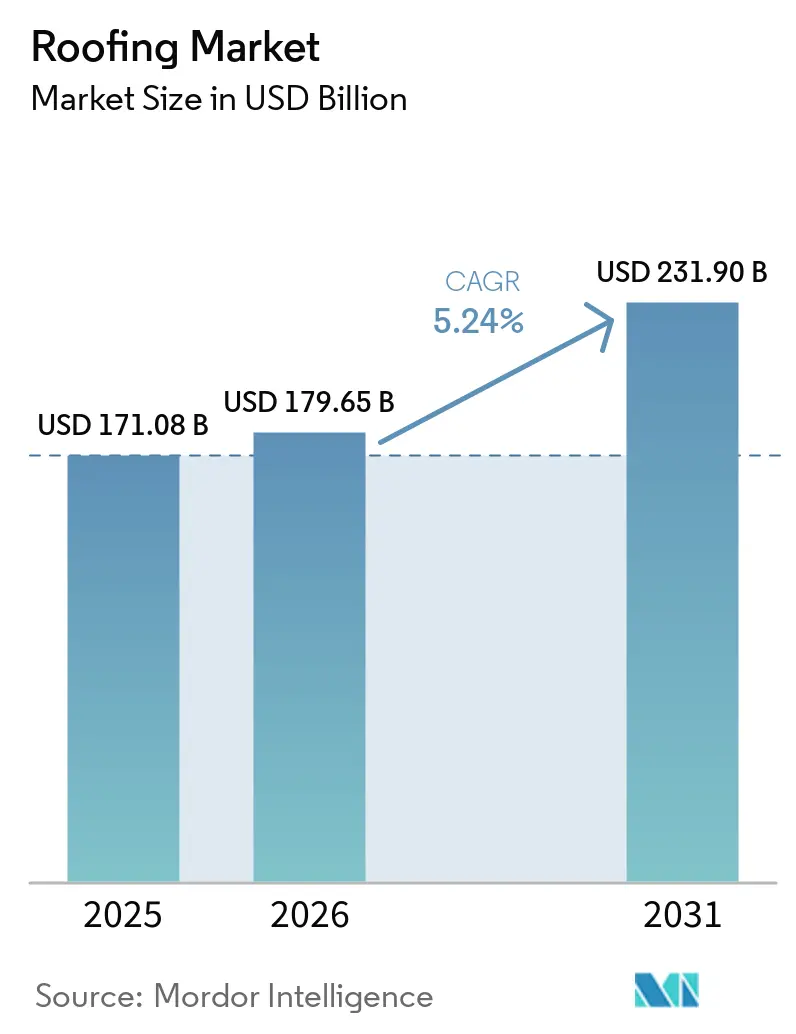
The Roofing Market size is expected to grow from USD 171.08 billion in 2025 to USD 179.65 billion in 2026 and is forecast to reach USD 231.90 billion by 2031 at 5.24% CAGR over 2026-2031. The roofing market is supported by various demand streams that are now moving at different paces, one tied to replacement needs in mature building stock and the other tied to new construction in faster-growing economies. In developed markets, older residential and commercial roofs are approaching the end of life, making replacement less discretionary and less sensitive to housing cycles. Building rules are also becoming stricter in major regions, which is pushing more building owners toward reflective, insulated, green, and higher-performance roof systems for compliance and operating cost reasons. At the same time, weather-related damage is raising reroofing demand in North America, while industrial and infrastructure construction in the Asia-Pacific and the Middle East is keeping the new-build pipeline active. Competition in the roofing market is also shifting, as distribution and service platforms are consolidating faster than manufacturing, raising purchasing leverage for large intermediaries. At the same time, raw-material inflation and labor shortages continue to pressure margins and execution capacity.
Key Report Takeaways
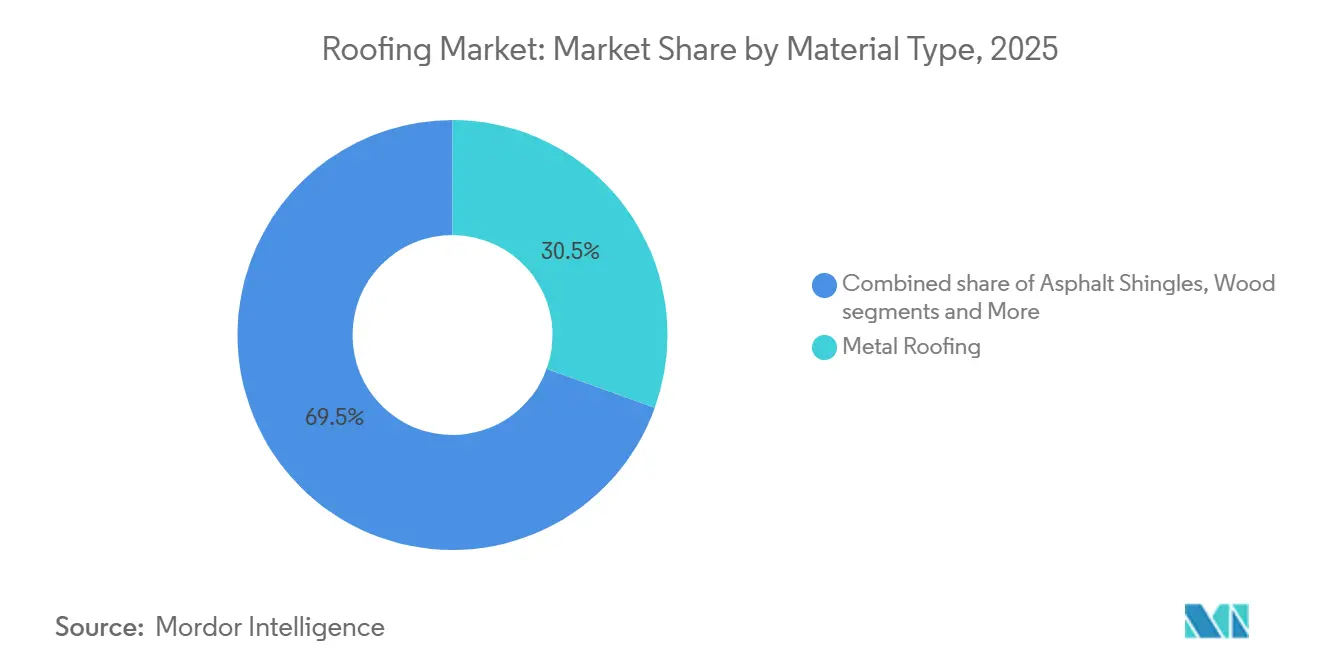
- By material type, metal roofing held 30.5% of the roofing market share in 2025, while single-ply membranes are forecast to expand at a 6.71% CAGR through 2031.
- By construction type, new construction accounted for 60% of the roofing market size in 2025, while reroofing and replacement are advancing at a 6.08% CAGR through 2031.
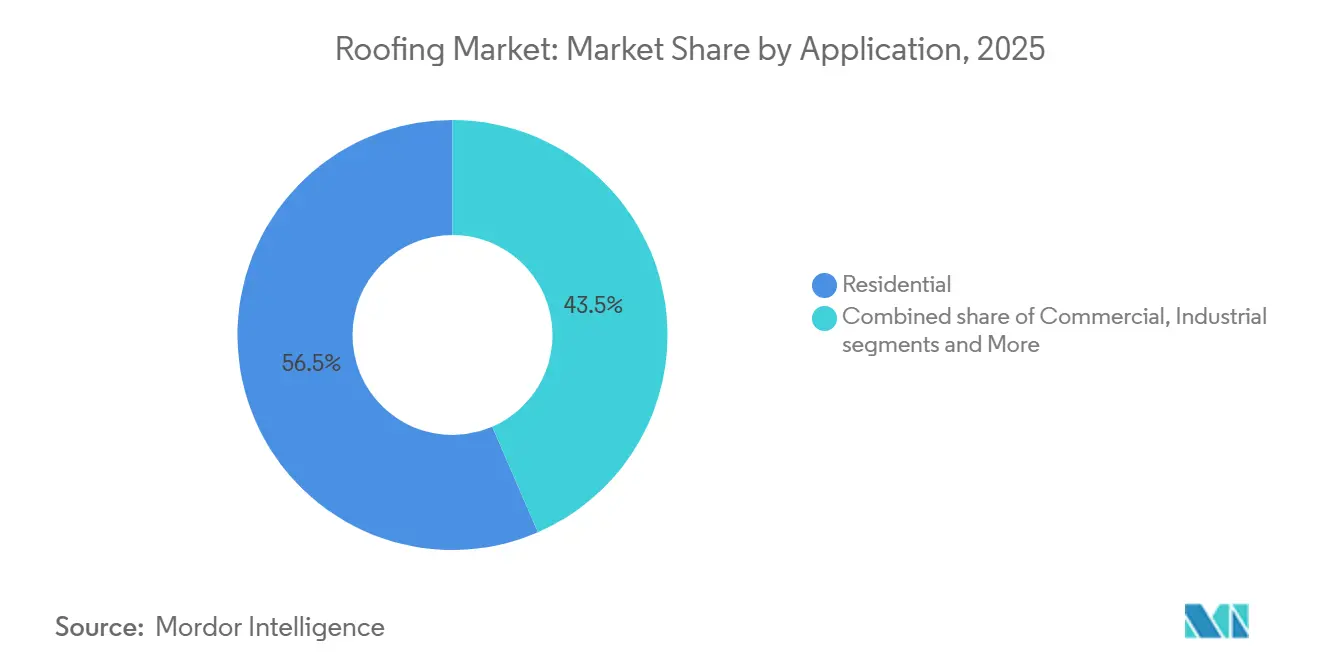
- By application, residential roofing accounted for 56.5% of the roofing market size in 2025, while industrial roofing recorded the highest projected CAGR at 7.02% through 2031.
- By geography, Asia-Pacific held 33.5% of the roofing market share in 2025 and is projected to grow at a 6.34% CAGR through 2031.
Note: Market size and forecast figures in this report are generated using Mordor Intelligence’s proprietary estimation framework, updated with the latest available data and insights as of 2026.
Market Trends and Insights
Drivers Impact Analysis of Roofing Market*
| Drivers | (~) % Impact on CAGR Forecast | Geographic Relevance | Impact Timeline |
|---|---|---|---|
| Aging building stock and reroofing cycles | +1.2% | North America, Europe, and core Asia-Pacific | Short term (≤ 2 years) |
| Asia and the Middle East construction pipeline expansion | +1.1% | Asia-Pacific, Middle East & Africa | Medium term (2-4 years) |
| Energy codes lifting cool and green roof demand | +0.9% | North America, Europe, Asia-Pacific | Medium term (2-4 years) |
| Severe-weather resilience favors premium systems | +0.8% | North America, South & Southeast Asia, Middle East & Africa | Short term (≤ 2 years) |
| Insurer preference for impact-rated and documented roofs | +0.5% | North America, Europe | Medium term (2-4 years) |
| Artificial intelligence and drone workflows are accelerating the roof replacement conversion | +0.3% | North America, Europe, Australia | Long term (≥ 4 years) |
| Source: Mordor Intelligence | |||
Aging Building Stock and Reroofing Cycles
Aging roof stock remains one of the clearest supports for the roofing market, especially in North America and Europe, where large construction cohorts are now well into later life stages. In the United States, 29% of homes with asphalt shingles had less than 4 years of remaining roof life in 2024, and 38% of residential roofs were already in moderate to poor condition. Roofs in that weaker condition group also incurred materially higher insurance loss costs, making it harder to defer replacement decisions once damage starts to accumulate. The same pattern is visible in the commercial base, where roofs installed during the early 2000s building cycle are now moving beyond intended service lives and creating a multi-year reroofing queue. This keeps the roofing market supported even when broader construction sentiment weakens, because deteriorating roofs turn into necessary repair or replacement spending rather than optional renovation activity.
Asia and Middle East Construction Pipeline Expansion
The roofing market is also benefiting from the scale of industrial, infrastructure, and institutional construction underway across Asia-Pacific and the Middle East. India remained one of the strongest construction growth markets in 2025, and Saudi Arabia continued to push forward with transport, energy, housing, and event-led development programs that keep roofing demand broad across project types. The United Arab Emirates also maintained a large infrastructure pipeline in Abu Dhabi, which supports roof demand across commercial, public, and industrial assets. This matters for the roofing market because many of these projects favor large-format systems such as metal roofing and single-ply membranes that suit warehouses, logistics buildings, factories, and other low-slope or wide-span facilities. The result is not only higher volume growth in these regions, but also a product mix that increasingly favors performance-driven materials instead of traditional residential formats.
Energy Codes Lifting Cool and Green Roof Demand
Energy-code tightening is creating a strong compliance-based demand layer in the roofing market that is less dependent on voluntary adoption. California’s 2025 Building Energy Efficiency Standards, effective January 1, 2026, require minimum solar reflectance and thermal emittance levels for non-residential low-slope roofs, which directly affect commercial reroofing specifications in the state[1]. Germany also continued to move roof upgrades into a more regulated framework, and the country’s green roof base reached 200 million square meters with a long-term annual average growth rate of 7.6%[2]. Similar regulatory pressure is also evident in New York City, France, and parts of Germany, where insulation, solar integration, and roof-performance requirements are becoming increasingly difficult to avoid in both new-build and alteration work. This lifts the roofing market because compliance now supports demand for reflective membranes, green roof assemblies, better insulation packages, and more documented system performance across several major roofing jurisdictions.
Severe-Weather Resilience Favoring Premium Systems
Weather resilience is becoming a stronger buying factor in the roofing market as insurers, contractors, and building owners place more weight on damage prevention and documented performance. Severe wind, hail, and flood events continued to raise repair burdens in the United States, and federal support after the 2024 hurricane season also highlighted the scale of damage costs tied to roof failure and envelope weakness. Research from the Insurance Institute for Business & Home Safety found that homes built or retrofitted to the FORTIFIED Roof standard experienced much lower insurer losses during Hurricane Sally, providing contractors and owners with a clearer financial case for higher-grade roof systems. That change matters because premium systems such as impact-rated shingles and metal roofing no longer compete only on durability claims; they also compete on insurance outcomes and loss reduction. As a result, the roofing market is seeing more demand shift from basic replacement toward resilience-led upgrades in storm-prone areas.
Restraints Impact Analysis of Roofing Market*
| Restraints | (~) % Impact on CAGR Forecast | Geographic Relevance | Impact Timeline |
|---|---|---|---|
| Raw material and installed-cost inflation | -0.6% | Global | Short term (≤ 2 years) |
| Skilled-labor shortages and installation bottlenecks | -0.5% | North America, Europe, Australia | Medium term (2-4 years) |
| Limited asphalt-shingle recycling infrastructure | -0.2% | North America, Europe | Long term (≥ 4 years) |
| Insurance and certification documentation burden | -0.2% | North America, Europe | Medium term (2-4 years) |
| Source: Mordor Intelligence | |||
Raw-Material and Installed-Cost Inflation
Cost inflation remains a clear brake on the roofing market because material and installed prices have not normalized across major roofing inputs. In the United States, the Producer Price Index for Asphalt Paving and Roofing Materials Manufacturing rose from 365.240 in December 2025 to 377.951 in March 2026, showing continued cost pressure in asphalt, polymer-based inputs, and related roofing materials[3]. Roofing materials also led annual cost increases among tracked construction categories in the United States, while combined labor and material rates rose over the last reported period. These increase pressure margins for contractors and manufacturers and force developers and owners to simplify specifications or delay non-urgent replacement work. In the roofing market, the effect is not a collapse in demand but a slower pace of conversion, where project feasibility, system choice, and replacement timing become more price-sensitive.
Skilled-Labor Shortages and Installation Bottlenecks
Labor availability is another important constraint for the roofing market, as demand does not translate into revenue unless qualified installers are available. In the 2025 workforce survey from the Associated General Contractors of America and the National Center for Construction Education and Research, 92% of construction firms reported difficulty hiring, and many also tied labor shortages directly to project delays. The Home Builders Institute also estimated a significant annual cost burden from skilled labor shortages in single-family construction, underscoring how workforce gaps are already affecting output and carrying costs across the broader building ecosystem. Roofing faces an added challenge: a significant share of its current workforce is nearing retirement, while demand for roofing professionals continues to rise. This leaves the roofing market exposed to scheduling delays, higher wages, and uneven installation capacity even in periods when end demand stays firm.
*Our forecasts treat driver/restraint impacts as directional, not additive. The impact forecasts reflect baseline growth, mix effects, and variable interactions.
Roofing Market Segment Analysis
By Material Type:
Metal Anchors Value, Membranes Add the Fastest GrowthMetal roofing held 30.5% of the roofing market in 2025, making it the largest material category by value. That lead reflects its broad use across industrial buildings, commercial assets, agricultural structures, and higher-end residential applications where durability and long service life matter. Metal systems also fit well with storm-prone markets, helping sustain their position in North America and parts of Asia, where weather exposure is shaping buying behavior. In the roofing market, this category benefits from a cross-sector role because it is not dependent on a single building type or region. The material also aligns with growing owner interest in better life-cycle performance, which supports steady specification across both developed and emerging markets.
Single-ply membranes are the fastest-growing material segment in the roofing market and are projected to expand at a 6.71% CAGR from 2026 to 2031. Their rise is linked to commercial and industrial low-slope roofing, where energy-code compliance, quick installation, and performance consistency are increasingly important. Thermoplastic polyolefin, ethylene-propylene-diene monomer, and polyvinyl chloride systems continue to gain traction because reflective membrane surfaces can help lower roof temperatures and support cooling efficiency goals. This trend is reinforced by commercial reroofing activity, where building owners often prefer lighter systems that work with existing decks and reduce installation disruption. Asphalt shingles still dominate large parts of the North American residential market due to cost and familiarity. At the same time, clay and concrete tiles remain relevant in Europe, Latin America, and South Asia. Still, the faster mix shift is moving toward membranes and metal in the parts of the roofing industry tied to compliance-heavy and performance-led projects.



By Construction Type:
New Build Holds the Base, Replacement Lifts MomentumNew construction accounted for 60% of the roofing market in 2025, underscoring the continued weight of greenfield building activity in total demand. This share was supported by residential expansion, commercial development, and infrastructure-linked building programs in the Asia-Pacific, the Middle East, and parts of North America. The category remains important because every large housing, industrial, or public building pipeline creates direct roofing volume from the outset. In the roofing market, new build still offers scale, especially as urbanization, manufacturing investment, and public spending are driving project starts across multiple end uses. That said, the quality of demand is increasingly tied to the type of assets being built, with industrial and logistics projects tending to favor higher-value roofing systems.
Reroofing and replacement is the faster-moving construction type and is forecast to grow at a 6.08% CAGR through 2031. This segment is gaining strength because roof failure, aging materials, and compliance-driven upgrades are creating a steadier demand floor in mature building markets. Replacement work also tends to favor lighter, faster-to-install systems, which support single-ply membranes and metal panels over heavier legacy formats. Private capital has taken notice of that predictability, and consolidation among service platforms reflects a view that recurring building-stock work can be more stable than exposure to the construction cycle. For the roofing market, this means growth is gradually shifting toward service intensity, installed replacement expertise, and certification-backed upgrade work rather than relying only on the volume swings of new construction. The roofing industry is therefore becoming less tied to housing-start volatility and more tied to the practical condition of existing roofs.
By Application:
Residential Leads Scale, Industrial Adds the Fastest ExpansionResidential roofing accounted for 56.5% of the roofing market in 2025, making it the largest application segment by a wide margin. That position comes from the depth of the world’s housing stock and the simple fact that residential reroofing needs accumulate continuously as homes age. In many developed markets, the residential base is now split between cost-sensitive replacement demand and premium upgrade demand tied to resilience, insurance savings, and longer-life systems. This split is important in the roofing market because it creates room for both commodity products and higher-value offerings within the same broad application class. It also explains why residential demand remains large even when new-home activity is uneven, since replacement and storm repair keep work flowing through the installed base.
Industrial roofing is the fastest-growing application and is projected to rise at a 7.02% CAGR from 2026 to 2031. Warehouses, logistics hubs, data centers, and manufacturing facilities are expanding across Asia-Pacific and the Gulf Cooperation Council, driving demand for large-format, low-slope roof systems that prioritize speed, energy performance, and long-term operational reliability. Those projects tend to favor metal panels and single-ply membranes, which, over time, structurally improve the product mix of the roofing market. Commercial and institutional buildings remain important secondary demand pools, especially where urban development and public projects continue, but industrial projects are setting the pace for premium specification growth. In the United States, resilience incentives also support residential upgrades, because impact-resistant and certified roof systems can improve the value case for higher-performance products in hail- and storm-exposed states. The roofing industry is therefore seeing its fastest application growth in asset classes that reward standardized performance and wide-span coverage rather than simple unit volume alone.

Geography Analysis
APAC Roofing Market
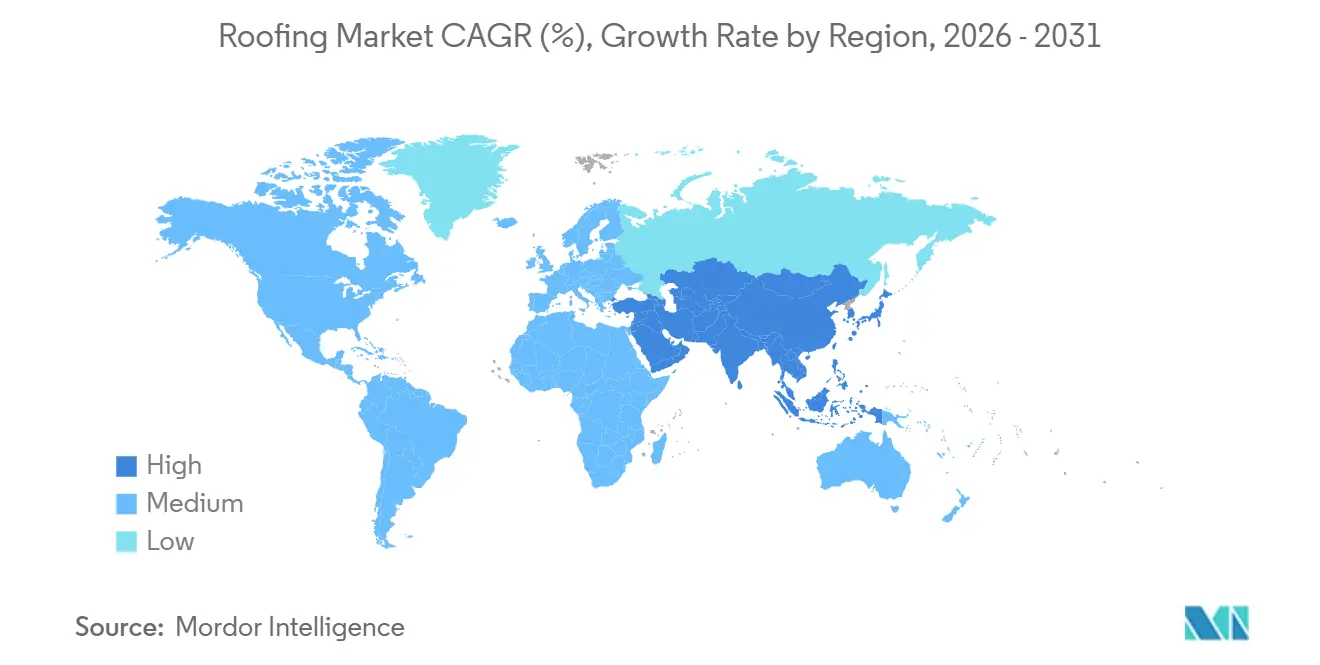
Asia-Pacific accounted for 33.5% of the roofing market in 2025 and is also the fastest-growing region, with a projected CAGR of 6.34% from 2026 to 2031. This dual position reflects both the size of its existing building base and the persistence of new construction across residential, commercial, industrial, and infrastructure projects. China remains important for great commercial and infrastructure roofing demand even as residential conditions are more mixed. India is adding momentum through industrial development, affordable housing, and public spending tied to a large infrastructure allocation, which keeps project flow broad across end uses. Japan and South Korea have different demand profiles, with greater emphasis on retrofit, resilience upgrades, and facility investment. At the same time, Australia continues to favor higher-performance metal and membrane systems in a stable construction setting.
North America and Europe Roofing Market
North America and Europe form the next major demand cluster in the roofing market, but the drivers are more replacement-led than greenfield-led. In North America, aging roof stock, weather-related claims, and insurance-linked specification changes are making reroofing demand more durable than simple housing-start data would suggest. This is especially visible in the United States, where end-of-life roof cohorts and stronger wind and hail loss patterns are keeping replacement volumes firm. Europe is being shaped more by regulatory compliance, as roof insulation, energy performance, and renovation requirements are pushing owners toward systematic upgrades in both residential and commercial stock. Germany remains one of the clearest examples, with the roofing trade sector generating USD 14.9 billion in 2025 and installation prices still moving higher.
MEA and South America Roofing Market
South America, the Middle East, and Africa add smaller but faster-growing pockets of demand to the roofing market. Brazil remains central in South America through metropolitan construction and affordable housing activity that supports both tile and metal roof volumes. In the Middle East and Africa, Saudi Arabia and the United Arab Emirates are the main growth engines, as large infrastructure, housing, and industrial programs continue to drive project flow across new assets. Nigeria and South Africa add residential and light-commercial demand, where metal roofing sheets remain common because they are practical, familiar, and relatively easy to install. Across these emerging regions, the roofing market is gaining from a mix of urbanization, public investment, and product choices that increasingly favor scalable systems for fast project delivery.
Competitive Landscape
Market Concentration
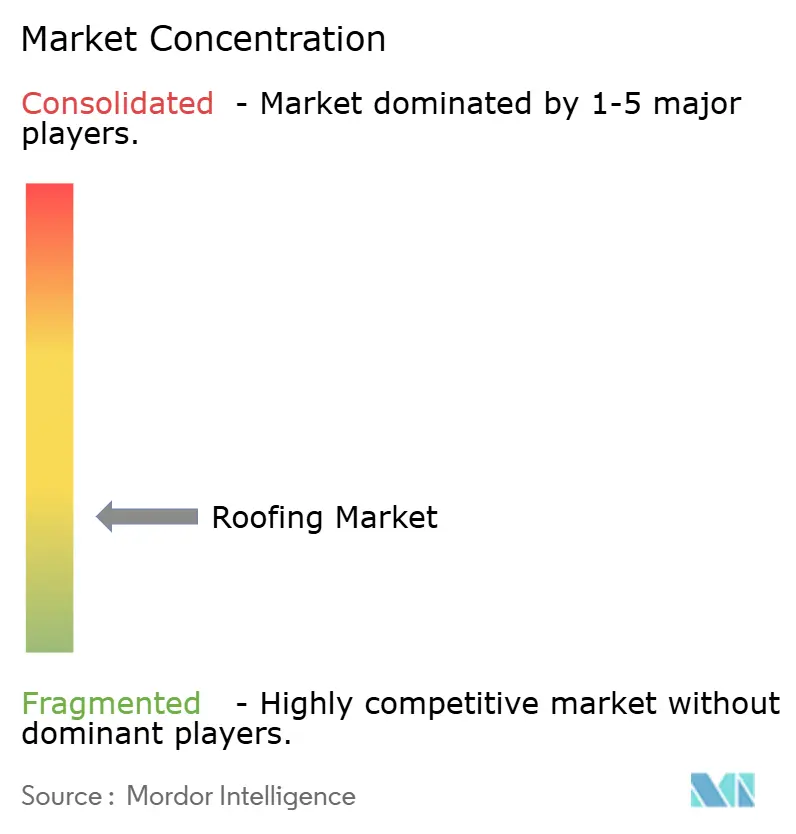
The roofing market remains moderately fragmented at the manufacturing level, even as competitive pressure is intensifying in selected channels and geographies. Standard Industries, through GAF and BMI Group, continues to hold a strong position across North American residential roofing and European flat and pitched roofing, providing broad exposure to both replacement- and specification-driven demand. Sika also kept expanding its roofing and building-envelope footprint through acquisitions and new facilities in 2025, indicating a deliberate push to broaden its reach before demand fully matures in several regions. These moves matter because scale in product breadth, regional presence, and contractor relationships can improve access to specification work and faster-growing roof categories. The roofing market is therefore not dominated by one manufacturer, but it clearly favors companies that can pair a product range with geographic reach and operational discipline.
The most important structural shift is happening in distribution and services, where consolidation has moved faster than in materials manufacturing. QXO’s acquisition of Beacon Roofing Supply in 2025 and its April 2026 agreement to acquire TopBuild created a much larger North American platform with more than 1,100 locations and over USD 18 billion in annual revenue. That scale can increase purchasing leverage with suppliers and raise barriers for smaller manufacturers that still depend on fragmented independent channels. It also gives large distributors more influence over contractor relationships, stocking decisions, and product visibility. In the roofing market, this means channel power is becoming a more important competitive variable alongside product quality and brand recognition.
A second competitive theme is the push into recycling, digital inspection, and certification-backed differentiation. Owens Corning’s pilot shingle recycling facility in Indianapolis shows how large manufacturers are responding to pressure on waste and sustainability with closed-loop initiatives that may become more important if regulations tighten. At the same time, inspection platforms that combine drone capture and artificial intelligence are improving defect detection and helping contractors convert more roofs into documented replacement projects, thereby expanding addressable demand without waiting for major storm events. Certification systems such as FORTIFIED Roof, Energy Star cool roof labeling, and Underwriters Laboratories 2218 impact ratings are also providing contractors with stronger ways to justify premium systems on insurance, durability, and energy performance grounds. The competitive outcome in the roofing market is a gradual move away from pure price competition toward documented performance, service execution, and channel control. The roofing market is also seeing more value captured by companies that can integrate products, contractor education, and compliance support into a single offering.
Roofing Industry Leaders
-
Standard Industries
-
BMI Group
-
Owens Corning
-
Holcim
-
Carlisle Companies
- *Disclaimer: Major Players sorted in no particular order
Roofing Market Companies Covered in this Report
- Standard Industries
- BMI Group
- Owens Corning
- Holcim
- Carlisle Companies
- Saint-Gobain
- SOPREMA Group
- Sika AG
- Johns Manville
- IKO Industries
- TAMKO Building Products
- Atlas Roofing
- Duro-Last
- Malarkey Roofing Products
- Wienerberger AG
- Etex Group
- TechnoNICOL Corporation
- Eagle Roofing Products
- JSW Steel
- BlueScope Steel
Recent Industry Developments in Roofing Market
- May 2026: Roofing Corp. of America acquired Schefers Roofing Co., a commercial roofing contractor based in Lee's Summit, Missouri, marking its 16th acquisition since founding in December 2020 and expanding its Midwest presence following a USD 413 million investment from FirstService Corporation.
- April 2026: QXO announced a definitive agreement to acquire TopBuild Corp. for USD 17 billion, creating a combined entity with over USD 18 billion in annual revenue and more than 1,100 locations across the United States and Canada. This is QXO's third major acquisition, following the USD 11 billion Beacon Roofing Supply deal in 2025 and the USD 2.25 billion Kodiak Building Partners acquisition in 2026, which have formed North America's second-largest publicly traded building products distributor.
- March 2025: Sika AG simultaneously acquired Cromar Building Products in the United Kingdom and Elmich Pte Ltd in Singapore, as part of Sika's seven-acquisition program for the year, strengthening its roofing and green roof portfolios in Europe and Asia-Pacific, respectively.
Global Roofing Market Report Scope
Segmentation Overview
| Asphalt Shingles |
| Clay & Concrete Tiles |
| Metal Roofing |
| Bituminous / Modified Bitumen Membranes |
| Single-Ply Membranes (TPO, EPDM, and PVC) |
| Wood |
| Others |
| New Construction |
| Reroofing and Replacement |
| Residential |
| Commercial |
| Industrial |
| Institutional |
| Others |
| North America | United States |
| Canada | |
| Mexico | |
| Europe | Germany |
| United Kingdom | |
| France | |
| Italy | |
| Spain | |
| Rest of Europe | |
| Asia-Pacific | China |
| India | |
| Japan | |
| South Korea | |
| Australia | |
| Rest of Asia-Pacific | |
| South America | Brazil |
| Argentina | |
| Chile | |
| Rest of South America | |
| Middle East & Africa | United Arab Emirates |
| Saudi Arabia | |
| South Africa | |
| Nigeria | |
| Rest of Middle East & Africa |
| By Material Type | Asphalt Shingles | |
| Clay & Concrete Tiles | ||
| Metal Roofing | ||
| Bituminous / Modified Bitumen Membranes | ||
| Single-Ply Membranes (TPO, EPDM, and PVC) | ||
| Wood | ||
| Others | ||
| By Construction Type | New Construction | |
| Reroofing and Replacement | ||
| By Application | Residential | |
| Commercial | ||
| Industrial | ||
| Institutional | ||
| Others | ||
| By Region | North America | United States |
| Canada | ||
| Mexico | ||
| Europe | Germany | |
| United Kingdom | ||
| France | ||
| Italy | ||
| Spain | ||
| Rest of Europe | ||
| Asia-Pacific | China | |
| India | ||
| Japan | ||
| South Korea | ||
| Australia | ||
| Rest of Asia-Pacific | ||
| South America | Brazil | |
| Argentina | ||
| Chile | ||
| Rest of South America | ||
| Middle East & Africa | United Arab Emirates | |
| Saudi Arabia | ||
| South Africa | ||
| Nigeria | ||
| Rest of Middle East & Africa | ||
Key Questions Answered in the Report
What is driving growth in roofing worldwide through 2031?
Growth is being supported by replacement demand in aging building stock, stricter energy codes, weather-related reroofing, and industrial construction expansion. The sector is projected to rise from USD 179.7 billion in 2026 to USD 231.9 billion by 2031 at a 5.24% CAGR.
Which material category currently leads roofing demand?
Metal roofing led the market with a 30.5% share in 2025, as it serves industrial, commercial, agricultural, and premium residential uses with strong durability and weather resistance.
Which roofing material is growing the fastest?
Single-ply membranes are projected to grow the fastest at a 6.71% CAGR through 2031, supported by demand for low-slope commercial and industrial roofs that meet energy and installation-efficiency needs.
Why is reroofing becoming more important than before?
Reroofing and replacement are growing at a 6.08% CAGR because older roofs in mature markets are reaching the end of life, and building owners cannot defer repairs without risking higher structural and insurance costs.
Which application is expanding the fastest?
Industrial roofing is the fastest-growing application at a 7.02% CAGR through 2031, driven by warehouses, logistics hubs, data centers, and manufacturing facilities across Asia-Pacific and the Gulf Cooperation Council.
Which region offers the strongest growth outlook?
Asia-Pacific holds the largest share at 33.5% and also the fastest growth at 6.34% CAGR through 2031, supported by broad construction activity across China, India, Japan, South Korea, and Australia.