
Steel Roofing Market Size and Share
Market Overview
| Study Period | 2021 - 2031 |
|---|---|
| Market Size (2026) | USD 20.42 Billion |
| Market Size (2031) | USD 26.72 Billion |
| Growth Rate (2026 - 2031) | 5.53 % |
| Fastest Growing Market | Asia-Pacific |
| Largest Market | Asia-Pacific |
| Market Concentration | Medium |
Major Players *Disclaimer: Major Players sorted in no particular order Image © Mordor Intelligence. Reuse requires attribution under CC BY 4.0. | |
Steel Roofing Market Analysis by Mordor Intelligence
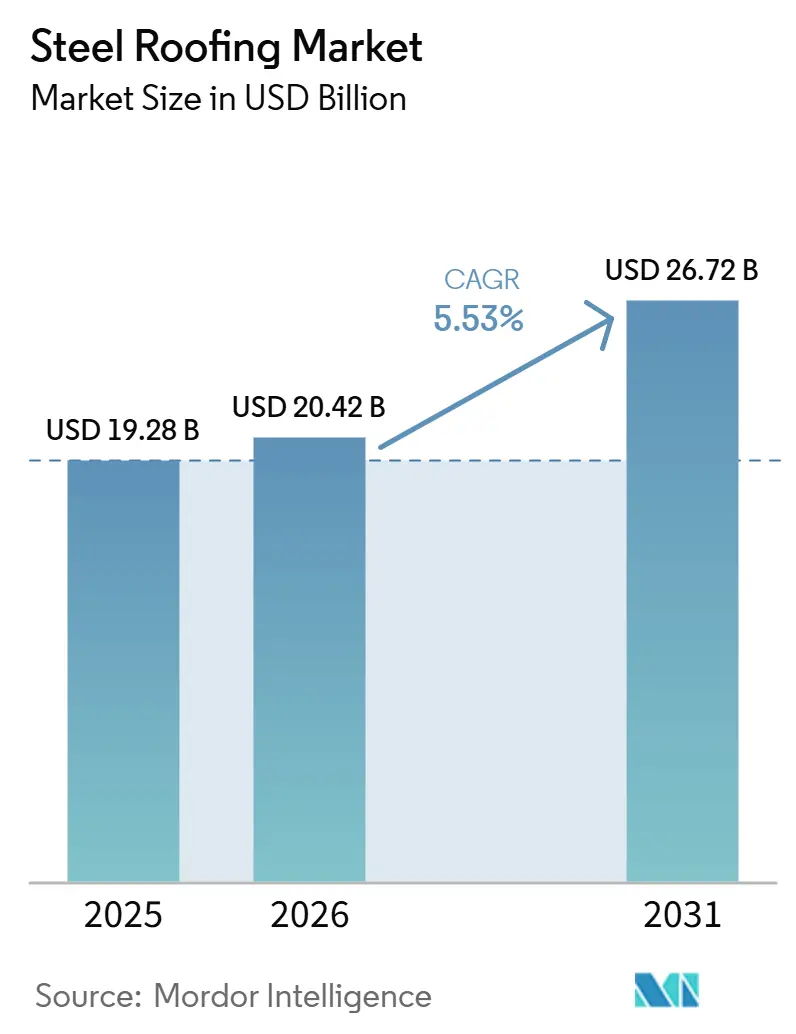
The Steel Roofing Market size is projected to expand from USD 19.28 billion in 2025 and USD 20.42 billion in 2026 to USD 26.72 billion by 2031, and is expected to register a CAGR of 5.53% between 2026 and 2031. The steel roofing market is being supported by strong new building activity in fast-growing economies and by a replacement cycle in mature building stocks, where stricter energy codes and wider insurance cost gaps are pushing owners toward more durable roofs. The steel roofing market is also benefiting from the wider use of pre-engineered building systems, because factories, warehouses, and logistics centers continue to favor steel panel roofing for span, speed, and cost control. Product demand is moving toward reflective, coated, and solar-ready formats, which are lifting value growth even when volume growth stays measured. Capacity additions by major producers show that the steel roofing market remains attractive for long-term investment, especially in coated and pre-painted lines that serve industrial and commercial projects. The main pressure point for the steel roofing market remains raw material and coating cost volatility, which can narrow margins for fabricators working on fixed-price contracts and delay mid-tier project decisions.
Key Report Takeaways
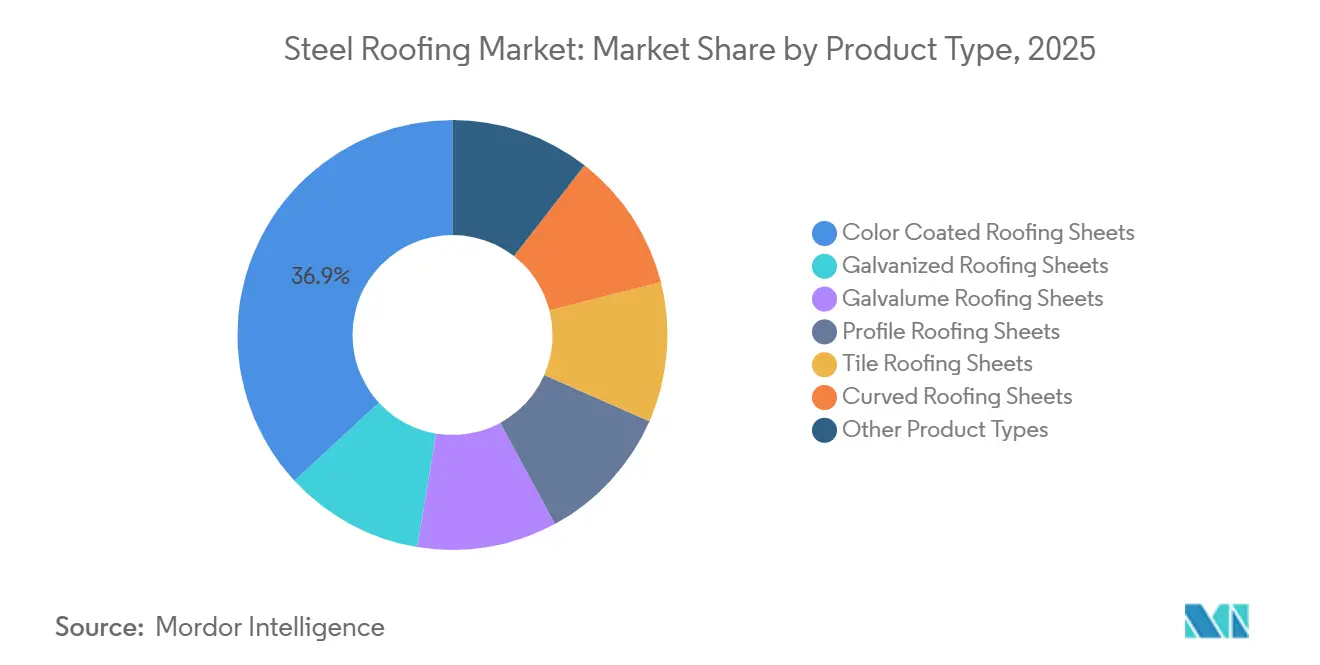
- By product type, color coated roofing sheets held 36.85% of the steel roofing market share in 2025, while galvalume roofing sheets are projected to expand at a 6.42% CAGR through 2031.
- By construction type, new construction held 68.71% of the steel roofing market share in 2025, while renovation and remodeling is forecast to grow at a 5.98% CAGR through 2031.
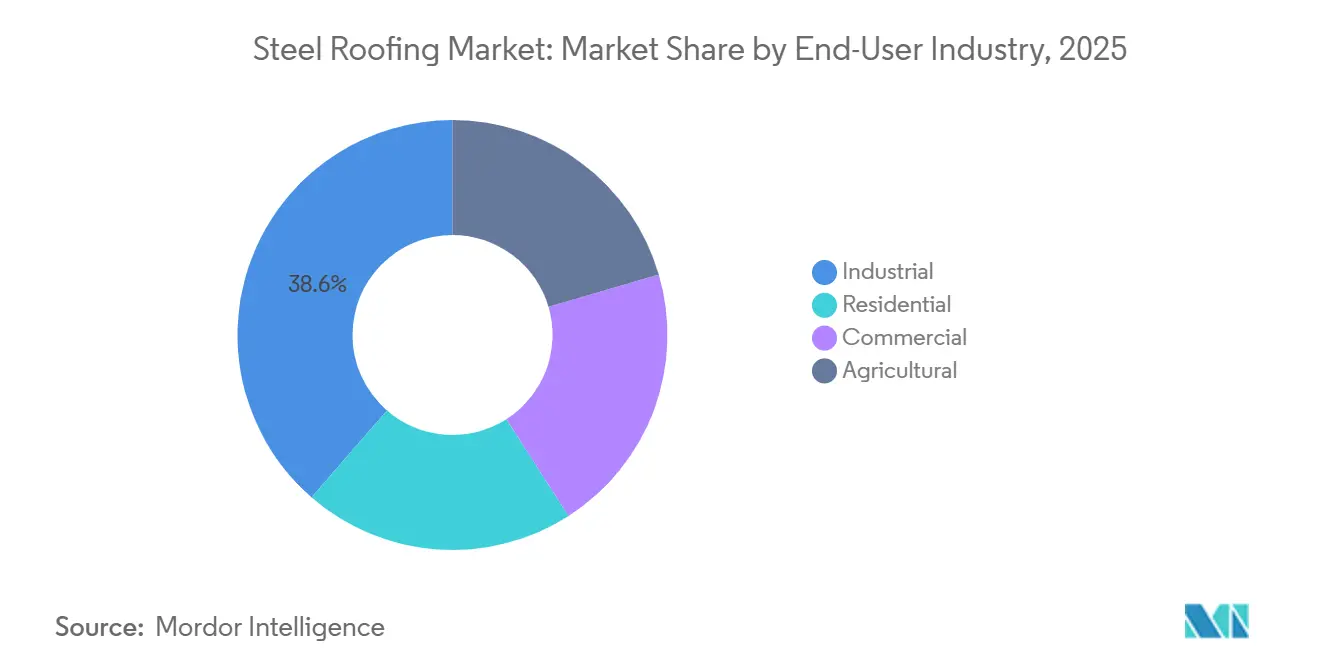
- By end-user industry, industrial held 38.62% of the steel roofing market share in 2025, while commercial is projected to advance at a 6.11% CAGR through 2031.
- By geography, Asia-Pacific held 44.27% of the steel roofing market share in 2025 and is also expected to post the fastest regional CAGR at 6.71% through 2031.
Note: Market size and forecast figures in this report are generated using Mordor Intelligence’s proprietary estimation framework, updated with the latest available data and insights as of January 2026.
Market Trends and Insights
Drivers Impact Analysis of Steel Roofing Market*
| Driver | (~) % Impact on CAGR Forecast | Geographic Relevance | Impact Timeline |
|---|---|---|---|
| Increasing Replacement of Aging Roofing Systems Across Developed Economies | +1.2% | North America, Europe | Medium term (2–4 years) |
| Rising Adoption of Pre-Engineered Buildings Driving Demand for Steel Roofing Systems | +1.4% | APAC, Middle East, South America | Medium term (2–4 years) |
| Increasing Preference for Energy-Efficient and Reflective Roofing Solutions | +1.0% | Global | Long term (≥ 4 years) |
| Growing Installation of Rooftop Solar Systems Supporting Metal Roof Adoption | +0.8% | Europe, APAC, North America | Long term (≥ 4 years) |
| Expansion of Warehousing, Logistics, Manufacturing, and Cold Storage Infrastructure | +1.3% | APAC, North America, Europe | Short term (≤ 2 years) |
| Source: Mordor Intelligence | |||
Rising Adoption of Pre-Engineered Buildings Driving Demand for Steel Roofing Systems
The steel roofing market is gaining a stable demand channel from the wider use of pre-engineered buildings across industrial and logistics projects. Warehousing and logistics structures represent more than 57% of total pre-engineered building demand by floor area in 2026, and these facilities almost always use steel panel enclosures because alternative materials do not match the same combination of clear spans, eave height flexibility, installation speed, and cost efficiency. This matters for the steel roofing market because every new logistics shed, factory shell, or distribution center expands the installed base that will later require coating maintenance, repair work, and eventual panel replacement. The supply side is already adjusting to this pattern, as POSCO and JSW Steel signed a 50/50 agreement in July 2025 to build a 6-million-metric ton-per-year integrated steel mill in Odisha with galvanizing capacity, with commissioning targeted by 2031. Quality rules also matter here, because Bureau of Indian Standards (BIS) IS:10748 continues to shape the coating and mechanical standards used in galvanized steel sheets for roofing applications in India.
Increasing Preference for Energy-Efficient and Reflective Steel Roofing Solutions
The steel roofing market is seeing a steady change in product selection as energy codes push buyers toward more reflective and better-performing roof systems. The ENERGY STAR Roof Products program sets minimum initial total solar reflectance of 0.65 and aged total solar reflectance of 0.50 for low-slope cool roofs, and Galvalume-coated steel products meet those thresholds in many commercial applications[1]U.S. Environmental Protection Agency, “Energy Star Roof Products Cool Metal Roofing Coalition Letter,” ENERGY STAR, energystar.gov. Reflective Galvalume roofing can lower cooling energy costs by up to 20%, which makes the value case stronger in hot urban markets where cooling loads are rising. That shift is moving renovation work away from standard galvanized sheets and toward coated Galvalume and pre-painted systems, which raises revenue per project even when roof area growth is moderate. ArcelorMittal also highlighted this move in March 2025 through Granite Storm roofing steel made with XCarb electric-arc-furnace steel, which the company said carries a 67% lower manufacturing carbon footprint than blast furnace routes.
Growing Installation of Rooftop Solar Systems Supporting Metal Roof Adoption
The steel roofing market is also benefiting from the move toward solar-ready and factory-integrated rooftop systems on commercial and industrial buildings. The key change in 2025 and 2026 is that solar modules are increasingly being built into roofing panels at the production stage, which removes a separate trade step and improves installation speed. Cornerstone Building Brands announced in January 2026 that its SunSteel bifacial monocrystalline solar panels would be factory-installed on Double-Lok standing seam metal roofing panels, with IEC/EN 61215 and UL 61730 certifications and a 20-year linear power guarantee to at least 91.4% output by year 20. In China, large industrial producers are aligning new metal-roof facilities with distributed solar programs, while policy support for green building materials is making solar-compatible steel roofs more relevant in new projects. Steel retains an advantage here because metal roof systems often last longer than the operating warranty period of the solar arrays placed on them, which reduces the risk of disruptive re-roofing during the life of the power asset.
Expansion of Warehousing, Logistics, Manufacturing, and Cold Storage Infrastructure
The steel roofing market continues to draw support from warehouse construction, supply chain regionalization, and new manufacturing capacity across Asia, North America, the Middle East, and Latin America. Warehousing and logistics facilities almost always use steel roofing, so each new wave of distribution investment feeds demand quickly and directly. The resumption of warehouse construction activity in the United States during 2026 adds a near-term lift after delayed projects from the prior cycle moved back into execution. Growth in high-end manufacturing, AI-linked data infrastructure, and export-oriented industrial parks is also broadening the project base for coated steel roofs beyond traditional factories. Nearshoring activity in Mexico, Eastern Europe, and Morocco adds another layer of support because greenfield industrial projects in those locations continue to favor steel roofing for speed of construction and fire performance.
Restraints Impact Analysis of Steel Roofing Market*
| Restraint | (~) % Impact on CAGR Forecast | Geographic Relevance | Impact Timeline |
|---|---|---|---|
| Fluctuations in Steel and Protective Coating Raw Material Prices Impact Production Costs | -0.9% | Global | Short term (≤ 2 years) |
| Higher Initial Installation Cost Compared with Conventional Roofing Materials | -0.6% | Emerging Markets, Residential Sector | Medium term (2–4 years) |
| Dependence on Skilled Installation to Ensure Long-Term Weather Resistance and Structural Performance | -0.4% | Global, particularly developing economies | Long term (≥ 4 years) |
| Source: Mordor Intelligence | |||
Fluctuations in Steel and Protective Coating Raw Material Prices Impact Production Costs
The steel roofing market remains exposed to raw material swings because coated roof products depend on hot-rolled coil, aluminum, zinc, and silicon. The galvalume steel coil prices averaged USD 1,150 to USD 1,250 per metric ton Free on Board (FOB)s in 2026, with year-over-year growth of 5.8% and monthly movement of USD 50 to USD 80 per metric ton. That kind of movement is hard for fabricators to pass through when roofing contracts have already been fixed with end customers. It can also slow investment in new coating and fabrication lines because producers need greater confidence in spreads before adding capacity. In Europe, Carbon Border Adjustment Mechanism (CBAM) Phase 2 is adding a structural cost layer for imports produced through higher-emission routes, which reduces the landed cost advantage that some imported coated sheets once held.
Higher Initial Installation Cost Compared with Conventional Roofing Materials
The steel roofing market still faces a real adoption hurdle in residential and light commercial work because installed cost stays above asphalt shingles, clay tiles, and bituminous membranes in many price-sensitive settings. In North American housing, steel roofing typically costs 2 to 3 times more per installed square foot than standard asphalt shingles, and the gap can feel even wider in developing regions where material cost weighs more heavily than labor. This is one reason residential demand is not moving as fast as industrial demand, even though steel often offers a better life-cycle return over 40 to 50 years. The payback period remains too long for many homeowners and small building owners unless insurance savings or green building incentives are available. Manufacturers have tried to narrow the gap through thinner-gauge and lighter-weight products, but those formats require more precise installation and expose the steel roofing market to skilled labor shortages in parts of South Asia and Sub-Saharan Africa.
*Our forecasts treat driver/restraint impacts as directional, not additive. The impact forecasts reflect baseline growth, mix effects, and variable interactions.
Steel Roofing Market Segment Analysis
By Product Type:
Color Coated Leads as Multi-Alloy Coatings EmergeColor coated roofing sheets accounted for 36.85% of the steel roofing market size in 2025, which kept them in the leading position across product categories. Their lead came from broad use across climates, strong acceptance in both industrial and residential buildings, and easier alignment with visual preferences in modern construction. The steel roofing market continues to favor this category because buyers want a balance of corrosion protection, appearance, and lower maintenance burden in a single panel format. Galvanized roofing sheets still serve a large installed base in cost-sensitive parts of Africa and South Asia, where low upfront cost remains the main purchase filter.
That cost-first pattern is slowly being challenged by Galvalume products, which are now competing on a life-cycle cost basis over 5 to 7 years rather than only on initial purchase price. Profile sheets still dominate agricultural and light industrial uses where simple geometry and quick installation matter most. Tile roofing sheets remain tied to residential projects where the roof needs to match traditional forms without giving up the benefits of steel. Curved roofing sheets remain smaller in value, but they are gaining ground in stadiums, airports, and transport hubs because lightweight roof forms are easier to deliver with steel than with conventional alternatives. Galvalume roofing sheets are projected to grow at a 6.42% CAGR through 2031, which shows that the steel roofing market is moving toward higher-performance coated products as code demands and project expectations rise.



By Construction Type:
Renovation Economics Narrow the Gap with New BuildNew Construction captured 68.71% of the steel roofing market share in 2025, reflecting the weight of greenfield industrial and commercial activity across Asia-Pacific, the Middle East, and selected South American markets. This base remains strong because large-format facilities continue to prioritize fast enclosure systems that reduce build time and keep structural layouts flexible. The steel roofing market still depends heavily on new factories, logistics sheds, utility facilities, and commercial shells for baseline volume. At the same time, renovation work is becoming more important as building owners reassess older roof systems against current fire, energy, and insurance requirements.
Renovation and remodeling is forecast to grow at a 5.98% CAGR through 2031, and that pace is being supported by more than simple repair demand. In the United States, the FORTIFIED Roof framework is helping owners justify upgrades to stronger roof assemblies in wind-exposed states because lower insurance costs can shorten the effective payback period. In Europe, renovation-focused policy measures are pushing the replacement of aging commercial roofing with systems that offer better fire performance, recyclability, and rooftop solar compatibility. Roof replacement is also turning into an energy decision, because solar-ready standing seam steel systems can convert a maintenance project into an operating asset. Central States Manufacturing reinforced this direction in September 2025 when it opened its 13th manufacturing facility in Tooele, Utah, to produce roof and wall panels, trim, and structural components for pre-engineered metal building and roofing applications.
By End-User Industry:
Industrial Anchors the Base While Commercial Gains PaceThe industrial end-user industry represented 38.62% of the steel roofing market size in 2025, which made the industry the largest end-use group. Factories, energy facilities, warehouses, and distribution centers continue to support that lead because steel roofing works well on large floorplates and repetitive structural grids. The ability to cover wide spans without frequent intermediate supports remains important in logistics facilities, where layout flexibility and speed matter during design and construction. Agricultural demand adds a smaller but steady layer through grain storage, livestock structures, and aquaculture buildings in humid environments.
Residential demand remains meaningful in rural and semi-urban parts of India, Southeast Asia, and Sub-Saharan Africa, where corrugated galvanized sheets still serve as an affordable roofing option. Commercial is projected to post the fastest end-user industry segment CAGR of 6.11% through 2031, driven by data centers, retail parks, healthcare buildings, and mixed-use projects that need rapid build schedules and higher roof performance. This is widening the role of insulated and engineered panel systems that combine thermal control with structural roofing in a single package. Product bundles from companies such as Isopan and Metecno reflect this preference for system-level value over single-material purchasing. As a result, the steel roofing market is creating more room for suppliers that can package roofing, insulation, and solar integration together rather than compete only on basic panel price.
Geography Analysis
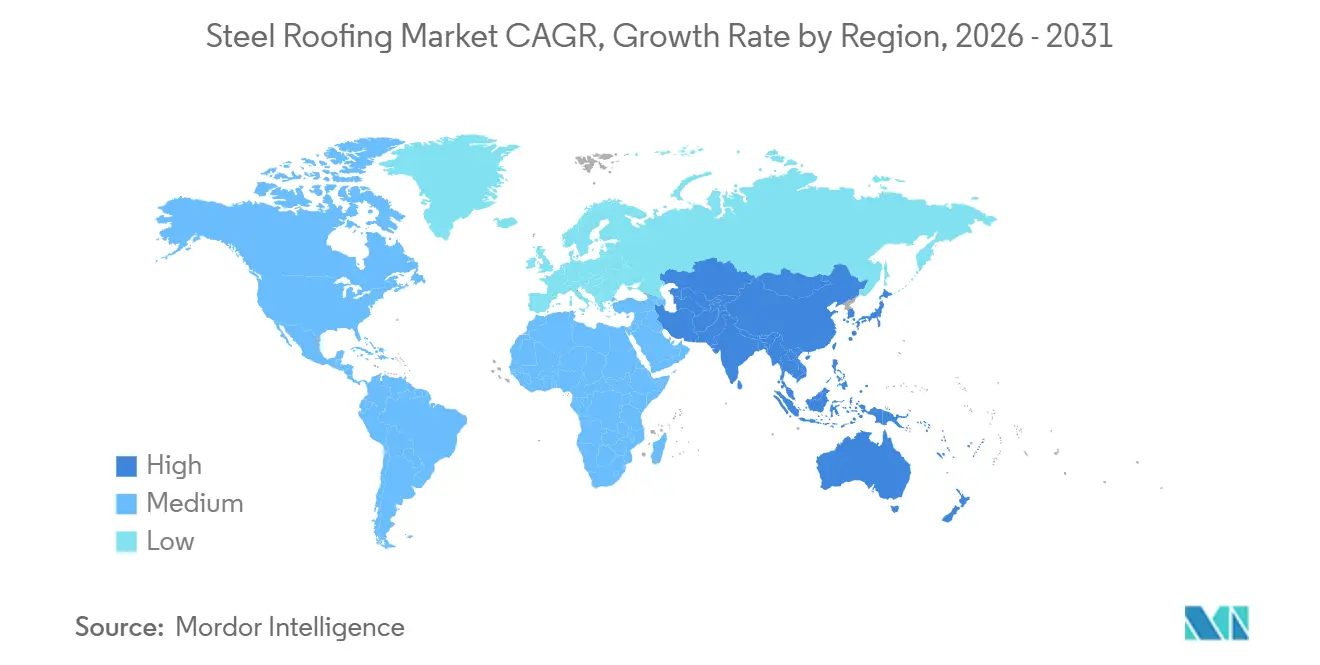
APAC Steel Roofing Market
Asia-Pacific held 44.27% of the steel roofing market share in 2025 and is projected to grow at a 6.71% CAGR through 2031, which makes it both the largest and the fastest-growing regional block. China continues to provide scale through industrial, commercial, and infrastructure activity, and 2026 construction programs that require high use of green building materials are supporting metal roofing formats that meet fire resistance and recyclability needs. India adds another growth engine, with the World Steel Association forecasting that the country’s steel demand is expected to rise 7.4% in 2026 as infrastructure and construction activity stay strong. Japan and South Korea add demand for higher-grade standing seam and Building-Integrated Photovoltaics (BIPV)-ready roofing, which keeps the regional mix tilted toward more advanced coated steel solutions.
North America and Europe Steel Roofing Market
North America and Europe form a supportive but more operationally complex setting for the steel roofing market in 2026. In the United States, steel demand is growing, supported by infrastructure spending and a gradual residential recovery, but high borrowing costs are still holding back broader housing starts. Trade actions on coated steel imports are tightening availability and widening the spread between hot-rolled coil and coated products, which strengthens the case for domestic investments such as Nucor’s 500,000 short-ton-per-year continuous galvanizing line in Berkeley County that remained on track for mid-2026 commissioning. In Europe, steel demand is recovering at 1.3% in 2026, and renovation work is favoring lower-carbon and more advanced coated flat steel products that fit stricter building and import rules.
The Americas and MEA Steel Roofing Market
South America and Middle-East and Africa remain smaller in base value, but they carry meaningful long-run opportunities for the steel roofing market. In South America, Brazil supported regional construction activity in 2025, and construction represented 49.2% of regional apparent steel demand according to the Latin American Steel Association (ALACERO). Mexico saw a 10.5% drop in apparent steel consumption in 2025, which weighed on the regional total, but Argentina, Chile, Peru, and Colombia posted construction expansion. Across the region, metal roofing is gaining place inside industrial parks, nearshoring-linked facilities, and agri-food infrastructure because project teams value durability and quick installation. In Africa, the World Steel Association forecasts steel demand growth of 3.8% in 2026 and 4.6% in 2027, which supports a durable long-term case for corrosion-resistant steel roofing in urban and infrastructure projects[2]World Steel Association, “Short Range Outlook April 2026,” World Steel Association, worldsteel.org. Saudi Arabia’s NEOM-related development and South Africa’s logistics and mining infrastructure work also support demand for higher-specification roofing in harsh desert and coastal conditions.

Competitive Landscape
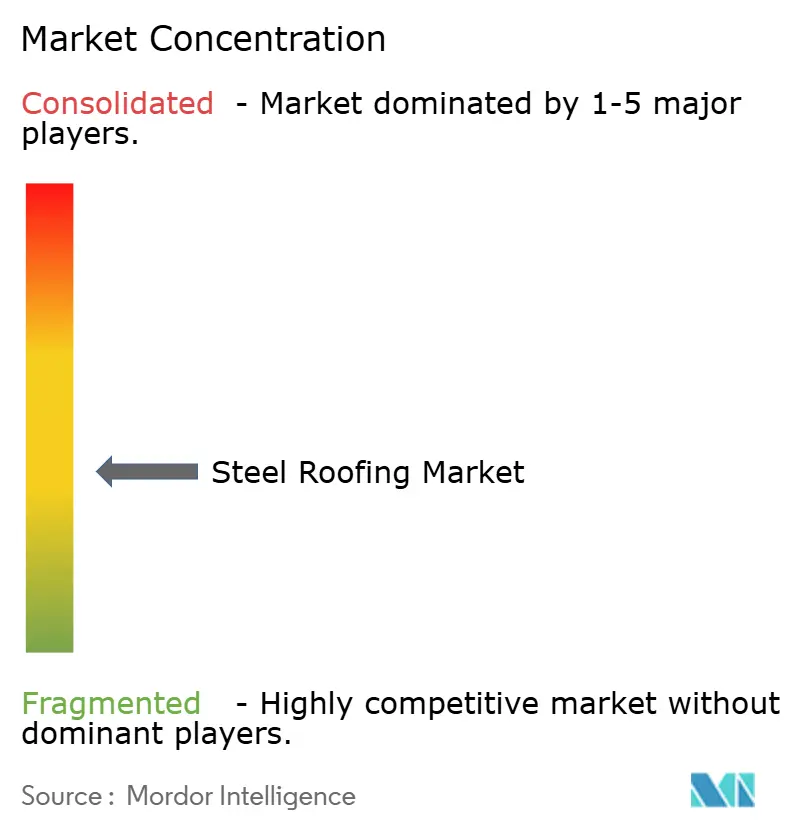
The steel roofing market is moderately fragmented, with the top five players including BlueScope Steel Limited, Nucor Corporation, Kingspan Group, TATA STEEL COLORS, and Carlisle Companies Inc. Upstream activity is moderately concentrated around companies such as ArcelorMittal, BlueScope Steel, Nucor, and POSCO, while downstream fabrication and installation remain widely spread across regional and local suppliers. This split matters because the steel roofing market does not behave like a single-layer commodity chain, as product power is stronger in coated flat steel and system design than in final installation. Competitive advantage at the upper end still comes from proprietary coating systems, scale in pre-paint and galvanizing lines, and the ability to certify higher-performance roofing packages.
Technology spending is becoming a clearer line of separation among leading suppliers in the steel roofing market. ArcelorMittal invested EUR 15 million (approximately USD 17.3 million) in its Helioroof production line in France, creating an integrated steel roof module that combines steel panels, insulation, and solar cells in one unit. BlueScope is commissioning its AUD 415 million (approximately USD 264 million) Metal Coating Line 7 in New South Wales during 2026, adding 240,000 metric tons per year of ZINCALUME and COLORBOND capacity in Australia’s first new steel coating line in more than 30 years. Nucor is following a volume-led route through additional galvanizing and pre-paint capacity in the United States, which is designed to serve domestic demand more closely and reduce reliance on imports.
Regional players still hold an important place because the steel roofing market is highly fragmented after the coated steel stage. Suppliers such as Safal Group in Africa and Tata Steel Colors in India compete by pairing local production economics with regional distribution strength. Premium residential specialists such as Interlock Roofing and Bilka Steel rely more on workmanship, finish quality, and brand trust than on raw volume. System-oriented firms like Cornerstone Building Brands, Metecno, and Isopan are shifting buyer attention from panel price toward envelope performance, insulation value, and solar integration. White space remains largest in BIPV-enabled roofing, where early moves by ArcelorMittal and Cornerstone show commercial readiness but not yet mass-scale penetration. This leaves the steel roofing market open to selective pricing power in advanced products, even while basic panel supply remains fragmented and price sensitive.
Steel Roofing Industry Leaders
BlueScope Steel Limited
Kingspan Group
Nucor Corporation
TATA STEEL COLORS
Carlisle Companies Inc.
- *Disclaimer: Major Players sorted in no particular order
Steel Roofing Market Companies Covered in this Report
- ArcelorMittal
- Bilka Steel
- BlueScope Steel Limited
- Carlisle Companies Inc.
- Cornerstone Building Brands, Inc.
- Interlock Roofing Ltd.
- Isopan S.p.A.
- Kingspan Group
- Metecno Group
- Nucor Corporation
- POSCO
- Safal Group
- SSAB AB
- TATA STEEL COLORS
- The OmniMax International, Inc.
- voestalpine Stahl GmbH

Recent Industry Developments in Steel Roofing Market
- March 2026: J&E Roofing Solutions, a family-owned roofing contractor, expanded its metal roofing services to meet growing demand for durable, energy-efficient roofing systems. The company serves communities including Shell Knob, Eagle Rock, Cassville, Republic, and Monett, offering metal roofing solutions such as corrugated metal sheets, standing seam metal systems, metal tile sheets, and stone-coated steel options.
- October 2025: ArcelorMittal inaugurated its Helioroof production line in Contrisson, France. The product integrates steel roofing panels, thermal insulation, and solar cells, and generates significantly lower carbon emissions compared with conventional products. Helioroof modules are ready-to-install and custom-made, measuring up to 12 meters in length, with an energy output of up to 2.1 kWp (kilowatt peak) per module.


Global Steel Roofing Market Report Scope
Steel roofing is a durable, sustainable, and weather-resistant roofing option for residential, commercial, and agricultural properties. It offers high tensile strength, exceptional fire resistance, and protection against extreme winds, heavy rain, and snow loads.
The Steel Roofing Market is segmented by product type, construction type, end-user industry, and geography. By product type, the market is segmented into color coated roofing sheets, galvanized roofing sheets, galvalume roofing sheets, profile roofing sheets, tile roofing sheets, curved roofing sheets, and other product types. By construction type, the market is segmented into new construction and renovation & remodeling. By end-user industry, the market is segmented into residential, commercial, industrial, and agricultural. The report also covers the market size and forecasts for steel roofing in 16 countries across major regions. For each segment, the market sizing and forecasts have been done on the basis of value (USD).
| Color Coated Roofing Sheets |
| Galvanized Roofing Sheets |
| Galvalume Roofing Sheets |
| Profile Roofing Sheets |
| Tile Roofing Sheets |
| Curved Roofing Sheets |
| Other Product Types |
| New Construction |
| Renovation & Remodeling |
| Residential |
| Commercial |
| Industrial |
| Agricultural |
| Asia-Pacific | China |
| India | |
| Japan | |
| South Korea | |
| Rest of Asia-Pacific | |
| North America | United States |
| Canada | |
| Mexico | |
| Europe | Germany |
| United Kingdom | |
| France | |
| Italy | |
| Russia | |
| Rest of Europe | |
| South America | Brazil |
| Argentina | |
| Rest of South America | |
| Middle-East and Africa | Saudi Arabia |
| South Africa | |
| Rest of Middle-East and Africa |
| By Product Type | Color Coated Roofing Sheets | |
| Galvanized Roofing Sheets | ||
| Galvalume Roofing Sheets | ||
| Profile Roofing Sheets | ||
| Tile Roofing Sheets | ||
| Curved Roofing Sheets | ||
| Other Product Types | ||
| By Construction Type | New Construction | |
| Renovation & Remodeling | ||
| By End-User Industry | Residential | |
| Commercial | ||
| Industrial | ||
| Agricultural | ||
| By Geography | Asia-Pacific | China |
| India | ||
| Japan | ||
| South Korea | ||
| Rest of Asia-Pacific | ||
| North America | United States | |
| Canada | ||
| Mexico | ||
| Europe | Germany | |
| United Kingdom | ||
| France | ||
| Italy | ||
| Russia | ||
| Rest of Europe | ||
| South America | Brazil | |
| Argentina | ||
| Rest of South America | ||
| Middle-East and Africa | Saudi Arabia | |
| South Africa | ||
| Rest of Middle-East and Africa | ||


Key Questions Answered in the Report
What is the size of the steel roofing market?
The Steel Roofing Market size is projected to expand from USD 19.28 billion in 2025 and USD 20.42 billion in 2026 to USD 26.72 billion by 2031, and is expected to register a CAGR of 5.53% between 2026 and 2031.
What is driving demand for steel roofing the most?
The strongest demand drivers are pre-engineered building adoption, warehouse and manufacturing expansion, roof replacement activity, and the shift toward energy-efficient and solar-ready roof systems.
Which product type led the market demand in 2025?
Color coated roofing sheets led in 2025 with 36.85% share.
Why is renovation & remodeling expected to grow fastest through 2031?
Renovation and remodeling is expected to grow at a 5.98% CAGR through 2031 because older roof stock is being replaced to meet energy, fire, insurance, and rooftop solar requirements.
Page last updated on:





