
Metal Roofing Market Size and Share
Market Overview
| Study Period | 2021 - 2031 |
|---|---|
| Market Size (2026) | USD 27.64 Billion |
| Market Size (2031) | USD 35.05 Billion |
| Growth Rate (2026 - 2031) | 4.87 % |
| Fastest Growing Market | Asia-Pacific |
| Largest Market | North America |
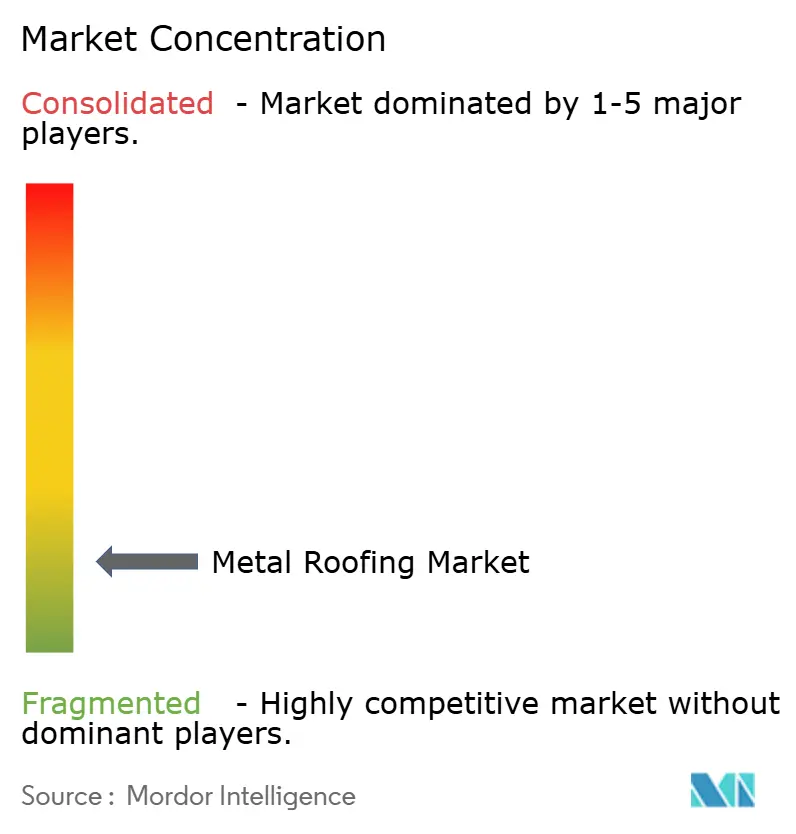
| Market Concentration | Low |
Major Players *Disclaimer: Major Players sorted in no particular order Image © Mordor Intelligence. Reuse requires attribution under CC BY 4.0. | |
Metal Roofing Market Analysis by Mordor Intelligence
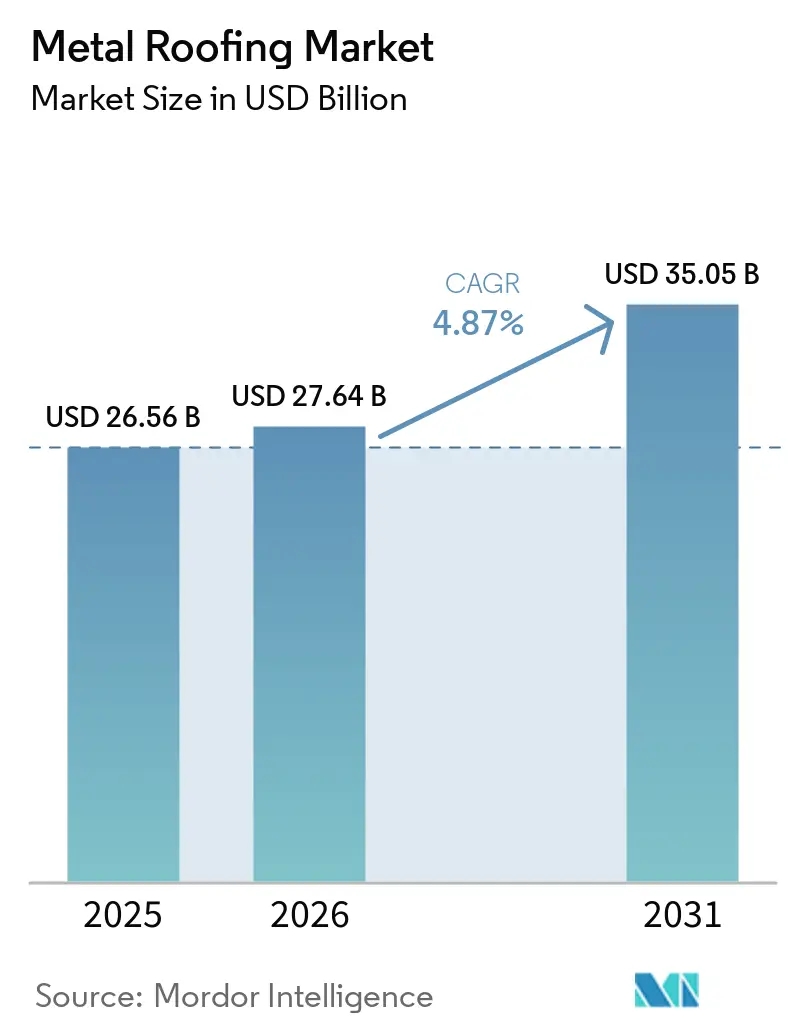
The Metal Roofing Market size was valued at USD 26.56 billion in 2025 and is estimated to grow from USD 27.64 billion in 2026 to USD 35.05 billion by 2031, at a CAGR of 4.87% during the forecast period (2026-2031). Steel remains the preferred material due to its broad compatibility with profiles and competitive cost position across industrial, commercial, and residential applications. Replacement demand, logistics construction, and tighter energy requirements support demand across developed and emerging economies. Solar-compatible standing-seam systems are becoming increasingly important as building owners evaluate roofing and energy equipment together. The competitive landscape is divided between a concentrated supply of coated steel and a fragmented downstream network of fabricators and distributors, making raw material costs and installer availability key constraints on project pricing.
Key Report Takeaways
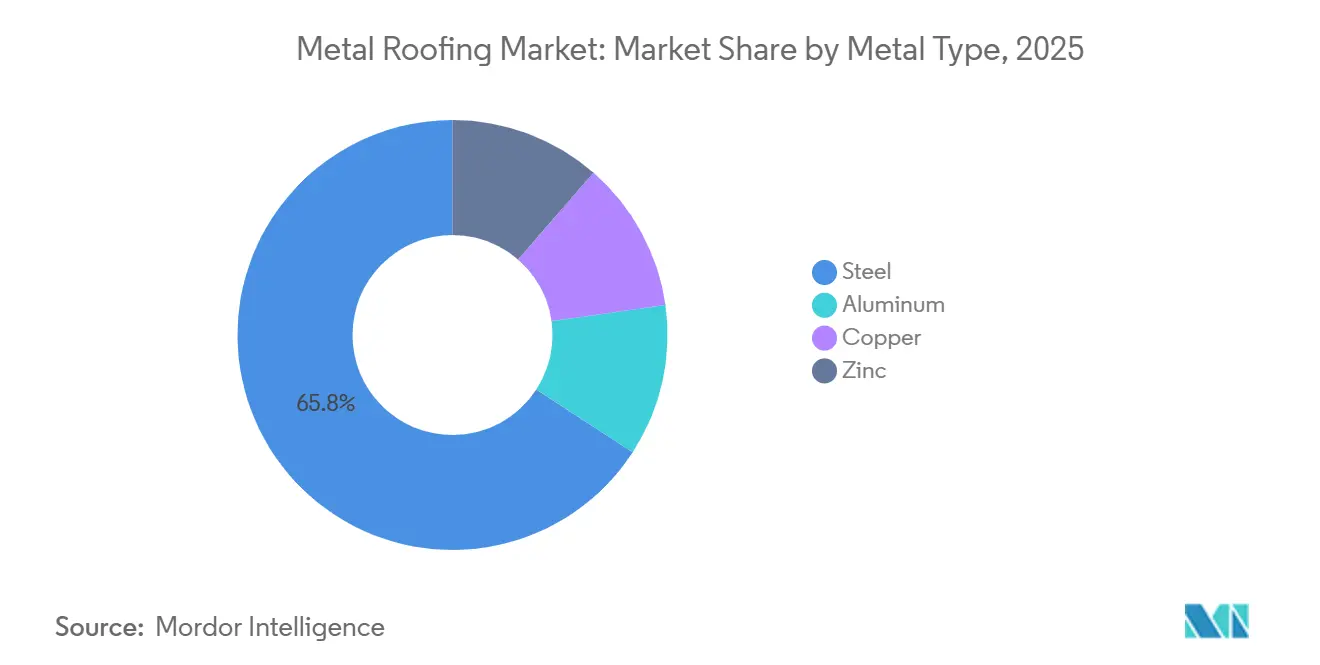
- By metal type, steel held 65.83% of the Metal Roofing Market share in 2025, while aluminum is forecast to grow at a 5.43% CAGR through 2031.
- By product type, panels accounted for 46.65% of the Metal Roofing Market size in 2025, while metal shingles are forecast to advance at a 5.57% CAGR through 2031.
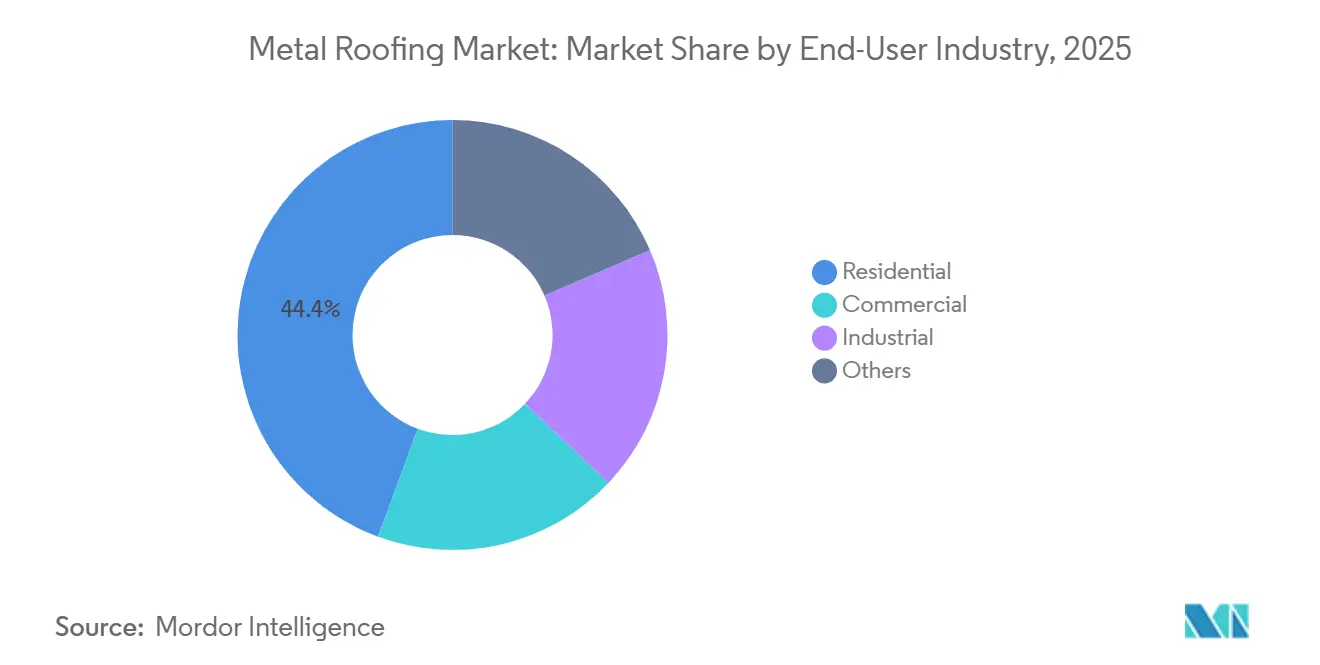
- By end-user industry, residential applications held 44.37% of the Metal Roofing Market share in 2025, while commercial end users are forecast to expand at a 5.68% CAGR through 2031.
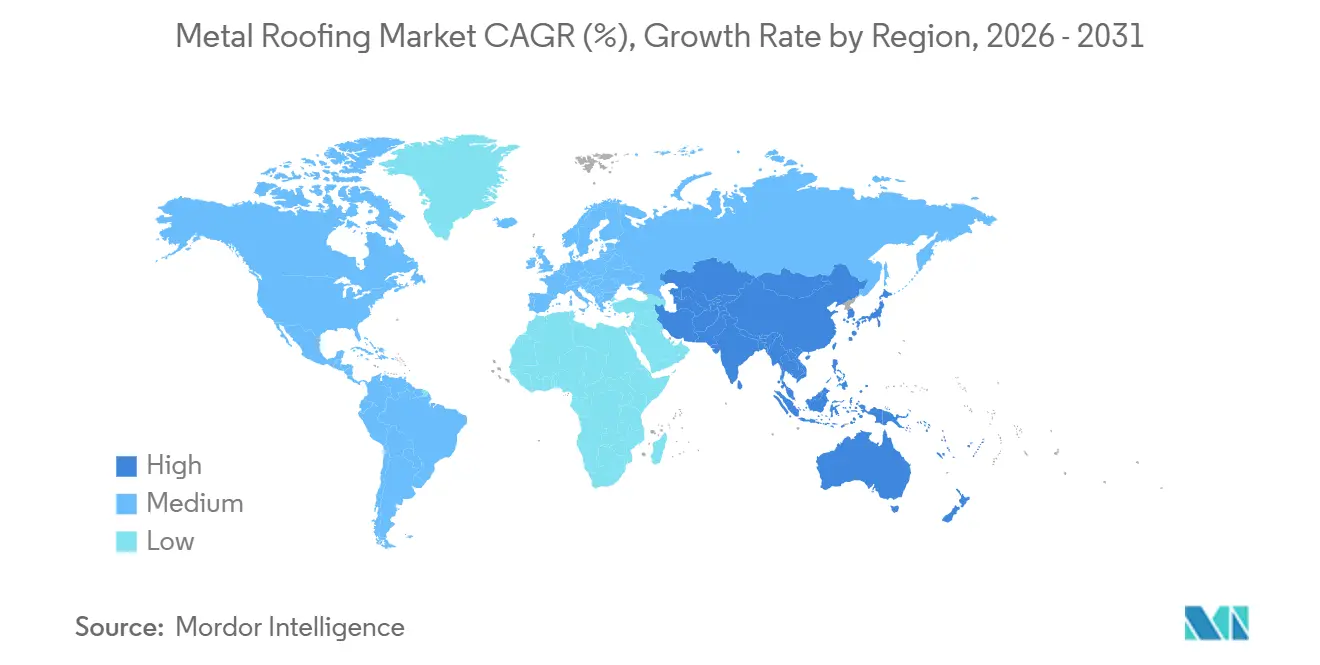
- By geography, North America held 30.11% of the Metal Roofing Market share in 2025, and Asia-Pacific is forecast to expand at a CAGR of 5.32% through 2031.
Note: Market size and forecast figures in this report are generated using Mordor Intelligence’s proprietary estimation framework, updated with the latest available data and insights as of January 2026.
Market Trends and Insights
Drivers Impact Analysis of Metal Roofing Market*
| Drivers | (~) % Impact on CAGR Forecast | Geographic Relevance | Impact Timeline |
|---|---|---|---|
| Replacement of Aging Roofs in Developed Markets | +1.0% | North America and Europe | Medium term (2-4 years) |
| Expansion of Warehousing, Logistics, and Industrial Facilities | +1.2% | Global, with Asia-Pacific (APAC) core and spill-over to North America and Europe | Short term (≤ 2 years) |
| Energy-Efficient and Reflective Roofing Requirements | +0.8% | North America and Europe | Medium term (2-4 years) |
| Rooftop Solar and Building-Integrated Photovoltaic Adoption | +0.6% | Global | Long term (≥ 4 years) |
| Pre-Engineered Building Adoption in Emerging Markets | +0.7% | APAC core, with spillover to the Middle East, Africa, and South America | Medium term (2-4 years) |
| Source: Mordor Intelligence | |||
Replacement of Aging Roofs in Developed Markets
Replacement activity is supporting the metal roofing market as aging housing stock enters reroofing cycles. McElroy Metal reported that 23% of U.S. homeowners planned to reroof in 2026, and that 17% of homeowners replacing a roof selected metal rather than asphalt. Standing seam and shingle systems can reach cost parity with repeated asphalt replacement cycles after 16 to 20 years in storm-prone and hot-climate locations. Metal systems then provide lower lifecycle costs over a service life of 40 to 80 years. Impact-resistant metal products can also qualify homeowners for insurance discounts through FORTIFIED Roof-affiliated programs, particularly in the Gulf Coast and Tornado Alley regions. Renee Ramey of the Metal Roofing Alliance stated that demand was outpacing the availability of qualified contractors, thereby supporting premium pricing for trained installers[1]. Each successful conversion also extends a home's replacement cycle, reducing the property's future replacement frequency.
Expansion of Warehousing, Logistics, and Industrial Facilities
Warehousing, logistics, and industrial construction provide a reliable base for the metal roofing market. United States manufacturing construction spending was running at an annualized rate of USD 199.5 billion in December 2025, supporting demand for R-panel and insulated metal panel systems. Semiconductor facilities, data center shells, and electric vehicle battery plants require large building envelopes that favor metal systems. India's Production Linked Incentive schemes and PM GatiShakti National Master Plan are directing investment into industrial parks, where pre-engineered steel buildings enable rapid occupancy and lower construction costs. Large European fulfillment centers also require long-span roofs that support insulation, ventilation, solar equipment, and refrigeration systems within a single building envelope.
Energy-Efficient and Reflective Roofing Requirements
Energy performance requirements are increasing the value of reflective metal roofing specifications. ENERGY STAR criteria require a minimum initial solar reflectance of 0.25 for steep-slope roof applications. Eligible reflective products can reduce peak cooling demand by 10% to 25% compared with nonreflective alternatives. Research from Oak Ridge National Laboratory and Lawrence Berkeley National Laboratory found that above-sheathing ventilation in batten-mounted metal roof assemblies can reduce heat flow into a building by nearly 30%. Premium specifications are increasingly using polyvinylidene fluoride (PVDF) coatings because they retain solar reflectance longer under ultraviolet exposure. Infrared-reflective pigments also allow dark panels, including charcoal, slate gray, and burnished copper, to meet applicable reflectance thresholds without limiting color selection.
Rooftop Solar and Building-Integrated Photovoltaic Adoption
Rooftop solar deployment is driving demand for premium standing-seam systems in the metal roofing market. Concealed seams allow clamp-attached solar panels without penetrating the roof surface, which preserves the roof assembly. ArcelorMittal inaugurated its Helioroof production line in Contrisson, France, in October 2025. The system combines steel panels, insulation, and solar cells into factory-assembled modules up to 12 meters long, producing up to 2.1 kWp per unit. ArcelorMittal stated that the product weighs 50% less than a conventional roof-plus-solar configuration and is protected by 15 company patents. In January 2026, Cornerstone Building Brands announced a SunSteel partnership that integrates solar panels directly into Double-Lok standing-seam panels prior to delivery to commercial and industrial sites.
Restraints Impact Analysis of Metal Roofing Market*
| Restraints | (~) % Impact on CAGR Forecast | Geographic Relevance | Impact Timeline |
|---|---|---|---|
| Higher Initial Installed Cost Versus Asphalt Roofing | -0.7% | Global, with North America and Europe most exposed | Short term (≤ 2 years) |
| Steel, Aluminum, and Coating Raw-Material Price Volatility | -0.8% | Global | Short term (≤ 2 years) |
| Shortage of Qualified Standing-Seam Installers | -0.5% | North America and Europe | Medium term (2-4 years) |
| Source: Mordor Intelligence | |||
Higher Initial Installed Cost Versus Asphalt Roofing
Higher installed costs remain a barrier for residential and mid-tier commercial buyers in the metal roofing market. Section 232 tariffs on steel and aluminum imports were set at 50% in 2026, raising costs for metal products[2]. Domestic mills can also price under the higher import floor, which affects fabricated panel pricing. Building owners with short holding periods or limited upfront capital may select asphalt or membrane products even when metal offers stronger lifecycle economics. The financial case is less compelling in temperate locations with lower storm exposure. Insurance discounts for impact-resistant products can offset part of the premium in exposed areas, but awareness and availability vary across insurers and regions.
Steel, Aluminum, and Coating Raw-Material Price Volatility
Raw material price volatility creates a direct operating challenge for fabricators and roll-formers. Price changes in steel, aluminum, coatings, zinc, and copper can compress margins on fixed-price and long-lead construction contracts. Fabricators without hedging programs or coil-supply integration have less ability to protect margins when input prices move. This constraint is particularly relevant for mid-sized suppliers bidding for large projects with fixed delivery terms. Trade policy uncertainty, including country-specific tariff schedules and potential exemptions, further complicates forward project pricing. The installer shortage compounds this issue, as labor constraints limit the number of projects qualified contractors can complete.
*Our forecasts treat driver/restraint impacts as directional, not additive. The impact forecasts reflect baseline growth, mix effects, and variable interactions.
Metal Roofing Market Segment Analysis
By Metal Type:
Steel Dominates by Share While Aluminum Gains SpecificationSteel held 65.83% of the metal roofing market share in 2025, while aluminum is projected to grow at a 5.43% CAGR from 2026 to 2031. Aluminum is gaining adoption due to its corrosion resistance in coastal, humid, and salt-spray environments. Its lower weight also makes it suitable for reroofing projects where existing structural framing cannot support heavier materials. This factor is becoming increasingly relevant as North American buildings constructed in the 1980s and 1990s enter a replacement cycle. In 2026, BlueScope commissioned its AUD 415 million (USD 264 million) Metal Coating Line 7 in New South Wales. The line adds 240,000 metric tons of annual capacity for ZINCALUME and COLORBOND products and is the first new steel-coating line in Australia in more than 30 years. This investment reflects continued demand for aluminum-alloy-coated products in the Asia-Pacific region.
Steel retained its position by offering a broad cost-to-performance balance across profiles and coating systems. Galvalume-coated steel supports corrugated and R-panel formats used in agricultural, industrial, and logistics buildings, where installed cost per square meter and reliable coverage over large spans are the primary considerations. Copper and zinc remain concentrated in premium architectural roofing applications. Zinc develops a patina that eliminates the need for recoating over an 80- to 100-year service life, making it suitable for heritage restoration and institutional specifications in Germany, Switzerland, and Scandinavia. The metal roofing market is segmented, with steel accounting for the largest share, while specialty metals contribute greater value per square meter. Specialty-metal demand is less sensitive to fluctuations in commodity steel prices, as buyers prioritize architectural performance and long service life.

By Product Type:
Panels Drive Commercial Output as Shingles Support Residential ConversionPanels accounted for 46.65% of the metal roofing market in 2025, while metal shingles are forecast to expand at a 5.57% CAGR from 2026 to 2031. Shingle growth is primarily driven by residential reroofing conversions in North America. Polyvinylidene fluoride (PVDF)-coated metal shingle systems meeting ENERGY STAR criteria may qualify for utility rebates in participating jurisdictions. The International Residential Code permits installing metal shingles over one existing asphalt-shingle layer under Section R908.3.1, which can reduce removal labor costs and make metal reroofing accessible to buyers who cannot afford a full roof replacement. Wider color palettes and infrared-reflective dark shades are also addressing aesthetic preferences that previously favored light-colored cool-roof products.
Panels are well established in commercial, industrial, and large-span buildings. Standing seam panels are particularly relevant for logistics and data center projects, as they can support clamp-attached solar installations without roof penetration. Cornerstone Building Brands' SunSteel program illustrates the move toward factory-integrated solar arrays for this format. Corrugated profiles address cost-sensitive agricultural and light-industrial applications in the Asia-Pacific and Latin America. Tile profiles serve residential projects in Southern Europe, Australia, and parts of Latin America where a clay or terracotta appearance is required. Stone-coated steel tiles combine the visual weight of conventional tiles with the durability and recyclability of steel and are expanding in East Asian housing applications where fire resistance and typhoon-wind ratings are valued.
By End-User Industry:
Residential Scale and Commercial AccelerationResidential applications accounted for 44.37% of the metal roofing market in 2025, and commercial end users are projected to grow at a 5.68% CAGR from 2026 to 2031. Residential demand is driven by replacement cycles across North America and Northern Europe, where much of the postwar housing stock is reaching the end of its existing roof service life. A metal conversion replaces an asphalt replacement cycle with one lasting 40 to 80 years, altering the property's long-term replacement profile. Stone-coated steel shingles and standing seam panels are gaining traction in East Asia, where buyers value fire resistance, typhoon-wind performance, and multi-decade durability. The other end-user category continues to absorb corrugated and R-panel output across agricultural, institutional, and infrastructure applications in rural and emerging markets.
Commercial growth reflects investment in e-commerce fulfillment, cold-chain logistics, pharmaceutical production, and hyperscale data centers. Pre-engineered metal buildings use roofing as an integral structural component and can deliver construction cost savings of 20% to 40%, while reducing construction timelines by 50% to 70% compared with reinforced-concrete buildings of equivalent floor area. Insulated metal panels combine the structural shell, thermal performance, and vapor barrier in a factory-assembled system, making them relevant to pharmaceutical, food-processing, and data-center projects where envelope performance is a priority. Industrial development in the Middle East and Africa is also supported by investments in airports and infrastructure corridors. Solar-ready metal roofing systems are attracting interest as desert-based energy generation expands in these regions.
Geography Analysis
North America Metal Roofing Market
North America accounted for 30.11% of the metal roofing market share in 2025, making it the largest regional market. Replacement activity and non-residential construction supported regional demand. Insurance incentives are reshaping material selection in storm-exposed locations. Canada contributed demand through residential replacement and commercial construction linked to commodity-export infrastructure. Mexico's expanding automotive and aerospace manufacturing sector is supporting pre-engineered industrial building envelopes. California's Title 24 Energy Efficiency Standards have encouraged the use of polyvinylidene fluoride (PVDF) and styrene-modified polyester (SMP) coatings in the largest US construction market.
APAC Metal Roofing Market
Asia-Pacific is forecast to grow at a 5.32% CAGR from 2026 to 2031, the fastest rate among all regions. The adoption of pre-engineered buildings and commercial construction in industrializing economies supports this growth. Vietnam benefited from China Plus One manufacturing diversification, with industrial park occupancy increasing in southern provinces during 2025. Compressed project timelines favor metal buildings that can be erected quickly. China and Japan contribute high per-unit values through building-integrated photovoltaics (BIPV) and insulated metal panel specifications. South Korea and Australia remain established commercial and industrial markets with stringent performance requirements.
EMEA Metal Roofing Market
Europe's demand is shaped by heritage renovation, green-building regulation, and premium-metal architecture. Germany remains important for zinc and copper specification in institutional renovation and high-specification new construction. The European Commission's Renovation Wave aims to double the annual energy renovation rate by 2030, and renovation already accounts for a significant share of European metal roofing installations. Demand for premium panels in semiconductor fabrication plants, battery gigafactories, and data centers is expected to grow at a high single-digit rate through 2031. In the Middle East and Africa, airports, industrial corridors, and logistics projects in Saudi Arabia and South Africa are supporting market demand. Solar-integrated roofing is gaining traction as building owners seek systems compatible with on-roof energy generation.
Competitive Landscape
The metal roofing market is fragmented. Upstream supply is concentrated among integrated steel producers, including ArcelorMittal, BlueScope Steel, Nucor, POSCO, and SSAB. These companies influence the availability of coated substrates and input cost structures, and compete through BIPV systems, advanced coatings, and investments in production capacity. Downstream competition includes numerous roll-formers, panel fabricators, and regional distributors that compete on product breadth, distribution coverage, and installer support. Cornerstone Building Brands and Kingspan operate at scale in North American commercial and industrial fabrication through broad manufacturing and installer networks.
Kingspan committed USD 1 billion to U.S. roofing investment over five years. Manufacturing campuses in Maryland and Oklahoma began producing nonresidential roofing in 2026. This approach combines fabrication, distribution, and installer training and requires substantial capital. The commercial tier is moderately competitive, while residential and agricultural segments remain fragmented among regional suppliers. Patent activity and vertical product integration increasingly differentiate suppliers with research capabilities from those competing on price alone. ArcelorMittal's Helioroof® integrates steel roofing, insulation, and photovoltaics into a single factory-produced module. Its 15 company patents and automated production requirements make replication difficult for standard fabricators.
BlueScope's 2026 coating-line commissioning supports COLORBOND and ZINCALUME supply in the Asia-Pacific region. These products have established recognition among customers in residential and commercial roofing applications. Isopan S.p.A. remains active in European commercial and industrial work through composite insulated panel systems. Opportunities exist in factory-integrated BIPV retrofit systems for existing commercial buildings. Branded distribution networks in South and Southeast Asia also present opportunities, as premium metal penetration remains low relative to the broader construction base. Certification programs, including ISO environmental product declarations and ENERGY STAR listings, are becoming more relevant to green-building bids.
Metal Roofing Industry Leaders
-
Cornerstone Building Brands, Inc.
-
BlueScope Steel Limited
-
Nucor Corporation
-
Kingspan Group
-
Metal Sales
- *Disclaimer: Major Players sorted in no particular order
Metal Roofing Market Companies Covered in this Report
- ArcelorMittal
- ATAS International, Inc.
- BlueScope Steel Limited
- Carlisle Companies Inc.
- Cornerstone Building Brands, Inc.
- Isopan S.p.A.
- Kingspan Group
- McElroy Metal, Inc.
- Metal Sales
- Nucor Corporation
- Owens Corning
- POSCO
- Saint-Gobain
- SSAB
- TATA STEEL COLORS PRIVATE LIMITED
Recent Industry Developments in Metal Roofing Market
- May 2026: Kingspan acquired Duggan Profiles, an Irish manufacturer of single-skin steel construction sheets, purlins, profiled steel sheeting, and flashings for agricultural and industrial markets. The transaction was cleared by Ireland's Competition and Consumer Protection Commission and complements Kingspan's single-skin construction sheeting offering.
- January 2026: Cornerstone Building Brands announced a partnership to integrate SunSteel solar panels directly into its Double-Lok standing-seam metal roofing panels at the factory. The system was delivered site-ready with arrays pre-applied, reducing on-site installation time. It was available across the MBCI, Ceco, Star Building Systems, Metallic Building Systems, and Robertson Building Systems brand portfolio.
Global Metal Roofing Market Report Scope
Metal roofing is a building system made of metal sheets or tiles. It offers durability, fire resistance, and energy efficiency. It is used in residential, commercial, and industrial buildings.
The metal roofing market is segmented by metal type, product type, end-user industry, and geography. By metal type, the market is segmented into steel, aluminum, copper, and zinc. By product type, the market is segmented into panel, corrugated, tile, and shingle. By end-user industry, the market is segmented into residential, commercial, industrial, and others. The report also covers market size and forecasts for metal roofing across 16 countries in major regions. The market sizes and forecasts are provided in terms of value (USD).
Segmentation Overview
| Steel |
| Aluminum |
| Copper |
| Zinc |
| Panel |
| Corrugated |
| Tile |
| Shingle |
| Residential |
| Commercial |
| Industrial |
| Others |
| Asia-Pacific | China |
| India | |
| Japan | |
| South Korea | |
| ASEAN Countries | |
| Rest of Asia-Pacific | |
| North America | United States |
| Canada | |
| Mexico | |
| Europe | Germany |
| United Kingdom | |
| France | |
| Italy | |
| NORDIC Countries | |
| Russia | |
| Rest of Europe | |
| South America | Brazil |
| Argentina | |
| Rest of South America | |
| Middle East and Africa | Saudi Arabia |
| South Africa | |
| Rest of Middle East and Africa |
| By Metal Type | Steel | |
| Aluminum | ||
| Copper | ||
| Zinc | ||
| By Product Type | Panel | |
| Corrugated | ||
| Tile | ||
| Shingle | ||
| By End-User Industry | Residential | |
| Commercial | ||
| Industrial | ||
| Others | ||
| By Geography | Asia-Pacific | China |
| India | ||
| Japan | ||
| South Korea | ||
| ASEAN Countries | ||
| Rest of Asia-Pacific | ||
| North America | United States | |
| Canada | ||
| Mexico | ||
| Europe | Germany | |
| United Kingdom | ||
| France | ||
| Italy | ||
| NORDIC Countries | ||
| Russia | ||
| Rest of Europe | ||
| South America | Brazil | |
| Argentina | ||
| Rest of South America | ||
| Middle East and Africa | Saudi Arabia | |
| South Africa | ||
| Rest of Middle East and Africa | ||
Key Questions Answered in the Report
What is current market size of Metal Roofing Market?
The Metal Roofing Market size was valued at USD 26.56 billion in 2025 and is estimated to grow from USD 27.64 billion in 2026 to USD 35.05 billion by 2031, at a CAGR of 4.87% during the forecast period (2026-2031).
Which metal roofing material leads global demand?
Steel led demand with a 65.83% share in 2025 because it served a wide range of roofing profiles and building uses.
Which product format is growing fastest through 2031?
Metal shingles are forecast to grow at a 5.57% CAGR, supported by residential reroofing conversion in North America.
Which end-user application is expanding fastest?
Commercial end users are forecast to grow at a 5.68% CAGR through 2031, supported by logistics, cold-chain, and data center construction.