
Composite Slate Roofing Market Size and Share
Market Overview
| Study Period | 2021 - 2031 |
|---|---|
| Market Size (2026) | USD 2.54 Billion |
| Market Size (2031) | USD 3.34 Billion |
| Growth Rate (2026 - 2031) | 5.63 % |
| Fastest Growing Market | Asia-Pacific |
| Largest Market | North America |
| Market Concentration | Medium |
Major Players *Disclaimer: Major Players sorted in no particular order Image © Mordor Intelligence. Reuse requires attribution under CC BY 4.0. | |
Composite Slate Roofing Market Analysis by Mordor Intelligence
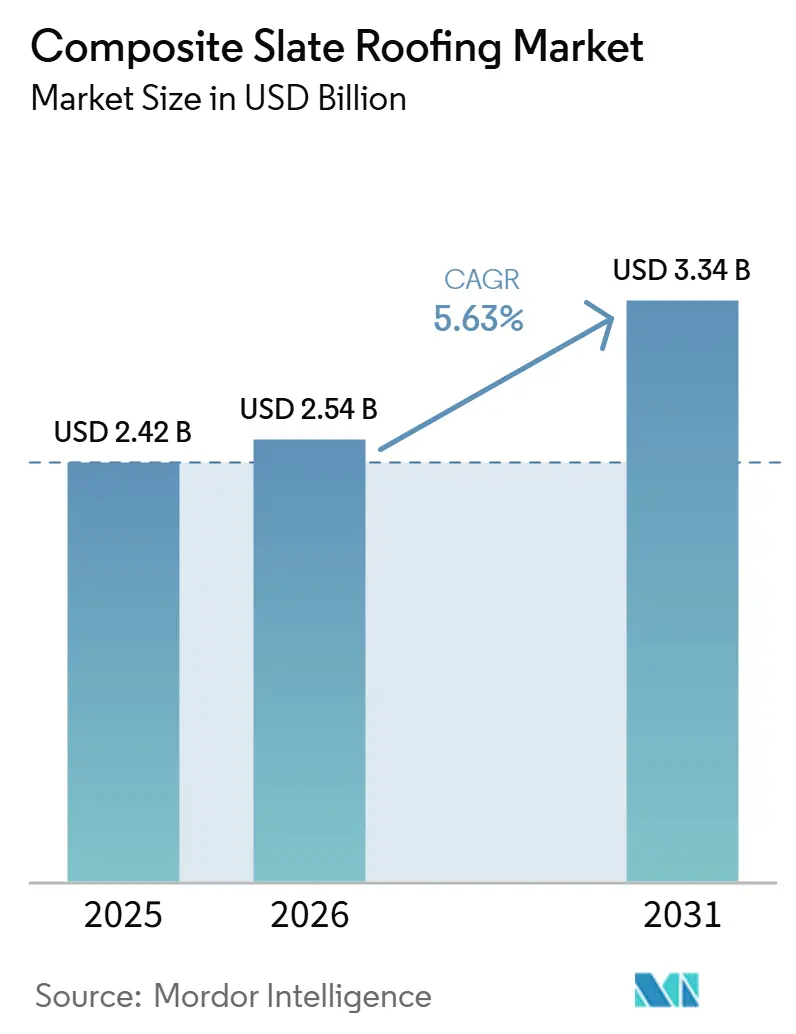
The composite slate roofing market size reached USD 2.42 billion in 2025 and USD 2.54 billion in 2026, before reaching USD 3.34 billion by 2031, and is expected to register a CAGR of 5.63% from 2026 to 2031. The market is expanding as buyers increasingly prioritize durability, lower maintenance requirements, and longer replacement cycles when evaluating roofing systems for residential and institutional properties. Insurance-linked reroofing activity is also gaining importance, as rising wind and hail losses are encouraging property owners to adopt higher-impact products that can support better coverage terms and reduce lifecycle disruption. The composite slate roofing market is also benefiting from stricter building standards, particularly in areas where cool roof performance, fire resistance, wind resistance, and product certification are becoming critical requirements for new projects and major renovations[1]California Energy Commission, “2025 Building Energy Efficiency Standards,” State of California, energy.ca.gov . Competition remains active between large building product groups and specialist manufacturers. Scale players rely on distribution networks and contractor relationships, while specialists compete through recycled content, impact ratings, and warranty depth. The composite slate roofing market still faces a significant price gap compared to conventional asphalt systems. However, the category is moving beyond a purely aesthetic upgrade and is increasingly being selected as a practical risk management and compliance solution in storm-exposed and code-sensitive applications.
Key Report Takeaways
- By type, shingles led with 54.72% revenue share in 2025, while panels are projected to grow the fastest at a 6.24% CAGR through 2031.
- By material type, polymer composite held 43.57% share in 2025, while recycled plastic composite is expected to record the highest CAGR at 6.52% through 2031.
- By end user, residential accounted for 65.14% share in 2025, while commercial is forecast to expand the fastest at a 6.11% CAGR through 2031.
- By installation type, renovation and replacement held 58.72% share in 2025, while new construction is projected to grow the fastest at a 5.91% CAGR through 2031.
- By roof type, sloped roofs captured 73.53% share in 2025, while flat roofs are expected to advance at the highest CAGR of 6.08% through 2031.
By geography, North America led with 41.82% share in 2025, while Asia-Pacific is projected to post the fastest regional CAGR at 6.34% through 2031.
Note: Market size and forecast figures in this report are generated using Mordor Intelligence’s proprietary estimation framework, updated with the latest available data and insights as of January 2026.
Market Trends and Insights
Drivers Impact Analysis of Composite Slate Roofing Market*
| Driver | (~) % Impact on CAGR Forecast | Geographic Relevance | Impact Timeline |
|---|---|---|---|
| Growing Demand for Durable and Low-Maintenance Roofing Solutions | +1.8% | Global, concentrated in North America and Europe | Short term (≤ 2 years) |
| Increasing Roof Replacement and Renovation Activities in Storm-Prone Regions | +1.5% | North America, Australia | Medium term (2-4 years) |
| Stringent Building Codes and Energy-Efficient Building Envelope Standards | +1.3% | North America and Europe, with spillover to core Asia-Pacific markets | Medium term (2-4 years) |
| Rising Preference for Lightweight Alternatives to Natural Slate Roofing | +1.0% | North America, Europe, Japan, South Korea | Short term (≤ 2 years) |
| Growing Investment in Impact-Resistant and Weather-Resilient Roofing Systems | +1.2% | North America, core Asia-Pacific markets, with spillover to Middle East and Africa | Medium term (2-4 years) |
| Source: Mordor Intelligence | |||
Growing Demand for Durable and Low-Maintenance Roofing Solutions
The composite slate roofing market benefits from a clear shift toward roofing systems that offer longer service intervals and lower upkeep over an asset’s lifecycle. Manufacturers commonly sell products in this category with warranties of 50 years or more, which significantly exceeds standard asphalt expectations and changes how owners assess replacement timing and long-term value. The composite slate roofing market also gains from stronger environmental documentation. For instance, EcoStar secured a UL-certified Environmental Product Declaration that highlights lower embodied carbon and reduced landfill pressure for its roofing products. As a result, buyers increasingly view roofs less as recurring repair items and more as long-lived building components that must address fire performance, structural integrity, weather exposure, and sustainability requirements within a single specification. This shift is strongest in aging residential stock and is also becoming more visible in institutional procurement, where longer lifecycle planning already influences building envelope decisions.
Increasing Roof Replacement and Renovation Activities in Storm-Prone Regions
The composite slate roofing market benefits from a replacement cycle increasingly linked to weather-related losses rather than age-based wear. In 2025, the average residential roof replacement cost reached USD 17,631, increasing the financial importance of selecting materials that improve durability and claim outcomes. Class 4 impact-rated systems are increasingly associated with insurance premium discounts, making roof replacement decisions financially significant beyond the repair scope alone. Since renovation and replacement already represented the largest installation pathway, this weather and insurance dynamic continues to reinforce the structural role of reroofing in the composite slate roofing market.
Stringent Building Codes and Energy-Efficient Building Envelope Standards
The composite slate roofing market benefits from stricter code frameworks that now influence specification decisions more directly than in the past. California’s 2025 Building Energy Efficiency Standards are scheduled to take effect on January 1, 2026, and are expected to reinforce performance thresholds for solar reflectance and thermal behavior, favoring compliant lightweight roofing systems. The International Energy Conservation Code and the EU Energy Performance of Buildings Directive are also raising envelope requirements across many jurisdictions, increasing the value of validated thermal and weather performance during product reviews. Westlake Royal’s DaVinci Roofscapes product family is expected to receive updated code evaluation reports in June 2025 under the 2024 IBC and IRC and the 2022 California Building Code, confirming compliance with fire, wind, hail-impact, and weather-resistance criteria. These compliance pathways matter because they create a durable demand floor that does not depend entirely on discretionary upgrade activity. As a result, the composite slate roofing market is gaining stronger support in regions where regulatory compliance cannot be delayed without project or permitting consequences.
Rising Preference for Lightweight Alternatives to Natural Slate Roofing
The composite slate roofing market is benefiting from a broader shift toward materials that preserve the visual profile of natural slate without imposing the same structural burden. Lightweight products are particularly attractive for reroofing older buildings, where deck capacity and framing limitations make heavier stone options difficult to justify. This advantage is important in residential renovation, institutional retrofits, and heritage-adjacent projects, where visual continuity remains a priority, but structural interventions can quickly increase project scope and cost. Westlake Royal Building Products has highlighted higher-education reroofing activity as an area where project stakeholders are evaluating synthetic slate for its long service life and premium appearance, without the weight penalty of quarried stone. As a result, the composite slate roofing market is expanding into applications that previously defaulted to natural slate at the high end or asphalt shingles in the mid-market, as lightweight composite options now address more of the performance and design gap. This trend is especially important where building owners seek premium curb appeal while working within retrofit budgets, contractor availability constraints, and existing roof structure limitations.
Restraints Impact Analysis of Composite Slate Roofing Market*
| Restraint | (~) % Impact on CAGR Forecast | Geographic Relevance | Impact Timeline |
|---|---|---|---|
| Higher Initial Installation Cost Compared to Conventional Roofing Materials | -0.8% | Global, most acute in Middle East and Africa, South America, and lower-income Asia-Pacific markets | Short term (≤ 2 years) |
| Performance and Aesthetic Preference for Natural Slate in Premium Applications | -0.5% | Europe and North America, especially in high-net-worth residential and heritage conservation projects | Long term (≥ 4 years) |
| Variations in Regional Building Codes and Product Certification Requirements | -0.4% | Global, most complex in multi-regulatory markets such as Europe and Asia-Pacific | Medium term (2-4 years) |
| Source: Mordor Intelligence | |||
Higher Initial Installation Cost Compared to Conventional Roofing Materials
The composite slate roofing market continues to face a significant adoption barrier, as installed system costs remain well above those of standard asphalt alternatives. This cost gap is especially important in price-sensitive residential segments, lower-income suburban applications, and developing regions, where roofing remains a functional purchase before it becomes a design or resilience-driven decision. The challenge persists because the category’s value proposition is strongest when buyers compare it with natural slate, while many customers are actually choosing between composite products and architectural asphalt shingles. Brava Roof Tile’s price reduction on its Multi-Width Slate Roof System in April 2026 would indicate that suppliers are actively trying to improve accessibility without moving away from performance-based positioning[2]Brava Roof Tile, “Brava Roof Tile Announces Price Reduction on Multi-Width Slate Roof System,” Retrofit Home Magazine, retrofithomemagazine.com. This move would also suggest that margin management remains tight in a segment influenced by recycled polymer availability and the cost of specialized additives that support fire and weather performance. For the composite slate roofing market, broader adoption is more likely to improve through lifecycle value education and insurance-linked benefits than through price compression alone.
Performance And Aesthetic Preference For Natural Slate In Premium Applications
The composite slate roofing market still faces limitations in high-end applications where authentic stone remains part of the design brief rather than serving only as a functional roofing choice. Heritage restoration, premium residential projects, and certain institutional developments continue to favor natural slate because material provenance, texture, and historical continuity matter as much as performance. This dynamic remains strongest in parts of Europe and select North American preservation contexts, where genuine slate holds architectural significance that composites have not fully displaced. Composite offerings have improved in texture, color depth, and visual realism; however, natural slate still retains an on-paper lifespan advantage in many buyer evaluations, particularly where long-term ownership considerations influence specification decisions. Preservation standards in listed or heritage-sensitive projects also make it harder for alternative materials to secure approval, even when they deliver strong weather performance. As a result, the composite slate roofing market can now address a broader premium segment than before, but it still does not fully replace natural slate in projects where authenticity remains the core requirement.
*Our forecasts treat driver/restraint impacts as directional, not additive. The impact forecasts reflect baseline growth, mix effects, and variable interactions.
Composite Slate Roofing Market Segment Analysis
By Type:
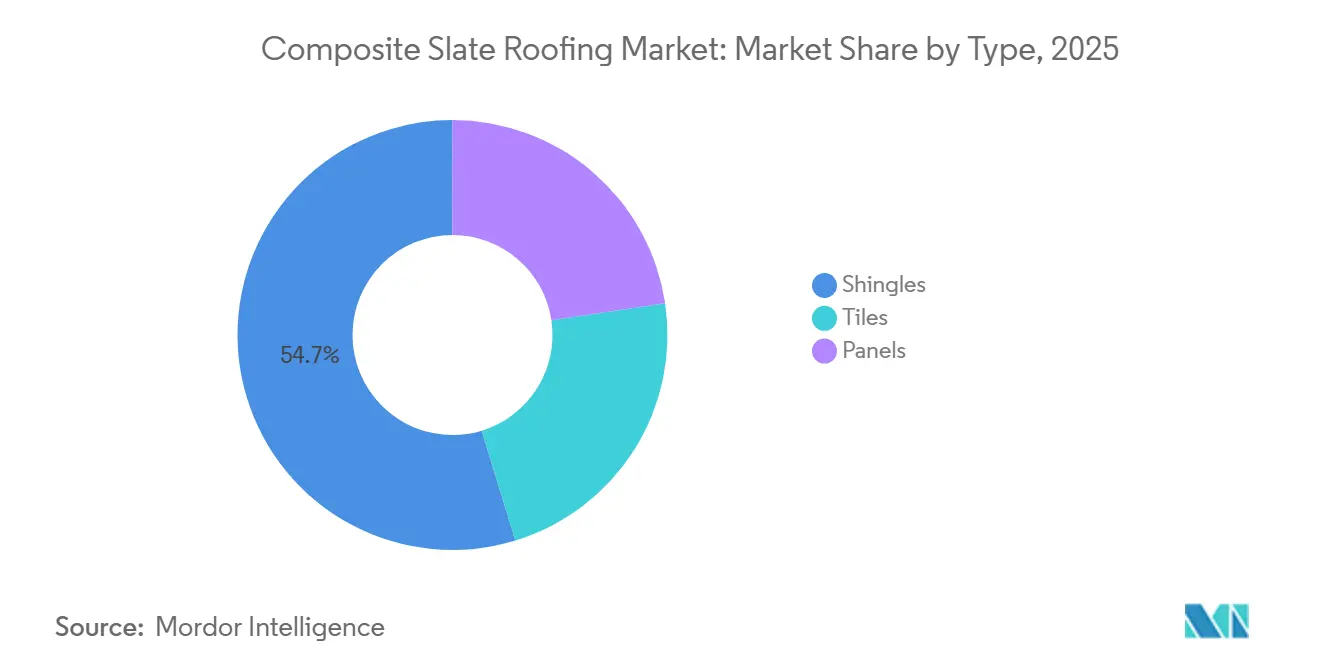
Renovation Economics Sustain Shingle DominanceShingles are expected to account for 54.72% of the composite slate roofing market size in 2025, reflecting their strong fit with the dominant reroofing workflow across mature residential markets. The shingle format aligns with existing contractor practices, keeps labor processes familiar, and reduces disruption in replacement projects. This factor is especially important in North America, where existing homes account for a large share of demand, rather than greenfield construction. Shingles also support faster quoting, simpler crew planning, and easier homeowner acceptance during time-sensitive, storm-related replacements. As a result, the composite slate roofing market is expected to keep shingles in the leading position, as the format aligns with the operational requirements of high-volume renovation demand.
Panels are projected to record the fastest growth, at a CAGR of 6.24% through 2031, driven by rising interest in interlocking systems that improve installation efficiency and weather performance. FWAVE’s XTM platform highlights this shift by combining an interlocking design with Class 4 impact resistance and a 150 mph wind warranty. Panels are also gaining traction in commercial settings, where project owners seek roofing solutions that offer a premium appearance and stronger wind-uplift performance. Tiles remain relevant in institutional and design-led applications, where a more traditional profile continues to hold value over longer specification cycles. ENERGY STAR roof product criteria are also encouraging product development focused on reflective performance, supporting formats that can integrate coatings and engineered surface behavior more effectively. Therefore, the composite slate roofing market is expected to retain shingle volume leadership while panel demand expands across commercial, resilience-led, and performance-sensitive use cases.



By Material Type:
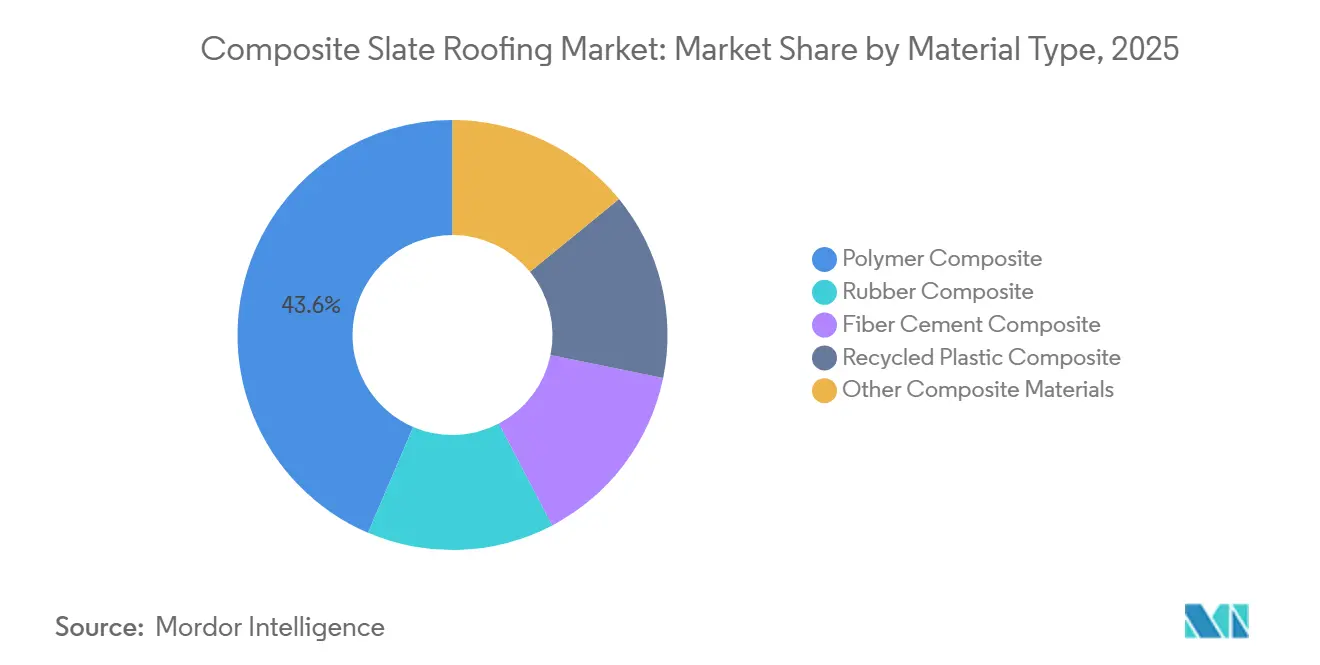
Polymer Leads, Recycled Plastics Reshape The Growth FrontierPolymer composite is expected to capture 43.57% of the composite slate roofing market share in 2025, supported by its established balance of color stability, impact resistance, and weather durability. Large manufacturers have commercialized this material base effectively by controlling formulation, quality consistency, and product certification across wider geographic footprints. Westlake Royal Building Products has positioned DaVinci Roofscapes around these performance strengths through formal product documentation and current code compliance support. Rubber composite and fiber cement composite continue to serve targeted niches where hail resilience, recycled feedstock use, or mid-market pricing can influence purchasing decisions. The composite slate roofing industry continues to depend heavily on polymer chemistry because it offers the broadest route to balancing weight, appearance, fire performance, and impact resistance in a single system.
Recycled plastic composite is forecast to register the fastest growth, at a CAGR of 6.52% through 2031, indicating that sustainability criteria are beginning to reshape material preferences within the composite slate roofing market. Commercial buyers and public projects are paying closer attention to recycled content, environmental declarations, and procurement rules that support lower lifecycle impact. A 2026 peer-reviewed study on waste plastics-integrated agro-waste roofing formulations is expected to argue that such materials could capture a meaningful share of future roofing demand while reducing embodied carbon, supporting the commercial direction already visible in this segment. EcoStar’s roofing range, which uses up to 80% upcycled content and is supported by a UL-certified Environmental Product Declaration, provides a direct commercial example of how the recycled-content proposition is moving from concept to specification. Rubber and fiber cement will remain relevant where their specific technical profiles fit project needs, but recycled plastics are increasingly setting the pace for material innovation, differentiation, and sustainability-led growth within the composite slate roofing market.
By End User:
Residential Anchors Volume, Commercial Leads On Growth RateResidential is expected to account for 65.14% of the composite slate roofing market share in 2025, confirming that homeowners remain the category’s core demand base. Suburban reroofing, storm-damage replacement, and the rising preference for products that combine aesthetic upgrades with stronger impact performance drive a large share of this demand. Insurance-linked decisions play a particularly important role in this part of the composite slate roofing market, as contractor recommendations and carrier incentives often influence the final material choice more than purely architectural preferences. As a result, residential volume leadership is likely to remain intact, even as buyer expectations shift from appearance alone toward durability, maintenance, and claims resilience.
Commercial is projected to be the fastest-growing end-user group, registering a CAGR of 6.11% through 2031. This growth reflects how institutional buyers evaluate roofing over long ownership periods. Higher-education campuses, government facilities, and religious properties are more likely to assess lifecycle value, warranty depth, and compliance requirements in formal specifications. Green building frameworks, such as LEED v4.1 and BREEAM, are also supporting interest in roof assemblies with documented reflectance and environmental credentials, helping composite products compete more effectively in non-residential procurement. Industrial demand remains smaller and is expected to grow more gradually. However, it still benefits from operators seeking lower maintenance exposure and better weather resistance than basic alternatives can provide. The composite slate roofing market is therefore showing a clear split between residential volume and commercial momentum, with each channel responding to a different mix of replacement urgency, compliance pressure, and lifecycle economics. This distinction allows suppliers to position the same product family differently across homeowner, contractor, architect, and institutional buyer conversations.
By Installation Type:
Replacement Dominates, New Construction Gains Structural MomentumRenovation and replacement are expected to account for 58.72% of the composite slate roofing market size in 2025, reflecting the fundamental structure of mature roofing demand. In many developed markets, existing buildings generate more roofing volume than new projects, especially in regions with older housing stock and rising claim activity due to severe weather. Owens Corning stated in 2025 that more than 80% of its United States roofing demand came from nondiscretionary reroofing and storm activity, supporting the broader role of replacement work across the category. Replacement projects also benefit from insurance claim funding, which reduces the extent to which homeowner affordability alone determines whether a roof is upgraded or simply repaired. For the composite slate roofing market, this creates a more resilient volume base because replacement needs are often mandatory rather than discretionary.
New construction is expected to record the fastest growth, at a CAGR of 5.91% through 2031. Greenfield residential and commercial activity in expanding regions, along with the design of new storm-hardened housing in exposed U.S. states, supports this growth. The new-build channel also gives manufacturers a stronger opportunity to influence specifications before budget pressures shift the focus mainly to replacement costs. Sustainability certifications, resilience frameworks, and energy code compliance are helping higher-performance roofing products gain early inclusion in project planning. This is important because the composite slate roofing industry can often compete more effectively when roof structure, visual design, and thermal performance are considered together from the outset. New construction will continue to trail replacement in absolute size, but it is becoming a more strategic channel for brand positioning and higher-value applications. Therefore, the composite slate roofing market is likely to remain replacement-led in volume terms while using new construction to strengthen specification depth, design influence, and long-term premium mix improvement.
By Roof Type:
Sloped Roofs Retain Structural Share, Flat Roofs Accelerate CommerciallySloped roofs are expected to account for 73.53% of the composite slate roofing market size in 2025, reflecting the architectural prevalence of pitched roofs across the category’s largest consumption regions. Composite slate products align naturally with sloped applications, as manufacturers developed their profiles, interlocking geometry, and dimensional appearance around this roof form. Residential construction in North America and Europe continues to favor pitched roofs, keeping sloped installations central to category demand. In these applications, the slate appearance also delivers the strongest visual value for homeowners and influences neighborhood-level renovation decisions. As a result, the composite slate roofing market has built its core installed base on sloped systems, where both performance and appearance support adoption.
Flat roofs are projected to record the fastest growth, at a CAGR of 6.08% through 2031, primarily as commercial and mixed-use building owners create more specification opportunities for differentiated composite systems. Low-slope and flat applications require greater attention to drainage, wind uplift, and assembly design, driving innovation in panelized and interlocking products. This shift aligns closely with the faster growth of commercial end users, who are more likely to consider premium exterior systems when they improve both resilience and visual identity. ASTM- and ICC-linked evaluation pathways are also helping expand the regulatory basis for polymeric roofing products in these applications, which remains important for broader project acceptance. While sloped roofs will continue to dominate overall volume, the composite slate roofing market is gradually expanding into flatter commercial formats, where institutional buyers seek both envelope performance and a more distinctive finished roofscape. This trend gives suppliers a meaningful growth runway beyond the category’s traditional residential stronghold.
Geography Analysis
North America Composite Slate Roofing Market
North America is projected to hold 41.82% of the composite slate roofing market size in 2025, keeping the region at the center of global demand. The United States remains the largest contributor, supported by strong reroofing activity, well-established insurance incentives for impact-rated materials, and aging housing stock that continues to drive replacement demand. The value of roof repair and replacement costs in the United States reached nearly USD 31 billion in 2024, with wind and hail accounting for more than half of all residential claims. California’s 2025 energy standards, effective January 2026, are expected to add a code-driven demand layer that favors compliant, lightweight, and thermally efficient roofing systems. Canada supports regional demand through requirements for winter durability and exposure to hail, while Mexico remains a smaller but visible opportunity in upper-tier residential development.
Europe Composite Slate Roofing Market
Europe is expected to hold the second-largest share of the composite slate roofing market, supported by renovation activity, stricter building envelope expectations, and the continued relevance of premium roof aesthetics. The EU Energy Performance of Buildings Directive and national standards, such as Germany’s GEG and France’s RE2020, support stronger demand for documented material performance in the building envelope. Environmental Product Declarations are also becoming more important in European procurement, benefiting companies that can provide verified lifecycle documentation, such as EcoStar. The region still presents structural limitations for composites in heritage work, but it remains an important premium and retrofit geography for the composite slate roofing market.
APAC, South America and MEA Composite Slate Roofing Market
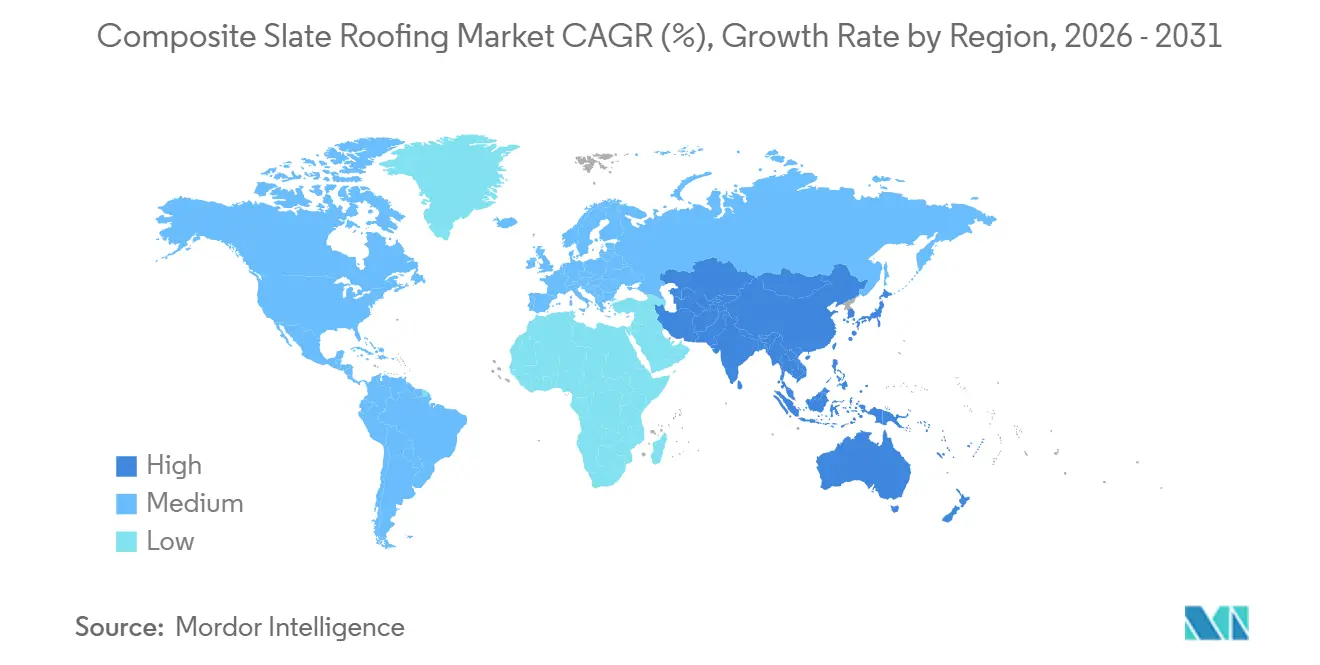
Asia-Pacific is expected to be the fastest-growing region in the composite slate roofing market, with a forecast CAGR of 6.34% through 2031. Construction activity across China, India, and Southeast Asia, along with rising acceptance of premium roofing materials in urban and institutional applications, supports this growth. Japan and South Korea also add relevance, as disaster-resilient building standards and weather exposure increase the value of lightweight, impact-resistant roofing systems. South America and the Middle East and Africa remain smaller in current scale, but Brazil and Saudi Arabia offer visible entry opportunities where premium residential demand and construction pipelines support niche expansion. In high-solar and weather-stressed settings, the composite slate roofing market can differentiate through lower maintenance needs, UV stability, and the ability to combine resilience with a premium appearance.

Competitive Landscape
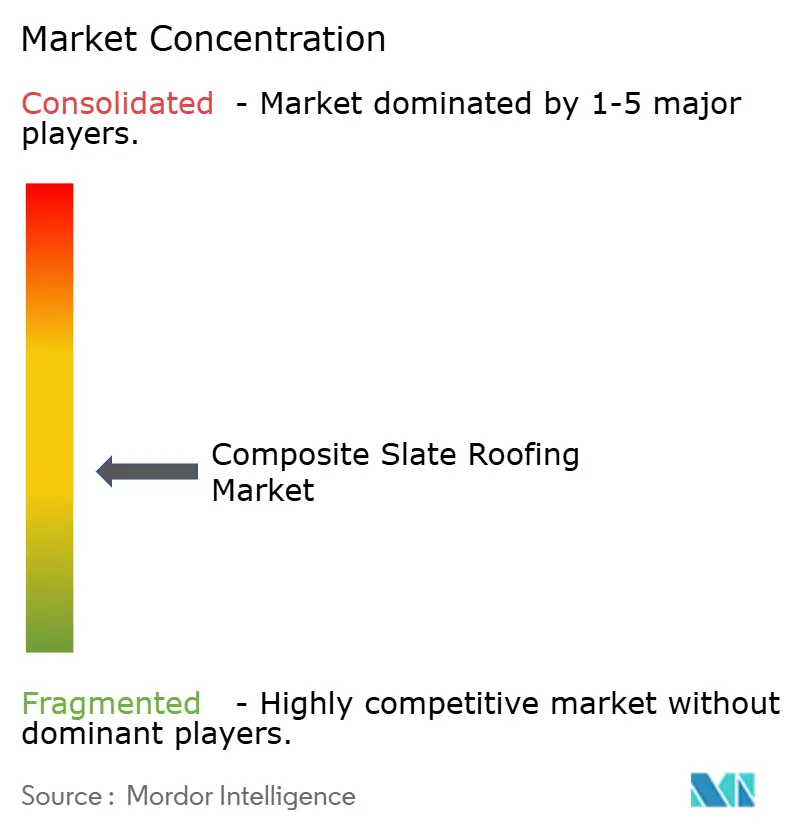
The composite slate roofing market remains moderately fragmented, with competition divided between diversified building materials groups and specialist composite roofing manufacturers. Large companies such as GAF Materials, Owens Corning, CertainTeed, and Westlake Royal Building Products benefit from national distribution networks, contractor familiarity, and the ability to support broader product portfolios across adjacent exterior categories. Specialist players such as Brava Roof Tile, EcoStar LLC, FWAVE, Enviroshake, and Euroshield compete by emphasizing recycled content, impact performance, design realism, and warranty depth. This mix keeps the composite slate roofing market active across both the premium specification segment and the replacement-driven volume segment. It also means that no single competitive model fully defines the category, as scale, technical differentiation, and channel relationships influence different stages of the buying process.
Strategic moves expected in 2025 and 2026 indicate how companies may defend their positions and expand their relevance in the composite slate roofing market. Owens Corning announced a new shingle plant in the southeastern United States in February 2025, with production expected to reach 6 million squares per year from 2027. This development signals confidence in long-term roofing demand and supply chain depth. Westlake Royal secured updated code evaluation support in June 2025 for multiple DaVinci and Inspire products, strengthening its specification credibility in regulated markets. EcoStar’s EPD-backed positioning and FWAVE’s interlocking, impact-resistant platform show how specialists are working to expand the category through sustainability and resilience rather than price alone.
Compliance depth is becoming a more important competitive moat in the composite slate roofing market, as approvals, code reports, and state-level recognition can materially affect both sell-through and specification access. Companies that maintain current evaluation reports across active code cycles, along with energy and sustainability documentation, are better positioned to win architect-led and insurer-sensitive projects. Florida’s updated mitigation form recognition for synthetic and composite tile in 2026 provides a strong example of how regulatory alignment can improve the category’s commercial viability in a demanding roofing state. At the same time, regional installers such as Baker Roofing Company and Colorado Roofing Contractors do not belong in the competitive set for this market, as they are service contractors rather than product manufacturers with relevant IP, manufacturing scale, or product portfolios. As a result, manufacturers that combine product validation, material innovation, distribution reach, and specification support primarily define the composite slate roofing market, which continues to expand but remains technically demanding.
Composite Slate Roofing Industry Leaders
Westlake Royal Building Products
CertainTeed, LLC
BRAVA Roof Tile
Ecostar
Enviroshake Quality Engineered Roofing
- *Disclaimer: Major Players sorted in no particular order
Composite Slate Roofing Market Companies Covered in this Report
- Atlas Roofing Corporation
- Baker Roofing Company
- Boral Roofing
- BRAVA Roof Tile
- CEDUR
- CertainTeed, LLC
- Colorado Roofing Contractors LLC
- Ecostar
- Enviroshake Quality Engineered Roofing
- Euroshield
- FWAVE
- GAF Materials LLC
- IKO Ltd
- Owens Corning
- TAMKO Building Products LLC
- Westlake Royal Building Products

Recent Industry Developments in Composite Slate Roofing Market
- June 2026: Brava Roof Tile announced that Florida's revised OIR-B1-1802 Uniform Mitigation Verification Inspection Form now officially lists “Synthetic/Composite Tile” as a recognized roof covering type. This regulatory milestone supports insurance alignment and specification adoption in one of the most demanding roofing code jurisdictions in the United States. The recognition strengthens the credibility of the composite category among insurers, specifiers, and building officials across Florida, which has more than 9 million insured residential properties.
- February 2025: Owens Corning announced plans to build a new shingle manufacturing plant in the southeastern United States. The facility is designed to produce approximately 6 million squares per year using a four-wide laminator with advanced automation. The plant is expected to create approximately 100 skilled manufacturing jobs, with production scheduled to begin in 2027.


Global Composite Slate Roofing Market Report Scope
Composite slate, or synthetic slate, roofing is an engineered alternative to natural stone slate. Manufacturers typically produce it using a blend of recyclable polymers, rubber, and crushed limestone. It offers the authentic, premium aesthetic of traditional slate while being significantly lighter, more crack-resistant, and easier to install.
The composite slate roofing market is segmented by type, material type, end-user, installation type, roof type, and geography. By type, the market is segmented into shingles, tiles, and panels. By material type, the market is segmented into polymer composite, rubber composite, fiber cement composite, recycled plastic composite, and other composite materials. By end user, the market is segmented into residential, commercial, and industrial. By installation type, the market is segmented into new construction, renovation and replacement. By roof type, the market is segmented into flat roofs and sloped roofs. The report also covers the composite slate roofing market size and forecasts for the composite slate roofing market in 16 countries across major regions. For each segment, the market sizing and forecasts have been done on the basis of value (USD).
| Shingles |
| Tiles |
| Panels |
| Polymer Composite |
| Rubber Composite |
| Fiber Cement Composite |
| Recycled Plastic Composite |
| Other Composite Materials |
| Residential |
| Commercial |
| Industrial |
| New Construction |
| Renovation and Replacement |
| Flat Roofs |
| Sloped Roofs |
| Asia-Pacific | China |
| India | |
| Japan | |
| South Korea | |
| Rest of Asia-Pacific | |
| North America | United States |
| Canada | |
| Mexico | |
| Europe | Germany |
| United Kingdom | |
| France | |
| Italy | |
| Russia | |
| Rest of Europe | |
| South America | Brazil |
| Argentina | |
| Rest of South America | |
| Middle-East and Africa | Saudi Arabia |
| South Africa | |
| Rest of Middle-East and Africa |
| By Type | Shingles | |
| Tiles | ||
| Panels | ||
| By Material Type | Polymer Composite | |
| Rubber Composite | ||
| Fiber Cement Composite | ||
| Recycled Plastic Composite | ||
| Other Composite Materials | ||
| By End User | Residential | |
| Commercial | ||
| Industrial | ||
| By Installation Type | New Construction | |
| Renovation and Replacement | ||
| By Roof Type | Flat Roofs | |
| Sloped Roofs | ||
| By Geography | Asia-Pacific | China |
| India | ||
| Japan | ||
| South Korea | ||
| Rest of Asia-Pacific | ||
| North America | United States | |
| Canada | ||
| Mexico | ||
| Europe | Germany | |
| United Kingdom | ||
| France | ||
| Italy | ||
| Russia | ||
| Rest of Europe | ||
| South America | Brazil | |
| Argentina | ||
| Rest of South America | ||
| Middle-East and Africa | Saudi Arabia | |
| South Africa | ||
| Rest of Middle-East and Africa | ||


Key Questions Answered in the Report
What is the projected value of the composite slate roofing market by 2031?
The composite slate roofing market is forecast to reach USD 3.34 billion by 2031, growing from USD 2.54 billion in 2026 at a CAGR of 5.63%.
Which product type leads the composite slate roofing market?
Shingles led the product type segment with a 54.72% share in 2025 because they fit established reroofing workflows and contractor installation practices.
Which material type is growing the fastest in the forecast period?
Recycled plastic composite is projected to grow the fastest at a 6.52% CAGR through 2031, supported by circular procurement trends and stronger environmental documentation.
Which region is growing the fastest in composite slate roofing market?
Asia-Pacific is expected to record the fastest regional growth, with a CAGR of 6.34% through 2031, as construction activity expands and the adoption of premium materials continues to increase.
Page last updated on:





