
Market Overview
| Study Period | 2020 - 2031 |
|---|---|
| Forecast Data Period | 2026 - 2031 |
| Base Year Market Size (2025) | 3.47 gigawatt |
| Market Volume (2026) | 3.61 gigawatt |
| Market Volume (2031) | 4.42 gigawatt |
| Growth Rate (2026 - 2031) | 4.12 % |
| Market Concentration | Medium |
Major Players *Disclaimer: Major Players sorted in no particular order Image © Mordor Intelligence. Reuse requires attribution under CC BY 4.0. | |
Romania Wind Energy Market Analysis by Mordor Intelligence
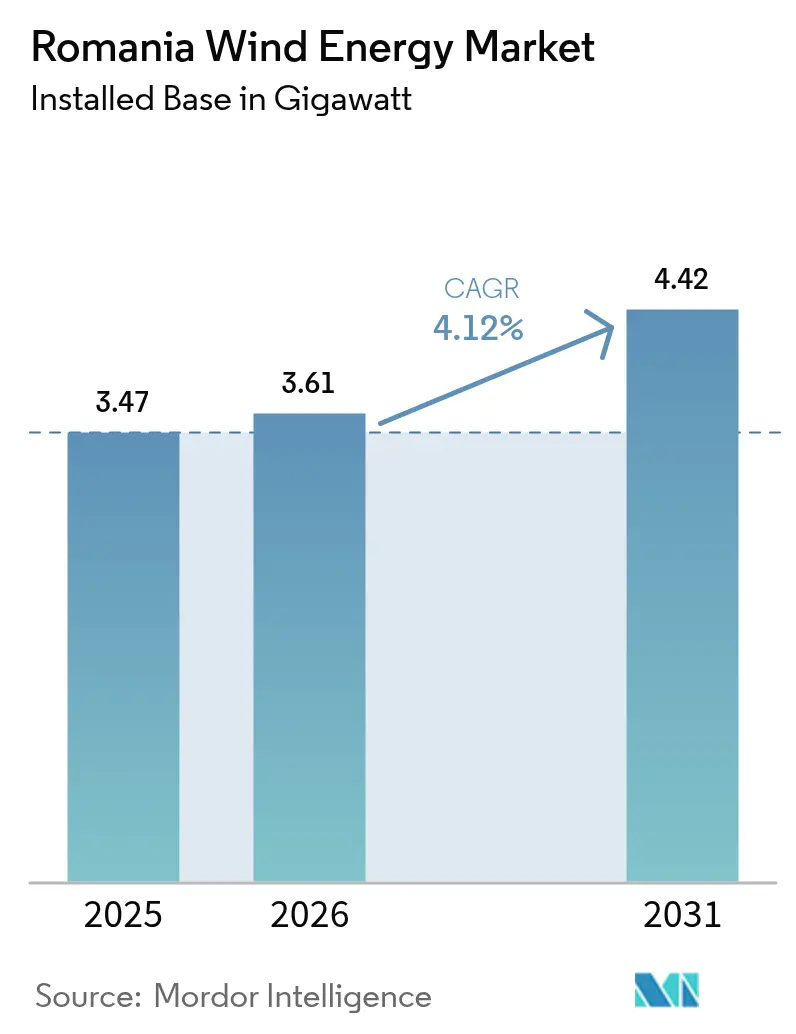
The Romania Wind Energy Market size was valued at 3.47 gigawatt in 2025 and estimated to grow from 3.61 gigawatt in 2026 to reach 4.42 gigawatt by 2031, at a CAGR of 4.12% during the forecast period (2026-2031).
- Over the medium term, the wind energy market in Romania is expected to be driven by favorable government programs and the country's strong wind energy potential during the forecast period.
- On the other hand, the increasing adoption of alternative renewable energy sources such as solar energy is expected to hinder the Romanian wind energy market during the forecast period.
- Nevertheless, the Romanian Ministry of Energy is enforcing new laws on offshore wind energy and help investors build it up. This is expected to create significant opportunities for the market in the forthcoming years.
Note: Market size and forecast figures in this report are generated using Mordor Intelligence’s proprietary estimation framework, updated with the latest available data and insights as of 2026.
Romania Wind Energy Market Trends and Insights
Onshore Wind Energy to Dominate the Market
- Romania's total installed wind energy capacity was from onshore wind farms is dominating. Wind energy production has been growing in Romania over the past decade. Romania's wind energy sector is the second-largest renewable energy source after hydropower.
- According to Energy Institute Statistical Review of World Energy 2023 data, wind energy generated about 12.56% of Romania's electricity, standing at second position among renewables, behind hydropower.
- Increasing government policies supporting the onshore wind farms are also pushing the wind sector in Romania. In August 2023, Romania launched its first auction for a contracts-for-difference (CfD) support scheme, which will tender 2,000 megawatts of solar PV and wind energy capacity projects, backed by 15-year power purchase agreements (PPAs).
- In January 2023, Vestas announced the closing of a turbine deal with DTEK Renewable International Moldova Eolian for the Ruginosa wind project with 600 MW capacity in Romania. The project will feature ten V162 turbines at 6 MW and have a height of 125 meters.
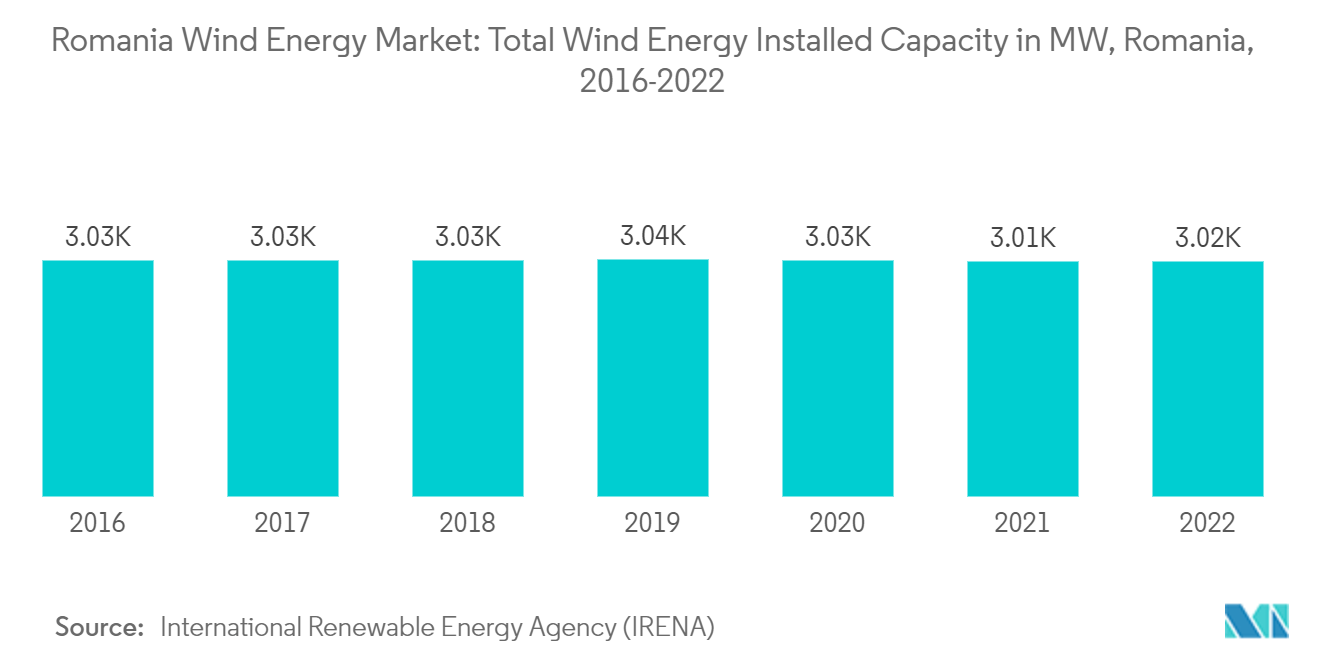
- According to International Renewable Energy Agency (IRENA) statistics, the onshore wind energy installed capacity in Romania reached 3,015 megawatts in 2022.
- Romania includes second-highest wind potential in Europe as it contains the Dobrogea region, which consists of Tulcea and Constanța counties. The country has an expected wind power potential of 14,000 Megawatt, out of which only a small portion has only been developed.
- Although the installed wind energy capacity has remained constant for the past few years, upcoming wind energy projects and plans to increase the renewable energy share in the country's power generation mix are expected to drive the market during the forecast period.


Increasing Adoption of Alternative Energy Sources Restraining Market Growth
- Romania's renewable energy mix is dominated by wind and hydropower. But this scenario has begun to change fast with the growth of solar energy and bioenergy.
- Romania's solar potential is widespread as well. The country benefits from about 210 sunny days per year and direct solar irradiation levels of around 1100 to 1350 kWh ∙ m–2 per year, which are considered viable for developing large-scale solar PV projects.
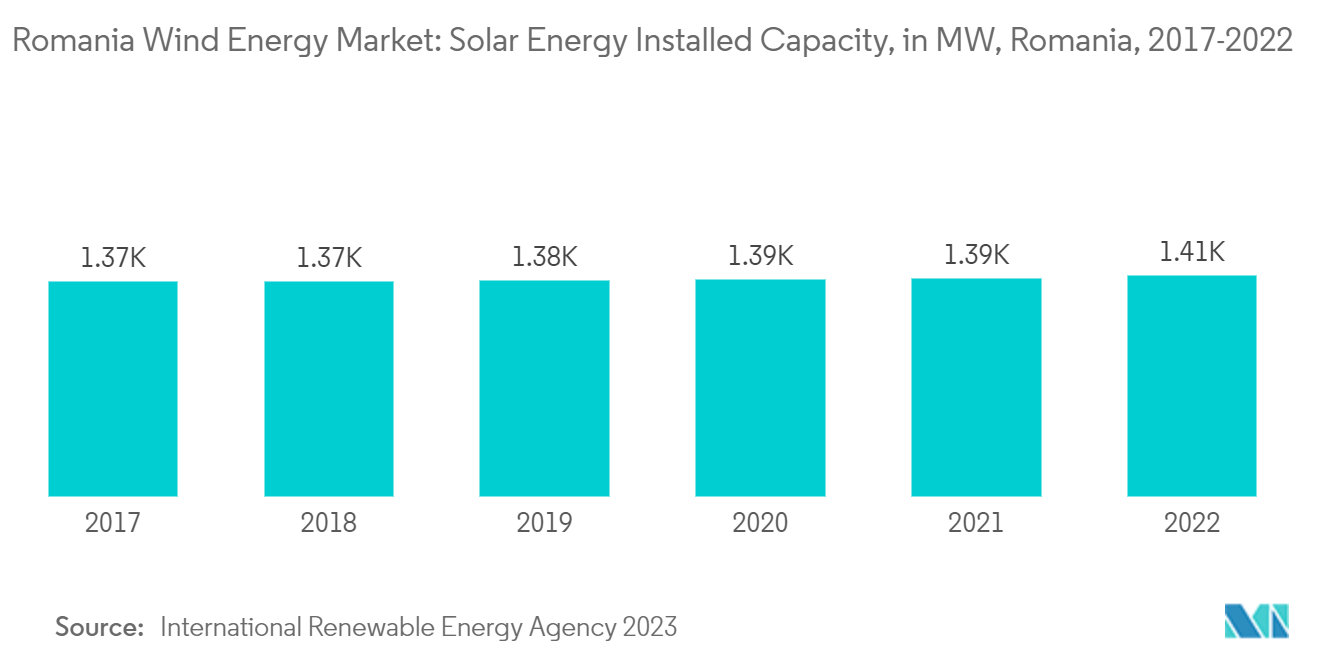
- According to International Renewable Energy Agency (IRENA) data, the total capacity of Solar energy sources as of 2022 was 1,414 megawatts (MW), increasing from 1,394 MW in 2021, thus showing the active role of Increasing Solar Energy Installations, restraining the Wind Energy Market in Romania during the forecast period.
- Solar energy has witnessed substantial growth in Romania in recent years, mainly driven by decreasing prices of solar panels, favorable government policies, and their ability to be installed on a small scale for households and commercial centers.
- In 2022, the Romanian government revealed plans to hold the country's first tender for utility-scale renewables projects in the first half of 2022, of which around 2 GW were expected to come from solar power. The ultimate goal of the government is to achieve at least 3 GW of additional renewable capacity by 2026.
- In April 2023, Amsterdam-based Independent Power Producer Photon Energy NV announced that it had finalised three solar PV projects totalling 6 MWp near the city of Calafat, Romania, and connected the plants to the grid. The newly commissioned solar farms have enabled Photon to pass the symbolic milestone of 100 MWp and reach 103.6 MWp of combined generation capacity across its markets.
- Therefore such developments finally results in solar power industry in the country growing faster than the wind power industry. This is expected to slow down the market during the forecast period.
Regulatory Landscape
Romania's wind sector is governed mainly by Electricity and Gas Law No. 123/2012 and Law No. 220/2008 for promoting electricity from renewable sources, with ANRE overseeing licensing and compliance and Transelectrica acting as the transmission system operator for grid access. In support mechanisms, the Ministry of Energy has advanced a Contracts for Difference (CfD) framework used for utility-scale renewables auctions, aligning new-build wind projects with long-tenor revenue stabilization instruments.
A key recent regulatory anchor is Law No. 121/2024, which established the legal framework for offshore wind in the Black Sea and assigns the Ministry of Energy a central role in designating offshore perimeters. On grid access, ANRE Order No. 53/2024 introduced an auction-based capacity allocation mechanism for connecting new generation projects of at least 5 MW, with the mechanism effective from January 1, 2026, replacing the first-come, first-served approach and changing the sequencing and bankability milestones for wind developers.
Value Chain Analysis
Romania's wind value chain is led by project developers and IPPs that originate sites, manage permitting and land rights, contract resource assessment and engineering, and secure routes to market through CfDs and other offtake structures. Equipment procurement is centered on turbine OEMs and their logistics and installation partners, while balance-of-plant (civil works, foundations, roads, cabling, substations) is delivered by EPC and construction contractors. For example, Rezolv Energy awarded the balance-of-plant contract for Phase 2 of the 461 MW Vifor wind farm to PORR in 2025, alongside turbine supply from Vestas.
Downstream, grid connection and dispatch depend on Transelectrica's network and the distribution operators, with ANRE regulating connection rules and licensing. The main operational bottlenecks cited by market participants are grid congestion and the availability and timing of connection capacity, which is now compounded by the shift toward auction-based connection capacity allocation for projects of at least 5 MW effective from January 1, 2026 under ANRE Order No. 53/2024. This change alters project development sequencing and increases the importance of early grid strategy and financial readiness.
Competitive Landscape
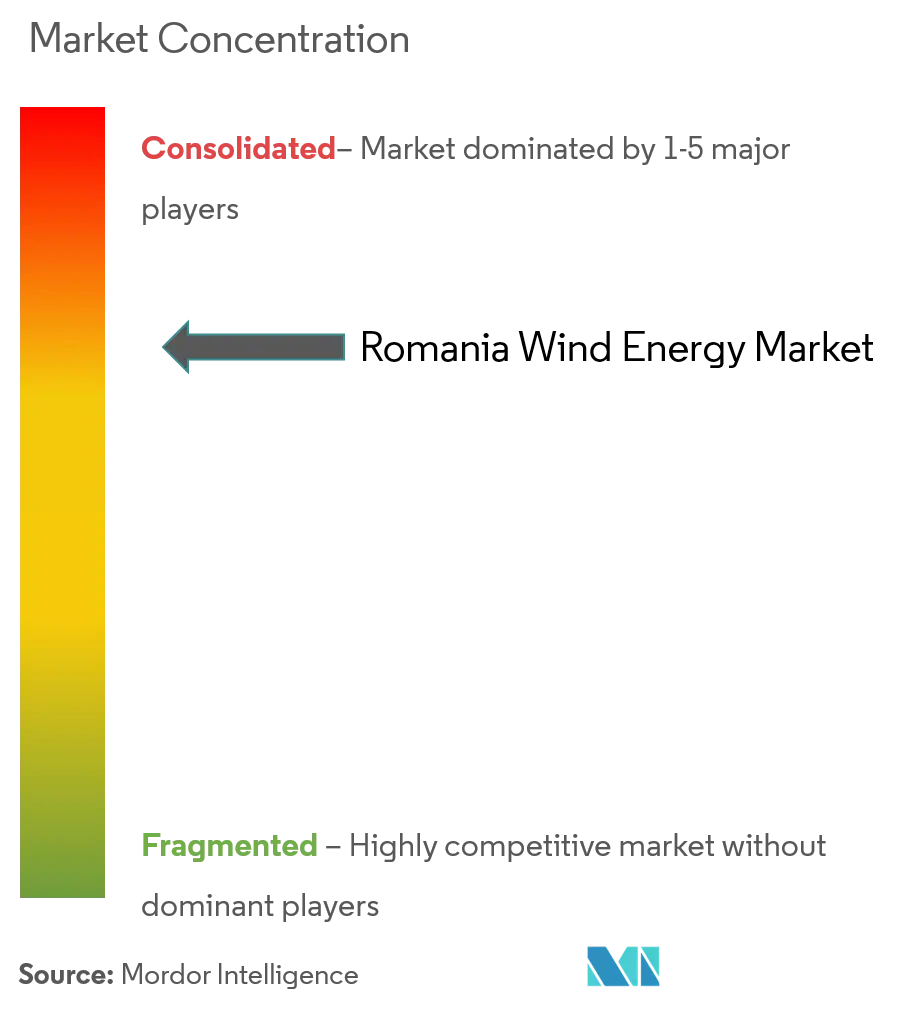
The Romanian wind energy market is semi-consolidated. Some of the major players (in no particular order) include CEZ Romania, Enel Green Power SpA, Verbund AG, Siemens Gamesa Renewable Energy SA, and EDP Sp Energias de Portugal.
Romania Wind Energy Industry Leaders
VERBUND AG
Siemens Gamesa Renewable Energy, S.A
Enel Green Power S.p.A.
EDP - Energias de Portugal
CEZ Romania
- *Disclaimer: Major Players sorted in no particular order

Market Opportunities and Future Outlook
Offshore wind development is a clear expansion whitespace given Law No. 121/2024, which established a dedicated legal framework for offshore wind in the Black Sea and positions the Ministry of Energy to designate perimeters. This should enable developers and the supply chain to advance early-stage studies, permitting strategies, and port and logistics planning. In parallel, the CfD program provides a structured route to long-term contracted revenues, with auctions initiated by the Ministry of Energy and managed through sector institutions, creating a defined pipeline pathway for new onshore wind additions beyond merchant-only economics.
The onshore opportunity is reinforced by visible project financing and execution activity in Constanta county and other wind-resource areas, where institutional-scale projects have reached bankable milestones. In June 2026, Copenhagen Infrastructure Partners reached financial close on the 392 MW Pestera II onshore wind farm with approximately EUR 510 million in financing, reflecting active lender appetite for CfD-backed wind assets. Eurowind Energy's commissioning activity at Pecineaga (48 MW) using Siemens Gamesa SG 6.6-170 turbines also points to technology upgrades and supply-chain engagement around higher-capacity machines, which supports repowering and new-build optimization where grid access and permitting align.
Recent Industry Developments
- June 2026: Copenhagen Infrastructure Partners reached financial close on the 392 MW Pestera II onshore wind project in Constanta county, backed by around EUR 510 million in financing. The milestone moves the project from development into an executed investment phase and underscores the role of bankable contracted revenues in scaling new wind capacity in Romania.
- April 2026: Eurowind Energy inaugurated the 48 MW Pecineaga wind farm in Constanta county, with a reported EUR 90 million investment using eight Siemens Gamesa SG 6.6-170 turbines. The project adds modern turbine technology to the Romanian fleet and supports local installation and commissioning for large-format machines.
- August 2025: Romania's Ministry of Energy concluded the second round of renewable energy auctions, allocating about 1.26 GW of wind capacity against a 2 GW wind quota. The partial allocation highlighted the importance of the CfD mechanism for new builds and the practical constraints developers face in getting projects auction-ready, including grid and permitting readiness.


Research Methodology Framework and Report Scope
Market Definition and Coverage
For this methodology, the Romania wind energy market is defined as the country-level installed wind power capacity connected to the grid, reported in gigawatts, and tracked across operating wind farms.
Scope exclusions: We exclude project revenues, EPC and O&M service value, and non-grid or off-grid pilot installations that are not reflected in official installed-capacity reporting.
Segmentation Overview
- Onshore
- Offshore
Data Sources, Market Sizing, and Validation
Desk Research
Desk work started by building a clean historical time series for Romania wind installations, net additions, and retirements, aligned to how the market is measured in this study. We relied on public and official sources such as national energy regulator publications, transmission system operator grid connection and dispatch updates, Eurostat energy statistics, and the International Energy Agency energy databases, then cross-checked against Renewable Energy Country Profiles where available.
To make the model practical, we also used non-paywalled project announcements, permitting updates, and policy documents that affect commissioning timing, including auction design, grid access rules, and connection queues. Company filings and investor presentations helped validate commissioning schedules and typical turbine nameplate ranges used in Romania. In a few cases, a paid subscription focused on company financials and news was used only to verify timelines and ownership changes. These sources are illustrative, and many other references were used to collect, validate, and clarify the underlying data.
Primary Interviews and Surveys
Expert interviews and surveys with wind-farm developers, equipment and service providers, grid specialists, regulators, and energy buyers in Romania test commissioning dates, capacity factors, project pipelines, power prices, and local procurement. We use the findings to fill gaps, validate CfD treatment, and adjust assumptions when announced projects are not yet operating. Re-contact is triggered by material changes in project status, tariffs, or grid milestones.
Distribution of primary research fieldwork respondents
| Company type | Respondent position |
|---|---|
| Top tier: 32% | CXOs: 15% |
| Mid tier: 48% | Functional/Unit leaders: 30% |
| Smaller Players: 20% | Managers: 55% |
Market-Sizing & Forecasting
The core sizing logic is a top-down reconstruction of installed capacity by year, built from official capacity reporting, grid connection disclosures, and documented commissioning and decommissioning events. Once the national total is set, it is checked with selective bottom-up approximations using visible project lists, sampled turbine nameplate capacity, and developer pipeline sanity checks, which helps adjust for timing gaps and reporting lags.
Key inputs used in the model include annual net additions (MW), connection and permitting status of late-stage projects, expected commissioning slippage, repowering likelihood for older assets, and grid constraint signals that can delay practical energization. Where public sources were thin on project timing, we used primary feedback to apply conservative COD probability weights to the pipeline, and then rolled this into year-by-year capacity outcomes.
For forecasting, scenario analysis was used because commissioning schedules depend heavily on grid availability and policy follow-through, which do not always move like a smooth time series. Base, faster, and slower cases were built around practical indicators such as auction cadence, connection queue movement, and financing readiness, and then the final forecast path was selected after reconciling with expert consensus on what is buildable in Romania.
Data Validation & Update Cycle
Validation is done by comparing the modeled installed capacity against independent signals such as official grid-connected capacity totals, visible commissioning news, and year-over-year changes implied by project COD lists. Outliers are reviewed in a second pass, and if a large variance is seen, the assumptions on COD timing or retirements are revisited and the relevant experts are re-contacted.
Before sign-off, the numbers and logic are reviewed across analysts so calculation steps, unit handling, and year definitions remain consistent. Reports are refreshed annually, with interim updates when material events occur such as major auction announcements, rule changes, or unexpected commissioning delays. Right before delivery, a quick market scan is completed so clients receive the latest updated view.
Mordor Intelligence's Romania Wind Energy Market Size Measured Against Other Published Estimates
Published market figures for Romania wind energy often do not match because the unit of measurement and the timing choices differ, even when the topic sounds the same. Some sources report money value, others report installed capacity, and the year used for conversion and updates can shift the stated size.
The spread also reflects how commissioning is counted, which is why refresh cadence and cut-off dates matter in practice. When FX timing or price assumptions are used to translate capacity activity into USD, totals can move quickly, especially if a study mixes pipeline value with operating capacity. A refresh-led approach that re-checks COD and uses the same year definition for currency conversion is what keeps Mordor Intelligence aligned to a consistent installed-capacity series for Romania.
Benchmark comparison
| Source | Market Size | Gaps in Research Methodology |
|---|---|---|
| Mordor Intelligence | USD 3.47 B (2025) | |
| Global Consultancy A | USD 1.31 B (2024) | Reports market value in USD, which is sensitive to capex assumptions, FX timing, and whether pipeline activity is counted alongside operating assets, instead of using installed capacity as the core market unit. |
| Industry Bulletin B | USD 3.30 B (2024) | Uses end-2024 cumulative installed capacity as a snapshot, which can differ from a base-year definition that applies a consistent cut-off and incorporates verified net additions and retirements during the year. |
The table indicates that most of the gap is not specific to Romania itself, but instead reflects what is being measured and when the estimates were last refreshed. By keeping the market unit anchored to verified installed capacity and using consistent year cut-offs and checks on commissioning timing, the final size stays traceable to clear steps that can be repeated.


Key Questions Answered in the Report
How big is the Romania Wind Energy Market?
The Romania Wind Energy Market size is expected to reach 3.61 gigawatt in 2026 and grow at a CAGR of 4.12% to reach 4.42 gigawatt by 2031.
What is the current Romania Wind Energy Market size?
In 2026, the Romania Wind Energy Market size is expected to reach 3.61 gigawatt.
Who are the key players in Romania Wind Energy Market?
VERBUND AG, Siemens Gamesa Renewable Energy, S.A, Enel Green Power S.p.A., EDP - Energias de Portugal and CEZ Romania are the major companies operating in the Romania Wind Energy Market.
What years does this Romania Wind Energy Market cover, and what was the market size in 2025?
In 2025, the Romania Wind Energy Market size was estimated at 3.61 gigawatt. The report covers the Romania Wind Energy Market historical market size for years: 2019, 2020, 2021, 2022, 2023 and 2024. The report also forecasts the Romania Wind Energy Market size for years: 2026, 2027, 2028, 2029, 2030 and 2031.
Page last updated on:


 Your data is secure and never sold or shared.


