
Scandinavian Residential Real Estate Market Size and Share
Market Overview
| Study Period | 2020 - 2031 |
|---|---|
| Forecast Data Period | 2026 - 2031 |
| Base Year Market Size (2025) | USD 28.12 Billion |
| Market Size (2026) | USD 29.75 Billion |
| Market Size (2031) | USD 39.44 Billion |
| Growth Rate (2026 - 2031) | 5.80 % |
| Market Concentration | Medium |
Major Players.webp) *Disclaimer: Major Players sorted in no particular order Image © Mordor Intelligence. Reuse requires attribution under CC BY 4.0. | |
Scandinavian Residential Real Estate Market Analysis by Mordor Intelligence
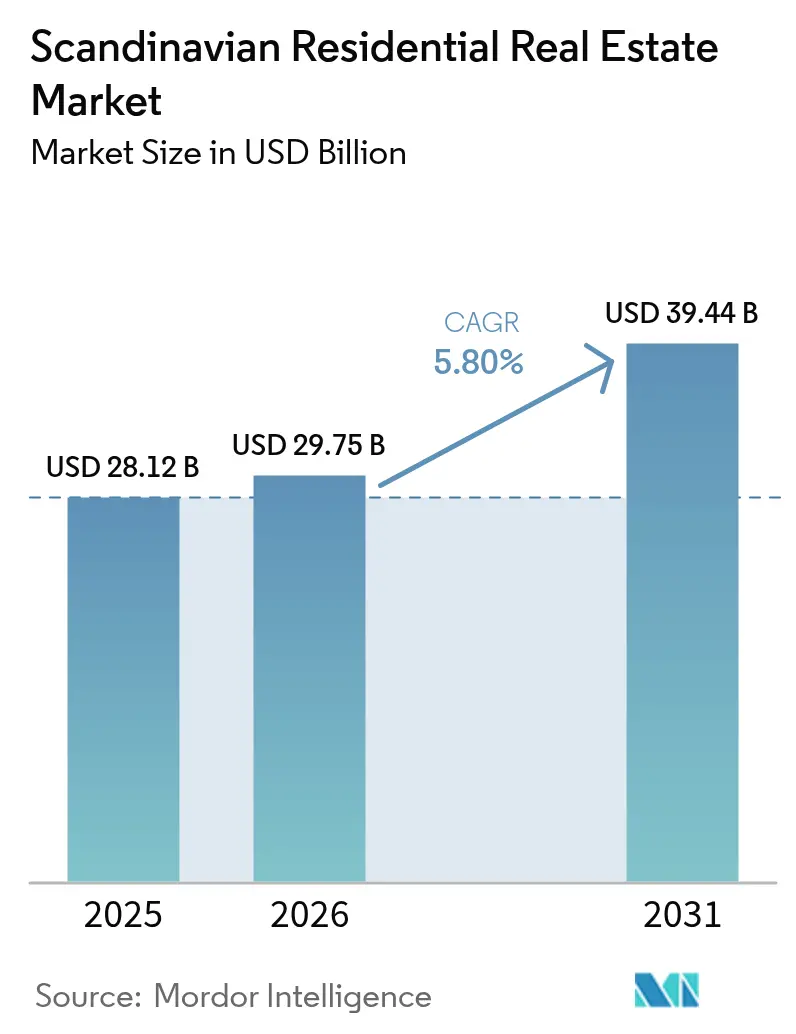
Scandinavian residential real estate market size in 2026 is estimated at USD 29.75 billion, growing from 2025 value of USD 28.12 billion with 2031 projections showing USD 39.44 billion, growing at 5.80% CAGR over 2026-2031. Normalized interest rates, a surge of institutional capital and demographic shifts toward renting underpin this growth trajectory[1]. Sweden’s rapid rate-cut cycle, Denmark’s consistent 4.2% annual price gains through 2026 and Norway’s looser lending terms collectively expand transaction volumes and bolster pricing power[2]. Tight urban land supply intensifies demand for high-density apartments, while EU-aligned green-building rules accelerate new-build activity across the Scandinavian residential real estate market. Institutional investors, lured by predictable rental cash flows and ESG credentials, now treat housing as a core allocation alongside logistics and infrastructure.
Key Report Takeaways
- By property type, apartments and condominiums commanded 58.62% share of the Scandinavian residential real estate market size in 2025 and are projected to grow at a 6.02% CAGR through 2031.
- By price band, the mid-market segment held 45.55% share of the Scandinavian residential real estate market size in 2025; the affordable tier is advancing at a 6.08% CAGR to 2031.
- By business model, rental housing captured 19.35% of Scandinavian residential real estate market share in 2025 and is forecast to expand at 6.74% CAGR through 2031.
- By mode of sale, primary transactions accounted for 37.45% share of the Scandinavian residential real estate market size in 2025 and will grow at 6.79% CAGR between 2026-2031.
- By geography, Sweden led with 47.60% of Scandinavian residential real estate market share in 2025, while Denmark is forecast to expand at 6.86% CAGR to 2031.
Note: Market size and forecast figures in this report are generated using Mordor Intelligence’s proprietary estimation framework, updated with the latest available data and insights as of 2026.
Market Trends and Insights
Drivers Impact Analysis of Scandinavian Residential Real Estate Market*
| Driver | (~) % Impact on CAGR Forecast | Geographic Relevance | Impact Timeline |
|---|---|---|---|
| Interest-rate normalisation & expected cuts | +1.5% | Global, strongest in Sweden and Norway | Short term (≤ 2 years) |
| Rapid urbanisation & shrinking household size | +1.2% | Sweden and Denmark urban centers, spillover to Norway | Medium term (2-4 years) |
| Institutional capital inflow & REIT expansion | +1.1% | Stockholm and Copenhagen | Medium term (2-4 years) |
| Green-housing incentives & EPC regulation | +0.8% | EU-wide, early adoption in Denmark and Sweden | Long term (≥ 4 years) |
| Municipal land-release reforms | +0.7% | National policies, city-specific execution | Long term (≥ 4 years) |
| Cross-border remote-worker inflow | +0.6% | Major urban centers | Medium term (2-4 years) |
| Source: Mordor Intelligence | |||
Interest-Rate Normalisation & Expected Cuts
The Riksbank’s key rate is set to slide to 2.25% by 2025, while Norges Bank guides toward a 3.25% base rate, lowering mortgage servicing costs and boosting loan approvals. Sweden saw investment volumes rebound 66% year-over-year to SEK 138.5 billion in 2024, with residential assets representing 28% of deal flow. Danish mortgage coupons stabilised near 3.5%, opening regional arbitrage opportunities for cross-border capital. First-time buyers already make up half of new Norwegian home loans after down-payment rules eased, signalling rising proprietorship demand. Cheaper credit also galvanises institutional allocations, a structural boon for the Scandinavian residential real estate market.
Rapid Urbanisation & Shrinking Household Size
Population concentration and smaller household units intensify demand for compact apartments in Stockholm, Copenhagen and Oslo. Average household size is falling, prompting developers to prioritize micro-units, coworking lounges and shared amenities that raise per-square-meter revenue while preserving affordability. Oslo’s central districts posted 6% price growth in 2024, underscoring how urban cores command a premium despite flexible work trends. The Scandinavian residential real estate market therefore pivots toward high-density projects that limit commute times and offer lifestyle convenience. Remote workers still gravitate to lively neighborhoods, reinforcing the value proposition of centrally located apartments.
Institutional Capital Inflow & REIT Expansion
Residential allocations now rank third in global cross-border flows into Europe, jumping 10% to USD 21.63 billion in H2 2024. Foreign investors accounted for 45% of Danish residential trades in the same period, attracted by krona hedging benefits and stable yields. Stockholm REITs achieved liquidity spikes after regulatory tweaks simplified unit issuance, enabling retail investors to piggy-back on institutional underwriting. Scale-seeking pension funds back build-to-rent vehicles that promise predictable income and ESG compliance, deepening capital pools for the Scandinavian residential real estate market. Manager competition now centres on track record and sustainability scores rather than leverage.
Green-Housing Incentives & EPC Regulation
Denmark will cap operational emissions for all new housing at 7.1 kg CO2e/m²/year from July 2025, forcing a shift toward timber, recycled steel and on-site renewables. Stockholm Wood City, a 2,000-unit mass-timber district, exemplifies the cost and branding upside of exceeding minimum environmental thresholds. Nordic lenders offer interest-rate rebates for EPC-rated projects, translating sustainability into cheaper capital. Energy-efficient stock realizes rental premiums and lower vacancy risk, bolstering cash-flow resilience across the Scandinavian residential real estate market. Developers integrating heat-pump systems and smart-metering platforms report faster pre-sales and reduced lifecycle costs.
Restraints Impact Analysis of Scandinavian Residential Real Estate Market*
| Restraint | (~) % Impact on CAGR Forecast | Geographic Relevance | Impact Timeline |
|---|---|---|---|
| High household indebtedness | -0.9% | Norway and Sweden, moderate effect in Denmark | Short term (≤ 2 years) |
| Macro-prudential lending caps (LTV/DSI) | -0.7% | All three countries with varying implementation | Medium term (2-4 years) |
| Skilled-labour shortage in modern timber construction | -0.6% | Sweden and Denmark mass-timber projects, spillover to Norway | Medium term (2-4 years) |
| Climate-adaptation cost for coastal homes | -0.5% | Denmark and Norway coastal zones, limited pockets in Sweden | Long term (≥ 4 years) |
| Source: Mordor Intelligence | |||
High Household Indebtedness
Norwegian households allocate a significant share of disposable income to mortgages, with 14.5% experiencing acute strain during 2023’s rate spike[3]. Sweden and Denmark likewise face elevated debt-to-income ratios, prompting warnings from the European Systemic Risk Board about variable-rate exposure. Heavy leverage curbs upgrade activity and dampens speculative demand across the Scandinavian residential real estate market. Younger buyers juggling student loans and rising living costs delay ownership, sustaining rental demand but clipping sales momentum. Banks respond with tougher underwriting, preserving asset-quality ratios at the expense of loan-book growth.
Macro-Prudential Lending Caps (LTV/DSI)
Regulators maintain LTV ceilings and impose debt-service limits to contain systemic risk, thereby capping leverage available to first-time buyers. Norway’s down-payment cut to 10% eases entry but overall borrowing power remains constrained by DSI rules, particularly in Oslo’s pricey districts. Stockholm buyers confront similar affordability walls as banks stress-test loans at interest-rate buffers well above prevailing coupons. While these policies fortify financial stability, they slow turnover and temper price escalation within the Scandinavian residential real estate market. Developers pivot to rental and co-living offerings to monetise demand sidelined by credit caps.
*Our forecasts treat driver/restraint impacts as directional, not additive. The impact forecasts reflect baseline growth, mix effects, and variable interactions.
Scandinavian Residential Real Estate Market Segment Analysis
By Property Type:
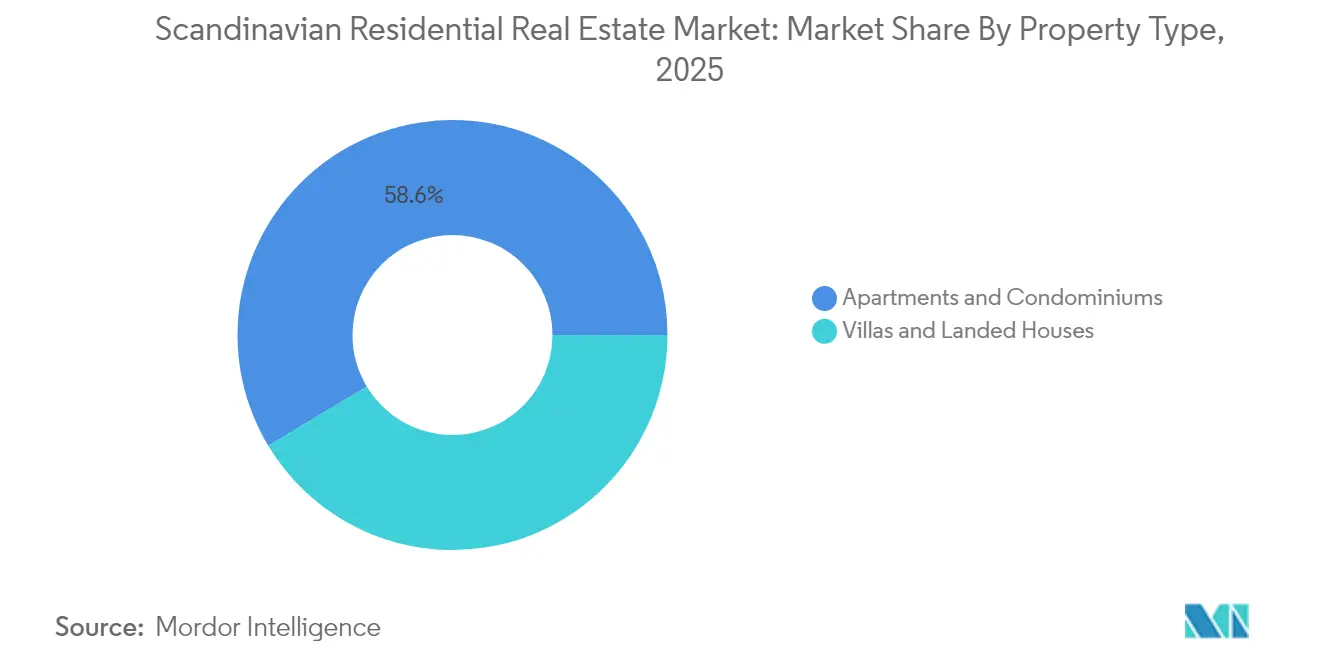
Apartments Drive Urban DensityApartments and condominiums secured 58.62% of Scandinavian residential real estate market share in 2025 and register the fastest 6.02% CAGR through 2031. Villas hold the remaining 41.38%, appealing to families favoring private outdoor space in commuter belts. High land costs, zoning limits and mass-timber modular systems give apartments superior build-economics, supporting sustained outperformance in the Scandinavian residential real estate market.
Stockholm Wood City’s 2,000 units illustrate how embedded coworking, EV charging and neutral-carbon credentials unlock premiums among eco-conscious urbanites. Developers also exploit density bonuses offered by municipalities to integrate public transport nodes and mixed-use podiums. Energy-sharing heat grids cut operating bills, reinforcing occupancy stability for institutional landlords and underpinning the segment’s contribution to Scandinavian residential real estate market size.

By Price Band:
Mid-Market Dominance Faces Affordable PressureMid-market homes represented 45.55% of Scandinavian residential real estate market size in 2025, balancing quality and cost for dual-income households. Yet policy-backed affordable stock is expanding at 6.08% CAGR, aided by municipal land-release auctions and favourable VAT waivers.
Danish schemes permitting shared-equity mortgages have widened the buyer base, creating tailwinds for affordable builders and cooperative housing associations. Luxury residences remain niche, battling a smaller demand pool and higher capital-gains taxes. The mid-market must therefore differentiate via smart-home packages and flexible layouts to retain wallet share in the increasingly competitive Scandinavian residential real estate market.
By Business Model:
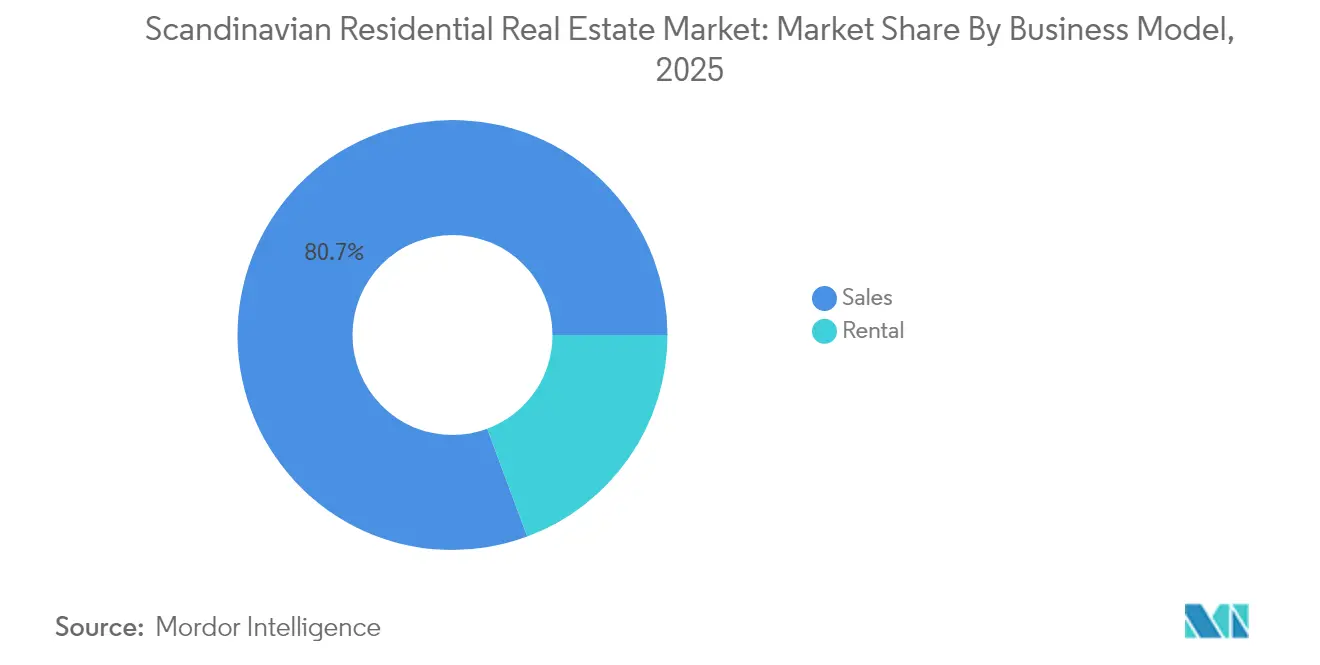
Rental Surge Reshapes Ownership PatternsRental housing held 19.35% of Scandinavian residential real estate market share in 2025 but accelerates at a sector-leading 6.74% CAGR, propelled by mobility-minded professionals and strict credit rules. Sales transactions grow more modestly as ownership affordability wanes.
Institutional funds back purpose-built rental platforms offering hotel-grade services, bulk broadband and community apps that lift retention. Copenhagen’s rents climbed 5-7% in 2024 amid undersupply, cushioning investor yields versus bond spreads. The rental boom is therefore reshaping cash-flow expectations and asset-allocation models across the Scandinavian residential real estate market.
By Mode of Sale:
Primary Market Leads New ConstructionPrimary sales captured 37.45% of Scandinavian residential real estate market size in 2025 and are forecast to expand at 6.79% CAGR, buoyed by pent-up demand for energy-efficient inventory. Secondary trades, though larger at 62.55%, contend with ageing stock that often requires costly retrofits to meet EPC thresholds.
Developers leverage modular timber, BIM and on-site PV arrays to cut embodied carbon and shorten delivery cycles, thereby securing green-loan discounts and faster absorption rates. Buyers prize customisable interiors and future-proof wiring, validating premiums that lift gross development margins in the Scandinavian residential real estate market.
Geography Analysis
Sweden Scandinavian Residential Real Estate Market
Sweden commanded 47.60% of Scandinavian residential real estate market value in 2025, powered by Stockholm’s technology-led jobs boom and landmark urban timber schemes such as Stockholm Wood City. Residential investment hit SEK 138.5 billion in 2024, a 66% rebound that signals re-liquefied capital markets and expanding Scandinavian residential real estate market size. Rate cuts and balanced housing policy sustain demand across both ownership and rental sectors, while EPC incentives reward green-forward developers.
Denmark Scandinavian Residential Real Estate Market
Denmark is the fastest-growing slice of the Scandinavian residential real estate market at 6.86% CAGR to 2031, anchored by Copenhagen’s 61% transaction share and 45% foreign-capital penetration. House prices are projected to rise 4.2% in 2025 and 4.0% in 2026 on the back of tight labour markets and wage growth beating inflation. Emissions caps effective July 2025 amplify demand for next-generation, low-carbon housing, reinforcing Denmark’s regulatory leadership and supporting further expansion of Scandinavian residential real estate market size.
Norway Scandinavian Residential Real Estate Market
Norway retains a meaningful position despite indebtedness headwinds and buildable-land scarcity near fjordside metros. The government’s down-payment relaxation to 10% from January 2025 broadens access, while base-rate reductions ease servicing costs, nudging latent demand into action. Oslo’s prime districts predict 6% price appreciation in 2024, as currency weakness entices overseas buyers and green construction incentives attract institutional partners. The country’s surplus renewable energy underpins highly efficient housing, differentiating Norway within the broader Scandinavian residential real estate market.
Regulatory Landscape
In Sweden, the Riksdag enacted the rent-to-own housing law on May 22, 2026, creating a unified legal framework for rent-to-own agreements, with the law taking effect on July 2, 2026. The building-regulations transition culminated on July 1, 2026, when Boverket fully moved to the new structure, ending the transitional allowance to apply older BBR/EKS rules after the July 2025 implementation. A June 4, 2026 regulatory referral (lagrådsremiss) sought to clarify building permit requirements for specific building categories, with proposed entry into force on March 1, 2027. In Denmark, Social- og Boligstyrelsen continues staged implementation of its holistic building regulation program through 2028, with a multi-year CO2e tightening roadmap and political review checkpoints in 2026, plus a broader status review targeted toward end-2026.
Value Chain Analysis
The Scandinavian residential real estate value chain runs from land sourcing and municipal planning through development, financing, construction, sales or leasing, and lifecycle operations. Municipalities shape upstream feasibility through land-release, zoning density, and permitting capacity. Developers and contractors such as Veidekke and Peab orchestrate design, procurement, and delivery, increasingly using design-and-build models to compress schedules and manage execution risk. Financing and underwriting sit near the center of the chain, with banks often requiring a high pre-sales threshold before construction starts, while institutional capital plays a growing role in build-to-rent platforms. Downstream, brokers and portals and property managers influence leasing velocity, while valuation, legal, and technical advisory services support transactions and compliance.
The chain remains sensitive to skilled labor availability and to imported materials exposure, particularly where sustainability requirements increase specification complexity and upfront costs. In Norway, Veidekke's and OBOS's design-and-build project in Nydalen (153 apartments, over NOK 600 million) illustrates how established developer-contractor partnerships and bankable counterparties move projects through a constrained pipeline.
Competitive Landscape
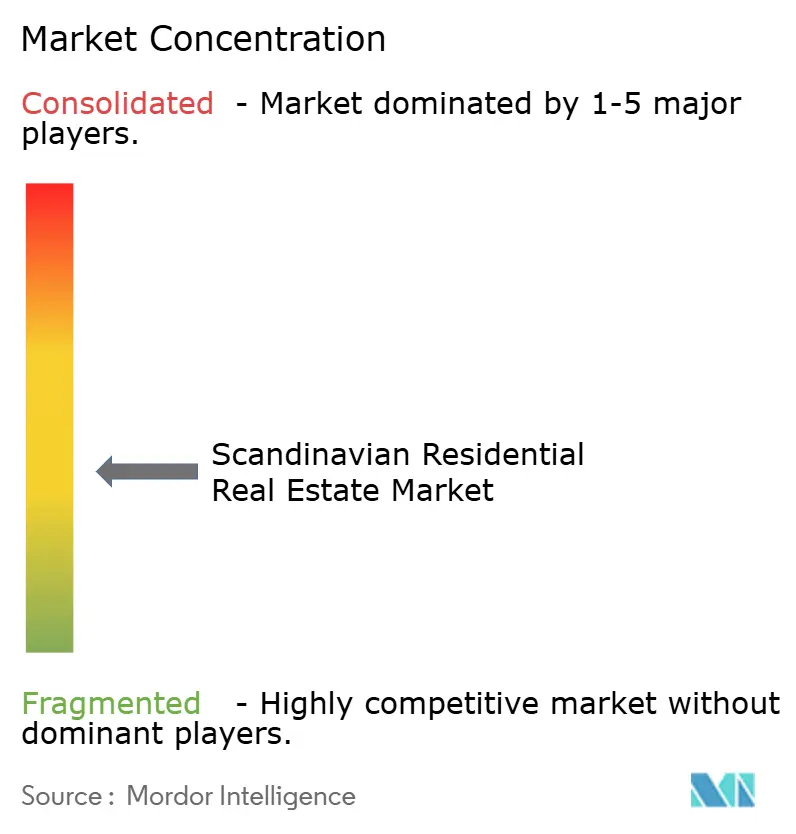
The Scandinavian residential real estate market is moderately fragmented. Fastighets AB Balder manages SEK 216.9 billion in assets, maintaining a 50% net-debt-to-assets ceiling to safeguard credit metrics. Heimstaden Bostad controls 71,838 homes with SEK 2.3 billion rental income and >97% occupancy, illustrating the scale institutional landlords now bring to the Scandinavian residential real estate market. Skanska adapts its pipeline, prioritising energy-efficient builds after recording SEK 42.8 billion revenue in Q3 2024 despite softer condo presales.
PropTech challengers multiply. Oslo-based Findable raised EUR 9 million to automate document compliance across 2 million property files, signalling that data-driven OPEX reduction is a new competitive lever. Bane NOR Eiendom teamed with Telescope to embed AI risk-scoring across its portfolio, marrying sustainability reporting with asset-management dashboards. Such partnerships intensify the digital arms race, forcing incumbents in the Scandinavian residential real estate market to integrate sensors, IoT and analytics or risk obsolescence.
Institutional consolidation continues in build-to-rent, where pension and insurance capital seek platform scale to harvest steady cash flows. KLP Eiendom’s acquisition of Ulven Boligutleie extends its Norwegian rental foothold, while Brookfield’s SEK 95 billion commitment to Swedish data-centre infrastructure may spur ancillary housing demand for tech-sector staff. Overall, capability differentiation hinges on balance-sheet strength, ESG credentials and operational tech adoption within the Scandinavian residential real estate market.
Scandinavian Residential Real Estate Industry Leaders
-
Riksbyggen
-
Fastighets AB Balder
-
Danish Homes
-
Dades AS
-
Veidekke ASA
- *Disclaimer: Major Players sorted in no particular order
Scandinavian Residential Real Estate Market Companies Covered in this Report
- Fastighets AB Balder
- Heimstaden AB
- OBOS BBL
- Riksbyggen
- Akelius Residential Property AB
- Skanska AB
- JM AB
- Veidekke ASA
- Peab AB
- NCC AB
- Bonava AB
- HSB
- L E Lundbergföretagen AB
- Selvaag Bolig ASA
- Oscar Properties Holding AB
- Danish Homes
- EDC Mæglerne
- Eiendomsmegler Krogsveen AS
- Utleiemegleren
Read Analysis of Scandinavian Residential Real Estate Companies
Market Opportunities and Future Outlook
White-space is forming around tenure innovation, adaptive reuse, and compliance-led housing upgrades as regulation and affordability constraints reshape demand. Sweden's rent-to-own framework enacted in May 2026 (effective July 2026) creates a clearer legal path for structured rent-to-own offerings and broadens the buyer funnel for developers, cooperatives, and institutional landlords. Sweden's 2025-2026 state policy support earmarks annual funding for converting non-residential premises into housing and for municipal planning incentives, aligning with established project pathways for conversions and infill supply in land-constrained cities.
Operational and leasing-side digitization is another opportunity area, particularly where landlord tooling has lagged analytical rigor. In Norway, FINN's April 2026 partnership with Roomvo added interactive virtual staging to listings and showed how portals and agents invest in conversion-rate improvements. Nordic property transaction volume rose in H1 2026 versus H1 2025, with residential the largest segment share, supporting shifts toward stabilized rental portfolios, energy-efficient new builds, and renovation programs designed to meet tightening CO2e and building-rule requirements.
Recent Industry Developments in Scandinavian Residential Real Estate Market
- June 2026: Riksbyggen won a land allocation for the Repslagaren block in Pottholmen, Karlskrona, in partnership with Karlskronahem. The allocation enables a sizable apartment-led regeneration project and reinforces municipal collaborations to bring new stock to market.
- May 2026: Riksbyggen started construction of 33 senior housing units under its Bonum Brf concept in Rydebäck, Helsingborg. The start highlights ongoing product specialization around senior living and service-oriented communities as demographic shifts drive demand for rental and care-enabled formats.
- February 2025: KLP Eiendom acquired Ulven Boligutleie, expanding its Norwegian residential rental exposure. The deal supports platform scale in build-to-rent operations and underscores institutional investors' focus on stabilized cash-flowing housing assets.
Scandinavian Residential Real Estate Market Report Scope and Research Methodology
Market Definition and Coverage
For this study, the market is defined as the total value generated from residential property transactions across Scandinavian countries. This includes both new-build and existing homes, covering sales and formal rental contracts where monetary consideration is paid.
Scope exclusions: commercial real estate, student housing, and markets outside Scandinavia (such as Finland and Iceland) were kept out of scope.
Segments Covered in This Report
- By Property Type
- Apartments & Condominiums
- Villas & Landed Houses
- By Price Band
- Affordable
- Mid-Market
- Luxury
- By Business Model
- Sales
- Rental
- By Mode of Sale
- Primary (New-build)
- Secondary (Existing-home Resale)
- By Country
- Norway
- Sweden
- Denmark
Data Sources, Market Sizing, and Validation
Desk Research
Desk research was used to build the starting dataset for housing demand, pricing, and transaction activity across the region. We referenced public sources such as national statistics offices for dwelling stock and housing starts, central bank releases for mortgage rates and credit conditions, and land registry or cadastre portals for recorded transactions.
To keep assumptions realistic, additional checks were made using OECD and Eurostat series where available, along with planning or housing agencies for permitting and pipeline indicators. We also reviewed company filings and investor presentations from listed housing developers and property owners. For market mapping, we used paid subscriptions for company financials and intelligence, plus a news and financials service to monitor policy changes and notable project announcements. These desk research sources are illustrative and not exhaustive, and additional references were used across the research process for data collection, validation, and clarification.
Primary Interviews and Surveys
We use interviews and surveys with developers, brokers, lenders, property managers, and housing advisers working in Denmark, Norway, and Sweden. Respondent input helps assess mortgage sensitivity, rent movement, sales timing, new-build supply, and gaps in country-level data. These findings are compared with official transaction, price, and housing records when setting assumptions for the final analysis.
Distribution of primary research fieldwork respondents
| Company type | Respondent position |
|---|---|
| Top tier: 30% | CXOs: 15% |
| Mid tier: 50% | Functional/Unit leaders: 30% |
| Smaller Players: 20% | Managers: 55% |
Market-Sizing & Forecasting
Sizing was first built using a top-down and bottom-up combination. Recorded residential transaction activity and rental contract flows were reconstructed into annual value for the region, then aligned to country-level housing indicators. To avoid relying on a single data stream, totals were corroborated with selective bottom-up approximations, such as sampled price per square meter checks, typical unit sizes, and volume-to-value conversions taken from a controlled set of cities and public developer disclosures.
Key inputs that shaped the model included residential transaction volumes, housing price indices, mortgage rate levels and spreads, new housing starts and permits, household formation and migration signals, and rental growth versus vacancy trends. Forecasting was carried out using scenario analysis supported by sensitivity to interest rates and supply pipeline changes, then adjusted through expert consensus on how quickly affordability and lending conditions are likely to normalize.
Where a bottom-up view was incomplete for smaller municipalities or thinly traded submarkets, gaps were handled through country-weighted extrapolation using official housing stock and transaction intensity ratios, and then rechecked against the regional total to keep sums consistent.
Data Validation & Update Cycle
Outputs were validated through triangulation across independent indicators, followed by variance checks at the country level so unusual spikes in value were investigated before being accepted. When an outlier was detected, underlying assumptions were reopened, and targeted re-contacts were triggered to confirm whether the change was driven by mix shifts (for example, more apartments versus villas) or by pricing movements.
Each report goes through multi-step analyst review before sign-off, and the model is refreshed on an annual cycle. If a material event occurs, such as a sharp rate move or a major policy change affecting housing supply, interim updates are performed so the narrative and numbers stay current. Right before delivery, a final pass is completed to reflect the most recent public releases and interview feedback.
Mordor Intelligence's Scandinavian Countries Residential Real Estate Market Size Versus Other Published Estimates
It is normal to see different market values for the same region, even when the topic label looks identical. In residential real estate, differences usually come from what gets counted as market value, which countries are included, and whether rentals are treated as part of the total or kept separate.
Key gap drivers here are mostly about scope boundaries and the pricing logic used to turn activity into value. Some sources use a broader Nordic definition or extend the market to overall real estate, which can pull in non-residential value. Others may rely on a single price series and apply it uniformly, or they may report in local currencies and convert using different timing, which changes the USD outcome when FX is volatile. By tracking transaction registrations and refreshing FX timing and rental-contract inclusion rules, Mordor Intelligence ties the estimate to housing activity recorded across Denmark, Norway, and Sweden.
Benchmark comparison
| Source | Market Size | Gaps in Research Methodology |
|---|---|---|
| Mordor Intelligence | USD 28.12 B (2025) | |
| Global Consultancy A | USD 218.03 B (2024) | Uses a broader Nordic geographic definition and a revenue framing that can capture a wider residential value pool than Scandinavia-only transaction and rental flows, which lifts the total versus a narrower country set. |
| Trade Journal B | USD 158.30 B (2022) | Appears to cover general real estate for Scandinavia, and the line between residential-only and total property is not clearly separated, which can mix in commercial value and increase the stated market size. |
The spread across publishers is mostly explained by geography coverage and what is treated as market value, rather than a single modeling input. When scope is kept to Scandinavia and the model is anchored to transaction and rental activity that can be cross-checked, the result stays easy to trace back to clear variables and repeatable update steps.
Key Questions Answered in the Report
What is the current size of the Scandinavian residential real estate market?
The market is valued at USD 29.75 billion in 2026 and is projected to reach USD 39.44 billion by 2031.
Which country leads in market share?
Sweden holds 47.60% of market value, backed by Stockholm’s technology economy and large-scale timber projects.
How do green-building regulations affect development costs?
Denmark’s 2025 CO₂ cap and broader EPC rules encourage mass-timber and renewable energy use, raising upfront costs but unlocking financing discounts and premium pricing.
Which property type offers the best growth outlook?
Apartments and condominiums post the strongest 6.02% CAGR, driven by urbanisation and efficient land use.