
Regulatory Reporting and Compliance Market Size and Share
Market Overview
| Study Period | 2020 - 2031 |
|---|---|
| Market Size (2026) | USD 4.70 Billion |
| Market Size (2031) | USD 7.24 Billion |
| Growth Rate (2026 - 2031) | 9.03 % |
| Fastest Growing Market | Asia-Pacific |
| Largest Market | North America |
| Market Concentration | Medium |
Major Players *Disclaimer: Major Players sorted in no particular order Image © Mordor Intelligence. Reuse requires attribution under CC BY 4.0. | |
Regulatory Reporting and Compliance Market Analysis by Mordor Intelligence
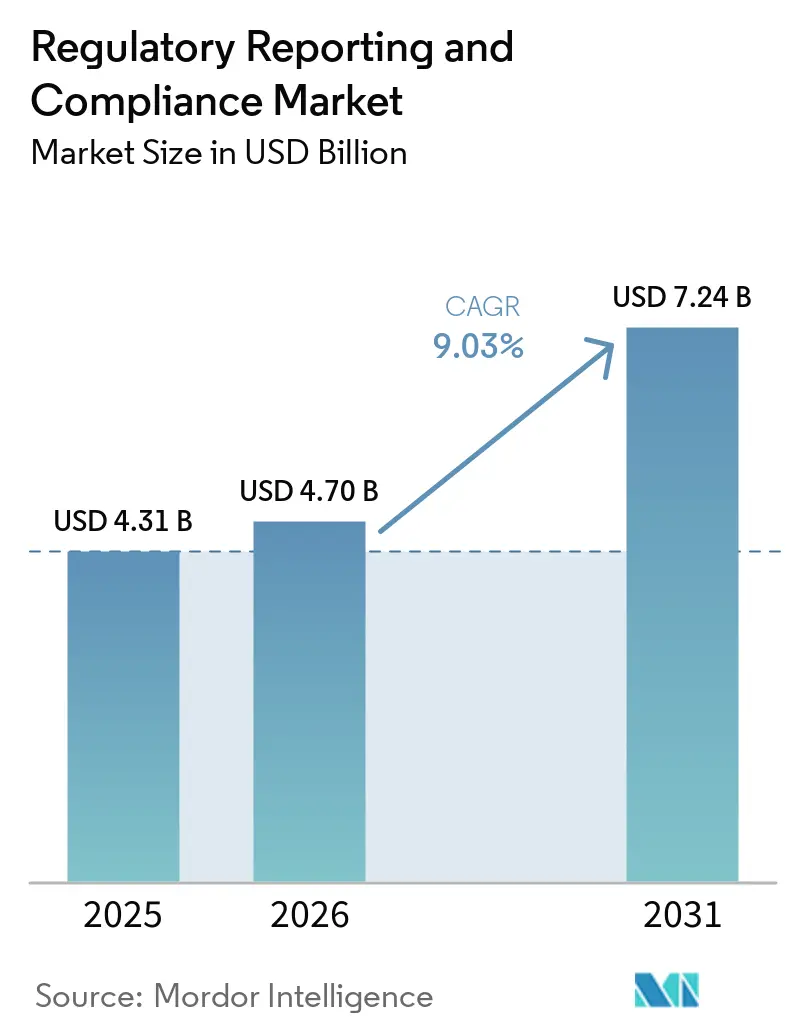
The regulatory reporting and compliance market size in 2026 is estimated at USD 4.70 billion, growing from 2025 value of USD 4.31 billion with 2031 projections showing USD 7.24 billion, growing at 9.03% CAGR over 2026-2031. Market expansion is driven by harmonized guidelines from the International Council for Harmonisation (ICH), the U.S. Food and Drug Administration’s (FDA) stricter data integrity rules, and the European Medicines Agency’s (EMA) digital submission mandates. Heightened demand for rapid dossier approval, widespread adoption of electronic Common Technical Document (eCTD) formats, and the increasing prevalence of multi-regional clinical trials underscore the need for a sophisticated compliance infrastructure. Biotechnology pipelines, breakthroughs in gene and cell therapy, and the rise of artificial-intelligence (AI)–enabled regulatory platforms further accelerate spending. Vendors capable of pairing deep domain expertise with cloud-native, data-driven technologies are gaining competitive traction, reshaping service delivery models across the pharmaceutical, biotechnology, and medical device segments.
Key Report Takeaways
- By service type, consulting led with 28.10% of the regulatory reporting and compliance market share in 2025, whereas regulatory writing and publishing is poised for an 11.10% CAGR through 2031.
- By service provider type, in-house teams held 63.65% of the regulatory reporting and compliance market share in 2025, while outsourced models are expected to expand at a 10.75% CAGR over 2026-2031.
- By end user, pharmaceutical firms captured 34.80% share of the regulatory reporting and compliance market size in 2025, yet biotechnology companies record the fastest 12.10% CAGR to 2031.
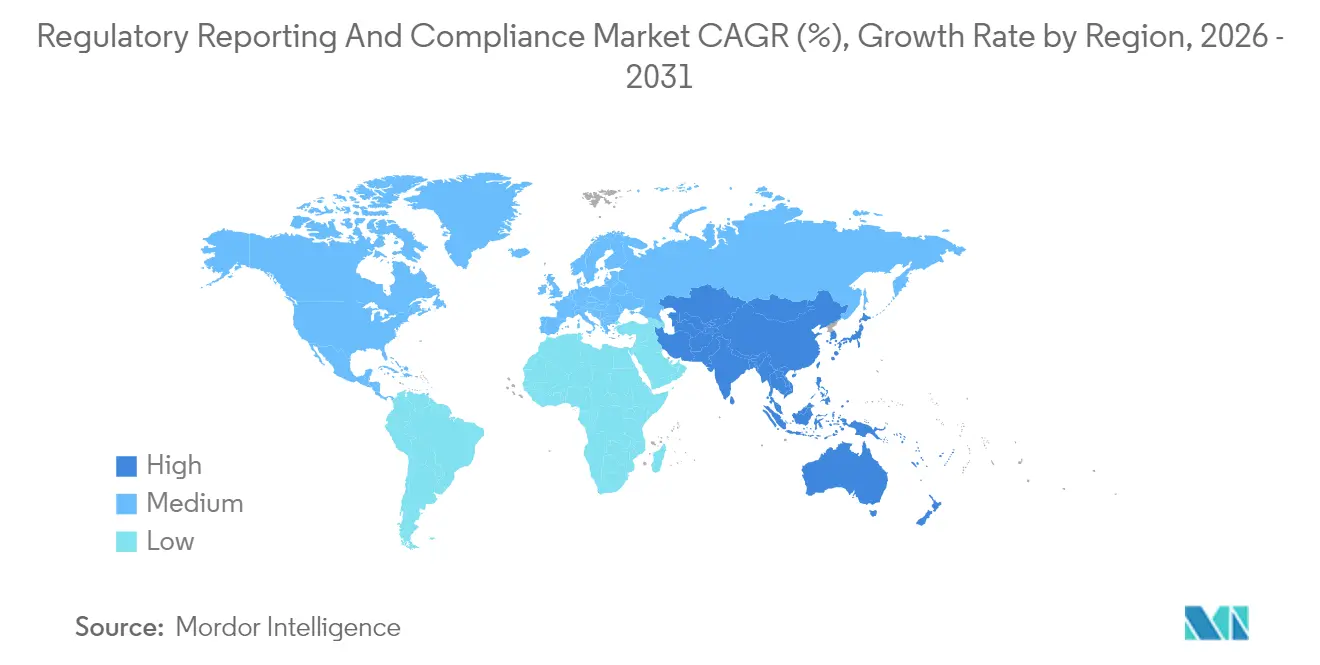
- By geography, North America dominated with 41.10% share in 2025; Asia-Pacific advances at a 10.15% CAGR through 2031.
Note: Market size and forecast figures in this report are generated using Mordor Intelligence’s proprietary estimation framework, updated with the latest available data and insights as of 2026.
Market Trends and Insights
Drivers Impact Analysis of Regulatory Reporting and Compliance Market*
| Driver | % (~) Impact on CAGR Forecast | Geographic Relevance | Impact Timeline |
|---|---|---|---|
| Growing Demand for Faster Approval Process | +2.1% | Global, highest in North America & Europe | Short term (≤ 2 years) |
| Continuously Changing Regulatory Landscape | +1.8% | Global, notably APAC emerging markets | Medium term (2–4 years) |
| Digitalization of Regulatory Processes | +2.3% | North America & EU core, spill-over to APAC | Medium term (2–4 years) |
| Increasing Complexity of Multi-Region Clinical Trials | +1.6% | Global, concentrated in major pharma hubs | Long term (≥ 4 years) |
| AI-Enabled Regulatory-Intelligence Platforms Shorten Dossier Cycles | +1.4% | North America & Europe, expanding to APAC | Long term (≥ 4 years) |
| ESG-Driven Disclosure Mandates Expand Compliance Scope | +0.8% | Europe & North America, emerging in APAC | Medium term (2–4 years) |
| Source: Mordor Intelligence | |||
Growing Demand for Faster Approval Process
Breakthrough therapy designation halves FDA review timelines, creating premium demand for advisory services that compress submissions without compromising rigor[1]U.S. Food and Drug Administration, “Breakthrough Therapy Program Performance Report,” fda.gov. Specialized regulatory writers now command 40% price premiums for expedited dossiers. Real-world evidence (RWE) guidelines, updated in 2024, open new acceleration avenues yet require advanced analytics unavailable in most in-house teams. As sponsors harness RWE, external partners with robust data-science capabilities help navigate evolving evidence standards. This emphasis on speed sustains above-market fee structures and cements deep vendor-client collaboration. Competitive pressure to reduce launch gaps reinforces the regulatory reporting and compliance market’s strategic value proposition.
Continuously Changing Regulatory Landscape
In 2024, regulators issued more than 200 substantive guideline updates, forcing companies to maintain continuous surveillance. China’s National Medical Products Administration released 15 new technical guidelines, reshaping dossier formats and safety-reporting thresholds. Timely interpretation of overlapping national and ICH frameworks now exceeds the capacity of many internal teams. Hybrid models blend core expertise with specialized consultants for jurisdiction-specific compliance, enabling flexible resource allocation. While global harmonization holds long-term promise, near-term complexity keeps external advisory services indispensable. Companies allocating higher budgets for horizon-scanning tools illustrate the regulatory reporting and compliance market’s resilience.
Digitalization of Regulatory Processes
Electronic submissions represent 85% of FDA filings, up from 45% in 2019. EMA’s IRIS pilot cut first-cycle assessment times by 30%. Structured Product Labeling (SPL) upgrades mandate machine-readable formats, compelling sponsors to adopt cloud-native regulatory information management systems. Consultancy demand spans platform selection, data migration, and user training. Vendors offering turnkey implementation solutions report 40% efficiency gains for clients. As agencies increasingly employ AI-driven document screening, service providers with natural-language processing tools strengthen competitive edges.
Increasing Complexity of Multi-Region Clinical Trials
Global trials now span an average of 12 jurisdictions, each enforcing distinct data standards. WHO’s registry logged 25% more multi-regional trials in 2024, reflecting decentralization strategies[2]World Health Organization, “International Clinical Trials Registry Platform Annual Report 2024,” who.int. Divergence between EU and post-Brexit UK rules adds dual-compliance burdens, while rare-disease programs necessitate compassionate-use protocols across regions. Consultants skilled in FDA, EMA, PMDA, and NMPA nuances command premium fees. Digital trial-master-file solutions and cross-jurisdictional harmonization frameworks create new service niches. Complexity extends engagement cycles, supporting sustained growth in the regulatory reporting and compliance market.
Restraints Impact Analysis of Regulatory Reporting and Compliance Market*
| Restraint | % (~) Impact on CAGR Forecast | Geographic Relevance | Impact Timeline |
|---|---|---|---|
| Lack of Technologically Advanced Infrastructure in Developing Nations | −1.2% | APAC emerging markets, MEA, Latin America | Medium term (2–4 years) |
| Complicated Local and Global Regulatory Norms | −1.5% | Global, most acute in multi-jurisdiction filings | Short term (≤ 2 years) |
| Shortage of Skilled Regulatory-Affairs Professionals | −1.8% | Global, most acute in North America & Europe | Long term (≥ 4 years) |
| Cyber-Security & Data-Residency Hurdles for Cloud Compliance Tools | −1.1% | Europe, North America, data-sovereignty focused regions | Medium term (2–4 years) |
| Source: Mordor Intelligence | |||
Lack of Technologically Advanced Infrastructure in Developing Nations
Paper-based processes persist in India, Brazil, and parts of Africa, forcing multinational sponsors to run parallel paper and electronic workflows, inflating compliance costs by up to 30%. Government-funded upgrades progress unevenly, leaving implementation gaps that hamper cloud-based submissions. Vendors address the divide through hybrid solutions combining low-bandwidth portals with on-site scanning hubs. Nonetheless, slow modernization tempers adoption of advanced AI-driven tools, moderating the regulatory reporting and compliance market’s broader CAGR.
Shortage of Skilled Regulatory-Affairs Professionals
Industry surveys show 40% of firms struggle to fill senior roles, particularly in AI-centric dossier strategy[3]Regulatory Affairs Professionals Society, “2024 Global Regulatory Workforce Trends Survey,” raps.org. Salary premiums surpass 60% for cross-jurisdictional experts. Universities lag in offering curricula covering digital submissions and real-world data analytics. The impending retirement of one-third of senior practitioners risks institutional knowledge drain. Consulting firms counter talent scarcity through accelerated training academies and global talent hubs, yet supply gaps persist, capping near-term growth.
*Our forecasts treat driver/restraint impacts as directional, not additive. The impact forecasts reflect baseline growth, mix effects, and variable interactions.
Regulatory Reporting and Compliance Market Segment Analysis
By Service Type:
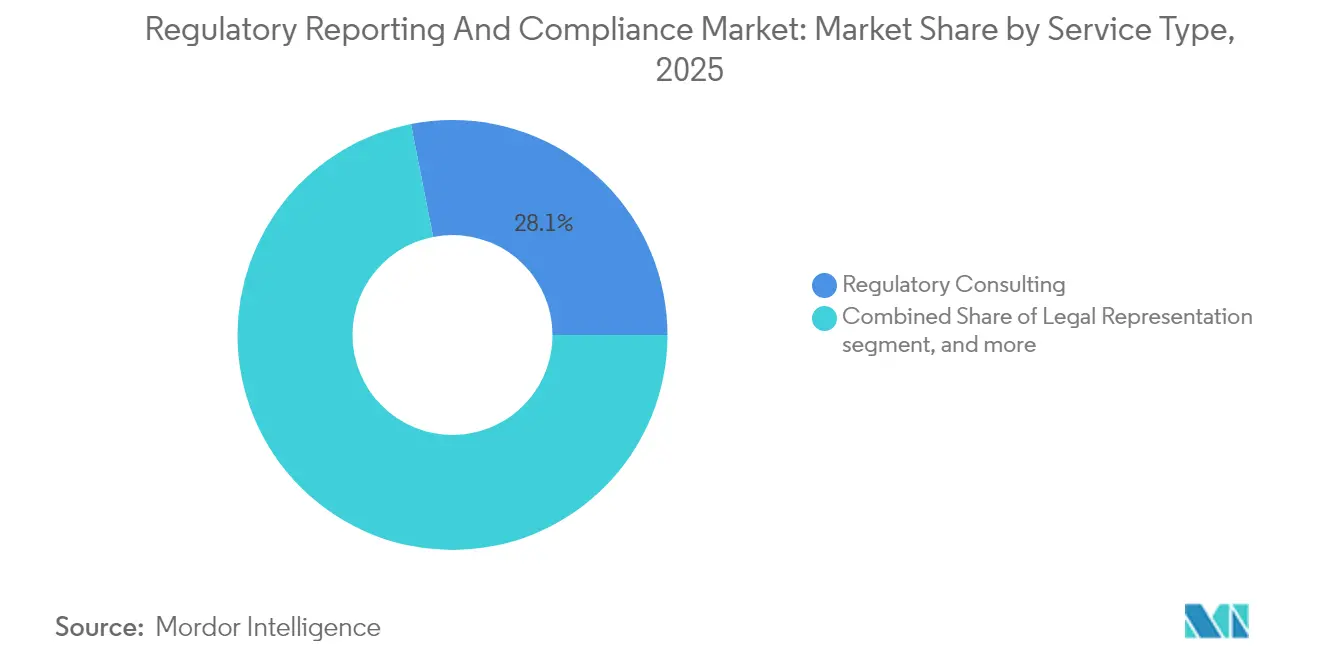
Consulting Dominance Faces Digital DisruptionConsulting captured 28.10% of the regulatory reporting and compliance market share in 2025 on the strength of expertise in navigating complex submission pathways. Regulatory writing and publishing is accelerating at an 11.10% CAGR, supported by the FDA’s enhanced eCTD and the EMA’s structured-data mandates. This rise in automation, artificial-intelligence content generation, and cloud-enabled template libraries reshapes resource allocation, prompting consultants to integrate technology partnerships. As sponsors prioritize speed, specialized writing teams deliver machine-readable dossiers that satisfy global agencies’ evolving technical standards. Meanwhile, legal-representation services grow steadily due to increased FDA warning-letter activity, and pharmacovigilance consulting gains momentum amid expanded post-market safety requirements.
Digitization casts consulting firms as technology orchestrators rather than pure advisory bodies. To protect margins, incumbents embed proprietary natural-language processing engines that auto-populate Module 3 and 5 components. This integration repositions human experts toward high-value strategic content. Consulting’s incumbency remains resilient, yet providers without technology roadmaps risk commoditization. Over the forecast period, the regulatory reporting and compliance market will witness convergence between content generation, data-engineering, and strategic advisory as clients demand unified, technology-enabled service suites.



By Service Provider Type:
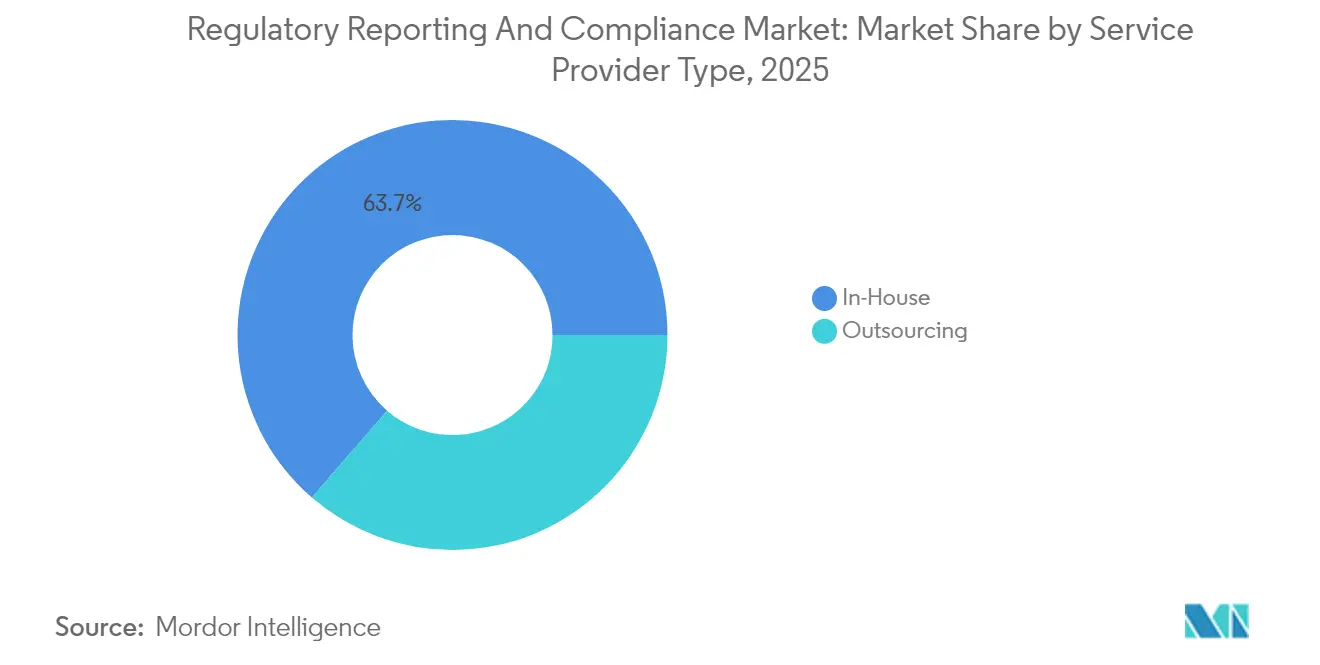
Outsourcing Accelerates Despite In-House PreferenceAlthough in-house teams controlled 63.65% of the regulatory reporting and compliance market size in 2025, outsourced models are advancing at a 10.75% CAGR on cost and expertise advantages. Remote-work normalization dissolved geographic barriers, enabling sponsors to engage global talent pools. Outsourcing firms leverage economies of scale, offering turnkey regulatory information management systems and 24/7 monitoring services. Hybrid strategies now dominate: core regulatory strategy remains internal, while dossier authoring, horizon scanning, and multi-jurisdictional intelligence shift externally.
To capture premium engagements, providers invest in AI-based knowledge graphs that map historical agency queries to predictive response templates. These innovations drive first-cycle approval rates higher, appealing to cash-constrained biotech clients. Nevertheless, intellectual-property security and cultural alignment remain board-level concerns, prompting rigorous vendor due-diligence processes. The regulatory reporting and compliance market’s competitive intensity rises as full-service CROs, specialized boutiques, and RegTech startups vie for share through differentiated technology stacks.
By End User:
Biotechnology Innovation Drives Premium ServicesPharmaceutical companies maintained 34.80% revenue share in 2025, yet biotechnology sponsors spearhead growth with a 12.10% CAGR. Rapid gene and cell therapy development introduces complex CMC (chemistry, manufacturing, and controls) data packages and heightened post-market commitments, stretching biotech in-house resources. Consultants capable of orchestrating accelerated approval pathways command 50% fee premiums. Meanwhile, medical-device firms rely on specialized advisors for EMA Medical Device Regulation (MDR) dossiers and the FDA’s evolving AI/ML product guidelines.
As convergence blurs lines between pharmaceuticals, biologics, and devices, service providers must integrate multidisciplinary expertise. Sponsors increasingly request platform-agnostic regulatory strategies covering gene editing, digital therapeutics, and combination products. This breadth reinforces the value proposition of end-to-end advisory firms. Over the forecast horizon, biotech’s share of the regulatory reporting and compliance market will continue expanding as venture investment funds scientific breakthroughs, keeping compliance consultancies central to commercialization success.
Geography Analysis
North America Regulatory Reporting and Compliance Market
North America controlled 41.10% of the regulatory reporting and compliance market size in 2025, anchored by stringent FDA standards and a high concentration of large pharmaceutical sponsors. The agency’s adoption of AI-assisted review tools elevates technical-compliance requirements, channeling demand toward consultants adept in machine-readable submissions. Canada’s participation in Project Orbis and alignment with FDA oncology frameworks further sparks cross-border advisory engagements. Intellectual-property protection and strong venture funding amplify the region’s outsourcing budgets, sustaining above-average service pricing.
APAC Regulatory Reporting and Compliance Market
Asia-Pacific is the fastest-growing region at a 10.15% CAGR through 2031, powered by China’s regulatory reform agenda, Japan’s PMDA consultation enhancements, and India’s digital-submission pilot programs. Diversity of regulatory maturity creates fragmented demand patterns: global firms need local partners to interpret country-specific rules, while indigenous manufacturers seek expertise to meet FDA and EMA export requirements. Vendors that establish regional centers with bilingual teams and real-time intelligence platforms capture early-mover advantages in the regulatory reporting and compliance market.
EMEA and LATAM Regulatory Reporting and Compliance Market
Europe remains a mature but evolving arena. EMA’s ongoing digital-transformation roadmap and the UK MHRA’s post-Brexit divergence introduce complexity that bolsters advisory fees. Sustainability-related disclosure obligations broaden the compliance remit, creating opportunities for ESG-focused consultants. Northern and Western Europe lead digital adoption, whereas Central and Eastern sub-regions lag, opening niche engagements for infrastructure modernization. Elsewhere, Latin America, the Middle East, and Africa register slower uptake due to limited technical infrastructure but represent long-term opportunities as multinationals expand trials and manufacturing footprints. Targeted capacity-building initiatives by global health agencies gradually unlock new consulting revenue streams.

Regulatory Landscape
Regulatory requirements are converging around structured, electronic submissions and interoperable data exchange, which increases the compliance burden for globally operating life sciences and healthcare organizations. In March 2026, CMS finalized CMS-0053-F to adopt standards for the electronic exchange of health care claims attachments transactions, further reducing reliance on manual documentation workflows and supporting demand for systems and services that can operationalize standardized transactions.
In the life sciences context, ICH and EU-aligned adoption of updated Good Clinical Practice standards continues to shape expectations for consistent trial governance and documentation. Annex 2 of ICH E6(R3) reached Step 4 adoption on June 3, 2026, and the EMA CHMP adopted Annex 2 on June 25, 2026. In the US health IT ecosystem, ONC published the 2026 Standards Version Advancement Process (SVAP) fact sheet in June 2026, indicating continued updates to accepted interoperability standards that influence how regulated entities manage data integrity, auditability, and submission-ready outputs.
Value Chain Analysis
Demand typically starts with pharmaceutical, biotechnology, and medical device sponsors that face multi-jurisdiction filing requirements and post-market obligations. Regulatory affairs teams translate these needs into submission strategy, evidence requirements, and timelines, while the supply chain inputs include clinical, safety, and CMC data, ICH-aligned standardized terminologies and models, and product master data used for regulated supply and shortage reporting (including identifiers across traceability and product data portals). These inputs then flow into regulatory writing, publishing, and validation workflows, supported by RIM and eCTD tooling, structured content management, and increasingly modeling and analytics packages used to support submissions.
Execution is handled through a mix of in-house teams and outsourced specialists, including consultancies, CROs, and software or platform vendors, which assemble dossiers, maintain regulatory intelligence, and manage submission operations and lifecycle changes. On the downstream side, regulator-facing gateways and standards updates create recurring implementation work, including the EMA Product Management Service (PMS), where a December 2025 deadline required Marketing Authorisation Holders to complete manufacturing and business operation data submissions. Cross-border trade and supply compliance adds another chain layer, as shown in March 2026 when US CBP issued the FDA Supplemental Guide Version 2.6 for the Automated Commercial Environment (ACE), tightening structured import reporting expectations for regulated medical commodities and increasing integration needs across regulatory, quality, and supply-chain data systems.
Competitive Landscape
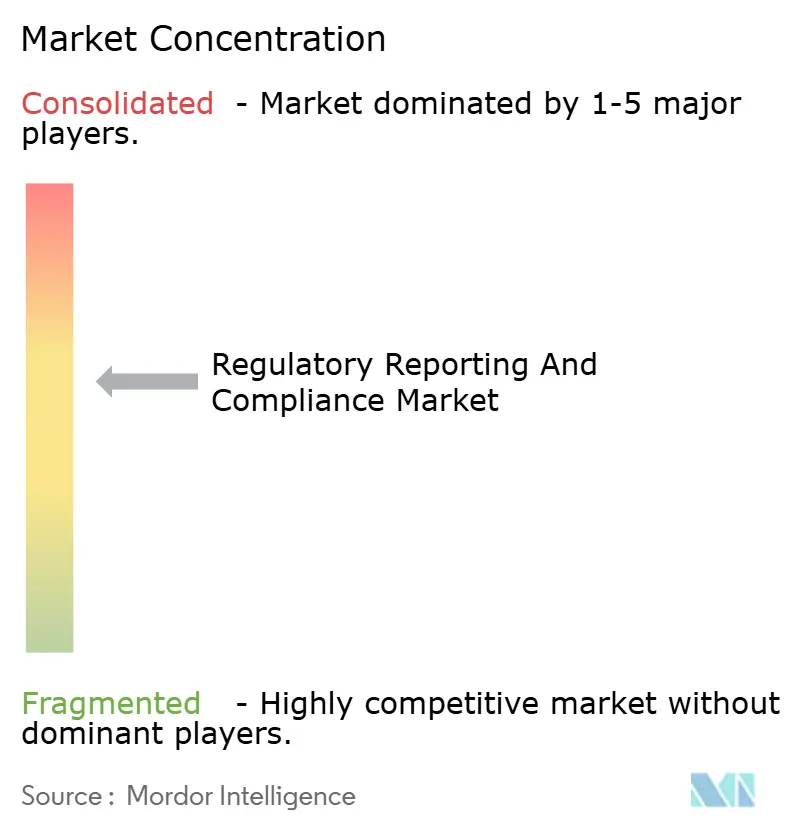
The regulatory reporting and compliance market is moderately fragmented, with top players comprising a combined 40-45% revenue share. Global leaders IQVIA, Syneos Health, and Parexel integrate scale, therapeutic breadth, and proprietary technology to defend positions. They invest heavily in machine-learning engines that predict approval timelines and auto-curate global regulatory changes. Mid-tier firms differentiate through deep expertise in specific therapeutic areas, such as rare diseases or advanced biologics, while RegTech startups focus on platform-based automation.
Consolidation accelerated in 2024 as strategic acquisitions filled technology gaps and expanded geographic reach. Syneos Health acquired Endpoint Clinical to strengthen rare-disease and breakthrough-therapy capabilities. Parexel established an APAC regulatory intelligence center in Singapore, reflecting geographic diversification strategies. Traditional contract research organizations integrate end-to-end regulatory offerings, challenging pure-play consultancies. Meanwhile, cloud-native platforms offer subscription access, pressuring hourly billing models.
Competitive success increasingly hinges on AI, data analytics, and interoperability with sponsor ecosystems. Firms embracing outcome-based pricing tying fees to approval timelines or first-cycle success gain traction. The competitive frontier now pivots on intellectual-property protection, data-security certifications, and the ability to deliver seamless hybrid on-shore/off-shore service models. As sponsors expect integrated solutions covering strategy, submission, and post-market surveillance, providers unable to combine domain expertise with technology at scale risk marginalization.
Regulatory Reporting and Compliance Industry Leaders
Genpact Ltd
IQVIA Holdings Inc
Certara, L.P.
Pharmaceutical Product Development, LLC (PPD)
Charles River Laboratories International, Inc
- *Disclaimer: Major Players sorted in no particular order
Regulatory Reporting and Compliance Market Companies Covered in this Report
- Accenture
- AmerisourceBergen / Cencora
- Celegence
- Certara
- Charles River
- Clinilabs
- Freyr Solutions
- Genpact
- ICON
- Indegene
- IQVIA
- LabCorp
- MED-EL
- Navitas Life Sciences
- Parexel International
- PharmaLex GmbH
- PPD
- ProPharma Group
- Syneos Health
- WuXi App Tec
Read Analysis of Regulatory Reporting and Compliance Companies

Market Opportunities and Future Outlook
Near-term opportunities concentrate where new electronic transaction mandates, interoperability initiatives, and updated global standards create implementation backlogs that exceed internal regulatory capacity. In the US, CMS action provides a direct catalyst, since the March 2026 CMS-0053-F rule adopting standards for electronic claims attachments expands needs around compliant document assembly, coding, audit trails, and exception handling across payers, providers, and vendors supporting regulated exchanges. ONC activity also supports ongoing platform and services demand, with the June 2026 SVAP fact sheet enabling adoption of newer health IT standard versions, which drives recurring work around standards assessment, system upgrades, validation, and governance.
In life sciences, ongoing ICH and EMA-aligned expectations continue to move spend toward standardized, inspection-ready processes and tooling for multi-region filings. Annex 2 of ICH E6(R3) reached Step 4 adoption on June 3, 2026 and CHMP adoption followed on June 25, 2026, expanding demand for services that translate updated GCP requirements into operating procedures, vendor oversight, and submission documentation. A related whitespace centers on scaling automation safely, as sponsors and health systems embed AI into regulatory and compliance workflows, shifting procurement and delivery toward defensible data governance, model documentation, and audit-ready controls rather than standalone point solutions, benefiting vendors that combine domain expertise with validated, interoperable platforms.
Recent Industry Developments in Regulatory Reporting and Compliance Market
- May 2026: IQVIA expanded its strategic collaboration with Kexing Biopharm to accelerate global biosimilar development, combining clinical development support with regulatory strategy and advanced analytics. The expanded scope strengthens IQVIA's ability to bundle regulatory reporting and compliance services into broader development programs, particularly for cross-border submissions.
- December 2025: Certara launched an Expedited Pharmacometrics (PMx) Regulatory Submissions offering designed to reduce submission timelines by more than 50 percent. The service productizes specialized modeling and documentation workflows, widening access for teams that lack in-house pharmacometrics capacity but need submission-ready outputs on compressed schedules.
- November 2024: Certara delivered a major release of GlobalSubmit regulatory software to support the FDA version 4.0 submission standard. The update highlights continuing technical change in submission formats and reinforces demand for vendors that can keep publishing systems current while maintaining validation and auditability.


Regulatory Reporting and Compliance Market Report Scope and Research Methodology
Market Definition and Coverage
We size the regulatory reporting and compliance market as revenues earned from outsourced services that help life science companies meet regulatory submission, documentation, and ongoing compliance needs across the product life cycle.
Scope exclusions: We exclude internal staff cost for in-house regulatory teams and general quality management work that is not tied to regulatory submissions or regulator-facing reporting.
Segments Covered in This Report
- By Service Type
- Regulatory Consulting
- Product Registration & Clinical Trial Applications
- Legal Representation
- Regulatory Writing & Publishing
- Other Regulatory Services
- By Service Provider Type
- In-House
- Outsourcing
- By End User
- Pharmaceutical Companies
- Medical Device Companies
- Biotechnology Companies
- Geography
- North America
- United States
- Canada
- Mexico
- Europe
- Germany
- United Kingdom
- France
- Italy
- Spain
- Rest of Europe
- Asia-Pacific
- China
- Japan
- India
- Australia
- South Korea
- Rest of Asia-Pacific
- Middle East & Africa
- GCC
- South Africa
- Rest of Middle East & Africa
- South America
- Brazil
- Argentina
- Rest of South America
- North America
Data Sources, Market Sizing, and Validation
Desk Research
Desk work starts with public rules and reporting standards so the market is grounded in what companies are actually required to submit. We reviewed sources such as the US FDA guidance library, the European Medicines Agency public procedures, ICH guideline publications, ClinicalTrials.gov and EU Clinical Trials Register trends, and selected peer reviewed articles on eCTD adoption and submission quality.
We then connect those requirements to spend signals using company annual reports, investor presentations, press releases, and association materials that discuss regulatory workload, filings, and outsourcing intensity. Where available, paid subscriptions for company financials, patent databases, and global contracts and tenders were used to cross-check supplier scale and service mix. This list is illustrative only, and we used many other public and paid sources to collect data, validate assumptions, and clarify gray areas.
Primary Interviews and Surveys
Primary conversations were used to pressure test what is counted as regulatory reporting and compliance services, and to confirm typical engagement models across consulting, writing, publishing, and submission support. We spoke with a mix of service providers and buyer-side stakeholders across major regions, so pricing logic, outsourcing shares, and workload drivers could be reconciled with what we saw in desk research.
Distribution of primary research fieldwork respondents
| Company type | Respondent position | Region |
|---|---|---|
| Top tier: 25% | CXOs: 19% | APAC: 46% |
| Mid tier: 56% | Functional/Unit leaders: 35% | EMEA: 35% |
| Smaller Players: 19% | Managers: 46% | Americas: 19% |
Market-Sizing & Forecasting
For sizing, we start from a top-down build that reconstructs the addressable demand pool from life sciences R and D activity and regulatory submission workload, which is then translated into outsourced service spend. Inputs include new drug and device filing activity, clinical trial volumes by phase, the share of multi-region submissions, eCTD and publishing workload, and typical resubmission and maintenance cycles, which together indicate how much regulatory work is generated in a year.
Those totals are then checked using selective bottom-up approximations, such as sampled provider revenue ranges, region-level outsourcing penetration, and ASP-by-project benchmarks for consulting and writing work, before the final number is adjusted. Where bottom-up visibility is thin for smaller providers, we fill gaps using buyer-side spend splits and channel checks on common contract structures.
For forecasting, we use scenario analysis supported by expert views, because demand moves with policy updates, inspection intensity, and the clinical pipeline. Growth assumptions are guided by expected trial starts, evolving submission formats, expanding post-market surveillance expectations, and changes in timelines for approvals and renewals. We convert these into service volume and pricing trajectories.
Data Validation & Update Cycle
We validate outputs through multiple passes, starting with range checks against independent signals such as filing counts, trial registries activity, and disclosed outsourcing budgets. Any outliers are reviewed for geography mix, service scope, or one-time events, and then rechecked with follow-up calls when the variance is material.
Before sign-off, the model is reviewed by another analyst so logic, assumptions, and unit consistency are confirmed. Reports are refreshed annually, and interim updates are made when meaningful regulatory changes, macro shifts, or major contract patterns alter near-term demand. Right before delivery, we run a fresh review so clients receive the most current view available.
Mordor Intelligence's Regulatory Reporting and Compliance Market Sizing Compared With Other Published Estimates
Published values for this market often vary, since teams do not always count the same set of services and end users, and the base year can shift depending on when the model was last refreshed. Differences also come from whether figures are built from regulated workload signals, or mainly from supplier revenue rollups.
In practice, the biggest gap drivers are what is included, such as whether legal representation is counted, whether only life sciences are counted, or broader compliance services are blended in, and how outsourcing shares are applied versus assuming all regulatory effort is purchased. The spread also increases when pricing is projected using a flat inflation factor instead of being tied to project mix shifts between consulting, writing, and publishing, and then reconciled with submission activity, which is the approach used here. The final modeling choice is applied by Mordor Intelligence.
Benchmark comparison
| Source | Market Size | Gaps in Research Methodology |
|---|---|---|
| Mordor Intelligence | USD 4.70 B (2026) | |
| Trade Journal A | USD 5.19 B (2025) | Uses a managed regulatory reporting services lens and can over-count recurring managed-service revenue while under-counting consulting and dossier writing work linked to new submissions, making the scope not fully comparable. |
| Industry Publisher B | USD 7.20 B (2025) | Centers on regulatory reporting software and related services, which blends technology spend with services and can include non-life-sciences compliance use cases, leading to a higher total versus a services-only life sciences definition. |
The table shows that most differences are not about the arithmetic, they are about what is inside the market and which year is treated as current. When scope is kept limited to life sciences regulatory services and the demand pool is anchored to filing and trial activity, the estimate stays easier to track, explain, and update with repeatable checks.


Key Questions Answered in the Report
What is the current size of the regulatory reporting and compliance market?
The regulatory reporting and compliance market size is USD 4.70 billion in 2026.
How fast is the market expected to grow?
The market is forecast to expand at a 9.03% CAGR, reaching USD 7.24 billion by 2031.
Which region leads in spending on regulatory compliance services?
North America holds the largest share at 41.10% as of 2025.
Which service type is growing the quickest?
Regulatory writing and publishing services are expanding at an 11.10% CAGR through 2031.
Why are biotechnology firms key to future growth?
Biotech sponsors face complex, accelerated approval pathways, driving a 12.10% CAGR demand for premium compliance support.
How does AI affect regulatory consulting?
AI-enabled intelligence platforms shorten dossier cycles, improve first-cycle approval odds, and differentiate service providers.
Page last updated on:





