
Market Overview
| Study Period | 2020 - 2031 |
|---|---|
| Forecast Data Period | 2026 - 2031 |
| Base Year Market Size (2025) | USD 11.18 Billion |
| Market Size (2026) | USD 11.91 Billion |
| Market Size (2031) | USD 16.76 Billion |
| Growth Rate (2026 - 2031) | 7.08 % |
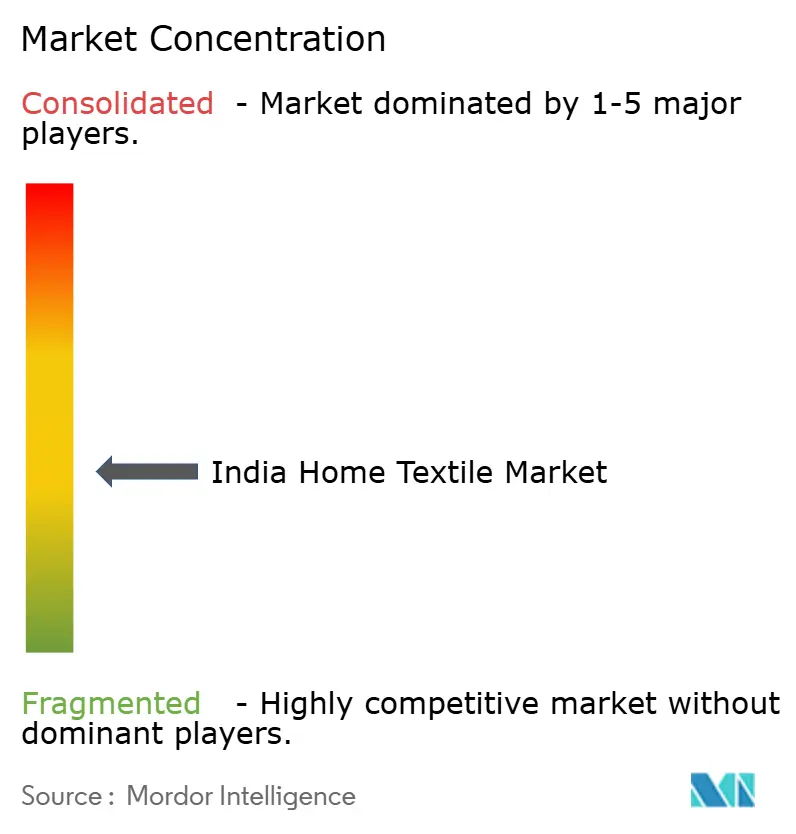
| Market Concentration | Medium |
Major Players *Disclaimer: Major Players sorted in no particular order Image © Mordor Intelligence. Reuse requires attribution under CC BY 4.0. | |
India Home Textile Market Analysis by Mordor Intelligence
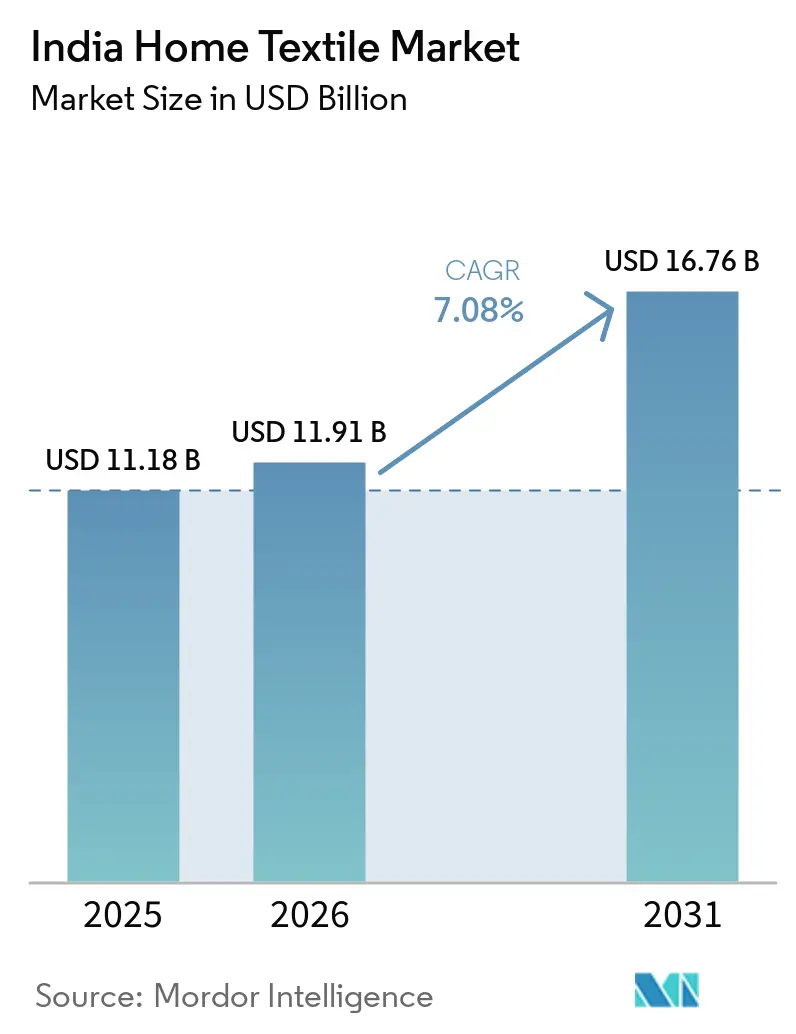
The India Home Textile Market size was valued at USD 11.18 billion in 2025 and is estimated to grow from USD 11.91 billion in 2026 to reach USD 16.76 billion by 2031, at a CAGR of 7.08% during the forecast period (2026-2031).
This rise defines the current market size trajectory of the India home textile market. Robust export contracts, sustained urban disposable-income growth, and active government production incentives continue to stimulate capacity additions even as cotton-price swings and new quality-control orders compress short-term margins. Leading manufacturers modernize spinning and finishing lines to support antimicrobial, temperature-regulating, and eco-certified fabrics, a move encouraged by consumer preference for premium, sustainable products in Tier-1 and Tier-2 cities. E-commerce channels, including quick-commerce pilots in metropolitan zones, strengthen omnichannel inventory visibility, cut delivery times, and improve basket sizes through algorithmic pricing. Export momentum is reinforced by a “China+1” sourcing pattern in the United States and the European Union, while integrated textile parks under the PM-MITRA scheme lower cap-ex for greenfield projects by offering subsidized land and common utilities. Parallel investments in zero-liquid-discharge systems and renewable power are increasingly viewed as defensive strategies to meet forthcoming EU Digital Product Passport rules.
Key Report Takeaways
- By application, bed linen captured 53.77% of the India home textile market share in 2025, and bed linen is projected to expand at an 8.21% CAGR through 2031.
- By material, cotton retained 66.25% of the India home textile market size in 2025, while other materials (Wool, Hemp, Silk, Jute, Bamboo, etc.) are projected to rise at a 10.29% CAGR through 2031.
- By end-user, the residential segment commanded 73.75% of the India home textile market size in 2025, yet the residential segment is expected to accelerate at a 7.65% CAGR through 2031.
- By distribution channel, offline retail held 88.03% of the India home textile market share in 2025, while online channels are forecast to advance at an 11.02% CAGR through 2031.
Note: Market size and forecast figures in this report are generated using Mordor Intelligence’s proprietary estimation framework, updated with the latest available data and insights as of January 2026.
India Home Textile Market Trends and Insights
Drivers Impact Analysis*
| Driver | (~) % Impact on CAGR Forecast | Geographic Relevance | Impact Timeline |
|---|---|---|---|
| Rising middle-class spending power and rapid urban migration | +1.8% | National, Tier-1 and Tier-2 cities | Medium term (2–4 years) |
| Accelerating e-commerce adoption and omnichannel retail expansion | +2.1% | National, led by Maharashtra, Karnataka, and Delhi-NCR | Short term (≤ 2 years) |
| “China + 1” sourcing shift boosting India’s export orders from US & EU buyers | +1.5% | Gujarat, Tamil Nadu, Maharashtra | Medium term (2–4 years) |
| PLI scheme and PM-MITRA mega textile parks lowering capital intensity | +1.0% | Gujarat, Tamil Nadu, Telangana | Long term (≥ 4 years) |
| Eco-friendly & smart-textile innovations lifting average selling prices | +0.9% | Major metros | Long term (≥ 4 years) |
| Rapid hotel and serviced-apartment expansion swelling institutional linen demand | +1.8% | National, Tier-1 and Tier-2 cities | Medium term (2–4 years) |
| Source: Mordor Intelligence | |||
Rising middle-class spending power and rapid urban migration
Per-capita net national income advanced to FY24 at INR 188,892 and projected to rise further to INR 205,324 for FY25.[1] Urban households now allocate 4.2% of monthly spending to home furnishings versus 3.1% in 2020, and the Ministry of Housing projects urbanization will hit 40% by 2030, adding 60 million households. Branded products steadily replace unbranded bazaar offerings as first-time buyers migrate toward higher thread counts and durable finishes, shrinking the replacement cycle for bed linen from five to three years. Domestic retailers confirm that premium cotton and blended fabrics now attract consumers from middle-income bands seeking elevated aesthetics and hygiene benefits. This demand recalibration incentivizes mills to run finer cotton counts and invest in automated quality checks to maintain consistent texture and colorfastness.
Accelerating e-commerce adoption and omnichannel retail expansion
Online home-textile sales crossed INR 8,500 crore (USD 993.7 million) in 2024, realizing a 28% year-on-year increase as unified payments surpassed 131 billion transactions, lowering checkout friction[2]. Amazon and Flipkart added more than 50,000 SKUs from 1,200 sellers, using dynamic pricing to lift average order value by 18%. Welspun India’s direct-to-consumer portal synchronizes inventory across 200 stores to support same-day pickup, trimming cart abandonment by 15%. Quick-commerce platforms now deliver towels and sheets in 10 minutes across Bengaluru, Mumbai, and Delhi, compressing replenishment cycles and forcing incumbents to rethink last-mile strategies. These tech-enabled channels provide real-time demand signals that help mills adjust loom schedules and reduce finished-goods inventory.
“China + 1” sourcing shift boosting India’s export orders from US & EU buyers
eHome-textile exports reached USD 5.1 billion in the first nine months of 2024, up 9% from the same period in 2023 as India captured 34% of US bed-linen imports. Indian mills deliver 40-foot containers within six to eight weeks, faster than many Southeast Asian competitors, while Germany’s imports from India climbed 12% in 2024 as European retailers sourced GOTS-certified products [3]. Government buyer-seller meets linked 500 SMEs with global buyers, speeding order visibility. Larger exporters sign multiyear contracts that pass through cotton-price escalations and hedge tariff risk. Logistics savings from Gujarat ports reinforce margin stability despite freight volatility.
PLI scheme and PM-MITRA mega textile parks lowering capital intensity
The production-linked incentive scheme allocates INR 10,683 crore (USD 1.25 billion) over five years, offering a 15% boost on incremental turnover for investments in man-made fiber and technical textiles. GHCL Textiles announced an investment of INR 215 crore (USD 25.1million) to add 25,000 spindles by Q2 FY26, following the successful installation of 40,000 spindles and 15 MW of renewable energy over the past two years[4] . Seven PM-MITRA parks provide plug-and-play infrastructure at INR 500 (USD 5.85) per square meter versus INR 2,000 (USD 23.4) to INR 3,000 (USD 35.1) market rates, easing entry barriers. Trident positions satellite units inside these parks to slash logistics costs by 12% and shorten lead times to ports. The combined effect of tax incentives, land subsidies and shared utilities lowers IRR thresholds and accelerates project sanctions.
Restraints Impact Analysis*
| Restraint | (~) % Impact on CAGR Forecast | Geographic Relevance | Impact Timeline |
|---|---|---|---|
| Volatile cotton prices and broader raw-material inflation squeezing margins | −1.9% | National, with concentration in cotton-dependent Gujarat and Maharashtra | Short term (≤2 years) |
| Uncertain tariffs and trade policies in key Western markets clouding export flows | −1.2% | West and South export-oriented hubs | Medium term (2–4 years) |
| Highly fragmented domestic supplier base causing inconsistent product quality | −0.8% | National, with focus on unorganized manufacturing clusters | Medium term (2–4 years) |
| Stricter BIS quality norms elevating compliance costs for small manufacturers | −0.6% | National, with greater burden on SME and micro-scale units | Short term (≤2 years) |
| Source: Mordor Intelligence | |||
Volatile cotton prices and broader raw-material inflation squeezing margins
Cotton prices spiked to INR 62,000 (USD 724.8) per candy in March 2024, an 18% rise since December 2023. The minimum support price for medium-staple cotton increased to INR 7,020 (USD 82.1) per quintal for the 2024-25 season, squeezing gross margins by up to 300 basis points. Polyester staple fiber averaged INR 95 (USD 1.11) per kilogram in 2024, a 12% year-on-year hike that compounded cost pressure. To mitigate volatility, manufacturers shift toward 60% cotton-40% polyester blends that reduce raw-material expenses by roughly 15%. Futures hedging and longer-term contracts offer partial insulation but remain underutilized among SMEs.
Uncertain tariffs and trade policies in key Western markets clouding export flows
The United States initiated a Section 301 review in late 2024 that could impose 10% to 25% duties on Indian home textiles, threatening price competitiveness. The EU’s Carbon Border Adjustment Mechanism from 2026 will levy charges on textiles produced with coal-based electricity, raising compliance challenges for mills in thermal-power-dependent states. Grid connectivity gaps and capital costs of INR 4 crore (USD 0.47 million) to INR 6 crore (USD 0.70 million) for a 1 MW solar setup slow immediate renewable transitions. Exporters respond by accelerating green-power purchase agreements and seeking carbon-neutral certifications. Industry associations lobby for tariff exemptions and smoother standards alignment.
*Our forecasts treat driver/restraint impacts as directional, not additive. The impact forecasts reflect baseline growth, mix effects, and variable interactions.
Segment Analysis
By Application: Bed Linen Anchors Market Leadership
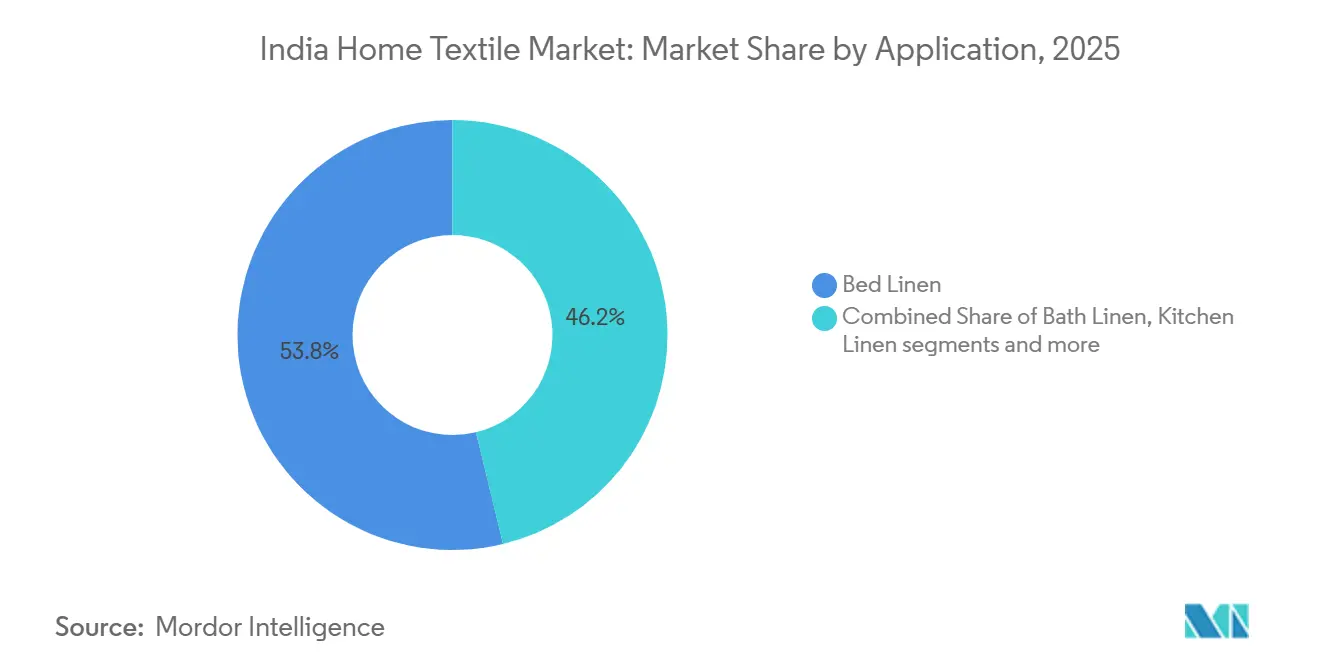
The India home textile market by application was led by bed linen, accounting for 53.77% of the total market share in 2025. This was driven by strong replacement demand from urban households, stable export orders to the United States and European Union retailers, and a preference for premium products with higher thread counts. Hospitality chains boosted demand by shortening replacement cycles, while government initiatives like the One District One Product scheme promoted unique hand-loom designs.
Bed linen is projected to be the fastest-growing segment during 2026 - 2031, with a CAGR of 8.21%. Growth will be supported by increased adoption of branded labels among middle-income households, digital campaigns highlighting sustainability, and the expansion of direct-to-consumer channels. These factors ensure bed linen remains a key market segment and a primary growth driver across residential and hospitality applications.

By Material: Cotton Dominates While Niche Fibers Accelerate
Cotton accounted for 66.25% of the India home textile market size by material in 2025, driven by strong domestic production and consumer preference for its affordability and versatility. It remains central to domestic and export demand, supported by modernization under the Technology Upgradation Fund Scheme, enabling mills to produce finer counts. Synthetic fibers cater to price-sensitive households, while premiumization in bed and bath categories reinforces cotton’s dominance.
Materials like wool, hemp, silk, jute, and bamboo are projected to grow at a CAGR of 10.29% during 2026 - 2031. Growth is fueled by rising sustainability awareness, water scarcity driving demand for linen alternatives, and the premium appeal of hemp and jute in urban markets. Bamboo viscose, marketed as bamboo linen, is gaining traction for its silky texture and biodegradability, while recycled polyester appeals to eco-conscious consumers. These niche fibers are diversifying the market and aligning with global sustainability trends.
By End‑User: Residential Buyers Drive Demand Growth
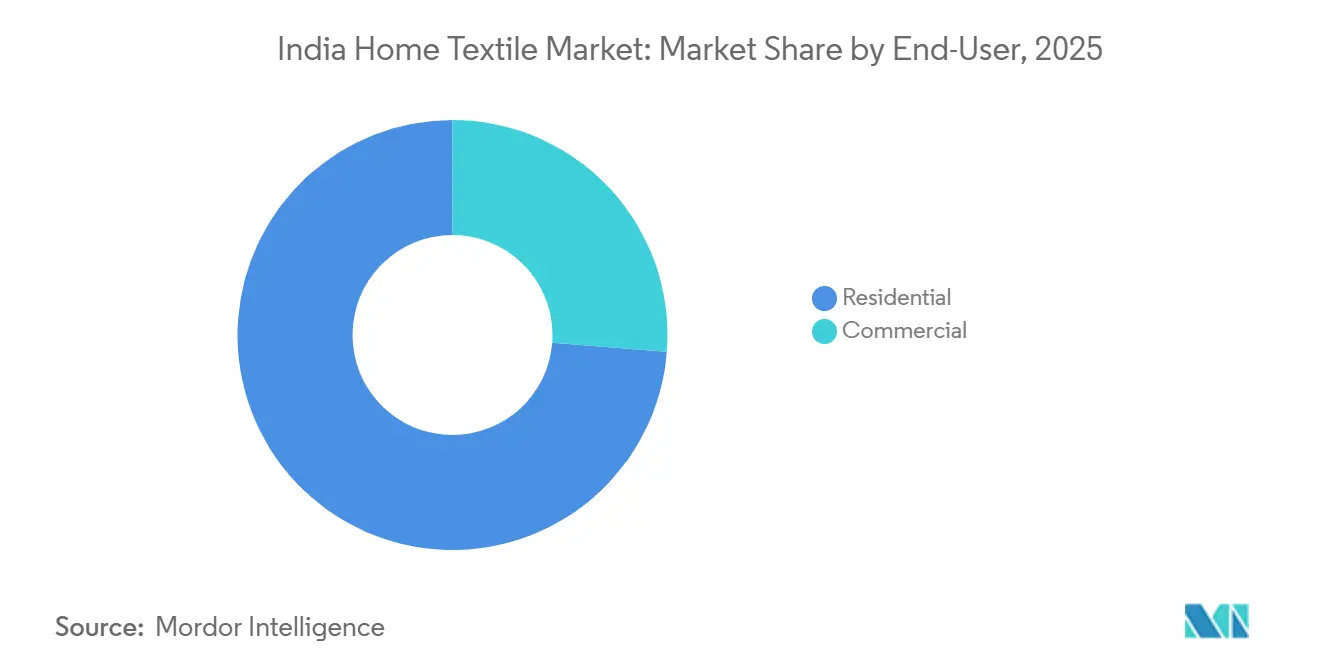
The India home textile market in 2025 was led by residential buyers, comprising 73.75% of total demand. High urban home-ownership rates and strong replacement cycles drove this dominance. The top 20% of families favored branded products, while middle-income buyers opted for hypermarket private labels priced between INR 1,500 (USD 16.69) and INR 3,000 (USD 33.38). Government initiatives like the One District One Product scheme supported hand-loom designs, and direct-to-consumer channels enabled niche brands to target sustainability-conscious homeowners.
Residential demand is projected to grow fastest during 2026-2031, with a CAGR of 7.65%, driven by rising disposable incomes, premiumization trends, and digital campaigns promoting coordinated purchases across bed, bath, and kitchen categories. While commercial buyers, including hotels, healthcare institutions, and co-living spaces, remain significant, the residential segment anchors the market, ensuring stability and long-term growth across diverse consumer groups.
By Distribution Channel: Online Gains on Quick Commerce and D2C
Offline still accounted for 88.03% of sales in 2025, leveraging more than 3,000 mass-merchandise outlets. Online channels grew at an 11.02% CAGR, with Amazon and Flipkart processing 12 million orders and using algorithmic repricing to raise basket sizes. Quick-commerce start-ups now deliver in 10 minutes across three metros. D2C brands such as Maspar expanded same-day delivery to five cities, integrating 120 store inventories. Specialty showrooms, representing 15% of offline sales, curate coordinated sets to lift transaction values by 25%.
Mass merchandisers negotiate 40% to 50% factory discounts while stand-alone boutiques maintain relevance by offering exclusive weaves. Integrated omnichannel platforms synchronize SKUs across warehouses and shelves, improving turn rates. Digital payments adoption lowers cart abandonment and supports cash-flow cycles for online retailers. Real-time analytics feed upstream demand planning, enabling mills to minimize dead stock.
Geography Analysis
West India leads with Solapur producing 40% of terry towels and Surat specializing in synthetic bed linen, making the region an important hub for the India bed and bath linen market. Solapur benefits from lower logistics costs due to local cotton sourcing, while Surat's proximity to major ports supports exports. The Sanand PM-MITRA park offers subsidized land prices, though Maharashtra's water scarcity necessitates costly zero-liquid-discharge systems.
South India holds a significant share, with Coimbatore and Tiruppur adopting compact spinning systems for export premiums. Bengaluru and Mysuru are emerging as smart-textile hubs integrating nanotechnology. North India relies on Delhi-NCR and Panipat power-loom clusters, producing millions of sheets annually within competitive price ranges.
East and North-East India are growing rapidly, supported by subsidies, reduced costs, and competitive wages. Assam promotes Guwahati as a hand-loom hub, while the Dedicated Freight Corridor enhances connectivity, making East-based mills competitive in northern markets.
Regulatory Landscape
India’s home textile compliance environment is tightening around product standards and consumer-facing disclosures. The Textiles Committee’s Labelling and Marking for Textiles Apparels and Made-Up Articles Regulation, 2025 (covering home textile made-ups such as towels, covers, curtains, and quilts) formalizes mandatory label fields including fiber composition, country of origin, manufacturer/importer/brand details, care and safety instructions, and traceability (barcode/QR). In parallel, product safety and performance requirements are being enforced through quality control orders and updated standards, including the Protective Textiles Quality Control (Upholstered Composites used for Non-Domestic Furniture) Order, 2024 (notified 12 September 2024), which mandates compliance with IS 15768:2008 for fire resistance in non-domestic use.
Standards maintenance is also active under the Bureau of Indian Standards (BIS), which gazetted revisions in February 2026 for textile floor coverings such as IS 11205:2026 (vocabulary) and IS 18554:2026 (water impermeability test). Manufacturers and importers are expected to align internal test plans and QA documentation with the updated methods. On the industrial-policy side, the Ministry of Textiles continues to run the Production Linked Incentive (PLI) Scheme for Textiles (performance years through 2029-2030) to support capacity creation in MMF and technical textile value chains, while sector efforts toward a domestic sustainability certification framework are positioned to help exporters match stricter EU/UK traceability and environmental disclosure expectations.
Value Chain Analysis
India’s home textile value chain spans fiber (cotton and man-made fibres) sourcing, spinning, weaving or knitting (including wide-width greige fabric), wet processing (dyeing, printing, finishing), and conversion into made-ups such as bed linen, bath linen, kitchen or table linen, upholstery fabrics, and floor coverings, followed by packaging and outbound logistics. Production is organized around clusters including Karur, Panipat, Ahmedabad, Jaipur, Solapur, Bhadohi, Kannur, and Coimbatore, and export and industry bodies such as TEXPROCIL, HEPC, and HEWA connect manufacturers to overseas buyers, coordinate trade facilitation, and support sector advocacy.
Key friction points remain raw-material price volatility, notably cotton, processing compliance costs (including sustainability and traceability demands), and logistics and port delays that affect export lead times. This is pushing brands and exporters toward greater vertical integration and more standardized quality systems. Policy interventions are increasingly mapped across the chain, including the Union Budget 2026-27 announcement of a National Fibre Scheme (February 2026) to bring natural and man-made fibre schemes under one umbrella, plus powerloom upgradation and modernization in furnishing and bed linen clusters to improve productivity and consistency. Complementary programs in the sector ecosystem include the PLI Scheme for Textiles (MMF/technical textiles), Tex-RAMPS (FY 2025-26 to FY 2030-31) for R&D and data systems, and Samarth 2.0 for skill development, which target capability upgrades from fibre-to-made-up conversion.
Competitive Landscape
The India home textile market is moderately fragmented, with leading producers accounting for a significant share. Welspun's vertical integration reduces lead times significantly. Trident has expanded towel production capacity with substantial investments and secured numerous hotel contracts. Indo Count directs most of its production to United States retailers and has filed patents for innovative finishes. GHCL's Tamil Nadu facility uses automation to lower labor costs effectively. D2C brands hold a notable share of the premium segment, leveraging social media for growth. IKEA collaborates with multiple Indian suppliers and plans to increase sourcing in the coming years. Private labels from Reliance Retail and DMart offer competitive discounts. Compliance with BIS norms involves annual audits with associated costs.
While online retailing of home textiles is gaining momentum, it's still nascent. Shoppers in metropolitan areas, as well as Tier-2 and Tier-3 cities, are increasingly drawn to the convenience, broader selection, and ease of online shopping for home textiles. While large corporations leverage volume purchases, diverse product offerings, and savvy marketing, smaller businesses home in on specific segments, excelling through a broad product range and top-notch customer service.
Indian brands are making their mark on the global stage. For instance, in April 2025, Jaipur Rugs, a frontrunner in the luxury handmade carpet sector, took a significant step by acquiring the Shyam Ahuja brand. Their goal is to uphold the founder's original vision while elevating the brand's status on the global luxury stage.
India Home Textile Industry Leaders
-
Welspun Group
-
Trident Group
-
Indo Count Industries Ltd.
-
Himatsingka Seide Ltd.
-
GHCL Ltd.
- *Disclaimer: Major Players sorted in no particular order
Market Opportunities and Future Outlook
Export-facing opportunities are being shaped by regulatory alignment and buyer demand for traceability, which creates whitespace for manufacturers that can document fiber origin, processing inputs, and product attributes at SKU level. The Textiles Committee’s Labelling and Marking Regulation, 2025 (with barcode/QR traceability requirements) and ongoing BIS standard updates push the market toward stronger test-and-certification infrastructure and higher compliance readiness, which in turn supports premium export segments that require certifications such as GOTS and OEKO-TEX. Government efforts to develop a domestic sustainability certification system for exports, positioned to align with EU/UK traceability and disclosure expectations, provide a pathway for exporters to standardize claims and documentation across bed, bath, and floor-covering categories.
Manufacturing modernization and cluster enablement programs also create opportunity levers for SMEs and mid-tier players seeking to graduate into export-grade made-ups. In January 2026, the Ministry of Textiles launched the District-Led Textiles Transformation (DLTT) initiative to develop 100 districts into export champions and 100 as aspirational textile hubs, while the Union Budget 2026-27 announced an integrated textile program that includes the National Fibre Scheme and cluster modernization components. Company actions reinforce the value of vertical integration and processing capacity: Paramount Textile Mills began a dedicated dyeing and finishing project for premium home textiles in Tamil Nadu (January 2026), and Premier Fine Linens disclosed commissioning a 250-loom weaving facility and expansion of an automated sewing plant near Coimbatore (July 2026). Taken together, these moves highlight how controlling processing and conversion steps can reduce lead times, improve consistency for large retail programs, and support higher-spec products such as performance finishes and eco-certified collections.
Recent Industry Developments
- July 2026: The Ministry of Textiles reviewed progress on Integrated Textile and Apparel Development Centres (ITADCs) and their repositioning as one-stop facilitation hubs for MSMEs. The shift strengthens access to testing, compliance, and process support that smaller home textile units need for stricter labeling, standards, and export documentation.
- December 2025: Welspun Home Solutions inaugurated a terry-towel plant in Anjar, Gujarat, described as the world’s largest single-site towel facility. The new capacity supports faster replenishment for large retail and hospitality programs and reinforces scale advantages in cost and delivery reliability.
- November 2024: The United States initiated a Section 301 review that could impose 10% to 25% duties on Indian home textiles. The move elevated tariff-risk management in export planning, encouraging longer-tenor buyer contracts, diversification of end markets, and tighter cost control across the cotton-to-made-up chain.
Research Methodology Framework and Report Scope
Market Definition and Coverage
This market covers the value of home-use textile products sold in India for typical household applications, including items used on beds, baths, kitchens, floors, and upholstered furniture. The sizing is done in USD and reflects domestic demand across organized and smaller-scale selling routes.
Scope exclusions: We do not count apparel textiles, industrial or technical textiles, or textile machinery and chemical inputs, and we avoid double counting between raw fabric and finished home textile items.
Segmentation Overview
- By Application
- Bed Linen
- Bath Linen
- Kitchen Linen
- Upholstery
- Carpets & Area Rugs
- By Material
- Cotton
- Linen
- Synthetic Fibres
- Other Materials (Wool, Hemp, Silk, Jute, Bamboo)
- By End-User
- Residential
- Commercial
- By Distribution Channel
- Offline
- Mass Merchandisers (Hypermarkets/Supermarkets)
- Home Centers
- Specialty Stores
- Other Distribution Channels
- Online
- Offline
- By Region
- North India
- West India
- South India
- East India
Data Sources, Market Sizing, and Validation
Desk Research
Desk work starts with building a clean fact base on India textile production, consumption signals, and external trade flows for finished home textile categories. We refer to public data series and documents such as the Ministry of Textiles releases, Directorate General of Commercial Intelligence and Statistics trade tables, UN Comtrade category-wise import-export values, RBI macro indicators (inflation and FX), and publications from textile councils and export promotion bodies.
Next, company annual reports, investor presentations, and reputable news coverage are reviewed to understand shifts in channel strategy, changes in product mix, and pricing movement over time. For selected checks, we also use paid subscriptions for company financials and intelligence, shipment-level import-export records, and patent databases, mainly to validate assumptions rather than to drive the whole model. The sources listed here are illustrative, and we used additional public references to collect data, validate ranges, and clarify open questions.
Primary Interviews and Surveys
Primary work is used to pressure-test the desk assumptions, especially around how demand differs by region, channel, and end-use, and how price points move across categories like bed linen, bath linen, kitchen linen, upholstery, and floor textiles. We speak with a balanced mix of manufacturers, distributors, retailers, and institutional buyers, and we compare inputs across North, West, South, and East India so that one local view does not dominate the total market.
Distribution of primary research fieldwork respondents
| Company type | Respondent position |
|---|---|
| Top tier: 38% | CXOs: 12% |
| Mid tier: 47% | Functional/Unit leaders: 34% |
| Smaller Players: 15% | Managers: 54% |
Market-Sizing & Forecasting
Sizing is built using a top-down approach where production, trade, and category demand signals are reconstructed into a finished-goods value pool for India, then filtered through realistic channel and end-use splits gathered from interviews. The total is corroborated with selective bottom-up approximations, such as sampled price ranges by category multiplied by indicative volume movement, plus sanity checks using supplier and retailer scale cues.
To keep the model practical, we track a few variables closely because they move the market in visible ways. These include export and import values for key home textile HS categories, cotton and synthetic fiber price direction as a cost and pricing proxy, CPI-based inflation pass-through for home-related goods, the share shift toward online selling, and housing and hospitality activity as demand triggers for replacement and new purchases. When a subcategory lacks a clean public series, we handle gaps by using proxy categories and then adjusting the split using primary feedback within a conservative range.
For forecasting, scenario analysis is used so growth reflects a mix of macro demand conditions and category-level signals, aligned to expert expectations on pricing and volume progression. Assumptions are kept transparent so a client can trace which levers changed between the base year and the out-years.
Data Validation & Update Cycle
Validation is done in steps so the final numbers do not rely on one dataset or one interview stream. We compare the modeled totals against independent signals such as trade direction, category price movement, and channel growth, then re-check any sharp jumps that do not match the underlying drivers.
Before sign-off, the work goes through cross-analyst review where inputs, conversions, and split logic are checked, followed by a final variance scan versus prior versions and external anchors. Reports are refreshed annually, with interim updates when a material event changes pricing, trade, or demand direction, and a final pre-delivery pass is completed so the client receives the most current view available.
Mordor Intelligence's India Home Textile Market Sizing Compared With Other Published Estimates
Published market sizes for India home textiles often do not match because firms make different choices on what counts as a finished home textile product, which selling routes are included, and whether the year is calendar or fiscal. Differences also appear when currency timing, inflation handling, and how online sales are treated are not aligned.
The main gap comes from whether export-linked finished goods and adjacent floor textile items are counted into the same pool. In our approach, Mordor Intelligence ties the total to finished home textile categories across bed, bath, kitchen, upholstery, and floor use, then checks the value against India trade codes and interview-confirmed price progression rather than applying a single broad textile multiplier. Some other estimates use a narrower product basket or a fiscal-year snapshot, which can shift the stated value even if the demand trend looks similar.
Benchmark comparison
| Source | Market Size | Gaps in Research Methodology |
|---|---|---|
| Mordor Intelligence | USD 11.18 B (2025) | |
| Sector Research Note A | USD 10.00 B (2024) | Uses a fiscal-year estimate (FY24) and typically reflects a domestic-market framing, which can understate categories captured through calendar-year trade-linked checks and can shift USD values due to different FX timing. |
| Industry Publisher B | USD 4.51 B (2025) | Appears to apply a tighter definition or narrower included value chain for home textiles, which can exclude adjacent finished categories or certain channels, thereby producing a smaller 2025 total even with similar growth direction. |
Looking across the three figures, the spread mainly comes from scope breadth, calendar versus fiscal timing, and how pricing and trade signals are converted into a finished-goods value. By keeping assumptions explicit and cross-checking totals against multiple demand and trade indicators, the model is easier to replicate and simpler to explain when clients need to map the number to their own category exposure.
Key Questions Answered in the Report
What is the current value of the India home textile market?
The market was valued at USD 11.91 billion in 2026 and is projected to reach USD 16.76 billion by 2031.
Which application segment currently leads in revenue?
Bed linen leads with a 53.77% share in 2025 and is also the fastest‑growing segment, with an 8.21% CAGR during 2026–2031.
How fast are online sales of home textiles expanding in India?
Online channels are advancing at an 11.02% CAGR, propelled by large marketplaces and emerging quick-commerce models.
Why are linen and bamboo blends gaining popularity?
Consumers value breathability, lower water usage and biodegradability, driving a 12.65% CAGR for these blends during 2026-2031.
What incentives drive new textile investments?
The PLI scheme and PM-MITRA parks provide cash incentives, subsidized land at INR 500 (USD 5.85) per m² and shared infrastructure, lowering capital costs.
How fragmented is the supplier landscape?
The top five companies control about 40% of sales, leaving room for mid-tier and niche firms that focus on design innovation or artisanal products.