
Quaternary Ammonium Compounds Market Size and Share
Market Overview
| Study Period | 2020 - 2031 |
|---|---|
| Market Size (2026) | USD 2.17 Billion |
| Market Size (2031) | USD 2.82 Billion |
| Growth Rate (2026 - 2031) | 5.39 % |
| Fastest Growing Market | Middle East and Africa |
| Largest Market | Asia-Pacific |
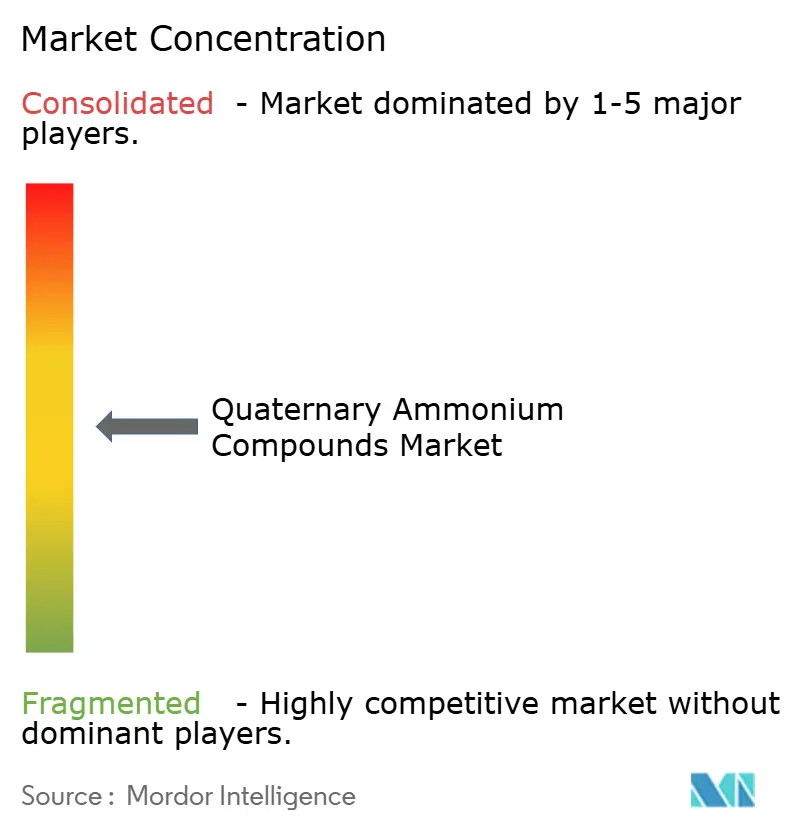
| Market Concentration | Medium |
Major Players *Disclaimer: Major Players sorted in no particular order Image © Mordor Intelligence. Reuse requires attribution under CC BY 4.0. | |
Quaternary Ammonium Compounds Market Analysis by Mordor Intelligence
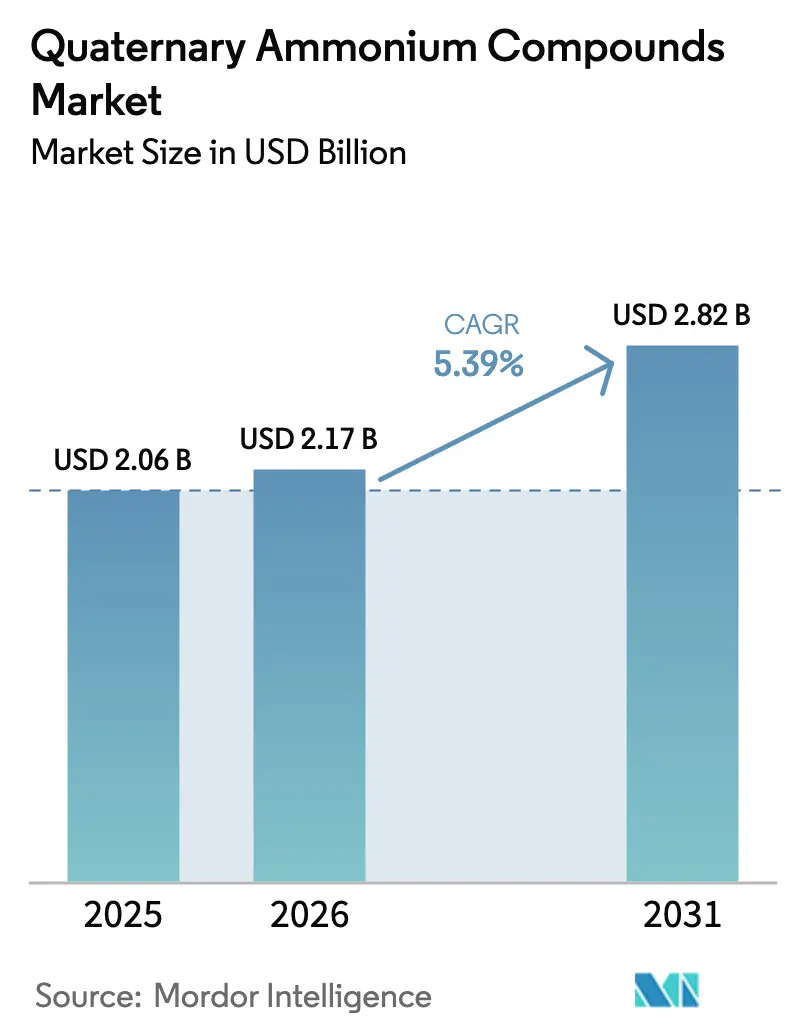
The Quaternary Ammonium Compounds Market size was valued at USD 2.06 billion in 2025 and estimated to grow from USD 2.17 billion in 2026 to reach USD 2.82 billion by 2031, at a CAGR of 5.39% during the forecast period (2026-2031). Demand continues to broaden as healthcare facilities, municipal utilities, and industrial operators embed quaternary ammonium compounds into routine hygiene, water-treatment, and process-chemical regimes. Post-pandemic infection-control standards in hospitals, schools, and transportation hubs sustain elevated disinfectant consumption, while textile producers in Asia expand fabric-softener lines that rely on cationic surfactants for softness and odor control. Infrastructure buildouts across emerging economies drive steady uptake in water-treatment circuits, and oil-field operators strengthen usage in enhanced-recovery fluids that remain effective under extreme pressure and salinity. At the same time, formulators increase research spending on biodegradable and low-VOC chemistries to pre-empt tighter environmental rules in North America and Europe.
Key Report Takeaways
- By grade, industrial grade held 45.22% of the quaternary ammonium compounds market share in 2025; cosmetic grade is projected to grow the fastest at a 5.95% CAGR through 2031.
- By application, disinfectants led with 41.05% revenue share in 2025, while fabric softeners are expected to expand at a 5.91% CAGR to 2031.
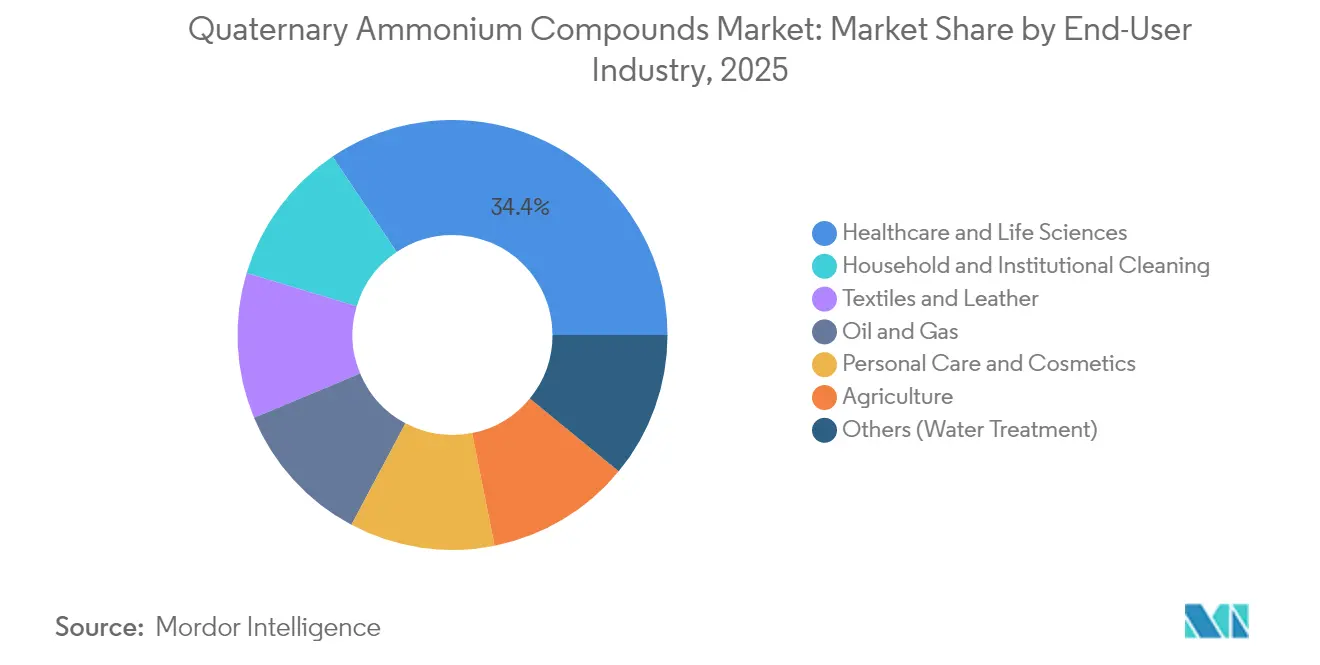
- By end-user industry, healthcare accounted for 34.42% of the quaternary ammonium compounds market size in 2025 and personal care and cosmetics shows the strongest outlook with a 6.78% CAGR to 2031.
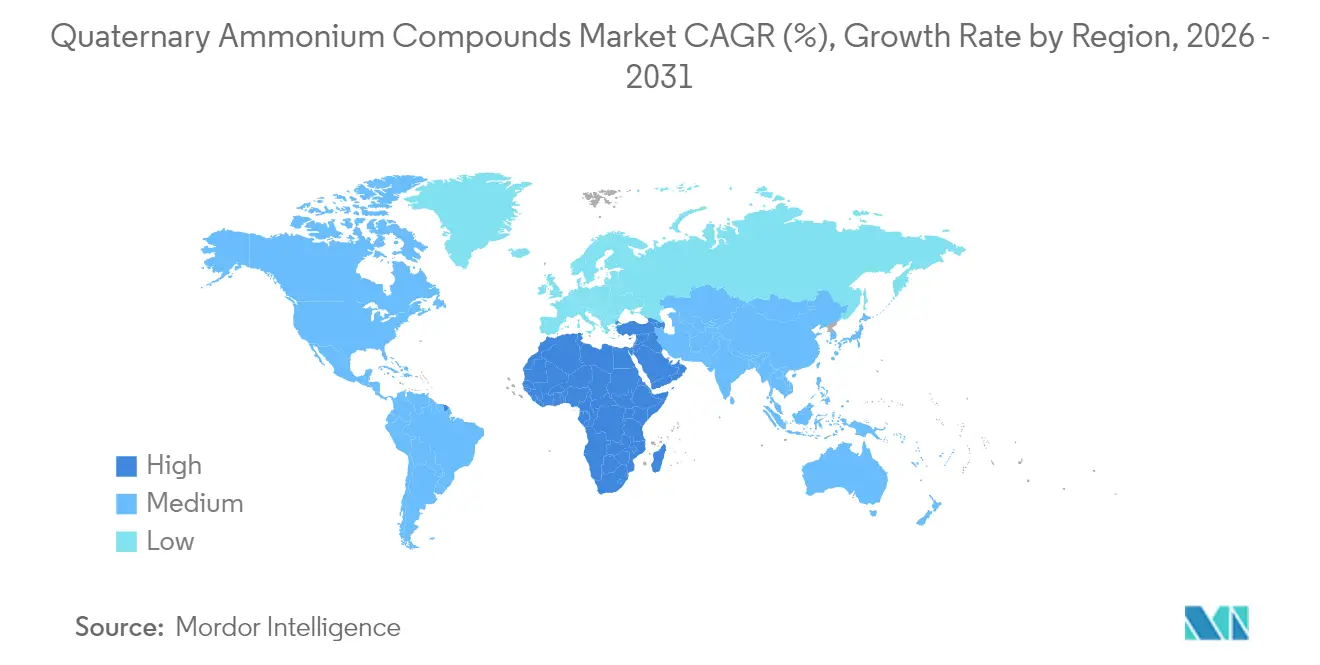
- By geography, Asia Pacific commanded 32.21% of 2025 revenues; the Middle East and Africa region is set to advance the quickest at a 6.91% CAGR during the forecast period.
Note: Market size and forecast figures in this report are generated using Mordor Intelligence’s proprietary estimation framework, updated with the latest available data and insights as of 2026.
Market Trends and Insights
Drivers Impact Analysis of Quaternary Ammonium Compounds Market*
| Driver | (~) % Impact on CAGR Forecast | Geographic Relevance | Impact Timeline |
|---|---|---|---|
| Rising demand for hospital-grade disinfectants for post-COVID infection-control protocols | +1.8% | Global, with concentration in North America & EU | Short term (≤ 2 years) |
| Expansion of municipal & industrial water-treatment infrastructure in emerging economies | +0.9% | APAC core, spill-over to MEA | Medium term (2-4 years) |
| Surging textile softener usage in Asia's apparel manufacturing hubs | +0.7% | APAC, particularly China & India | Medium term (2-4 years) |
| Regulatory push for low-VOC surface-cleaner chemistries | +0.6% | North America & EU, expanding globally | Long term (≥ 4 years) |
| Adoption of cationic surfactants in enhanced oil-recovery fluids | +0.5% | Middle East, North America, Latin America | Long term (≥ 4 years) |
| Source: Mordor Intelligence | |||
Rising Demand for Hospital-Grade Disinfectants for Post-COVID Infection-Control Protocols
The pandemic forever raised baseline hygiene expectations in clinics and long-term-care facilities, and quaternary ammonium compounds remain the primary actives in more than 500 products on the United States Environmental Protection Agency List N[1]. Surgical suites, emergency units, and diagnostic labs maintain cleaning cycles that call for benzalkonium chloride and dialkyldimethylammonium blends several times each shift. Their broad-spectrum action against bacteria, enveloped viruses, and fungi, coupled with surface-compatibility on stainless steel and polymer finishes, sustains institutional demand. Recent EPA residue-analysis methods help facilities track deposition and rinse efficiency to limit patient exposure. Supplier R&D now centers on dual-active mixtures that pair quaternary ammonium compounds with peroxide to cut dwell times below one minute, a shift that aligns with workflow efficiency goals in high-turnover departments.
Expansion of Municipal & Industrial Water-Treatment Infrastructure in Emerging Economies
Rapid urbanization across China, India, Indonesia, and Nigeria requires new drinking-water plants and distribution-line upgrades, many of which substitute or supplement chlorination with quaternary ammonium compound dosing to control biofilm formation. Industrial parks add closed-loop cooling towers that recirculate large volumes of process water, creating steady baseline demand for cationic biocides that resist high hardness and variable pH. Electrochemical generation units that synthesize active chlorine in situ from quaternary ammonium precursors cut chemical-handling costs and appeal to remote plants that lack bulk-chemical logistics. Such systems, once installed, guarantee replenishment orders for two to three decades. Policy mandates on non-revenue water losses also prompt utilities to adopt compounds with stronger residuals, thereby ensuring microbiological safety despite pipeline leaks.
Surging Textile Softener Usage in Asia's Apparel Manufacturing Hubs
China, India, and Bangladesh collectively export more than half of global apparel, and their finishing mills incorporate esterquat-based softeners to deliver a premium hand-feel and antimicrobial performance in athleisure and medical garments[2]. Plant managers now retrofit jet-dye lines with low-bath-ratio processes that leverage quaternary ammonium compounds to reduce rinse steps by 90% and energy needs by 75%. Concurrently, formulators shift toward tallow-sourced esterquats whose ultimate biodegradation exceeds 90% within 28 days, easing pressure from European retailers that assess upstream cradle-to-gate emissions. Textile chemical clusters in Guangzhou and Tiruppur secure volume discounts from local suppliers, translating into cost advantages that reinforce Asia Pacific leadership in the quaternary ammonium compounds market.
Regulatory Push for Low-VOC Surface-Cleaner Chemistries
Volatile organic compound ceilings in California, Ontario, and Germany limit traditional solvent levels in household and institutional cleaners. Manufacturers therefore reformulate with water-based systems built around quaternary ammonium compounds that meet Safer Choice profiling and comply with Europe’s Chemical Strategy for Sustainability. Strict disclosure norms drive brands to list every ingredient above 100 ppm, nudging them toward single-active disinfectants with a long record of occupational-safety data. European Chemicals Agency risk-evaluation templates now consider antimicrobial-resistance potential; early movers address this by incorporating readily hydrolyzable quaternary ammonium backbones. These compliance drivers spur continuous innovation and open opportunities for suppliers with robust toxicology dossiers.
Restraints Impact Analysis of Quaternary Ammonium Compounds Market*
| Restraint | (~) % Impact on CAGR Forecast | Geographic Relevance | Impact Timeline |
|---|---|---|---|
| Feedstock (tallow & petro) price volatility | -0.8% | Global, with acute impact in Asia & North America | Short term (≤ 2 years) |
| Antimicrobial-resistance concerns driving regulatory scrutiny | -0.4% | North America & EU, expanding to APAC | Medium term (2-4 years) |
| Toxicity debates restricting leave-on cosmetic use in the EU | -0.3% | EU, with potential spillover to North America | Medium term (2-4 years) |
| Source: Mordor Intelligence | |||
Feedstock (Tallow & Petro) Price Volatility
Tallow demand surged after large biodiesel capacities came online in Southeast Asia and the United States, diverting animal-fat streams away from specialty chemicals. Simultaneously, ethylene and propylene price swings linked to refinery utilization rates introduce cost unpredictability for petro-based quaternary ammonium intermediates. Producers hedge exposure through multi-year offtake contracts and selective biomass-balanced purchasing mechanisms offered by integrated suppliers. When input costs spike, formulators rationalize product lines, prioritize higher-margin healthcare grades, and pass through surcharges to institutional buyers under index-based clauses.
Antimicrobial-Resistance Concerns Driving Regulatory Scrutiny
Laboratory studies link sustained low-level quaternary ammonium exposure in wastewater biofilms to gene up-regulation that confers cross-resistance to antibiotics. European wastewater directives now propose monitoring quaternary ammonium residuals at treatment-plant outfalls, and North American regulators investigate potential restrictions on leave-on wipes. To stay ahead, chemical suppliers invest in surveillance programs that track minimal inhibitory concentrations across hospital isolates and publish findings in peer-reviewed journals. Compliance teams also promote “soft” quaternary ammonium molecules that undergo rapid ester-cleavage in sewage, lowering selective pressure in the environment.
*Our forecasts treat driver/restraint impacts as directional, not additive. The impact forecasts reflect baseline growth, mix effects, and variable interactions.
Quaternary Ammonium Compounds Market Segment Analysis
By Type:
Industrial Grade Dominates Through Infrastructure ApplicationsIndustrial grade products controlled 45.22% of 2025 revenue because water utilities, oil-field service contractors, and pulp-and-paper mills specify higher purity and performance thresholds. This segment benefits from accelerated capital spending on desalination plants in Saudi Arabia and Nigeria, each of which consumes continuous doses that preserve membrane efficiency throughout 25-year operating lifecycles. Enhanced-oil-recovery pilots in the Permian Basin adopt gemini cationic surfactants that maintain stability above 120 °C and at 200,000 ppm brine, thereby advancing the quaternary ammonium compounds market size for industrial grade fluids. Regulatory pressure on chloride emissions encourages drillers to switch from potassium chloride to quaternary ammonium clay-inhibition systems, which also reduce formation damage.
Research pipelines emphasize ester-linked quats that hydrolyze into benign fatty acids under neutral pH in wastewater. This pivot aligns with European Union discharge limits and supports higher growth in the cosmetic grade segment, forecast to expand at a 5.95% CAGR. Cosmetic formulators favor dialkyldimethyl ammonium chloride variants with longer alkyl chains that offer wet-combing improvements at dosages below 0.2 wt%, helping conditioners meet label claims without silicones. As biodegradable performance improves, cosmetic grade volumes will erode part of industrial grade’s share yet lift overall quaternary ammonium compounds market value.


By Application:
Disinfectants Lead Amid Post-Pandemic ProtocolsDisinfectants accounted for 41.05% of 2025 demand owing to permanent adoption of rapid-turnaround cleaning cycles in hospitals, transit systems, and food-service kitchens. The quaternary ammonium compounds market size tied to surface disinfectants rose further in early 2025 as airlines reinstated pre-departure cabin fogging between long-haul segments. Innovation centers on synergistic blends that drop contact time to 30 seconds without compromising material compatibility, giving manufacturers competitive headroom in tender cycles.
Fabric softener use, while historically mature, accelerates at a 5.91% CAGR through 2031 as premium sportswear labels launch multi-wash odor-control lines. Mills in Zhejiang Province deploy in-line finishes that combine esterquats with silver-free antimicrobials, extending garment lifetime and catering to circular-fashion pledges. These developments widen profit pools and distribute quaternary ammonium compounds market share more evenly across consumer and institutional channels.
By End-User Industry:
Healthcare Leads Through Institutional DemandHospitals, outpatient clinics, and diagnostic laboratories represented 34.42% of 2025 consumption because every surface-decontamination protocol specifies quaternary ammonium formulations that neither corrode steel nor degrade polyurethane tubing. Average bed-turnover per day has climbed since elective surgeries normalized, magnifying chemical throughput in environmental-services departments and boosting the quaternary ammonium compounds market share attributable to healthcare settings.
Personal care companies chart the fastest trajectory at 6.78% CAGR as hair-conditioning emulsions migrate from synthetic polyquaterniums to plant-based quats introduced by ingredient suppliers such as Symrise. Consumer-health trends that prioritize “microbiome-friendly” claims spur interest in next-generation lipid-quat systems that deposit conditioning layers yet rinse cleanly, limiting buildup on the scalp. This narrative strengthens retailer willingness to allocate shelf space, thereby enlarging quaternary ammonium compounds industry penetration into mass-premium price points.
Geography Analysis
APAC Quaternary Ammonium Compounds Market
Asia Pacific commands 32.21% of 2025 turnover thanks to its dense textile value chain, broad chemical clusters, and large installed base of municipal water infrastructure. Chinese fabric-softener demand alone accounted for nearly one-quarter of regional volume, a figure expected to climb as apparel exporters pivot toward value-added performance wear. India’s Smart Cities Mission grants accelerate installation of tertiary-treatment plants that rely on cationic biocides for biofilm control, anchoring procurement contracts that underpin long-term supply visibility across the quaternary ammonium compounds market.
North America Quaternary Ammonium Compounds Market
North America holds an entrenched position through hospital networks that standardize on EPA-registered List N disinfectants and through shale-gas operators that employ quaternary ammonium clay-control systems in unconventional wells. With more than 180 million m² of commercial flooring installed annually, janitorial service providers in the United States maintain high pull-through rates, cushioning the impact of periodic budget constraints. Canada’s oil-sands producers trial biodegradable cationic surfactants in steam-assisted gravity drainage, a move that could enlarge regional quaternary ammonium compounds market size under increasingly strict carbon-intensity benchmarks.
EMEA and South America Quaternary Ammonium Compounds Market
Europe emphasizes sustainable chemistries, prompting formulators to adopt ester-link quats and biomass-balanced feedstocks that cut cradle-to-gate emissions by 50% or more. Leading consumer brands seek Nordic Swan Ecolabel certification, which caps cumulative aquatic toxicity; compliance advantages will likely raise switching costs for specifiers and therefore stabilize the supplier roster. The Middle East and Africa post the strongest growth outlook at 6.91% CAGR as offshore rigs in Qatar, Angola, and Guyana expand cationic surfactant programs aimed at maximizing recovery from deepwater assets. South America, led by Brazil, leverages quaternary ammonium disinfectants in expanding poultry and beef-processing plants that must comply with updated US and EU import hygiene codes.
Regulatory Landscape
Regulation of quaternary ammonium compounds covers biocidal efficacy, chemical hazard classification, and product disclosure, with the highest scrutiny concentrated in North America and Europe. In the European Union, the European Chemicals Agency (ECHA) published an Assessment of Regulatory Needs in January 2025 for certain short-chain aliphatic quaternary ammonium compounds (notably bromide and iodide salts), identifying the need for further risk-management action, including potential harmonized classification and labeling considerations for endpoints such as reproductive toxicity and neurotoxicity.
In the United States, disinfectant market access continues to rely on US Environmental Protection Agency (EPA) registration and periodic registration review for antimicrobial actives used across institutional and healthcare settings. State-level programs add additional compliance requirements for formulators, including California Department of Toxic Substances Control (DTSC) tracking of quaternary ammonium compounds in personal care and cosmetic products under its Safer Consumer Products program workstreams (2025), which reinforces pressure for full ingredient disclosure and reformulation toward lower-impact chemistries where feasible.
Value Chain Analysis
The value chain starts with renewable and petrochemical feedstocks, including fatty alcohols and fatty acids from palm kernel and coconut supply chains, plus petro-based intermediates. These feedstocks are converted into alkylamines and then quaternized into quaternary ammonium compounds, followed by purification into industrial, cosmetic, and pharmaceutical grades.
Integrated chemical complexes in established manufacturing corridors, such as BASF in Ludwigshafen, and major production hubs in Houston and Shanghai, support scale production and global export of core intermediates and finished quats. Downstream, quats are supplied to formulators and blenders for disinfectants, fabric softeners, personal care conditioners, and industrial water and oilfield applications, where distribution networks and local compliance capabilities influence competitiveness. Oleochemical input volatility in Southeast Asia and tallow/petro alternatives can squeeze margins for non-integrated producers. A key bottleneck remains GMP-grade purification and qualification for pharmaceutical and high-spec applications, where facility qualification can take 18 to 24 months, slowing capacity additions and increasing exposure to single-source risks for benzalkonium chloride and other pharma-grade quat excipients.
Competitive Landscape
The quaternary ammonium compounds market features a moderate fragmentation. BASF, Evonik, Clariant, Nouryon, and Kao leverage integrated raw-material positions and broad formulation libraries to serve pharmaceutical, household, and oil-field customers. BASF’s EcoBalanced lines substitute fossil methanol with biogas-derived methanol, reported to cut product carbon footprints by 65% while keeping antimicrobial potency intact. Evonik initiated pilot manufacture of trimethylamine from green ammonia in Marl, Germany, advancing internal Scope 3 reduction goals and differentiating supply to European disinfectant blenders.
Mid-tier competitors pursue niche angles: Stepan builds esterquat plants in Singapore to meet Asia’s cosmetics reformulation surge, whereas Colonial Chemical focuses on feedstock flexibility, offering RSPO-certified palm versions to personal care brands experimenting with “clean” conditioner labels. Patent filings reveal momentum around gemini-structure cationic surfactants designed for reservoir temperatures exceeding 150 °C while maintaining lower adsorption on sandstone formations, thereby reducing chemical-slug costs in tertiary recovery projects.
Quaternary Ammonium Compounds Industry Leaders
-
Nouryon
-
Lonza Group
-
BASF
-
Stepan Company
-
KLK Oleo
- *Disclaimer: Major Players sorted in no particular order
Quaternary Ammonium Compounds Market Companies Covered in this Report
- Arkema
- BASF
- Clariant
- Croda International plc
- Diversey Holdings Ltd.
- DuPont
- Evonik Industries AG
- Henkel AG & Co. KGaA
- Huntsman Corporation
- Kao Corporation
- KLK Oleo
- LANXESS AG
- Lonza Group
- Merck KGaA
- Nouryon
- Oxiteno S.A.
- Pilot Chemical Company
- Solvay S.A.
- Spartan Chemical Company
- Stepan Company
Market Opportunities and Future Outlook
The clearest whitespace lies at the intersection of compliance-driven market access and application-specific performance, especially in personal care and household cleaning where ingredient acceptability and documentation carry as much weight as cost. In March 2026, Nouryon reported halal certification for selected ingredients tied to its China manufacturing footprint, including quaternary ammonium compounds produced at the Boxing site. For formulators targeting halal-sensitive consumer markets, this creates a more practical route to qualification while preserving established performance needs in fabric care and cleaning.
Opportunity also comes from substitution and reformulation pressure that is reshaping product design in disinfectants and personal care, including movement toward biodegradable backbones and non-quat alternatives as regulatory and consumer constraints tighten. Nouryon has promoted biodegradable, non-quat conditioning technology (Armocare Aqua 12) for hair care, which points to active development of adjacent technologies that can displace conventional quats in select uses. At the same time, the disinfectant segment remains anchored in regulated performance requirements and EPA-registered use patterns, supporting two parallel tracks: higher-documentation, lower-residue quat systems for regulated institutional settings, and differentiated specialty quats, such as durable textile finishes, where longer performance life can reduce reapplication frequency and shift demand away from pure commodity softener volumes.
Recent Industry Developments in Quaternary Ammonium Compounds Market
- May 2026: Tanatex Chemicals introduced QuatLock, a silane quaternary ammonium compound (Si-QAC) technology for textile finishing designed to form a durable antimicrobial layer through covalent bonding to treated surfaces. The launch targets performance apparel and technical textiles where wash durability is a key spec, pushing quat consumption toward higher-value specialty finishes rather than commodity softener-only demand.
- March 2026: Nouryon announced that selected ingredients made in China received halal certification, including quaternary ammonium compounds produced at the Boxing site for fabric softeners and cleaning applications. The certification broadens addressable customer programs that require halal-compliant inputs and strengthens regional supply positioning for multinational formulators sourcing within China.
- March 2024: Actylis and Novo Nordisk Pharmatech announced a strategic partnership for the distribution of pharmaceutical-grade benzalkonium chloride in targeted European countries, including Germany, Spain, Portugal, the United Kingdom, and Ireland. The agreement improves route-to-market for higher-purity quat excipients and supports supply continuity and qualification needs for regulated pharmaceutical and healthcare formulations.
Quaternary Ammonium Compounds Market Report Scope and Research Methodology
Market Definition and Coverage
This market covers the value of quaternary ammonium compounds sold as active chemistries used in end-use formulations where quats provide antimicrobial, surfactant, antistatic, or conditioning performance, across major regions.
Scope exclusions: We exclude downstream branded finished goods revenues where quat value cannot be separated from the overall product price, along with internal transfers that would double count sales.
Segments Covered in This Report
- By Type
- Industrial Grade
- Pharmaceutical Grade
- Cosmetic Grade
- Others (Food Grade, Lab Grade)
- By Application
- Disinfectants
- Fabric Softeners
- Wood Preservatives
- Surfactants
- Antistatic Agents
- Oil and Gas Chemicals
- Others (Personal-Care Conditioners etc)
- By End-User Industry
- Healthcare and Life Sciences
- Household and Institutional Cleaning
- Textiles and Leather
- Oil and Gas
- Personal Care and Cosmetics
- Agriculture
- Others (Water Treatment)
- By Geography
- Asia-Pacific
- China
- India
- Japan
- South Korea
- Rest of Asia-Pacific
- North America
- United States
- Canada
- Mexico
- Europe
- Germany
- United Kingdom
- France
- Italy
- Rest of Europe
- South America
- Brazil
- Argentina
- Rest of South America
- Middle East and Africa
- Saudi Arabia
- South Africa
- Rest of Middle East and Africa
- Asia-Pacific
Data Sources, Market Sizing, and Validation
Desk Research
Desk research was used to set the fact base and boundaries before building the model. We reviewed public statistics on chemicals and surfactants, trade and customs series, and environmental and health regulatory publications that shape usage patterns and allowed concentrations.
Key inputs were drawn from sources such as UN Comtrade and national customs portals for HS-code level trade flows, the US EPA and EU ECHA for registration and use constraints, the USGS and similar agencies for chemical industry context, and peer reviewed journals that clarify quat performance and substitution behavior. We also used company annual reports, investor presentations, and credible industry press to confirm capacity additions, plant utilization directionally, and shifts in application mix. Where needed, paid subscriptions for company financials and patent databases were used to cross check revenue exposure statements and innovation intensity. This list is not exhaustive, and many other public sources were also reviewed for data collection, validation, and research clarification.
Primary Interviews and Surveys
Primary work was done to convert the fact base into usable assumptions, especially where public data is not directly reported for quats as a standalone line item. We spoke with a mix of producers, formulators, distributors, and large end users across hygiene, water treatment, and industrial applications, so demand signals could be checked across regions and price tiers.
Distribution of primary research fieldwork respondents
| Company type | Respondent position | Region |
|---|---|---|
| Top tier: 35% | CXOs: 13% | APAC: 49% |
| Mid tier: 51% | Functional/Unit leaders: 42% | EMEA: 29% |
| Smaller Players: 14% | Managers: 45% | Americas: 22% |
Market-Sizing & Forecasting
Sizing started from a top-down build where chemical production context and HS-coded trade flows were used to reconstruct a global demand pool. We then adjusted that pool using application level penetration of quat actives and typical active-loading ranges in key formulations. To keep the total practical, we corroborated the output with selective bottom-up checks, including sampled supplier revenue exposure to quats, distributor channel feedback, and implied consumption using average selling price bands multiplied by estimated volumes.
Inputs that mattered most included regional disinfectant and institutional cleaning consumption intensity, fabric softener and textile processing activity, water treatment chemical dosing trends, and observed price movements linked to feedstock costs and formulation changes. These variables were reviewed country by country for major consuming regions, then rolled up to regional totals after gaps were handled with proxy indicators (for example, trade plus consumption indices where local production data was limited).
For forecasting, scenario analysis was used, with a base case guided by expert views on hygiene protocol persistence, regulatory tightening, and substitution toward lower-impact chemistries in sensitive uses. The final trajectory was moderated where price increases were not expected to be fully accepted by downstream formulators, and where demand growth is constrained by use restrictions in certain geographies.
Data Validation & Update Cycle
Validation relied on triangulation across independent signals, so unusual jumps were not accepted without a clear explanation. We checked the model against trade direction, capacity announcements, and application side demand indicators, and then reviewed variances across regions to confirm they align with known consumption centers.
Before sign-off, a second analyst review is performed to challenge assumptions such as active-loading, price bands, and regional allocation. Experts are re-contacted when results fall outside reasonable ranges. Reports are refreshed annually, with interim updates when material events occur, and a final pre-delivery pass is done so clients receive the latest updated view.
Mordor Intelligence's Quaternary Ammonium Compounds Market Size Measured Against Other Published Estimates
Published market sizes for quaternary ammonium compounds can look far apart because studies set different chemistry boundaries and counting points. The biggest swings usually come from whether the estimate follows quat active ingredient value versus finished formulation revenue, and whether trade and local production are reconciled at the same time.
By tracking application level active-loading ranges and then refreshing price bands with recent trade and producer checks, Mordor Intelligence keeps the total tied to quat active value. This approach reduces the risk of accidentally counting full disinfectant or personal care product revenues as quat sales.
Benchmark comparison
| Source | Market Size | Gaps in Research Methodology |
|---|---|---|
| Mordor Intelligence | USD 2.06 B (2025) | |
| Industry Portal A | USD 4.75 B (2024) | Likely counts broader finished formulation revenues across disinfectants and personal care, and uses a different base year that can lift the total when prices are inflated. |
| Press Release B | USD 1.09 B (2022) | Uses an older base year and appears to apply narrower coverage or conservative adoption assumptions, which can understate later demand normalization and cross-industry uses. |
The spread in the table is mostly explained by what is being counted and how recent the inputs are. When scope is kept at quat active value and cross checked against trade signals and end-use demand drivers, the result becomes easier to audit and repeat over time.
Key Questions Answered in the Report
What is the current Quaternary Ammonium Compounds Market size?
The market is valued at USD 2.17 billion in 2026 and is projected to reach USD 2.82 billion by 2031.
Which grade leads the quaternary ammonium compounds market?
Industrial grade products lead, holding 45.22% share in 2025 due to extensive use in water treatment and oil-field operations.
Why are quaternary ammonium compounds preferred in hospital disinfectants?
They offer rapid broad-spectrum antimicrobial activity, material compatibility, and EPA List N approval for SARS-CoV-2, making them the cornerstone of institutional hygiene programs.
Which region is expected to grow the fastest?
The Middle East and Africa region is forecast to expand at a 6.91% CAGR between 2026 and 2031, driven by oil-and-gas and infrastructure projects.