
Quartz Crystal Oscillators Market Size and Share
Market Overview
| Study Period | 2020 - 2031 |
|---|---|
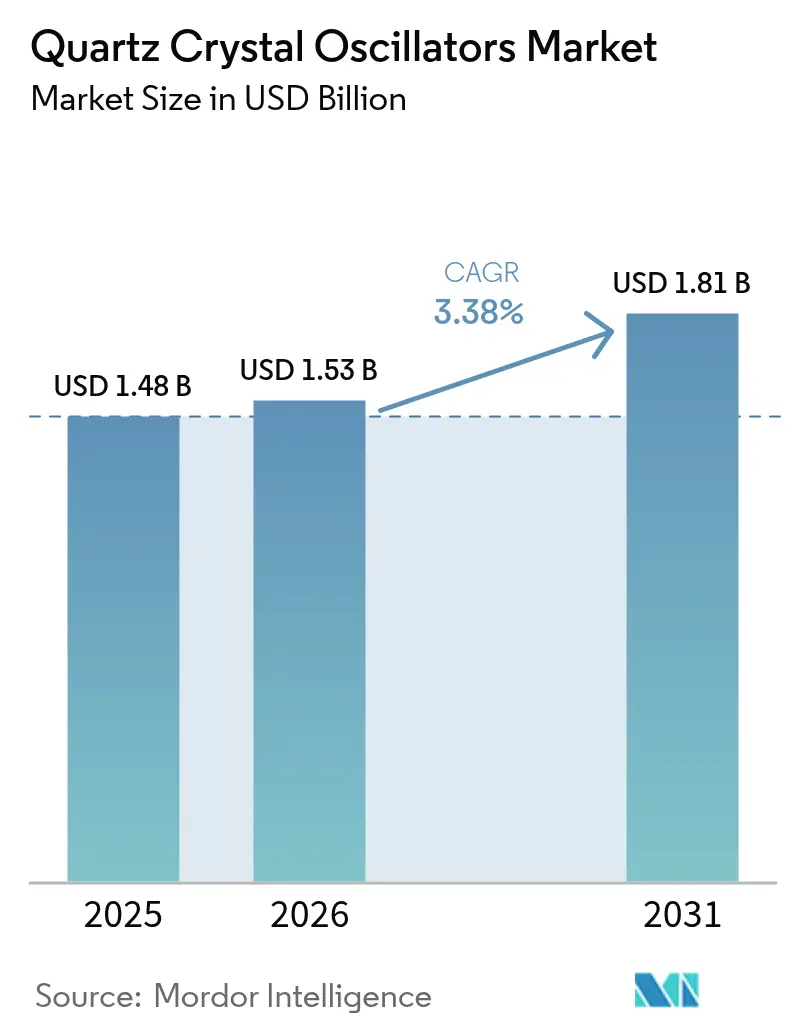
| Market Size (2026) | USD 1.53 Billion |
| Market Size (2031) | USD 1.81 Billion |
| Growth Rate (2026 - 2031) | 3.38 % |
| Fastest Growing Market | Middle East |
| Largest Market | Asia |
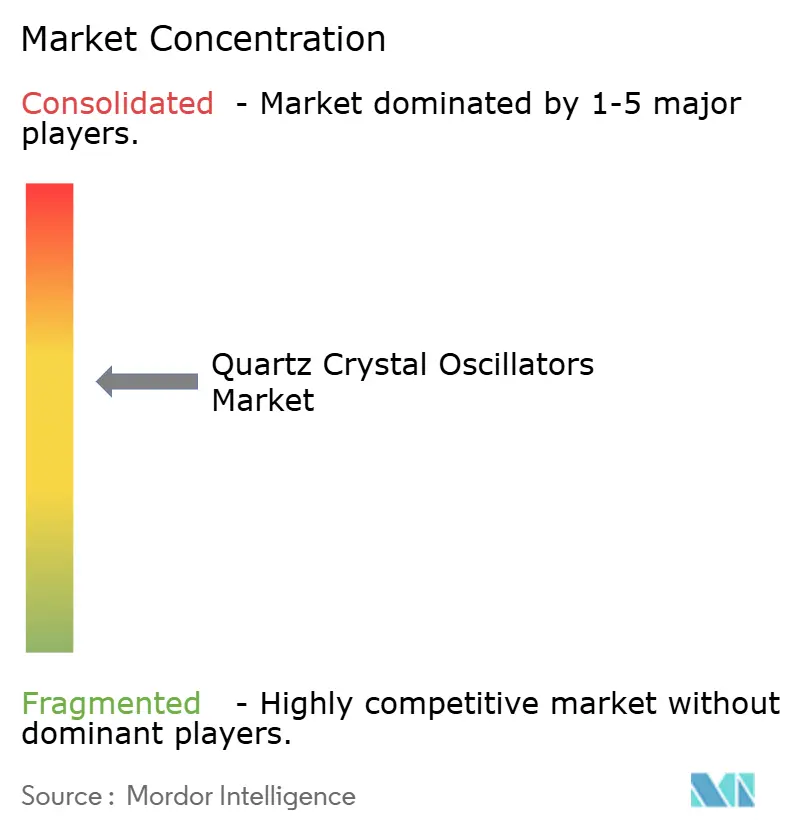
| Market Concentration | Medium |
Major Players *Disclaimer: Major Players sorted in no particular order Image © Mordor Intelligence. Reuse requires attribution under CC BY 4.0. | |
Quartz Crystal Oscillators Market Analysis by Mordor Intelligence
The Quartz crystal oscillators market size was valued at USD 1.48 billion in 2025 and estimated to grow from USD 1.53 billion in 2026 to reach USD 1.81 billion by 2031, at a CAGR of 3.38% during the forecast period (2026-2031). The measured growth underscores a maturing yet resilient landscape in which quartz continues to outperform rival technologies on phase-noise, power consumption and start-up time. Expansion of semiconductor fabs in Asia-Pacific, accelerated electrification of vehicles, and migration of hyperscale data-centres to 400/800 G optical links are the principal catalysts. At the same time, supply-chain shocks in high-purity quartz and mounting competition from MEMS oscillators moderate the trajectory yet fail to displace the incumbent technology in high-precision niches.
Key Report Takeaways
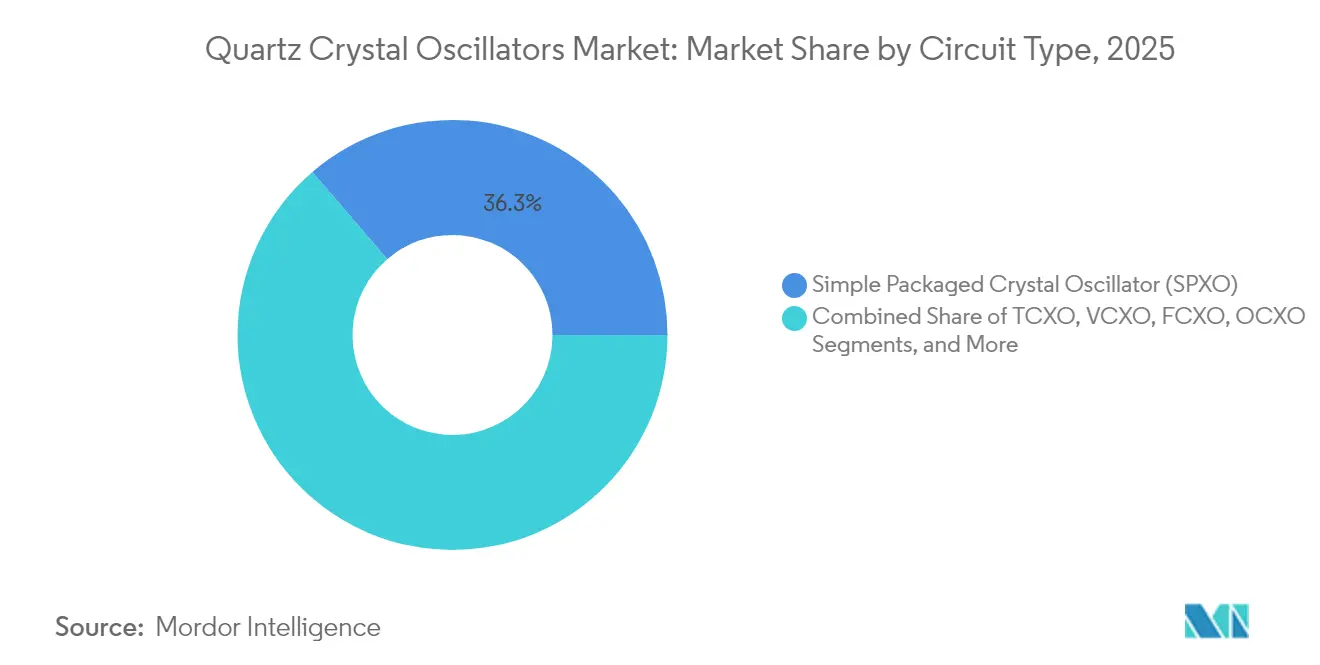
- By circuit type, Simple-Packaged Crystal Oscillators led with 36.30% of Quartz crystal oscillators market share in 2025, whereas Temperature-Compensated devices are set to expand at a 4.05% CAGR through 2031.
- By mounting type, surface-mount packages held 81.20% share of the Quartz crystal oscillators market size in 2025 and through-hole formats log the fastest projected 3.55% CAGR to 2031.
- By crystal cut, AT-cut units accounted for 63.10% share of the Quartz crystal oscillators market size in 2025; SC-cut variants lead growth at 4.40% CAGR.
- By end-user, consumer electronics retained 40.60% revenue share in 2025, while automotive demand advances at a 4.85% CAGR as electric-drive and ADAS architectures proliferate.
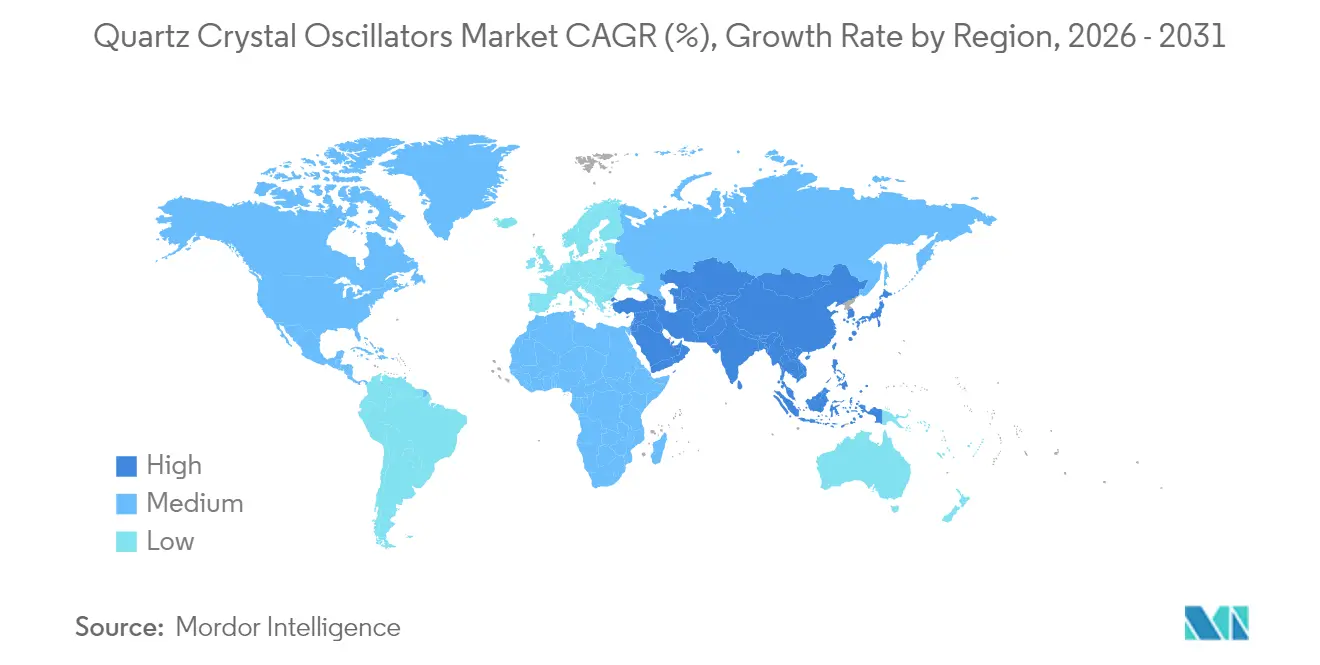
- By geography, Asia-Pacific commanded 45.10% revenue in 2025; the Middle East records the quickest 3.78% CAGR as 5G and smart-city programmes accelerate.
Note: Market size and forecast figures in this report are generated using Mordor Intelligence’s proprietary estimation framework, updated with the latest available data and insights as of 2026.
Market Trends and Insights
Drivers Impact Analysis of Quartz Crystal Oscillators Market*
| Driver | (~) % Impact on CAGR Forecast | Geographic Relevance | Impact Timeline |
|---|---|---|---|
| Proliferation of 5G base-stations elevating high-stability timing demand | 0.80% | Global, led by APAC & North America | Medium term (2-4 years) |
| ADAS & autonomous driving electronics requiring low-jitter clock sources | 0.60% | North America, Europe, China | Medium term (2-4 years) |
| Miniaturisation trend in wearables fuelling µ-package XTAL adoption | 0.40% | Global consumer-electronics hubs | Short term (≤ 2 years) |
| Industry 4.0 retro-fits boosting industrial-grade TCXO uptake | 0.30% | Europe & North America corridors | Long term (≥ 4 years) |
| Satellite mega-constellations expanding OCXO deployment | 0.20% | Global, US & China lead | Long term (≥ 4 years) |
| Data-centre migration to 400/800 G driving low-phase-noise VCXO | 0.50% | North America, Europe, APAC | Medium term (2-4 years) |
| Source: Mordor Intelligence | |||
Proliferation of 5G Base-Stations Elevating High-Stability Timing Demand
The shift from 4G frequency-only synchronisation to 5G’s time-division-duplex architecture imposes UTC-traceable phase accuracy within ±1.5 µs, compelling operators to deploy ePRTC-grade OCXOs and TCXOs in radio heads and grandmasters.[1]Microchip Technology, “Synchronizing 5G Networks with Timing Design and Management,” microchip.comSpecifications such as ITU-T G.8272.1 prescribe ±30 ns limits, encouraging vendors like Rakon to miniaturise OCXOs able to holdover during GNSS loss. Each small-cell node in dense urban layouts now embeds its own precision source, multiplying unit demand as macro-only roll-outs give way to distributed antenna systems. Solutions such as Oscilloquartz OSA 5430 integrate optical atomic references to future-proof 5G timing architectures, reinforcing quartz relevance where picosecond-level jitter tolerance is mandatory. [2]Oscilloquartz, “Synchronizing 5G Networks,” oscilloquartz.com
ADAS and Autonomous Driving Electronics Requiring Low-Jitter Clock Sources
Level-3 autonomy increases sensor fusion and real-time compute loads that must align to sub-ns windows over automotive Ethernet. Skyworks and SiTime have qualified low-jitter oscillators to AEC-Q100 and ISO 26262 standards, delivering power budgets below 1 µW for always-on domains while surviving vibration peaks above 20 g.[3]Skyworks Solutions, “Automotive – ADAS and Automated Driving,” skyworksinc.com TDK forecasts 27% electric-vehicle production growth, implying a parallel expansion in timing nodes per chassis as zonal ECUs replace distributed architectures. Centralised processors linked by PCIe demand clock sources with RMS phase-noise under 100 fs, a threshold still favouring quartz in high-reliability settings.
Miniaturisation Trend in Wearables Fuelling µ-Package XTAL Adoption
Wearable form-factors compress by double-digit percentages each design cycle. Daishinku’s 1.6 × 1.2 mm DSO1612AR occupies just 58% of its predecessor’s volume yet covers 0.6-80 MHz, supporting everything from BLE beacons to GNSS receivers. Epson’s vertically integrated quartz growth enables defect-free wafers essential for die-level lithography that scales below 0.5 mm thickness. Medical wearables need timing references that survive sweat-induced corrosion and 10 °C body-temperature swings without recalibration, reinforcing demand for hermetically sealed SMD crystals.
Industry-4.0 Retro-fits in Brown-Field Plants Boosting Industrial-Grade TCXO Uptake
Deterministic Ethernet upgrades in legacy factories rely on IEEE 802.1AS profiles achieving sub-µs accuracy across daisy-chained switches. Texas Instruments’ Sitara processors integrate TSN hardware, but network latency still hinges on the local oscillator’s temperature coefficient. Industrial-grade TCXOs, rated -40 °C to +105 °C and shielded for EMI immunity, satisfy retrofit constraints where through-hole cards are replaced in-situ without climate control. Analog Devices highlights that every millisecond drift in multiaxis robotics elongates toolpath execution and raises scrap rates, linking timing precision directly to yield
Restraints Impact Analysis of Quartz Crystal Oscillators Market*
| Restraint | (~) % Impact on CAGR Forecast | Geographic Relevance | Impact Timeline |
|---|---|---|---|
| Emergence of MEMS-based silicon oscillators cannibalising entry-level SPXO | -0.90% | Global consumer segments | Short term (≤ 2 years) |
| Price volatility in high-purity synthetic quartz supply chain | -0.40% | Global high-end users | Medium term (2-4 years) |
| Natural-disaster disruptions at Spruce Pine source mine | -0.30% | North America-centric supply | Short term (≤ 2 years) |
| High power consumption restraining OCXO use in mobile devices | -0.20% | Global telecom & IoT | Medium term (2-4 years) |
| Source: Mordor Intelligence | |||
Emergence of MEMS-Based Silicon Oscillators Cannibalising Entry-Level SPXO
SiTime and a handful of rivals now ship programmable MEMS clocks that withstand 50,000 g shocks and operate up to 125 °C, benefits that resonate in smart-phones, action cameras and industrial IoT . Unit absorption escalated after SiTime posted USD 144 million revenue in 2024, up seven-fold in a decade, indicating broad acceptance in cost-sensitive designs. Yet quartz retains supremacy where 0.18 ps rms phase-noise, 3 mA supply current and sub-100 µs start-up dominate the specification sheet, sustaining the Quartz crystal oscillators market at the high-performance end.
Price Volatility in High-Purity Synthetic Quartz Supply Chain
urricane Helene exposed the fragility of a supply chain in which Spruce Pine mines deliver up to 90% of 99.9%-pure SiO₂ feedstock for semiconductor fabs. Producers of OCXOs and TCXOs that require ultra-low alkali content faced spot-price spikes exceeding 35% in late 2024. China’s April 2025 discovery of new deposits may diversify sources, but purification know-how and qualification cycles extend beyond the forecast horizon. Such volatility squeezes margins for oscillator vendors tied to long-term fixed-price contracts with telecom OEMs.
*Our forecasts treat driver/restraint impacts as directional, not additive. The impact forecasts reflect baseline growth, mix effects, and variable interactions.
Quartz Crystal Oscillators Market Segment Analysis
By Circuit Type:
TCXO Growth Outpaces Traditional SPXO DominanceSPXOs held 36.30% of the Quartz crystal oscillators market in 2025, reflecting their ubiquity in mass-market electronics. TCXOs, while accounting for a smaller slice today, are projected to expand 4.05% annually as 5G radios, Industry 4.0 gateways and ADAS modules place thermal-stability above BOM cost. VCXOs uphold a niche in optical interconnects where the Quartz crystal oscillators market size requirement ties directly to phase-locked loop accuracy at 56 Gbps and above.
NDK, Epson and Rakon race to shrink power draw in OCXOs so that sub-ppb stability migrates from core networks to edge nodes. Epson’s OG7050CAN, 85% smaller than legacy devices yet delivering 56% lower power, signals a pathway for OCXO penetration into rack-mounted base-band units . Meanwhile, FCXO architectures surface in quantum-computing testbeds that demand 10⁻¹⁴ short-term stability unattainable by standard cuts. The resulting mix preserves the fragmented character of the Quartz crystal oscillators market while enabling specialist suppliers to capture outsized margins.



By Mounting Type:
Surface-Mount Dominance Reflects Miniaturisation ImperativeSurface-mount packages accounted for 81.20% revenue in 2025 as smartphones, wearables and IoT sensors pursue reflow-solderable components compatible with automated pick-and-place lines. The Quartz crystal oscillators market continues shifting toward chip-scale and µ-package footprints, with Daishinku’s 0.5 mm-high SPXOs setting industry benchmarks in volumetric efficiency.
Through-hole formats still chart a 3.55% CAGR because defense avionics and harsh-environment machinery favour socketed replacements that survive repeated thermal cycling. Large-body oscillators also host heater-regulated chambers indispensable for high-end OCXOs, sustaining a profitable if narrow segment. Supplier differentiation now hinges on plating chemistry and lead-free solderability, parameters that protect installed bases across automotive and rail signalling where design lifecycles exceed 15 years.
By Crystal Cut:
AT-Cut Stability Meets SC-Cut InnovationAT-cut blanks delivered 63.10% share of 2025 revenue owing to balanced cost, temperature drift and manufacturability. SC-cut devices, although dearer, grow 4.40% annually as telecom backhaul and satellite payloads insist on drift below 20 ppb per year. The Quartz crystal oscillators market size attached to SC-cut resonators thus rises disproportionately to their unit volume.
Process yield improvements shrink the premium once associated with SC-cut angles that deviate by mere arc-seconds. Vendors now deploy laser-alignment tooling and X-ray diffraction feedback to elevate throughput, making SC-cut variants viable for remote-radio-head deployments where operating budgets tighten. BT-cut crystals persist in real-time clocks at 32.768 kHz, ensuring the Quartz crystal oscillators market covers both extremes of frequency and stability.

By End-User:
Automotive Acceleration Challenges Consumer Electronics LeadershipConsumer electronics sustained 40.60% share in 2025, yet growth normalises as handset saturation peaks. Automotive applications expand 4.85% annually, reflecting surging ECU counts in battery-electric vehicles, lidar modules and vehicle-to-everything (V2X) gateways. Each platform needs multiple redundant timing channels, pushing the Quartz crystal oscillators market deeper into AEC-Q200 grade production.
Telecom networks remain pivotal, absorbing OCXOs and TCXOs that anchor ePRTC nodes and PTP grandmasters. Industrial users are retrofitting brown-field factories with TSN-enabled switches; deterministic control loops thereby enlarge addressable demand for temperature-hardened oscillators. Aerospace and defense purchasers, though volume-small, procure radiation-hardened variants priced at multi-hundred USD, bolstering the blended ASP for the Quartz crystal oscillators market.
Geography Analysis
APAC Quartz Crystal Oscillators Market
Asia-Pacific commanded 45.10% of 2025 revenue as China, Japan and South Korea manufactured more than 70% of global chips and housed tier-one oscillator makers. SEMI projects wafer starts in the region to climb 7% in 2025, translating into incremental pull-through for timing devices across test-and-measurement benches and lithography steppers. Japan’s heritage suppliers such as NDK and Epson exploit local quartz mines and vertically integrated fabs to retain leadership in sub-pS jitter performance.
North America and Europe Quartz Crystal Oscillators Market
North America benefits from hyperscale data-centre build-outs and a vibrant aerospace sector. RTX recorded USD 80.7 billion sales in 2024, underlining defense programmes that specify rad-hard quartz oscillators in missile guidance and secure communication payloads. Europe advances industrial-automation and electric-vehicle ecosystems that favour TCXO deployments for deterministic networking; Germany’s Industry 4.0 initiatives and France’s manufacturing revitalisation create tailwinds despite macroeconomic slowdowns.
MEA and LATAM Quartz Crystal Oscillators Market
The Middle East, while currently holding a modest slice, registers the fastest 3.78% CAGR to 2031 as operators in the United Arab Emirates and Saudi Arabia fast-track 5G and smart-city grids. National diversification drives semiconductor assembly programmes that in turn consume discrete timing parts. Latin America and Africa lag broader adoption because 4G still predominates and electronics production remains limited, yet small-cell densification and IoT agriculture pilots hint at incremental demand that sustains global volume growth within the Quartz crystal oscillators market.

Regulatory Landscape
Quartz crystal oscillators for high-reliability and telecom timing applications are shaped mainly by international component and measurement standards, alongside defense qualification regimes. IEC 60679-1:2017 sets generic specification and qualification approval procedures for piezoelectric oscillators, while the IEC 60444 series anchors measurement methods for resonator parameters such as resonant frequency and series resistance. This, in turn, influences how vendors characterize phase noise, stability, and aging during customer qualification.
For defense and aerospace procurement, MIL-PRF-55310 remains a key US performance specification for crystal-controlled oscillators, using a Qualified Products List (QPL) model that enforces controlled manufacturing and statistical process control practices (referenced via EIA-557-B). IEC 60122-2:2025 also updates guidance for quartz crystal units used in filters and oscillators, including refined treatment of SC-cut and aging calculation approaches. Standardized test evidence from these frameworks is increasingly treated as a design-in prerequisite across 5G timing, satellite, and other precision-clock use cases.
Value Chain Analysis
The quartz crystal oscillator value chain starts with high-purity quartz feedstock and synthetic quartz cultivation, then moves into wafer growth, blank cutting (AT-cut, SC-cut, etc.), lapping and electrode deposition, hermetic sealing or package assembly (dominantly surface-mount), oscillator IC/ASIC integration, calibration (temperature compensation or oven control), and final electrical test and screening prior to shipment. Vertical integration is a practical advantage for leaders such as Seiko Epson and Murata, since in-house quartz cultivation and manufacturing control support miniaturized packages and the tight jitter and aging specifications demanded by telecom and data-center clocks.
Downstream, distribution is increasingly supported by direct OEM and Tier 1 engagement for 5G infrastructure, automotive electronics, and industrial TSN systems, where supplier panels narrow to qualified sources with proven lifecycle support. Upstream constraints remain concentrated around semiconductor-grade quartz inputs and synthetic quartz crucible capacity, with exposure amplified by single-region concentration and qualification delays when materials or processes change. That close linkage between materials, process capability, and end-customer qualification keeps time-to-requalify meaningful, which elevates the value of long-term supply agreements, second-source strategies, and geographically diversified back-end assembly and test.
Competitive Landscape
The market remains moderately fragmented. The top five vendors combine for roughly 55% of global shipments, leaving ample room for regional specialists. NDK posted JPY 50.31 billion revenue and JPY 2.33 billion net income in FY 2024, leveraging proprietary crystal-growth furnaces and global back-end plants Finas. Epson capitalises on complete vertical integration from synthetic quartz pulling to automated dicing, yielding defect densities that underpin its leadership in µ-sized packages.
Murata reported 883.5 billion yen sales in Q2 2024, driven by smartphone RF modules that embed multi-output clock generators. Rakon, meanwhile, pursues niche leadership with MercuryX that fuses ASIC drivers and XMEMS resonators targeting AI server clock trees. SiTime’s MEMS portfolio continues to challenge quartz incumbents in harsh-motion and high-temperature domains, yet its technology coexists rather than fully displaces quartz because telecom and satellite integrators still mandate picosecond-class phase-noise unattainable via capacitive MEMS actuation.
Strategic moves in 2024 included Epson’s launch of a 56% lower-power OCXO for edge-compute blades, NDK’s capacity expansion in Malaysia to mitigate single-site risk, and SiTime’s partnership with NVIDIA to synchronise GPU lanes inside AI clusters. M&A activity stays muted as antitrust scrutiny discourages consolidation that might elevate component ASPs, sustaining the broadly competitive profile of the Quartz crystal oscillators market.
Quartz Crystal Oscillators Industry Leaders
Nihon Dempa Kogyo Co., Ltd. (NDK)
Epson Device Corporation
Daishinku Corp. (KDS)
Murata Manufacturing Co., Ltd.
Microchip Technology Inc. (Microsemi/Vectron)
- *Disclaimer: Major Players sorted in no particular order
Quartz Crystal Oscillators Market Companies Covered in this Report
- Nihon Dempa Kogyo Co., Ltd. (NDK)
- Epson Device Corporation
- Daishinku Corp. (KDS)
- Murata Manufacturing Co., Ltd.
- Microchip Technology Inc. (Microsemi/Vectron)
- TXC Corporation
- Rakon Ltd.
- SiTime Corporation
- Epson Toyocom
- River Eletec Corp.
- Siward Crystal Technology
- Hosonic Electronic Co., Ltd.
- CTS Corporation
- NDK Quartz (Asia)
- Bliley Technologies
- KYOCERA Crystal Device
- Integral Petrovsky Plant
- Fortune Semiconductor
- ICM (International Crystal Mfg.)
- Euroquartz Ltd.

Market Opportunities and Future Outlook
A clear opportunity is the shift in high-speed networking and AI infrastructure toward differential-output crystal oscillators and higher-frequency timing, where tighter jitter budgets map to 800G and emerging 1.6T optical modules. Product introductions tied to these requirements include NDK sampling a 625 MHz fundamental-mode differential-output crystal oscillator for AI data-center optical transceivers (2026) and Daishinku (KDS) announcing the Arkh.2G differential-output oscillator series up to 625 MHz using wafer-level packaging, aimed at smaller footprints and higher-volume manufacturability for advanced transceiver designs.
Another whitespace centers on energy-efficient holdover-grade and compact high-stability timing for edge compute, telecom infrastructure, and aerospace platforms that cannot accommodate legacy OCXO size and power needs. Epson introduced the OG7050CAN OCXO with reduced power consumption and volume versus prior models, and KDS advanced low-voltage TCXO development (1.2 V) in a 1612-size package, highlighting how power, size, and stability are being addressed together. These moves, alongside ongoing pressure from material volatility in high-purity quartz inputs, also create room for multi-sourcing programs and requalification services that help OEMs balance performance requirements with supply resilience.
Recent Industry Developments in Quartz Crystal Oscillators Market
- June 2026: Epson introduced the OG7050CAN low-power oven-controlled crystal oscillator (OCXO) targeting AI, edge computing, and telecom infrastructure. The design reduces power and cubic volume versus previous models, expanding where OCXO-class stability can be used in power-constrained equipment such as base stations and data-center timing nodes.
- April 2025: Daishinku Corp. (KDS) developed the industrys first 1612-size (1.6 mm x 1.2 mm) low-voltage (1.2 V) temperature-compensated crystal oscillator (TCXO). The combination of smaller footprint and lower operating voltage supports always-on timing domains in wearables, IoT, and compact modules where board area and power budgets are tightly constrained.
- October 2024: Epson unveiled the OG7050CAN OCXO as a smaller and more power-efficient oven-controlled device tailored for base stations and data centers. The launch highlighted a product roadmap focused on lowering OCXO power draw and size, reinforcing quartz-based timing relevance in telecom synchronization and high-performance computing infrastructure.


Quartz Crystal Oscillators Market Report Scope and Research Methodology
Market Definition and Coverage
For this study, the quartz crystal oscillators market covers packaged frequency-control components that use a quartz resonator and an oscillator circuit to generate a stable clock signal for electronic systems across industries.
Scope exclusions: Discrete quartz resonators or raw quartz wafers sold without an oscillator circuit, and alternative timing technologies such as MEMS oscillators, are not counted.
Segments Covered in This Report
- By Circuit Type
- Simple Packaged Crystal Oscillator (SPXO)
- Temperature-Compensated Crystal Oscillator (TCXO)
- Voltage-Controlled Crystal Oscillator (VCXO)
- Frequency-Controlled Crystal Oscillator (FCXO)
- Oven-Controlled Crystal Oscillator (OCXO)
- Other Circuit Types
- By Mounting Type
- Surface-Mount
- Thru-Hole
- By Crystal Cut
- AT-Cut
- BT-Cut
- SC-Cut
- By End-User
- Consumer Electronics
- Telecom and Networking
- Industrial Automation and IoT
- Automotive (ADAS, Infotainment, EV Powertrain)
- Aerospace and Defense
- Medical and Healthcare Devices
- Others
- By Geography
- North America
- United States
- Canada
- Mexico
- Europe
- Germany
- United Kingdom
- France
- Nordics
- Rest of Europe
- South America
- Brazil
- Rest of South America
- Asia-Pacific
- China
- Japan
- India
- South-East Asia
- Rest of Asia-Pacific
- Middle East and Africa
- Middle East
- Gulf Cooperation Council Countries
- Turkey
- Rest of Middle East
- Africa
- South Africa
- Rest of Africa
- Middle East
- North America
Data Sources, Market Sizing, and Validation
Desk Research
Desk research is used to build the base structure of the market and to anchor assumptions that later get tested in interviews. We rely on public data points that show electronics production and demand signals, such as USITC trade data for component flows, UN Comtrade for cross-checking import and export trends, and World Semiconductor Trade Statistics for the broader semiconductor cycle that often moves timing demand.
We also review technical and standards context from sources such as IEEE publications, NIST references on frequency and time, and patent databases to track packaging shifts and product direction. Company annual reports, investor presentations, and reputable press coverage help us understand pricing pressure, lead times, and end-market exposure. These sources are not exhaustive, and many other public references were also reviewed for data collection, validation, and clarification.
Primary Interviews and Surveys
Primary work focuses on confirming what is actually shipped and paid for, and then checking that the model matches how demand is created in each end market. We speak with a mix of component suppliers, electronics manufacturing ecosystem contacts, and downstream buyers across APAC, EMEA, and the Americas to validate use rates, typical price ranges, and changes in specifications, such as stability needs in automotive and networking.
Distribution of primary research fieldwork respondents
| Company type | Respondent position | Region |
|---|---|---|
| Top tier: 30% | CXOs: 12% | APAC: 53% |
| Mid tier: 53% | Functional/Unit leaders: 37% | EMEA: 29% |
| Smaller Players: 17% | Managers: 51% | Americas: 18% |
Market-Sizing & Forecasting
Sizing starts with a top-down build where production, trade, and electronics output signals are used to reconstruct the addressable timing component demand pool by region. The totals are then corroborated with selective bottom-up approximations, where we test sampled shipment volumes and average selling price ranges for key oscillator families and adjust for channel effects.
Inputs used in the model include smartphone and consumer device build trends, automotive electronics content growth, especially EV-related modules, telecom and data center capex cycles tied to 400G and 800G upgrades, packaging mix shifts toward compact surface-mount formats, and the pace of substitution toward alternative timing solutions. Where direct volume signals are thin, gaps are handled by using conservative penetration bands agreed in interviews, followed by sensitivity checks on price progression and product mix.
For forecasting, scenario analysis is applied so that short-cycle demand swings are separated from longer-cycle drivers like vehicle electrification and network upgrades. Assumptions are revisited with primary inputs so that the forward curve stays consistent with what respondents expect for lead times, qualification cycles, and pricing movement.
Data Validation & Update Cycle
Model outputs are checked against independent indicators, including regional electronics output trends, trade movement direction, and the implied revenue per unit ranges that respondents consider realistic. When a variance looks too large, we re-check the scope mapping, currency timing, and whether an end market assumption is being double counted, then follow up with select contacts to confirm.
Before sign-off, the work goes through multi-step internal reviews where assumptions and calculations are traced back to the input logic. Reports are refreshed annually, and interim updates are triggered when material events occur, such as major supply disruptions or step-changes in demand from telecom or automotive. Right before delivery, a final analyst pass is completed so clients receive the latest updated view.
Mordor Intelligence's Quartz Crystal Oscillators Market Size Compared With Other Published Estimates
Published market sizes for quartz crystal oscillators can look far apart even when the topic sounds identical, because the scope is often interpreted differently and the pricing and volume assumptions are refreshed at different times. Differences also come from whether a study counts only packaged oscillators or folds in adjacent timing parts, and from how much of the demand pool is treated as addressable.
The benchmark table shows a wide spread across current-year values, and in Mordor Intelligence's model the total is limited to packaged quartz crystal oscillator devices, not standalone resonators. The 2026 starting point is aligned to verified end-use demand signals rather than broad timing-device rollups. Some other estimates appear to include a larger product set, or they use more aggressive price progression without clear checks against electronics output or trade movement.
Benchmark comparison
| Source | Market Size | Gaps in Research Methodology |
|---|---|---|
| Mordor Intelligence | USD 1.53 B (2026) | |
| Industry Publisher A | USD 3.73 B (2026) | Uses a broader product taxonomy and segmentation that can pull in non-quartz or adjacent oscillator categories, and it reflects an estimated-year value that may embed higher average prices across applications. |
| Industry Publisher B | USD 3.45 B (2024) | Combines quartz crystal resonators and oscillators in one number, which increases the addressable revenue pool versus a packaged-oscillator-only definition and can also shift the base year and currency timing. |
In practice, most of the gap can be explained by what is included in the product boundary and which year is used as the anchor for pricing and demand. When scope is kept tight to packaged oscillators and the forward view is tied to observable end-market build cycles, the final size becomes easier to trace, review, and repeat.


Key Questions Answered in the Report
What is the current value of the Quartz crystal oscillators market?
The market generated USD 1.53 billion revenue in 2026 and is projected to reach USD 1.81 billion by 2031 at a 3.38% CAGR.
Which circuit type grows the fastest?
Temperature-Compensated Crystal Oscillators (TCXO) expand at 4.05% annually through 2031, outpacing other circuit categories.
Why does Asia-Pacific hold the largest regional share?
High semiconductor fabrication density in China, Japan and South Korea underpins 45.10% of 2025 revenues, supported by continual fab capacity expansion.
How are MEMS oscillators influencing the market outlook?
MEMS devices capture cost-sensitive consumer segments and trim growth by about 0.9 percentage points, yet quartz remains favoured where picosecond-level jitter and low power draw are critical.
Page last updated on:





