
Purging Compound Market Size and Share
Market Overview
| Study Period | 2021 - 2031 |
|---|---|
| Market Volume (2026) | 26.78 kilotons |
| Market Volume (2031) | 35.43 kilotons |
| Growth Rate (2026 - 2031) | 5.76 % |
| Fastest Growing Market | Asia-Pacific |
| Largest Market | North America |
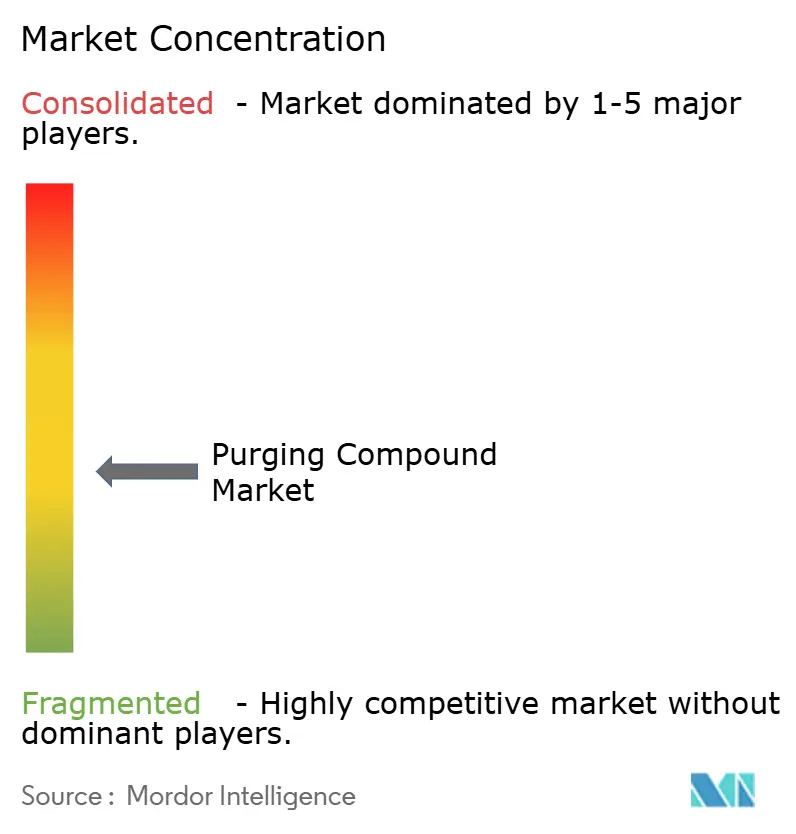
| Market Concentration | Medium |
Major Players *Disclaimer: Major Players sorted in no particular order Image © Mordor Intelligence. Reuse requires attribution under CC BY 4.0. | |
Purging Compound Market Analysis by Mordor Intelligence
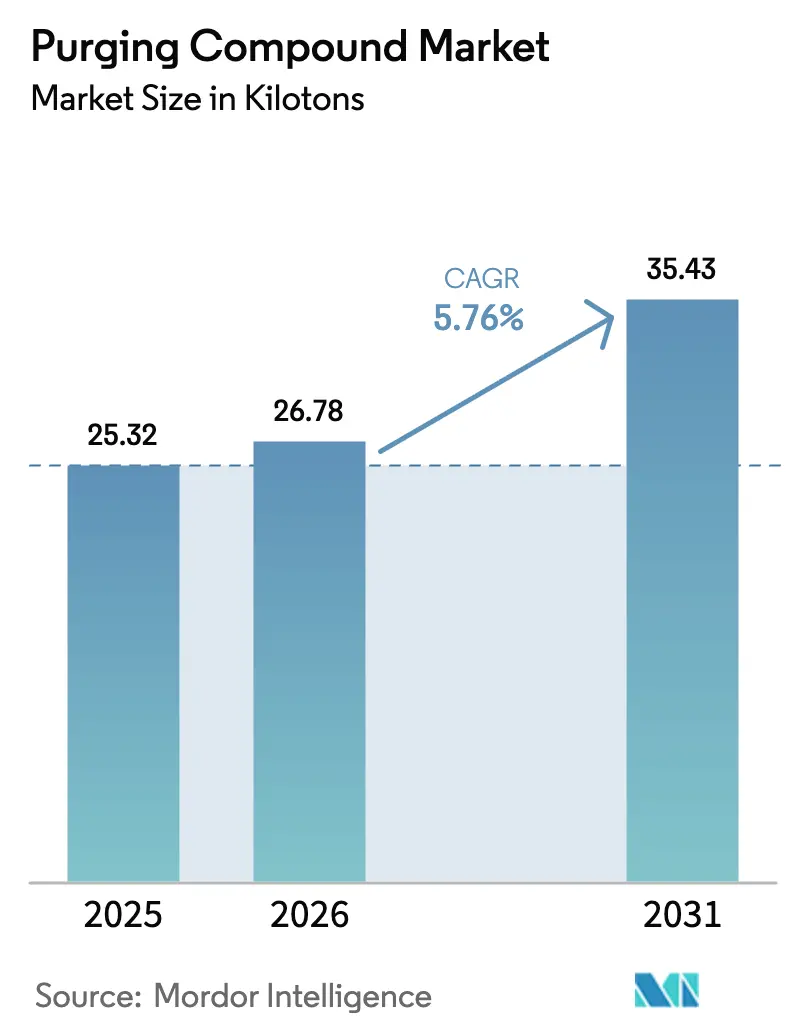
The Purging Compound Market size is projected to expand from 25.32 kilotons in 2025 and 26.78 kilotons in 2026 to 35.43 kilotons by 2031, registering a CAGR of 5.76% between 2026 to 2031. Growth is propelled by rapid adoption of high-temperature engineering polymers, shorter change-over intervals in Industry 4.0 plants, and rising regulatory pressure to curb microplastic abrasion. North America accounted for a dominant 50.12% purging compound market share in 2025, yet Asia-Pacific is the fastest-growing region at a 6.18% CAGR, supported by China’s surge in electric-vehicle production. Mechanical purge products led with 55.49% volume share in 2025 and are expanding at 6.08% CAGR, while injection molding represents 59.16% of volume on the back of frequent color and resin transitions. Automotive and transportation applications captured 25.16% share in 2025 and continue to benefit from zero-defect mandates on battery enclosures and structural parts. Competitive intensity remains moderate because integrated chemical majors bundle purging compounds with engineering resins, whereas niche suppliers focus on application-specific formulations that yield up to 85% scrap reduction.
Key Report Takeaways
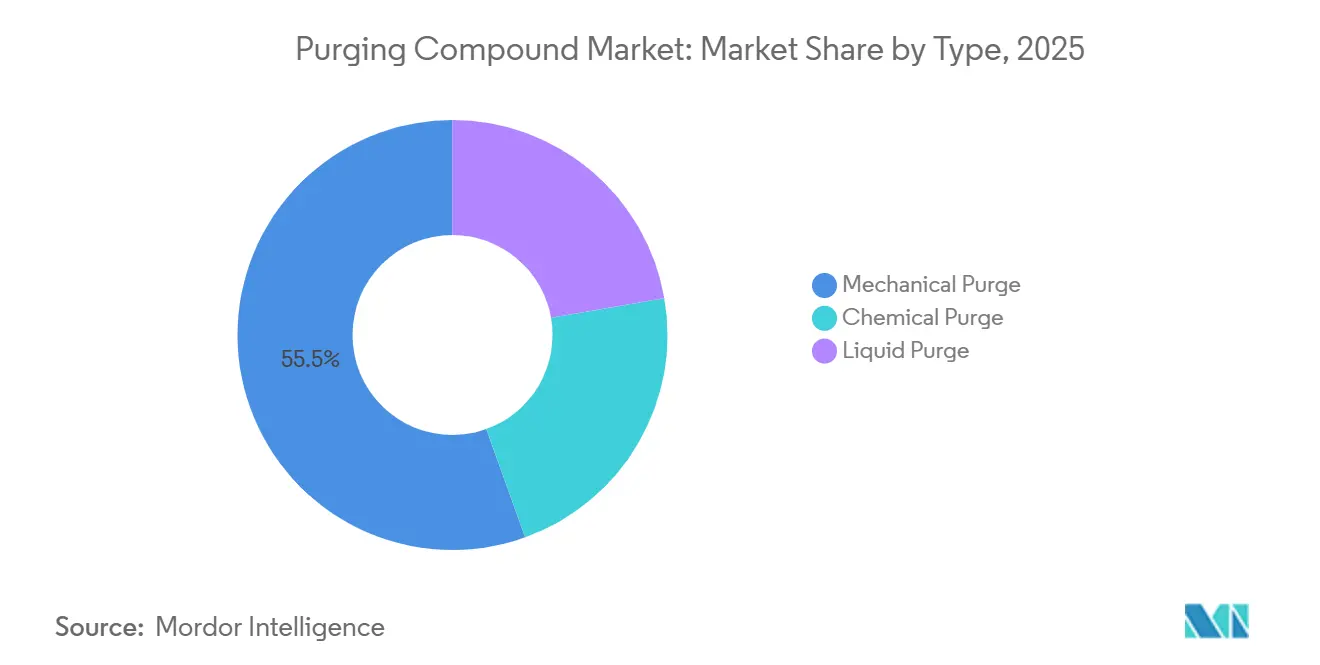
- By type, mechanical purge held 55.49% of the purging compound market size in 2025 and is forecast to post the quickest 6.08% CAGR through 2031.
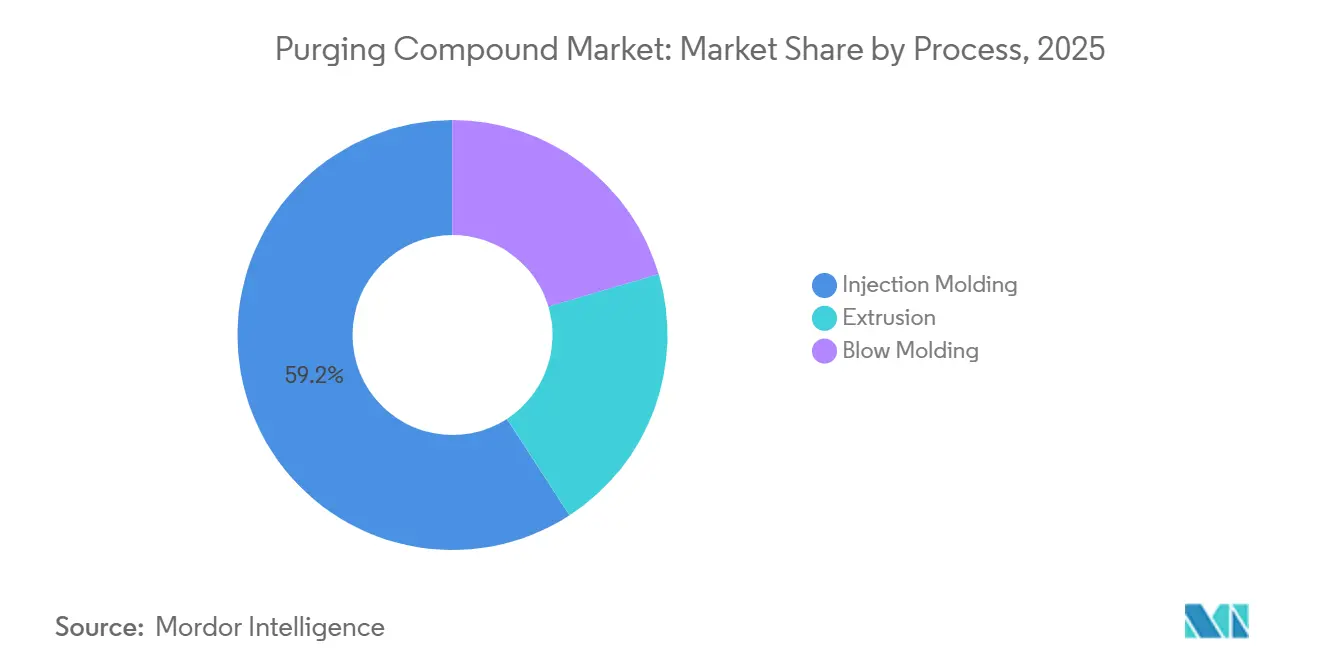
- By process, injection molding commanded 59.16% share of the purging compound market size in 2025 and exhibits the fastest 6.10% CAGR to 2031.
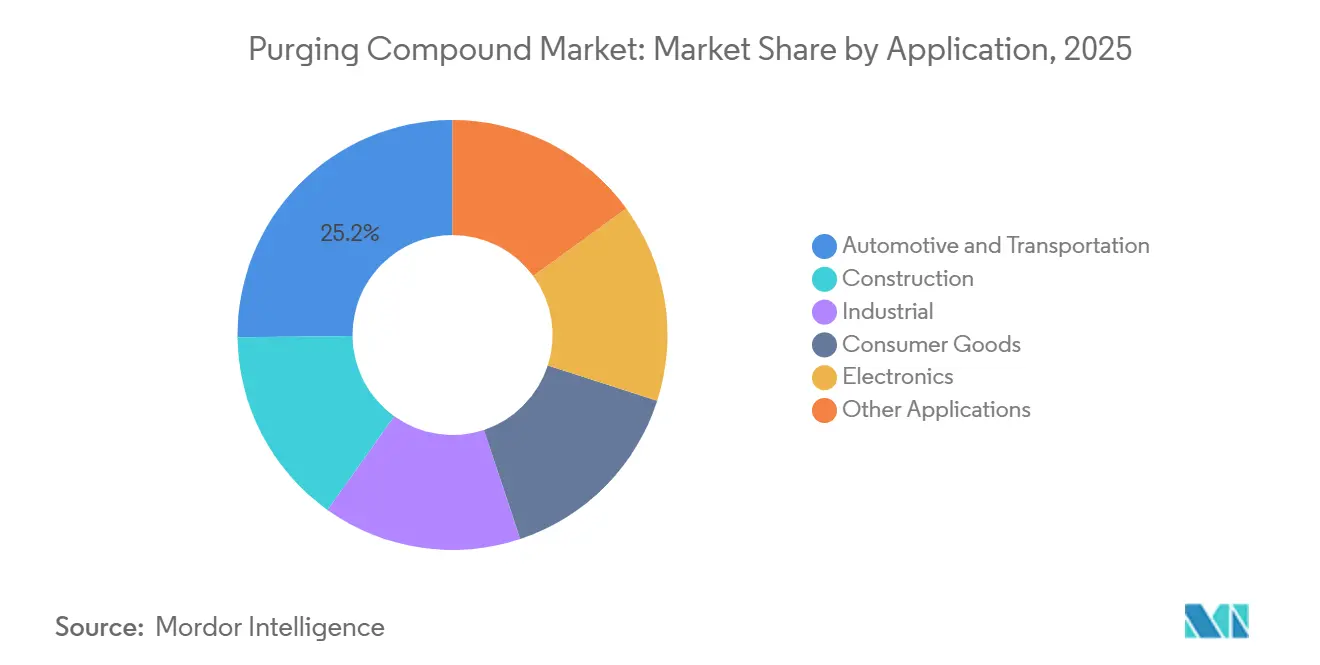
- By application, automotive and transportation led with 25.16% share of the purging compound market size in 2025 and is projected to expand at the highest 5.95% CAGR through 2031.
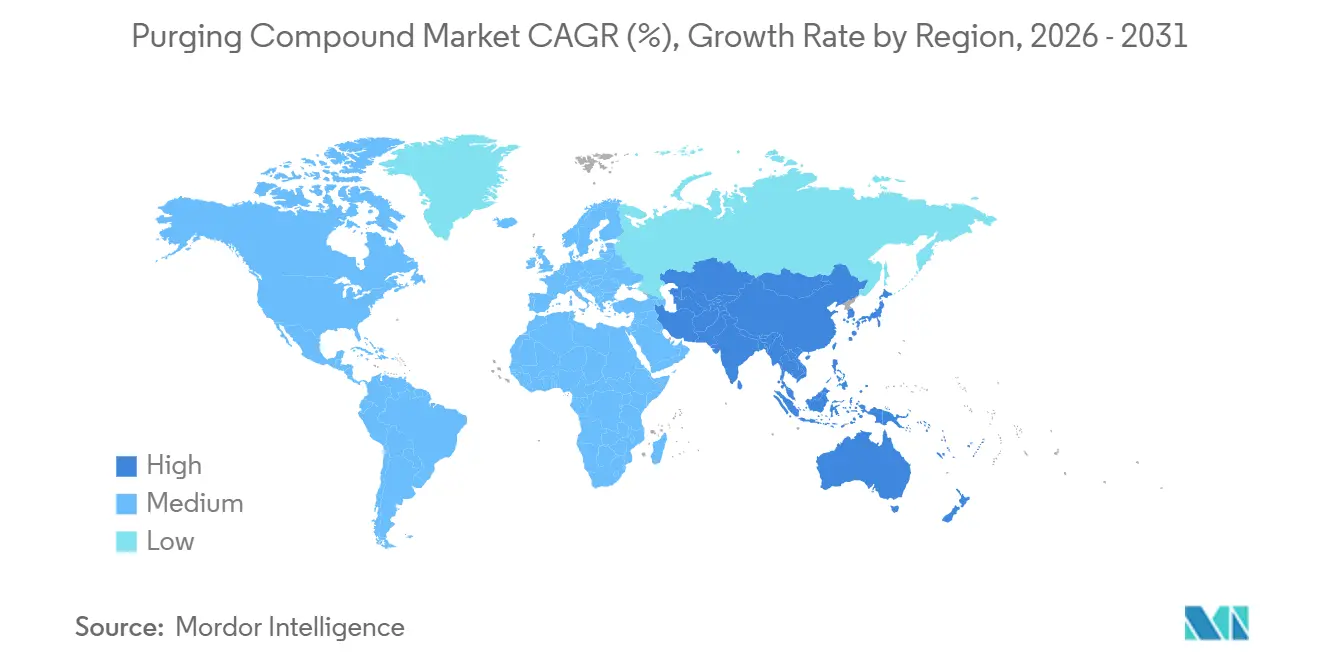
- By geography, North America retained 50.12% purging compound market share in 2025, yet Asia-Pacific is growing at a robust 6.18% CAGR to 2031.
Note: Market size and forecast figures in this report are generated using Mordor Intelligence’s proprietary estimation framework, updated with the latest available data and insights as of January 2026.
Market Trends and Insights
Drivers Impact Analysis of Purging Compound Market*
| Driver | (~) % Impact on CAGR Forecast | Geographic Relevance | Impact Timeline |
|---|---|---|---|
| Rapid Adoption of High-Temperature Engineering Polymers | +1.2% | Global, with concentration in North America, Europe, and APAC manufacturing hubs | Medium term (2-4 years) |
| Shorter Color and Resin Change-Over Intervals in Industry 4.0 Plants | +1.5% | North America and Europe, expanding to APAC smart factories | Short term (≤ 2 years) |
| Rising Demand for Bio-Based / Low-VOC Purging Chemistries | +0.8% | Europe and North America, driven by sustainability mandates | Long term (≥ 4 years) |
| Surge in Micro-Lot Packaging and Medical Disposables | +1.1% | Global, with peak demand in North America and Europe healthcare sectors | Medium term (2-4 years) |
| OEM Qualification Norms for E-Mobility Parts | +1.0% | APAC core (China, South Korea, Japan), spill-over to North America and Europe | Medium term (2-4 years) |
| Source: Mordor Intelligence | |||
Rapid Adoption of High-Temperature Engineering Polymers
Processing temperatures above 350 °C for polyetherimide, polyphenylene sulfide, and polyethersulfone accelerate polymer degradation that standard purges cannot remove. BASF’s Ultrason PESU lowered processing temperature requirements by about 12.5% in 2024, yet flame-retardant polyamides and polycarbonates still leave carbonized residues on screw flights. Battery enclosures molded under IEC 62660-3 safety norms demand contamination-free conditions to avoid electrical shorts. Processors note purge cycles are 20% longer for these polymers, which lifts volumetric demand. SABIC’s USD 220 million ULTEM facility in Singapore added 50% capacity in 2024, enhancing regional availability and stimulating the purging compound market.
Shorter Color and Resin Change-Over Intervals
Industry 4.0 platforms compress change-over windows from hours to minutes, requiring purging compounds capable of cleaning in fewer screw rotations. Asaclean field trials in 2024 demonstrated 47% faster color changes and 67% scrap savings when compared with virgin-resin flushing. Engel’s e-victory electric molding machines embed automated purge programs that inject compounds at preset temperature thresholds, reducing operator error. Tier 1 suppliers molding 15-20 color variants per shift gain economic leverage, which in turn enlarges the purging compound market.
Rising Demand for Bio-Based / Low-VOC Purging Chemistries
European directives seeking 55% recycling of plastic packaging by 2030 and the upcoming PFAS limits are encouraging adoption of bio-attributed formulations. BASF’s biomass-balanced Ultrason PESU launched in 2025 enables sustainability claims without process changes. Premix introduced PRE-PRG, a natural-fiber compound exceeding 50% bio-based content, aimed at medical and food-contact processors. Clariant’s bio-surfactant packages cut hazardous air pollutants by 30%, meeting California Air Resources Board caps. Although unit prices sit 15%-25% higher than conventional products, brand owners with explicit environmental mandates remain early adopters.
Surge in Micro-Lot Packaging and Medical Disposables
Single-use medical devices and personalized packaging require frequent resin changes that magnify purging-compound consumption. Chem-Trend’s Ultra Purge 3615 achieved 85% scrap reduction and 69% downtime savings in 2024 medical-molding trials. Europe generated 900,000 metric tons of healthcare plastics waste in 2023, of which single-use items formed 60%, underlining the volume effect on the purging compound market.
Restraints Impact Analysis of Purging Compound Market*
| Restraint | (~) % Impact on CAGR Forecast | Geographic Relevance | Impact Timeline |
|---|---|---|---|
| Volatile Prices of Specialty Resins and Additives | -0.9% | Global, with acute impact in regions dependent on imported feedstocks | Short term (≤ 2 years) |
| High Unit Price Versus Re-Grind/Virgin Resin | -0.7% | Price-sensitive markets in South America, MEA, and ASEAN | Medium term (2-4 years) |
| Regulatory Scrutiny on Micro-Plastic Abrasion | -0.5% | Europe and North America, with emerging pressure in APAC coastal regions | Long term (≥ 4 years) |
| Source: Mordor Intelligence | |||
Volatile Prices of Specialty Resins and Additives
Price spikes for carrier resins and antioxidant packages compress margins and discourage inventory build-up. BASF lifted Ultraform polyoxymethylene prices by USD 350 per ton in March 2025 amid feedstock inflation[1]BASF, “Price Adjustment for Ultraform POM,” basf.com . Antioxidant costs rose 10% in March 2024 following outages at Asian suppliers, while the U.S. Producer Price Index for plastic resins logged a negative 1.1% twelve-month change in September 2025, highlighting volatility. Converters in currency-depreciating regions often extend purge intervals or revert to re-grind, dampening short-term demand.
High Unit Price Versus Re-Grind / Virgin Resin
Mechanical purges cost USD 4-8 per kilogram, a 300% premium over post-industrial re-grind, prompting commodity processors to tolerate minor contamination. Chem-Trend data show that Ultra Purge 3615 can yield payback in as little as four weeks through scrap and downtime savings, yet many small processors in ASEAN and South America lack tools to quantify total cost of ownership. This price sensitivity slows adoption, especially where labor costs are low and throughput trumps efficiency.
*Our forecasts treat driver/restraint impacts as directional, not additive. The impact forecasts reflect baseline growth, mix effects, and variable interactions.
Purging Compound Market Segment Analysis
By Type:
Mechanical Purge Dominates Through Abrasive EfficiencyMechanical purges accounted for 55.49% of the purging compound market size in 2025 and are set to expand at a 6.08% CAGR through 2031. Their blend of carrier resin and mineral fillers forms an abrasive slurry that detaches carbonized deposits even at processing temperatures above 300 °C. Chem-Trend’s Ultra Purge 3615 demonstrated 85% scrap reduction in 2024 field trials, reinforcing the performance advantage over passive flushing. Chemical purges, though gaining ground where mold-surface integrity is critical, currently hold just under one-third of demand. Liquid purges occupy a niche in hot-runner systems with narrow channels. European sustainability rules are nudging suppliers to replace petro-based carriers with bio-attributed resins, a pivot led by BASF’s biomass-balanced Ultrason PESU. The push for low-VOC plants further favors mechanical purges with minimal solvent content, positioning them to defend leadership even as alternative chemistries mature.
Demand differentials arise from process temperature, residue tenacity, and change-over frequency. Injection-molding lines running high-temperature polyamides favor mechanical grades because chemical foaming agents can leave gas pockets inside manifolds. Extrusion processors shift toward chemical grades during long runs to avoid abrasive barrel wear, yet still maintain mechanical products for transition between dark and light colors. Market entrants focusing on bio-based abrasive fillers promise 30% carbon-footprint savings, although price premiums of 15% mean penetration will stay limited to brand owners with explicit climate targets.



By Process:
Injection Molding Leads on Frequent ChangeoversInjection molding seized 59.16% of the purging compound market size in 2025 and is forecast to grow at a 6.10% CAGR through 2031, reflecting its high-mix, low-volume production model. Instrument panels, battery enclosures, and diagnostic housings each require resin or color switches several times per shift. Engel’s e-victory machines automatically trigger purge sequences, cutting operator-driven variability. Extrusion stands second due to sheer throughput, yet fewer changeovers translate to lower usage intensity on a per-kilogram basis. Blow molding, though smallest, is accelerating as pharmaceutical vials and single-dose bottles command contamination-free standards. Asaclean reported 67% scrap savings and 47% faster color transitions in 2024 extrusion trials, illustrating tangible paybacks.
Automation amplifies demand by shortening idle periods between runs, yet it also raises expectations for purge effectiveness on the first attempt. Processors integrating real-time quality monitoring reject even faint streaks, forcing full purges rather than partial pushes with virgin resin. New vanguard machines feature closed-loop screw-position feedback that flags contamination early, creating another trigger for compound use. Extrusion processors dealing with multilayer film increasingly purge each layer separately, doubling consumption relative to monolayer lines. Although blow-molding volumes lag, rising use of high-viscosity polyester for medical containers necessitates specialized liquid or chemical purges that can negotiate narrow parison heads.
By Application:
Automotive Leads, Electronics AcceleratesAutomotive and transportation held 25.16% of the purging compound market size in 2025 and will continue at a healthy 5.95% CAGR through 2031. Mandatory zero-defect thresholds on surface finish, coupled with the IEC 62660-3 battery-safety standard, push Tier 1 suppliers to purge thoroughly between each molding batch. Electric-vehicle growth in China remains a prime volume driver, as 9.59 million units rolled off assembly lines in 2023. Electronics displays the fastest momentum as shrinking component dimensions make even microscopic residue unacceptable. SEMI recorded USD 109 billion in semiconductor equipment sales during 2024, illustrating the scale of plastics integration into chip packaging.
Construction and consumer goods generate stable if slower growth, given their longer production runs which dilute per-unit purge usage. Still, window-profile lines switching from PVC to ASA color variants rely on purging compounds to avoid streaking. The medical segment benefits from soaring demand for single-use devices; American Chemistry Council data peg medical-device reprocessing at a 16.2% CAGR through 2032, indirectly lifting purging volumes. Appliance makers in Asia-Pacific are adopting anti-bacterial resin grades that need separate purge regimes, while industrial machinery suppliers stipulate contamination control in warranty clauses, adding a downstream pull on demand.
Geography Analysis
North America Purging Compound Market
North America maintained a commanding 50.12% purging compound market share in 2025, thanks to its concentration of advanced automotive and medical molding hubs that value quality over cost. Formosa Plastics’ 249,000 ton polypropylene plant started in Texas during Q3 2024, boosting regional resin availability and directly increasing compound use during qualification trials. United States processors comply with FDA biocompatibility rules and EPA air-quality standards that encourage low-VOC purges, whereas Canadian suppliers of surgical disposables echo similar contamination tolerances. Mexico’s automotive clusters serving Ford, General Motors, and Volkswagen rely on purging compounds to minimize cosmetic rejects in instrument panels.
APAC Purging Compound Market
Asia-Pacific represents the fastest-growing node with a 6.18% CAGR through 2031, driven by Chinese electric-vehicle momentum, India’s USD 2.4 billion advanced chemistry cell incentive, and ASEAN contract manufacturing for electronics. BASF’s Zhanjiang Verbund site moved a 1 million-ton ethylene cracker online in November 2025, enlarging downstream polyethylene streams and spurring regional demand for compatible purging compounds. Japan’s precision molding sector demands liquid purges suitable for narrow hot-runner channels, while South Korea’s share of global semiconductor equipment sales ensures continuous use of chemical purges in chip-packaging injection systems. In India, price sensitivity limits premium adoption, yet exporters to Europe must demonstrate compliance with EU microplastic rules, stimulating gradual uptake.
EMEA and South America Purging Compound Market
In Europe, Germany, France, and Italy together molded over half of the region’s 52.8 million-ton plastics output in 2023. The EU REACH Regulation 2023/2055 accelerates transition from abrasive mechanical grades to chemical variants that dissolve residues without generating particulate emissions. South America and the Middle East and Africa remain emerging markets for the purging compound market, with Brazil’s Braskem and Saudi Arabia’s SABIC bundling compounds alongside resins, though lower contamination standards and higher price sensitivity slow progress. IMCD Group’s 2024 acquisition of Protea Chemicals expanded technical support in sub-Saharan Africa, hinting at gradual penetration.

Regulatory Landscape
Regulation increasingly targets emissions, hazardous substances, and polymer microparticle releases that affect purging chemistry selection and the documentation processors must maintain around purge processes. In the European Union, REACH restrictions on synthetic polymer microparticles (including the 2023/2055 framework referenced in the report context) are being refined through EU Regulation 2026/1168, which amends REACH Annex XVII and clarifies certain derogations and implementation details for specified applications. This shapes how processors justify particulate generation from abrasive mechanical purges versus dissolving chemistries, especially where frequent changeovers increase the need for validated low-residue purge procedures.
Trade and chemical-management actions also influence where purging compounds are sourced and which formulations gain favor. EU actions around plastic waste movement, including a November 2026 prohibition on exports of plastic waste to non-OECD countries, reinforce a shift toward more domestic recycling and reprocessing loops. That, in turn, raises the operational need for purge protocols when plants run recycled-content resins with variable contamination. In the United States, EPA actions under TSCA and air programs add compliance considerations for upstream and adjacent chemical production, including April 2026 Federal Register activity on proposed Significant New Use Rules (SNURs) that can trigger notification requirements for specified new uses. These steps can encourage suppliers and processors to maintain tighter substance stewardship and change-control records across additive packages used in purging compounds.
Value Chain Analysis
The value chain starts with upstream suppliers of carrier or base resins and additive packages (including surfactants, mineral fillers, dispersants, and functional chemistries), followed by purging compound formulators that compound, blend, and pelletize products into mechanical, chemical or foaming, and liquid grades. Integrated chemical companies can bundle purging compounds with engineering resins to support converter qualification cycles, while specialist brands differentiate through application engineering for high-heat polymers and rapid changeovers. Downstream, regional distributors and MRO channels support just-in-time availability for plastics processors across injection molding, extrusion, and blow molding, where purge selection is commonly set by machine type, resin family, and quality documentation requirements.
The chain is also sensitive to raw-material price volatility and short-notice availability. Although purging compounds are often treated as maintenance consumables, they become critical when plants compress changeovers under Industry 4.0 schedules. Processors mitigate disruption through Kanban-style replenishment, blanket purchase orders with scheduled releases, and safety stocks for key purge SKUs, particularly in high-mix operations such as automotive, medical, and electronics, where scrapped parts and downtime carry outsized penalties. Technical service and trials are a major value-capture step as well, since suppliers that provide machine-specific purge parameters, residue verification practices, and training can keep share even when unit prices exceed regrind or virgin-resin flushing.
Competitive Landscape
The purging compound market shows moderate concentration because integrated majors such as BASF, Dow, and Clariant leverage upstream resin production to bundle purge grades, while specialists like Chem-Trend capture value through tailored formulations. BASF’s March 2025 price increase of USD 350 per ton on Ultraform polyoxymethylene highlighted feedstock volatility that squeezes independent suppliers who buy open-market resins. Chem-Trend’s Ultra Purge 3615 recorded up to 69% downtime savings in 2024 field evaluations, setting performance benchmarks for mechanical grades. Clariant advances bio-surfactant systems compatible with EU VOC caps, while Dow scales advanced recycling to supply post-consumer carriers at competitive cost[2]Dow, “Advanced Recycling Expansion in Texas,” dow.com .
Strategic differentiators fall along three axes, namely thermal-stability enhancements permitting safe purging above 350 °C, bio-based content to satisfy circular-economy mandates, and digital service integrations linking purge sequences with PLC control. North American and European converters lead on digital adoption, embedding Siemens or Rockwell Automation modules that auto-dose compounds. Asia-Pacific processors emphasize cost efficiency, often selecting high-abrasive mechanical purges that work without additional infrastructure. Patent activity recorded during 2024-2025 focuses on foaming agents that expand within barrel cavities and bio-attributed carriers made from waste cooking oil, targeting 30% lower carbon footprints.
Distribution partnerships influence regional reach. IMCD’s takeover of Protea Chemicals in 2024 widened VELOX purging compound access across southern Africa, while Calsak Corporation expanded Chem-Trend distribution in Western U.S. states. Emerging disruptors market compounds using post-consumer recycled carriers, claiming 10%-15% price discounts compared with virgin-based incumbents. While uptake remains limited, these offerings align with voluntary scope-3 emission targets set by global brand owners, creating a niche yet expanding revenue pool.
Purging Compound Industry Leaders
Chem-Trend L.P.
Asahi Kasei Corporation
Shuman Plastics, Inc.
CLARIANT
Daicel Corporation
- *Disclaimer: Major Players sorted in no particular order
Purging Compound Market Companies Covered in this Report
- 3M
- Asahi Kasei Corporation
- BASF
- Calsak Corporation
- Chem-Trend L.P.
- CLARIANT
- Daicel Corporation
- Dow Chemical Company
- Formosa Plastics Corporation
- Kuraray Co. Ltd
- Purge Right
- RapidPurge
- Shuman Plastics, Inc.
- Ultra System SA
- VELOX GmbH (IMCD Group)

Market Opportunities and Future Outlook
Product whitespace is expanding around high-temperature engineering polymers and tighter contamination tolerances in e-mobility, electronics, and medical molding. In these segments, standard purge cycles often run longer, and residue risk is less acceptable at processing temperatures above 350 C. Shuman Plastics Dyna-Purge introducing its E4 compound in February 2026 for high-temperature resins such as PEEK, PEI, and PPS supports supplier efforts to validate performance on these resin families and win qualifications tied to battery enclosures and other safety-critical parts. The opportunity is not only improved temperature stability, but also reduced rinsing material and shorter changeover windows, which translate into scrap and downtime savings already cited in the market context, including field-trial results reported for Asaclean and Chem-Trend products.
A second opportunity track runs through low-VOC and sustainability-oriented formulations that align with tightening chemical and microplastic scrutiny, particularly in Europe and North America where regulatory pressure is explicitly noted in the report context. BASF biomass-balanced Ultrason PESU (2025) and related supplier efforts to cut hazardous air pollutants support purging-compound options that fit compliance narratives without changing processor equipment, while also addressing particulate-generation concerns that can arise from abrasive mechanical grades. As processors run more recycled and variable feedstocks under circularity programs, suppliers that pair compatible purge chemistries with documented, repeatable purge protocols, including automated purge recipes integrated into molding-machine control practices, can find a more practical route to deeper penetration in high-mix plants.
Recent Industry Developments in Purging Compound Market
- April 2026: Asahi Kasei debuted a high-performance Asaclean screw cleaning agent at ChinaPlas 2026, positioned to reduce injection-molding changeover downtime to under 12 minutes. The launch targets high-mix production environments where frequent resin and color transitions increase scrap risk. It also supports broader qualification needs from export-oriented converters that require repeatable, documented cleaning performance.
- November 2025: BASF commissioned a 1 million-ton ethylene cracker and a 500,000-ton HDPE unit at its Zhanjiang Verbund site in China. The added upstream resin capacity increases regional availability of common carrier resins used across plastics processing. More qualification trials and production ramp-ups in downstream molding and extrusion raise the need for purge cycles during start-ups and transitions.
- October 2025: Asahi Kasei initiated European sales activities for its Asaclean R-Series purging compounds, offered in multiple grades designed to optimize material changeovers. The rollout strengthens competitive positioning in a region where processors weigh low-VOC and compliance considerations alongside downtime and scrap reduction. Expanding the portfolio in Europe also supports standardization across multi-plant converter footprints that run diverse resin families.


Purging Compound Market Report Scope and Research Methodology
Market Definition and Coverage
This market covers materials used to clean and purge polymer processing equipment, mainly screws, barrels, hot runners, and dies, to cut downtime and scrap during resin or color changeovers and restarts across molding and extrusion operations.
Scope exclusions: recycling line cleaning agents, general solvents, and polymer stabilizer additive packages sold for end product performance are excluded.
Segments Covered in This Report
- By Type
- Mechanical Purge
- Chemical Purge
- Liquid Purge
- By Process
- Injection Molding
- Extrusion
- Blow Molding
- By Application
- Automotive and Transportation
- Construction
- Industrial
- Consumer Goods
- Electronics
- Other Applications
- By Geography
- Asia-Pacific
- China
- India
- Japan
- South Korea
- ASEAN Countries
- Rest of Asia-Pacific
- North America
- United States
- Canada
- Mexico
- Europe
- Germany
- United Kingdom
- France
- Italy
- Spain
- NORDIC Countries
- Rest of Europe
- South America
- Brazil
- Argentina
- Rest of South America
- Middle-East and Africa
- Saudi Arabia
- South Africa
- Rest of Middle-East and Africa
- Asia-Pacific
Data Sources, Market Sizing, and Validation
Desk Research
Desk work was used to map the demand pool and confirm how purging is used in real production settings, before any numbers were built. We referred to public sources such as the US Census Bureau and UN Comtrade for plastics and machinery trade signals, the International Energy Agency for industry activity context, and OSHA or similar safety guidance that shapes how chemical handling is managed at plants.
To keep the model grounded, we also checked polymer processing and materials science journals, association materials from groups such as SPE, and public investor materials and annual reports from relevant value chain companies. Select paid databases were used only to speed up company financial checks, patent lookups, and shipment-level import-export screening where it helped validate directional demand. These examples are not exhaustive, and many other sources were used for data collection, validation, and clarification.
Primary Interviews and Surveys
Primary discussions were completed with compound producers and distributors, plastics processors, and plant-level engineering and operations teams who manage changeovers. For a global view, feedback was captured across key manufacturing regions and then used to validate usage rates, typical purge frequency, and realistic price ranges by type and process.
Distribution of primary research fieldwork respondents
| Company type | Respondent position | Region |
|---|---|---|
| Top tier: 36% | CXOs: 19% | APAC: 45% |
| Mid tier: 43% | Functional/Unit leaders: 26% | EMEA: 32% |
| Smaller Players: 21% | Managers: 55% | Americas: 23% |
Market-Sizing & Forecasting
Sizing started with a top-down build where polymer processing activity is converted into a workable purge demand pool, using molding and extrusion output signals and then applying purge frequency and dosing assumptions. These inputs were adjusted by process mix (injection molding, extrusion, blow molding), average line sizes, and the share of lines that use commercial purging versus in-house regrind purging.
To keep totals realistic, we corroborated the results with selective bottom-up approximations, including sampled volume by key end uses and channel checks on typical price per kilogram by mechanical, chemical, and liquid grades. Where gaps appeared in country coverage or small-processor behavior, we used proxy ratios tied to plastics processing capacity and then pressure-tested them with expert feedback.
For forecasting, scenario analysis was used around resin substitution, throughput growth, and plant efficiency programs, and the yearly path was smoothed using short series trend fitting so the curve matches expected adoption timing. Key model indicators included polymer processing throughput, changeover intensity for color and resin switches, engineering polymer penetration (which usually raises cleaning needs), purge effectiveness requirements for food contact or high-purity runs, and crude-linked feedstock moves that influence compound pricing.
Data Validation & Update Cycle
Outputs were checked against independent signals like plastics machinery operating rates, polymer production and trade direction, and the implied consumption per processing site so the numbers did not drift away from what plants can practically use. When a variance looked high, assumptions were revisited and, if needed, experts were re-contacted to confirm whether a shift was real or just a data timing issue.
Before sign-off, the model goes through multi-step analyst reviews that focus on unit consistency, year-over-year jumps, and regional share logic. Reports are refreshed annually, with interim updates when material events occur, and a final pre-delivery review is done so clients receive the latest updated view.
Mordor Intelligence's Purging Compound Market Size Compared With Other Published Estimates
Published market numbers for purging compounds often differ because the studies do not always count the same demand pool, and they also use different pricing logic and base years. Differences show up most when one estimate leans heavily on a single region, or when the changeover and purge-rate assumptions are not validated with processors.
Cleaning solutions sold as general solvents sit outside Mordor Intelligence's scope, which reduces the value pool versus estimates that group all cleaning chemistries used around polymer processing into one total. Gaps also come from whether pricing is modeled as a blended average across mechanical, chemical, and liquid grades, how fast prices are assumed to move with resin and additive inputs, and whether the forecast reflects a base case versus a more aggressive adoption scenario.
Benchmark comparison
| Source | Market Size | Gaps in Research Methodology |
|---|---|---|
| Mordor Intelligence | USD 0.83 B (2025) | |
| Global Consultancy A | USD 0.60 B (2024) | Uses an earlier base year and appears to lean on reported revenues for a narrower set of product types, which can undercount usage by smaller processors and indirect channels. |
| Industry Publisher B | USD 0.87 B (2024) | Shows inconsistent point estimates for the same base year and likely applies a broader cleaning-chemistry basket, which can inflate the total when solvents and adjacent additives are included. |
The comparison shows that the spread is mostly explained by what is included in the product scope and how pricing and adoption are carried year to year. By keeping the demand pool tied to purge events in molding and extrusion, and then cross-checking implied volumes and prices with multiple respondent types, we can present a practical estimate that can be repeated and reviewed.


Key Questions Answered in the Report
What is the current volume of the purging compound market?
The purging compound market size is 26.78 kilotons in 2026 and is projected to reach 35.43 kilotons by 2031.
Which process segment leads demand for purging compounds?
Injection molding holds 59.16% of volume and grows at a 6.10% CAGR because frequent color and resin changes require rapid cleaning.
Why are mechanical purge compounds dominant?
Mechanical grades secure 55.49% share due to abrasive fillers that effectively remove carbonized residues during high-temperature transitions.
Which region is expanding fastest?
Asia-Pacific records the highest 6.18% CAGR through 2031, driven by rapid electric-vehicle and electronics manufacturing expansion.
Page last updated on:


 Your data is secure and never sold or shared.


