
Engineering Plastic Recycling Market Size and Share
Market Overview
| Study Period | 2021 - 2031 |
|---|---|
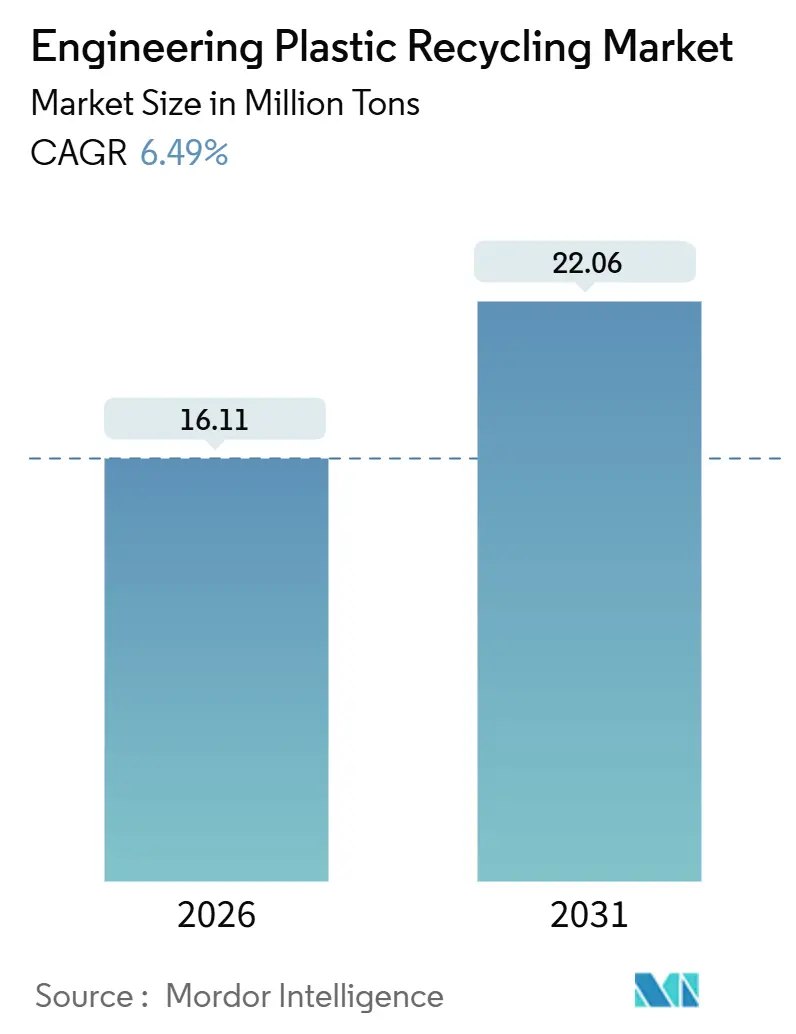
| Market Volume (2026) | 16.11 Million tons |
| Market Volume (2031) | 22.06 Million tons |
| Growth Rate (2026 - 2031) | 6.49 % |
| Fastest Growing Market | Europe |
| Largest Market | Asia Pacific |
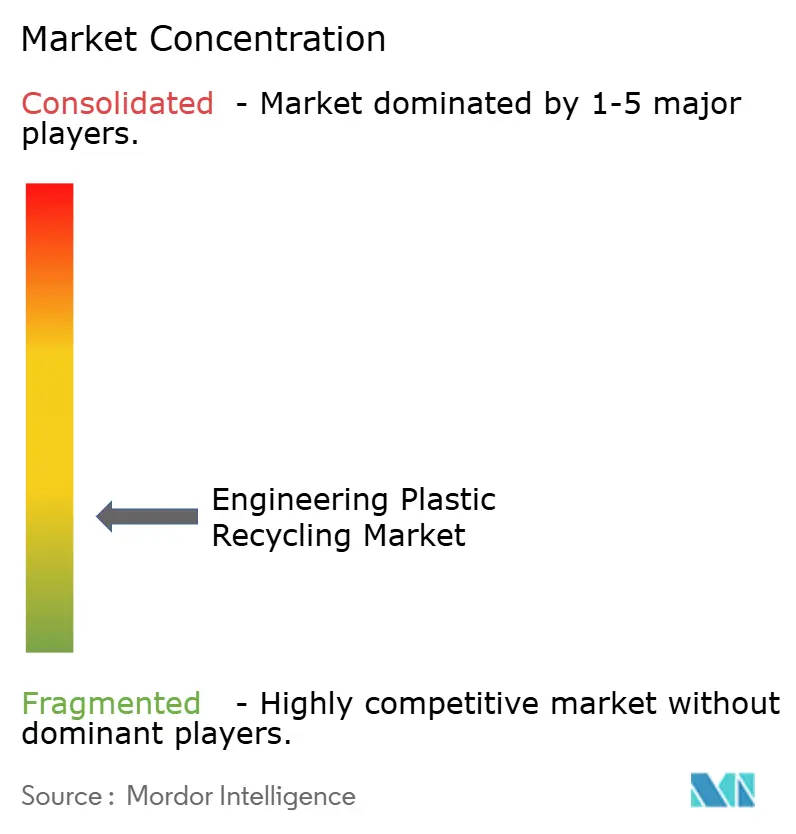
| Market Concentration | Low |
Major Players *Disclaimer: Major Players sorted in no particular order Image © Mordor Intelligence. Reuse requires attribution under CC BY 4.0. | |
Engineering Plastic Recycling Market Analysis by Mordor Intelligence
The Engineering Plastic Recycling Market size is estimated at 16.11 Million tons in 2026, and is expected to reach 22.06 Million tons by 2031, at a CAGR of 6.49% during the forecast period (2026-2031). Regulatory quotas in the European Union and California, coupled with brand-owner procurement pledges, are shifting recycled content from a voluntary initiative to a legal requirement, anchoring growth across packaging and industrial yarn streams. China’s post-National Sword build-out, Europe’s deposit-return schemes, and North American chemical-recycling investments are strengthening regional supply positions, while digital watermarking and AI-vision sortation are lifting recovery rates for mixed engineering plastics. Venture-backed depolymerization projects that cut capital cost per ton by 30% are narrowing the price gap with virgin resin, heightening competition and prompting consolidation among incumbents. Food-contact approval bottlenecks and bale-price volatility remain near-term hurdles, yet long-term demand pull from automotive, electronics, and green-building applications continues to expand the engineering plastic recycling market footprint.
Key Report Takeaways
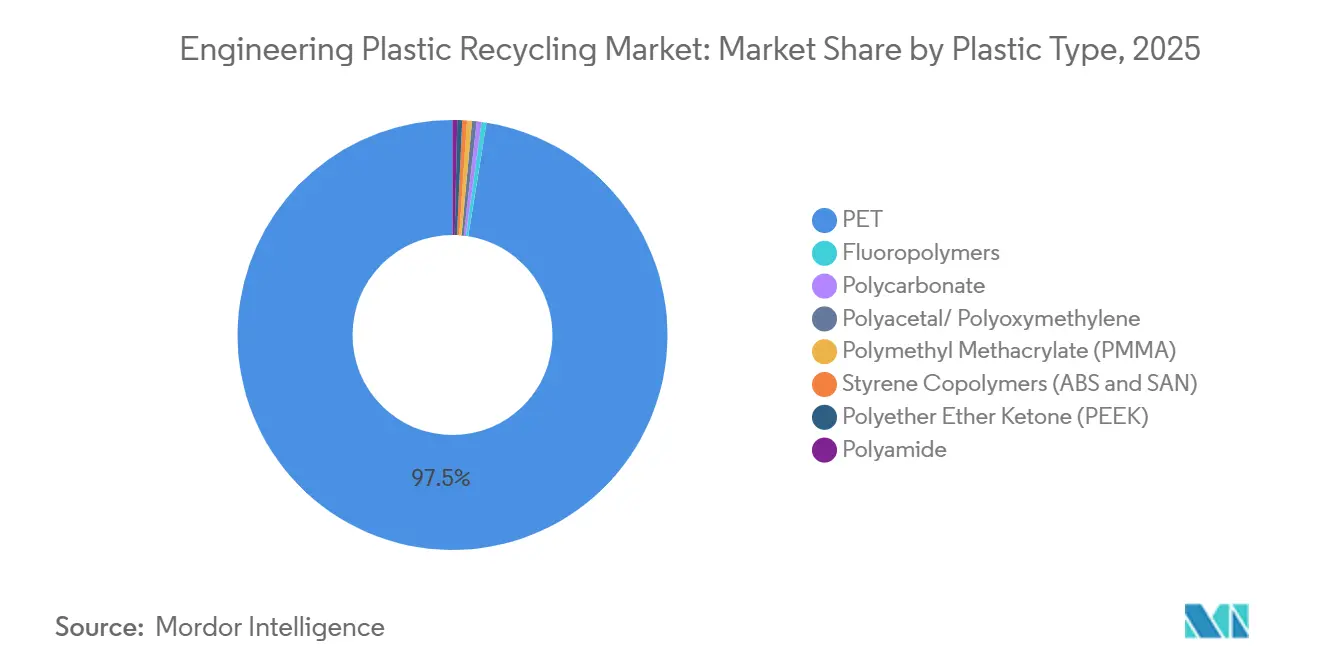
- By plastic type, PET captured 97.47% of engineering plastic recycling market share in 2025 and is forecast to expand at a 6.51% CAGR through 2031.
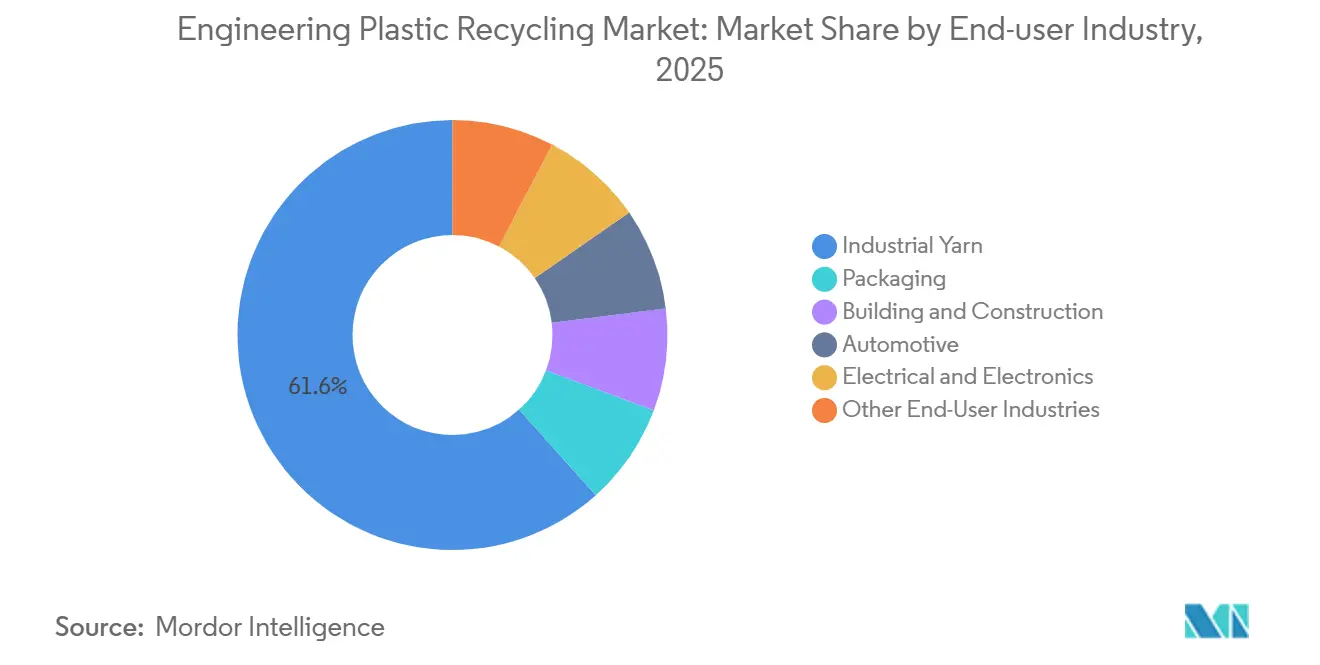
- By end-user industry, industrial yarn held 61.61% of the engineering plastic recycling market size in 2025; packaging is advancing at an 8.12% CAGR through 2031.
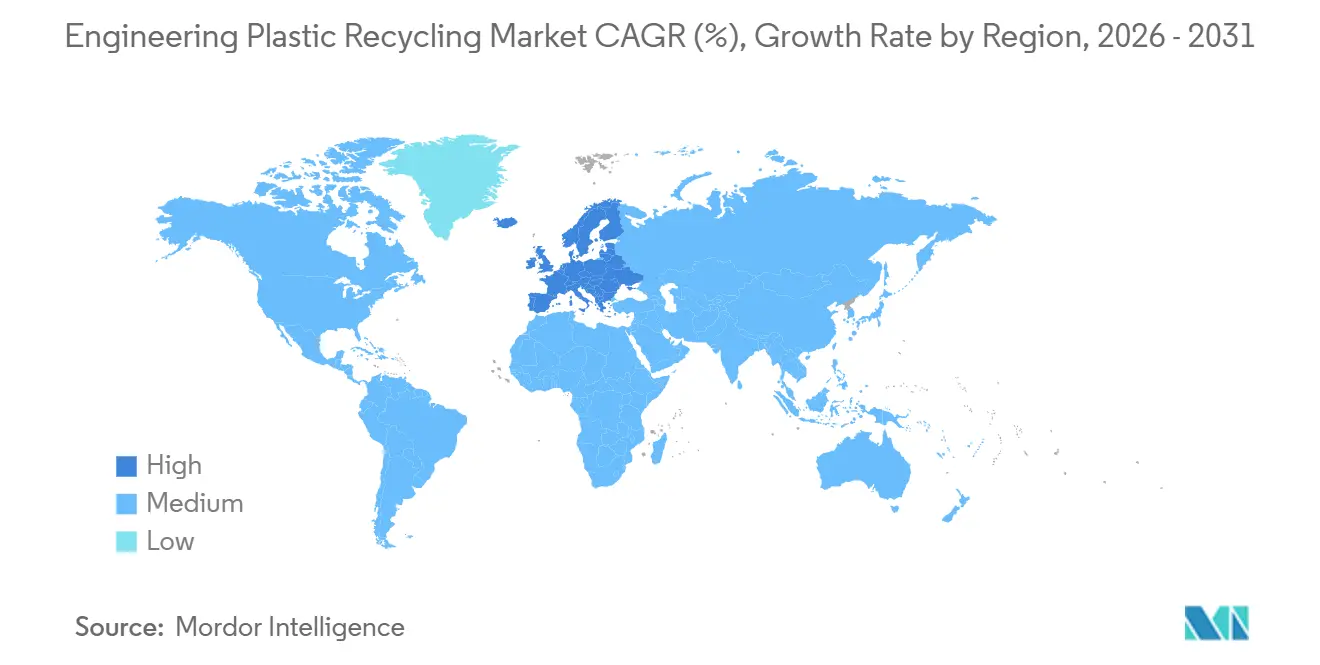
- By geography, Asia-Pacific commanded 56.39% share of the engineering plastic recycling market in 2025; Europe records the highest projected CAGR at 6.55% to 2031.
Note: Market size and forecast figures in this report are generated using Mordor Intelligence’s proprietary estimation framework, updated with the latest available data and insights as of January 2026.
Market Trends and Insights
Drivers Impact Analysis of Engineering Plastic Recycling Market*
| Driver | (~) % Impact on CAGR Forecast | Geographic Relevance | Impact Timeline |
|---|---|---|---|
| Policy-Mandated Recycled-Content Quotas Tightening After 2026 | +1.8% | Europe, North America, APAC core markets | Medium term (2-4 years) |
| Brand-Owner Pledges to Shift 25–50% of Engineering-Plastic Packaging to Recycled Feedstock by 2030 | +1.5% | Global, with concentration in Europe and North America | Short term (≤ 2 years) |
| OEM Demand for Chemically Recycled PA and PC Grades in EV and Electronics Thermal-Management Parts | +1.2% | APAC (China, South Korea), Europe (Germany, France) | Medium term (2-4 years) |
| Emergence of Digital Water-Marking and AI-Vision Sorting Lines Boosting Yield of Mixed Streams | +0.9% | Europe, North America pilot sites, expanding to APAC | Long term (≥ 4 years) |
| Venture-Backed Solvent-Based Depolymerization Plants Achieving 30% Capex/Ton Cost Reduction | +1.1% | North America, Europe, selective APAC hubs | Medium term (2-4 years) |
| Source: Mordor Intelligence | |||
Policy-Mandated Recycled-Content Quotas Tightening After 2026
Binding targets in the EU’s Packaging and Packaging Waste Regulation compel 30% recycled content in beverage bottles by 2030, rising to 65% by 2040, while France’s AGEC law extends quotas to automotive and electronics parts[1]. California’s SB 54 exacts fines of USD 50,000 per day for non-compliance, converting recycled-content sourcing into a cost-avoidance measure. These mandates compressed the recycled-resin premium from 15-25% in 2024 to 5-10% by late 2025 as supply scaled. Capital flowed toward both mechanical and chemical lines, accelerating the engineering plastic recycling market expansion. As thresholds tighten after 2026, demand visibility improves and financing risk declines, reinforcing growth momentum.
Brand-Owner Pledges to Shift 25–50% of Engineering-Plastic Packaging to Recycled Feedstock by 2030
Unilever, Procter & Gamble, and Nestlé have embedded recycled-content clauses in global procurement contracts, collectively requiring more than 600,000 tons of food-grade recycled PET annually from 2027. Long-term offtake agreements underpin mega-scale depolymerization plants such as Eastman’s Tennessee site, enabling project finance exceeding USD 150 million per facility. Brand pressure cascades down supply chains, incentivizing converters to re-qualify recycled grades across barrier film, caps, and closures. The ripple effect sustains double-digit capacity growth in the engineering plastic recycling market during the near term.
OEM Demand for Chemically Recycled PA and PC Grades in EV and Electronics Thermal-Management Parts
BMW, Tesla, and Apple now specify chemically recycled polyamide and polycarbonate for under-hood and thermal-interface applications, citing 20–30% life-cycle-carbon reductions alongside UL 94 flammability compliance. Premiums of 20–30% over mechanically recycled alternatives are accepted due to virgin-equivalent performance, fostering a two-tier price landscape. Rising EV production volumes and heat-management needs elevate demand for these grades, channeling higher-margin growth within the broader engineering plastic recycling market.
Emergence of Digital Watermarking and AI-Vision Sorting Lines Boosting Yield of Mixed Streams
HolyGrail 2.0 pilots achieved 95% accuracy in identifying multi-layer and black plastics that escape near-infrared systems, doubling throughput at European material recovery facilities. Tomra’s AI-enhanced optics lifted polyamide recovery from WEEE streams by 40% in early 2026, unlocking feedstock once relegated to incineration. Improved sortation economics support investment in hard-to-recycle engineering plastics, widening material scope and bolstering the overall engineering plastic recycling market.
Restraints Impact Analysis of Engineering Plastic Recycling Market*
| Restraint | (~) % Impact on CAGR Forecast | Geographic Relevance | Impact Timeline |
|---|---|---|---|
| Limited Food-Contact Approvals for R-Engineering Plastics in Many Jurisdictions | -0.6% | North America (FDA), APAC (China, India, Japan), South America | Medium term (2-4 years) |
| Volatility in Bale Pricing Making ROI Unpredictable for Recyclers | -0.5% | Global, acute in North America and Europe | Short term (≤ 2 years) |
| High Brominated-Flame-Retardant Content in WEEE Plastics Raising Processing Cost | -0.4% | Europe, North America, APAC (e-waste hubs) | Long term (≥ 4 years) |
| Source: Mordor Intelligence | |||
Limited Food-Contact Approvals for Recycled Engineering Plastics in Many Jurisdictions
The FDA’s letter-of-no-objection process costs USD 500,000 and can last up to 24 months per grade, constraining U.S. supply of food-grade recycled polycarbonate and polyamide[2]. China lacks comprehensive guidelines, pushing brand owners toward virgin resin for dairy and beverage packaging. Segregated food-contact streams lower plant utilization and raise sortation costs by around 15%. Until regulatory convergence improves, this hurdle tempers near-term uptake in the engineering plastic recycling market.
Volatility in Bale Pricing Making ROI Unpredictable for Recyclers
PET and polyamide bale prices fluctuated between USD 250 and USD 420 per ton during 2024–2025 on crude-oil swings and textile-mill demand spikes. Mid-sized European recyclers idled capacity when bale costs spiked 35% in Q3 2025 while flake prices stagnated, underscoring thin 8–12% EBITDA margins. Bale volatility undermines lender confidence in non-recourse project finance, slowing plant expansions and moderating growth of the engineering plastic recycling market.
*Our forecasts treat driver/restraint impacts as directional, not additive. The impact forecasts reflect baseline growth, mix effects, and variable interactions.
Engineering Plastic Recycling Market Segment Analysis
By Plastic Type:
PET Dominance Continues While Specialty Polymers EmergePET held 97.47% of engineering plastic recycling market share in 2025, and the segment is on track for 6.51% CAGR through 2031 as beverage and textile applications absorb rising recycled volumes. The engineering plastic recycling market size for PET is growing, supported by Indorama Ventures’ 400,000-ton capacity additions and Europe’s deposit-return schemes.
Polyamide demand growth is propelled by automotive and electronics OEM specifications for mechanically and chemically recycled grades with flame-retardant performance. ChemCycling-sourced PA commands a 40% price premium, offering recyclers margin resilience. Polycarbonate recycling advances through robotic disassembly trials that attain 85% purity, reducing processing cost curves. PMMA, ABS, SAN, and niche polymers such as PEEK remain at pilot-scale but present white-space opportunities as solvent-based depolymerization reaches commercial maturity.

By End-user Industry:
Packaging Growth Outpaces Industrial Yarn LeadIndustrial yarn accounted for 61.61% of engineering plastic recycling market size in 2025 as polyester fiber can integrate 100% recycled flake without tensile strength loss. Reliance Industries’ 300,000-ton recycled-PSF line exemplifies scale advantages and captive demand from apparel exporters.
Packaging is advancing at an 8.12% CAGR, eroding industrial yarn’s dominance as regulatory fees on virgin resin accelerate conversions to recycled feedstock. The engineering plastic recycling market size for the packaging industry is driven by Amcor’s commitment to integrate recycled content across 30% of its portfolio and by chemical-recycling investments that unlock food-contact grades. Automotive and electronics segments are smaller by volume yet offer higher value per ton as OEMs adopt recycled PA and PC for thermal-management and structural components, signaling long-term diversification of demand.
Geography Analysis
APAC Engineering Plastic Recycling Market
Asia-Pacific retained 56.39% share of the engineering plastic recycling market in 2025, buttressed by China’s 12 million-ton PET-recycling build-out after the National Sword policy and by India’s recent 500,000-ton capacity surge. Integrated fiber-spinning sites in Zhejiang and Gujarat convert flake directly into yarn, maximizing supply-chain efficiency. Japan’s Jeplan, funded with USD 150 million in late 2024, scales PET depolymerization, underscoring regional technology diversification.
Europe Engineering Plastic Recycling Market
Europe records the fastest growth at 6.55% CAGR as the EUR 0.80/kg plastic-tax differential incentivizes brand owners to source recycled grades. Deposit-return schemes push PET collection above 90% in Germany and the Netherlands, supplying clean feedstock to Eastman’s forthcoming 160,000-ton Normandy molecular-recycling complex. Government grants and low-interest green bonds facilitate plant financing, strengthening regional competitive positions.
The Americas and MEA Engineering Plastic Recycling Market
North America trails in share yet accelerates capital deployment. Eight chemical-recycling plants under construction in Texas, Ohio, and Tennessee focus on polyamide and polycarbonate grades for EV and electronics OEMs. Federal tax credits for clean-manufacturing equipment and state-level recycled-content mandates narrow economics in favor of recycled resin. South America and the Middle East and Africa account for smaller volumes but register new projects such as Braskem-Valoren’s São Paulo plant and ADNOC-Loop’s Abu Dhabi pilot, reflecting global proliferation of the engineering plastic recycling market.
Regulatory Landscape
Regulation is tightening around recycled-content claims, recyclability requirements, and traceability, especially for packaging and higher-spec applications that use recycled engineering plastics. In the European Union, the Packaging and Packaging Waste Regulation (PPWR) 2025/40 entered into force in February 2025 and applies from 12 August 2026, strengthening harmonized rules that shape design-for-recycling and recycled-content calculations across packaging markets.
Standards and accounting rules are also moving toward tighter definitions. Commission Implementing Decision (EU) 2026/1425, adopted on 30 June 2026, sets mass balance accounting rules for recycled plastic content in beverage bottles, while EN 18065:2025 (recycled plastic classification and data quality) supports consistent documentation and comparability of recyclate claims. In the United States, the EPA has been active on advanced (chemical) recycling, and as of April 2026 it has been reviewing how advanced recycling facilities are classified under the Clean Air Act, which can influence permitting and compliance pathways for depolymerization and related technologies.
Value Chain Analysis
The engineering plastic recycling value chain starts with post-consumer and post-industrial feedstock capture (municipal collection, deposit-return streams, and industrial scrap), then moves into sorting and pre-processing (baling, washing, flake production, and contaminant removal). Downstream, mechanical recycling supports established streams, notably PET into packaging and industrial yarn, while higher-spec engineering polymers route through advanced processes, including solvent-based dissolution and depolymerization, where virgin-like properties or food-contact readiness are required. Certification, chain-of-custody documentation, and mass balance bookkeeping run alongside physical processing, enabling recycled-content attribution in demanding end markets.
Downstream buyers include compounders and converters, which qualify recyclate and produce pellets, fibers, and parts for packaging, automotive, electrical and electronics, and building and construction. Policy and standards are reshaping how recycled content flows through the chain. PPWR 2025/40 applies from 12 August 2026, and Commission Implementing Decision (EU) 2026/1425 (30 June 2026) formalizes mass balance accounting for beverage bottles, reinforcing the need for data systems and third-party verification. Partnerships increasingly link technology providers, resin producers, and brand owners to reduce scale-up friction, including June 2026 steps by BASF to expand its work with Encina on a planned 175,000 metric ton/year circular benzene facility, and the launch of Nerea (Alterra, Technip Energies, Neste) as a standardized modular chemical recycling solution. Together, these efforts connect feedstock sourcing, process design, and offtake into more integrated project execution.
Competitive Landscape
The top five players control 34% of global capacity, indicating low concentration in the engineering plastic recycling market. Petrochemical majors pursue vertical integration: Eastman, BASF, and Solvay now operate collection, sortation, and depolymerization assets to secure feedstock and capture margin. Long-term supply contracts between brand owners and recyclers, such as Unilever-Indorama and Nestlé-Veolia, lock in volumes and stabilize revenue. Technology-licensing models from Loop Industries and Carbios monetize intellectual property, expanding geographic reach without heavy capital outlay.
AI-vision sortation providers like AMP Robotics and Tomra enable smaller recyclers to recover engineering plastics from mixed municipal waste at yields that previously required source-separated streams. ISO 14021 certification emerges as a competitive differentiator as retailers police greenwashing, prompting Far Eastern Group and Clean Tech UK to invest in third-party verification. Disruptive innovation targets high-performance polymers: Solvay’s supercritical-fluid extraction patent for PEEK recycling exemplifies frontier research with potential to unlock aerospace and medical applications. Cost-parity advances in solvent-based depolymerization intensify competition and foreshadow further consolidation.
Engineering Plastic Recycling Industry Leaders
-
Alpek S.A.B. de C.V.
-
Indorama Corporation
-
TEIJIN LIMITED
-
Far Eastern Group
-
Reliance Industries Limited
- *Disclaimer: Major Players sorted in no particular order
Engineering Plastic Recycling Market Companies Covered in this Report
- Alpek S.A.B. de C.V.
- Avro India Limited
- BASF
- Clean Tech UK Ltd
- EF Plastics UK Ltd
- Euresi Plastics SL
- Far Eastern Group
- Indorama Corporation
- JFC Group
- Krones AG
- Petco
- Placon
- PolyClean Technologies
- Reliance Industries Limited
- REPRO-PET
- TEIJIN LIMITED
- UltrePET LLC
Market Opportunities and Future Outlook
Opportunities are widening beyond PET volumes into higher-value engineering polymers and into applications where performance, traceability, and verifiable recycled content support a premium. In 2026, commercialization steps broaden the addressable material set: Lummus Technology and Sumitomo Chemical announced the commercial availability of PMMA chemical recycling technology (PMMA-CR) in February 2026, and Polyplastics launched DURAFIDE PPS grades with mechanically recycled content in January 2026 under its DURACIRCLE initiative, both aimed at aligning recycled engineering plastics with automotive and electronics requirements.
A second opportunity area sits at the intersection of compliance and scale, where standardized modules and accounting frameworks help shift projects from bespoke pilots toward repeatable deployments. In June 2026, Alterra, Technip Energies, and Neste launched Nerea as a standardized modular chemical recycling solution, which is designed to support quicker replication and broader geographic rollout for circular feedstock production. In Europe, operationalization of mass balance and data quality rules, including Commission Implementing Decision (EU) 2026/1425, improves commercial usability of attributed recycled content for packaging supply chains. That creates room for recyclers and compounders that can deliver audited claims and consistent quality across polyamide, polycarbonate, PMMA, PPS, and other specialty polymers.
Recent Industry Developments in Engineering Plastic Recycling Market
- June 2026: Alterra, Technip Energies, and Neste launched Nerea as a standardized modular chemical recycling solution, enabling quicker replication and broader geographic rollout for circular feedstock production. This marks a scalable approach to integrating feedstock sourcing, processing, and co-ordination with brand owners to advance circularity across engineering polymers.
- October 2025: BASF announced two new depolymerization-centered recycling processes for polyamides from end-of-life vehicles. The initiative targets ELV-derived polyamide streams and supports automotive-grade circular polymers by enabling virgin-like properties through chemical recycling.
- September 2024: Indorama Ventures established a joint venture with Dhunseri Ventures and Varun Beverages to construct greenfield PET recycling facilities in Kathua and Khurdha, India, targeting a combined 100 kiloton annual rPET capacity. The projects strengthen regional supply by linking recycling capacity additions with downstream bottling and beverage ecosystem demand, and they support higher collection and processing rates in a market where PET remains the dominant recycled engineering plastic by volume.
Engineering Plastic Recycling Market Report Scope and Research Methodology
Market Definition and Coverage
This market covers the recycling of engineering plastic waste into secondary raw materials that can be used again in manufacturing. The scope follows recycled output linked to engineering polymers typically recovered from sectors like automotive and electrical and electronics, and it is tracked across major regions.
Scope exclusions: It excludes virgin engineering plastic production and other plastic recycling streams that are mainly commodity-grade unless they are counted as engineering plastic recycling output.
Segments Covered in This Report
- By Plastic Type
- PET
- Fluoropolymers
- Polycarbonate
- Polyacetal/ Polyoxymethylene
- Polymethyl Methacrylate (PMMA)
- Styrene Copolymers (ABS and SAN)
- Polyether Ether Ketone (PEEK)
- Polyamide
- By End-user Industry
- Industrial Yarn
- Packaging
- Building and Construction
- Automotive
- Electrical and Electronics
- Other End-User Industries
- By Geography
- Asia-Pacific
- China
- India
- Japan
- South Korea
- ASEAN Countries
- Rest of Asia-Pacific
- North America
- United States
- Canada
- Mexico
- Europe
- Germany
- United Kingdom
- France
- Italy
- Spain
- NORDIC Countries
- Rest of Europe
- South America
- Brazil
- Argentina
- Rest of South America
- Middle-East and Africa
- Saudi Arabia
- South Africa
- Rest of Middle-East and Africa
- Asia-Pacific
Data Sources, Market Sizing, and Validation
Desk Research
Desk work starts by building the supply and demand context for engineering polymers and recycled resin output, since the market is sized in volume. We reviewed public sources such as OECD environment and waste indicators, Eurostat waste and recycling statistics, the US EPA materials and waste data, UN Comtrade trade flows for polymer resins and scrap, and UNEP circular economy publications to understand collection, sorting, and recycling throughput signals.
We then used company annual reports, sustainability disclosures, investor presentations, and reputable press coverage to map capacity additions and technology shifts between mechanical and chemical routes, and to confirm end-market pull. A paid subscription for company financials and intelligence, along with an import and export shipment-level database, was used selectively to cross-check plant footprints and trade direction when public series were not granular enough. These examples are illustrative rather than exhaustive, and additional sources were also referenced during data collection, validation, and research clarification.
Primary Interviews and Surveys
Primary work focused on recycling operators, compounders, converters, and large end users that specify engineering polymers, since these groups help confirm the volumes that are actually recycled and placed back into use. We also discussed price realization and quality constraints, including contamination tolerance and performance specifications, and then used those inputs to validate assumptions across APAC, EMEA, and the Americas where recycling rules and export flows differ.
Distribution of primary research fieldwork respondents
| Company type | Respondent position | Region |
|---|---|---|
| Top tier: 30% | CXOs: 14% | APAC: 51% |
| Mid tier: 52% | Functional/Unit leaders: 41% | EMEA: 31% |
| Smaller Players: 18% | Managers: 45% | Americas: 18% |
Market-Sizing & Forecasting
The core model is built top-down by reconstructing the recycle-ready engineering plastic pool and the share that is processed into recycled output, and it is then expressed in tons. Inputs include engineering polymer use by key end markets, recycling collection and sorting intensity, the mechanical versus chemical processing split, trade movement of plastic scrap and recycled resins, and realistic yield losses from sorting and reprocessing. When the main clause is reached, the total market volume comes from the treated waste stream that can meet engineering-grade performance needs.
We corroborated totals using selective bottom-up approximations, such as checks on sampled recycler and compounder capacity, utilization ranges, and typical output mixes by polymer family. We then ran ASP sanity checks only when a value cross-check was needed. For forecasts, we apply scenario analysis so changes in recycled-content mandates, export restrictions, and new capacity ramps can be tested as distinct cases, then refined through expert consensus on timing. Where local data gaps exist, ratios are inferred from comparable countries with similar regulation maturity and end-use structure, and then adjusted using interview feedback.
Data Validation & Update Cycle
Validation is done through repeated cross-checks between the model output and independent signals, such as waste and recycling statistics, trade direction, and announced capacity changes. If a variance looks unusual, we re-check the input series, revisit yield and utilization assumptions, and re-contact sources when the discrepancy is tied to a specific region or polymer group.
Before sign-off, the model and key assumptions go through multiple analyst reviews so arithmetic, unit handling, and logic consistency can be confirmed. Reports are refreshed annually, and interim updates are triggered when material events occur, such as major policy changes, large plant starts, or sharp feedstock price swings that shift recycled resin demand. Right before delivery, a final pass is completed so clients receive the latest updated view.
Mordor Intelligence's Engineering Plastic Recycling Market Size Compared Against Other Published Estimates
Published estimates for engineering plastic recycling often do not line up because the market can be counted either in volume or in revenue, and each option pulls in different assumptions. Differences also come from what is treated as engineering-grade output versus broader recycled plastics, along with the timing of price inputs and currency conversion.
A refresh-led gap is common here, since recycled resin pricing can move quickly with virgin polymer spreads and scrap availability. When the price series and currency timing are refreshed close to publication and then rechecked against recycler throughput and end-user qualification feedback, the market stays tied to tradable grades and realistic yields, which is the check applied in Mordor Intelligence.
Benchmark comparison
| Source | Market Size | Gaps in Research Methodology |
|---|---|---|
| Mordor Intelligence | USD 16.11 M (2026) | |
| Global Consultancy A | USD 4.95 B (2025) | Sizes recycled engineering plastics in revenue terms, which relies heavily on ASP assumptions and may blend engineering-grade recycled compounds with adjacent recycled resin categories, making it hard to reconcile with tonnage-defined output. |
| Industry Publisher B | USD 6.80 B (2025) | Uses a revenue baseline and a long forecast window, and it appears to include broad recycling methods and polymer groups without consistently separating engineering-grade recycled output from lower-spec recycled plastics, which expands the addressable pool. |
The spread is mainly explained by unit choice, scope boundaries around engineering-grade output, and how quickly price and currency inputs are refreshed. Using repeatable throughput drivers and then stress-testing implied price paths against interview validation keeps the total easier to reconcile with real operating conditions.
Key Questions Answered in the Report
How large is the engineering plastic recycling market in 2026 and what growth is expected?
The engineering plastic recycling market size is 16.11 million tons in 2026 and is forecast to reach 22.06 million tons by 2031 at a 6.49% CAGR.
Which polymer dominates recycled engineering plastics?
PET controls 97.47% of volume in 2025 owing to its established collection networks and high mechanical recyclability.
Which end-user industry is growing fastest for recycled engineering plastics?
Packaging is advancing at an 8.12% CAGR through 2031 as brand-owner and regulatory mandates escalate recycled-content requirements.
Why is Europe growing faster than Asia-Pacific despite lower volume?
Europe’s plastic tax and deposit-return schemes create strong economic incentives, while escalating quotas in the EU’s PPWR further lift demand for recycled resin.