
Singapore Floriculture Market Analysis by Mordor Intelligence
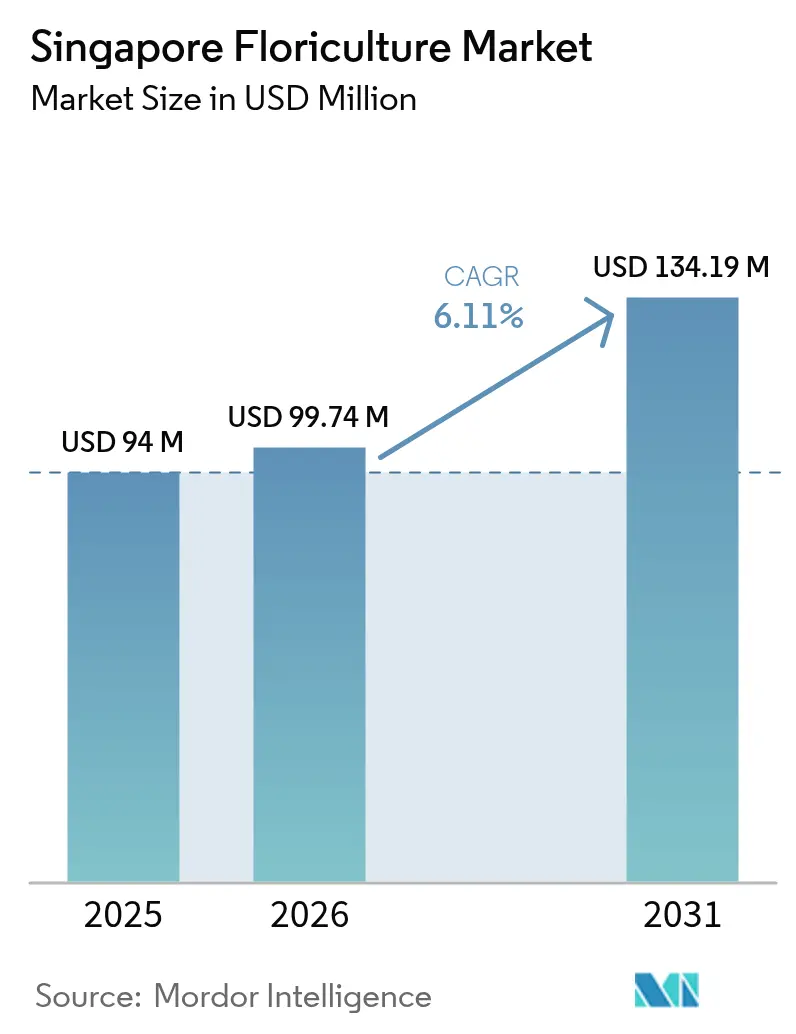
The Singapore floriculture market size is expected to grow from USD 94.0 million in 2025 to USD 99.74 million in 2026 and is forecast to reach USD 134.19 million by 2031 at 6.11% CAGR over 2026-2031. The market growth is supported by high consumer purchasing power, government initiatives, and Singapore's strategic position as a logistics hub.[1] The market expansion is driven by increased interest in home gardening among younger consumers following the pandemic, alongside corporate adoption of plant-integrated designs in buildings. To address land scarcity constraints, the industry employs controlled-environment agriculture systems to maximize yield efficiency, supported by government grants for infrastructure development. Developed e-commerce platforms strengthen the market's competitive position, the "SG Fresh Produce" certification program, and consistent orchid exports, despite challenges from fluctuating freight costs and pest management issues.
Key Report Takeaways
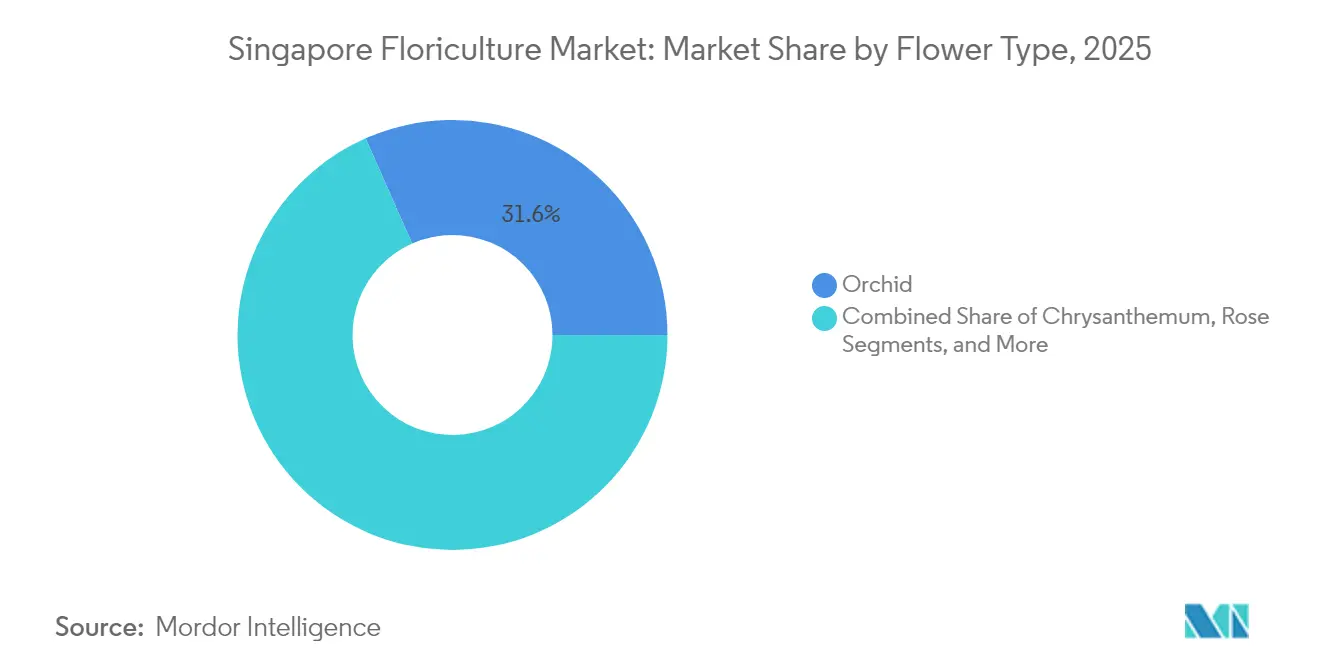
- By flower type, orchids led with a 31.62% Singapore floriculture market share in 2025, while Chrysanthemums recorded the swiftest growth at a 6.5% CAGR toward 2031.
Note: Market size and forecast figures in this report are generated using Mordor Intelligence’s proprietary estimation framework, updated with the latest available data and insights as of 2026.
Market Trends and Insights
Drivers Impact Analysis of Singapore Floriculture Market*
| Driver | (~) % Impact on CAGR Forecast | Geographic Relevance | Impact Timeline |
|---|---|---|---|
| Rising Domestic Demand and Urban Gardening | +1.2% | Singapore domestic market | Short term (≤ 2 years) |
| Government Supports and Grants | +0.9% | Singapore national | Medium term (2-4 years) |
| E-commerce Flower Retail Expansion | +0.8% | Singapore and regional exports | Short term (≤ 2 years) |
| ESG Biophilic Trends and Event Revival | +0.7% | Singapore corporate sector | Medium term (2-4 years) |
| Controlled-environment Yield Gains | +0.6% | Singapore production facilities | Long term (≥ 4 years) |
| Circular Bioeconomy Valorisation of Wastes | +0.4% | Singapore and regional | Long term (≥ 4 years) |
| Source: Mordor Intelligence | |||
Rising Domestic Demand and Urban Gardening
Singapore's younger households, influenced by pandemic-era lifestyle changes, are increasing their purchases of foliage and flowering plants, contributing to steady retail growth in the floriculture market. Weekend plant fairs and terrarium workshops drive consumer spending, while residential developments incorporate rooftop gardens. Commercial property owners are implementing seasonal floral displays to improve tenant satisfaction and achieve sustainability targets. The expansion of public landscaping projects under national environmental initiatives creates broader revenue opportunities for floriculture businesses across retail, residential, and commercial segments.
Government Supports and Grants
The Singapore government provides comprehensive support to the floriculture industry through funding programs for automation, climate control, and data-driven farming initiatives. Equipment co-funding programs increase access to advanced growing systems, facilitating industry modernization. Local growers benefit from certification programs that secure premium retail placement, while partnerships with the hospitality sector ensure consistent demand. These measures minimize financial risk and enhance operational efficiency, enabling floriculture businesses to overcome high operating costs and establish Singapore as a sustainable flower production center.
E-commerce Flower Retail Expansion
Singapore's online flower retailers are reshaping the market through rapid delivery services, efficient logistics, and digital platforms. The introduction of preserved bouquets increases customer retention through extended product longevity. Corporate ordering processes are streamlined through virtual florist consultations, while customer engagement during peak seasons is enhanced through loyalty programs and promotional campaigns. These digital platforms provide accessibility and personalization options, expanding market reach. The growth of digital sales channels creates a reliable revenue stream, complementing traditional retail operations and supporting business adaptation to evolving consumer preferences.
ESG Biophilic Trends and Event Revival
Singapore's commercial spaces are incorporating biophilic design elements, including plant walls, to enhance air quality and workplace wellness. The events industry recovery shows increased preference for locally sourced flowers, supporting sustainability initiatives. Industry professionals are implementing environmentally conscious practices, including reusable containers and biodegradable packaging materials, to align with corporate environmental standards. Supply chain transparency is improved through lifecycle monitoring systems, attracting international clients. The proliferation of floral art festivals strengthens the connection between urban development and floriculture, highlighting the market's importance in environmental sustainability.
Restraints Impact Analysis of Singapore Floriculture Market*
| Restraint | (~) % Impact on CAGR Forecast | Geographic Relevance | Impact Timeline |
|---|---|---|---|
| Scarce Land and High Real-estate Cost | −1.8% | Singapore domestic production | Long term (≥ 4 years) |
| Labor Shortages and Foreign-worker Curbs | −1.1% | Singapore production facilities | Medium term (2-4 years) |
| Freight Cost Volatility | −0.7% | Import-dependent supply chains | Short term (≤ 2 years) |
| Resistant Thrips and Botrytis Strains | −0.5% | Greenhouse and outdoor cultivation | Medium term (2-4 years) |
| Source: Mordor Intelligence | |||
Labor Shortages and Foreign-worker Curbs
Foreign worker regulations in Singapore impose higher levies and strict quotas, affecting nursery operations that operate with limited profit margins. The preference of local workforce for knowledge-based careers creates a skills gap in horticulture. While automation offers a solution to reduce labor requirements, small nurseries face difficulties in securing the necessary capital investment. The administrative burden of managing work permit renewals impacts operational efficiency. These factors create production constraints during high-demand periods, affecting the supply capacity in the Singapore floriculture market.
Freight Cost Volatility
The Singapore floriculture market's reliance on imported flowers from Europe and India makes it vulnerable to fluctuations in air freight costs and currency exchange rates.[2] Air cargo capacity constraints during the pandemic increased per-kilogram shipping rates significantly, reducing retailer profitability. While forward freight agreements provide some protection, smaller florists cannot meet the required volume commitments. Weather-related disruptions in source countries affect shipping reliability, increasing inventory management risks. These cost uncertainties affect price stability in the Singapore floriculture market.
*Our forecasts treat driver/restraint impacts as directional, not additive. The impact forecasts reflect baseline growth, mix effects, and variable interactions.
Singapore Floriculture Market Segment Analysis
By Flower Type:
Orchids Dominate While Chrysanthemums AcceleratesOrchids maintained a 31.62% of Singapore floriculture market share in 2025, driven by established breeding programs at the National Orchid Garden, which cultivates over 1,000 species. The flowers' premium pricing and durability during transport enable exporters to consistently supply regional gift and hotel markets. Singapore's diplomatic gifting initiatives enhance the reputation of locally bred hybrids. The market for orchid exports expanded as genetic research accelerates hybrid development. Local greenhouses use fogging and evaporative-cooling systems to create mountain-like conditions, ensuring quality production despite the tropical climate. Roses continue their significant share in premium bouquet sales, with substantial imports from India and China. Rising transportation of roses and cold-chain logistics affect profit margins. In response, distributors are investigating regional sourcing options and hybrid varieties with improved shelf life and petal durability.
Chrysanthemums maintain the highest growth rate in the Singapore floriculture market size with a 6.5% CAGR through 2031, supported by their strong stems, diverse colors, and suitability for events and ceremonial arrangements. Regular supply from Malaysian producers ensures consistent availability, while improved post-harvest techniques increase vase life, making them preferred by event planners and retailers. Carnations are expanding in mid-tier retail and gifting segments, benefiting from their cost-effectiveness, durability, and cultural significance. Local producers implement precise irrigation and nutrient management systems to improve bloom consistency and reduce growing cycles. Their demand during festivals and cultural events strengthens their market position. Other flowers, including tulips, gerberas, and anthuriums, maintain their presence in high-end market segments during peak seasons, contributing to revenue diversification in Singapore's floriculture market.

Geography Analysis
The western region of Singapore, including Clementi, Bukit Batok, and Jurong West, functions as a primary location for large-scale nurseries and garden centers. These facilities attract customers from nearby residential areas during weekends, providing a comprehensive range of potted plants, cut flowers, and gardening materials. The industrial estates in Jurong house technology-enabled farms that grow orchids and ornamental plants using controlled environment systems, aligned with the Singapore Food Agency's "30 by 30" initiative. These western facilities integrate retail and production operations, supporting the domestic supply chain within the urban environment.
The central districts of Orchard, Newton, and Marina Bay feature premium florists that serve corporate clients, hotels, and high-end consumers seeking customized arrangements. These areas benefit from their location near business districts and tourist destinations, particularly during holiday periods when demand increases for imported flowers like tulips and lilies. The eastern region, specifically Changi, serves as a key logistics center, with modern post-harvest facilities near the airport managing cold-chain operations and customs processes. This infrastructure supports both local distribution and exports to countries including Australia and Japan.
The northeastern residential towns of Hougang, Punggol, Tampines, and Woodlands show increasing demand for floriculture products. Rooftop gardens on Housing and Development Board (HDB) buildings offer residents access to seedlings, soil materials, and educational workshops, connecting new gardeners with local suppliers. Residents in these areas regularly purchase floral products through online platforms, with delivery services operating within two-hour windows. This combination of digital retail and traditional nursery shopping maintains consistent demand across Singapore's compact but diverse consumer landscape.
Regulatory Landscape
Singapore’s floriculture supply is governed primarily by the National Parks Board (NParks) through its plant biosecurity and phytosanitary controls for the import of ornamental plants, nursery stock, seeds, cut flowers, and foliage. Importation of regulated plant material requires a permit issued by the NParks Director-General, with requirements varying by product type. Plants with growing media and certain planting materials typically require stricter documentation than cut flowers and fresh foliage. Plant materials must be free from pests and diseases, and CITES-listed species require additional permits.
On the trade and standards side, Singapore maintains an open import regime with no tariffs or quotas on imported food and agricultural products other than specific excisable goods. This raises the importance of SPS compliance at the border. The Singapore Food Agency (SFA) regulates agricultural commodities intended for human consumption and governs commercial import registration and licensing processes (including UEN activation with Singapore Customs), while Enterprise Singapore, via the Singapore Standards Council, develops national standards and technical references that influence quality practices across the broader agriculture value chain.
Value Chain Analysis
Singapore’s floriculture value chain covers inputs (planting materials, substrates, nutrients, and packaging), cultivation (greenhouses and controlled-environment facilities, with orchids as a core specialty), post-harvest handling (grading, conditioning, and cold chain), wholesale and distribution, and retail channels (nurseries, florists, and e-commerce platforms). NParks is the key regulator for plant and plant-product movements, shaping compliance steps at import, on-farm biosecurity, and phytosanitary readiness for re-export. At the enterprise level, participants such as Hua Hng Trading Co. Pte Ltd, Candy Floriculture Pte Ltd, and Toh Orchids operate across wholesale supply, landscaping demand, and export-oriented activities.
Two structural constraints dominate the chain: land scarcity and high operating costs (especially rentals and labor). These pressures encourage automation and climate-controlled cultivation to protect quality and improve yield consistency. Government-backed capability building supports this transition, including SFA’s Agri-food Cluster Transformation (ACT) Fund 2 (a S$70 million program effective 2026) and investments linked to breeding and cultivar development such as the Seed Innovation Hub award announced in 2025. On the outbound side, Singapore’s role as a logistics node supports both domestic distribution and regional exports, with 2024 exports of fresh cut flowers and buds recorded at USD 1.689 million, and Australia, Japan, and Brunei among key destinations.
Market Opportunities and Future Outlook
A central opportunity area is increasing domestic production value per square meter by shifting more floriculture output toward controlled-environment, automation-led, and energy-aware operations that can operate within Singapore’s land constraint (only about 1% of land allocated for agriculture). Funding and programs provide enabling pathways, including SFA’s ACT Fund 2 (S$70 million starting in 2026) for capability and capacity building, along with policy framing under Singapore Food Story 2 introduced in November 2025 that reinforces technology adoption and resilience objectives. For commercial nurseries, operating benchmarks such as NParks’ Nursery Accreditation Scheme (launched in 2012) also create room for differentiated retail positioning based on standardized practices.
Place-based redevelopment plans further widen the scope for scaled horticulture activities and supplier clustering, including URA’s Draft Master Plan 2025 identification of Lim Chu Kang for redevelopment to house local food production and horticulture activities, alongside the Sungei Kadut Eco-District positioning for agri-tech industries. At the site level, converting underutilized spaces into productive sites, such as multi-storey HDB carpark rooftops for urban farming, supports modular, distributed production models that can extend to ornamental plants where suitable. Technology pathways are also expanding through research and programs targeting energy and heat-stress constraints in urban farming, including modular building-integrated designs highlighted in 2026 research and initiatives such as SingFarms led by the National Research Foundation in partnership with Nanyang Technological University.
Recent Industry Developments in Singapore Floriculture Market
- April 2026: A Singapore-based florist launched an AI-powered sales chatbot to automate customer interactions and order handling. The rollout reduced customer service administration costs by more than USD 4,500 per month and shortened response times from hours to seconds, strengthening competitiveness for digital-first flower retail and corporate ordering workflows.
- March 2025: Singapore received its first consignment of Anthurium flowers from Mizoram, India, establishing a new sourcing corridor for premium ornamental blooms. The addition broadened import variety for event-driven demand segments and supported supply-chain diversification beyond traditional source markets.
- April 2024: Singapore-based florist Petite Fleur entered the Indonesian market using its existing brand and logistics capabilities to serve premium floral services. The expansion extended regional reach for a Singapore operator and reinforced cross-border fulfillment and procurement links that influence sourcing and distribution practices.
Singapore Floriculture Market Report Scope and Research Methodology
Market Definition and Coverage
For this methodology, the Singapore floriculture market is defined as the value of flowers and ornamental plant materials sold in Singapore, covering domestic cultivation plus imported supply that is distributed for local use.
Scope exclusions: We exclude florist gifts that are not plant-based, such as packaging-only add-ons and non-floral hampers, when they are billed as separate items.
Segments Covered in This Report
- By Type of Flower (Production Analysis (Volume), Consumption Analysis (Volume and Value), Import Analysis (Volume and Value), Export Analysis (Volume and Value), and Price Trend Analysis)
- Rosa (Roses)
- Chrysanthemum
- Lily
- Orchid
- Carnation
- Other Types of Flowers (Tulip, Gerbera, Anthurium, and Others)
Data Sources, Market Sizing, and Validation
Desk Research
We start by mapping the supply chain that typically serves Singapore, from incoming trade lanes to local cultivation and onward to wholesale and retail movement. For this, we lean on public statistical releases and structured trade datasets, such as World Bank WITS (UN Comtrade), Singapore government portals for agriculture and food-related updates, and Singapore Customs style trade classifications where relevant.
To keep assumptions grounded, the desk phase also reviews open sources such as trade association updates, peer-reviewed horticulture and controlled-environment agriculture papers, and reputed press coverage on import flows, freight conditions, and consumer occasions that shape demand. Company annual reports and investor presentations are used to understand revenue mix, channel focus, and pricing posture, and then we sanity-check directions using paid subscriptions focused on company financials, news, and shipment-level import and export signals. These desk research sources are illustrative only, and many other public and paid references were also used to collect data, validate inputs, and clarify open questions.
Primary Interviews and Surveys
Primary work fills the biggest gaps that desk sources cannot answer cleanly, especially around channel margins, product mix, and how prices move by flower type and season. We speak with growers, importers, wholesalers, and organized retail and florist operators, and we also test assumptions with logistics-linked stakeholders who see shipment frequency and spoilage risk. Since this is a single-country market, the outreach focuses on Singapore-specific demand centers and purchasing behaviors rather than regional splits.
Distribution of primary research fieldwork respondents
| Company type | Respondent position |
|---|---|
| Top tier: 27% | CXOs: 21% |
| Mid tier: 51% | Functional/Unit leaders: 23% |
| Smaller Players: 22% | Managers: 56% |
Market-Sizing & Forecasting
The sizing starts with a top-down build where import and domestic supply signals are converted into a value pool using observed category pricing and mix. For Singapore, trade-linked indicators are especially useful because a meaningful share of supply is imported, which means the demand pool can be reconstructed using import values and volumes for relevant plant and flower codes, followed by adjustments for re-exports and local production.
To keep totals realistic, we corroborate the model using selective bottom-up checks, such as sampled wholesaler and retailer price bands, typical markups, and volume movement estimates shared in interviews, which are then used to correct extreme outcomes. Inputs that materially affect the market math include import volume by flower types, average unit value shifts from trade data, seasonality around gifting peaks, freight and cold-chain cost pressure, and the mix between premium orchids and higher-volume cut flowers.
For forecasting, we rely on scenario analysis supported by simple time-series smoothing for the more stable variables, and then we overlay interview-led expectations for pricing, sourcing patterns, and channel shifts. When some channel data is missing, we fill gaps using proxy indicators like trade unit values and validated margin ranges, and then the gaps are re-tested with primary respondents before finalizing the curve.
Data Validation & Update Cycle
Validation happens in layers, where the computed market value is cross-checked against independent signals such as trade totals, implied per-capita spend direction, and reported price movements from market participants. When a jump or dip looks unusual, we rerun the model with alternate price and mix assumptions and re-contact selected interviewees to confirm whether the change was driven by demand, supply disruptions, or currency and freight effects.
Each report goes through analyst reviews that look for outliers by year and by product grouping, followed by a final sign-off after variances are explained. Reports are refreshed annually, and interim updates are made when a material event changes trade flows, pricing, or supply availability. Before delivery, we do a fresh check so clients receive the latest updated view available at that time.
Mordor Intelligence's Singapore Floriculture Market Sizing Compared With Other Published Estimates
Published market sizes for Singapore floriculture can look far apart, even when the topic sounds the same, because the underlying boundaries and pricing steps are not consistent. Differences usually come from what is counted as floriculture, how imports and local output are treated, and which year and currency timing are used for converting prices into USD.
A frequent gap driver is the pricing logic, since some estimates apply a single average selling price across all flower types, while others blend wholesale and retail values without stating the handoff. Another driver is timing, where updates are not aligned to the latest trade year and exchange-rate conditions, which can move a small market by several million dollars when values are reported in USD.
Benchmark comparison
| Source | Market Size | Gaps in Research Methodology |
|---|---|---|
| Mordor Intelligence | USD 94.0 M (2025) | |
| Trade Publisher A | USD 37.02 M (2026) | Uses an older, narrow framing that appears closer to selected flower categories and a shorter forecast window, and it is less clear on whether values reflect border prices, wholesale, or retail conversion. |
| E-commerce Data Source B | USD 57.0 M (2025) | Captures online Flowers and Gifts revenue only, so offline florist sales, wholesale distribution, and non-e-commerce purchasing occasions are not represented in the total. |
The spread is best explained by scope and timing choices, where a channel-only view or a narrow product set will naturally sit below a full market view. By refreshing the model around the latest available trade and pricing signals, and by re-validating the USD conversion timing during updates, Mordor Intelligence keeps the estimate tied to how floriculture is actually supplied and priced in Singapore.
Key Questions Answered in the Report
How large is the Singapore floriculture market in 2026?
The Singapore floriculture market size is USD 99.74 million in 2026.
What growth rate will the market register to 2031?
The market is set to record a 6.11% CAGR, taking value to USD 134.19 million by 2031.
Which flower type commands the biggest revenue share?
Orchids lead with 31.62% Singapore floriculture market share in 2025.
Which segment is expanding fastest?
Chrysanthemums segment is advancing at 6.5% CAGR through 2031 within the Singapore floriculture market.
What is the key restraint for growers?
Scarce land and elevated real-estate costs subtract 1.8% from forecast CAGR.