
Post-Quantum Cryptography Managed Services Market Size and Share
Market Overview
| Study Period | 2021 - 2032 |
|---|---|
| Market Size (2027) | USD 0.43 Billion |
| Market Size (2032) | USD 1.72 Billion |
| Growth Rate (2027 - 2032) | 31.95 % |
| Fastest Growing Market | Asia-Pacific |
| Largest Market | North America |
| Market Concentration | Medium |
Major Players *Disclaimer: Major Players sorted in no particular order Image © Mordor Intelligence. Reuse requires attribution under CC BY 4.0. | |
Post-Quantum Cryptography Managed Services Market Analysis by Mordor Intelligence
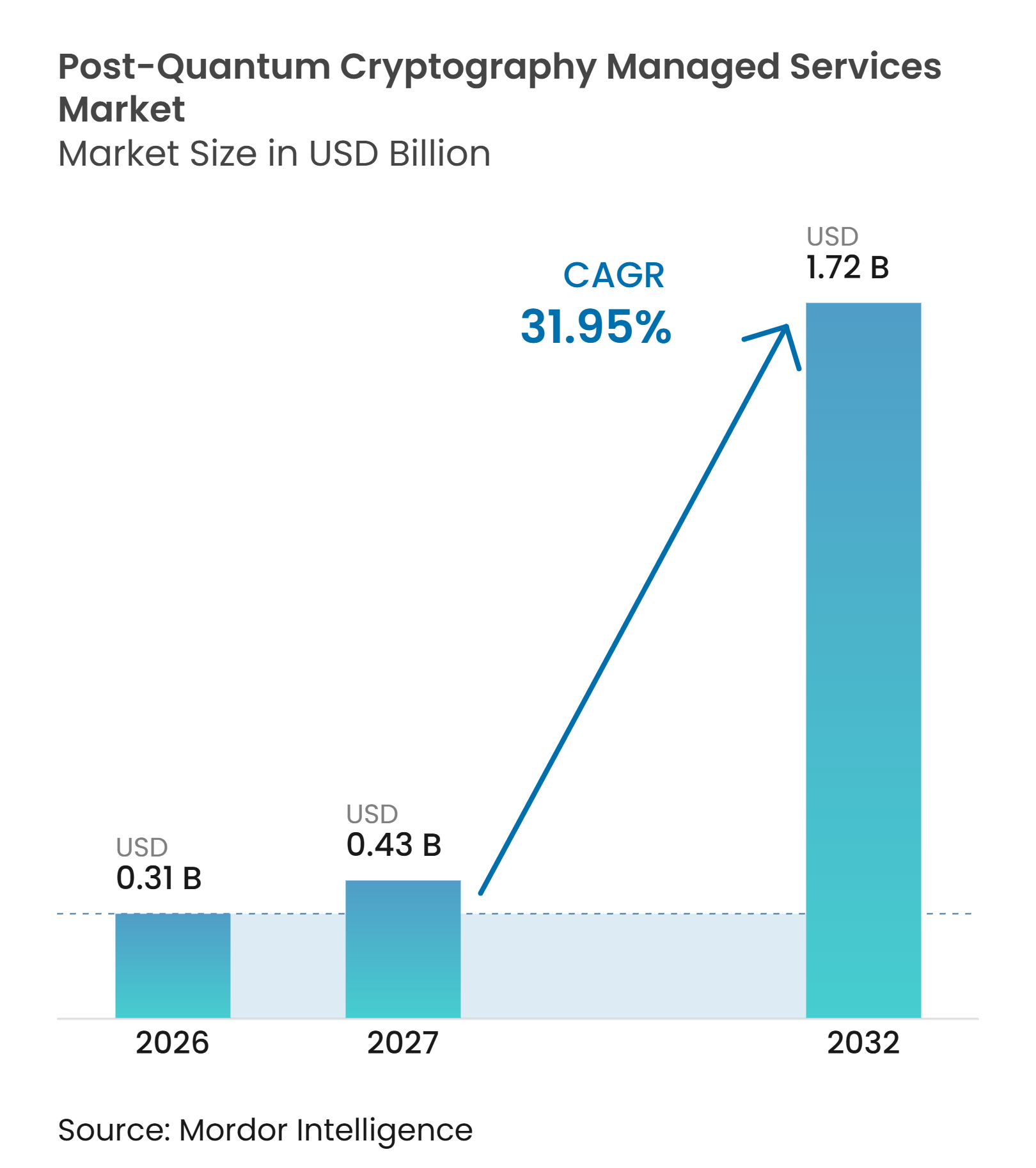
The post-quantum cryptography managed services market size is projected to expand from USD 0.31 billion in 2026 to USD 0.43 billion in 2027, and to USD 1.72 billion by 2032, registering a CAGR of 31.95% between 2027 and 2032. The post-quantum cryptography managed services market is moving from limited trials toward enterprise migration programs as technical standards and public-sector deadlines make planning more urgent. Finalized NIST standards give buyers a common baseline for encryption, signatures, and procurement decisions. Compliance requirements also extend beyond government agencies because contractors and suppliers must prepare for the same transition. Providers are responding by offering discovery, implementation, and managed crypto-agility services to help organizations navigate complex environments. The main opportunity lies in combining migration work with ongoing management of certificates, keys, and algorithms across cloud and legacy systems.
Key Report Takeaways
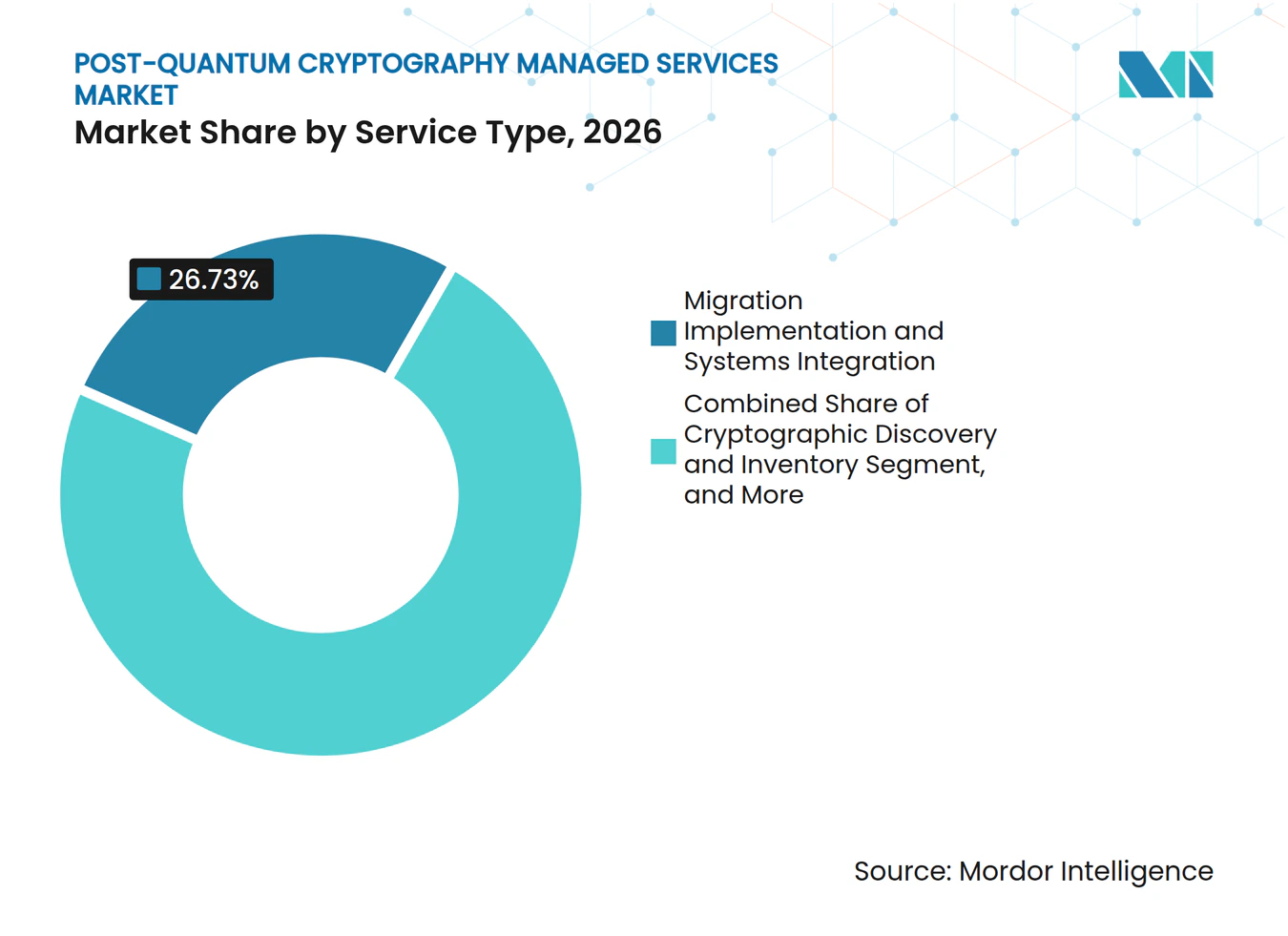
- By service type, Migration Implementation and Systems Integration held 26.73% of the post-quantum cryptography managed services market share in 2026, while Managed Crypto-Agility and Continuous Remediation is projected to expand at a 32.28% CAGR through 2032.
- By cryptographic asset, Public Key Infrastructure and Digital Certificates accounted for 29.41% of the post-quantum cryptography managed services market size in 2026, while Code Signing and Software Supply Chain is projected to expand at a 33.26% CAGR through 2032.
- By deployment model, Cloud-Based held 67.89% of the market share in 2026 and is projected to expand at a 34.74% CAGR through 2032.
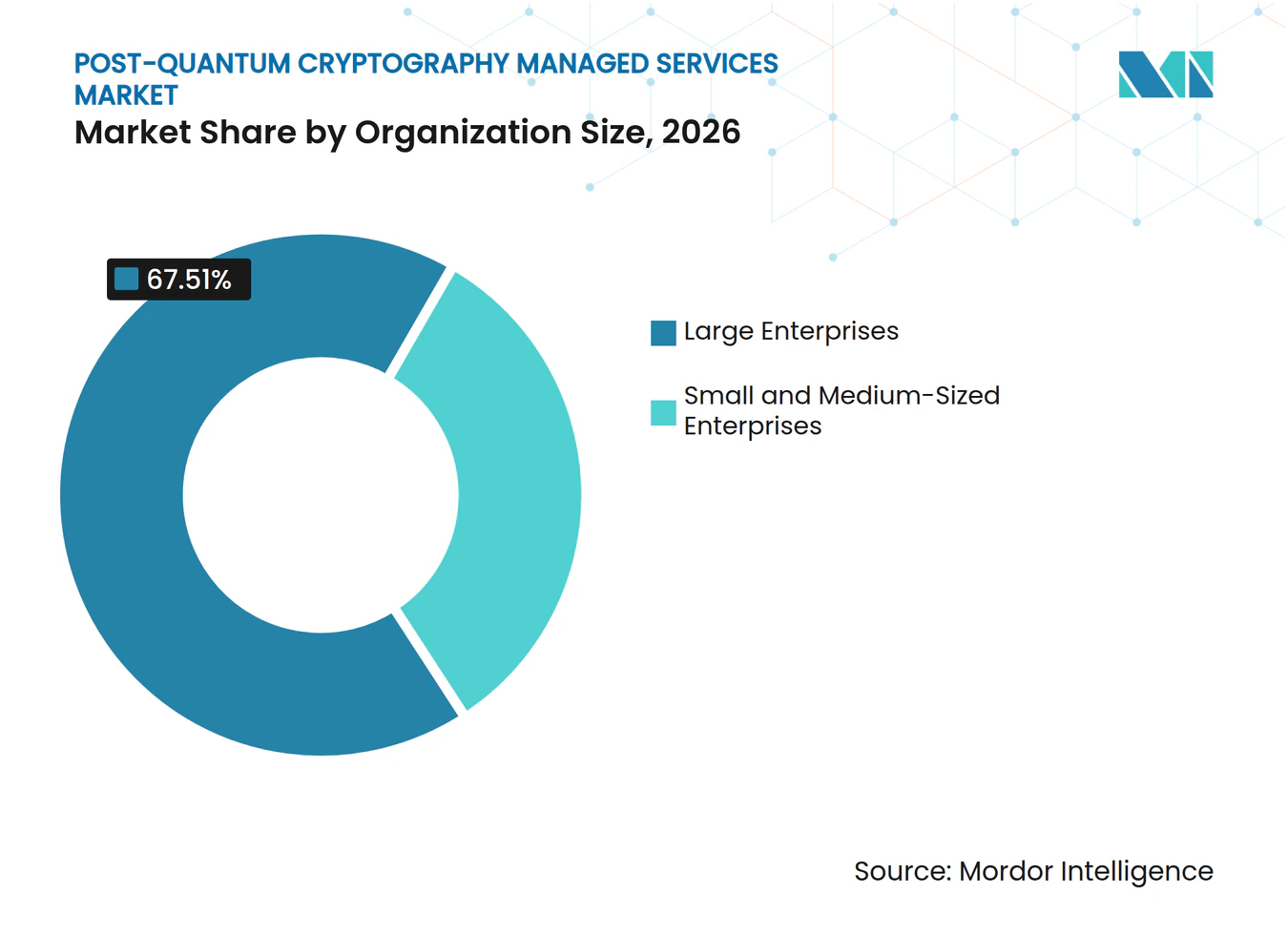
- By organization size, Large Enterprises held 67.51% of the market share in 2026, while Small and Medium-Sized Enterprises are projected to expand at a 32.43% CAGR through 2032.
- By end-user industry, BFSI held 28.39% of the market share in 2026, while Government and Public Administration is projected to expand at a 33.61% CAGR through 2032.
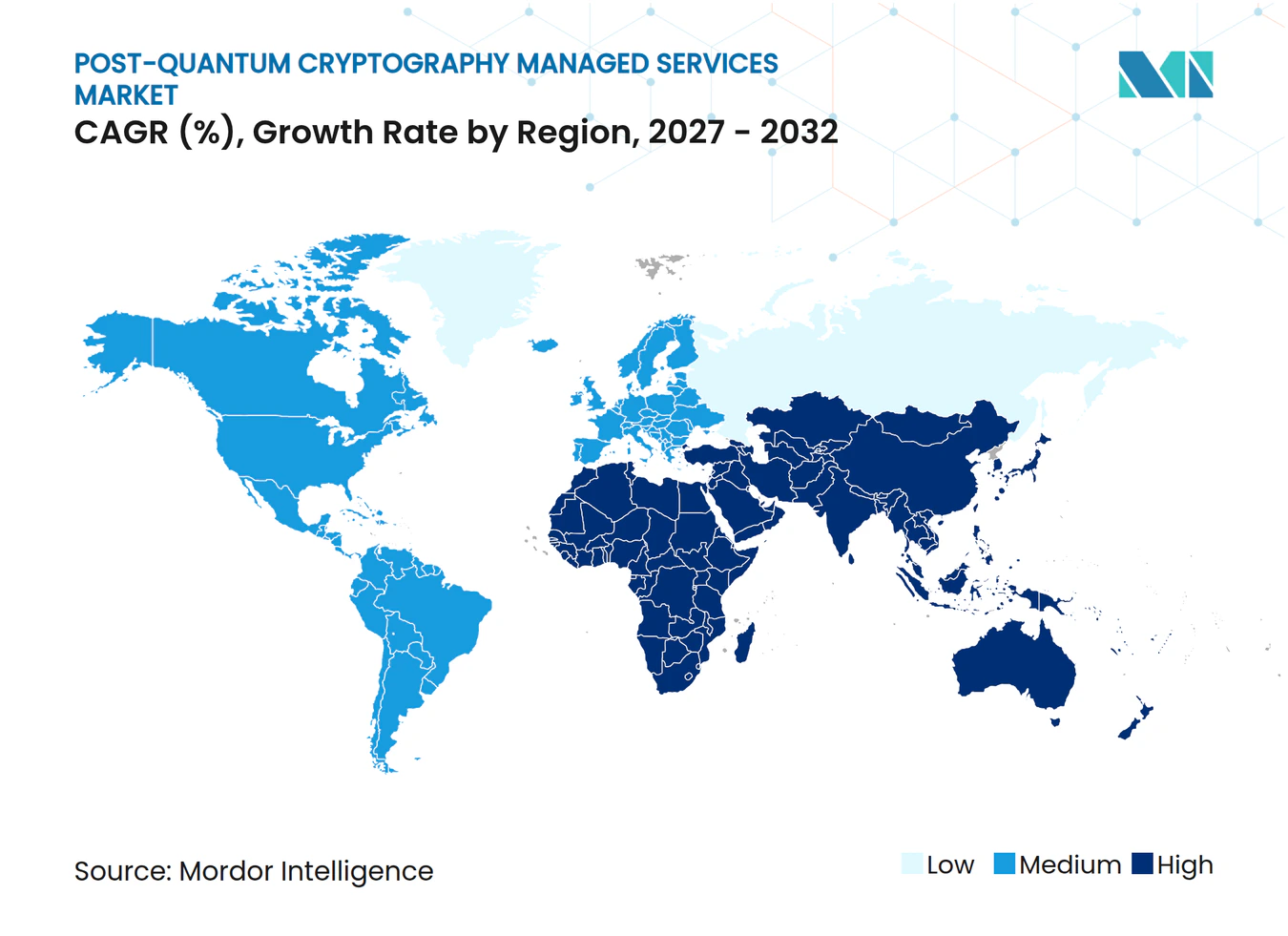
- By geography, North America held 41.67% of the market share in 2026 in the post-quantum cryptography managed services market, while Asia-Pacific is projected to expand at a 32.94% CAGR through 2032.
Note: Market numbers in this report are based on Mordor Intelligence's proprietary estimation framework, which combines nine months of actuals with Q4 projections for base year 2026.
Market Trends and Insights
Drivers Impact Analysis of Post-Quantum Cryptography Managed Services Market*
| Driver | (~) % Impact on CAGR Forecast | Geographic Relevance | Impact Timeline |
|---|---|---|---|
| Mandatory Migration Toward NIST-Standardized Algorithms | +8.5% | Global, with concentrated near-term pressure in North America and Europe | Short term (≤ 2 years) |
| Harvest-Now-Decrypt-Later Exposure of Long-Lived Data | +7.0% | Global, with highest relevance in BFSI, government, and healthcare | Short term (≤ 2 years) |
| Cloud and Hybrid-IT Expansion Increasing Cryptographic Complexity | +4.5% | Global, with strongest relevance in Asia-Pacific and North America | Medium term (2-4 years) |
| Certificate-Lifecycle Compression Creating Continuous PQC Operations Demand | +3.8% | North America and Europe, with Asia-Pacific spillover | Short term (≤ 2 years) |
| Shortage of Enterprise Cryptography and Crypto-Agility Skills | +3.2% | Global, with high relevance in South America, the Middle East, and Africa | Medium term (2-4 years) |
| Cryptographic Bill of Materials Becoming an Operating Control | +2.5% | North America, India, and Europe | Medium term (2-4 years) |
| Source: Mordor Intelligence | |||
Mandatory Migration Toward NIST-Standardized Algorithms
Federal and international requirements have made post-quantum migration a compliance matter rather than an optional security upgrade. NIST finalized FIPS 203, FIPS 204, and FIPS 205 in August 2024, providing standards for migration planning and product design.[1] The June 2026 U.S. Executive Order 14412 requires federal agencies to transition to key establishment by December 31, 2030, and to digital signatures by December 31, 2031. Covered contractors face the same direction, which brings demand into the commercial supply chain. The post-quantum cryptography managed services market, therefore, benefits from earlier spending on asset discovery, migration roadmaps, and implementation plans. NIST also selected HQC as a backup key-encapsulation mechanism in March 2025, adding another algorithm that organizations must consider in their migration programs.
Harvest-Now-Decrypt-Later Exposure of Long-Lived Data
Harvest-now-decrypt-later risk makes the timing of protection important for data that must remain confidential for many years. A 2026 peer-reviewed study found that delayed post-quantum migration can leave high-retention data exposed for extended periods, while hybrid key exchange can reduce the exposure window. Healthcare, government, financial services, and satellite communications have long-lived records and communications that require prioritization. Providers can distinguish their services by ranking assets according to confidentiality, retention period, and transmission frequency. This approach directs scarce implementation resources to the assets where delay has the greatest consequence. Cisco has described data collection by state-linked actors as a current risk that organizations should address before cryptographically relevant quantum computers are available.
Certificate-Lifecycle Compression Creating Continuous PQC Operations Demand
Shorter certificate validity periods are creating an operational reason to improve automation before full post-quantum migration begins. The CA/Browser Forum schedule reduces the maximum TLS certificate lifetime to 200 days from March 2026, 100 days in 2027, and 47 days by March 2029.[2] Organizations managing large certificate estates need automated renewal, inventory, and policy controls to meet those timelines. Those same controls enable frequent changes to keys and algorithms during a post-quantum transition. The post-quantum cryptography managed services market benefits from this overlap, as certificate-management projects can evolve into broader crypto-agility engagements. Microsoft began a post-quantum TLS pilot in August 2026, allowing certificate authorities and enterprises to test ML-DSA-87 authentication before broader use.
Cloud and Hybrid-IT Expansion Increasing Cryptographic Complexity
Multi-cloud systems, containerized workloads, and non-human identities increase the number of cryptographic assets that an organization must identify and manage. A 2026 peer-reviewed study found that delaying a cloud migration program from 2026 to 2030 can materially increase the proportion of a confidentiality window exposed to later decryption risk. Cloud tools are useful for discovery because they can collect inventory data across cloud control planes and hybrid environments. Google Cloud has published a roadmap for ML-KEM, ML-DSA, SLH-DSA, and quantum-safe key import across its services. The post-quantum cryptography managed services market is supported by buyers that need one view across cloud-native, on-premises, and operational technology environments. Providers that can identify unmanaged cryptography across those environments have a stronger position in complex enterprise engagements.
Restraints Impact Analysis of Post-Quantum Cryptography Managed Services Market*
| Restraint | (~) % Impact on CAGR Forecast | Geographic Relevance | Impact Timeline |
|---|---|---|---|
| Brownfield Interoperability and Performance Constraints | -2.5% | Global, with highest relevance in large enterprises and critical infrastructure | Medium term (2-4 years) |
| Unclear Multi-Jurisdiction Transition Requirements | -1.8% | Global, with highest friction for multinational organizations | Long term (≥ 4 years) |
| Hidden Cryptography in Software Supply Chains and Operational Technology | -1.3% | Global, concentrated in manufacturing, energy, and defense supply chains | Medium term (2-4 years) |
| Customer Reluctance to Outsource Crown-Jewel Key Operations | -1.0% | Global, with strongest relevance in BFSI, government, and defense | Long term (≥ 4 years) |
| Source: Mordor Intelligence | |||
Brownfield Interoperability and Performance Constraints
Legacy infrastructure limits the speed of migration because post-quantum algorithms use larger keys, signatures, and memory resources than older cryptography. Research published in 2026 found that a transition from elliptic-curve cryptography to ML-KEM-768 reduced maximum server connections per second by 33.6%.[3] The same research reported an increase in L3 cache misses from 4.2% to 11.5%, showing the pressure that new algorithms can place on existing infrastructure. Network appliances, embedded devices, hardware security modules, and mainframe systems may need refreshes before they can support new cryptography. These requirements raise project cost and slow adoption in brownfield estates. The post-quantum cryptography managed services market still has an opportunity in gateway and proxy approaches that can introduce hybrid protection without rewriting every legacy application.
Unclear Multi-Jurisdiction Transition Requirements
Multinational organizations must navigate different standards, certification processes, and transition dates across their operating regions. The United States uses NIST standards, while China continues a parallel standardization process that can require separate technical choices. This creates a risk that an organization must maintain multiple cryptographic architectures for different markets. AWS has noted that countries across North America, Europe, Asia-Pacific, and the Middle East have issued formal guidance with differing timelines and sector requirements. Separate rules can delay procurement because organizations need policies that work across their legal and technical environments. The post-quantum cryptography managed services market can address this constraint through centralized asset inventories and policy management that support multiple compliance programs.
*Our forecasts treat driver/restraint impacts as directional, not additive. The impact forecasts reflect baseline growth, mix effects, and variable interactions.
Post-Quantum Cryptography Managed Services Market Segment Analysis
By Service Type:
Implementation Services Lead Revenue While Managed Agility Gains MomentumMigration Implementation and Systems Integration held 26.73% of the post-quantum cryptography managed services market share in 2026. This position indicates that early adopters have moved from assessment to execution work. Replacing asymmetric libraries across enterprise applications, payment systems, and PKI hierarchies requires specialized integration skills. These projects often involve business continuity testing and coordination with infrastructure owners. Managed Crypto-Agility and Continuous Remediation is projected to expand at a 32.28% CAGR through 2032. Its advancement reflects the need to treat cryptographic maintenance as an ongoing activity rather than a one-time program.
Cryptographic Discovery and Inventory remains a starting point for the other service categories because an organization cannot prioritize assets it has not identified. Risk Assessment and Prioritization helps clients rank exposure by retention period, data sensitivity, and connectivity. Migration Planning and Roadmap Design is relevant for organizations that understand their inventory but need a practical transition sequence. Other services include work for operational technology, bespoke protocols, and hardware security module integration. In April 2026, Entrust and IBM Consulting announced a joint delivery model that combines discovery, risk-based roadmaps, migration governance, and ongoing operations.[4] This type of bundled engagement supports longer client relationships in the Post-quantum cryptography managed services market.



By Cryptographic Asset:
PKI Forms the Largest Base While Code Signing Advances QuicklyPublic Key Infrastructure and Digital Certificates accounted for 29.41% of the post-quantum cryptography managed services market size in 2026. The post-quantum cryptography managed services market segment reflects the extensive use of X.509 certificates across enterprise and internet-facing infrastructure. Certificate authorities, internal PKI teams, and application owners must coordinate when certificate profiles and signing methods change. Code Signing and Software Supply Chain is projected to expand at a 33.26% CAGR through 2032. The category receives attention because software artifacts can have long validity periods and must remain trustworthy after distribution. Code-signing migration also depends on a clear record of algorithms, keys, certificate chains, and build systems.
TLS, VPN, and network encryption have seen visible interoperability progress as internet-scale services begin to support hybrid key exchange. Cloudflare reported in 2026 that more than two-thirds of human-generated TLS traffic to its network used hybrid ML-KEM protection. Hardware Security Modules and Key Management systems require careful planning because they are durable trust anchors with validation and replacement cycles. Entrust received CAVP certification in September 2025 for ML-DSA, ML-KEM, and SLH-DSA support in nShield 5 firmware. Databases, backups, and archives have a central role in long-retention risk management. Other assets include embedded products and proprietary protocols that need case-specific implementation work.
By Deployment Model:
Cloud Delivery Leads While On-Premises Controls Remain RelevantCloud-Based deployment held 67.89% of the post-quantum cryptography managed services market share in 2026 and is projected to expand at a 34.74% CAGR through 2032. Buyers use cloud delivery for discovery and inventory tools because agents can collect data across distributed systems without extensive on-site deployment. Consumption-based delivery also lowers the initial cost for organizations starting with a limited scope. Cloud platforms can integrate discovery with cloud key management and certificate controls. The model is especially relevant to organizations with multiple public-cloud accounts and rapidly changing workloads. It does not eliminate the need for local controls where key material or critical applications must remain in isolated environments.
On-Premises deployment continues to serve clients with data sovereignty rules, air-gapped networks, or direct control requirements for cryptographic keys. Thales has described Luna HSM firmware with native ML-KEM and ML-DSA support for clients preparing local trust infrastructure.[5] Hybrid designs combine local hardware security modules with cloud-based discovery, lifecycle management, and managed services. This arrangement can suit large enterprises that operate both legacy estates and cloud environments. The IETF has published a draft ACME PQC agility profile that outlines a path for interoperability between cloud and local certificate systems. The post-quantum cryptography managed services market benefits when providers can support these mixed operating models.
By Organization Size:
Large Enterprises Account for Current Spending, While SMEs Expand AccessLarge Enterprises held 67.51% of the post-quantum cryptography managed services market share in 2026. They have extensive certificate estates, multiple cloud environments, legacy infrastructure, and the budget to fund multi-year programs. Their requirements commonly include external consulting, implementation, governance, and managed services. Small and Medium-Sized Enterprises are projected to expand at a 32.43% CAGR through 2032. Managed offerings can lower entry barriers for organizations that do not employ dedicated cryptography teams. Supply-chain requirements also bring smaller suppliers into migration planning when larger clients request quantum-safe certificates or updated controls.
Large organizations are more likely to have begun cryptographic inventories, while many smaller organizations have not mapped their asymmetric dependencies. Government-backed programs can reduce this gap by supporting discovery and assessment for public-sector suppliers. Cloud-based managed services offer a practical path for smaller clients, as they do not require large capital commitments. Service providers need clear workflows for onboarding, asset discovery, and remediation to serve this customer group effectively. The post-quantum cryptography managed services market may see small businesses capture a larger share of contracts, even as large enterprises retain higher revenue per engagement. That difference favors vendors that can offer repeatable services at several levels of complexity.

By End-User Industry:
BFSI Provides the Largest Base While Public Administration Leads ExpansionBFSI accounted for 28.39% of the post-quantum cryptography managed services market size in 2026. Financial institutions maintain long-lived records and operate through interconnected payment, custody, settlement, and identity systems. The G7 Cyber Expert Group published a coordinated roadmap in January 2026 that focuses on a 2030-32 transition for the sector's most critical systems. These requirements sustain demand for inventory, planning, and migration support. Government and Public Administration is projected to expand at a 33.61% CAGR through 2032. National deadlines make public procurement a major source of implementation activity.
The U.S. federal timeline creates a multi-year need for agencies to assess systems, prepare roadmaps, and replace vulnerable cryptography. Japan cleared ML-KEM for government use in April 2026, enabling public-sector procurement planning. IT and telecommunications have significant PKI needs through network and 5G security architectures. Healthcare is relevant because patient records have long confidentiality requirements. Energy and utilities need specialized services because operational technology can be difficult to inventory and update. Other end users include professional services, retail financial services, and logistics companies responding to customer and partner obligations.
Geography Analysis
North America Post-Quantum Cryptography Managed Services Market
North America held 41.67% of the Post-quantum cryptography managed services market share in 2026. The Post-quantum cryptography managed services market in the region has the most prescriptive public-sector migration environment, led by the June 2026 U.S. executive order. The order requires transition dates for federal key establishment and digital signatures, while contractors also face related obligations. The NSA CNSA 2.0 timetable adds a parallel requirement for national security systems and the defense supply chain. Canada requires government information technology systems to migrate to post-quantum cryptography by 2035, with agency plans due in 2026. Healthcare and defense organizations in the region have high long-retention exposure, which supports early discovery and prioritization work.
APAC Post-Quantum Cryptography Managed Services Market
Asia-Pacific is projected to expand at a 32.94% CAGR through 2032. Japan cleared ML-KEM for government use in April 2026 and is preparing a national migration roadmap, which provides a basis for agency procurement.[6] NTT Data announced a quantum-safe key management service for its OpenCanvas cloud platform in October 2026. India is positioning Cryptographic Bills of Materials as a control for critical information infrastructure suppliers. South Korea has used pilot programs to support adoption in public-sector systems. China continues to develop its own standards and production solutions, which adds complexity for global companies operating in the country.
EMEA and South America Post-Quantum Cryptography Managed Services Market
Europe has regulatory relevance through DORA and broader resilience obligations for financial entities and essential services. The post-quantum cryptography managed services market in the region is supported by banks and other regulated organizations that must assess cryptographic risks. The Middle East has demand linked to national quantum investment, sovereign cloud programs, and critical infrastructure procurement. African adoption remains early, and infrastructure constraints limit near-term implementation demand. South America has emerging activity in digital finance and data protection, although binding post-quantum requirements are less developed. These conditions create more immediate advisory opportunities for financial and telecommunications operators with cross-border exposure.
Competitive Landscape
Market Concentration
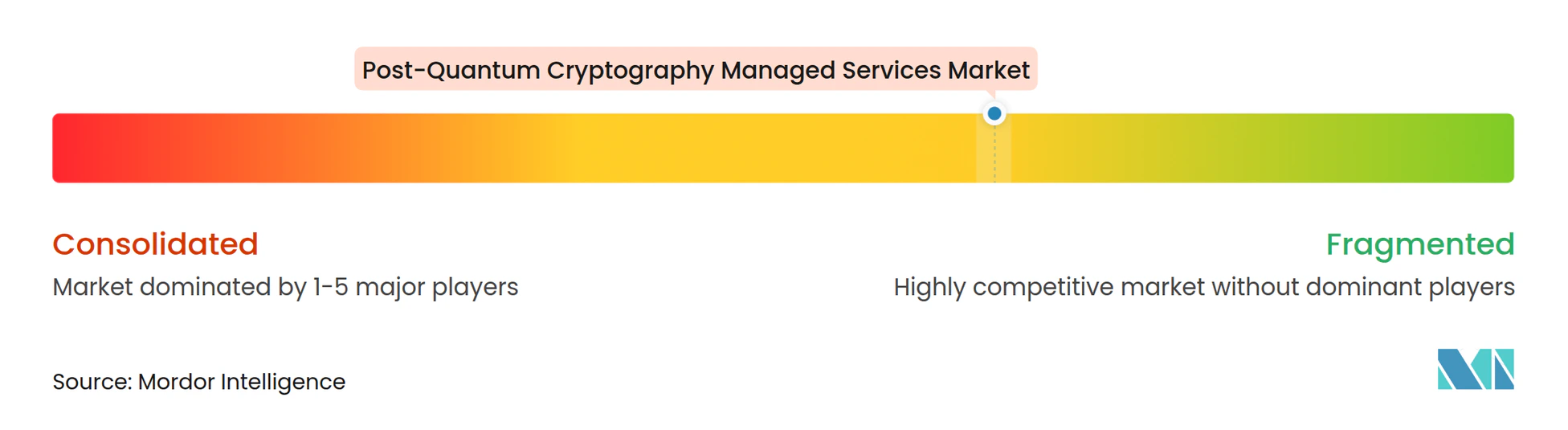
The post-quantum cryptography managed services market is moderately fragmented because no provider leads all service categories. Large systems integrators and hyperscalers offer post-quantum work as part of broader cloud security and transformation contracts. Specialist providers focus on cryptographic discovery, certificate lifecycle management, public key infrastructure, hardware security modules, or algorithm libraries. This structure gives buyers several options, but it also increases the need for integration between services and technology. The Quantum-Safe 360 Alliance, formed by Keyfactor, IBM Consulting, Thales, and Quantinuum, published enterprise guidance in August 2025 covering discovery, PKI migration, crypto-agile development, and managed deployment. Alliances help vendors combine advisory capacity, product depth, and delivery capability.
Entrust and IBM Consulting announced a collaboration in April 2026 to connect the Entrust Cryptographic Security Platform with IBM Consulting's transformation services. The combination targets discovery, risk-based roadmap design, migration governance, execution, and ongoing compliance. Cloudflare announced in September 2026 that it intends to become a public certificate authority for the post-quantum web and issue post-quantum Merkle Tree Certificates. This move could change competitive conditions in public certificate issuance by adding a large network operator to the field. Google Cloud has also made post-quantum capabilities part of its cloud security roadmap.
Opportunities remain in managed offerings for smaller organizations, discovery tools for operational technology, and software for cross-border compliance management. Code signing and software supply chains need more attention because long-lived software artifacts can retain cryptographic exposure after distribution. IBM Research has published work on Cryptographic Bills of Materials in CycloneDX, contributing to the development of common methods for recording cryptographic components. Providers will compete on the speed of validated algorithm support and their ability to work with legacy environments. Compatibility with industrial systems, old network hardware, and mainframe applications can be an important differentiator.
Post-Quantum Cryptography Managed Services Industry Leaders
-
Accenture plc
-
Amazon Web Services, Inc.
-
Cisco Systems, Inc.
-
Google LLC
-
IBM Corporation
- *Disclaimer: Major Players sorted in no particular order
Post-Quantum Cryptography Managed Services Market Companies Covered in this Report
- Accenture plc
- Amazon Web Services, Inc.
- Cisco Systems, Inc.
- Google LLC
- IBM Corporation
- Arqit Quantum Inc.
- Atos SE, through Eviden
- Cloudflare, Inc.
- Crypto4A Technologies Inc.
- CryptoNext Security SAS
- DigiCert, Inc.
- Entrust Corporation
- ISARA Corporation
- Keyfactor, Inc.
- Microsoft Corporation
- Nokia Corporation
- PQShield Ltd.
- QuSecure, Inc.
- SandboxAQ, Inc.
- Securosys SA
- Thales Group
- Quantinuum Ltd.
- Quantropi Inc.
- Qrypt, Inc.
- Utimaco GmbH
Recent Industry Developments in Post-Quantum Cryptography Managed Services Market
- October 2026: NTT Data announced the launch of a domestic quantum-safe key management service on its OpenCanvas cloud platform, enabling Japanese enterprises and government agencies to generate, store, and manage cryptographic keys with post-quantum readiness under data sovereignty controls, a service timed to the Japanese government's accelerating PQC procurement cycle following CRYPTREC's April 2026 clearance of ML-KEM.
- September 2026: Cloudflare announced its intent to become a public Certificate Authority supporting post-quantum Merkle Tree Certificates alongside classical TLS, and simultaneously agreed to acquire established, publicly trusted root CA key material from GlobalSign. Production MTC issuance was targeted for Q1 2027, positioning Cloudflare as an independent, high-scale issuer in a web certificate ecosystem currently dominated by a small number of incumbent authorities.
- August 2026: Microsoft launched the Post-Quantum Cryptography TLS Pilot Program, adding seven pilot roots operated by DigiCert, Sectigo, IdenTrust Services, and 4 other certificate authorities, enabling enterprise-scale controlled testing of ML-DSA-87 post-quantum authentication. The program provided the first production-adjacent test environment for certificate authority interoperability ahead of anticipated broad deployment.
- April 2026: TOPPAN Holdings, the National Institute of Information and Communications Technology, and ISARA Corporation established a proof of concept demonstrating seamless migration of certificate authority infrastructure to PQC in Japan, using hybrid certificate chain techniques compatible with NIST's ML-DSA and ML-KEM standards, a development directly relevant to Japan's planned national CA migration roadmap.
Global Post-Quantum Cryptography Managed Services Market Report Scope
The post-quantum cryptography managed services market comprises revenue generated from outsourced, recurring, and co-managed services that support an organization’s ongoing transition to quantum-safe cryptography. Offerings include managed cryptographic discovery, PQC readiness monitoring, managed PKI and certificate operations, managed key and HSM lifecycle services, migration-factory support, compliance reporting, and continuous crypto-agility operations. The market focuses on sustained operational responsibility for PQC readiness and remediation, rather than one-time software sales or standalone consulting projects.
The Post-Quantum Cryptography Managed Services Market Report is Segmented by Service Type (Cryptographic Discovery and Inventory, Quantum Risk Assessment and Prioritization, PQC Migration Planning and Roadmap Design, Migration Implementation and Systems Integration, Managed Crypto-Agility and Continuous Remediation, and Other Service Types), Cryptographic Asset (Public Key Infrastructure and Digital Certificates, TLS, VPN, and Network Encryption, Code Signing and Software Supply Chain, Hardware Security Modules and Key Management, Databases, Backups, and Long-Lived Archives, and Other Cryptographic Assets), Deployment Model (Cloud-Based, On-Premises, and Hybrid), Organization Size (Large Enterprises, and Small and Medium-Sized Enterprises), End-User Industry (Banking, Financial Services, and Insurance (BFSI), IT and Telecommunications, Government and Public Administration, Healthcare and Medical Devices, Energy and Utilities, and Other End-User Industries), and Geography (North America, South America, Europe, Asia-Pacific, Middle East, and Africa), The Market Forecasts are Provided in Terms of Value (USD).
Segmentation Overview
| Cryptographic Discovery and Inventory |
| Quantum Risk Assessment and Prioritization |
| PQC Migration Planning and Roadmap Design |
| Migration Implementation and Systems Integration |
| Managed Crypto-Agility and Continuous Remediation |
| Other Service Types |
| Public Key Infrastructure and Digital Certificates |
| TLS, VPN, and Network Encryption |
| Code Signing and Software Supply Chain |
| Hardware Security Modules and Key Management |
| Databases, Backups, and Long-Lived Archives |
| Other Cryptographic Assets |
| Cloud-Based |
| On-Premises |
| Hybrid |
| Large Enterprises |
| Small and Medium-Sized Enterprises |
| Banking, Financial Services, and Insurance (BFSI) |
| IT and Telecommunications |
| Government and Public Administration |
| Healthcare and Medical Devices |
| Energy and Utilities |
| Other End-User Industries |
| North America | United States |
| Canada | |
| Mexico | |
| South America | Brazil |
| Argentina | |
| Rest of South America | |
| Europe | United Kingdom |
| Germany | |
| France | |
| Italy | |
| Rest of Europe | |
| Asia-Pacific | China |
| Japan | |
| India | |
| South Korea | |
| Rest of Asia-Pacific | |
| Middle East | Israel |
| Saudi Arabia | |
| United Arab Emirates | |
| Rest of Middle East | |
| Africa | South Africa |
| Egypt | |
| Rest of Africa |
| By Service Type | Cryptographic Discovery and Inventory | |
| Quantum Risk Assessment and Prioritization | ||
| PQC Migration Planning and Roadmap Design | ||
| Migration Implementation and Systems Integration | ||
| Managed Crypto-Agility and Continuous Remediation | ||
| Other Service Types | ||
| By Cryptographic Asset | Public Key Infrastructure and Digital Certificates | |
| TLS, VPN, and Network Encryption | ||
| Code Signing and Software Supply Chain | ||
| Hardware Security Modules and Key Management | ||
| Databases, Backups, and Long-Lived Archives | ||
| Other Cryptographic Assets | ||
| By Deployment Model | Cloud-Based | |
| On-Premises | ||
| Hybrid | ||
| By Organization Size | Large Enterprises | |
| Small and Medium-Sized Enterprises | ||
| By End-User Industry | Banking, Financial Services, and Insurance (BFSI) | |
| IT and Telecommunications | ||
| Government and Public Administration | ||
| Healthcare and Medical Devices | ||
| Energy and Utilities | ||
| Other End-User Industries | ||
| By Geography | North America | United States |
| Canada | ||
| Mexico | ||
| South America | Brazil | |
| Argentina | ||
| Rest of South America | ||
| Europe | United Kingdom | |
| Germany | ||
| France | ||
| Italy | ||
| Rest of Europe | ||
| Asia-Pacific | China | |
| Japan | ||
| India | ||
| South Korea | ||
| Rest of Asia-Pacific | ||
| Middle East | Israel | |
| Saudi Arabia | ||
| United Arab Emirates | ||
| Rest of Middle East | ||
| Africa | South Africa | |
| Egypt | ||
| Rest of Africa | ||
Key Questions Answered in the Report
What is the size of the post-quantum cryptography managed services market?
The post-quantum cryptography managed services market size is projected to expand from USD 0.31 billion in 2026 and USD 0.43 billion in 2027 to USD 1.72 billion by 2032, registering a CAGR of 31.95% between 2027 and 2032.
What is driving demand for post-quantum cryptography services?
NIST standards, government migration deadlines, long-lived data exposure, and shorter certificate lifecycles are increasing demand for discovery, implementation, and crypto-agility services.
Which service type has the largest revenue share?
Migration Implementation and Systems Integration held the largest share at 26.73% in 2026, while Managed Crypto-Agility and Continuous Remediation has the highest projected CAGR at 32.28%.
Why are certificate management systems important for quantum readiness?
Certificate lifetimes are scheduled to fall to 47 days by 2029, which makes automated inventory, renewal, and key-management processes necessary for large certificate estates.
Which organizations are adopting services most quickly?
Government and Public Administration has the highest projected end-user CAGR at 33.61%, while SMEs are projected to expand at a 32.43% CAGR as managed services reduce skills and cost barriers.
Which region has the strongest current position?
North America held 41.67% share in 2026, supported by federal requirements and a mature security services ecosystem, while Asia-Pacific has the highest projected CAGR at 32.94%.