
Post-Quantum Cryptography Testing and Validation Market Size and Share
Market Overview
| Study Period | 2021 - 2032 |
|---|---|
| Market Size (2027) | USD 0.33 Billion |
| Market Size (2032) | USD 1.02 Billion |
| Growth Rate (2027 - 2032) | 25.32 % |
| Fastest Growing Market | Asia-Pacific |
| Largest Market | North America |
| Market Concentration | Low |
Major Players *Disclaimer: Major Players sorted in no particular order Image © Mordor Intelligence. Reuse requires attribution under CC BY 4.0. | |
Post-Quantum Cryptography Testing and Validation Market Analysis by Mordor Intelligence
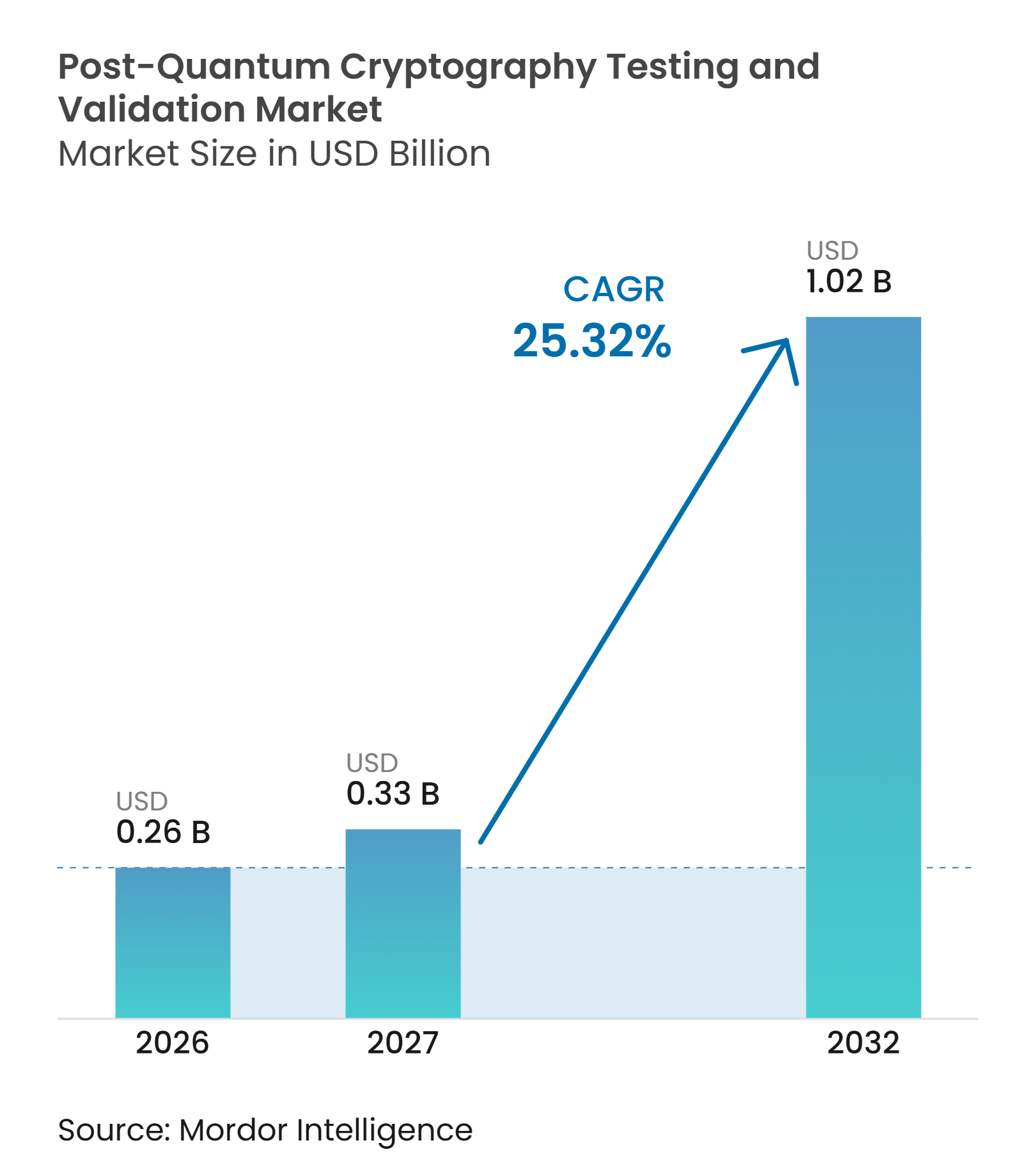
The post-quantum cryptography testing and validation market size is projected to expand from USD 0.26 billion in 2026 to USD 0.33 billion in 2027, and to USD 1.02 billion by 2032, registering a CAGR of 25.32% between 2027 and 2032. Government deadlines are moving post-quantum cryptography from planning to formal procurement and validation. Organizations need evidence that algorithms, cryptographic modules, and deployed systems meet relevant requirements before they can be used in regulated environments. The post-quantum cryptography testing and validation market is also being shaped by cryptographic discovery, because enterprises must identify vulnerable algorithms and dependencies before testing can begin. Cloud delivery is widening access to testing tools, while regulated deployments still require hybrid and on-premises capabilities. Competition is divided among test equipment providers, semiconductor security companies, cryptographic software providers, hardware security module suppliers, and cloud platforms.
Key Report Takeaways
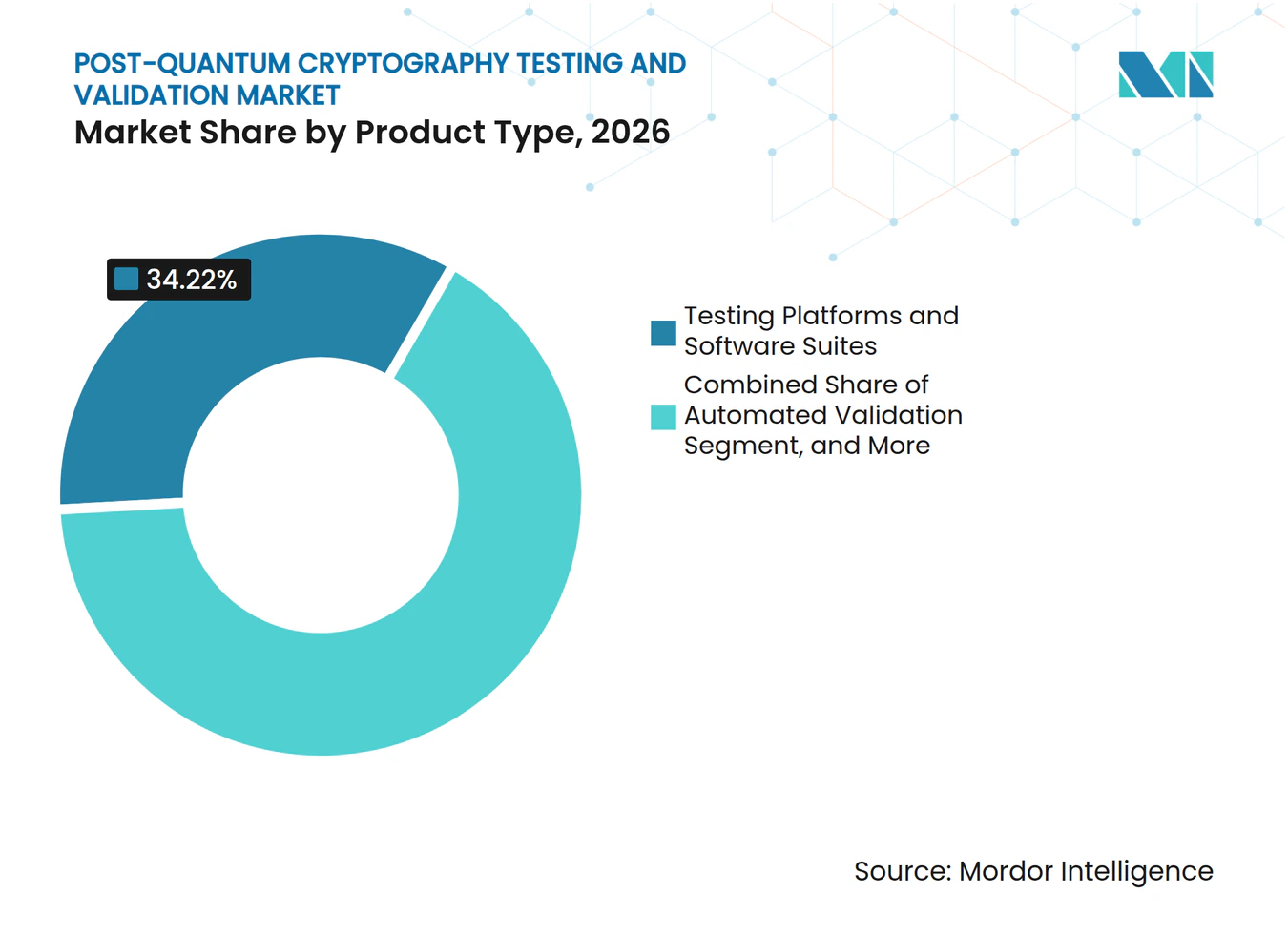
- By product type, Testing Platforms and Software Suites held 34.22% of revenue in the post-quantum cryptography testing and validation market in 2026, while Automated Validation and Conformance Tools are projected to expand at a 27.31% CAGR through 2032.
- By testing and validation modality, Algorithm Correctness Testing held 26.47% of revenue in 2026, while Formal Verification is projected to expand at a 28.52% CAGR through 2032.
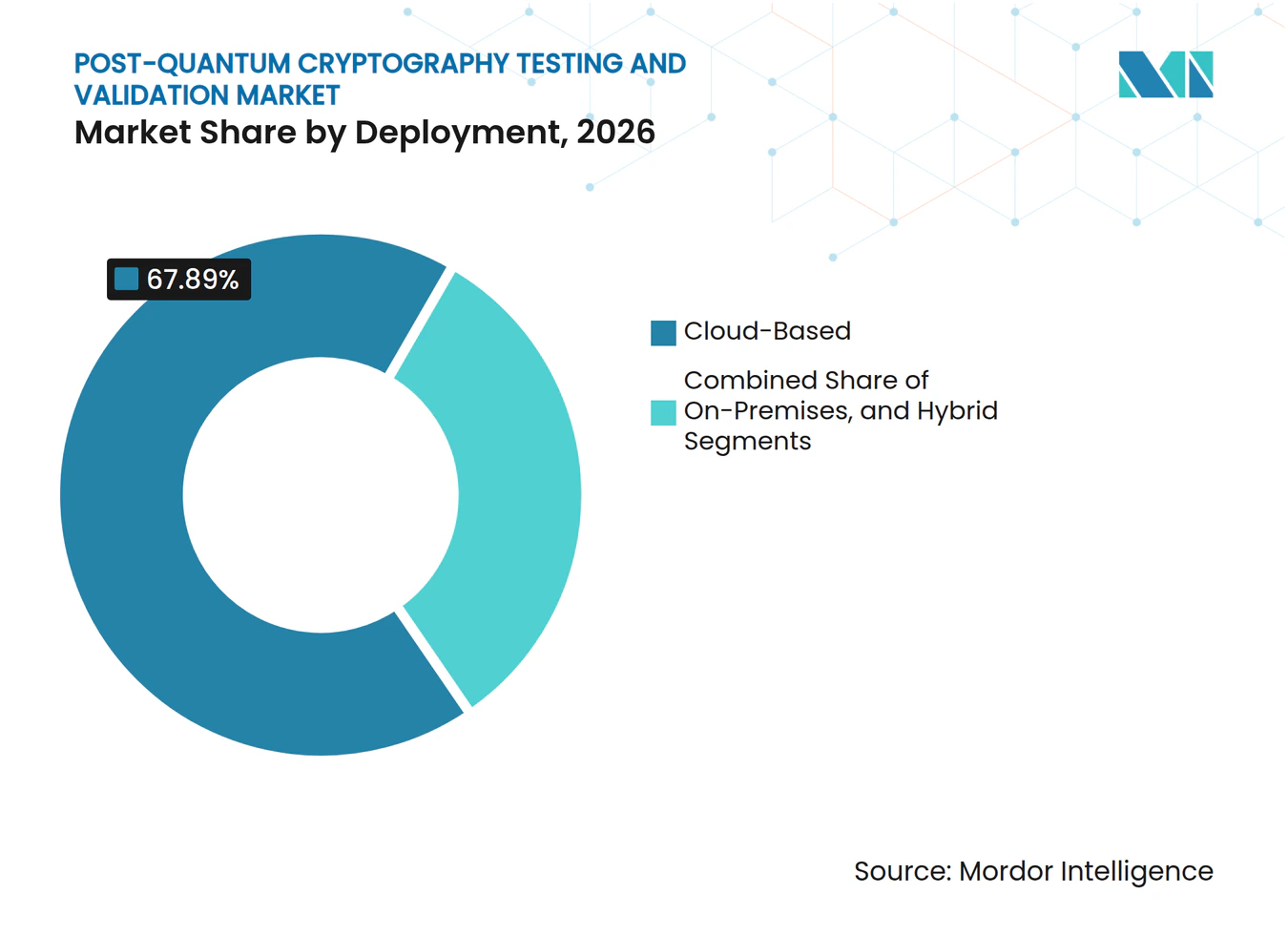
- By deployment environment, cloud-based deployments held 67.89% of revenue in 2026 in the post-quantum cryptography testing and validation market, while hybrid deployments are projected to expand at a 26.81% CAGR through 2032.
- By service type, Testing-as-a-Service held 24.94% of revenue in 2026, while Test Automation and Continuous Validation is projected to expand at a 27.43% CAGR through 2032.
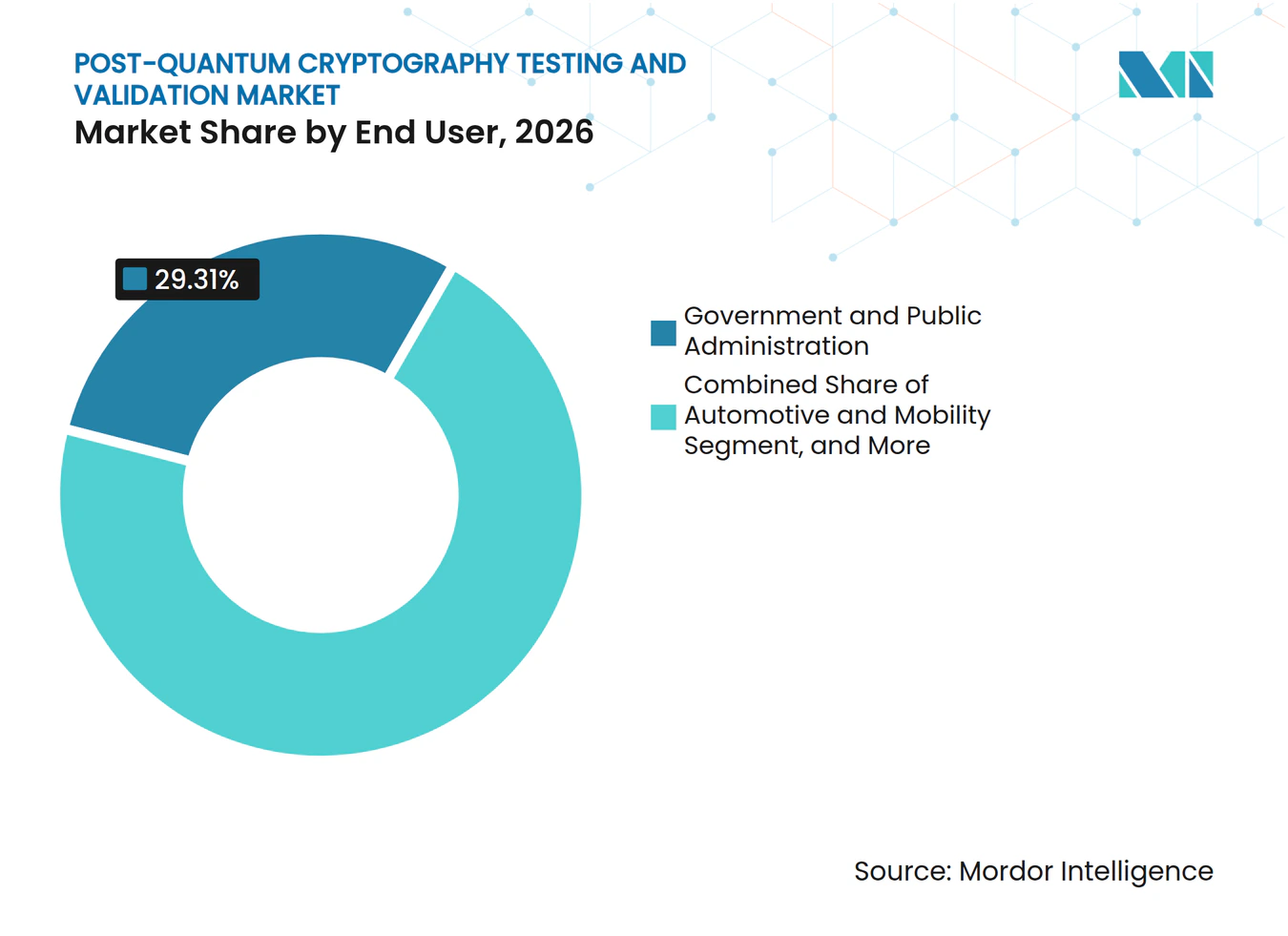
- By end user, Government and Public Administration held 29.31% of revenue in 2026, while Automotive and Mobility is projected to expand at a 28.72% CAGR through 2032.
- By organization size, large enterprises held 68.54% of revenue in 2026, while SMEs are projected to expand at a 27.43% CAGR through 2032.
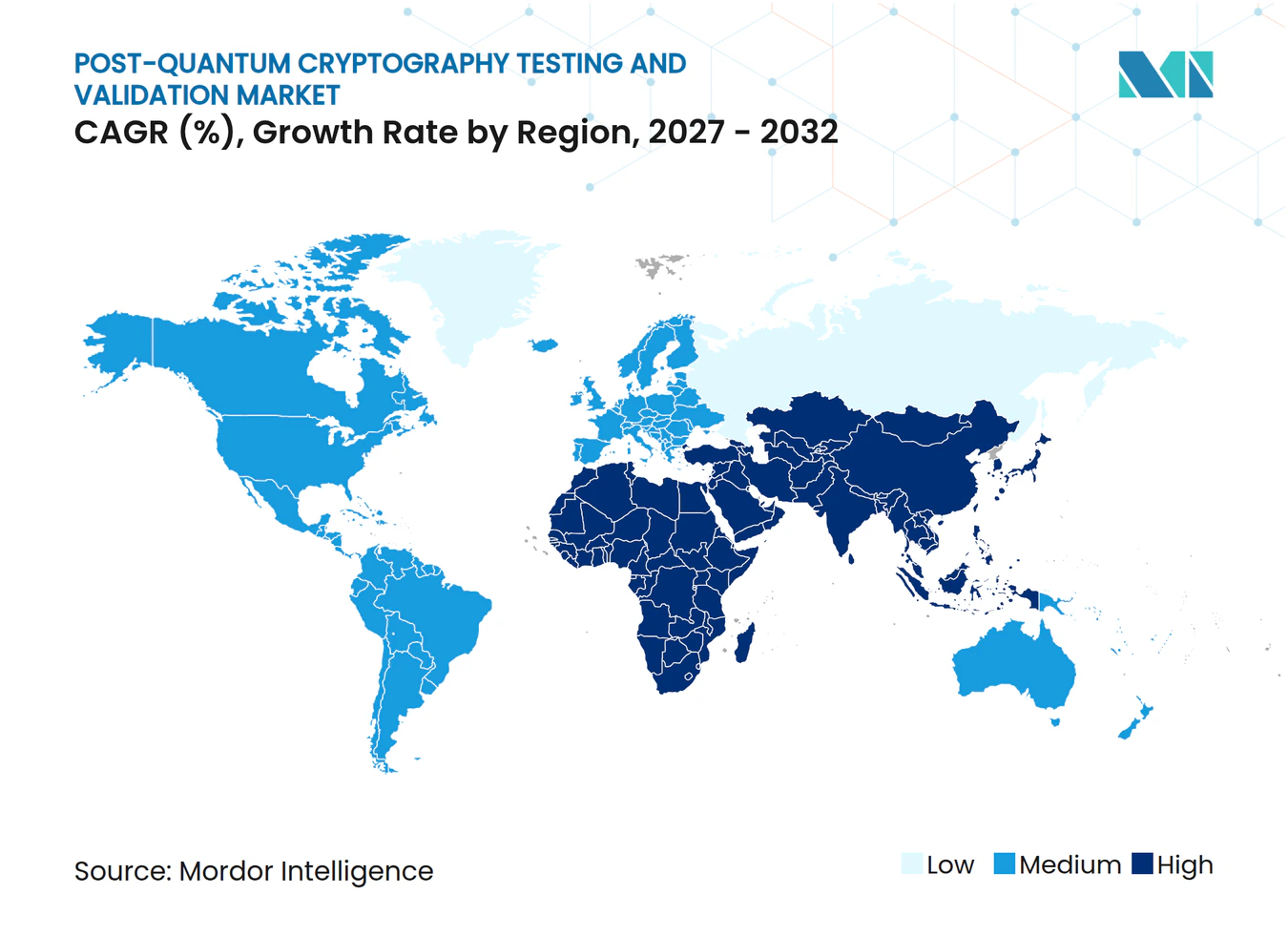
- By geography, North America held 41.64% of revenue in the post-quantum cryptography testing and validation market in 2026, while Asia-Pacific is projected to expand at a 39.28% CAGR through 2032.
Note: Market numbers in this report are based on Mordor Intelligence's proprietary estimation framework, which combines nine months of actuals with Q4 projections for base year 2026.
Market Trends and Insights
Drivers Impact Analysis of Post-Quantum Cryptography Testing and Validation Market*
| Driver | (~) % Impact on CAGR Forecast | Geographic Relevance | Impact Timeline |
|---|---|---|---|
| Government Procurement and Compliance Deadlines | +3.5% | Global, concentrated near-term impact in North America and Europe | Short term (≤ 2 years) |
| Growing Use of NIST-Standardized PQC Algorithms | +2.8% | Global, with spillover to Asia-Pacific, Middle East, and South America | Medium term (2-4 years) |
| Rising Demand for Cryptographic Discovery and Inventory | +2.2% | North America and Europe core, Asia-Pacific accelerating | Short term (≤ 2 years) |
| Expansion of PQC Into Embedded and Long-Lived Devices | +2.0% | Global, with early gains in Germany, Japan, South Korea, and the United States | Medium term (2-4 years) |
| Increasing Adoption of Hybrid Key Establishment | +1.8% | North America and Europe core, with spillover to Middle East and South America | Medium term (2-4 years) |
| Evidence Requirements for Algorithm and Module-Level Claims | +1.5% | Global, strongest in regulated sectors in North America and Europe | Short term (≤ 2 years) |
| Source: Mordor Intelligence | |||
Government Procurement and Compliance Deadlines
Federal procurement deadlines are creating a direct need for independently tested post-quantum implementations. Executive Order 14412 set December 31, 2030, as the deadline for covered contractors to meet applicable NIST FIPS requirements. The order also directed agencies to transition high-value systems to post-quantum key establishment and digital signatures on defined schedules.[1] New commercial National Security Systems must support quantum-resistant algorithms from 2027 under NSA direction. These requirements make test evidence a procurement condition rather than a voluntary security improvement. The post-quantum cryptography testing and validation market benefits as suppliers seek proof of algorithm correctness, interoperability, and module conformance before submitting products for government use.
Growing Use of NIST-Standardized PQC Algorithms
NIST standards provide vendors and buyers with a clearer technical basis for implementation testing. The agency published FIPS 203, FIPS 204, and FIPS 205 in 2024 for key encapsulation, digital signatures, and hash-based signatures, respectively.[2] NIST also selected HQC as a backup key encapsulation mechanism, requiring validation programs to prepare for an additional family of algorithms. Organizations operating across countries may need to test both NIST-aligned and national algorithm stacks. South Korea has developed domestic quantum-resistant algorithms, while China is advancing its own standards framework. This creates demand for flexible platforms in the post-quantum cryptography testing and validation market that can run conformance and interoperability checks across several algorithms.
Rising Demand for Cryptographic Discovery and Inventory
Cryptographic testing begins with an inventory of the algorithms, certificates, libraries, and device dependencies already in use. NIST’s NCCoE places cryptographic discovery at the beginning of its migration-to-PQC work. Executive Order 14412 calls for guidance on Cryptographic Bill of Materials elements that support automated asset assessment. IBM extended Quantum Safe Explorer to LinuxONE in 2025 to help identify cryptographic dependencies in mainframe environments. Inventory work often identifies undocumented or outdated cryptography in firmware, applications, and third-party components. For the post-quantum cryptography testing and validation market, these findings widen the number of implementations that need subsequent testing and remediation.
Expansion of PQC Into Embedded and Long-Lived Devices
Long product lifetimes make early post-quantum design and testing important for connected vehicles, smart cards, and industrial devices. A 2025 SAE technical paper examined the practical deployment of post-quantum algorithms in intravehicular networks. It identified transport constraints created by large cryptographic objects on legacy automotive networks. STMicroelectronics introduced post-quantum software libraries for Stellar automotive microcontrollers in 2025. Infineon received Common Criteria EAL6 certification for an ML-KEM implementation on its TEGRION security controller in 2025. The post-quantum cryptography testing and validation market, therefore, has opportunities in performance, side-channel, interoperability, and certification work for constrained hardware.
Restraints Impact Analysis of Post-Quantum Cryptography Testing and Validation Market*
| Restraint | (~) % Impact on CAGR Forecast | Geographic Relevance | Impact Timeline |
|---|---|---|---|
| High Cost and Scarcity of Specialized Validation Expertise | -1.8% | Global, most acute in Asia-Pacific and South America | Medium term (2-4 years) |
| Performance, Memory, and Bandwidth Overheads of PQC Implementations | -1.2% | Global, most constraining in embedded and Internet of Things device contexts | Medium term (2-4 years) |
| Non-Deterministic Testing Challenges in Production Implementations | -0.9% | Global | Long term (≥ 4 years) |
| Validation Fragmentation Across Algorithms, Platforms, and Operating Environments | -0.8% | Global, most pronounced in multijurisdictional enterprises | Long term (≥ 4 years) |
| Source: Mordor Intelligence | |||
High Cost and Scarcity of Specialized Validation Expertise
Post-quantum migration requires cryptography, product security, and compliance skills that are not widely available. The World Economic Forum has identified a material global shortfall in quantum-skilled talent.[3] This shortage affects organizations that need staff to plan and oversee validation programs. It also affects suppliers that need qualified personnel to develop test methods and support certification submissions. Smaller organizations may defer complex testing if specialist consulting costs remain high. The post-quantum cryptography testing and validation market can address part of this constraint through managed services and reusable automated workflows, but expertise remains essential for high-assurance programs.
Performance, Memory, and Bandwidth Overheads of PQC Implementations
Post-quantum algorithms can impose material processing, memory, and communication overheads when compared with established algorithms. Banque de France reported that Project Leap found meaningful performance differences during testing of quantum-resistant approaches for payment systems. Automotive networks face similar issues where large post-quantum objects must traverse legacy communication links. Organizations in the post-quantum cryptography testing and validation market need repeated testing under realistic loads before they can deploy these algorithms in production. This expands the scope of each project but can delay rollout decisions. It also increases the value of tools that measure latency, throughput, memory use, and operational behavior across target environments.
*Our forecasts treat driver/restraint impacts as directional, not additive. The impact forecasts reflect baseline growth, mix effects, and variable interactions.
Post-Quantum Cryptography Testing and Validation Market Segment Analysis
By Product Type:
Integrated Platforms Establish the Commercial BaselineTesting Platforms and Software Suites accounted for 34.22% of revenue in 2026, making them the central entry point for many formal compliance programs. They combine test-vector execution, algorithm checks, interoperability testing, and performance measurement within a single environment. This reduces coordination work when organizations must validate ML-KEM, ML-DSA, SLH-DSA, and future standards. Keysight introduced its Next-Generation Embedded Security Testbench in April 2025 for security evaluation workflows. It later introduced the APS-ONE-400 platform for high-volume network cybersecurity testing in 2026. The post-quantum cryptography testing and validation market size for this segment reflects demand for integrated environments that reduce execution complexity. Buyers favor platforms that can preserve test records and connect results to development and assurance activities.
Automated Validation and Conformance Tools are projected to expand at a 27.31% CAGR through 2032. Their role is growing as software teams embed cryptographic checks into continuous integration and release processes. Executive Order 14412 directed work to improve the speed of cryptographic module validation processes. This can increase demand for tools that reduce repetitive engineering work before submissions. Within the post-quantum cryptography testing and validation market, Hardware Security Module and Secure Element Test Solutions remain necessary where keys and algorithms operate in dedicated hardware. Side-channel analysis and fault-injection tools support evaluation of implementation security beyond functional correctness. Secure-IC positions its Analyzr platform for security evaluation of post-quantum implementations. These specialized systems serve a narrower customer base, but they are important for high-assurance hardware programs. The post-quantum cryptography testing and validation industry increasingly requires integrated records that support technical and procurement review.



By Testing and Validation Modality:
Formal Verification Gains Importance in High-Assurance EnvironmentsAlgorithm Correctness Testing accounted for 26.47% of revenue in 2026 because it is the first requirement in a structured validation program. Organizations must establish that an implementation produces expected results before pursuing deeper performance or security testing. Interoperability Testing then assesses whether systems exchange protected information correctly across software, hardware, and network environments. Performance and benchmark testing measure whether implementations meet application requirements under expected operating loads. Fuzz Testing provides additional assurance by exposing malformed inputs and unexpected execution paths. A 2025 IACR paper showed how verifiable decapsulation methods can identify faulty post-quantum KEM implementations. The post-quantum cryptography testing and validation market uses these modalities together because evidence from one does not replace evidence from another.
Formal Verification is projected to expand at a 28.52% CAGR through 2032, the highest rate among testing modalities. It is especially relevant when users of defense, financial, and critical infrastructure need machine-checked proofs of specific security properties. PQShield published work on formally verified implementations using EasyCrypt and circuit-based reasoning. Amazon also described formal verification and optimization work for post-quantum cryptography within AWS. Formal methods can reduce confidence gaps that remain after test-vector execution alone. Adoption remains limited by the availability of specialists who understand proof tools and implementation engineering. Reusable proof frameworks may make formal verification more accessible over time. This part of the post-quantum cryptography testing and validation market brings cryptographic research more closely into line with operational software assurance.
By Deployment:
Cloud Leads, While Hybrid Supports Regulated WorkloadsCloud-based deployments accounted for 67.89% of revenue in 2026, reflecting the scale and accessibility of cloud-delivered testing. Cloud-native applications are a major location for certificates, key exchange, and encrypted service traffic. Google Cloud made quantum-safe digital signatures available in Cloud KMS in 2025. Microsoft launched a post-quantum TLS pilot program for certificate authorities in 2026. AWS has described support for ML-KEM post-quantum TLS in several managed services.[4] The post-quantum cryptography testing and validation market share held by cloud environments shows how hosted tools reduce infrastructure barriers for mid-sized users.
Hybrid deployments are projected to expand at a 26.81% CAGR through 2032 as organizations preserve local control over sensitive cryptographic operations. Banks, defense organizations, and public bodies may require that key material and selected operations remain within controlled infrastructure. Hybrid architectures use local hardware security modules and systems while employing cloud platforms for reporting, collaboration, or scalable testing. This model also supports staged migrations when legacy assets cannot be fully migrated to public cloud environments. The post-quantum cryptography testing and validation market requires testing that confirms behavior across local and hosted components, rather than treating them as separate systems. Interoperability failures in network controls may only become apparent during end-to-end trials. On-premises systems remain relevant for air-gapped national security applications. Their higher maintenance burden limits broad adoption but sustains demand for dedicated validation capabilities.

By Service Type:
Inventory and Automation Extend the Testing PipelineTesting-as-a-Service accounted for 24.94% of revenue in 2026 and supports organizations without in-house cryptographic teams. Service providers can supply specialist support, managed testing processes, and documentation for validation activities. Migration readiness assessments establish priorities before organizations commit to detailed remediation work. Cryptographic inventory and discovery services identify vulnerable algorithms, certificate populations, and code dependencies. DigiCert reported in 2026 that many organizations were planning or testing post-quantum initiatives, while broad deployment remained limited. This implementation gap provides a clear opening for readiness assessments and managed validation. The post-quantum cryptography testing and validation market benefits when discovery engagements lead to remediation and formal testing work.
Test Automation and Continuous Validation are projected to expand at a 27.43% CAGR through 2032. Organizations are moving from isolated certification events toward repeated assurance across development cycles. Automated regression checks can identify when software changes affect cryptographic behavior or configuration. QuSecure introduced QuProtect R3 in 2025 with capabilities covering discovery, resilience, and reporting. Independent validation and certification support also remain important because module submissions can involve long queues and detailed evidence requirements. Architecture and code reviews can find dependencies that automated discovery misses. These services complement, rather than replace, automated tools. Across the post-quantum cryptography testing and validation market, they help customers establish repeatable control over transition programs.
By End User:
Government Provides the Base, While Automotive Gains MomentumGovernment and Public Administration accounted for 29.31% of revenue in 2026, supported by defined mandates from national security and civilian agencies. Federal migration plans, procurement changes, and requirements for validated cryptography create early demand for discovery and testing. The NSA has confirmed its approach for transitioning National Security Systems to quantum-resistant algorithms. Financial services is another major adoption group because secure transactions, certificates, and key management are central to operations. Healthcare, energy, utilities, telecommunications, and information technology are at earlier stages of adoption. Medical-device procurement can include cryptographic inventory and implementation security as acceptance criteria. Government programs are, therefore, important reference cases for commercial buyers in the post-quantum cryptography testing and validation market.
Automotive and Mobility is projected to expand at a 28.72% CAGR through 2032. Software-defined vehicles require cryptographic agility for secure boot, signed firmware updates, and vehicle-to-everything communications. In 2026, NXP stated that automotive manufacturers had begun post-quantum implementation programs for future vehicle platforms. These programs require testing across controllers with varied processing capacity and long support periods. Automotive suppliers must validate that cryptographic changes fit safety, performance, and cybersecurity requirements. Connected infrastructure introduces another layer of interoperability beyond the vehicle itself. Semiconductor vendors are providing building blocks, but vehicle manufacturers and tier suppliers still need evidence for their specific implementations. This makes automotive a substantial demand area within the post-quantum cryptography testing and validation market.
By Organization Size:
Large Enterprises Lead, and SMEs Use Hosted ServicesLarge enterprises accounted for 68.54% of revenue in 2026 because their cryptographic estates are large and diverse. They often manage extensive certificate inventories, several cryptographic libraries, numerous applications, and multicloud environments. This complexity makes manual discovery and validation impractical. IBM’s Quantum Safe Explorer for LinuxONE supports cryptographic visibility and Cryptographic Bill of Materials outputs for enterprise systems. Entrust received CAVP certification for several post-quantum algorithms in nShield 5 hardware security modules during 2025.[5] Utimaco also announced successful NIST testing for algorithms in its Quantum Protect offering. These examples show why large organizations are active buyers of formal validation support in the post-quantum cryptography testing and validation market.
SMEs are projected to expand at a 27.43% CAGR through 2032 as supply-chain and regulatory requirements spread. Smaller businesses with custom software can face the same transition milestones as larger customers. The UK National Cyber Security Center has provided timelines for organizations preparing their migration to post-quantum cryptography. Prime contractors may also require suppliers to demonstrate readiness before participating in sensitive work. Cloud-based Testing-as-a-Service helps remove the capital cost of building an internal laboratory. Providers can package discovery, assessment, testing, and reporting into an accessible service model. SMEs still face resource constraints, especially when specialized software requires tailored remediation. Their participation expands the addressable customer base for the post-quantum cryptography testing and validation market.
Geography Analysis
North America Post-Quantum Cryptography Testing and Validation Market
North America held 41.64% of revenue in 2026, the largest regional position in the post-quantum cryptography testing and validation market. The United States has the most concentrated set of binding national security, civilian agency, and federal contractor requirements. Executive Order 14412 links technical transition work to procurement and compliance obligations for covered federal contractors. The NSA’s direction for National Security Systems creates further demand for validated implementations. QuSecure received an AFWERX contract in 2026 for post-quantum encryption capabilities for US Air Force missions. Canada is also aligning guidance with NIST-led transition activity. The combination of policy, defense procurement, and mature security spending supports early regional demand.
Europe Post-Quantum Cryptography Testing and Validation Market
Europe is the second-largest regional market, with Germany, France, the United Kingdom, and the Netherlands as important demand centers. Germany’s BSI set post-quantum transition timelines for classified IT products in 2025.[6] France’s ANSSI provides guidance on post-quantum cryptography and national evaluation requirements. Thales introduced a certified quantum-age smart card for European customers during 2025. European customers often require control over cryptographic operations and evidence that aligns with national assurance frameworks. This supports demand for hybrid testing environments, evaluation laboratories, and strong documentation.
APAC, South America and Africa Post-Quantum Cryptography Testing and Validation Market
Asia-Pacific is projected to expand at a 39.28% CAGR through 2032, the highest regional rate. South Korea is building national capabilities through research programs, certification activity, and public initiatives. The Ministry of Science and ICT announced expanded support for post-quantum cryptography in 2026. Japan has advanced security verification work for HQC through KDDI Research. China is progressing national standards, which can require localized testing approaches for domestic deployments. Asia-Pacific demand in the post-quantum cryptography testing and validation market is also supported by semiconductor manufacturing, automotive production, telecommunications investment, and financial-sector modernization. Africa and South America remain earlier-stage regions, though cross-regional financial pilots indicate the formation of structured testing programs.
Competitive Landscape
Market Concentration
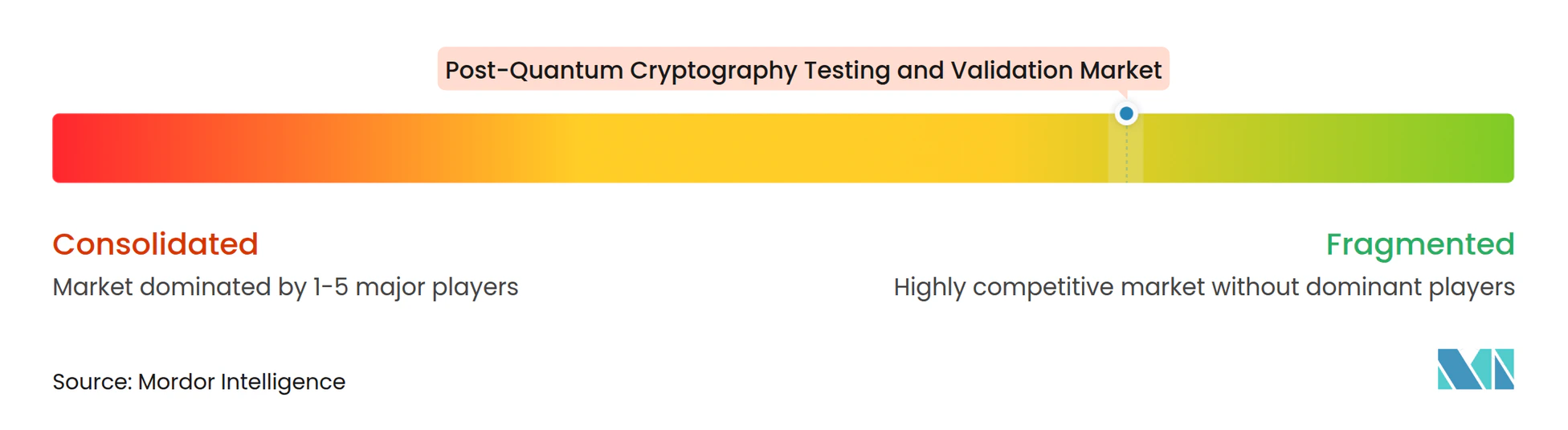
The post-quantum cryptography testing and validation market is fragmented across equipment suppliers, semiconductor security firms, cryptographic software providers, hardware security module vendors, and cloud platforms. Keysight and Riscure address test and measurement requirements. Infineon, NXP Semiconductors, and Rambus provide security components that create downstream validation needs. Thales, Entrust, Utimaco, PQShield, and DigiCert offer cryptographic software, hardware security, or certificate management capabilities. AWS, Google Cloud, and Microsoft are embedding post-quantum capabilities within managed services. QuSecure, Crypto4A Technologies, and CryptoNext Security focus on specialized post-quantum security offerings. This structure means customers frequently use several suppliers across discovery, development, hardware assurance, and deployment.
Competitive strategies are separating into platform integration and specialist depth. Google Cloud introduced quantum-safe digital signatures in Cloud KMS during 2025. Microsoft’s 2026 PQC TLS pilot gives certificate authorities a setting to test authentication interoperability. AWS has integrated ML-KEM support in selected services and described its formal verification work. These providers can place testing features close to existing cloud workloads. In the post-quantum cryptography testing and validation market, specialist providers compete through certification knowledge, laboratory relationships, and security testing depth. QuSecure’s collaboration with NIST’s NCCoE illustrates the value of direct engagement with migration programs.
Hardware certification is becoming an important competitive marker. Thales TCT received FIPS 140-3 Level 3 validation in 2026 for an HSM implementation covering ML-DSA, ML-KEM, and Leighton-Micali Signature. Infineon’s 2025 Common Criteria certification established another reference point for post-quantum implementation assurance. Entrust and Utimaco also announced validation milestones for post-quantum algorithm support. A gap remains between formal verification, automated evidence collection, and module certification submission processes. Providers that reduce this coordination burden can create a defensible position. Market concentration score is 3 out of 10 because no leading supplier has a disclosed dominant combined share, and customers draw on a broad set of specialized vendors.
Post-Quantum Cryptography Testing and Validation Industry Leaders
-
Keysight Technologies, Inc.
-
Synopsys, Inc.
-
Rohde & Schwarz GmbH & Co. KG
-
National Instruments Corporation
-
IBM Corporation
- *Disclaimer: Major Players sorted in no particular order
Post-Quantum Cryptography Testing and Validation Market Companies Covered in this Report
- Keysight Technologies, Inc.
- Synopsys, Inc.
- Rohde & Schwarz GmbH & Co. KG
- National Instruments Corporation
- IBM Corporation
- Microsoft Corporation
- Amazon Web Services, Inc.
- Google LLC
- Thales Group
- Entrust Corporation
- NXP Semiconductors N.V.
- Infineon Technologies AG
- PQShield Ltd.
- CryptoNext Security
- QuSecure, Inc.
- ISARA Corporation
- Keyfactor, Inc.
- DigiCert, Inc.
- Crypto4A Technologies Inc.
- Riscure B.V.
- Utimaco GmbH
- SafeLogic Inc.
- Crypto Quantique Ltd.
- Rambus Inc.
- Hewlett Packard Enterprise Company
Recent Industry Developments in Post-Quantum Cryptography Testing and Validation Market
- August 2026: Thales TCT received FIPS 140-3 Level 3 validation for Luna T-Series HSM firmware version 7.15.1, covering ML-DSA, ML-KEM, and Leighton-Micali Signature algorithms, making it the first PQC-enabled HSM manufactured in the US to achieve FIPS 140-3 Level 3 validation and the first to include all NSA CNSA Suite 2.0 PQC algorithms within a single module certificate.
- August 2026: Microsoft launched its PQC TLS Pilot Program on August 27, 2026, providing eligible certificate authorities in the Microsoft Trusted Root Program with a structured environment to test post-quantum authentication interoperability, the pilot continues with rolling admissions through end-2026.
- July 2026: DigiCert launched Quantum Central on July 1, 2026, a cryptographic discovery, risk prioritization, and migration tracking solution within the DigiCert ONE portfolio, available as a free preview to organizations beginning PQC readiness programs, integrating with Jira for structured change management.
- July 2026: Keysight Technologies launched the APS-ONE-400, a modular 4x100GE network cybersecurity test platform supporting PQC-encrypted TLS throughput testing, security strike generation, and ZTNA validation within a compact 1RU footprint, targeting network equipment manufacturers and data center operators validating PQC-encrypted traffic under production-scale conditions.
Global Post-Quantum Cryptography Testing and Validation Market Report Scope
The post-quantum cryptography testing and validation market comprises revenue generated from tools and services used to assess the correctness, security, interoperability, performance, and compliance of PQC implementations before and after deployment. It includes algorithm correctness and known-answer testing, interoperability testing, performance benchmarking, formal verification, fuzz testing, side-channel and fault-injection testing, and certification-readiness support. Testing and validation are essential because PQC algorithms can introduce different performance, key-size, protocol, and implementation-security requirements.
The Post-Quantum Cryptography Testing And Validation Market Report is Segmented by Product Type (Testing Platforms and Software Suites, Automated Validation and Conformance Tools, Side-Channel Analysis and Fault-Injection Equipment, PQC Test Libraries and Reference Implementations, and Hardware Security Module and Secure Element Test Solutions), Testing and Validation Modality (Algorithm Correctness Testing, Interoperability Testing, Performance and Benchmark Testing, Formal Verification, Fuzz Testing, and Other Testing and Validation Modalities), Deployment (Cloud-Based, On-Premises, and Hybrid), Service Type (Testing-as-a-Service, Independent Validation and Certification Support, Migration Readiness Assessment, Cryptographic Inventory and Discovery, Architecture and Code Review, Test Automation and Continuous Validation, and Other Service Types), End User (Government and Public Administration, Banking, Financial Services and Insurance, Telecommunications and Information Technology, Healthcare and Life Sciences, Energy and Utilities, Automotive and Mobility, and Other End Users), Organization Size (Large Enterprises, and Small and Medium Enterprises), and Geography (North America, Europe, Asia-Pacific, Middle East, Africa, and South America). The Market Forecasts are Provided in Terms of Value (USD).
Segmentation Overview
| Testing Platforms and Software Suites |
| Automated Validation and Conformance Tools |
| Side-Channel Analysis and Fault-Injection Equipment |
| PQC Test Libraries and Reference Implementations |
| Hardware Security Module and Secure Element Test Solutions |
| Algorithm Correctness Testing |
| Interoperability Testing |
| Performance and Benchmark Testing |
| Formal Verification |
| Fuzz Testing |
| Other Testing and Validation Modalities |
| Cloud-Based |
| On-Premises |
| Hybrid |
| Testing-as-a-Service |
| Independent Validation and Certification Support |
| Migration Readiness Assessment |
| Cryptographic Inventory and Discovery |
| Architecture and Code Review |
| Test Automation and Continuous Validation |
| Other Service Types |
| Government and Public Administration |
| Banking, Financial Services and Insurance |
| Telecommunications and Information Technology |
| Healthcare and Life Sciences |
| Energy and Utilities |
| Automotive and Mobility |
| Other End Users |
| Large Enterprises |
| Small and Medium Enterprises |
| North America | United States |
| Canada | |
| Europe | United Kingdom |
| Germany | |
| France | |
| Netherlands | |
| Rest of Europe | |
| Asia-Pacific | China |
| Japan | |
| India | |
| South Korea | |
| Singapore | |
| Australia | |
| Rest of Asia-Pacific | |
| Middle East | Israel |
| Saudi Arabia | |
| United Arab Emirates | |
| Turkey | |
| Rest of Middle East | |
| Africa | South Africa |
| Egypt | |
| Rest of Africa | |
| South America | Brazil |
| Argentina | |
| Rest of South America |
| By Product Type | Testing Platforms and Software Suites | |
| Automated Validation and Conformance Tools | ||
| Side-Channel Analysis and Fault-Injection Equipment | ||
| PQC Test Libraries and Reference Implementations | ||
| Hardware Security Module and Secure Element Test Solutions | ||
| By Testing and Validation Modality | Algorithm Correctness Testing | |
| Interoperability Testing | ||
| Performance and Benchmark Testing | ||
| Formal Verification | ||
| Fuzz Testing | ||
| Other Testing and Validation Modalities | ||
| By Deployment | Cloud-Based | |
| On-Premises | ||
| Hybrid | ||
| By Service Type | Testing-as-a-Service | |
| Independent Validation and Certification Support | ||
| Migration Readiness Assessment | ||
| Cryptographic Inventory and Discovery | ||
| Architecture and Code Review | ||
| Test Automation and Continuous Validation | ||
| Other Service Types | ||
| By End User | Government and Public Administration | |
| Banking, Financial Services and Insurance | ||
| Telecommunications and Information Technology | ||
| Healthcare and Life Sciences | ||
| Energy and Utilities | ||
| Automotive and Mobility | ||
| Other End Users | ||
| By Organization Size | Large Enterprises | |
| Small and Medium Enterprises | ||
| By Geography | North America | United States |
| Canada | ||
| Europe | United Kingdom | |
| Germany | ||
| France | ||
| Netherlands | ||
| Rest of Europe | ||
| Asia-Pacific | China | |
| Japan | ||
| India | ||
| South Korea | ||
| Singapore | ||
| Australia | ||
| Rest of Asia-Pacific | ||
| Middle East | Israel | |
| Saudi Arabia | ||
| United Arab Emirates | ||
| Turkey | ||
| Rest of Middle East | ||
| Africa | South Africa | |
| Egypt | ||
| Rest of Africa | ||
| South America | Brazil | |
| Argentina | ||
| Rest of South America | ||
Key Questions Answered in the Report
What is the post-quantum cryptography testing and validation market size?
The post-quantum cryptography testing and validation market size is projected to expand from USD 0.26 billion in 2026 to USD 0.33 billion in 2027, and to USD 1.02 billion by 2032, registering a CAGR of 25.32% between 2027 and 2032.
Why do organizations need post-quantum cryptography testing?
Testing provides evidence of algorithm correctness, implementation security, interoperability, and performance before production deployment or regulated procurement.
Which deployment model leads post-quantum validation activity?
Cloud-based deployments hold 67.89% of revenue in 2026 because hosted environments reduce infrastructure barriers and align with cloud-native workloads.
Which end user is expected to expand fastest through 2032?
Automotive and Mobility is projected to expand at a 28.72% CAGR as connected vehicles require secure boot, signed updates, and vehicle-to-everything authentication.
Why is formal verification becoming more relevant for cryptography?
Formal verification is projected to expand at a 28.52% CAGR because high-assurance users require machine-checked evidence beyond test-vector results.
Which region is expected to expand fastest?
Asia-Pacific is projected to expand at a 39.28% CAGR through 2032 as national programs and certification activity progress into procurement and implementation.