
Post-Quantum Cryptography Migration Services Market Size and Share
Market Overview
| Study Period | 2021 - 2032 |
|---|---|
| Market Size (2027) | USD 0.81 Billion |
| Market Size (2032) | USD 2.92 Billion |
| Growth Rate (2027 - 2032) | 29.23 % |
| Fastest Growing Market | Asia-Pacific |
| Largest Market | North America |
| Market Concentration | Low |
Major Players *Disclaimer: Major Players sorted in no particular order Image © Mordor Intelligence. Reuse requires attribution under CC BY 4.0. | |
Post-Quantum Cryptography Migration Services Market Analysis by Mordor Intelligence
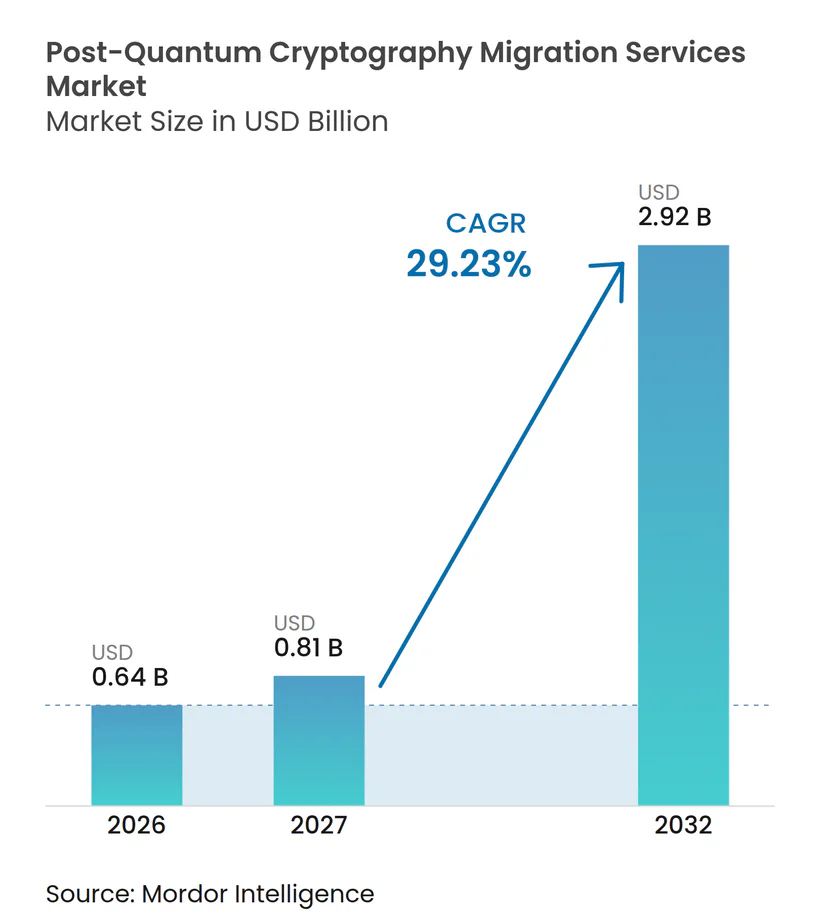
The post-quantum cryptography migration services market size is projected to expand from USD 0.64 billion in 2026 and USD 0.81 billion in 2027 to USD 2.92 billion by 2032, registering a CAGR of 29.23% between 2027 to 2032. Binding government schedules, standardized algorithms, and concern over long-lived encrypted data are moving quantum-safe work from preparation into operational programs. Organizations are increasingly treating cryptographic exposure as a current security and compliance issue because encrypted information collected today may be attacked later. Service providers are responding with discovery tools, crypto-agility capabilities, and validated hardware integrations that support staged transitions. The post-quantum cryptography migration services market also benefits from a widening procurement base, since public-sector rules can extend to contractors and technology suppliers. This creates opportunities for providers that can link inventory, governance, remediation, and managed operations in a single engagement.
Key Report Takeaways
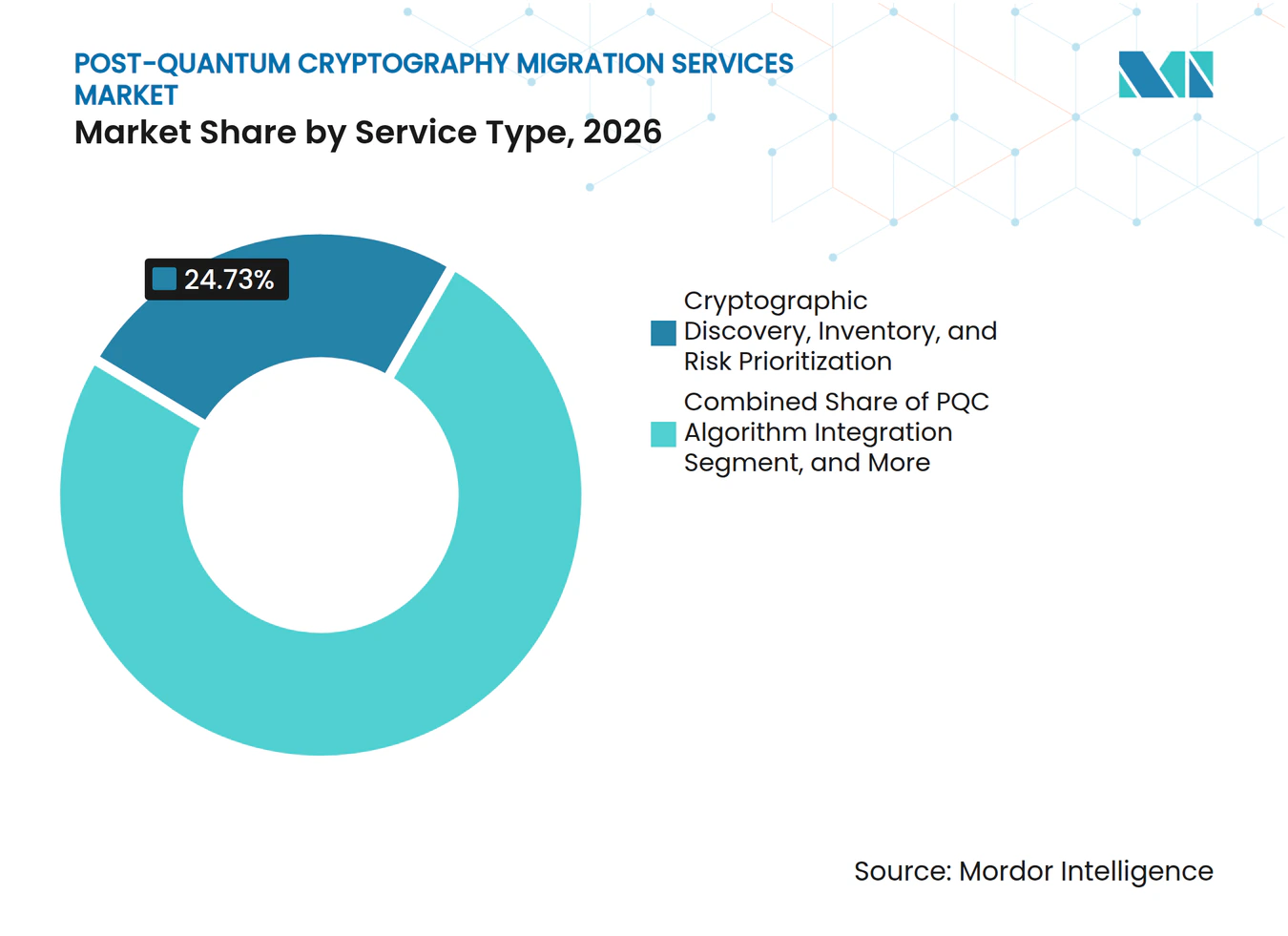
- By service type, Cryptographic Discovery, Inventory, and Risk Prioritization held 24.73% of the post-quantum cryptography migration services market share in 2026, while PQC Algorithm Integration and Remediation is projected to expand at a 31.28% CAGR through 2032.
- By migration target, Applications and Source Code accounted for 27.41% of the post-quantum cryptography migration services market size in 2026, while PKI, Certificates, and Digital Identity is expected to expand at a 32.76% CAGR through 2032.
- By deployment model, cloud-based delivery commanded a 64.89% share in the post-quantum cryptography migration services market in 2026 and is projected to expand at a 30.94% CAGR through 2032.
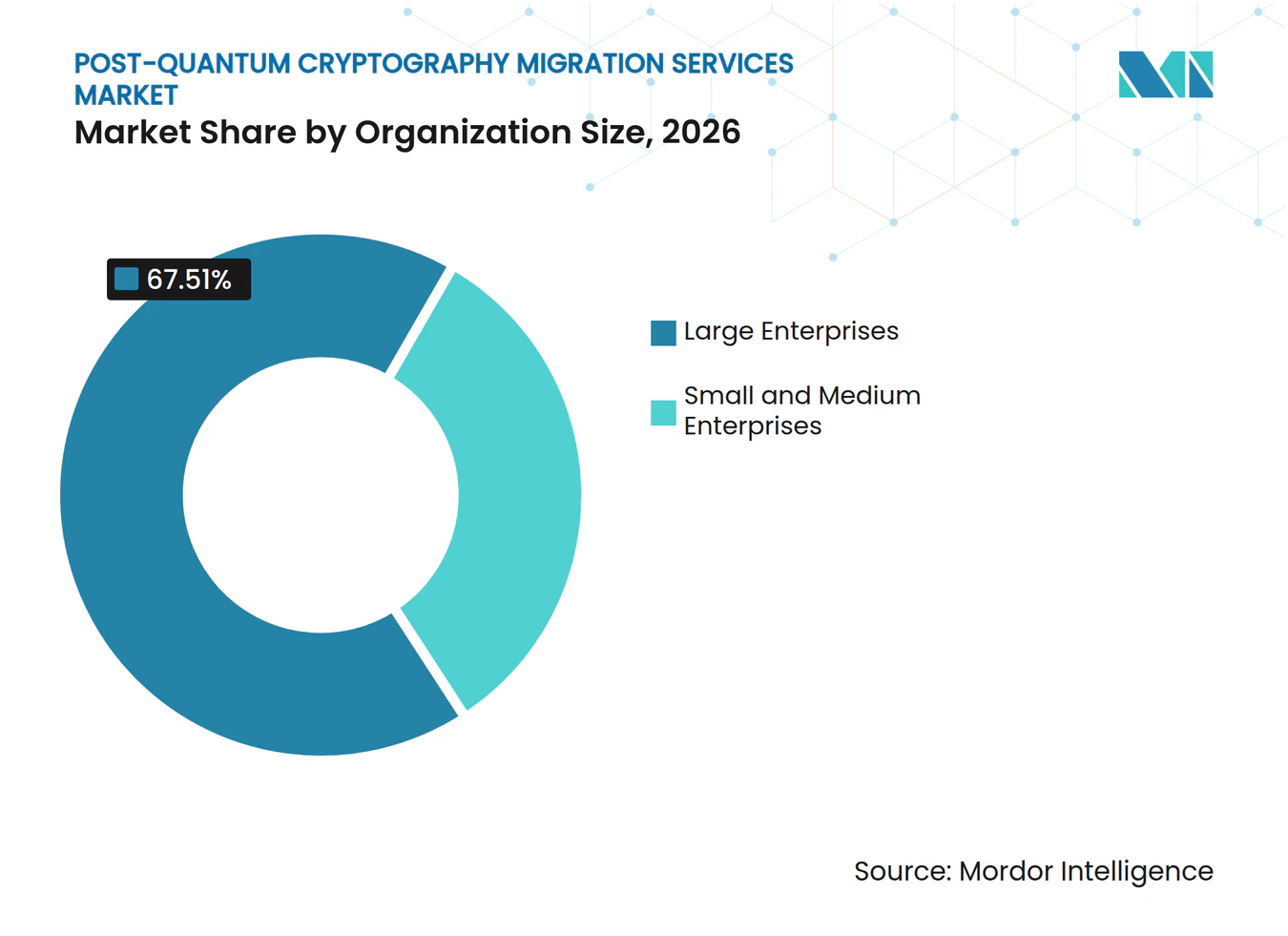
- By organization size, Large Enterprises held 67.51% share in 2026, while Small and Medium-Sized Enterprises are projected to expand at a 31.43% CAGR through 2032.
- By end-use industry, BFSI held 34.28% share in 2026, while Government and Public Administration is projected to expand at a 33.61% CAGR through 2032.
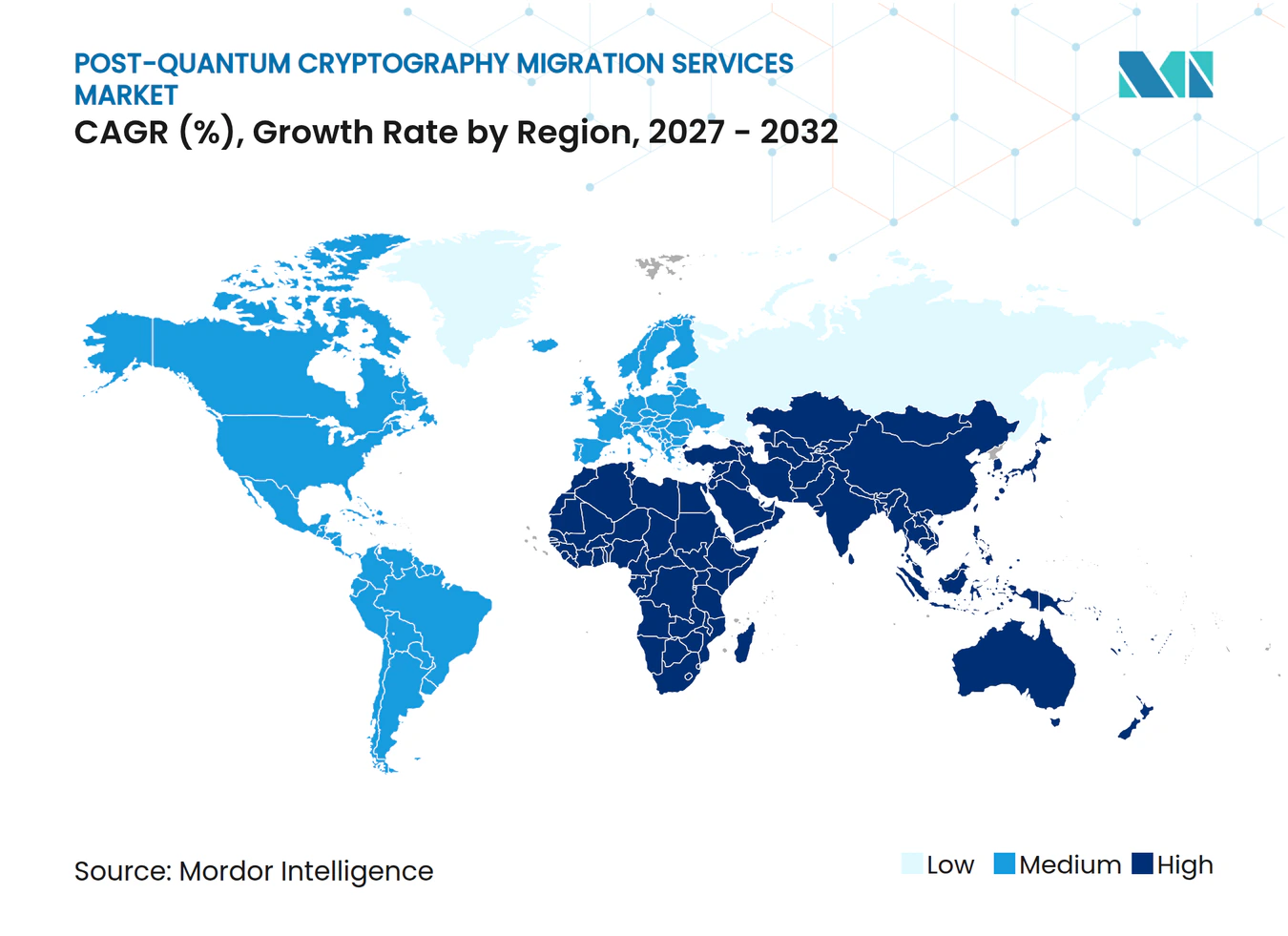
- By geography, North America held 41.67% share in 2026 in the post-quantum cryptography migration services market, while Asia-Pacific is projected to expand at a 32.94% CAGR through 2032.
Note: Market numbers in this report are based on Mordor Intelligence's proprietary estimation framework, which combines nine months of actuals with Q4 projections for base year 2026.
Market Trends and Insights
Drivers Impact Analysis of Post-Quantum Cryptography Migration Services Market*
| Driver | (~) % Impact on CAGR Forecast | Geographic Relevance | Impact Timeline |
|---|---|---|---|
| Finalization of NIST PQC Standards and Government Migration Timelines | +8.0% | Global, with strongest pull in North America and Europe | Short term (≤ 2 years) |
| Harvest-Now-Decrypt-Later Risk for Long-Lived Sensitive Data | +6.5% | Global, pronounced in BFSI, defense, and healthcare | Short term (≤ 2 years) |
| Cryptographic Debt Across Cloud, PKI, and Distributed Applications | +4.5% | North America and Europe, with spillover to Asia-Pacific | Medium term (2-4 years) |
| Expansion of Digital Identity, Payments, and Connected Infrastructure | +3.5% | Global, with Asia-Pacific and Europe expanding rapidly | Medium term (2-4 years) |
| Cryptographic Bill of Materials and Continuous Discovery Adoption | +3.0% | North America and Europe, with early enterprise adoption in Asia-Pacific | Short term (≤ 2 years) |
| Supplier-Level Cryptography Visibility as a Procurement Requirement | +2.0% | Global, with strongest enforcement in United States federal supply chains | Long term (≥ 4 years) |
| Source: Mordor Intelligence | |||
Finalization of NIST PQC Standards and Government Migration Timelines
NIST finalized FIPS 203 for ML-KEM, FIPS 204 for ML-DSA, and FIPS 205 for SLH-DSA, giving organizations a defined baseline for migration planning. NIST also selected HQC as a candidate for additional standardization in March 2025. These standards allow security teams to replace general planning with testing, architecture decisions, and supplier selection. The European Commission's coordinated roadmap calls for member states to begin the transition by the end of 2026 and complete transitions for high-risk use cases by 2030.[1] The post-quantum cryptography migration services market is therefore driven by a shift from optional readiness activities to programs requiring documented milestones. Contractors and suppliers can also be drawn into the work when public procurement requirements make quantum-safe capability a condition of participation.
Harvest-Now-Decrypt-Later Risk for Long-Lived Sensitive Data
Harvest-now-decrypt-later risk arises when an adversary stores encrypted traffic or data now and waits for a future capability to break the underlying public-key protection. Europol has urged financial services organizations to prioritize post-quantum migration activity because the risk applies to data with long confidentiality requirements. A Federal Reserve paper examined this risk in distributed ledger networks and noted that later decryption can permanently expose previously recorded information. Financial institutions, health care organizations, and public bodies face greater exposure where records must remain confidential for many years. This condition makes cryptographic inventory and data classification central parts of the post-quantum cryptography migration services market. It also favors migration sequencing that first protects data with the longest confidentiality life.
Cryptographic Debt Across Cloud, PKI, and Distributed Applications
Many enterprises have cryptographic dependencies across software libraries, container images, CI/CD processes, PKI hierarchies, APIs, and cloud services. The OWASP Quantum Security Project identifies the absence of a cryptographic inventory and a Cryptographic Bill of Materials as a major obstacle to a successful transition.[2] Cloud-native systems can make dependencies difficult to see because applications are split across many services and external platforms. Discovery programs often need to cover source repositories, certificate authorities, HSMs, key management systems, and network endpoints. These findings can lead to a longer remediation program as hidden dependencies and third-party constraints become clear. The post-quantum cryptography migration services market sees recurring demand, with customers needing continuous monitoring rather than a one-time inventory.
Expansion of Digital Identity, Payments, and Connected Infrastructure
Digital identities, payment authentication, connected devices, and machine credentials rely on public-key cryptography at a large scale. The Bank for International Settlements has used Project Leap to examine the quantum resilience of payment systems. Payment networks and identity platforms must maintain trust as they change certificates, keys, and authentication flows. Non-human identities, such as API tokens, machine certificates, and device keys, are also expanding the number of assets requiring oversight. This raises demand for services that combine certificate lifecycle management with algorithm migration and policy controls. Providers in the post-quantum cryptography migration services market can address this need by connecting discovery data to deployment and validation work.
Restraints Impact Analysis of Post-Quantum Cryptography Migration Services Market*
| Restraint | (~) % Impact on CAGR Forecast | Geographic Relevance | Impact Timeline |
|---|---|---|---|
| Shortage of Specialized PQC Engineering and Migration Talent | -3.5% | Global, most acute in North America and Europe | Short term (≤ 2 years) |
| Legacy Dependencies and Interoperability Constraints | -2.5% | Global, most severe in large enterprises with mainframe and embedded system estates | Medium term (2-4 years) |
| Larger Keys, Signatures, and Protocol Messages Increase Performance Burden | -1.5% | Global, most acute in resource-constrained and latency-sensitive environments | Medium term (2-4 years) |
| Unclear Accountability for Cryptography Embedded in Third-Party and Open-Source Components | -1.0% | Global | Long term (≥ 4 years) |
| Source: Mordor Intelligence | |||
Shortage of Specialized PQC Engineering and Migration Talent
The number of professionals capable of executing post-quantum migration in large, complex environments remains limited. Financial services institutions have reported both insufficient specialized skills and unclear internal ownership of cryptographic transition programs.[3] Migration requires knowledge of cryptography, software engineering, network protocols, PKI, hardware security modules, and governance. This combination makes it difficult for organizations to staff programs entirely with internal personnel. The constraint can slow execution in the near term, particularly in North America and Europe, where early programs compete for scarce specialists. It can also sustain demand in the post-quantum cryptography migration services market for managed services and multi-year operational support.
Legacy Dependencies and Interoperability Constraints
Legacy hardware, firmware, proprietary protocols, and embedded software can limit the pace of cryptographic replacement. Systems used in industrial control, health care, core banking, and critical infrastructure may not support modular algorithm updates. Performance testing has shown that post-quantum TLS and certificate approaches can lead to larger message sizes and higher latency in constrained configurations. Hybrid deployments add further complexity because classical and post-quantum methods must operate together during the transition. This makes testing and validation a necessary phase rather than a final check. These conditions can defer full replacement while creating demand for practical deployment design, compatibility testing, and phased remediation services.
*Our forecasts treat driver/restraint impacts as directional, not additive. The impact forecasts reflect baseline growth, mix effects, and variable interactions.
Post-Quantum Cryptography Migration Services Market Segment Analysis
By Service Type:
Discovery and Inventory Anchor Spending, but Remediation Leads GrowthCryptographic Discovery, Inventory, and Risk Prioritization held 24.73% of revenue in 2026. Organizations cannot sequence a migration before identifying where vulnerable algorithms, certificates, libraries, and protocols are used. Discovery engagements assess source repositories, certificate authorities, HSMs, cloud key management services, and network endpoints. The work creates a Cryptographic Bill of Materials that links applications and infrastructure to cryptographic dependencies. Strategy, Governance, and Migration Roadmapping supports early decisions on ownership, policy, risk ranking, and budget allocation. Testing, Validation, and Performance Optimization then confirms that candidate controls can operate in production-like settings.
PQC Algorithm Integration and Remediation is projected to expand at a 31.28% CAGR through 2032. Customers that completed early discovery and planning work in 2025 and 2026 can move into algorithm replacement and library-level remediation. This phase may include updates to APIs, software dependencies, key exchange methods, signing workflows, and security policies. PKI, Certificate, and Digital Identity Migration remains an important related service because organizations must retire vulnerable certificate hierarchies and issue replacement credentials across large device fleets. Microsoft has advised organizations to inventory certificate dependencies and build non-production environments for post-quantum testing.[4] The post-quantum cryptography migration services industry therefore requires providers to carry work from assessment through controlled deployment.



By Migration Target:
Applications Dominate, but PKI and Identity Accelerate FastestApplications and Source Code accounted for 27.41% of the post-quantum cryptography migration services market in 2026. Software-layer cryptography is widely deployed and can often be addressed through library updates, code changes, and CI/CD controls. Application teams must identify any embedded dependencies on RSA, ECDSA, Diffie-Hellman, and certificate handling before making these changes. Cloud Workloads and Data Platforms are also important targets as infrastructure providers introduce hybrid key exchange support. AWS has documented approaches for migrating workloads and data protection services to quantum-resistant cryptography.[5] HSM, Key Management and Secrets, as well as Networks and Secure Protocols, require more careful compatibility work because firmware and hardware lifecycles can limit available options.
PKI, Certificates, and Digital Identity are expected to expand at a 32.76% CAGR through 2032. Digital trust systems require migration options that maintain interoperability across browsers, devices, applications, and external partners. An IETF draft describes composite certificates, dual certificates, and standalone post-quantum certificates as distinct approaches with different implementation tradeoffs. Shorter certificate validity periods can increase the need for automated renewal while organizations introduce hybrid certificate profiles. This makes certificate lifecycle management a direct part of the migration path rather than a separate administrative task. The post-quantum cryptography migration services market offers opportunities where providers can integrate PKI planning, automated issuance, testing, and governance.
By Deployment Model:
Cloud-Based Leads Both Share and GrowthCloud-based delivery held 64.89% of the post-quantum cryptography migration services revenue share in 2026. It is also projected to expand at a 30.94% CAGR through 2032. SaaS platforms can centralize cryptographic discovery, inventory, and lifecycle management across multiple environments. They can reduce the need to install and maintain separate tools in every location. Cloud-based services also allow organizations to connect findings from applications, certificates, endpoints, and key management services within a single operational view. This is valuable when internal teams lack the specialist skills needed to develop and sustain their own platforms.
Hyperscaler roadmaps make cloud environments a practical place to begin hybrid key exchange and workload testing. AWS has stated that migration should begin with an understanding of cryptographic assets, dependencies, and the operational requirements of each service. On-premises models remain necessary in classified settings, core banking environments, and operations with strict data sovereignty requirements. Hybrid designs can support gradual movement by running classical and post-quantum-capable workloads in parallel. Thales TCT reported FIPS 140-3 Level 3 validation for its Luna T-Series HSMs, supporting hardware-rooted deployment requirements. The post-quantum cryptography migration services market must therefore support both centralized cloud services and tightly controlled local systems.
By Organization Size:
Large Enterprises Drive Revenue While SMEs Lead Growth RateLarge Enterprises held 67.51% of the post-quantum cryptography migration services market size in 2026. These organizations tend to operate extensive application estates, international networks, long-lived data repositories, and large certificate populations. They also face exposure across more jurisdictions and can fund multi-year transformation programs. Their engagements frequently span assessment, governance, remediation, validation, and ongoing compliance management. Global IT services firms are structured to support this type of end-to-end work. Large accounts can also need coordination among business units, technology vendors, cloud providers, and external regulators.
Small and Medium-Sized Enterprises are projected to expand at a 31.43% CAGR through 2032. Cloud-delivered discovery and lifecycle management tools can lower the entry threshold for smaller organizations. The United Kingdom's NCSC has said that organizations using standard browsers and SaaS services will benefit from vendor-led transitions in common infrastructure, while custom software will require specific action. Smaller suppliers may also face stronger expectations when large customers include quantum-safe requirements in supplier contracts. This can move post-quantum work from a technical consideration to a commercial requirement. Providers can address this segment with managed services, packaged assessments, and guided remediation programs.

By End-Use Industry:
BFSI Anchors the Market, Government Resets the Growth CeilingBFSI held 34.28% of the post-quantum cryptography migration services revenue share in 2026. Financial institutions manage high volumes of sensitive transactions, identity data, payment messages, and records that must remain protected over long periods. Europol has identified the urgency of post-quantum migration in financial services and the relevance of the harvest-now-decrypt-later threat. The Bank for International Settlements has also explored quantum-safe approaches for payment system resilience through Project Leap. IT and Telecommunications are major adjacent verticals because network signaling, device certificates, and customer identity systems operate at scale. These sectors need staged migration plans that avoid service interruptions and preserve interoperability.
The government and public administration industry is projected to expand at a 33.61% CAGR through 2032. Public agencies need to protect classified information, citizen data, public services, and critical systems that may have long retention requirements. The EU roadmap provides member states with a time-based direction for initiating migration and prioritizing high-risk use cases. Health care and medical devices face additional complexity because software and firmware changes may require regulatory review. Energy and Utilities operators are also being drawn into transition planning through critical infrastructure obligations and supplier requirements. The post-quantum cryptography migration services industry can support these customers with inventories, risk prioritization, validated designs, and evidence for oversight bodies.
Geography Analysis
North America Post-Quantum Cryptography Migration Services Market
North America held 41.67% of the post-quantum cryptography migration services market share in 2026. The region combines federal security activity, defense procurement, financial-sector demand, major cloud platforms, and a concentration of specialist vendors. SandboxAQ announced a five-year agreement with the Department of War CIO in December 2025 to deploy AQtive Guard for cryptographic discovery across systems.[6] The concentration of IT services firms and cryptographic technology providers gives organizations access to a broad range of implementation options. It also raises competitive pressure among providers that seek federal and critical-infrastructure work.
EMEA and South America Post-Quantum Cryptography Migration Services Market
Europe has a strong policy basis for the post-quantum cryptography migration services market. The European Commission's coordinated roadmap sets out an expectation of beginning transition activities by the end of 2026. Germany's BSI issued its January 2026 update on cryptographic mechanisms and key lengths. The Digital Operational Resilience Act also places cyber resilience responsibilities on financial entities. These conditions create demand for migration planning that can be aligned with supervision, supplier relationships, and existing risk controls. South America, the Middle East, and Africa remain earlier-stage areas, with initial opportunities linked to public-sector, financial-services, and energy programs.
APAC Post-Quantum Cryptography Migration Services Market
Asia-Pacific is projected to expand at a 32.94% CAGR through 2032. South Korea demonstrated 16 cryptographic modules and 19 quantum-resistant transition cases through a national pilot in December 2025. Domestic standards, cloud infrastructure expansion, and state-backed technology programs can create localized service requirements. Japan's cybersecurity and post-quantum cryptography agenda has identified the protection of sensitive data and critical systems as an important priority. India has also published a quantum-safe ecosystem document that discusses a national approach for critical infrastructure. These developments support service models that can adapt global standards to national algorithms, local regulations, and regional technology ecosystems.
Competitive Landscape
Market Concentration
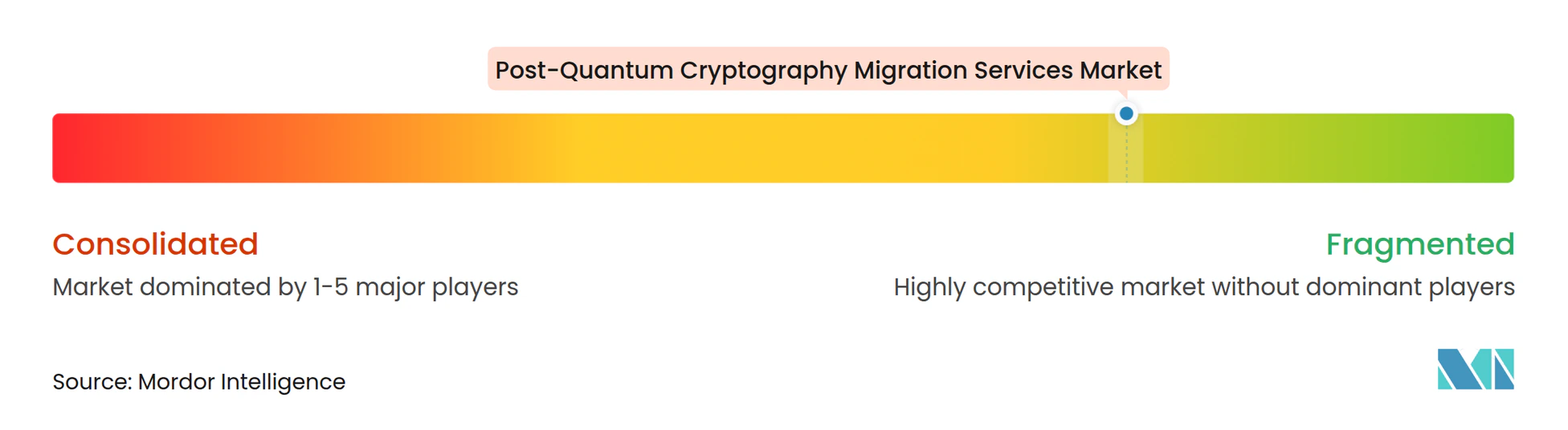
The post-quantum cryptography migration services market is fragmented because no single provider covers every service type, geography, and customer environment. Global IT services firms such as IBM Consulting, Accenture, Deloitte, Capgemini, TCS, Wipro, Infosys, HCLTech, NTT DATA, and Eviden compete for transformation programs. Specialist providers, including SandboxAQ, PQShield, QuSecure, Keyfactor, DigiCert, Thales, Entrust, CryptoNext Security, and ISARA, focus on particular layers of the cryptographic stack. Hyperscalers, including AWS, Microsoft, Google, and Cloudflare, influence the transition by building quantum-safe options into cloud infrastructure. This mix means buyers often need an ecosystem of providers rather than one vendor.
Partnerships are becoming important because discovery, certificate management, hardware assurance, algorithm integration, and systems integration are difficult to deliver as separate activities. Entrust and IBM Consulting announced a collaboration in April 2026 that combined Entrust's Cryptographic Security Platform with IBM Consulting's Quantum Safe Migration Orchestrator. Keyfactor, IBM Consulting, Thales, and Quantinuum formed the Quantum-Safe 360 Alliance in August 2025 to provide guidance and expertise for enterprise readiness. IBM and Telefónica Tech also entered a January 2025 collaboration to develop and deliver quantum-safe security offerings. These moves show that the post-quantum cryptography migration services industry is forming delivery networks around complementary capabilities.
Technology differentiation is centered on automated discovery, crypto-agility middleware, certificate automation, and validated hardware. QuSecure reported TRL-7 operational readiness for QuProtect R3 with the United States Army in September 2026. Thales TCT reported that its Luna T-Series HSMs received FIPS 140-3 Level 3 validation in August 2026. Providers that can connect discovery outputs to remediation and operating controls can reduce the handoffs that slow customer programs. Opportunities remain in Cryptographic Bill of Materials automation for embedded devices, managed offerings for smaller organizations, and governance for open-source software supply chains. The post-quantum cryptography migration services market will reward companies that make migration measurable, interoperable, and easier to manage over time.
Post-Quantum Cryptography Migration Services Industry Leaders
-
International Business Machines Corporation
-
Accenture plc
-
Capgemini SE
-
Deloitte Touche Tohmatsu Limited
-
Tata Consultancy Services Limited
- *Disclaimer: Major Players sorted in no particular order
Post-Quantum Cryptography Migration Services Market Companies Covered in this Report
- International Business Machines Corporation
- Accenture plc
- Capgemini SE
- Deloitte Touche Tohmatsu Limited
- Tata Consultancy Services Limited
- PwC International Limited
- KPMG International Cooperative
- Ernst & Young Global Limited
- Thales S.A.
- Entrust Corporation
- SandboxAQ LLC
- PQShield Limited
- QuSecure, Inc.
- Keyfactor, Inc.
- DigiCert, Inc.
- ISARA Corporation
- CryptoNext Security
- Microsoft Corporation
- Amazon Web Services, Inc.
- Google LLC
- Cloudflare, Inc.
- NTT DATA Corporation
- HCLTech
- Wipro Limited
- Infosys Limited
- Eviden
- Quantinuum Ltd.
- NXP Semiconductors N.V.
Recent Industry Developments in Post-Quantum Cryptography Migration Services Market
- October 2026: Microsoft launched a Post-Quantum Cryptography TLS Pilot Program for certificate authorities to evaluate interoperability in controlled environments, advising organizations to begin inventorying certificate dependencies and building non-production PQC test environments immediately.
- September 2026: QuSecure demonstrated TRL-7 operational readiness for QuProtect R3 at the US Army's Project Convergence Capstone 6, delivering quantum-resistant communications and cryptographic discovery for tactical mission systems under EO-14412's binding federal migration deadlines.
- August 2026: Thales TCT's Luna T-Series HSMs achieved FIPS 140-3 Level 3 validation (firmware 7.15.1), covering ML-DSA, ML-KEM, and LMS algorithms and making them the first US-manufactured PQC-enabled HSMs validated under all NSA CNSA Suite 2.0 PQC algorithms.
- June 2026: SandboxAQ received a USD 500 million commitment from the US Department of Commerce and affirmed its AQtive Guard platform as the automated cryptographic discovery tool for federal agencies beginning mandated PQC inventory under EO-14412.
Global Post-Quantum Cryptography Migration Services Market Report Scope
The post-quantum cryptography migration services market comprises revenue generated from advisory, consulting, implementation, integration, testing, and managed services that help organizations transition cryptographic systems from quantum-vulnerable algorithms to quantum-resistant alternatives. These services typically cover cryptographic discovery, inventory creation, risk assessment, migration roadmapping, algorithm and protocol replacement, PKI and certificate migration, interoperability testing, and post-migration validation. NIST’s migration guidance identifies discovery, cryptographic inventory, risk analysis, and prioritized remediation as core components of the transition process.
The Post-Quantum Cryptography Migration Services Market Report is Segmented by Service Type (Strategy, Governance, and Migration Roadmapping, Cryptographic Discovery, Inventory, and Risk Prioritization, PQC Algorithm Integration and Remediation, PKI, Certificate, and Digital Identity Migration, Network, TLS, and Secure-Protocol Migration, Testing, Validation, and Performance Optimization, and Other Services), Migration Target (Applications and Source Code, PKI, Certificates and Digital Identity, Networks and Secure Protocols, Cloud Workloads and Data Platforms, HSM, Key Management and Secrets, and Other Migration Targets), Deployment Model (Cloud-Based, On-Premises, and Hybrid), Organization Size (Large Enterprises, and Small and Medium-Sized Enterprises), End-User Industry (Banking, Financial Services, and Insurance (BFSI), IT and Telecommunications, Government and Public Administration, Healthcare and Medical Devices, Energy and Utilities, and Other End-User Industries), and Geography (North America, South America, Europe, Asia-Pacific, Middle East, and Africa). The Market Forecasts are Provided in Terms of Value (USD).
Segmentation Overview
| Strategy, Governance, and Migration Roadmapping |
| Cryptographic Discovery, Inventory, and Risk Prioritization |
| PQC Algorithm Integration and Remediation |
| PKI, Certificate, and Digital Identity Migration |
| Network, TLS, and Secure-Protocol Migration |
| Testing, Validation, and Performance Optimization |
| Other Services |
| Applications and Source Code |
| PKI, Certificates and Digital Identity |
| Networks and Secure Protocols |
| Cloud Workloads and Data Platforms |
| HSM, Key Management and Secrets |
| Other Migration Targets |
| Cloud-Based |
| On-Premises |
| Hybrid |
| Large Enterprises |
| Small and Medium Enterprises |
| Banking, Financial Services, and Insurance (BFSI) |
| IT and Telecommunications |
| Government and Public Administration |
| Healthcare and Medical Devices |
| Energy and Utilities |
| Other End-User Industries |
| North America | United States |
| Canada | |
| South America | Brazil |
| Mexico | |
| Rest of South America | |
| Europe | United Kingdom |
| Germany | |
| France | |
| Italy | |
| Rest of Europe | |
| Asia-Pacific | China |
| Japan | |
| South Korea | |
| India | |
| Australia and New Zealand | |
| Rest of Asia-Pacific | |
| Middle East | Israel |
| Saudi Arabia | |
| United Arab Emirates | |
| Rest of Middle East | |
| Africa | South Africa |
| Rest of Africa |
| By Service Type | Strategy, Governance, and Migration Roadmapping | |
| Cryptographic Discovery, Inventory, and Risk Prioritization | ||
| PQC Algorithm Integration and Remediation | ||
| PKI, Certificate, and Digital Identity Migration | ||
| Network, TLS, and Secure-Protocol Migration | ||
| Testing, Validation, and Performance Optimization | ||
| Other Services | ||
| By Migration Target | Applications and Source Code | |
| PKI, Certificates and Digital Identity | ||
| Networks and Secure Protocols | ||
| Cloud Workloads and Data Platforms | ||
| HSM, Key Management and Secrets | ||
| Other Migration Targets | ||
| By Deployment Model | Cloud-Based | |
| On-Premises | ||
| Hybrid | ||
| By Organization Size | Large Enterprises | |
| Small and Medium Enterprises | ||
| By End-User Industry | Banking, Financial Services, and Insurance (BFSI) | |
| IT and Telecommunications | ||
| Government and Public Administration | ||
| Healthcare and Medical Devices | ||
| Energy and Utilities | ||
| Other End-User Industries | ||
| By Geography | North America | United States |
| Canada | ||
| South America | Brazil | |
| Mexico | ||
| Rest of South America | ||
| Europe | United Kingdom | |
| Germany | ||
| France | ||
| Italy | ||
| Rest of Europe | ||
| Asia-Pacific | China | |
| Japan | ||
| South Korea | ||
| India | ||
| Australia and New Zealand | ||
| Rest of Asia-Pacific | ||
| Middle East | Israel | |
| Saudi Arabia | ||
| United Arab Emirates | ||
| Rest of Middle East | ||
| Africa | South Africa | |
| Rest of Africa | ||
Key Questions Answered in the Report
What is the size of the post-quantum cryptography migration services market?
The post-quantum cryptography migration services market size is projected to expand from USD 0.64 billion in 2026 and USD 0.81 billion in 2027 to USD 2.92 billion by 2032, registering a CAGR of 29.23% between 2027 to 2032.
Why are banks prioritizing post-quantum security programs?
BFSI held 34.28% share in 2026, driven by long-lived financial records, payment systems, identity infrastructure, and harvest-now-decrypt-later exposure.
What is the fastest-expanding migration target?
PKI, Certificates, and Digital Identity is expected to expand at a 32.76% CAGR through 2032 as organizations update trust hierarchies and certificate operations.
Why do enterprises need cryptographic discovery before algorithm replacement?
Discovery identifies embedded algorithms, certificates, keys, libraries, and third-party dependencies that may otherwise delay or weaken a migration program.
Which region has the strongest forecast for post-quantum migration services?
Asia-Pacific is projected to expand at a 32.94% CAGR through 2032, supported by national standards activity, cloud investment, and government-led programs.