
Polyimide Films Market Size and Share
Market Overview
| Study Period | 2021 - 2031 |
|---|---|
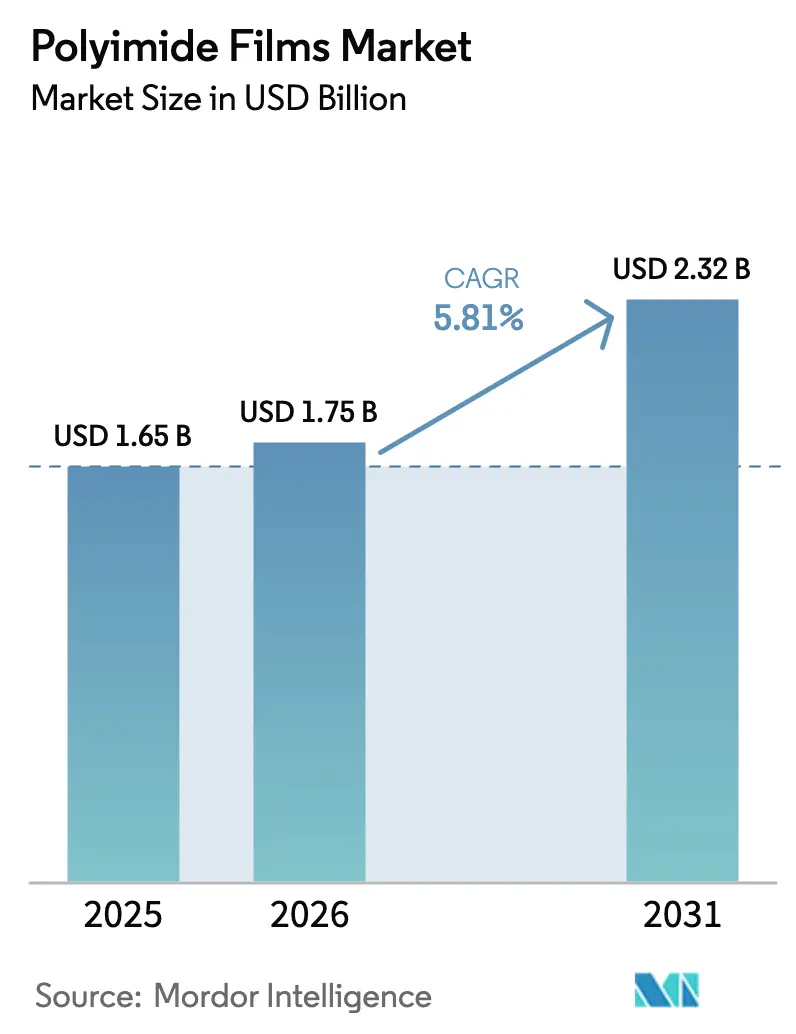
| Market Size (2026) | USD 1.75 Billion |
| Market Size (2031) | USD 2.32 Billion |
| Growth Rate (2026 - 2031) | 5.81 % |
| Fastest Growing Market | Asia Pacific |
| Largest Market | Asia Pacific |
| Market Concentration | Medium |
Major Players *Disclaimer: Major Players sorted in no particular order Image © Mordor Intelligence. Reuse requires attribution under CC BY 4.0. | |
Polyimide Films Market Analysis by Mordor Intelligence
The Polyimide Films Market size is projected to expand from USD 1.65 billion in 2025 and USD 1.75 billion in 2026 to USD 2.32 billion by 2031, registering a CAGR of 5.81% between 2026 to 2031. Growing investment in electric-vehicle battery enclosures, satellite thermal blankets, and advanced semiconductor packaging is shifting revenue toward specialty grades that command price premiums over commodity insulation films. Electronics miniaturization is shrinking dielectric layers in flexible printed circuits, while 5G base-station designers require low-loss substrates to handle millimeter-wave frequencies. Foldable displays are scaling commercial volumes and pushing demand for colorless grades that maintain optical clarity under mechanical stress. Concurrently, space-sector procurement emphasizes weight reduction, and automotive OEMs specify high-voltage insulation rated beyond 1,000 V, both of which reinforce structural demand for high-performance polyimides. Competitive dynamics remain moderately consolidated because a handful of suppliers control solvent-recovery infrastructure that new entrants find costly to replicate.
Key Report Takeaways
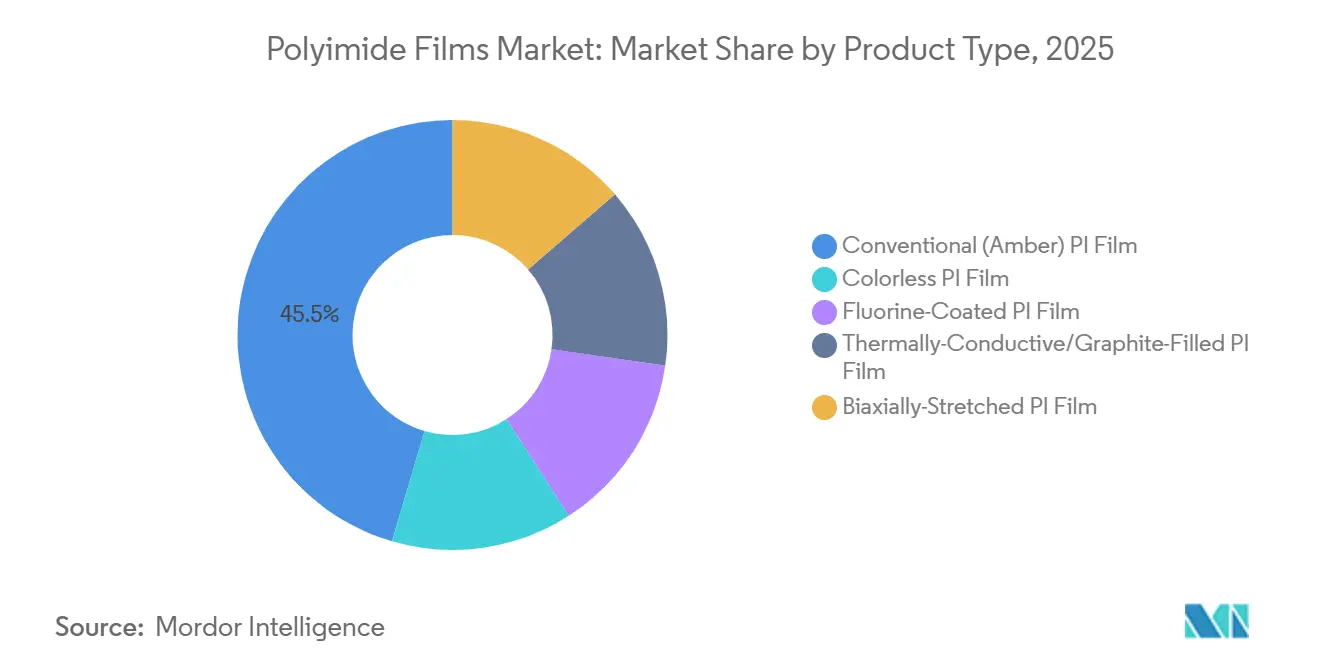
- By product type, Conventional (Amber) PI films led with 45.45% of polyimide films market share in 2025; colorless PI films are projected to expand at a 6.22% CAGR through 2031.
- By application, flexible printed circuit boards accounted for a 43.77% share of the polyimide films market size in 2025, while pressure-sensitive tapes recorded the fastest projected CAGR at 6.02% to 2031.
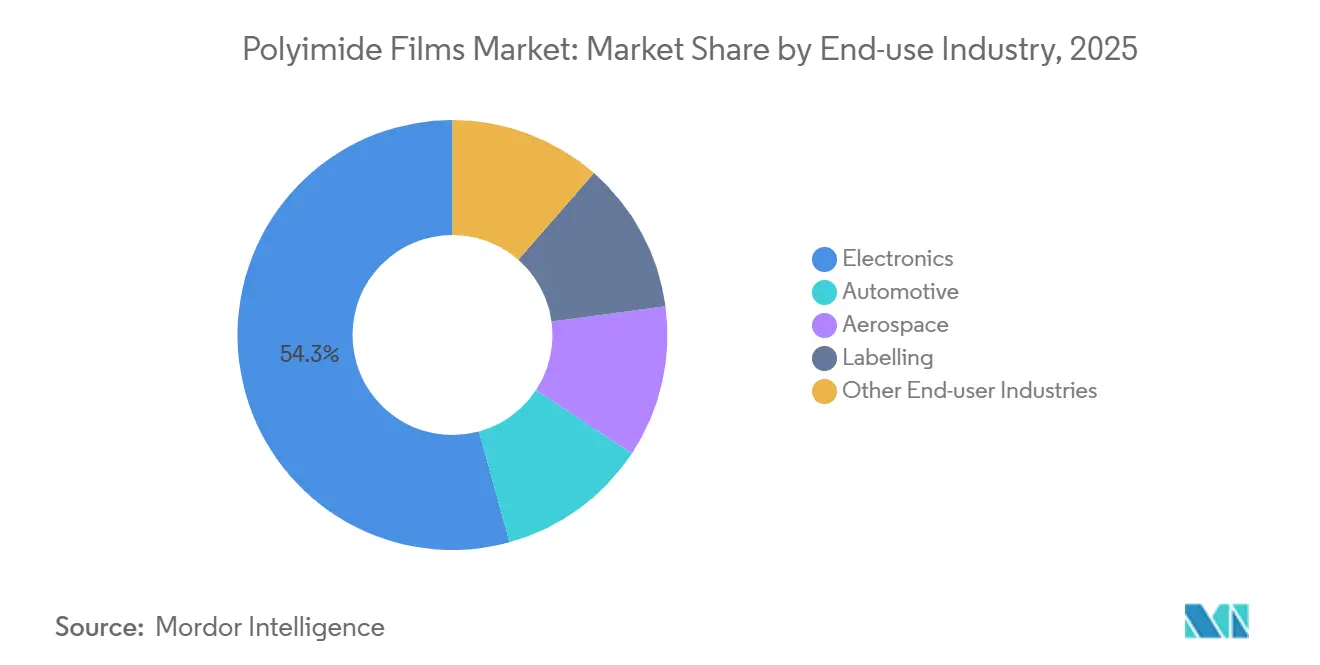
- By end-use industry, electronics commanded 54.28% share of the polyimide films market size in 2025, whereas the labelling segment is set to grow at a 6.09% CAGR to 2031.
- By geography, Asia-Pacific captured 44.91% of the polyimide films market share in 2025 and is advancing at a 6.14% CAGR through 2031.
Note: Market size and forecast figures in this report are generated using Mordor Intelligence’s proprietary estimation framework, updated with the latest available data and insights as of January 2026.
Market Trends and Insights
Drivers Impact Analysis of Polyimide Films Market*
| Driver | (~) % Impact on CAGR Forecast | Geographic Relevance | Impact Timeline |
|---|---|---|---|
| Electronics miniaturization and flexible-display boom | +1.2% | APAC core (China, South Korea, Japan), spill-over to North America | Medium term (2-4 years) |
| EV high-voltage insulation demand surge | +1.0% | Global, with early concentration in China, Europe, North America | Medium term (2-4 years) |
| 5G/6G high-frequency PCB adoption | +0.9% | APAC manufacturing hubs, North America telecom infrastructure | Short term (≤ 2 years) |
| Space-sector lightweight thermal shielding expansion | +0.6% | North America, Europe (ESA), emerging in India (ISRO) | Long term (≥ 4 years) |
| Additive-manufactured low-k PI for chiplet packaging | +0.8% | APAC (Taiwan, South Korea foundries), North America (Intel, AMD) | Medium term (2-4 years) |
| Source: Mordor Intelligence | |||
Electronics Miniaturization and Flexible-Display Boom
Colorless polyimide film enables foldable smartphones and rollable televisions because amber grades absorb blue wavelengths and depress OLED luminance by 8% to 12%[1]Samsung Display Newsroom, “Foldable OLED Advances,” Samsung Electronics, samsung.com. Samsung Display and LG Display migrated to colorless substrates in 2024, allowing screen radii below 1.5 mm without cracking. Kolon Industries expanded its Gumi line in 2025 to meet rising panel demand, signaling that colorless materials have shifted from niche prototypes to mass production. BOE is now qualifying the film for under-display cameras that require more than 88% light transmission. As a result, the polyimide film market is fragmenting into optically transparent and thermally robust subsegments, each demanding distinct polymer architectures.
EV High-Voltage Insulation Demand Surge
Battery architectures are moving from 400 V to 800 V platforms, pushing insulation specifications toward dielectric strengths above 200 kV /mm and continuous-use temperatures above 250°C. DuPont Kapton meets these thresholds and is already wrapped around busbars and separators in lithium-ion modules[2]DuPont, “Kapton Technical Data Sheet,” DuPont, dupont.com. Oerlikon introduced a plasma-enhanced coating in 2024 that trimmed thermal-runaway propagation by 18%, while Avery Dennison released a UL 94 V-0 compliant tape in 2025 for European automakers. Chinese battery producers are adopting graphite-filled grades to dissipate heat in cell-to-pack designs. Together, these developments draw the polyimide film market further into the EV battery value chain.
5G/6G High-Frequency PCB Adoption
Millimeter-wave base stations above 24 GHz need substrates with dielectric constants below 3.5 and loss factors under 0.005. DuPont’s Pyralux laminate posted a 0.0025 dissipation factor at 28 GHz in 2024, satisfying antenna-array designers. Telecom rollouts in India and Southeast Asia are replacing rigid FR-4 boards with flexible polyimide, shedding 30% weight from rooftop antennas. Nokia and Ericsson locked multi-year supply agreements with Asian laminators in 2025, ensuring demand continuity into early 6G trials. The polyimide film market, therefore, benefits from both the speed and density imperatives of next-generation wireless infrastructure.
Space-Sector Lightweight Thermal Shielding Expansion
Satellite operators prize polyimide blankets for their radiation resistance and low mass. NASA’s Parker Solar Probe survived 1,370°C perihelion temperatures using Kapton-based shielding. ESA specified similar films for its JUICE mission to Jupiter. SpaceX and OneWeb integrate polyimide flexible circuits in power distribution, trimming harness mass by 20%. ISRO is developing an indigenous supply for its Gaganyaan crewed mission, seeking to reduce import reliance. As launch economics hinge on kilograms delivered to orbit, the polyimide film market stands to gain sustainable aerospace pull.
Restraints Impact Analysis of Polyimide Films Market*
| Restraint | (~) % Impact on CAGR Forecast | Geographic Relevance | Impact Timeline |
|---|---|---|---|
| Volatile dianhydride and diamine feedstock pricing | -0.7% | Global, acute in regions dependent on Chinese intermediates | Short term (≤ 2 years) |
| VOC-emission compliance cost for solvent casting | -0.5% | Europe, North America, China (post-2025 enforcement) | Medium term (2-4 years) |
| PFAS-linked supply-chain traceability mandates | -0.3% | North America, Europe (REACH), emerging in Japan | Medium term (2-4 years) |
| Source: Mordor Intelligence | |||
Volatile Dianhydride and Diamine Feedstock Pricing
Pyromellitic dianhydride and oxydianiline prices swung 22% through 2024 as Chinese environmental inspections curtailed benzene-derivative output. Film producers exposed to 60-day contract cycles saw margins compress when raw-material spikes outpaced customer repricing. Vertically integrated suppliers such as DuPont and Toray hedge through long-term purchase agreements, but mid-tier players in Taiwan and India endured utilization dips below 70%. This volatility steers R&D toward solvent-free extrusion and aqueous dispersions, yet pilot lines have not matched the mechanical integrity of solvent-cast grades. Consequently, raw-material risk remains a drag on polyimide film market expansion.
VOC-Emission Compliance Cost for Solvent Casting
Solvent casting emits N-methyl-2-pyrrolidone and dimethylacetamide, now capped below 20 mg / m³ in many jurisdictions. Retrofitting thermal oxidizers adds USD 5 million to USD 15 million per line, discouraging capacity additions in Europe and North America. China tightened national standards in 2025, prompting domestic lines to upgrade abatement systems or suspend production during pollution alerts. Although water-based dispersions alleviate VOC exposure, tensile modulus lags by 10% to 15%. The resulting two-tier supply structure squeezes small converters and slows wider adoption, tempering the polyimide film market CAGR.
*Our forecasts treat driver/restraint impacts as directional, not additive. The impact forecasts reflect baseline growth, mix effects, and variable interactions.
Polyimide Films Market Segment Analysis
By Product Type:
Specialty Grades Drive Revenue DiversificationConventional amber film retained 45.45% share of the polyimide film market size in 2025, buoyed by cost-sensitive motor insulation and tape backings. Colorless grades are forecast to climb at a 6.22% CAGR as display makers demand more than 88% light transmission. Fluorine-coated films appeal to aerospace hydraulics, and graphite-filled variants move into EV battery thermal interfaces where heat flux tops 5 W / m-K. Biaxially stretched grades deliver higher tear resistance, though their 15% price premium restricts uptake to automotive electronics.
Specialty formulations now draw higher margins and insulate producers from commodity price swings. Kolon, Kaneka, and Asahi Kasei are expanding colorless and photosensitive capacity, with the latter investing to double PIMEL PSPI output by 2030. These multiyear bets indicate that premium segments will anchor revenue growth within the polyimide film market.



By Application:
Tape Growth Outpaces FPCB DominanceFlexible printed circuit boards delivered 43.77% of the polyimide film market share in 2025, reflecting entrenched use in smartphones, wearables, and ADAS sensors. Pressure-sensitive tapes, however, are tracking a 6.02% CAGR as RFID tags spread across retail logistics and pharmaceutical packaging. Specialty fabricated products such as die-cut gaskets serve mature motor markets, and wire-and-cable demand grows with renewable-energy installations.
Tape suppliers introduce flame-retardant and thermally conductive variants to penetrate EV battery assembly, where manual application and reworkability are crucial. FPCB technology is migrating toward finer pitch, yet price pressure persists because smartphone OEMs benchmark costs quarterly. These offsetting dynamics keep the polyimide film industry balanced between volume from circuits and premium growth from engineered adhesive systems.
By End-use Industry:
Labelling Emerges as a High-Growth AdopterElectronics retained 54.28% of demand in 2025, encompassing smartphones, laptops, and base-station hardware. Labelling applications are projected to expand at a 6.09% CAGR through 2031 as consumer-brand owners embed NFC chips in tamper-evident flexible labels for supply-chain visibility. Automotive electrification channels polyimide into battery modules, motor slots, and sensor circuits. Aerospace depends on the material for satellite blankets and harness insulation tied to constellation launches.
The polyimide film market now sees a diversified pipeline where non-traditional users, such as luxury goods and pharmaceuticals, rely on high-temperature labels to combat counterfeiting. Automotive growth is structural, given safety requirements in high-voltage packs, while aerospace orders remain episodic but sticky once qualified. This combination broadens the total addressable market and cushions revenue cycles.
Geography Analysis
APAC Polyimide Films Market
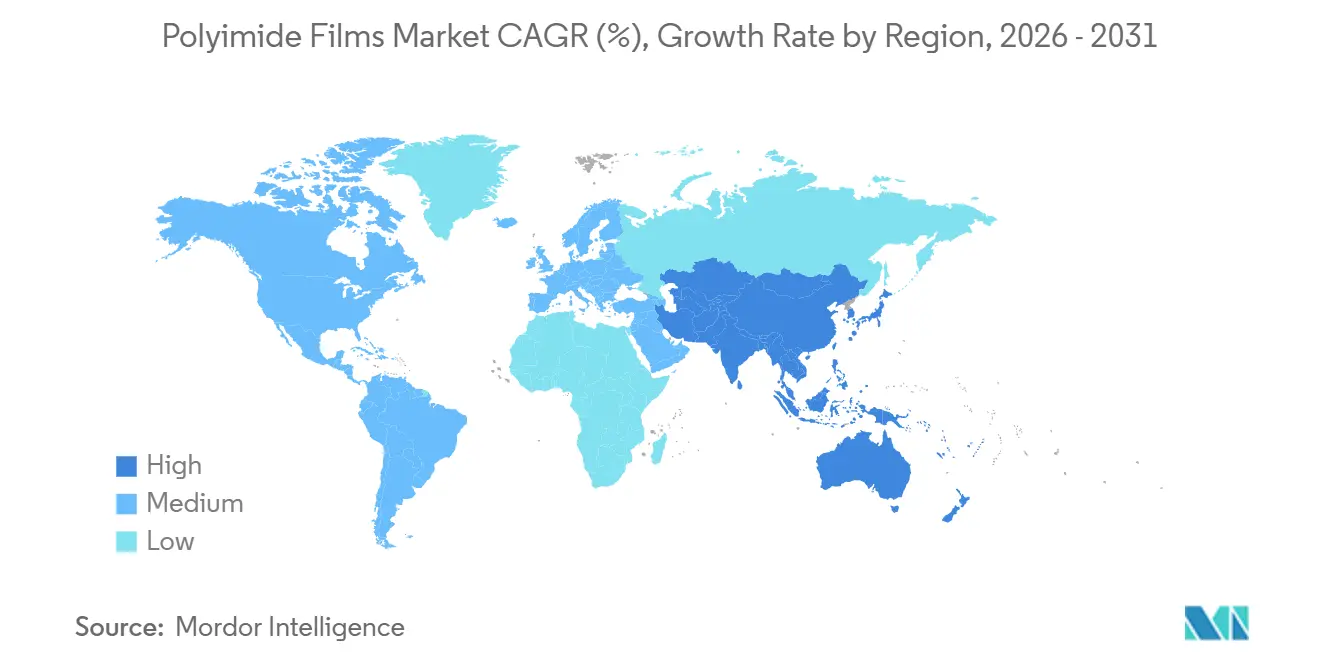
Asia-Pacific accounted for 44.91% of revenue in 2025 and is set to grow at a 6.14% CAGR through 2031, underpinned by electronics assembly, automotive production, and vertically integrated dianhydride supply in China. Japan maintains leadership in colorless and photosensitive grades, supplying Samsung Display, LG Display, and TSMC. South Korea leverages proximity to panel makers for rapid prototyping, while India’s production-linked incentive scheme spurs local FPCB demand, although film imports still dominate.
North America Polyimide Films Market
North America held a mid-teens slice of the polyimide film market. DuPont’s USD 250 million Circleville expansion in Ohio reinforces domestic supply for aerospace and defense customers who prioritize reliability over cost. The US CHIPS Act funds new packaging fabs in Arizona and New Mexico, pulling photosensitive grades into regional supply chains. Canada and Mexico absorb wire-and-cable volumes linked to wind and EV investments.
Europe, South America and Middle East Polyimide Films Market
Europe contributed a high-teens share, concentrated in Germany, France, and Italy, for automotive and satellite uses. REACH emission limits curb fresh capacity, so many converters import Asian film while focusing on downstream tapes and laminates. South America and the Middle East remain nascent, but Brazil’s EV programs and Saudi Arabia’s petrochemical diversification hint at future incremental demand for the polyimide film market.

Regulatory Landscape
Polyimide films used in electrical and electronic equipment supply chains must align with chemical and substance-control regimes, led by EU REACH (Regulation 1907/2006) and the EU RoHS Directive 2011/65/EU (including amendment EU 2015/863 on restricted phthalates). For insulation performance and qualification, widely referenced specifications include IEC 60674-3-4:2022 for polyimide films used for electrical insulation and ASTM D5213-19 for polymeric resin films in dielectric applications, which can affect procurement for FPCB laminates, motor insulation, and high-voltage EV components.
Trade classification and tariff treatment also shape sourcing decisions for thin-gauge films. Polyimide films are commonly traded under HS 3920.99 (with country-level subheadings such as 3920.9921 for polyimide foil and strip), while copper-covered polyimide film aligns with HS 7410.21 in certain tariff schedules. In China, a provisional import tariff rate of 3% for polyimide film with thickness not exceeding 0.03 mm took effect on January 1, 2026, giving downstream users a cost lever for flexible electronics and other strategic applications that consume ultra-thin film formats.
Value Chain Analysis
The polyimide films value chain starts upstream with petrochemical-derived intermediates and the production of key monomers, primarily dianhydrides and diamines (for example, pyromellitic dianhydride and oxydianiline), followed by polymer synthesis and film formation through solvent casting and related coating, stretching, and surface-treatment steps. Tight control of purity and solvent-recovery infrastructure is central to electronic-grade output, and vertical integration into upstream feedstocks can be a practical barrier to entry because it reduces exposure to short-cycle raw-material price swings and improves continuity for high-spec customers.
Midstream, film producers convert base resin into conventional amber, colorless, fluorine-coated, thermally conductive, or biaxially stretched formats, then supply rolls to converters and laminators that slit, treat, and laminate films into FPCB substrates, insulation layers, tapes (adhesive excluded from market scope), wire-and-cable wraps, and specialty fabricated parts. Downstream demand concentration is highest in electronics (notably FPCBs) and is expanding in EV battery insulation and aerospace thermal shielding, where qualification cycles, dielectric testing, and traceability requirements elevate the importance of long-term supplier relationships and multi-site manufacturing resilience.
Competitive Landscape
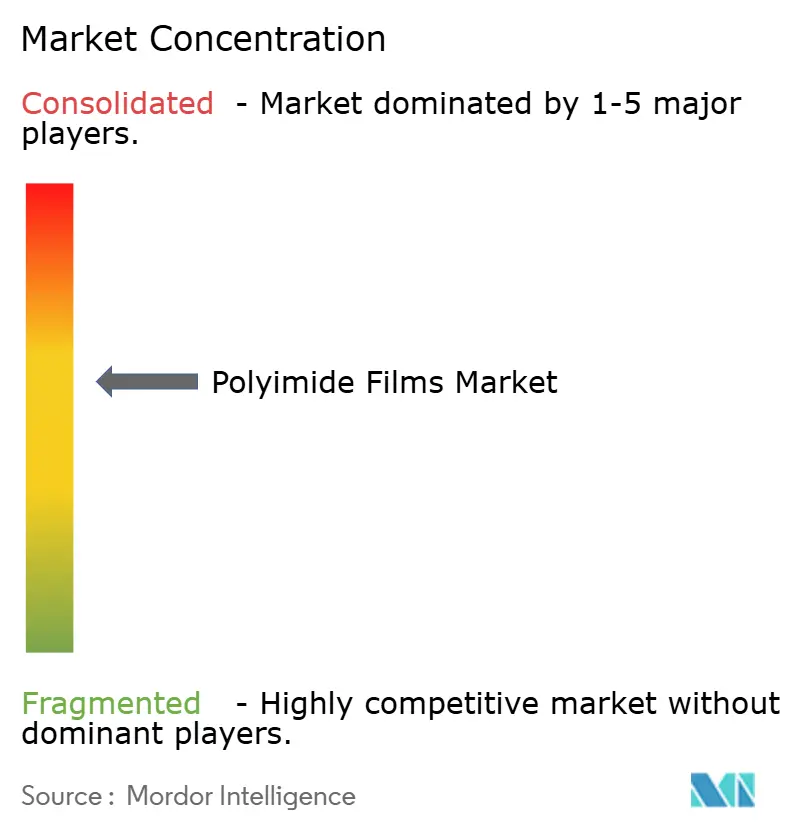
The Polyimide Films market is moderately consolidated. PI Advanced Materials, Taimide, and Wuhan Imide compete regionally and customize niche grades, while 3M, AGC, and Saint-Gobain leverage downstream laminates and tapes to capture value beyond raw film. Innovation continues in water-based dispersions and dry-phase processing aimed at eliminating VOCs, yet mechanical parity with solvent-cast grades remains elusive. Patent filings for graphite-filled thermal interface films and low-k photosensitive formulations underscore R&D rivalry.
Polyimide Films Industry Leaders
DuPont
KANEKA CORPORATION
PI Advanced Materials Co., Ltd.
TORAY INDUSTRIES, INC.
Kolon Industries, Inc.
- *Disclaimer: Major Players sorted in no particular order
Polyimide Films Market Companies Covered in this Report
- 3M
- AGC Inc.
- Arakawa Chemical Industries,Ltd.
- DuPont
- I.S.T Corporation
- KANEKA CORPORATION
- Kolon Industries, Inc.
- Mitsui Chemicals, Inc.
- PI Advanced Materials Co., Ltd.
- Saint-Gobain
- Taimide Tech. Inc.
- Teraoka Seisakusho co.,Ltd.
- TORAY INDUSTRIES, INC.
- UBE Corporation
- Von Roll
- Wuhan Imide New Materials Technology Co.,LTD
- Zhejiang Hecheng Smart Electric Co., Ltd.

Market Opportunities and Future Outlook
A primary opportunity is in electronic-grade capacity additions and localization programs tied to flexible electronics and advanced packaging supply chains. In China, Guofeng New Material disclosed polyimide film capacity exceeding 1,500 tons per year across 12 lines (January 2026) and is investing in a flexible-electronics materials project designed for 350 tons of annual capacity, while Henan Chenlong Chemical reported commissioning progress for phase one of a high-end electronic-grade film project in Puyang (April 2026) that includes four polyimide film production lines and a total project investment of 1.05 billion yuan. These moves highlight continued whitespace for qualified, high-purity film in regional ecosystems that want shorter lead times and reduced dependence on imported specialty grades.
Another opportunity is the shift toward ultra-thin and photo-definable polyimide materials that support shrinking line widths, higher interconnect density, and new substrate architectures in semiconductors and high-frequency electronics. Toray Industries announced a negative photo-definable polyimide sheet for glass core substrates (December 2025), aligning polyimide development with glass-core and fine-pattern packaging roadmaps, while Asahi Kasei completed a new PIMEL photosensitive polyimide (PSPI) plant in Fuji City, Japan (December 2024), strengthening regional supply for back-end processes that consume photosensitive insulating layers. Taken together with rising compliance costs for solvent casting, these product and capacity signals create room for suppliers that can scale low-defect, ultra-thin gauges and processable formulations while meeting tightening environmental and traceability requirements.
Recent Industry Developments in Polyimide Films Market
- March 2026: KANEKA CORPORATION announced a 20% price increase per square meter for its polyimide film products, including Apical and Pixeo, with the change applied to shipments starting April 16, 2026. The company attributed the move to instability in crude oil and petroleum product supplies, pointing to cost pressure flowing from upstream energy and solvent chains into electronic-grade film pricing.
- December 2025: FUJIFILM Corporation unveiled ZEMATES, a brand of photosensitive insulating materials aimed at semiconductor back-end processes, with a primary focus on polyimide. The launch expanded the commercial menu of polyimide-based options for redistribution layers (RDL) and protective films, reinforcing polyimide chemistry adoption in advanced packaging workflows.
- October 2024: PI Advanced Materials Co., Ltd. announced the successful production of a 4-micrometer non-stretched ultra-thin polyimide film at its Gumi plant. Achieving this gauge supports device-level miniaturization needs across smartphones, wearables, and display and semiconductor components that require thinner dielectric layers without sacrificing thermal performance.


Polyimide Films Market Report Scope and Research Methodology
Market Definition and Coverage
This market tracks the value of polyimide film sold as sheets or rolls that are used as a high-heat, electrically insulating, and dimensionally stable substrate across electronics and industrial applications.
Scope exclusions: Adhesive backed polyimide tapes and other downstream laminated products are excluded so the film value is not counted twice.
Segments Covered in This Report
- By Product Type
- Conventional (Amber) PI Film
- Colorless PI Film
- Fluorine-Coated PI Film
- Thermally-Conductive/Graphite-Filled PI Film
- Biaxially-Stretched PI Film
- By Application
- Flexible Printed Circuit Boards (FPCB)
- Specialty Fabricated Products
- Pressure Sensitive Tapes
- Wire and Cable
- Motor/Generator
- By End-use Industry
- Electronics
- Automotive
- Aerospace
- Labelling
- Other End-user Industries
- By Geography
- Asia-Pacific
- China
- Japan
- South Korea
- India
- ASEAN Countries
- Rest of Asia-Pacific
- North America
- United States
- Canada
- Mexico
- Europe
- Germany
- United Kingdom
- France
- Italy
- Rest of Europe
- South America
- Brazil
- Argentina
- Rest of South America
- Middle East and Africa
- Saudi Arabia
- South Africa
- Rest of Middle East and Africa
- Asia-Pacific
Data Sources, Market Sizing, and Validation
Desk Research
Desk research starts with public data that helps us understand where polyimide film demand is actually coming from and how it moves across regions. We typically review trade and tariff statistics and classification notes, such as those from UN Comtrade and national customs agencies, because they help check import reliance and regional supply patterns. Electronics and manufacturing context is added using sources such as government industrial production series, energy and environment agencies for solar installation context, and defense and aerospace procurement releases where insulation use is discussed.
Next, we use company filings, investor presentations, technical datasheets, and reputable press to map product positioning, capacity announcements, and pricing direction, especially when thickness, grade, and colorless variants shift the typical selling price. Patent databases are also used to understand where film innovations and process improvements are being filed, which supports validation of where future performance changes could show up. For hard to find financial splits and cross checks, selected paid subscriptions for company financials, news and financials, patents, and import export shipment level views are referenced as needed. The sources listed here are illustrative, and many other public and paid references were also reviewed for data collection, validation, and clarification.
Primary Interviews and Surveys
Primary work is used to convert the desk inputs into usable market parameters, since film pricing and mix can change quickly by grade and application. We speak with film manufacturers, converters, distributors, and large end users in electronics, industrial insulation, and advanced manufacturing, then we validate assumptions across APAC, EMEA, and the Americas so one region does not dominate the model. These discussions help confirm utilization levels, application shares, and price movement assumptions before the final numbers are locked.
Distribution of primary research fieldwork respondents
| Company type | Respondent position | Region |
|---|---|---|
| Top tier: 38% | CXOs: 20% | APAC: 40% |
| Mid tier: 41% | Functional/Unit leaders: 35% | EMEA: 36% |
| Smaller Players: 21% | Managers: 45% | Americas: 24% |
Market-Sizing & Forecasting
The core sizing logic is run using a top-down demand pool build that ties polyimide film consumption to end-use indicators, and then it is checked with selective bottom-up approximations so totals stay realistic. On the top-down side, we translate key demand signals into film volume and value by using application level activity, followed by conversion into value using an average selling price range that reflects grade and thickness mix. On the bottom-up check side, supplier and channel discussions are used to sense-check implied sales by region, and gaps are handled by using conservative ranges and then re-checking them against trade flows and capacity announcements.
A few inputs that matter in this market include flexible printed circuit production trends, electronics output growth, solar module build activity where film can be used as an insulating layer, aerospace and industrial insulation demand signals, and shifts in the share of colorless polyimide where pricing and adoption differ from standard amber film. Pricing is treated carefully since it can move due to resin costs, yields, and mix changes, so ASP progression is not assumed as a straight line. For the forecast, we use scenario analysis supported by a multivariate regression view on the most consistent demand indicators, and then the output is adjusted based on what industry participants expect for capacity, qualification cycles, and substitution limits.
Data Validation & Update Cycle
Outputs are validated through triangulation across three layers, independent demand indicators, cross-region consistency checks, and expert feedback. When a region shows a sudden jump, we review whether it is driven by a real end-use shift, a trade re-routing effect, or an ASP assumption that needs to be corrected, and then a second analyst review is completed before sign-off. If a variance remains material after these checks, respondents are re-contacted to confirm what changed and whether the change is temporary.
The dataset and model are refreshed on an annual cycle, and interim updates are made when major capacity additions, policy changes, or sharp raw material moves materially affect pricing or availability. Before delivery, a final review pass is done to capture the latest public releases and recent primary feedback so the numbers reflect current market conditions.
Mordor Intelligence's Polyimide Films Market Size Compared With Other Published Estimates
Published market sizes for polyimide films can vary widely, even when the same years are quoted, because the scope lines are not always drawn in the same place. Differences usually come from what is counted as film versus converted products, how regional currency conversion is timed, and whether pricing is modeled by grade mix or treated as a single blended number.
In this study, the largest gap driver is whether adhesive backed tapes and downstream laminates are included, along with how aggressive the ASP ramp is assumed for colorless grades, which can inflate the value quickly if qualification timing is not checked. The table points to this spread, where counting only film sold as sheets and rolls, and excluding adhesive value, keeps the 2025 total closer to actual film demand signals, a modeling choice applied by Mordor Intelligence.
Benchmark comparison
| Source | Market Size | Gaps in Research Methodology |
|---|---|---|
| Mordor Intelligence | USD 1.65 B (2025) | |
| Global Consultancy A | USD 2.76 B (2025) | This estimate appears to include broader converted products, and it likely treats polyimide tape and laminate value as part of the market, which raises the value beyond standalone film sales. |
| Industry Publisher B | USD 2.55 B (2025) | This figure likely assumes a faster price and mix shift toward premium grades across regions, and it may apply a more aggressive ASP progression without clearly separating thickness and grade driven price bands. |
Overall, the spread is explained less by arithmetic and more by what gets counted and how price is carried forward year to year. By tying demand to application activity and then checking pricing and mix with real market feedback, the approach stays traceable to clear steps that can be repeated when new information comes in.


Key Questions Answered in the Report
How large is the polyimide film market in 2026?
How large is the polyimide film market in 2026?
Which application segment leads demand?
Which application segment leads demand?
What region records the fastest revenue growth?
What region records the fastest revenue growth?
Why are colorless polyimide films important?
Why are colorless polyimide films important?
What is the main restraint facing producers?
What is the main restraint facing producers?
Page last updated on:


 Your data is secure and never sold or shared.


