
Polyethylene Foam Market Size and Share
Market Overview
| Study Period | 2021 - 2031 |
|---|---|
| Market Size (2026) | USD 2.21 Billion |
| Market Size (2031) | USD 2.70 Billion |
| Growth Rate (2026 - 2031) | 4.12 % |
| Fastest Growing Market | Asia Pacific |
| Largest Market | Asia Pacific |
| Market Concentration | Medium |
Major Players *Disclaimer: Major Players sorted in no particular order Image © Mordor Intelligence. Reuse requires attribution under CC BY 4.0. | |
Polyethylene Foam Market Analysis by Mordor Intelligence
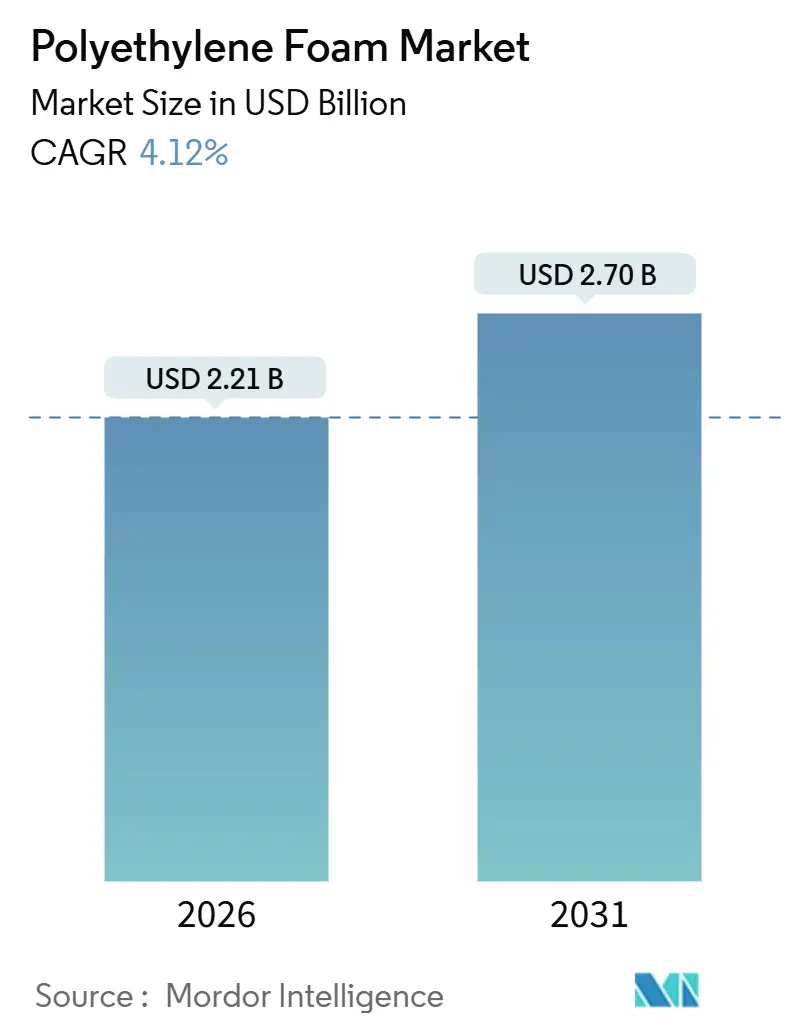
The Polyethylene Foam Market size is estimated at USD 2.21 billion in 2026, and is expected to reach USD 2.70 billion by 2031, at a CAGR of 4.12% during the forecast period (2026-2031). Asia-Pacific is steering growth as automotive lightweighting, construction retrofits, and pharmaceutical cold-chain logistics expand the addressable base of the Polyethylene foam market, while single-use plastic regulations in North America and Europe temper demand in consumer e-commerce packaging. Non-cross-linked grades still dominate because they thermoform quickly and cost less to ship, yet cross-linked variants are gaining share where building codes and battery safety rules mandate moisture resistance and dimensional stability. Feedstock economics favor integrated petrochemical hubs in China and the Middle East, creating regional price spreads that push converters to relocate extrusion capacity eastward. Competitive strategies now revolve around delivering recycled-content blends that keep tensile strength intact, and on capturing white space in insulation, cold-chain, and electric-vehicle (EV) noise-vibration-harshness applications.
Key Report Takeaways
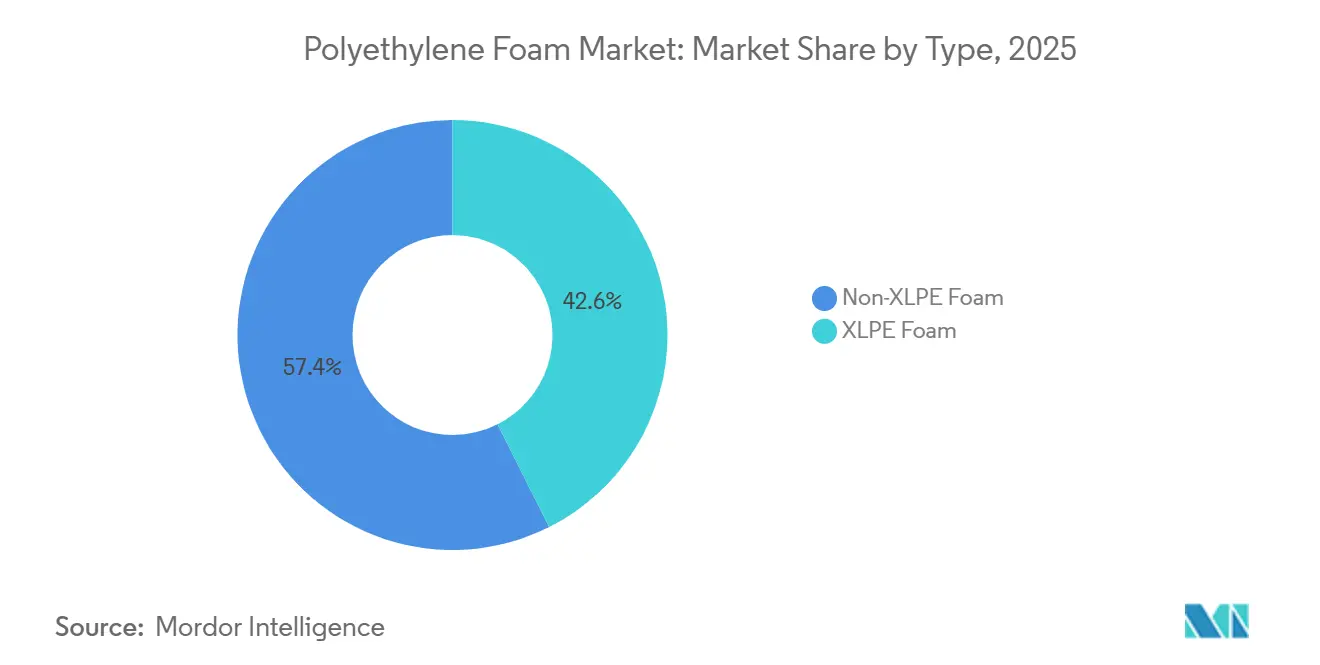
- By type, non-XLPE foam led with 57.42% revenue share in 2025, while XLPE foam is forecast to expand at a 5.24% CAGR through 2031.
- By application, packaging captured 39.36% of 2025 revenue; the “other applications” bucket shows the fastest 5.18% CAGR to 2031.
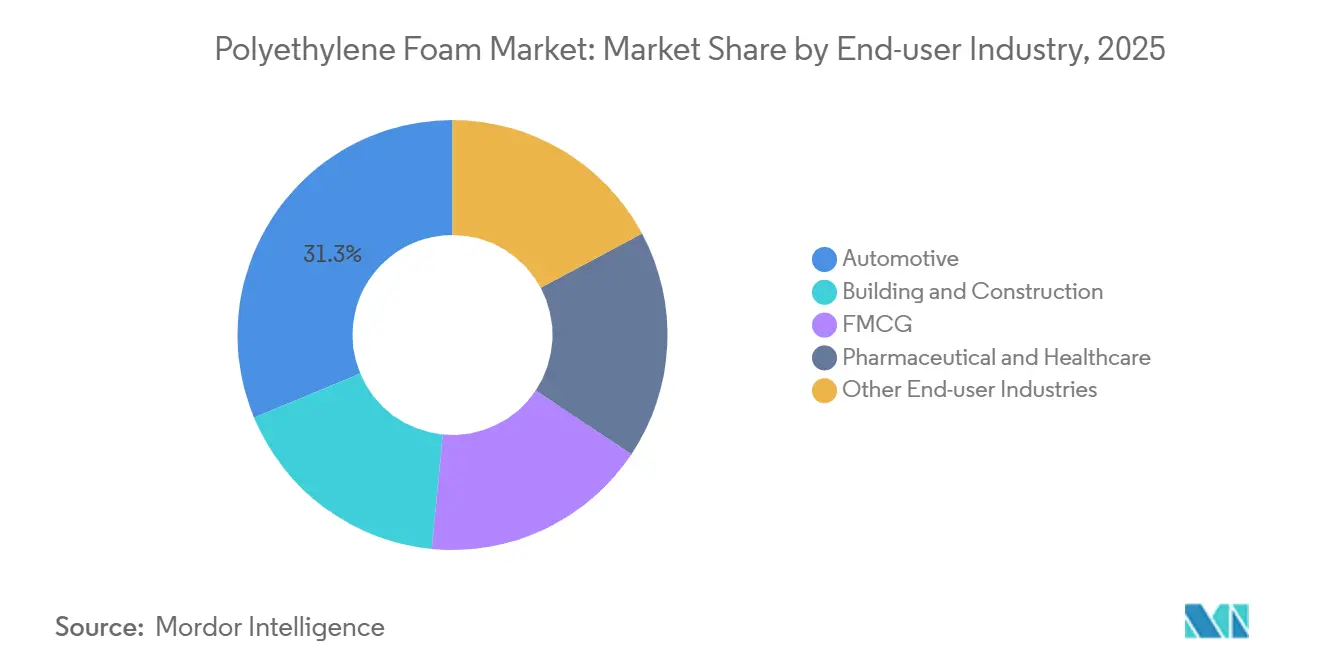
- By end-user, automotive generated 31.28% of 2025 demand, yet pharmaceutical and healthcare are set to grow the quickest at 6.22% CAGR through 2031.
- By geography, Asia-Pacific contributed 48.53% of 2025 revenue and is predicted to sustain a 6.03% annual rise to 2031.
Note: Market size and forecast figures in this report are generated using Mordor Intelligence’s proprietary estimation framework, updated with the latest available data and insights as of January 2026.
Global Polyethylene Foam Market Trends and Insights
Drivers Impact Analysis*
| Drivers | (~) % Impact on CAGR Forecast | Geographic Relevance | Impact Timeline |
|---|---|---|---|
| Surge in e-commerce protective packaging | +0.8% | North America, Europe, ASEAN | Short term (≤ 2 years) |
| Construction retrofits demanding closed-cell insulation | +1.2% | North America, Europe, India | Medium term (2-4 years) |
| Lightweight NVH solutions in electric vehicles | +1.0% | China, South Korea, spill-over to Europe | Medium term (2-4 years) |
| Cold-chain expansion for biologics and meal kits | +0.9% | North America, Europe, global pharma corridors | Long term (≥ 4 years) |
| Recyclate-compatible compatibilizer breakthroughs | +0.7% | Europe, North America | Medium term (2-4 years) |
| Source: Mordor Intelligence | |||
Surge in E-Commerce Protective Packaging
While fulfillment centers are automating their pack-out lines and reducing void fill per parcel, global B2B shipments of electronics and machinery continue to rely on polyethylene foam inserts for anti-static and moisture-barrier protection. By late 2024, Amazon had already eliminated plastic air pillows and was now aiming for paper filler by June 2025. This move is contributing to a decline in North American demand for light-density foam. In Europe, extended producer responsibility rules are accelerating the shift to paper. Meanwhile, ASEAN electronics exports are keeping industrial cushioning volumes steady[1]“ASEAN Investment Report 2022,” ASEAN Secretariat, asean.org. Despite a contraction in retail packaging, precision die-cut foam remains the go-to choice for semiconductor logistics, ensuring consistent baseline consumption.
Construction Retrofits Demanding Closed-Cell Insulation
California's Title 24 and the updated EU building codes emphasize high R-values and minimal water absorption for crawlspace and below-grade insulation, leading to a preference for cross-linked polyethylene (XLPE) foam. India's construction output is forecast to grow annually until 2029, expanding the market for closed-cell insulation. XLPE's dimensional stability and resistance to mold have made it the go-to choice for insulated concrete forms, structural insulated panels, and retrofit crawlspace liners. Despite increasing scrutiny on single-use plastics, these code-driven retrofits provide consistent momentum for the Polyethylene foam market.
Lightweight NVH Solutions in Electric Vehicles
China’s new-energy vehicle parc reached a record in 2024, intensifying lightweighting needs. While polyurethane dominates battery-pack flame barriers, polyethylene foam holds a niche in door seals, trunk liners, and under-body panels where recyclability and cost trump thermal performance. Automakers moving toward mono-material interiors for easier disassembly under the EU End-of-Life Vehicles Directive increasingly specify polyethylene foam laminates. As EV assembly localizes across Southeast Asia, regional foam demand benefits from proximity to gigafactories and component clusters.
Cold-Chain Expansion for Biologics and Meal Kits
mRNA vaccines and monoclonal antibodies need passive shippers that sustain −80 °C to +8 °C for up to 96 hours, a spec XLPE foam meets when paired with reflective barriers. Meal-kit providers such as HelloFresh continue double-digit subscriber growth, testing recyclable liners that mix bio-based polyethylene with phase-change gels to reduce box weight without sacrificing insulation. The result is incremental but durable demand for high-R-value foam panels that comply with FDA and EMA validation protocols, anchoring an attractive niche within the Polyethylene foam market.
Restraints Impact Analysis*
| Restraints | (~) % Impact on CAGR Forecast | Geographic Relevance | Impact Timeline |
|---|---|---|---|
| Volatile ethylene feedstock pricing | −0.6% | Europe, North America, global exposure | Short term (≤ 2 years) |
| Intensifying bans on single-use plastic foams | −0.9% | Europe, California, select ASEAN economies | Medium term (2-4 years) |
| Collection and sorting hurdles for foam recycling | −0.5% | Global, most acute in emerging markets | Long term (≥ 4 years) |
| Source: Mordor Intelligence | |||
Volatile Ethylene Feedstock Pricing
Steam-cracked ethylene output swings with naphtha prices and LNG availability, squeezing converter margins during upcycles. China’s new petrochemical complexes elevate regional production and suppress spot prices, while European crackers bear higher energy costs, prompting converters to shift extrusion lines close to low-cost feedstock hubs. Electrified furnace pilots by Dow, BASF, and others could dull volatility over the next decade, yet near-term price shocks remain a downside risk to the Polyethylene foam market.
Intensifying Bans on Single-Use Plastic Foams
The EU banned expanded polystyrene foodware in 2021 and now imposes recycled-content targets across all foam packaging. California and many U.S. municipalities restrict polystyrene foodservice articles, and public perception frequently lumps polyethylene foam into the same category. As curbside systems rarely segregate foam, converters struggle to source clean post-consumer feedstock, creating compliance and reputational headaches that dampen demand growth[2]“EU Regulation 2025/40 on Packaging and Packaging Waste,” EUR-Lex, eur-lex.europa.eu.
*Our forecasts treat driver/restraint impacts as directional, not additive. The impact forecasts reflect baseline growth, mix effects, and variable interactions.
Segment Analysis
By Type: Cross-Linking Raises Performance Ceiling
Cross-linked polyethylene (XLPE) captured a premium price and is forecast to post a 5.24% CAGR through 2031, outstripping the Polyethylene foam market’s overall 4.12% pace. Non-XLPE held a 57.42% share in 2025 thanks to low density and rapid thermoformability, yet code changes that mandate closed-cell insulation in moisture-prone assemblies steadily shift demand toward XLPE. A 2025 Angewandte Chemie paper detailed dynamic cross-linkers that let XLPE be reprocessed without sacrificing creep resistance, opening circular-economy pathways. The Polyethylene foam market size for XLPE applications in building envelopes and EV thermal barriers is poised to accelerate as recyclate-ready chemistries narrow the cost gap with commodity grades. Meanwhile, non-XLPE maintains traction in protective packaging where easy die-cutting and existing recycling streams sustain its competitive edge. When European food-contact regulation 2025/351 required high-purity documentation for recycled content, converters with ISO-certified traceability systems locked in long-term contracts, further polarizing market tiers.


By Application: Insulation Becomes the Growth Engine
Packaging controlled 39.36% of 2025 revenue, yet insulation, composites, and other specialty uses grow at a faster 5.18% CAGR. Building codes that raise R-value minimums fuel steady demand for closed-cell foam boards, while aerospace and rail adopt foam-core sandwich panels to cut structural weight. Amazon’s packaging shift removed demand in North America, but industrial electronics exports keep cushioning volumes healthy. The Polyethylene foam market share tied to insulation is widening as modular construction, prefabricated walls, and insulated concrete forms adopt XLPE panels for water-barrier and thermal-bridge control. Composite manufacturers blending foam cores with carbon-fiber skins widen their order books in renewable-energy nacelles and high-speed trains, underpinning a long-run growth channel.
By End-User Industry: Pharma Races Ahead
Automotive accounted for 31.28% of 2025 consumption, but pharmaceutical and healthcare shipments will grow at a 6.22% CAGR. WHO cold-chain guidelines set a 0.040 W/m-K thermal-conductivity ceiling, which XLPE meets when laminated with reflective foil, earning validation in mRNA vaccine shippers. EV adoption keeps automotive demand stable, shifting the mix from under-hood insulation to battery-pack and interior NVH liners. Building and construction ride infrastructure booms in India and ASEAN, while fast-moving consumer goods packaging slows where single-use bans bite. Furniture, bedding, and sports gear remain a durable niche of the Polyethylene foam industry, shielded from ready substitutes by the material’s balance of cushioning, durability, and cost.

Geography Analysis
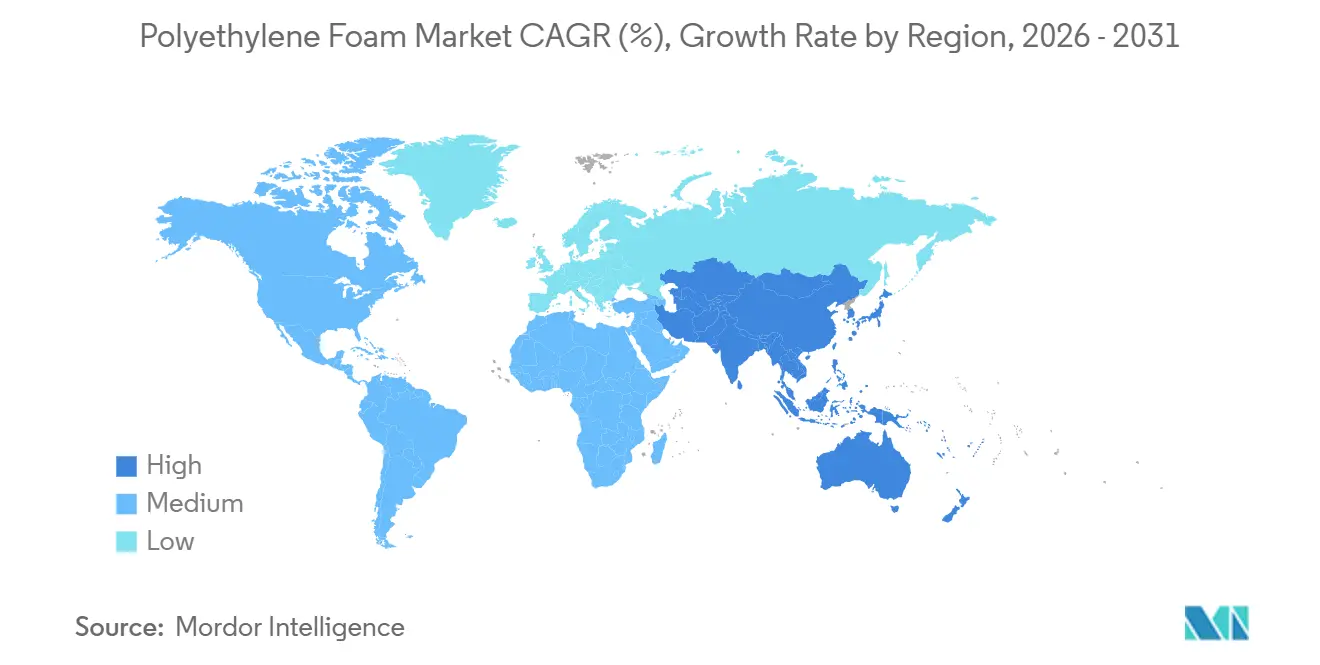
Asia-Pacific contributed 48.53% of 2025 revenue and is set to grow 6.03% annually through 2031, underpinned by China’s new-energy vehicles and India’s construction sector expansion. Local ethylene oversupply from integrated complexes compresses resin prices, incentivizing multinational converters to expand extrusion capacity in coastal China. Japan and South Korea innovate anti-static and flame-retardant grades for electronics, feeding regional value-added exports.
North America shows flat to low-single-digit growth as Amazon’s paper pivot trims consumer e-commerce foam, though construction retrofits under the Inflation Reduction Act and pharma cold-chain expansions partly offset declines. EU Regulation 2025/40 enforces recycled-content quotas, spurring capital investment in compatibilizer technology and favoring incumbents with ISO-certified quality systems. California Title 24 upgrades sustain demand for vapor-barrier XLPE in crawlspaces.
South America, the Middle East, and Africa together form a small but rising slice of the Polyethylene foam market. Brazil’s urban housing programs and Saudi Arabia’s Vision 2030 petrochemical build-out promise new downstream opportunities. Weak recycling infrastructure limits regulatory pressure, so virgin resin remains the norm, allowing converters to compete mainly on logistics and service rather than circularity credentials.

Value Chain Analysis
The polyethylene foam value chain starts with upstream ethylene and polyethylene (often LDPE) production, with feedstock economics favoring integrated hubs in China and the Middle East. This creates regional resin price spreads that shape converter siting decisions. Foam converters compound PE resin with blowing agents (chemical or physical) and performance additives, including cross-linking agents for XLPE, then process the melt through extrusion (and, for XLPE, subsequent cross-linking) before cutting, laminating, and die-cutting parts for packaging, insulation, automotive NVH, and cold-chain shippers.
On the downstream side, distribution splits between direct supply to large OEMs and fabricators (automotive, appliance, electronics), and packaging/insulation networks serving contractors and logistics users. In food-contact and medical or cold-chain applications, qualification and compliance requirements add lead time and tend to favor suppliers with ISO-based quality and traceability systems. On supply risk, geopolitical and logistics disruptions affecting Middle East petrochemical flows have tightened polyethylene availability and increased price volatility, leading procurement teams to diversify sourcing and use more flexible contracting, while some converters consider regionalizing foam production closer to end-use clusters.
Competitive Landscape
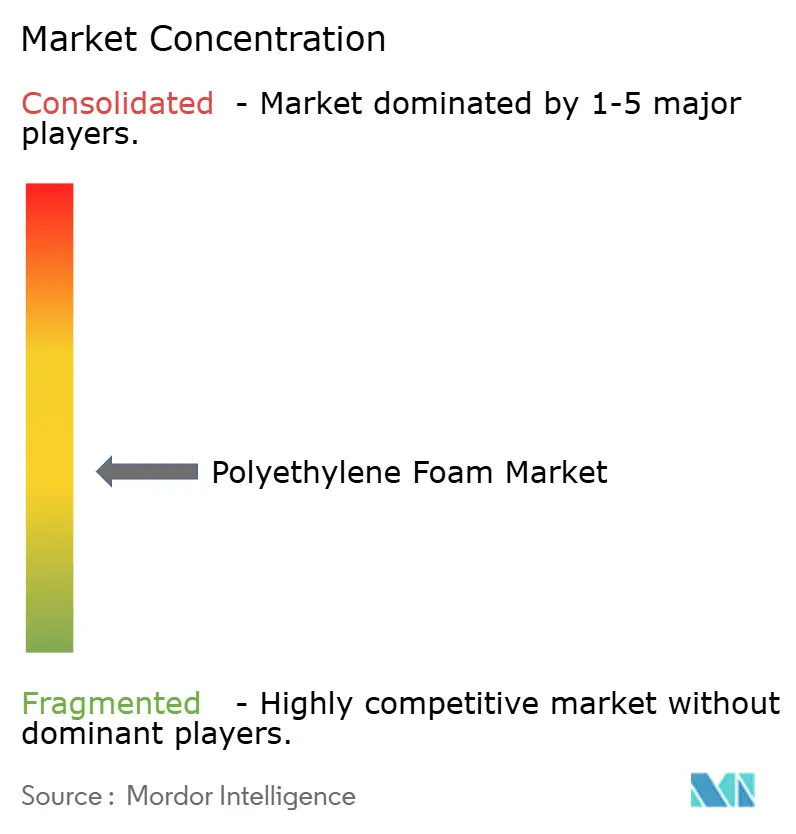
The polyethylene foam market is moderately fragmented. Technology is the key battleground. Large converters automate die-cutting and lamination to slash labor costs and meet tight tolerances for EV and electronic assemblies. Smaller firms defend their share with custom formulations and fast turnaround. Compatibilizer breakthroughs that allow recycled content without mechanical loss grant first movers pricing power under EU mandates, while laggards face a margin squeeze. Certifications such as ISO 9001 and ISO 14001 become gatekeepers for food-contact and pharma packaging, erecting compliance barriers that accelerate consolidation.
Polyethylene Foam Industry Leaders
Sealed Air
Pregis LLC
JSP
Zotefoams PLC
Armacell
- *Disclaimer: Major Players sorted in no particular order

Market Opportunities and Future Outlook
White space is opening around higher-performance and regulation-aligned polyethylene foam solutions, particularly where end-users need closed-cell moisture resistance, dimensional stability, and validated thermal performance beyond commodity cushioning. Cross-linkable polyethylene supply additions support this shift, including Borouge’s plan to deliver the first batch from a new 100,000 tpy cross-linkable polyethylene plant in the UAE in 2026, which targets XLPE value chains tied to building-envelope insulation, industrial insulation, and temperature-controlled packaging.
Circularity-enabling pathways are also moving past mechanical scrap reuse. Converters can position for recycled-content blends that maintain tensile and creep performance, an angle increasingly relevant where conventional foam collection and sorting remains a constraint. New recycling routes, such as KBR and ReVentas partnering in 2026 to scale polymer dissolution technology for polyethylene and polypropylene, point to movement toward virgin-like feedstock suitable for higher-end applications. At the fabrication and distribution end, on-site densification systems (used to compress foam waste for transport) and closed-loop programs at manufacturing sites expand reverse logistics economics, improving access to cleaner recycled streams for packaging and protective applications while supporting compliance under tighter packaging waste policies.
Recent Industry Developments
- July 2026: Zotefoams completed a USD 13.8 million expansion at its Kentucky facility to increase North American foam production capacity. The added output supports faster regional supply for medical, industrial, and protective packaging applications that use engineered polyolefin foam grades.
- June 2025: Armacell opened a new insulation manufacturing facility in India to strengthen local supply of insulation materials, including polyethylene foam products for industrial and building applications. The investment improves proximity to India’s construction retrofit and industrial insulation demand centers, reducing lead times versus imported supply.
- February 2024: Pregis launched certified-circular polyethylene foam packaging developed with ExxonMobil’s advanced recycling feedstock. The product adds a recycled-content pathway for protective packaging customers seeking circular-material claims while maintaining performance requirements in transit protection.


Research Methodology Framework and Report Scope
Market Definition and Coverage
This market is defined as the value of polyethylene foam materials sold for end uses like protective packaging, insulation, cushioning, and related industrial uses, across all major regions. The sizing reflects demand for PE foam in finished or semi-finished forms that are purchased for downstream conversion and direct use.
Scope exclusions: This sizing excludes non-polyethylene foam polymers (such as polyurethane and polystyrene foams) and excludes finished consumer products where the foam value cannot be separated reliably.
Segmentation Overview
- By Type
- XLPE Foam
- Non-XLPE Foam
- By Application
- Cushioning
- Packaging
- Other Applications (Insulations, Composite Materials, etc.)
- By End-user Industry
- Automotive
- Building and Construction
- FMCG
- Pharmaceutical and Healthcare
- Other End-user Industries (Furniture and Beedings, Sports, etc.)
- By Geography
- Asia-Pacific
- China
- India
- Japan
- South Korea
- ASEAN Countries
- Rest of Asia-Pacific
- North America
- United States
- Canada
- Mexico
- Europe
- Germany
- United Kingdom
- France
- Italy
- Spain
- Nordic Countries
- Russia
- Rest of Europe
- South America
- Brazil
- Argentina
- Colombia
- Rest of South America
- Middle-East and Africa
- Saudi Arabia
- South Africa
- Rest of Middle-East and Africa
- Asia-Pacific
Data Sources, Market Sizing, and Validation
Desk Research
Desk work was used to build the basic demand map, price logic, and the main external signals so the model stayed aligned with observed market conditions. We referenced public sources such as national statistics agencies for manufacturing and construction indicators, UN Comtrade for plastics trade flows, the US International Trade Commission for polymer and plastics notes, and energy and petrochemical price series from agencies such as the US Energy Information Administration. Standards and technical papers (for example, ASTM references and peer reviewed materials journals) helped us match foam types to typical properties and use cases.
On the industry side, we also reviewed company annual reports, investor decks, and news coverage to track capacity changes, resin and additive cost movements, and shifts in application mix across packaging, building, and automotive. Where available, paid subscriptions were used only for company financial intelligence, patent lookups, and shipment level trade checks to support assumptions. These desk sources are not exhaustive, and we used additional public references for cross-checks and clarification during the work.
Primary Interviews and Surveys
Primary work centered on interviews and structured surveys with foam producers, converters, distributors, and large end users in packaging and construction, since they see real purchase volumes and specification changes. For a global market, responses were balanced across APAC, EMEA, and the Americas to confirm price ranges, grade mix (XLPE vs non-XLPE), and substitution trends, then used to reconcile gaps left by public data.
Distribution of primary research fieldwork respondents
| Company type | Respondent position | Region |
|---|---|---|
| Top tier: 35% | CXOs: 12% | APAC: 43% |
| Mid tier: 50% | Functional/Unit leaders: 40% | EMEA: 32% |
| Smaller Players: 15% | Managers: 48% | Americas: 25% |
Market-Sizing & Forecasting
The market was built using a top-down approach where demand pools were reconstructed from packaging activity, construction insulation usage signals, and manufacturing output trends, then filtered into polyethylene foam eligible applications. After that structure was in place, the totals were corroborated with selective bottom-up approximations, such as sampled producer and converter revenue checks, volume by common foam formats, and an ASP times volume sanity test for key regions.
Inputs used in the model included resin and feedstock price direction, which affects foam pricing, the share shift between XLPE and non-XLPE in major applications, construction starts and insulation adoption in building, automotive build trends tied to interior and NVH uses, and trade flow direction for foam sheets and rolls. When a country level datapoint was weak, we bridged it using neighboring market ratios and conversion intensity assumptions validated through interviews, and then rechecked the implied per-capita and per-output consumption.
For forecasting, scenario analysis was used with a base case anchored to consensus views from industry participants on end-use growth, pricing pass-through, and regulation impact on packaging materials. The year-by-year path was then smoothed where needed so short-term resin spikes did not create unrealistic demand jumps in the forecast.
Data Validation & Update Cycle
Numbers were validated through repeated checks across independent signals, including implied consumption per construction output, trade direction versus regional production, and price ranges that align with resin and conversion economics. Large variances were flagged, reviewed by another analyst, and then revisited through follow-up calls when the gap came from a definitional mismatch or a one-off event.
Before sign-off, the full model is reviewed in steps so unit logic, currency conversion timing, and regional roll-ups stay consistent. Reports are refreshed annually, and interim updates are made when material events occur, such as major capacity additions, regulation changes affecting packaging, or sharp feedstock swings. Right before delivery, a final pass is completed so clients receive the latest updated view.
Mordor Intelligence's Polyethylene Foam Market Size Compared Against Other Published Estimates
Published market sizes for polyethylene foam do not always match, mainly because the market boundary is set differently across sources and the price and volume bridges are not built the same way. The benchmark table makes the spread visible, and it also indicates where the differences typically come from, such as base year choice, product inclusions, and how regional totals are converted into USD.
The table highlights a key gap, because in Mordor Intelligence's model the value is limited to polyethylene foam split into XLPE and non-XLPE, and adjacent polymer foam categories and broader finished goods revenue are not counted even if they use foam internally.
Benchmark comparison
| Source | Market Size | Gaps in Research Methodology |
|---|---|---|
| Mordor Intelligence | USD 2.21 B (2026) | |
| Global Consultancy A | USD 4.08 B (2024) | Uses an earlier base year and a wider product inclusion set, with type and density splits that can pull in broader PE foam formats and pricing assumptions that inflate the comparable value when mapped to a narrower PE-foam-only scope. |
| Industry Publisher B | USD 3.70 B (2024) | May apply a broader definition of polyethylene foams and a different currency timing, and it appears to lean on a straight CAGR ramp without enough checks against end-use demand indicators like construction activity and protective packaging intensity. |
Taken together, the comparison shows that the largest swings usually come from what is included in the product boundary and how prices are carried forward from resin and conversion economics. By keeping the assumptions tied to observable end-use signals and then cross-checking with targeted supplier and channel feedback, the estimate remains traceable and repeatable even when public data is uneven.


Key Questions Answered in the Report
What is the projected value of the Polyethylene foam market by 2031?
The Polyethylene foam market size is forecast to reach USD 2.70 billion by 2031, up from USD 2.21 billion in 2026, registering a CAGR of 4.12%.
Which application will grow the fastest through 2031?
Insulation and other specialty uses are expected to rise at a 5.18% CAGR, outpacing packaging and cushioning segments.
Why is Asia-Pacific the largest contributor to Polyethylene foam demand?
Rapid EV adoption in China and construction expansion in India push the region’s share to 48.53% of 2025 revenue with a 6.03% forecast CAGR.
Which end-user industry offers the highest growth upside?
Pharmaceutical and healthcare applications, driven by biologics cold-chain shipments, are projected to grow at a 6.22% CAGR through 2031.
Page last updated on:


 Your data is secure and never sold or shared.


