
Market Overview
| Study Period | 2020 - 2031 |
|---|---|
| Forecast Data Period | 2026 - 2031 |
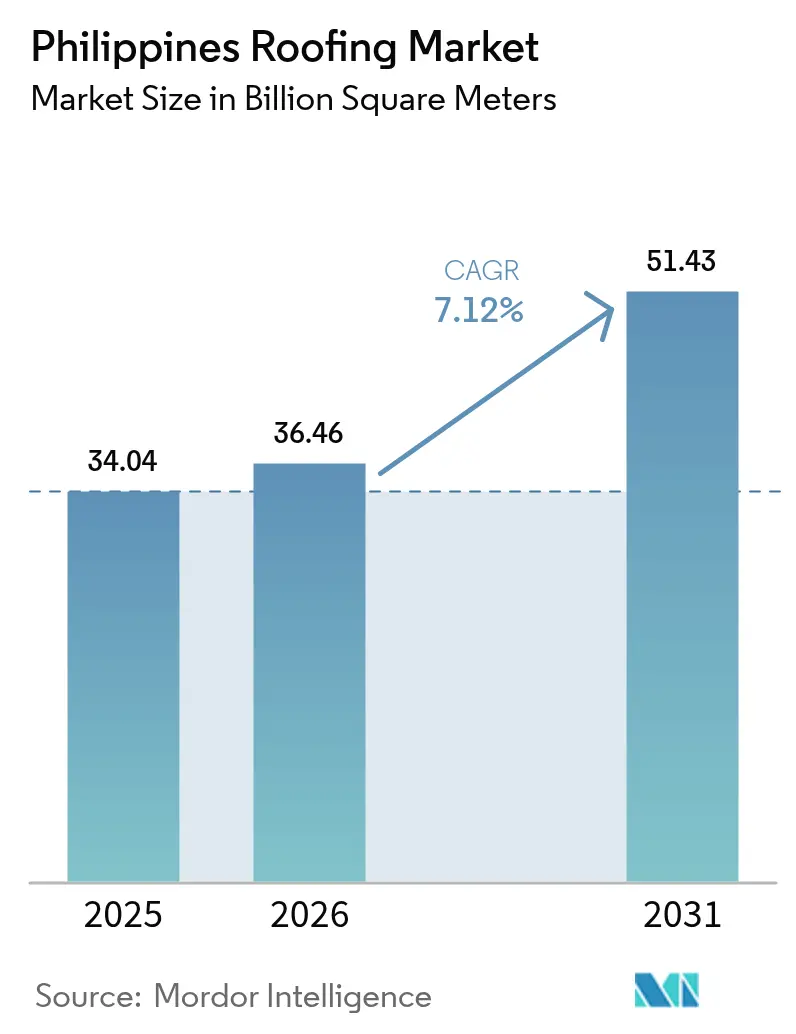
| Base Year Market Size (2025) | 34.04 Billion square meters |
| Market Volume (2026) | 36.46 Billion square meters |
| Market Volume (2031) | 51.43 Billion square meters |
| Growth Rate (2026 - 2031) | 7.12 % |
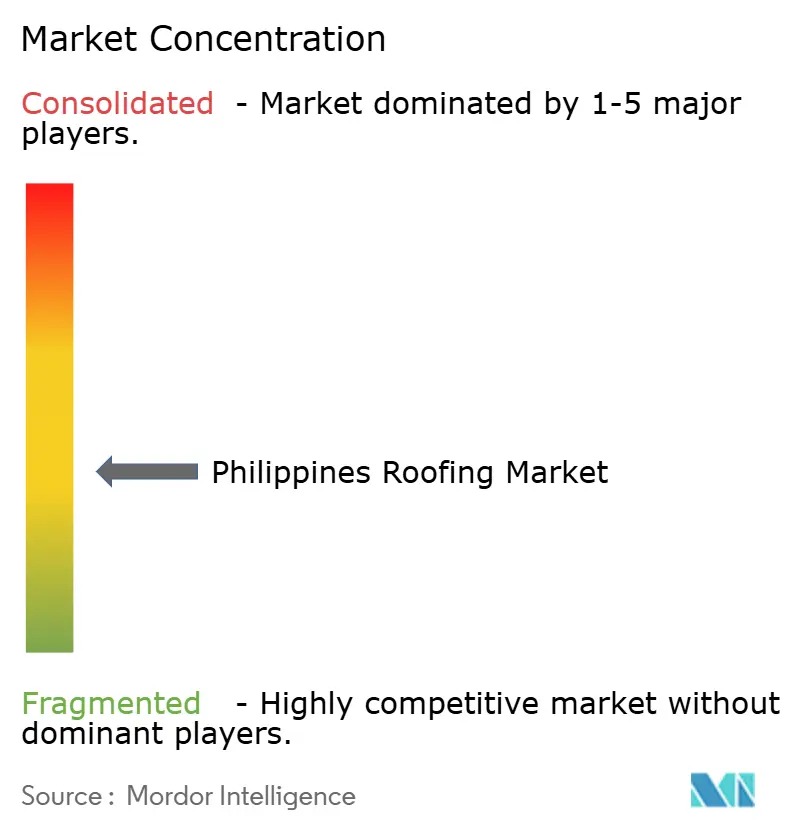
| Market Concentration | Medium |
Major Players *Disclaimer: Major Players sorted in no particular order Image © Mordor Intelligence. Reuse requires attribution under CC BY 4.0. | |
Philippines Roofing Market Analysis by Mordor Intelligence
Philippines Roofing market size in 2026 is estimated at 36.46 billion square meters, growing from 2025 value of 34.04 billion square meters with 2031 projections showing 51.43 billion square meters, growing at 7.12% CAGR over 2026-2031. Growth is underpinned by the Build Better More public works pipeline, resilient overseas Filipino worker (OFW) remittance inflows, and stricter rules that demand typhoon-ready building envelopes. Metal panels dominate because they satisfy the National Structural Code’s wind-load test and act as a ready substrate for rooftop solar, aligning with the Department of Energy’s goal of photovoltaic capacity by 2030. Pag-IBIG’s subsidized mortgage rate and the 4PH housing program’s one-million-units-per-year pledge funnel demand toward cost-effective pre-painted galvanized steel, while regional reconstruction after Super Typhoon Pepito keeps replacement activity elevated. Raw-material price swings and a shortage of TESDA-certified installers temper margins but have not derailed expansion, as local steel mills and global brands race to launch solar-ready, cool-roof products that fetch healthy premiums.
Key Report Takeaways
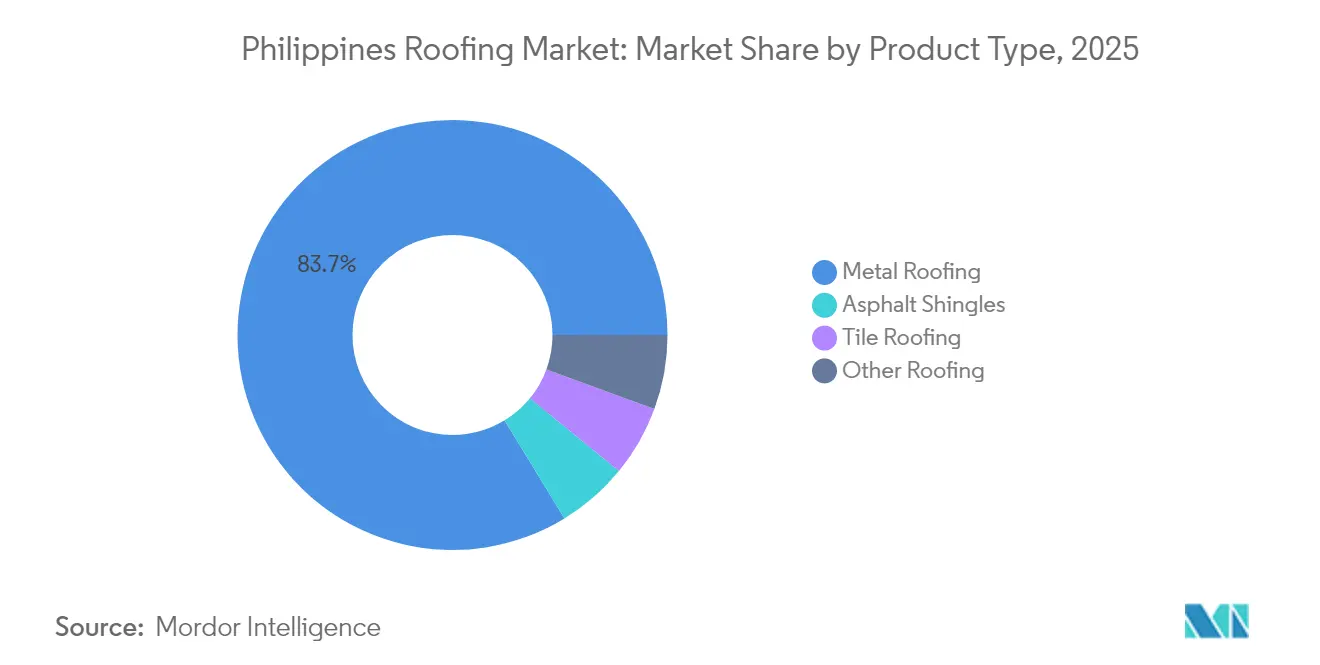
- By product type, metal roofing led with 83.72% of the Philippines' roofing market share in 2025 and is forecasted to grow at a 7.55% CAGR through 2031.
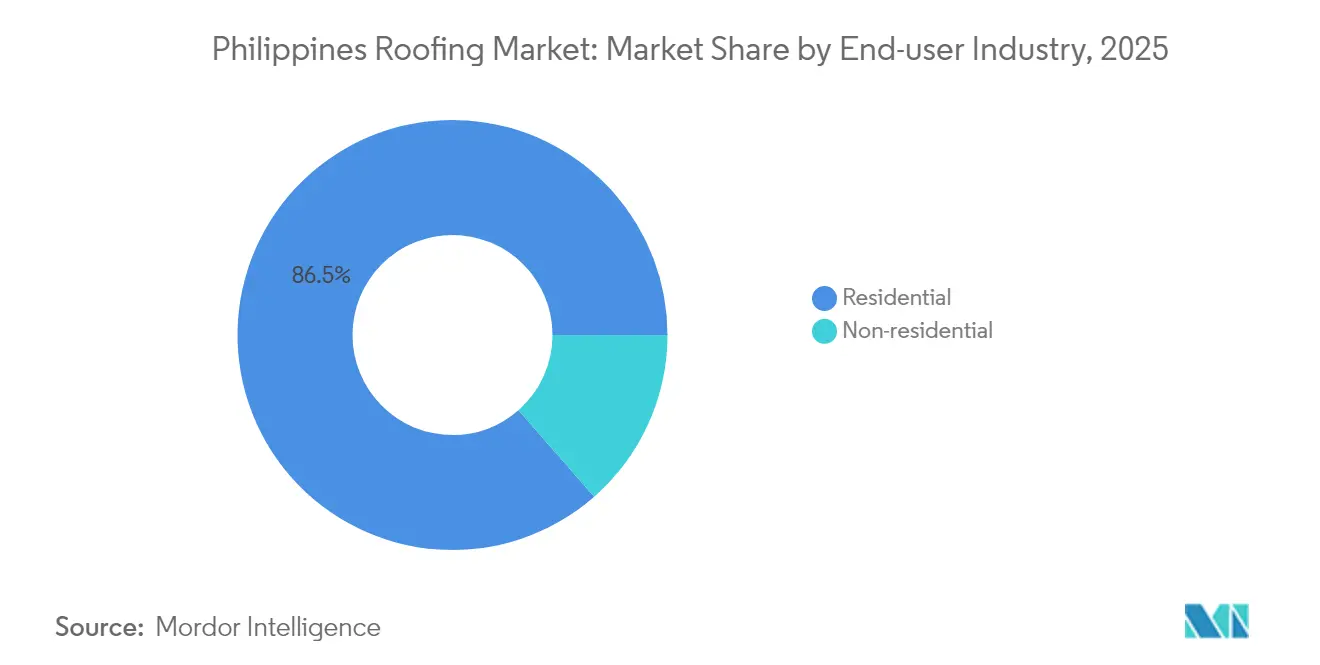
- By end-user industry, the residential segment accounted for 86.45% of the Philippines' roofing market size in 2025 and is projected to expand at a 7.18% CAGR through 2031.
Note: Market size and forecast figures in this report are generated using Mordor Intelligence’s proprietary estimation framework, updated with the latest available data and insights as of 2026.
Philippines Roofing Market Trends and Insights
Drivers Impact Analysis*
| Drivers | (~) % Impact on CAGR Forecast | Geographic Relevance | Impact Timeline |
|---|---|---|---|
| Build Better More infrastructure surge | +1.8% | National, especially Metro Manila, Calabarzon, Central Visayas | Medium term (2-4 years) |
| OFW-funded residential boom | +2.1% | Ilocos, Bicol, Western Visayas | Long term (≥4 years) |
| Green and energy-efficient code momentum | +0.9% | Metro Manila, Cebu City, Davao City | Long term (≥4 years) |
| National push for typhoon-resilient envelopes | +1.5% | Coastal provinces, Eastern Visayas, Bicol | Short term (≤2 years) |
| Emergence of solar-ready metal roofs | +1.2% | Luzon and Visayas grids | Medium term (2-4 years) |
| Source: Mordor Intelligence | |||
Surge in Build Better More Infrastructure Pipeline
The Build Better More plan features flagship projects, including those that specify new roofing for public markets, evacuation centers, and transport hubs. Pre-engineered metal roofs with long-term warranties have become the default option in these tenders, securing significant annual demand throughout the forecast period. National procurement rules now privilege systems with superior wind-uplift ratings, nudging local governments in key regions to copy the federal template. A 2025 budget of PHP 1.507 trillion preserves infrastructure outlays at 5.2% of GDP, smoothing the project pipeline despite fiscal tightening[1]. This accelerated timetable shortens the public-building replacement cycle in high-traffic facilities, helping sustain the Philippines' roofing market beyond the current construction surge.
Residential Construction Boom Driven by OFW Remittances
OFW remittances increased in 2024, demonstrating growth compared to the previous year and making a significant contribution to GDP. Surveys indicate a notable portion of this income is allocated to homebuilding, resulting in substantial spending on roofs and envelopes. Pag-IBIG’s subsidy lowers effective interest rates on mortgages, encouraging buyers to opt for specific metal brackets. Provinces with large migrant-worker communities, such as Pangasinan and Iloilo, experienced significant growth in residential permits in 2024, surpassing the national average. Since remittances are influenced by global labor demand rather than local economic cycles, this cash flow provides the Philippines' roofing market with a dependable long-term advantage.
Momentum Toward Green and Energy-Efficient Building Codes
The Philippine Green Building Code requires new commercial structures to reduce energy use, a threshold that has been further tightened in DOE Circular DC2024-08-0024. BERDE certifications have increased as developers have pursued cool roofs that reflect more solar heat and trim air conditioning loads. Government offices now mandate reflective metal surfaces on all new buildings, pushing private contractors to standardize on similar materials to streamline procurement. Although cool-roof coatings cost more than standard finishes, paybacks appeal to asset owners with long hold periods. Fast-track permit incentives in Metro Manila for projects that beat efficiency baselines further enlarge this premium niche.
National Push for Typhoon-Resilient Building Envelopes
Typhoon Kristine and Super Typhoon Pepito caused significant infrastructure damage and destroyed numerous homes in late 2024. Post-event audits showed fewer failures on houses clad with pre-painted galvanized steel that meets NSCP 2015 wind-load standards. Municipal engineers in coastal provinces now informally require metal roofs for new permits, further constricting asphalt and tile demand. Insurance carriers respond with premium discounts for certified typhoon-resistant designs, translating safety into a financial benefit. Build Better More also devotes resources to disaster-risk-reduction projects through 2028, many of which involve reroofing public buildings in high-risk zones.
Restraints Impact Analysis*
| Restraints | (~) % Impact on CAGR Forecast | Geographic Relevance | Impact Timeline |
|---|---|---|---|
| Raw-material price volatility | −1.3% | Nationwide, highest in import-heavy areas | Short term (≤2 years) |
| High upfront cost of premium systems | −0.8% | Metro Manila, Cebu, Davao | Medium term (2-4 years) |
| Shortage of certified installers | −0.6% | Regions I, II, V, VIII | Long term (≥4 years) |
| Source: Mordor Intelligence | |||
Raw-Material Price Volatility
Galvanized-steel prices rose in 2024 as China limited exports and freight rates climbed. With imports covering a significant portion of domestic steel use, currency shifts and trade policies immediately pass through to roof quoting. Bitumen cost spikes squeezed asphalt-shingle margins, prompting manufacturers to curtail promotions in the retrofit channel. Local mills meet only a portion of steel demand, so contractors now shorten price-validity windows, complicating project budgeting. A lack of hedging tools in the Philippine futures market amplifies volatility, discouraging developers from stockpiling ahead of builds. Although backward-integrated players such as Philsteel cushion shocks, the broader Philippines roofing market remains sensitive to global raw-material cycles.
High Upfront Cost of Premium Roofing Systems
Cool-roof, solar-ready panels sell at a premium compared to standard galvanized steel. Energy savings and lower upkeep costs offset this premium over time, yet buyers with limited income struggle to finance the extra outlay. Construction loans often leave little room for upgrades once land and structural costs are paid. Commercial owners with long-term leases accept the payback period, but speculative builders favor cheaper roofs to speed cash recovery. A shortage of green-finance products, such as energy-efficiency mortgages, further slows premium uptake.
*Our forecasts treat driver/restraint impacts as directional, not additive. The impact forecasts reflect baseline growth, mix effects, and variable interactions.
Segment Analysis
By Product Type: Metal Roofing Locks in Solar-Ready Premium
Metal panels accounted for 83.72% of the Philippines Roofing Market share in 2025 and are expected to grow at a rate of 7.55% through 2031, outpacing the overall market. Pre-painted galvanized steel is widely used due to its low weight, compliance with wind codes, and cost-effectiveness, making it the primary choice. Within the metal industry, solar-ready variants are scaling rapidly as installers pair mounting rails with the net-metering boom. Premium coatings are also gaining traction, particularly in coastal zones where corrosion resistance is a priority.
Tile roofs maintain a presence in heritage districts and luxury estates, where aesthetics are prioritized over cost and structural load. However, their heavier weight limits their use in typhoon-prone areas. Asphalt shingles are used in retrofit jobs for older Metro Manila subdivisions where rafters cannot support heavier tiles. Rising bitumen costs and informal coastal bans after severe typhoons are impacting this segment. Other materials, such as bituminous sheets, polycarbonate, and nipa thatch, are used for temporary structures and farms, but their share is declining as public housing increasingly adopts metal roofing.

By End-User Industry: Residential Anchors Volume, Non-Residential Captures Value
The residential channel accounted for 86.45% of the Philippines Roofing Market size in 2025 and is projected to grow at 7.18% from 2025 to 2031, driven by overseas remittances and government housing targets. Single-family homes outside Metro Manila predominantly choose budget aluminum-zinc panels that strike a balance between affordability and typhoon safety. Condominium and townhouse developers in major cities are increasingly adopting cool-roof metal to meet green building standards, driving growth in this premium segment. Government housing projects are also contributing to consistent demand for metal panels.
Non-residential work, while holding a smaller share of volume, contributes a larger share of revenue due to the preference for thicker gauges, cool coatings, and longer warranties in malls, warehouses, and municipal buildings. Infrastructure projects are creating significant demand for roofing materials. Incentives for solar-ready metal roofs are encouraging commercial owners to adopt energy-efficient options, reducing long-term energy costs. Although its growth rate is slightly lower than that of residential work, the higher margins in non-residential work make it a strategic focus for producers.
Geography Analysis
Metro Manila generated significant volume thanks to condominium towers, office build-outs, and civic projects tethered to Build Better More. High-rise sites specify cool-roof, solar-ready metal, whereas older districts still re-cover homes with asphalt shingles when rafter loads are restrictive. Net-metering approvals in the capital reinforced premium demand. Yet land scarcity means fewer square meters of roof per dwelling, capping Metro Manila’s expansion below the national pace.
Calabarzon and Central Visayas jointly represent a substantial portion of the Philippines' roofing market, propelled by OFW-funded self-builds and 4PH sites. Cavite, Laguna, and Cebu accounted for the bulk of the rise in residential permits, largely for single-story homes that standardize on galvanized sheets. Industrial parks surrounding Batangas ports and Mactan Airport also adopt pre-engineered metal roofs with long-term warranties, lifting the average revenue per square meter above the residential norm.
Bicol and Eastern Visayas contribute to the volume but lead growth, underwritten by reconstruction funds after Super Typhoon Pepito. Local permit offices now require metal panels for new builds, accelerating the displacement of tile and asphalt. The rest of Luzon and Mindanao, including Ilocos, Cagayan Valley, Western Visayas, Northern Mindanao, and SOCCSKSARGEN, account for a significant portion of demand. These areas rely on agriculture and remittance income, sustaining a steady flow of single-family projects that keep metal penetration high. Regional variations, therefore, reflect funding sources and disaster exposure, not fundamental material preferences, reinforcing metal’s nationwide supremacy in the Philippines' roofing market.
Value Chain Analysis
The Philippines roofing value chain starts with upstream inputs, primarily galvanized and pre-painted steel coils and sheets, plus polymer and chemical inputs for coatings, sealants, insulation, and PVC-based roofing components. Domestic petrochemical feedstock shortages keep core resins such as PE, PP, and PVC import-reliant, transmitting foreign-exchange and freight swings into roofing system costs. In metal, local integrated players convert coils into profiles and accessory systems, while importers supply certain grades and finishes.
Midstream processing and assembly is handled by local roll-formers and roofing-system suppliers (for example, Puyat Steel Corporation and PHINMA Construction Materials Group via Union Galvasteel), alongside building-system firms such as DwightSteel Building Systems Inc. Distribution is dealer-led, moving through wholesalers, hardware chains, and project-based supply to contractors and fabricators, with public works and housing programs amplifying tender-driven demand for certified products. Supplier selection hinges on quality and compliance, including DTI standards such as DAO 20-10 requiring certification for galvanized steel coils and sheets. Downstream channels increasingly bundle roofing with add-ons such as solar-ready mounting interfaces, as firms market integrated roof-and-PV propositions through construction trade platforms.
Competitive Landscape
The Philippines Roofing Market is moderately fragmented. Foreign specialists target niche markets instead of broad volumes. Digitization remains sparse. Very few projects use building information modeling to optimize panel cuts, and modular fabrication is even rarer. Early adopters report waste reduction and faster installation, suggesting process innovation could join product features as a differentiation lever. Given the volatility of raw materials and labor shortages, incumbents that control both steel conversion and field execution appear best positioned to increase their share of the Philippines' roofing market over the next five years.
Philippines Roofing Industry Leaders
-
Colorsteel Systems Corporation
-
DN Steel
-
Union Galvasteel Corporation
-
Philsteel Holdings Corporation
-
Jacinto Color Steel Inc.
- *Disclaimer: Major Players sorted in no particular order
Market Opportunities and Future Outlook
Product and service whitespace is building around compliance-driven, higher-spec roofing systems that link typhoon resilience with energy performance, beyond basic re-roofing. The Green Building Code momentum and the national Energy Efficiency and Conservation Roadmap 2017-2040 support more standardized use of reflective finishes, insulation-backed assemblies, and tested fastening packages, turning documentation into a differentiator for suppliers. The Construction Industry Roadmap 2020-2030 also pushes sustainability and technological integration, supporting shifts toward more engineered roof specifications, QA documentation, and digitally assisted planning that can reduce material waste and shorten installation time.
On the supply side, import dependence for key polymers and some steel inputs keeps attention on local value addition and import-substitution opportunities, especially for PVC-based roofing components and accessory products that can be localized through downstream conversion. Industry bodies such as the Philippine Plastics Industry Association (PPIA) provide an engagement platform for standards and policy alignment for polymer-based components used in roofing assemblies. While price volatility remains a constraint, monitoring via the Philippine Statistics Authority's Construction Materials Wholesale Price Index (CMWPI) reflects an active procurement environment in which contractors and developers track commodity movements closely, favoring suppliers that can offer stable availability, shorter lead times, and compliant system documentation for public procurement and large private projects.
Recent Industry Developments
- July 2026: Union Galvasteel Corporation supported PALAFOX Associates 37th anniversary, highlighting sustainability-linked positioning with a prominent architecture and design firm. The engagement strengthens specification-led selling for higher-performance roofing and building-envelope materials in large private developments.
- February 2025: GAF Materials LLC expanded its energy-efficient roofing portfolio with reflective-roof designs and recycled-content membranes across multiple distributor networks in Asia. This rollout broadens availability of cool-roof solutions to commercial and residential projects in the region.
- February 2024: China limited exports and freight rates climbed, contributing to higher galvanized-steel price levels that affected roofing quotations in the Philippines. Contractors responded by tightening quote-validity windows and adjusting procurement timing, shaping how suppliers manage inventory and pricing with dealers and project buyers.
Research Methodology Framework and Report Scope
Market Definition and Coverage
For this report, we define the Philippines roofing market as demand for roofing materials used to cover and protect buildings, captured as roof area installed over the study period. The market is measured in square meters and reflects activity across new build and replacement needs.
Scope exclusions: structural framing, insulation boards, and non-roof cladding are excluded even when they are procured alongside roofing work.
Segmentation Overview
- By Product Type
- Asphalt Shingles
- Tile Roofing
- Metal Roofing
- Other Roofing
- By End-user Industry
- Residential
- Non-residential
Data Sources, Market Sizing, and Validation
Desk Research
Desk work was used to build the base demand picture and keep assumptions realistic for local construction patterns. We relied on public construction and housing indicators, including Philippine Statistics Authority releases, Department of Public Works and Highways project updates, and building permit and floor area series that indicate roofable demand.
To translate construction activity into roofing area, we screened public references for typical roof-to-floor area relationships, common roof pitches, and the material mix. This included technical standards documents, peer-reviewed civil engineering papers, and product specification sheets that state coverage and wastage guidance. Trade and price direction were checked using sources such as UN Comtrade, Bureau of Customs summaries, and public tariff headings, then cross-checked with company filings, investor materials, association websites, and reputed local business press. Where useful, we also referenced paid subscriptions for company financials and intelligence, and an import-export shipment-level database to validate the direction of supply. These desk research sources are illustrative, and many other public references were used for data collection, validation, and clarification.
Primary Interviews and Surveys
Primary conversations were used to pressure-test the desk assumptions on material preference, on-site wastage, and the split between new construction and replacement demand, which can shift after typhoon seasons. We spoke with contractors, distributors, installers, and building material stakeholders. We also ensured coverage across major demand centers and provincial markets so the final model did not overfit to Metro Manila alone.
Distribution of primary research fieldwork respondents
| Company type | Respondent position |
|---|---|
| Top tier: 30% | CXOs: 13% |
| Mid tier: 52% | Functional/Unit leaders: 35% |
| Smaller Players: 18% | Managers: 52% |
Market-Sizing & Forecasting
The core sizing model uses a top-down build from the national construction demand pool, where building permits, floor area additions, and public works momentum are translated into roof area installed each year. Once the annual roofable area is reconstructed, it is adjusted using inputs such as the share of re-roofing versus new build, typical roof-to-floor area ratios by building type, material coverage rates, and expected wastage and overlaps during installation.
To keep totals grounded, we corroborated the results with selective bottom-up checks, such as sampled channel feedback on volumes sold, distributor throughput patterns, and a simple coverage-per-unit logic for common product formats. When province-level gaps appeared, we used construction activity proxies and then scaled them with interview-led normalization factors.
For forecasting, we used scenario analysis supported by short time-series smoothing. The near-term outlook follows stated public infrastructure pipelines and housing activity, then converges to steady replacement-driven demand. Key inputs varied in scenarios include construction growth, storm-related repair intensity, mix shifts toward metal roofing, and installation wastage ranges. These inputs were reconciled to a single, publishable forecast path.
Data Validation & Update Cycle
Validation was done through several passes so the market totals align with what is visible in independent signals. We compared modeled roof area against construction floor area trends, import direction for key roofing headings, and interview feedback on seasonality and supply tightness, then investigated any large variances before locking assumptions.
If an outlier was found, we re-checked the underlying driver and then made a quick follow-up with relevant respondents to confirm whether the change was real or data-related. Reports are refreshed annually, and interim checks are triggered when there are material events such as sudden policy shifts, major storm clusters, or sharp movements in key raw material prices. Before delivery, an analyst performs a fresh pass so clients receive the latest updated view.
Mordor Intelligence's Philippines Roofing Market Size Versus Other Published Estimates
Published market sizes for the Philippines roofing space can look far apart because the market can be expressed as area installed or as revenue, and because the included activities are not always the same. Differences also show up when one source treats re-roofing as a separate repair market, or when the year and currency conversion timing are not aligned.
Roofing labor and installation services sit outside Mordor Intelligence's scope here, which is one reason a revenue-based estimate can be higher even if it reflects similar on-ground demand. Some publications also rely on a single construction proxy without checking roof geometry, wastage, and post-typhoon replacement cycles, which can understate area demand in volatile years.
Benchmark comparison
| Source | Market Size | Gaps in Research Methodology |
|---|---|---|
| Mordor Intelligence | USD 34.04 B (2025) | |
| Global Consultancy A | USD 3.26 B (2026) | Reported in revenue terms and appears to include a wider system definition, which can fold in installation value and broader roof-solution bundles. The longer forecast window also increases sensitivity to assumed price escalation and mix shifts. |
| Trade Publisher B | USD 0.22 B (2024) | Lower total likely reflects a narrower product set or a partial channel capture for the year shown, and it is not clear how re-roofing and storm-driven replacement were treated. Differences in year selection and currency timing can further compress the figure. |
Looking across the figures, the spread mainly comes from unit of measurement and what gets counted with roofing demand. By keeping inputs traceable to roofable construction activity, replacement intensity, and coverage factors, we can explain each step and reconcile why revenue-led totals may move differently than area-led totals.
Key Questions Answered in the Report
What is the current size of the Philippines roofing market?
The Philippines roofing market size is projected to be 36.46 billion square meters in 2026 and is expected to reach 51.43 billion square meters by 2031.
Which material dominates Philippine roofing demand?
Metal panels account for 83.72% of the 2025 volume, as they meet typhoon wind codes and integrate easily with rooftop solar systems.
Why are OFW remittances important to roofing suppliers?
Remittances contribute billions of dollars to annual homebuilding expenditures, supporting steady 7.18% growth in residential roofing volume.
Which region is the fastest-growing roofing market?
Bicol and Eastern Visayas lead with reconstruction funds, accelerating rebuilding.