
Market Overview
| Study Period | 2021 - 2031 |
|---|---|
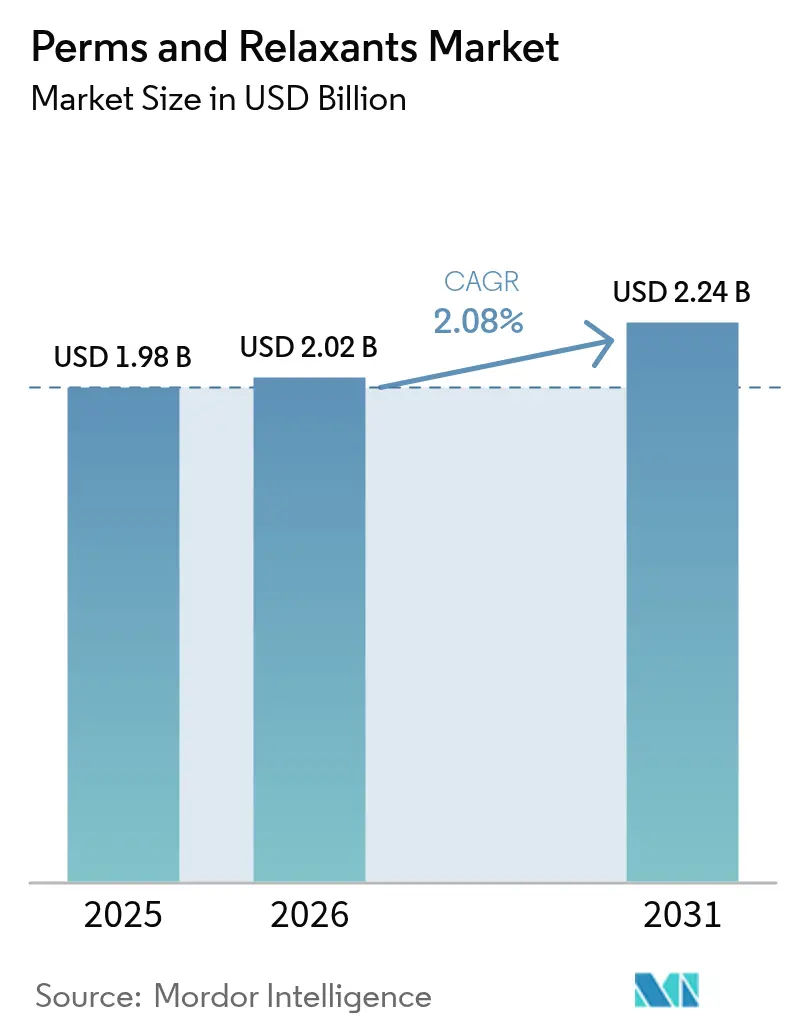
| Market Size (2026) | USD 2.02 Billion |
| Market Size (2031) | USD 2.24 Billion |
| Growth Rate (2026 - 2031) | 2.08 % |
| Fastest Growing Market | Asia-Pacific |
| Largest Market | Asia Pacific |
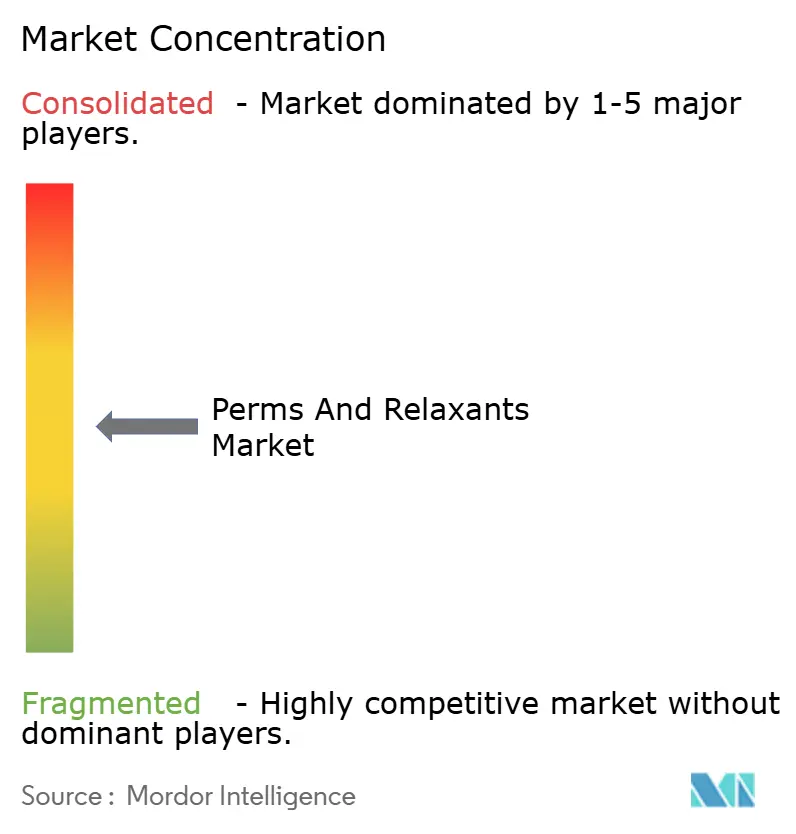
| Market Concentration | Medium |
Major Players *Disclaimer: Major Players sorted in no particular order Image © Mordor Intelligence. Reuse requires attribution under CC BY 4.0. | |
Perms And Relaxants Market Analysis by Mordor Intelligence
The perms and relaxants market size is expected to grow from USD 1.98 billion in 2025 to USD 2.02 billion in 2026 and is forecast to reach USD 2.24 billion by 2031 at 2.08% CAGR over 2026-2031. This moderate expansion is driven by a combination of increasingly stringent chemical-safety regulations, the influence of social media trends promoting textured hairstyles, and rising disposable incomes across the Asia-Pacific region. Regulatory authorities in North America, Europe, and Asia are imposing tighter limits on formaldehyde and thioglycolic acid, prompting manufacturers to adopt safer active ingredients and bond-repair technologies. Concurrently, platforms such as TikTok and Instagram, with content focused on curls and textured styles, are revitalizing consumer interest in hair texture management. Salon professionals are also embracing low-damage formulations to ensure client safety. In response, multinational corporations are introducing clean-label innovations and device-assisted delivery systems, while regional players leverage their expertise in ethnic hair care and agile digital distribution strategies.
Key Report Takeaways
- By product type, relaxants led with 53.02% of the perms and relaxants market share in 2025; perms are forecast to expand at a 4.68% CAGR through 2031.
- By form, creams & lotions commanded 61.05% of the 2025 revenue, while gels are poised to grow at a 3.58% CAGR to 2031.
- By distribution channel, professional services accounted for 55.63% of 2025 sales; however, retail channels are projected to rise at a 4.24% CAGR through 2031.
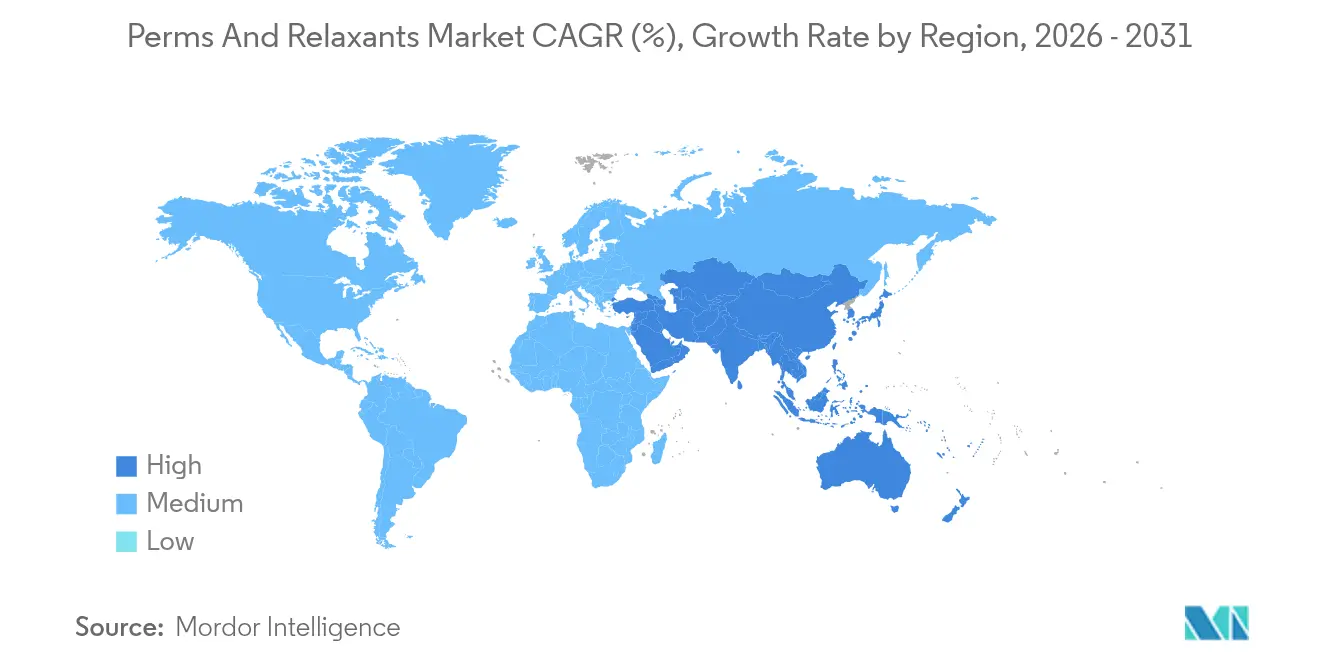
- By geography, the Asia-Pacific region captured 34.05% of the 2025 value and is advancing at a 3.92% CAGR, the fastest regional growth rate.
Note: Market size and forecast figures in this report are generated using Mordor Intelligence’s proprietary estimation framework, updated with the latest available data and insights as of 2026.
Global Perms And Relaxants Market Trends and Insights
Drivers Impact Analysis*
| Driver | (~) % Impact on CAGR Forecast | Geographic Relevance | Impact Timeline |
|---|---|---|---|
| Rising demand for texture management solutions | +0.6% | Global, with concentration in Asia-Pacific, North America, and Africa | Medium term (2-4 years) |
| Growth in professional salon services | +0.5% | North America, Europe, Asia-Pacific urban centers | Medium term (2-4 years) |
| Expanding influence of beauty and social media trends | +0.4% | Global, strongest in Asia-Pacific and North America | Short term (≤ 2 years) |
| Increased focus on long-lasting styling solutions | +0.3% | Global, particularly Asia-Pacific and Middle East | Long term (≥ 4 years) |
| Growth in ethnic hair care demand | +0.5% | Africa, Asia-Pacific, North America (diaspora communities) | Long term (≥ 4 years) |
| Innovation in low-damage and clean formulations | +0.4% | North America, Europe, Asia-Pacific | Medium term (2-4 years) |
| Source: Mordor Intelligence | |||


Rising demand for texture management solutions
Consumer demand for texture modification remains a central driver in the haircare market; however, the underlying motivation has shifted from uniformity to versatility. Industry professionals observe a growing preference for temporary or reversible texture changes, such as perms to enhance volume or relaxants to improve manageability, rather than permanent alterations. This trend is reinforced by social-media platforms, where users frequently display multiple hairstyles over short periods. By late 2024, TikTok’s #RelaxerTok had garnered over 600 million views, highlighting that, despite health advisories, a segment of consumers prioritizes aesthetic control. For manufacturers, this signals a clear requirement: product formulations must strike a balance between performance and safety, while marketing strategies should emphasize flexibility over permanence, reflecting the episodic styling behaviors of digitally native consumers.
Growth in professional salon services
Professional channels accounted for 56.28% of market distribution in 2024, underscoring consumers’ readiness to pay a premium for expert application when chemical treatments present potential health risks. Salon professionals receive specialized training to minimize scalp contact and limit exposure duration, capabilities that over-the-counter kits often struggle to match. Under the EU’s Regulation 1223/2009, thioglycolic acid is permitted at concentrations of up to 11% for professional formulations, compared with 8% for consumer-use products, effectively embedding a regulatory advantage for salon-based services. Nevertheless, the professional segment is experiencing margin pressures driven by rising labor costs and growing competition from direct-to-consumer brands that provide instructional content and virtual guidance. These dynamics indicate that the salon channel will need to adopt integrated digital engagement strategies to maintain its competitive position.
Expanding influence of beauty and social media trends
Social-media platforms have significantly shortened the time between trend emergence and measurable market impact. Procter & Gamble reported a 4,000% increase in Google searches for “how to moisturise scalp” during the four weeks ending 17 October 2024, following a series of TikTok posts linking scalp care to hair-texture outcomes, an example of how platform algorithms can rapidly stimulate demand in adjacent product categories[1]Source: Procter & Gamble, “Scalp Health Trends,” pg.com. Similarly, the “glass hair” trend, characterized by highly reflective, straight styles, drove volume growth of 10.9% for L’Oréal’s Elvive shampoo and 13.6% for its conditioner range in 2024, underscoring the capacity of aesthetic movements to reinvigorate mature product lines. For the perms and relaxants category, these dynamics necessitate shorter formulation and innovation cycles to align with accelerated trend velocity, as well as agile influencer collaborations capable of adjusting brand messaging as consumer preferences oscillate between sleek and textured looks.
Innovation in low-damage and clean formulations
Regulatory scrutiny and heightened consumer skepticism are catalyzing a broad reformulation cycle across the haircare industry. L’Oréal’s Colorsonic, introduced in June 2024, exemplifies this transition: protected by 29 patents, the device omits ammonia, silicones, parabens, sulfates, and phthalates, appealing to consumers seeking color innovation without perceived chemical compromise[2]Source: L’Oréal, “Colorsonic: Automated Hair Coloring Device,” loreal.com. In March 2025, the French Agency for Food, Environmental and Occupational Health & Safety issued an advisory linking glyoxylic acid, commonly used as a formaldehyde substitute, to cases of acute kidney failure, highlighting that ingredient substitution strategies entail their own safety considerations and that “clean” claims must be grounded in robust toxicological evidence. In parallel, China’s National Medical Products Administration expanded its cosmetic-ingredient database from 2,234 to 3,608 entries in February 2025, indicating greater regulatory receptivity to novel actives capable of delivering texture modification with improved safety profiles. Companies advancing bond-repair technologies, which aim to reconstruct disulfide bonds disrupted during chemical texturizing processes, are well-positioned to capture demand for premium, high-performance solutions.
Restraints Impact Analysis*
| Restraint | (~) % Impact on CAGR Forecast | Geographic Relevance | Impact Timeline |
|---|---|---|---|
| Concerns over chemical safety and hair damage | -0.4% | Global, most acute in North America and Europe | Short term (≤ 2 years) |
| Regulatory scrutiny on ingredients | -0.3% | North America, Europe, China, Brazil | Medium term (2-4 years) |
| Shift toward natural hair movements | -0.2% | North America, Europe, urban Africa | Long term (≥ 4 years) |
| High cost of professional salon services | -0.2% | Global, particularly emerging markets | Medium term (2-4 years) |
| Source: Mordor Intelligence | |||
Concerns over chemical safety and hair damage
Heightened health concerns and expanding legal exposure are reshaping the chemical straightening category. NIH research in 2022 linked frequent straightener use to a 4.05% lifetime uterine cancer risk versus 1.64% for non-users, helping trigger more than 8,500 consolidated federal lawsuits alleging undisclosed endocrine-disrupting hazards. The 2023 Black Women’s Health Study reported a 30% elevated risk among Black women using lye-based relaxers seven or more times per year for over 15 years, an acute concern for a demographic with 60% current usage and lifetime penetration of 84% to 95%. Trust eroded further when New York State’s Department of Health detected formaldehyde in products labeled “formaldehyde-free,” prompting additional class actions against major manufacturers. As litigation pressures margins and accelerates reformulation, even as companies dispute causation, closing the credibility gap will require transparent ingredient disclosure, rigorous safety validation, and independent third-party testing.
Regulatory scrutiny on ingredients
Regulatory fragmentation is intensifying compliance challenges for the hair-straightening and perm segments. The U.S. FDA proposed a ban on formaldehyde-releasing agents in April 2024; however, repeated delays have left the timelines uncertain. Meanwhile, California and Maryland implemented state-level prohibitions, effective in 2025, forcing brands to manage multiple formulations. In Canada, thioglycolic acid esters were added to the prohibited list in February 2025, directly affecting perm products[3]Source: Health Canada, “Cosmetic Ingredient Hotlist,” canada.ca. The EU’s Regulation 1223/2009 limits thioglycolic acid to 8% for general use and 11% for professional applications, and France plans a per- and polyfluoroalkyl substances ban by early 2026. Brazil’s ANVISA Resolution 907, effective September 2024, requires registration for all hair-styling products, raising entry barriers but legitimizing compliant brands. These overlapping rules escalate R&D costs, extend the time-to-market, and give an advantage to large multinationals with dedicated regulatory affairs teams over smaller innovators.
*Our forecasts treat driver/restraint impacts as directional, not additive. The impact forecasts reflect baseline growth, mix effects, and variable interactions.
Segment Analysis
By Product Type: Perms Outpace Relaxants Despite Smaller Base
In 2025, relaxants accounted for 53.02% of the market, reflecting entrenched demand in regions that favor straight-hair aesthetics. Meanwhile, perms are projected to grow at a 4.68% CAGR through 2031, driven by wave and curl trends amplified on Instagram and TikTok. This divergence highlights a generational shift: older consumers maintain relaxant routines for manageability, whereas younger cohorts seek texture for volume and movement. L’Oréal’s April 2025 patent for an aerosol-based dye system with potential perm applications illustrates the company's investment in delivery innovation to capture faster-growing segments. Regulatory changes, such as Canada’s February 2025 ban on thioglycolic acid esters, are prompting manufacturers to adopt alternative reducing agents like cysteamine or enzymatic processes, aligning with clean-beauty positioning.
Relaxants face added complexity from litigation over elevated uterine cancer risk, with over 8,500 federal lawsuits creating a margin and marketing overhang, even as TikTok’s #RelaxerTok surpassed 600 million views, demonstrating social-media influence on consumer behavior. Africa remains a growth opportunity, with countries such as Tunisia and Kenya posting ~10% sales growth over five years ending 2022, fueled by expanding middle classes and aspirational views of texture management. Strategically, relaxant brands must balance legacy formulations for mature markets with reformulated, formaldehyde-free variants tailored to regions with tightening regulations.



By Form: Gels Gain as Precision Application Reduces Irritation
In 2025, creams and lotions accounted for 61.05% of the perms and relaxants market, driven by the ease of application, consumer familiarity, and salon preference for thick consistencies that minimize dripping and uneven coverage. Gels, however, are projected to grow at 3.58% CAGR through 2031, the fastest among form segments, as precision-targeting formulations reduce scalp contact and irritation. EU Regulation 1223/2009 permits higher concentrations of thioglycolic acid for professional use, and gel formats enable stylists to apply actives to hair shafts while minimizing skin exposure, thereby satisfying both efficacy and safety requirements. Traditional liquid and solution formats, favored for perms due to their rapid penetration, are losing market share amid consumer demand for greater control and increased regulatory scrutiny of volatile organic compounds.
The rise of gels also aligns with the “skinification” of haircare, where consumers seek formulations incorporating skincare actives such as hyaluronic acid, vitamin C, and glycolic acid; gel systems effectively suspend these hydrophilic ingredients without phase separation. Examples include Unilever’s February 2024 Tresemmé Lamellar Shine, which combines texture modification with shine-enhancing serums for the “glass hair” trend, and L’Oréal’s Colorsonic device, demonstrating that innovative delivery can command premium pricing while bypassing traditional form constraints. The “Other” category, mousses, sprays, and powder-to-liquid systems, remains niche but is attracting R&D investment as brands pursue differentiation in a commoditized market.
By Distribution Channel: Retail Surges as E-Commerce Erodes Salon Gatekeeping
Professional channels accounted for 55.63% of distribution in 2025, supported by consumers’ willingness to pay for expert application in chemical treatments that carry health risks, while retail is projected to grow at a 4.24% CAGR through 2031, driven by e-commerce platforms and direct-to-consumer brands offering instructional content, virtual consultations, and subscription models. Deloitte’s 2024 Consumer Products Outlook found that most personal-care executives plan to expand direct-to-consumer channels, reflecting the advantages of higher margins and richer consumer insights compared with wholesale relationships. Within the retail sector, online stores are the fastest-growing sub-channel, drawing traffic from supermarkets, hypermarkets, and drugstores due to consumer demand for convenience and price transparency.
Drugstores and pharmacies maintain their relevance by positioning perms and relaxants alongside dermatologist-recommended haircare, leveraging trust signals that are unavailable to pure-play e-tailers. Meanwhile, convenience stores capture impulse and top-up purchases in emerging markets with low salon density. The strategic challenge lies in managing channel conflict: salons resist brands that undercut their pricing, yet manufacturers require retail volume to amortize R&D investments. L’Oréal’s Colorsonic exemplifies one approach, combining premium pricing with direct-to-consumer availability that salons cannot easily replicate, while ingredient bifurcation, offering higher-concentration actives to professionals and milder formulations to retail, leverages regulatory allowances such as the EU’s tiered thioglycolic acid limits.

Geography Analysis
Asia-Pacific accounted for 34.05% of the perms and relaxants market in 2025 and is projected to grow at a 3.92% CAGR through 2031, the fastest among regions, driven by rising disposable incomes, a youthful, influencer-guided demographic, and regulatory frameworks in China and Japan that support ingredient innovation. China’s NMPA expanded its cosmetic-ingredient database from 2,234 to 3,608 entries in February 2025 and offers subsidies of RMB 5 million for demonstration zones and RMB 1 million per new ingredient, incentivizing localized R&D. Japan updated its Standards of Quasi-drug Ingredients in March 2025, while South Korea issued usage precautions for eyelash perm products in September 2024, reflecting proactive consumer-safety measures.
North America and Europe face contrasting dynamics: the U.S. FDA’s proposed formaldehyde ban remains unpublished after multiple delays, while California and Maryland have implemented state-level bans effective in 2025. NIH studies linking frequent straightener use to uterine cancer have fueled over 8,500 lawsuits, creating litigation overhangs that constrain marketing and innovation. Europe enforces Regulation 1223/2009, limiting thioglycolic acid to 8% for general use and 11% for professional applications, with France banning per- and polyfluoroalkyl substances by early 2026, while Canada prohibited thioglycolic acid esters in February 2025, collectively increasing reformulation demands and reputational risk.
South America, the Middle East, and Africa offer growth opportunities amid enforcement challenges: Brazil’s ANVISA Resolution 907 mandates product registration and bans animal testing, though illicit products remain prevalent; Godrej, L’Oréal Dark & Lovely, and Namaste’s ORS Olive Oil dominate African haircare, while the Middle East, led by Saudi Arabia and the UAE, sees rising beauty spending driven by female workforce participation, despite limited market-size transparency.

Regulatory Landscape
Ingredient-safety enforcement is tightening around formaldehyde (and formaldehyde-releasing chemistries) and key reducing agents used in straightening and perming, increasing compliance complexity across major markets. In the United States, MoCRA shapes federal oversight, while hair-smoothing and straightening requirements are also being driven by a state-by-state patchwork: California’s Toxic-Free Cosmetics Act has been in effect since January 1, 2025, and Maryland enacted prohibitions on cosmetics with intentionally added formaldehyde/paraformaldehyde effective July 1, 2026. Washington State has also set a ban on multiple formaldehyde-releasing chemicals for manufacturers effective January 1, 2027, with retailer sell-through to January 1, 2028. Alongside these restrictions, OSHA guidance for hair salons continues to influence professional-use handling practices for products that can release formaldehyde when heated.
In Europe, the EU Cosmetics Regulation (EC) No 1223/2009 remains the core framework shaping permitted concentration limits and labeling requirements for cosmetic ingredients relevant to perms and relaxants. An additional compliance inflection point came with Commission Regulation (EU) 2026/78, effective May 1, 2026, which restricts certain substances classified as carcinogenic, mutagenic, or toxic for reproduction (CMR) in cosmetic products, pushing manufacturers to strengthen toxicological substantiation and accelerate reformulation. In Canada, the February 2025 addition of thioglycolic acid esters to the Cosmetic Ingredient Hotlist prohibited list directly affects perm formulations and reinforces the broader shift toward alternative actives and tighter ingredient screening across North America and Europe.
Competitive Landscape
The global perms and relaxants market demonstrates moderate concentration, with multinational conglomerates, L’Oréal, Procter & Gamble, Unilever, Henkel, and Coty, leveraging scale, distribution, and R&D resources to dominate retail and salon channels, while regional specialists such as Godrej Consumer Products, Namaste Laboratories, and Makarizo International capture niche share through ethnic-hair expertise and localized supply chains in Africa, South Asia, and Southeast Asia. L’Oréal’s June 2024 Colorsonic launch, an automated coloring device free of ammonia, silicones, parabens, and phthalates, exemplifies incumbent strategies of proprietary technology and premium pricing, further underscored by an April 2025 patent for an aerosol-based dye system with potential perm applications.
Portfolio diversification is evident in P&G’s acquisition of Mielle Organics, targeting consumers who avoid chemical texture modification, and Unilever’s Tresemmé Lamellar Shine, aligning with the “glass hair” trend. Consolidation continues with Shiseido’s February 2024 acquisition of Dr. Dennis Gross and Amorepacific’s April 2024 acquisition of COSRX, expanding dermatology-adjacent portfolios relevant to texture modification. White-space opportunities center on formulations that enable texture alteration while avoiding regulatory or consumer backlash.
Bond-repair technologies, which rebuild disulfide linkages, support claims of “damage reversal” and align with premiumization trends. The “skinification” of haircare, incorporating actives such as vitamin C, hyaluronic acid, and glycolic acid—opens adjacent revenue streams, while direct-to-consumer disruptors capture margin through instructional content, virtual consultations, and subscriptions. Regulatory frameworks, such as the EU’s tiered thioglycolic acid limits (11% for professional versus 8% for consumer use), continue to favor salon-distributed brands, reinforcing the performance and safety advantages of professional channels.
Perms And Relaxants Industry Leaders
L`Oreal S.A.
Henkel AG & Co KGaA
Procter & Gamble Co.
Unilever PLC
Coty Inc.
- *Disclaimer: Major Players sorted in no particular order

Market Opportunities and Future Outlook
Regulatory divergence and delayed federal action are opening whitespace for compliance-forward formulations, professional protocols, and clearer claims backed by testing. In the United States, the FDA has not finalized its proposed approach to prohibiting formaldehyde/formaldehyde-releasing ingredients in hair-smoothing products, after missing its December 2025 target for a proposed rulemaking milestone, while state actions, including California’s Toxic-Free Cosmetics Act effective since January 2025 and Maryland’s restrictions effective July 1, 2026, require multi-SKU strategies. California SB 236 (2025-2026) adds another pathway toward stricter oversight by mapping third-party laboratory accreditation for relaxer testing by January 1, 2028 and directing regulations by January 1, 2030, which raises the value of validated test methods, supply-chain documentation, and product substantiation that can support claims across channels and jurisdictions.
Technology-led differentiation is also emerging in lower-damage texture modification, particularly where traditional reduction/oxidation systems face scrutiny. Patent activity points to alternative pathways: L’Oréal secured US Patent 12,324,849 B2 (reported July 2025) describing a keratin fiber reshaping process using magnesium gluconate and heat without traditional reduction or oxidation steps. Other published applications describe alkanolamine-based systems and cysteamine/cysteine approaches that streamline processing steps. Together, these signals support premium positioning around damage mitigation and can be reinforced through professional training, device-assisted application, and post-treatment bond-repair routines.
Recent Industry Developments
- April 2026: US lawmakers introduced the Health Hair Act to prohibit the sale or distribution of hair straightening or smoothing products containing formaldehyde or formaldehyde-releasing chemicals by treating them as adulterated under the Federal Food, Drug, and Cosmetic Act. Even as a proposal, it sharpened the compliance and reformulation agenda for large manufacturers that sell across state lines and increased the urgency of ingredient-screening and documentation programs.
- June 2025: Marlo Beauty Supply added Joico to its e-commerce assortment, expanding online access to salon-positioned haircare built around repair-oriented technologies. This supports the broader shift of professional-grade brands into retail and digital channels, where education and bundled regimens can help offset consumer concerns about chemical damage.
- June 2024: L’Oréal launched Colorsonic, an automated hair-coloring device backed by 29 patents and formulated without ammonia, silicones, parabens, sulfates, or phthalates. The launch reinforced major players’ emphasis on clean-label innovation and device-enabled delivery systems, which are relevant to texture-management categories facing rising regulatory scrutiny and heightened safety expectations.


Research Methodology Framework and Report Scope
Market Definition and Coverage
This market covers hair perm and hair relaxant products sold through professional and retail channels, counted as the value of products used to curl, wave, or chemically straighten hair, across major regions.
Scope exclusions: Excludes shampoos, conditioners, hair colorants, and general styling gels or sprays that are not positioned and sold as perm or relaxant treatments.
Segmentation Overview
- By Product Type
- Perms
- Relaxants
- By Form
- Creams / Lotions
- Liquids / Solutions
- Gels
- Others
- By Distribution Channel
- Professional Channels
- Retail Channels
- Supermarkets / Hypermarkets
- Drugstores / Pharmacies
- Convenience Stores
- Online Stores
- Other Retail Channel
- By Geography
- North America
- United States
- Canada
- Mexico
- Rest of North America
- Europe
- Germany
- United Kingdom
- Italy
- France
- Spain
- Netherlands
- Rest of Europe
- Asia-Pacific
- China
- India
- Japan
- Australia
- Rest of Asia-Pacific
- South America
- Brazil
- Argentina
- Rest of South America
- Middle East and Africa
- South Africa
- Saudi Arabia
- United Arab Emirates
- Rest of Middle East and Africa
- North America
Data Sources, Market Sizing, and Validation
Desk Research
To set a clean starting point, we reviewed public information on how large the consumer hair treatment category can be, and where demand is shifting across regions. Sources used include national statistics offices for consumer spending and CPI series, UN Comtrade and customs statistics for import-export flows of hair preparations, and the World Bank and OECD for population, urbanization, and income indicators.
We also used open sources such as cosmetics and personal care association websites, public health and chemical safety regulator portals for ingredient and compliance cues, and peer reviewed journals covering cosmetic chemistry and hair fiber science. Company annual reports, investor presentations, and reputable business press were checked to confirm channel mix and regional exposure for leading suppliers. A paid subscription for company financials and news was used to cross check timelines and reported category focus. These desk research sources are illustrative only, and additional public documents were consulted for data collection, validation, and clarification.
Primary Interviews and Surveys
After the desk view was built, we spoke with industry participants across the value chain, including brand and channel executives, salon professionals, distributors, and subject experts on formulation and compliance. These discussions helped us validate typical pricing ladders by form, the split between professional and retail sales, and how local usage habits and ingredient rules affect demand by region.
Distribution of primary research fieldwork respondents
| Company type | Respondent position | Region |
|---|---|---|
| Top tier: 36% | CXOs: 15% | APAC: 43% |
| Mid tier: 44% | Functional/Unit leaders: 31% | EMEA: 36% |
| Smaller Players: 20% | Managers: 54% | Americas: 21% |
Market-Sizing & Forecasting
The sizing model starts with a top-down build where consumer hair care demand pools are reconstructed by region using population, urbanization, income bands, and beauty and personal care spending signals, then filtered through perm and relaxant usage rates shared by channel experts. To keep totals realistic, we corroborated results with selective bottom-up approximations, such as sampling average selling prices by form (cream or lotion, liquid or solution, gel) and combining them with channel volume proxies gathered from distributor and salon checks.
Key inputs used in the model include the share of sales going through professional versus retail channels, the shift toward at home routines, average pack sizes and replenishment cycles, pricing movements linked to chemical input costs, and regional differences in hair type preferences that influence treatment frequency. For forecasting, scenario analysis was applied since the category is sensitive to consumer trade down, salon footfall, and regulatory tightening around certain ingredients, and then assumptions were stress tested with expert feedback. Where bottom-up signals were thin for smaller countries, gaps were handled through ratio based allocations from comparable markets, followed by a check against import reliance and channel availability so the result stays practical and repeatable.
Data Validation & Update Cycle
Outputs are validated through triangulation across independent signals, such as trade flows for relevant hair preparations, pricing reality checks in key channels, and consistency against implied per capita consumption in major regions. If a region shows a sharp jump that cannot be explained by price, channel shifts, or macro drivers, we revisit assumptions and re contact selected respondents to confirm whether the change is structural or temporary.
Before sign off, the model and write up go through a multi step analyst review so definitions, units, and year alignment stay consistent throughout the report. The report is refreshed annually, and interim updates are made when material events occur, including major regulatory changes, step changes in pricing, or large distribution disruptions. Right before delivery, a final pass is completed so clients receive the most current view available at that time.
Mordor Intelligence's Perms and Relaxants Market Size Versus Other Published Estimates
Published numbers for perms and relaxants often vary because each publisher draws the product line differently, selects a different base year, and uses different pricing and channel splits when converting demand into dollars. Differences also come from how regional assumptions are handled when data is limited and whether the estimate is updated to reflect recent price movements.
Hair relaxer-only studies sit outside Mordor Intelligence's scope, which is one reason the 2025 value here can appear higher than estimates that track only straightening treatments or only one channel. Other gaps are driven by whether professional salon sales are fully counted, how form based price ladders are applied over time, and whether currency conversion is kept consistent across regions for the same year.
Benchmark comparison
| Source | Market Size | Gaps in Research Methodology |
|---|---|---|
| Mordor Intelligence | USD 1.98 B (2025) | |
| Global Consultancy A | USD 1.80 B (2024) | Uses an earlier base year and may apply a higher growth case, and the scope description is light on form and channel rules, which can shift what is counted in professional versus retail sales. |
| Industry Publisher B | USD 1.06 B (2025) | Likely narrower product and channel coverage and a different definition of what qualifies as a perm or relaxant treatment, which can exclude adjacent salon grade SKUs and reduce the captured value. |
Across the three figures, the spread is mainly explained by category inclusion rules, year alignment, and how channel mix and pricing are translated into revenue. By keeping the scope tied to perms plus relaxants and then checking price and channel assumptions with real market participants, the final number stays traceable to clear inputs and can be repeated when new information appears.


Key Questions Answered in the Report
How large is the perms and relaxants market in 2026?
The perms and relaxants market size stands at USD 2.02 billion in 2026.
What is the forecast CAGR for the sector to 2031?
The market is projected to expand at a 2.08% CAGR over 2026-2031.
Which region offers the fastest growth potential?
Asia-Pacific leads, with revenue rising at a 3.92% CAGR on the back of rising incomes and ingredient-friendly regulations.
Why are gels gaining popularity over creams?
Gels allow precision application that limits scalp exposure, align with stricter safety rules, and support “skinification” actives such as hyaluronic acid.
How are regulations affecting relaxant formulations in North America?
U.S. state bans on formaldehyde and delayed federal rules compel brands to shift toward formaldehyde-free systems and invest in bond-repair technologies.
Page last updated on:


 Your data is secure and never sold or shared.


