PCs And Laptops MLCC Market Size and Share
Market Overview
| Study Period | 2020 - 2031 |
|---|---|
| Market Size (2026) | USD 2.82 Billion |
| Market Size (2031) | USD 6.63 Billion |
| Growth Rate (2026 - 2031) | 18.62 % |
| Fastest Growing Market | Asia Pacific |
| Largest Market | North America |
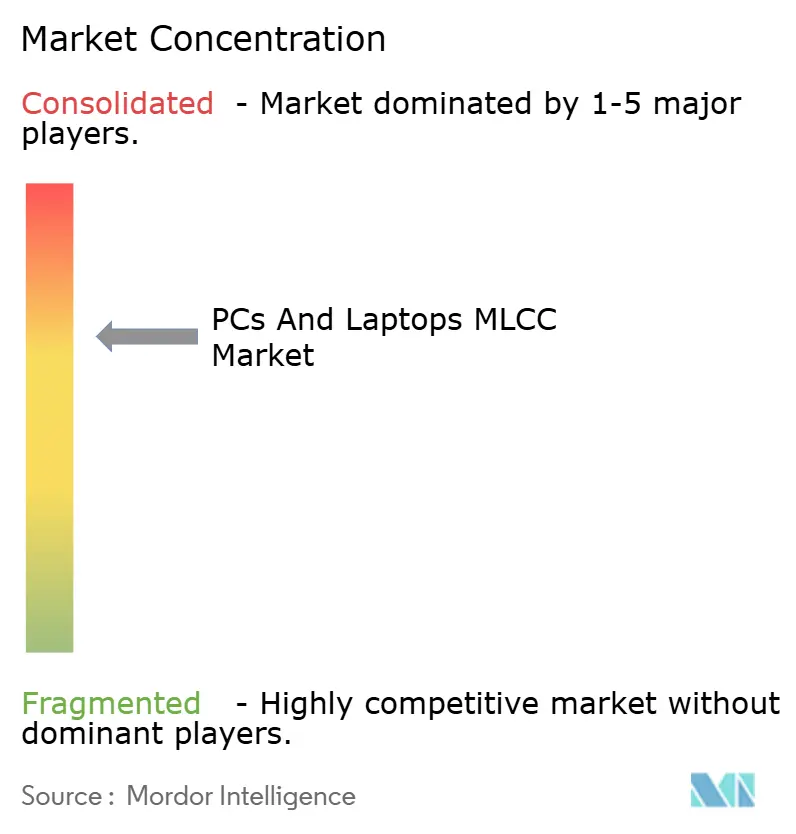
| Market Concentration | Medium |
Major Players *Disclaimer: Major Players sorted in no particular order Image © Mordor Intelligence. Reuse requires attribution under CC BY 4.0. | |
PCs And Laptops MLCC Market Analysis by Mordor Intelligence
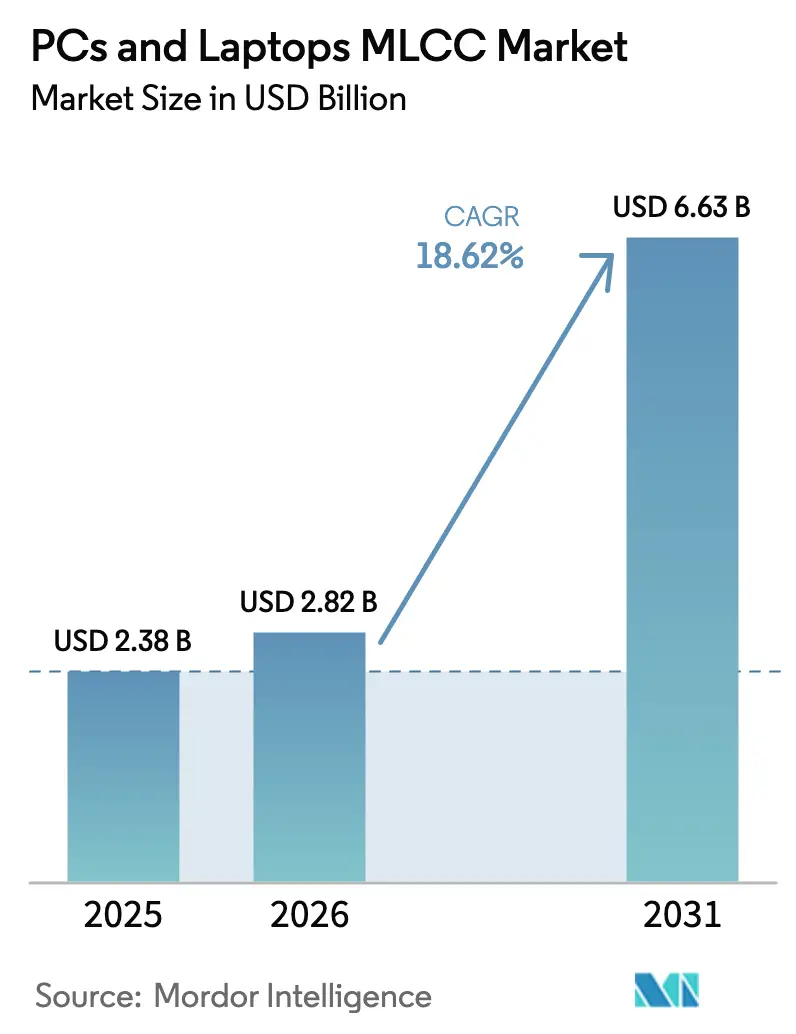
The PCs and Laptops MLCC market size is expected to grow from USD 2.38 billion in 2025 to USD 2.82 billion in 2026 and is forecast to reach USD 6.63 billion by 2031 at 18.62% CAGR over 2026-2031. Demand is propelled by the migration to DDR5/LPDDR5 memory, the surge of AI-ready PCs, and escalating power densities that each notebook and desktop must now handle. Supply-side momentum stems from the relentless miniaturization of MLCCs, which enables engineers to replace bulk aluminum capacitors, mitigate board-space constraints, and meet stringent battery-life targets. Vendor positioning hinges on who can scale advanced dielectric formulations quickly, with North America consuming premium AI systems while Asia-Pacific provides the volume manufacturing backbone. Across 2025–2030, tight raw-material supplies, export controls on high-K powders, and ESG-linked mining curbs temper the otherwise steep growth trajectory of the PCs and Laptops MLCC market.
Key Report Takeaways
- By dielectric type, Class 1 capacitors led the PCs and Laptops MLCC market with a 62.15% share in 2025, while the same category is forecast to log a 19.88% CAGR through 2031.
- By case size, the 201 format held 55.92% of the PCs and Laptops MLCC market share in 2025; the 402 format is set to accelerate at a 19.64% CAGR to 2031.
- By voltage rating, low-voltage units accounted for 58.92% of the PCs and Laptops MLCC market size in 2025 and are expected to expand at a 19.73% CAGR through 2031.
- By mounting type, surface-mount variants maintained a 41.25% revenue share in 2025, while metal-cap devices are poised to register a 19.36% CAGR by 2031.
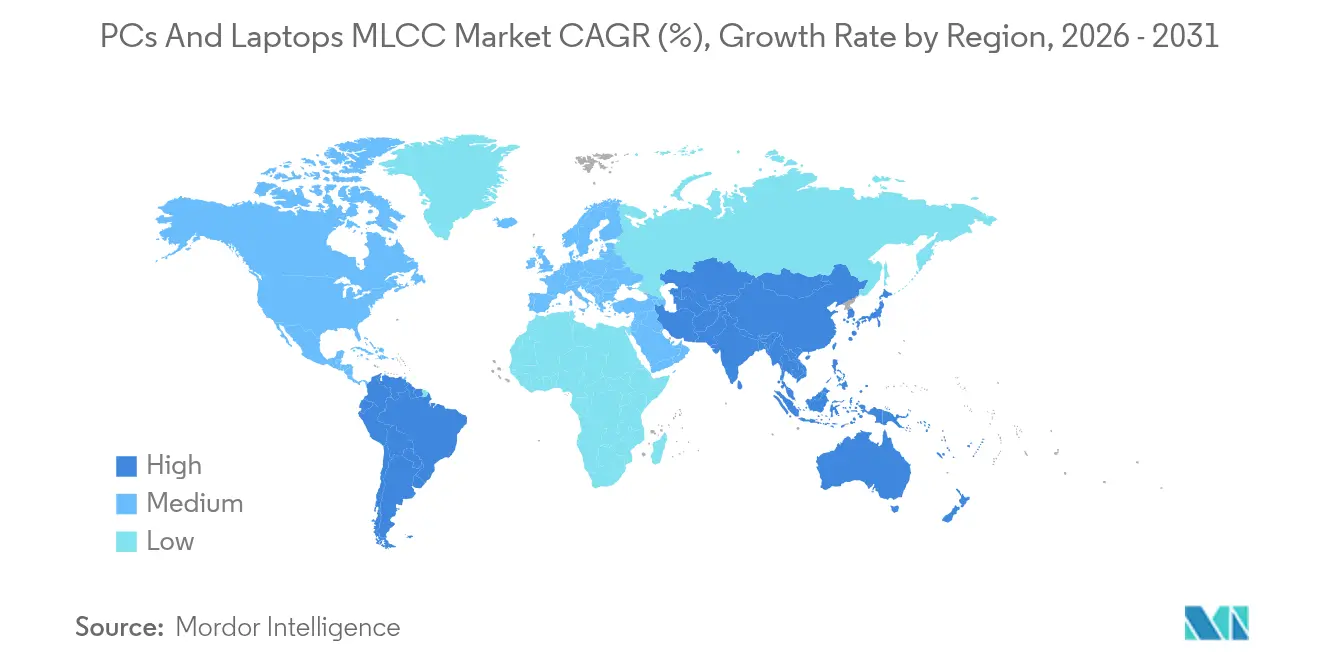
- By geography, North America captured 57.12% of the PCs and Laptops MLCC market in 2025, whereas the Asia-Pacific region is expected to outpace all others at a 20.31% CAGR over the forecast horizon.
Note: Market size and forecast figures in this report are generated using Mordor Intelligence’s proprietary estimation framework, updated with the latest available data and insights as of 2026.
Market Trends and Insights
Drivers Impact Analysis of PCs And Laptops MLCC Market*
| Driver | (~) % Impact on CAGR Forecast | Geographic Relevance | Impact Timeline |
|---|---|---|---|
| Shift to DDR5 and LPDDR5 RAM designs | +4.2% | Global, early North America and Asia-Pacific | Medium term (2-4 years) |
| Rapid adoption of USB-C/Thunderbolt 4 power delivery | +3.8% | Global, premium laptop segments | Short term (≤ 2 years) |
| Migration to high-resolution OLED and mini-LED panels | +3.1% | Asia-Pacific core, spreading to North America and Europe | Medium term (2-4 years) |
| Rising demand for on-board AI accelerators | +4.7% | North America and Asia-Pacific | Short term (≤ 2 years) |
| 3 nm and 2 nm CPU platform launches | +2.9% | Global, premium computing | Long term (≥ 4 years) |
| Government semiconductor reshoring incentives | +2.1% | North America and Europe | Long term (≥ 4 years) |
| Source: Mordor Intelligence | |||
Shift to DDR5 and LPDDR5 RAM Designs
New memory architectures relocate voltage regulation modules from the SODIMM to the motherboard, elevating MLCC voltage ratings to 25 V and increasing demand for compact 0805- and 1206-size capacitors capable of reaching 22 µF with X6S stability. [1]Samsung Electro-Mechanics, “25 V MLCC Solution for DDR5,” samsungsem.com Achieving such capacitance in a confined footprint requires refined dielectric chemistries, thinner electrodes, and tighter electrode-layer alignment. Server-grade boards intensify the need for long-life parts that can endure extended high-temperature cycles, further supporting premium pricing in the PC and Laptop MLCC market. Rapid DDR5 adoption across both consumer and enterprise systems keeps the design win funnel full for suppliers delivering these specialized parts, reinforcing the positive structural effect on the PCs and Laptops MLCC market.
Rapid Adoption of USB-C/Thunderbolt 4 Power Delivery
USB-C power delivery now scales to 240 W, consolidating multiple rails into a single high-current path and necessitating extensive input-filter arrays. Designers typically deploy dozens of low-ESR 0402 or 0603 MLCCs per port to absorb hot-plug transients and smooth load-step edges, thereby multiplying the per-unit capacitor counts. [2]TechInsights, “PC/Laptop Outlook 2025,” techinsights.com Because each new Thunderbolt-enabled port carries its own dedicated power-management IC, MLCC volumes increase in nearly a linear proportion to the port count. As a result, the PCs and Laptops MLCC market enjoys a structural uplift that tracks the replacement of barrel-type connectors with USB-C across entire notebook portfolios.
Migration to High-Resolution OLED and Mini-LED Panels
OLED and mini-LED technologies impose stricter ripple-voltage and EMI thresholds than legacy LCDs. Each mini-LED backlight zone requires localized dimming MOSFETs that operate optimally with point-of-load decoupling, necessitating the addition of tens of MLCCs per display subsystem. On high-brightness OLED panels, MLCCs in the 1 µF–10 µF range maintain pixel-drive voltages, preventing color shift and screen burn-in. Premium laptops adopting these displays therefore integrate roughly triple the display-related MLCC count seen on 2023-vintage LCD models, opening a lucrative high-value niche within the broader PC and Laptop MLCC market.
Rising Demand for On-Board AI Accelerators
AI-centric notebooks ship with separate NPUs that power-cycle aggressively, generating noisy current signatures that necessitate hundreds of small MLCCs clustered within 5 mm of the package pins. Shipments of AI laptops are expected to reach 102.4 million units in 2025, accounting for 51% of all notebooks, which is expected to heighten per-board capacitor counts. [3]Gartner, “AI PC Shipments 2025,” gartner.com Murata’s 100 µF 0603 device enables engineers to meet target impedance budgets without enlarging board outlines. This AI wave firmly underpins upside in the PCs and Laptops MLCC market.
Restraints Impact Analysis of PCs And Laptops MLCC Market*
| Restraint | (~) % Impact on CAGR Forecast | Geographic Relevance | Impact Timeline |
|---|---|---|---|
| Supply–demand imbalance for Class-2 X7R ceramic powders | −2.8% | Global, acute in Asia-Pacific hubs | Short term (≤ 2 years) |
| MLCC cracking failures in ultra-thin motherboards | −1.9% | Global, premium laptops | Medium term (2-4 years) |
| Geopolitical export controls on high-K raw materials | −2.3% | Asia-Pacific, global spillover | Medium term (2-4 years) |
| ESG-driven restrictions on rare-earth mining | −1.7% | Global | Long term (≥ 4 years) |
| Source: Mordor Intelligence | |||
Supply-Demand Imbalance for Class-2 X7R Ceramic Powders
High-K powders are sourced from a handful of suppliers in Japan and China, and recent production issues have extended lead times to 20 weeks, necessitating allocation measures that prioritize automotive over PC allocations. Because bulk-energy capacitors in notebook VRMs rely heavily on X7R dielectrics, shortages can limit shipment volumes even when downstream demand remains strong. The discrepancy curbs near-term upside for the PCs and Laptops MLCC market until new powder lines come online.
MLCC Cracking Failures in Ultra-Thin Motherboards
Sub-1 mm boards flex during reflow, inducing mechanical stress that gives rise to transverse cracks in 0201 and 0402 parts. Field returns tied to latent capacitor cracks can erode OEM confidence, prompting design teams to limit downsizing or to incorporate alternate stack-ups. These reliability concerns could slow rapid migration toward ever-smaller case sizes and dampen a portion of incremental unit demand inside the PCs and Laptops MLCC market.
*Our forecasts treat driver/restraint impacts as directional, not additive. The impact forecasts reflect baseline growth, mix effects, and variable interactions.
PCs And Laptops MLCC Market Segment Analysis
By Dielectric Type:
Class 1 Stability Sustains Premium AdoptionClass 1 MLCCs dominated the market with a 62.15% share in 2025, and their trajectory indicates a robust 19.88% CAGR through 2031. That scale cements a premium revenue pool within the PCs and Laptops MLCC market, where temperature-stable capacitors underpin timing, clock, and RF circuits critical to modern CPUs and NPUs. In desktop motherboards, low TCC parts enhance voltage control loops, ensuring consistent phase margin performance across thermal excursions.
Successive nodes shrink tolerances to millivolt bands, and platform architects deploy chains of Class 1 parts around each VRM stage for noise suppression. Murata’s 006003-inch package underscores the miniaturization front and shows that dielectric purity is the gating factor rather than electrode count. As OEMs chase ever-thinner form factors, Class 1’s mechanical robustness delivers an extra safety margin against board flex, extending its lead in the PCs and Laptops MLCC market.




By Case Size:
402 Format Accelerates Under Miniaturization PressureThe 201 footprint retained 55.92% of revenue in 2025, a testament to its optimal price-performance ratio and high manufacturing yields. Yet the 402 line will outpace all other formats at 19.64% CAGR, becoming the workhorse for slim notebooks and gaming rigs where space is at a premium. OEMs now favor distributing many small capacitors around a die instead of a few large 0805s to improve thermal gradients.
Case-shrink improvements align with dielectric innovation, making a 47 µF 0402 stack viable without exceeding board height constraints. This facilitates AI accelerator integration, where hundreds of 402s ring the package perimeter. Consequently, unit demand for the 402 variant creates a central growth lever for the PCs and Laptops MLCC market.
By Voltage Rating:
Low-Voltage Parts Dominate Core RailsLow-voltage (≤100 V) MLCCs held a 58.92% share in 2025 and are expected to grow at a 19.73% CAGR to 2031, in line with the proliferation of sub-5 V rails across notebook logic. DDR5’s need for 25 V decoupling introduces a higher voltage tier but still keeps parts within the low-voltage envelope according to established MLCC taxonomies.
USB-C’s 48 V rail, combined with multiphase down-conversion, further increases the number of low-voltage capacitor slots throughout the PCB. As designers transition from aluminum electrolytics to stacked MLCC arrays for input filtering, low-voltage volumes increase, solidifying their pivotal role in powering the PC and Laptop MLCC market.

By Mounting Type:
Metal-Cap Packaging Gains Share on Reliability MeritSurface-mount devices accounted for 41.25% of 2025 revenue, favored for their automated pick-and-place throughput. However, metal-cap packages are tracking a 19.36% CAGR as thermal cycling and board flex challenges mount in ultrathin chassis. Metal caps spread stress, lifting board-level reliability metrics and appealing to workstation and gaming OEMs that offer extended warranties.
Although unit prices are higher, failure-cost avoidance justifies the switch, resulting in a disproportionate revenue contribution relative to shipments. The trend represents an incremental catalyst for the PCs and Laptops MLCC market as AI and high-refresh OLED panels raise internal temperatures.
Geography Analysis
North America PCs and Laptops MLCC Market
North America retained a commanding 57.12% share in 2025 as premium notebook brands pursued early DDR5 and AI rollouts, bundling high-capacitance VRMs and exotic display panels, which in turn inflated MLCC counts. Elevated ASPs per unit give the region an outsized revenue footprint in the PCs and Laptops MLCC market relative to shipped volumes. Section 301 tariffs drive ongoing board-level redesigns that substitute domestic or Mexican MLCC sources, diversifying the supplier stack and altering freight flows.
APAC PCs and Laptops MLCC Market
Asia-Pacific is set to top the growth tables at 20.31% CAGR through 2031, powered by China’s post-pandemic refresh cycle, Taiwan’s ODM volume, and Korea’s leadership in mini-LED laptop displays. Regional component clusters intensify learning-curve advantages, anchoring long-term competitiveness in the PCs and Laptops MLCC market. Parallel government subsidies encourage incremental MLCC fabs in Malaysia and Vietnam to de-risk geographic concentration without displacing legacy capacity in Japan and China.
Europe PCs and Laptops MLCC Market
Europe maintains a smaller but profitable corridor focused on enterprise security-hardened laptops and rugged industrial tablets, where high-reliability MLCCs carry premium margins. Tight ESG regulations encourage OEMs to validate capacitor carbon footprints, rewarding suppliers such as Murata that have fast-tracked renewable energy sourcing and RE100 commitments. Although volume growth trails that of the Asia-Pacific region, elevated price points keep Europe strategically relevant to the PCs and Laptops MLCC market.

Competitive Landscape
Innovation and Adaptability Drive Future Success
The competitive profile is moderately concentrated. The top five vendors-Murata, Samsung Electro-Mechanics, TDK, Taiyo Yuden, and Kyocera AVX-command a combined share estimated to be near 75%, making scale fabrication and proprietary dielectric recipes the critical barriers to entry. Murata pushes the frontiers of miniaturization with its 006003-inch MLCC, capturing socket wins in ultrabooks where PCB real estate is scarce. Samsung Electro-Mechanics leverages its vertically integrated powder manufacturing capabilities to introduce the first 22 µF, 25 V, 0805 capacitor tailored for DDR5 motherboards.
TDK expands its CGA series into 100 V domains for automotive compute nodes, offering cross-platform synergy to notebook OEMs targeting semi-autonomous features. Yageo’s proposed USD 639.2 million acquisition of Shibaura Electronics integrates sensors and thermistors, broadening its passives suite and deepening ties with ODMs that seek supplier consolidation.
Beyond the majors, second-tier Asian players tackle niche specs such as application-specific MLCCs for AI accelerator modules. Still, stringent qualification times and the necessity for automotive-grade certifications impede rapid share gains, reinforcing the current hierarchy within the PCs and Laptops MLCC market.
PCs And Laptops MLCC Industry Leaders
Murata Manufacturing Co., Ltd.
Samsung Electro-Mechanics Co., Ltd.
Taiyo Yuden Co., Ltd.
TDK Corporation
Yageo Corporation
- *Disclaimer: Major Players sorted in no particular order
PCs And Laptops MLCC Market Companies Covered in this Report
- Murata Manufacturing Co., Ltd.
- Samsung Electro-Mechanics Co., Ltd.
- Taiyo Yuden Co., Ltd.
- TDK Corporation
- Yageo Corporation
- Kyocera AVX Components Corporation
- Maruwa Co., Ltd.
- Nippon Chemi-Con Corporation
- Samwha Capacitor Co., Ltd.
- Vishay Intertechnology, Inc.
- Walsin Technology Corporation
- Würth Elektronik GmbH and Co. KG
- KEMET Corporation (Yageo Group)
- Panasonic Industry Co., Ltd.
- Darfon Electronics Corporation
- Johanson Dielectrics, Inc.
- Holy Stone Enterprise Co., Ltd.
- Fenghua Advanced Technology Holding Co., Ltd.
- NIC Components Corp.
- Eyang Technology Development Co., Ltd.

Recent Industry Developments in PCs And Laptops MLCC Market
- July 2025: Yageo extended its Shibaura Electronics tender to August 1 while awaiting Japanese FDI approval, keeping the USD 639.2 million deal alive
- May 2025: Vishay reported a passive-component book-to-bill ratio of 1.04, indicating demand persistence despite supply headwinds
- March 2025: Kyocera AVX released the first 0402 MLCC to achieve 47 µF, boosting capacitance density for space-limited motherboards
- February 2025: Samsung Electro-Mechanics introduced the inaugural 0805 22 µF 25 V MLCC optimized for DDR5 VRMs


Global PCs And Laptops MLCC Market Report Scope
0 603, 0 805, 0 806, 1 206, 1 210, Others are covered as segments by Case Size. 10V to 20V, Above 20V, Less than 10V are covered as segments by Voltage. 10 μF to 100 μF, Less than 10 μF, More than 100 μF are covered as segments by Capacitance. Class 1, Class 2 are covered as segments by Dielectric Type. Asia-Pacific, Europe, North America are covered as segments by Region.| Class 1 |
| Class 2 |
| 201 |
| 402 |
| 603 |
| 1005 |
| 1210 |
| Other Case Sizes |
| Low Voltage (less than or equal to 100 V) |
| Mid Voltage (100 – 500 V) |
| High Voltage (above 500 V) |
| Metal-Cap |
| Radial Lead |
| Surface Mount |
| North America | United States |
| Rest of North America | |
| Europe | Germany |
| United Kingdom | |
| Rest of Europe | |
| Asia-Pacific | China |
| India | |
| Japan | |
| South Korea | |
| Rest of Asia-Pacific | |
| Rest of the World |
| By Dielectric Type | Class 1 | |
| Class 2 | ||
| By Case Size | 201 | |
| 402 | ||
| 603 | ||
| 1005 | ||
| 1210 | ||
| Other Case Sizes | ||
| By Voltage | Low Voltage (less than or equal to 100 V) | |
| Mid Voltage (100 – 500 V) | ||
| High Voltage (above 500 V) | ||
| By MLCC Mounting Type | Metal-Cap | |
| Radial Lead | ||
| Surface Mount | ||
| By Geography | North America | United States |
| Rest of North America | ||
| Europe | Germany | |
| United Kingdom | ||
| Rest of Europe | ||
| Asia-Pacific | China | |
| India | ||
| Japan | ||
| South Korea | ||
| Rest of Asia-Pacific | ||
| Rest of the World | ||


Market Definition
- MLCC (Multilayer Ceramic Capacitor) - A type of capacitor that consists of multiple layers of ceramic material, alternating with conductive layers, used for energy storage and filtering in electronic circuits.
- Voltage - The maximum voltage that a capacitor can safely withstand without experiencing breakdown or failure. It is typically expressed in volts (V)
- Capacitance - The measure of a capacitor's ability to store electrical charge, expressed in farads (F). It determines the amount of energy that can be stored in the capacitor
- Case Size - The physical dimensions of an MLCC, typically expressed in codes or millimeters, indicating its length, width, and height
| Keyword | Definition |
|---|---|
| MLCC (Multilayer Ceramic Capacitor) | A type of capacitor that consists of multiple layers of ceramic material, alternating with conductive layers, used for energy storage and filtering in electronic circuits. |
| Capacitance | The measure of a capacitor's ability to store electrical charge, expressed in farads (F). It determines the amount of energy that can be stored in the capacitor |
| Voltage Rating | The maximum voltage that a capacitor can safely withstand without experiencing breakdown or failure. It is typically expressed in volts (V) |
| ESR (Equivalent Series Resistance) | The total resistance of a capacitor, including its internal resistance and parasitic resistances. It affects the capacitor's ability to filter high-frequency noise and maintain stability in a circuit. |
| Dielectric Material | The insulating material used between the conductive layers of a capacitor. In MLCCs, commonly used dielectric materials include ceramic materials like barium titanate and ferroelectric materials |
| SMT (Surface Mount Technology) | A method of electronic component assembly that involves mounting components directly onto the surface of a printed circuit board (PCB) instead of through-hole mounting. |
| Solderability | The ability of a component, such as an MLCC, to form a reliable and durable solder joint when subjected to soldering processes. Good solderability is crucial for proper assembly and functionality of MLCCs on PCBs. |
| RoHS (Restriction of Hazardous Substances) | A directive that restricts the use of certain hazardous materials, such as lead, mercury, and cadmium, in electrical and electronic equipment. Compliance with RoHS is essential for automotive MLCCs due to environmental regulations |
| Case Size | The physical dimensions of an MLCC, typically expressed in codes or millimeters, indicating its length, width, and height |
| Flex Cracking | A phenomenon where MLCCs can develop cracks or fractures due to mechanical stress caused by bending or flexing of the PCB. Flex cracking can lead to electrical failures and should be avoided during PCB assembly and handling. |
| Aging | MLCCs can experience changes in their electrical properties over time due to factors like temperature, humidity, and applied voltage. Aging refers to the gradual alteration of MLCC characteristics, which can impact the performance of electronic circuits. |
| ASPs (Average Selling Prices) | The average price at which MLCCs are sold in the market, expressed in USD million. It reflects the average price per unit |
| Voltage | The electrical potential difference across an MLCC, often categorized into low-range voltage, mid-range voltage, and high-range voltage, indicating different voltage levels |
| MLCC RoHS Compliance | Compliance with the Restriction of Hazardous Substances (RoHS) directive, which restricts the use of certain hazardous substances, such as lead, mercury, cadmium, and others, in the manufacturing of MLCCs, promoting environmental protection and safety |
| Mounting Type | The method used to attach MLCCs to a circuit board, such as surface mount, metal cap, and radial lead, which indicates the different mounting configurations |
| Dielectric Type | The type of dielectric material used in MLCCs, often categorized into Class 1 and Class 2, representing different dielectric characteristics and performance |
| Low-Range Voltage | MLCCs designed for applications that require lower voltage levels, typically in the low voltage range |
| Mid-Range Voltage | MLCCs designed for applications that require moderate voltage levels, typically in the middle range of voltage requirements |
| High-Range Voltage | MLCCs designed for applications that require higher voltage levels, typically in the high voltage range |
| Low-Range Capacitance | MLCCs with lower capacitance values, suitable for applications that require smaller energy storage |
| Mid-Range Capacitance | MLCCs with moderate capacitance values, suitable for applications that require intermediate energy storage |
| High-Range Capacitance | MLCCs with higher capacitance values, suitable for applications that require larger energy storage |
| Surface Mount | MLCCs designed for direct surface mounting onto a printed circuit board (PCB), allowing for efficient space utilization and automated assembly |
| Class 1 Dielectric | MLCCs with Class 1 dielectric material, characterized by a high level of stability, low dissipation factor, and low capacitance change over temperature. They are suitable for applications requiring precise capacitance values and stability |
| Class 2 Dielectric | MLCCs with Class 2 dielectric material, characterized by a high capacitance value, high volumetric efficiency, and moderate stability. They are suitable for applications that require higher capacitance values and are less sensitive to capacitance changes over temperature |
| RF (Radio Frequency) | It refers to the range of electromagnetic frequencies used in wireless communication and other applications, typically from 3 kHz to 300 GHz, enabling the transmission and reception of radio signals for various wireless devices and systems. |
| Metal Cap | A protective metal cover used in certain MLCCs (Multilayer Ceramic Capacitors) to enhance durability and shield against external factors like moisture and mechanical stress |
| Radial Lead | A terminal configuration in specific MLCCs where electrical leads extend radially from the ceramic body, facilitating easy insertion and soldering in through-hole mounting applications. |
| Temperature Stability | The ability of MLCCs to maintain their capacitance values and performance characteristics across a range of temperatures, ensuring reliable operation in varying environmental conditions. |
| Low ESR (Equivalent Series Resistance) | MLCCs with low ESR values have minimal resistance to the flow of AC signals, allowing for efficient energy transfer and reduced power losses in high-frequency applications. |


Research Methodology
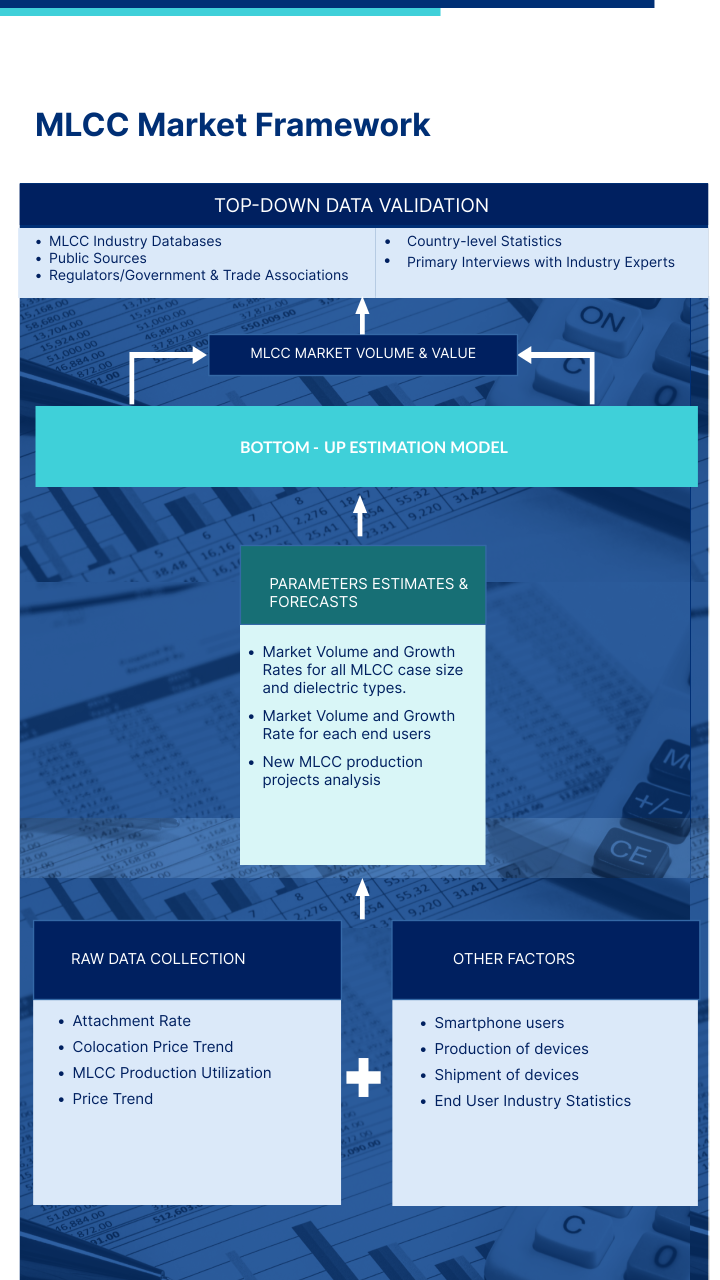
Mordor Intelligence has followed the following methodology in all our MLCC reports.
- Step 1: Identify Data Points: In this step, we identified key data points crucial for comprehending the MLCC market. This included historical and current production figures, as well as critical device metrics such as attachment rate, sales, production volume, and average selling price. Additionally, we estimated future production volumes and attachment rates for MLCCs in each device category. Lead times were also determined, aiding in forecasting market dynamics by understanding the time required for production and delivery, thereby enhancing the accuracy of our projections.
- Step 2: Identify Key Variables: In this step, we focused on identifying crucial variables essential for constructing a robust forecasting model for the MLCC market. These variables include lead times, trends in raw material prices used in MLCC manufacturing, automotive sales data, consumer electronics sales figures, and electric vehicle (EV) sales statistics. Through an iterative process, we determined the necessary variables for accurate market forecasting and proceeded to develop the forecasting model based on these identified variables.
- Step 3: Build a Market Model: In this step, we utilized production data and key industry trend variables, such as average pricing, attachment rate, and forecasted production data, to construct a comprehensive market estimation model. By integrating these critical variables, we developed a robust framework for accurately forecasting market trends and dynamics, thereby facilitating informed decision-making within the MLCC market landscape.
- Step 4: Validate and Finalize: In this crucial step, all market numbers and variables derived through an internal mathematical model were validated through an extensive network of primary research experts from all the markets studied. The respondents are selected across levels and functions to generate a holistic picture of the market studied.
- Step 5: Research Outputs: Syndicated Reports, Custom Consulting Assignments, Databases, and Subscription Platform