
Passwordless Push Authentication Market Size and Share
Market Overview
| Study Period | 2021 - 2032 |
|---|---|
| Market Size (2027) | USD 5.15 Billion |
| Market Size (2032) | USD 14.61 Billion |
| Growth Rate (2027 - 2032) | 23.21 % |
| Fastest Growing Market | Asia-Pacific |
| Largest Market | North America |
| Market Concentration | Medium |
Major Players *Disclaimer: Major Players sorted in no particular order Image © Mordor Intelligence. Reuse requires attribution under CC BY 4.0. | |
Passwordless Push Authentication Market Analysis by Mordor Intelligence
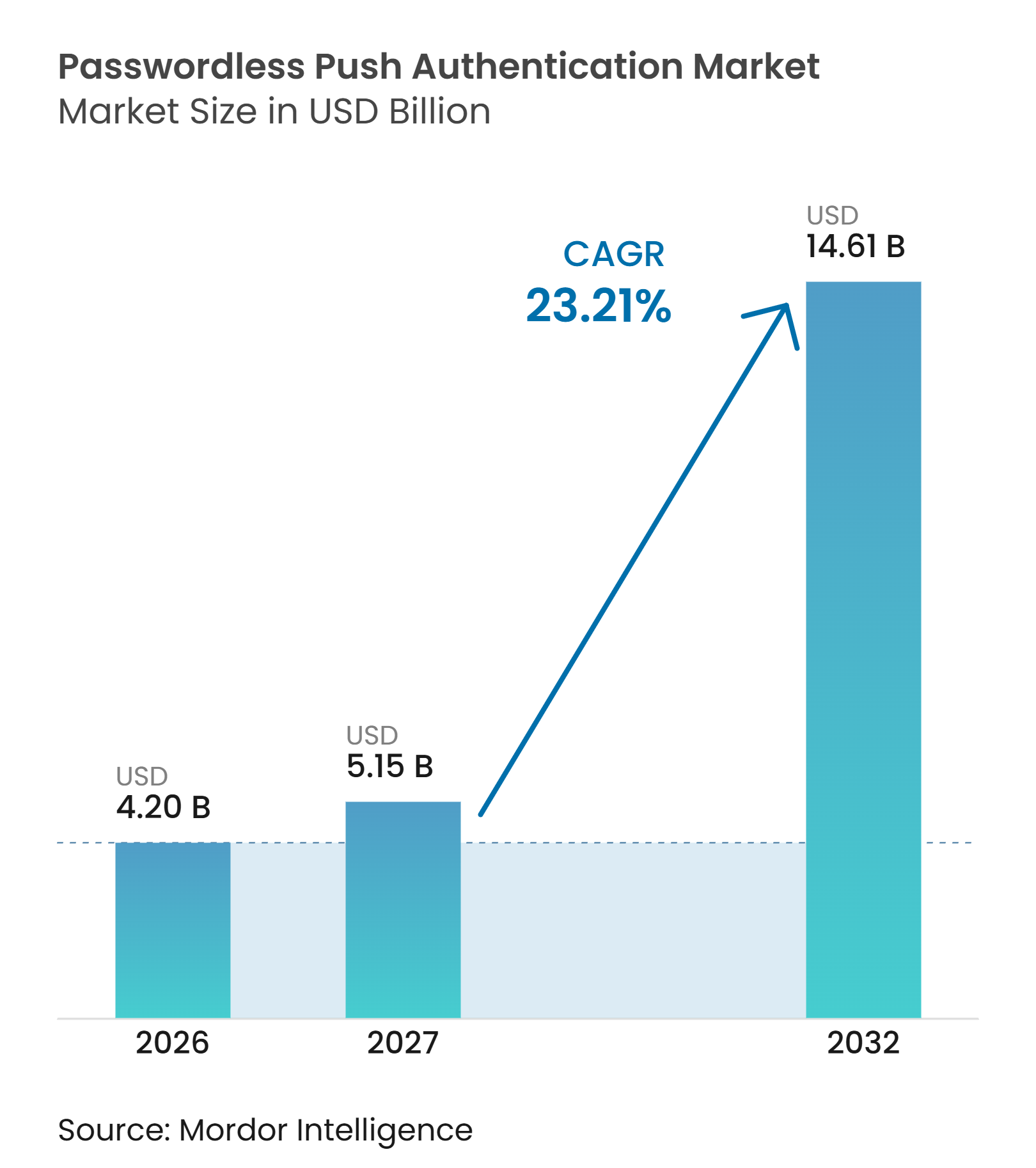
The Passwordless push authentication market size is projected to expand from USD 4.20 billion in 2026 to USD 5.15 billion in 2027, and to USD 14.61 billion by 2032, registering a CAGR of 23.21% between 2027 and 2032. Rising financial losses from phishing and account takeover are making device-bound authentication more urgent for employers, banks, and public agencies. The Passwordless push authentication market is moving from early enterprise deployments toward broader adoption as security teams replace password- and SMS-based flows. Regulatory deadlines are also turning many authentication projects into scheduled procurement decisions. Mobile banking and wallet activity increase the number of approvals organizations must obtain without disrupting a payment or account management session. Vendors are responding by adding passkeys, identity verification, risk controls, and connectors that fit existing identity systems, while basic push approval becomes more widely available through large technology platforms.
Key Report Takeaways
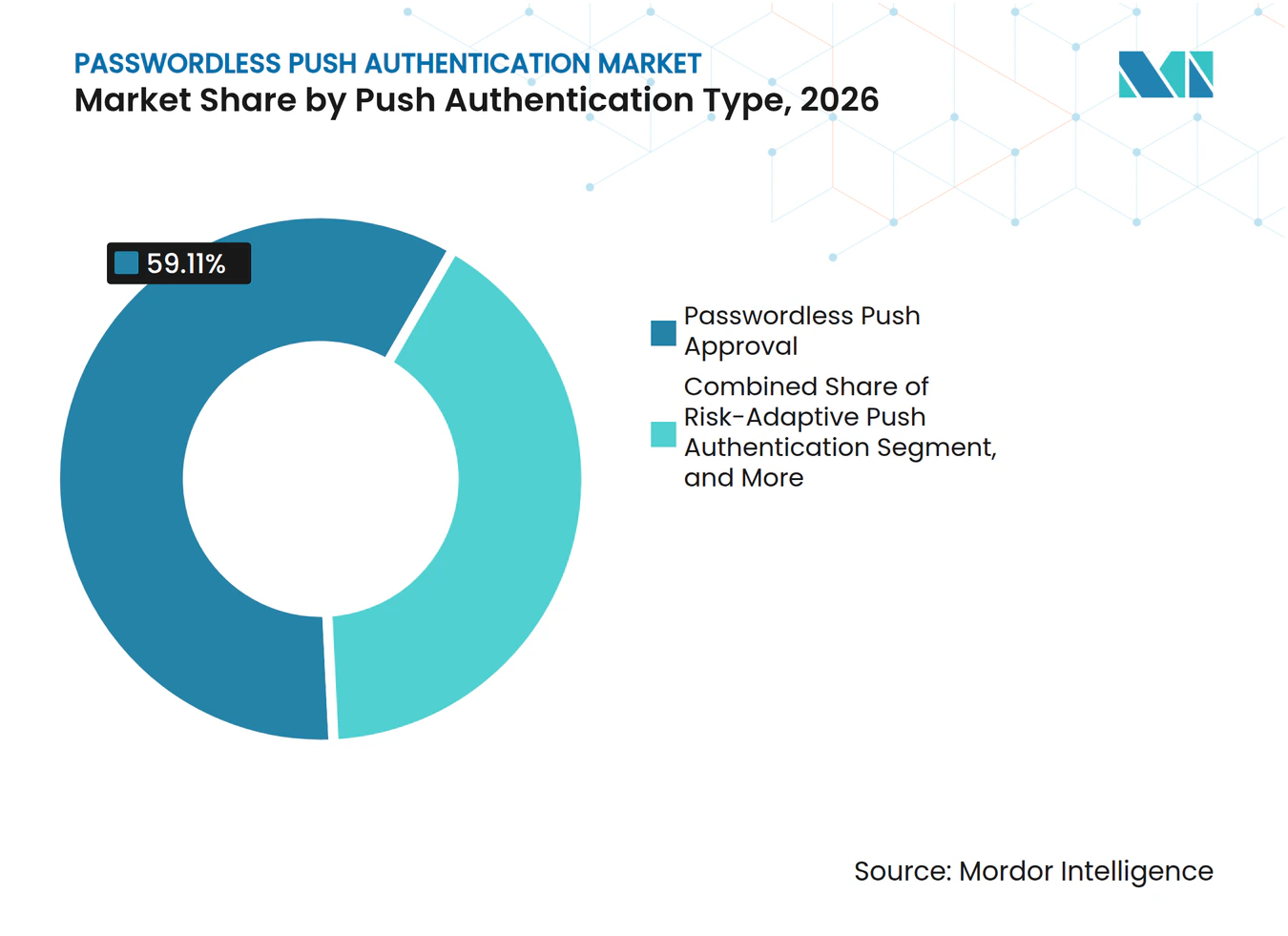
- By push authentication type, Passwordless Push Approval held 59.11% of the Passwordless push authentication market share in 2026, while Risk-Adaptive Push Authentication is projected to expand at a 24.33% CAGR through 2032.
- By deployment mode, On-Premises held 67.10% of the Passwordless push authentication market in 2026, while Cloud is expected to expand at a 24.75% CAGR through 2032.
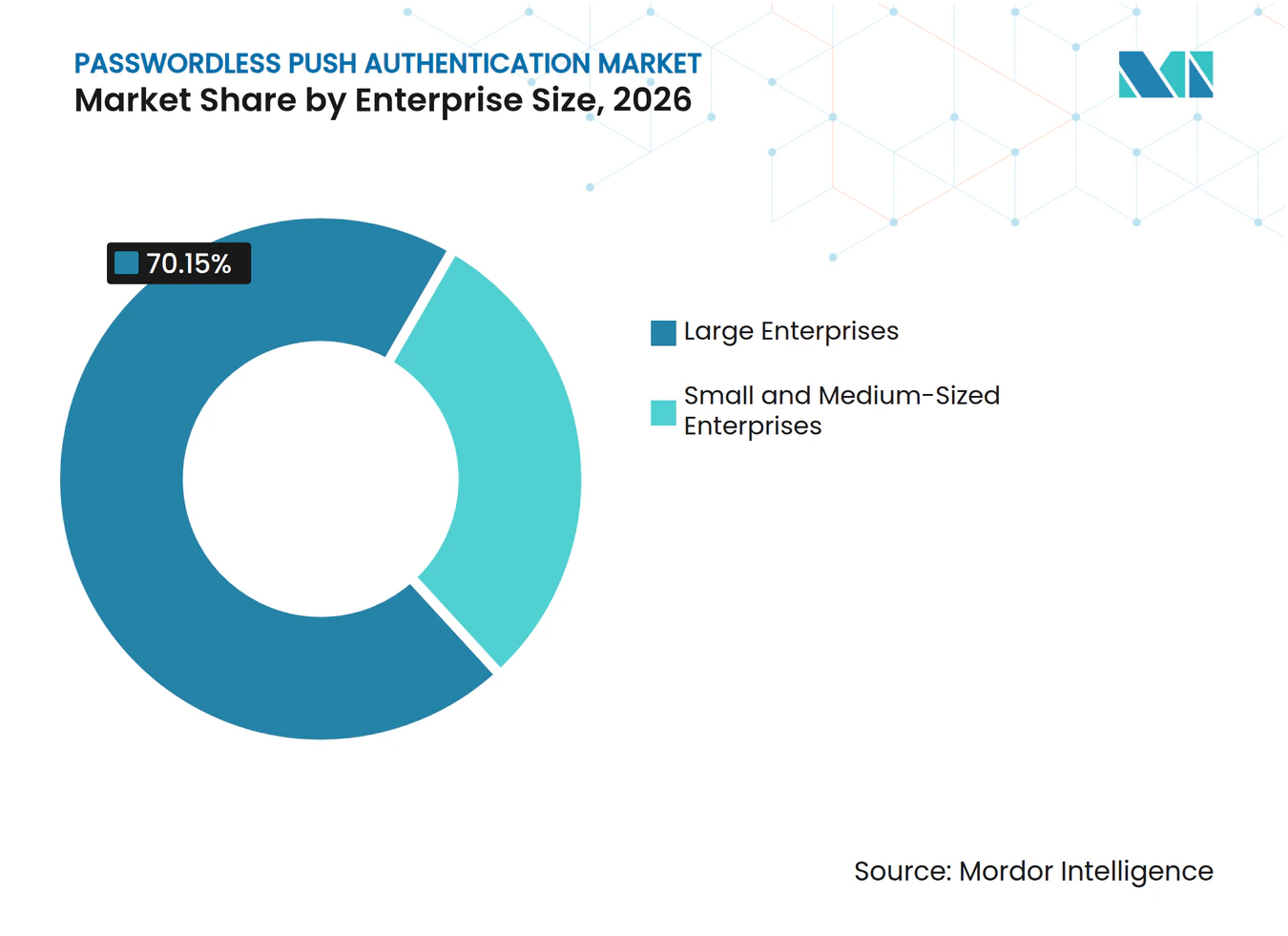
- By enterprise size, Large Enterprises held 70.15% of the Passwordless push authentication market in 2026, while SMEs are projected to expand at a 25.08% CAGR through 2032.
- By end-user industry, BFSI held 29.88% of the Passwordless push authentication market in 2026, while Government and Public Administration is expected to expand at a 23.76% CAGR through 2032.
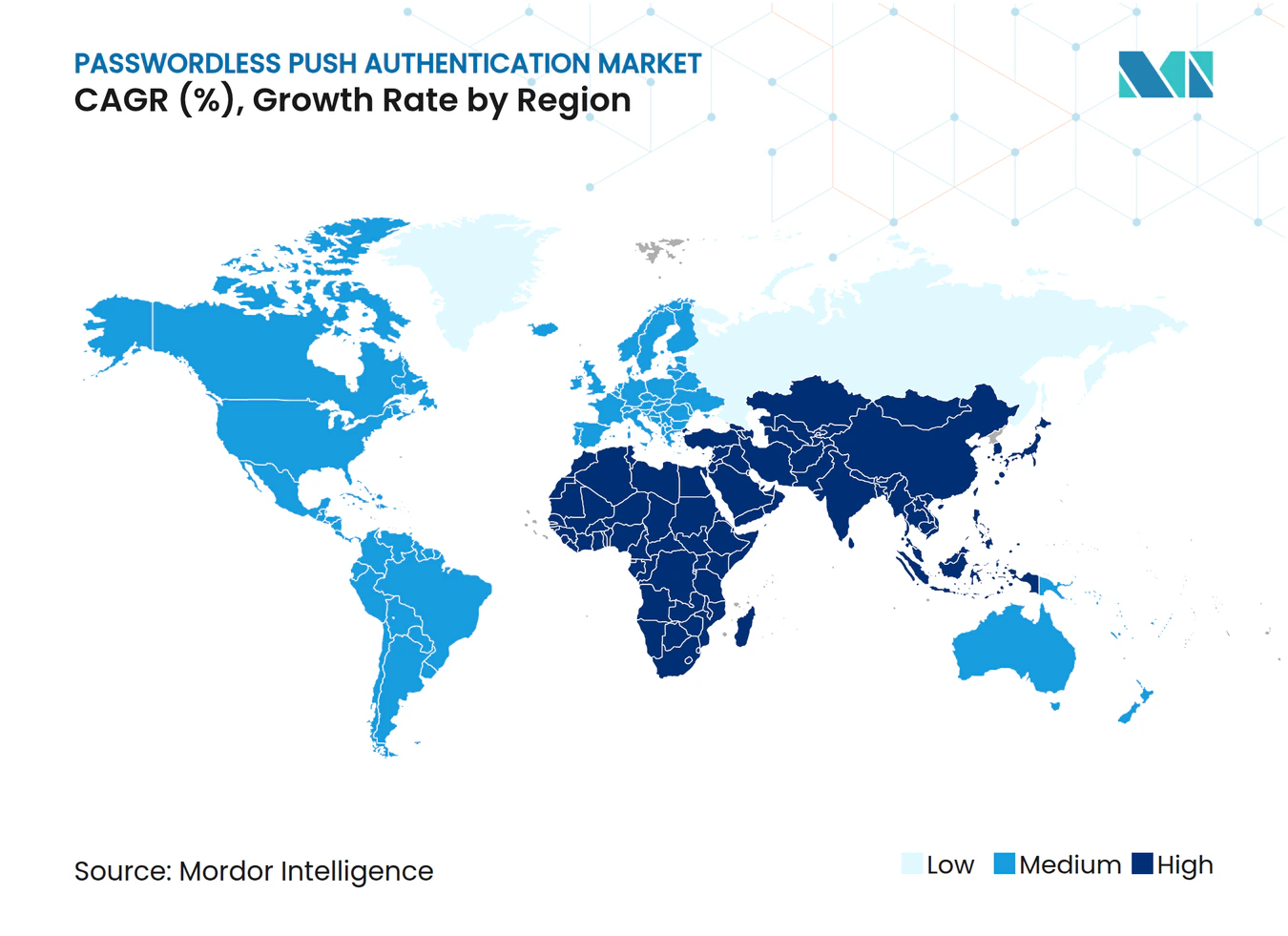
- By geography, North America held 37.16% of the Passwordless push authentication market in 2026, while Asia-Pacific is projected to expand at a 24.05% CAGR through 2032.
Note: Market numbers in this report are based on Mordor Intelligence's proprietary estimation framework, which combines nine months of actuals with Q4 projections for base year 2026.
Market Trends and Insights
Drivers Impact Analysis of Passwordless Push Authentication Market*
| Driver | (~) % Impact on CAGR Forecast | Geographic Relevance | Impact Timeline |
|---|---|---|---|
| Rising Phishing and Credential-Stuffing Losses | +4.5% | Global | Short term (≤ 2 years) |
| Zero-Trust and Phishing-Resistant Authentication Mandates | +4.2% | North America and Europe, spill-over to APAC | Short term (≤ 2 years) |
| Migration from SMS OTP to App-Based Verification | +3.8% | Global, with early gains in APAC and Middle East | Short term (≤ 2 years) |
| Expansion of Mobile Banking and High-Value Digital Transactions | +3.5% | APAC core, spill-over to South America and Africa | Medium term (2-4 years) |
| Lower Authentication Friction and Helpdesk Costs | +2.8% | Global | Medium term (2-4 years) |
| Enterprise Demand for Device-Bound and Context-Aware Approval | +2.1% | North America and Europe | Long term (≥ 4 years) |
| Source: Mordor Intelligence | |||
Rising Phishing and Credential-Stuffing Losses Drive Demand for Device-Bound Authentication
Credential attacks have become repeatable operations rather than isolated attempts. Credential theft and account takeover can create direct losses and may also enable later fraud recorded under other categories. A stolen password can support later fraud that is recorded under a different crime category, so direct loss totals may not show the full exposure. The Passwordless push authentication market benefits because a captured password cannot, by itself, generate an approval on a registered device, a practical benefit for organizations trying to reduce account takeover without altering every application at the same time. This changes the control point from knowledge of a credential to possession of a device that has already been bound to the user. Security teams, therefore, have a clearer reason to replace login methods that rely solely on passwords.
Zero-Trust and Phishing-Resistant Authentication Mandates Reshape Enterprise Security
NIST published the final Digital Identity Guidelines in August 2025, setting phishing-resistant authentication as the standard for Authenticator Assurance Level 2 and higher.[1] The Passwordless push authentication market benefits from this requirement because regulated organizations must consider practical methods to meet stronger assurance expectations, document their control choices, and demonstrate progress to internal reviewers and regulators. U.S. Senate language, published in September 2025, directed the Department of Defense to establish a phishing-resistant authentication plan in 2026 and to retire legacy methods by the end of 2027. FIDO Alliance guidance identified push-capable FIDO2 authenticators as a lower-disruption option where smart cards are impractical. Published retirement dates allow procurement teams to sequence deployments across employee groups and applications. They also raise demand for products that can work with cloud and mobile environments without requiring a full replacement of every existing identity component.
Migration From SMS OTP to App-Based Verification Accelerates Push Adoption
The Passwordless push authentication market is supported by a move away from SMS OTPs in regulated financial services, where customer and employee authentication programs may be updated under the same policy cycle. The UAE Central Bank directive 3057/2025 required licensed financial institutions to stop using SMS and email OTPs as standalone methods from March 2026, favoring in-app approval, passkeys, and biometric verification. Philippine BSP Circular 1213 also required banks to transition to phishing-resistant methods by June 2026. The United Kingdom National Cyber Security Center began replacing SMS verification in government digital services with FIDO passkeys in 2025. Many organizations cannot implement a full passkey program immediately because they must continue supporting older applications and identity providers. App-based push approval can serve as an interim approach by adding device binding and contextual checks while the broader architecture changes.
Expansion of Mobile Banking and High-Value Digital Transactions Elevates Authentication Stakes
The Passwordless push authentication market is influenced by mobile banking, which creates frequent authentication moments for payments, profile changes, and high-value account requests. India’s 2025 authentication directions require 2 independent factors for digital payment transactions and allow added risk checks for high-value activity. This encourages an approval method that can assess transaction value, device posture, and behavior without forcing every user through the same step. Global mobile wallet users reached 4.3 billion in 2024 and are expected to reach 5.8 billion by 2029, while transaction value is expected to rise from USD 10 trillion to USD 17 trillion. The Australian Banking Association reported a 28% year-over-year increase in mobile wallet payment value in 2025. Those payment flows increase the need to keep authentication secure without adding unnecessary delay.
Restraints Impact Analysis of Passwordless Push Authentication Market*
| Restraint | (~) % Impact on CAGR Forecast | Geographic Relevance | Impact Timeline |
|---|---|---|---|
| Push Fatigue and Number-Matching Requirements | -2.0% | Global | Short term (≤ 2 years) |
| Legacy Application Integration and Account-Recovery Complexity | -1.8% | Global, most acute in North America and Europe | Medium term (2-4 years) |
| Privacy and Consent Constraints for Device and Behavioral Signals | -1.4% | Europe, APAC | Medium term (2-4 years) |
| Native Platform Bundling and Commoditization of Basic Push Authentication | -1.2% | Global | Long term (≥ 4 years) |
| Source: Mordor Intelligence | |||
Push Fatigue and Number-Matching Requirements Constrain Mass Deployment
Push fatigue exploits the point at which repeated prompts become a user behavior problem rather than a cryptography problem. In June 2025, Scattered Spider gained access to Hawaiian Airlines systems after repeatedly sending approval prompts to a staff member until 1 was accepted. The incident showed that basic notification flows can fail even when an attacker lacks malware or an exploit. Number matching requires the user to enter a code shown on the active screen, making prompt bombing harder to carry out. This control can slow rollout because teams must update the user interface, revise instructions, and prepare support staff. Small mobile screens and decentralized workforces can make that adjustment more difficult, potentially delaying broad deployment.
Legacy Application Integration and Account-Recovery Complexity Slow Enterprise Transitions
The Passwordless push authentication market must work with many manufacturing, energy, and operational technology systems that use proprietary sign-in methods and do not support SAML, OAuth, or OIDC connections. The Passwordless push authentication market faces longer deployment cycles when organizations must build middleware, use custom connectors, or replace older applications. These steps extend the total cost beyond a software license and can create multiyear implementation plans. Account recovery is another concern, as a lost registered device may push users back to knowledge questions or SMS codes, which are still vulnerable to phishing. CyberProof described a July 2025 compromise in which a phishing attack was followed by successful approval of a mobile notification, with logs appearing normal because each authentication step was completed. A secure recovery design must therefore receive the same attention as the everyday sign-in flow.
*Our forecasts treat driver/restraint impacts as directional, not additive. The impact forecasts reflect baseline growth, mix effects, and variable interactions.
Passwordless Push Authentication Market Segment Analysis
By Push Authentication Type:
Passwordless Approval Leads While Risk-Adaptive Models Gain TractionPasswordless Push Approval held 59.11% market share in the Passwordless push authentication market in 2026. Its position reflects broad compatibility with enterprise identity providers such as Okta, Microsoft Entra, and Ping Identity. Organizations facing deadlines in 2025 and 2026 often selected it because deployment could be completed in weeks rather than months. The approach allowed them to improve authentication without waiting for a complete FIDO2 passkey infrastructure. Push-Enhanced Passwordless MFA adds biometric confirmation to the approval event. That model can address higher-assurance needs in healthcare and financial services without the provisioning burden of hardware keys. Number-Matched Push Authentication expanded during 2025 as enterprises responded to push fatigue. Major platforms made it available as a policy setting, and BSP Circular 1213 recognized it as an acceptable step-up measure for high-risk transactions.
Risk-Adaptive Push Authentication is expected to expand at a 24.33% CAGR through 2032, above the overall Passwordless push authentication market size growth rate. The higher growth reflects a shift from simple approval prompts to decisions based on context. Organizations that adopted basic push approval in 2024 and 2025 found that static prompts cannot distinguish a routine sign-in from access originating from an unfamiliar device or geography. Risk-adaptive systems bring together behavioral signals, device posture, and transaction context to increase or reduce verification when needed. South Korea’s Personal Information Protection Commission clarified in December 2025 that on-device FIDO biometric processing falls outside personal-information consent rules. This supports deployments in a regulated banking environment where consent requirements could otherwise limit use. Hardware-token-assisted and voice-push methods remain relevant where smartphones are prohibited. Their combined role is still limited because most users can access mobile devices, although they remain important for tightly controlled work areas and organizations with strict device rules.



By Deployment Mode:
On-Premises Retains Control While Cloud Use ExpandsOn-Premises held 67.10% of the Passwordless push authentication market share in 2026. Regulated financial institutions, government agencies, and defense contractors often keep authentication records and behavioral data within controlled environments. FISMA in the United States and NIS2 in the European Union reinforce scrutiny over the location of sensitive identity data. Existing Active Directory Federation Services, RADIUS servers, and custom SAML implementations also make migration expensive within limited budget cycles. Air-gapped and restricted networks can further prevent organizations from routing approval events through public cloud APIs. These conditions keep on-premises systems important for organizations with strict operating requirements. They also make a phased approach more realistic than an immediate change to infrastructure. Vendors must support existing systems to compete for these accounts, since the buyer often cannot pause critical services during an authentication transition.
Cloud deployment is projected to expand at a 24.75% CAGR through 2032. Identity-as-a-service platforms can handle large approval volumes with low latency and redundancy across locations. The Passwordless push authentication market size for cloud services is supported by organizations with 200 to 2,000 employees that lack the resources to operate on-premises identity infrastructure. Many of these organizations already use cloud-hosted software and still face the same phishing-resistant requirements as larger employers. Descope and 1Kosmos have positioned cloud-native offerings as lower-friction choices for these buyers. Pre-built SaaS connections can reduce implementation from months to days. Cloud adoption also makes continuous updates and policy changes easier to manage. Buyers must still assess data residency, integration needs, and recovery controls before selecting a provider.
By Enterprise Size:
Large Enterprises Lead While SMEs Gain MomentumLarge Enterprises held 70.15% of the Passwordless push authentication market share in 2026. They have made multiyear investments in identity and access management platforms that can support push authentication. Financial services firms, healthcare systems, and defense contractors faced early compliance pressure and completed initial deployments before smaller organizations. Their focus is now moving toward risk-adaptive orchestration and management of device lifecycles. HYPR introduced its Workforce Identity Verification Audit in June 2025 to conduct a one-time identity-proofing review across the workforce.[2] The product addresses the need to confirm that each registered device belongs to the intended person. This requirement is especially important for distributed workforces and organizations that manage many devices. Larger buyers also need detailed integration support for complex internal environments.
SMEs are projected to expand at a 25.08% CAGR through 2032. Cyber insurance underwriting has increased attention to phishing-resistant MFA, changing the cost calculation for smaller organizations. Password-only access can limit coverage or lead to premium surcharges that exceed the cost of push authentication licensing. Cloud offerings with per-user, per-month pricing reduce the capital expenditure barrier that previously kept some SMEs on SMS OTP or passwords. The Passwordless push authentication market is, therefore, more accessible to businesses without a dedicated security team. Professional services, retail, and light manufacturing have high SME representation and are highly exposed to credential theft. These organizations are also sensitive to licensing costs and operational disruption. Providers that simplify setup, recovery, and policy management can better serve this group, particularly when a small IT team must also manage ordinary business applications and employee onboarding.

By End-User Industry:
BFSI Leads While Government Deployment AcceleratesBFSI held 29.88% market share in the Passwordless push authentication market in 2026. PSD2 strong customer authentication in Europe, the RBI directions in India, and the UAE directive 3057/2025 each target weaknesses in SMS-based transaction confirmation. Financial institutions use push approval for both workforce access and customer transaction authorization. This results in a higher volume of authentication events per organization than for many other end uses. Kaspersky recorded more than 1 million compromised online banking credentials from customers of the world’s 100 largest banks during 2025. The circulation of these credentials strengthens the case for device-bound transaction confirmation as an added layer beyond a stolen password. Healthcare and life sciences also represent an expanding use case in the United States. Remote clinical workers require access to electronic health records under HIPAA-related safeguards.
Government and Public Administration is expected to expand at a 23.76% CAGR through 2032. Civilian agencies in the United States, the United Kingdom, Singapore, and Australia manage large user populations that require multiyear rollout plans. These deployments can sustain demand rather than producing a single upgrade cycle. Government users also need methods that work across older applications and dispersed employee groups. Industrial manufacturing, energy, and utilities are emerging as another field of use as operational technology connects more closely with IT networks. CISA cross-sector performance goals have increased attention to cybersecurity in industrial control settings. Retail and e-commerce adoption remains centered on employee access to payment data. Consumer-facing uses are more selective because their compliance and usability needs differ from those of workforce identity requirements.
Geography Analysis
North America Passwordless Push Authentication Market
North America held 37.16% of the Passwordless push authentication market share in 2026. The Passwordless push authentication market is supported by a deep base of identity investment in the United States and federal rules that influence contractor procurement. Senate language, published in September 2025, directed the Department of Defense to develop a phishing-resistant plan in 2026 and to retire legacy methods by the end of 2027. Cyber insurance conditions also pressure mid-market firms that may not be directly covered by a government mandate.
APAC Passwordless Push Authentication Market
Asia-Pacific is projected to expand at a 24.05% CAGR through 2032. The Passwordless push authentication market in the region is supported by India’s 2-factor baseline for digital payments from April 2026.[3] BSP Circular 1213 required Philippine banks to phase out SMS and email OTPs, and HID Global launched FIDO-certified solutions to meet that compliance requirement in September 2025. South Korea’s December 2025 clarification on on-device biometric FIDO processing removed a consent-related obstacle. China, Japan, and Australia are mature secondary markets where cloud migration provides additional demand.
EMEA and South America Passwordless Push Authentication Market
Europe held the second-largest regional share in 2026, led by Germany, the United Kingdom, and France. The United Kingdom passkey initiative, eIDAS 2.0 digital wallet requirements, and evolving PSD3 standards support enterprise purchasing across Western Europe. South America is emerging through Brazil and Mexico, while the Middle East is growing through the UAE's Vision 2021 and Saudi Arabia’s Vision 2030 programs. Africa remains at an earlier stage, with adoption centered on fintech platforms and mobile money operators in South Africa and Nigeria.
Competitive Landscape
Market Concentration
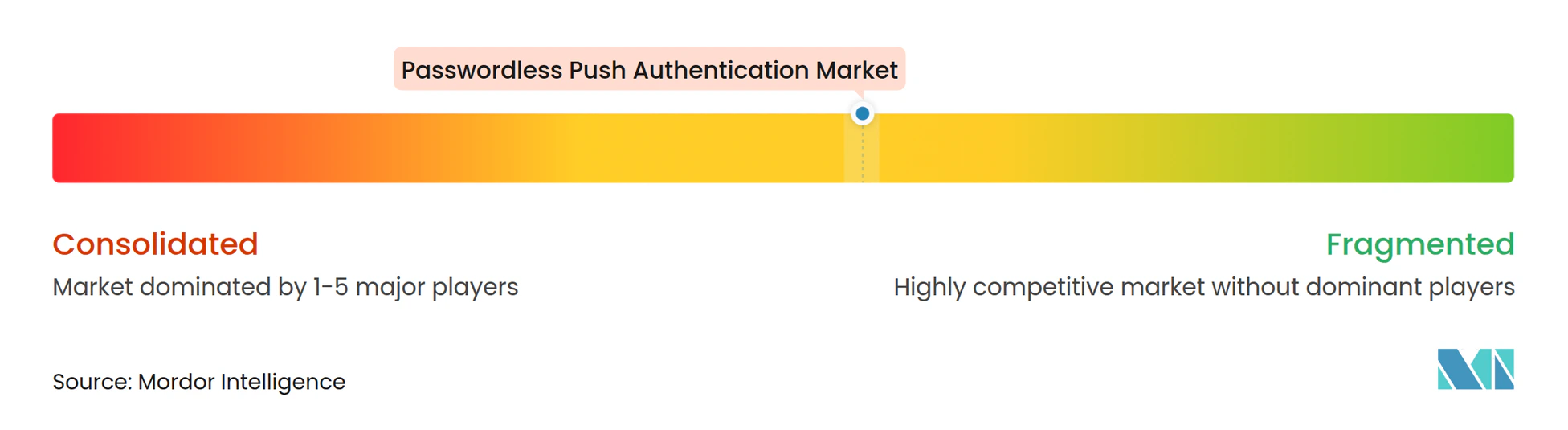
The Passwordless push authentication market is moderately concentrated among leading identity platforms and specialist vendors. Okta, Ping Identity, and Entrust compete with passwordless specialists that built device-bound, FIDO2-native architectures. Competition depends on the depth of integration, as HYPR and Secret Double Octopus offer connectors for Windows logon, VPN, and privileged access management. Established vendors offer broader systems for identity governance, MFA, and lifecycle management.
Ping Identity completed its acquisition of Keyless in January 2026, adding Zero-Knowledge Biometrics and sub-300-millisecond re-verification.[4] SecureAuth acquired Cloudentity in October 2025, adding fine-grained API authorization and real-time session policy enforcement. HYPR and Yubico expanded their partnership in November 2025 to automate identity-verified YubiKey provisioning. These moves add identity proofing, biometrics, hardware credentials, and authorization controls around push approval. They also make risk controls, deployment speed, and application compatibility central to vendor selection.
The Passwordless push authentication market has opportunities in operational technology environments and shared-device workforces, where smartphone-centered models require adaptation. Axiad IDS, Cyphercor, and SecurEnvoy serve needs such as government PIV/CAC migration and call-center shared-device workflows. Basic push approval is increasingly bundled by Apple, Google, and Microsoft, requiring independent vendors to focus on risk-adaptive intelligence and workflow integration. The Passwordless push authentication market industry, therefore, supports both large platforms and focused providers that address legacy systems, regulated settings, and recovery controls.
Passwordless Push Authentication Industry Leaders
-
Okta, Inc.
-
Ping Identity Corporation
-
OneSpan Inc.
-
Yubico AB
-
SecureAuth Corporation
- *Disclaimer: Major Players sorted in no particular order
Passwordless Push Authentication Market Companies Covered in this Report
- Okta, Inc.
- Ping Identity Corporation
- OneSpan Inc.
- Entrust Corporation
- HID Global Corporation
- Yubico AB
- HYPR Corp.
- Beyond Identity, Inc.
- Secret Double Octopus Ltd.
- Trusona, Inc.
- Veridium Ltd.
- 1Kosmos Inc.
- Descope, Inc.
- SecurEnvoy Ltd.
- Axiad IDS, Inc.
- SecureAuth Corporation
- Transmit Security, Inc.
- Cyphercor, Inc.
- Signicat AS
- Prove Identity, Inc.
Recent Industry Developments in Passwordless Push Authentication Market
- January 2026: Ping Identity completed its acquisition of Keyless, a London-based innovator in Zero-Knowledge Biometrics. The integrated capability delivers device-independent cryptographic biometric authentication with sub-300-millisecond re-verification, extending continuous passwordless assurance across CIAM, workforce, and B2B identity environments and supporting PSD3, eIDAS 2.0, GDPR, and CCPA compliance requirements.
- January 2026: The Bangko Sentral ng Pilipinas confirmed it would not extend the June 2026 deadline under BSP Circular 1213, creating an immediate procurement urgency for push authentication and passkey solutions across the Philippine banking sector and cementing it as one of the fastest-moving regulatory transitions in the Asia-Pacific market.
- December 2025: BeyondTrust and Ping Identity announced a strategic partnership integrating Privileged Access Management, Identity and Access Management, and Identity Governance and Administration into a unified identity security platform, available through designated partners and on the AWS Marketplace, closing the gap between privileged-access controls and enterprise push authentication workflows.
- November 2025: HYPR and Yubico expanded their partnership by integrating HYPR Affirm with Yubico's YubiKey provisioning infrastructure. The solution pre-registers FIDO credentials on YubiKeys, binds them to enterprise identity providers, and ships pre-activated hardware to end users, enabling hardware-backed phishing-resistant authentication at AAL3 without IT intermediation during enrollment.
Global Passwordless Push Authentication Market Report Scope
The Passwordless Push Authentication Market comprises software platforms and services that enable users to verify their identities through secure push notifications sent to registered mobile devices without requiring passwords. These solutions leverage device-bound credentials, biometrics, contextual risk assessment, behavioral analytics, and cryptographic authentication to deliver secure and seamless access experiences. The market supports workforce authentication, customer authentication, digital banking security, Zero Trust architectures, and phishing-resistant authentication initiatives across enterprise and consumer environments.
The Passwordless Push Authentication Market Report is Segmented by Push Authentication Type (Passwordless Push Approval, Push-Enhanced Passwordless MFA, Number-Matched Push Authentication, Risk-Adaptive Push Authentication, and Other Push Authentication Types), Deployment Mode (On-Premises, and Cloud), Enterprise Size (Large Enterprises, and Small and Medium-Sized Enterprises), End-User Industry (Banking, Financial Services, and Insurance [BFSI], Government and Public Administration, Healthcare and Life Sciences, IT and Telecommunication, Industrial Manufacturing, Retail and E-commerce, Energy and Utilities, and Other End-User Industries), and Geography (North America, South America, Europe, Asia-Pacific, Middle East, and Africa). The Market Forecasts are Provided in Terms of Value (USD).
Segmentation Overview
| Passwordless Push Approval |
| Push-Enhanced Passwordless MFA |
| Number-Matched Push Authentication |
| Risk-Adaptive Push Authentication |
| Other Push Authentication Types |
| On-Premises |
| Cloud |
| Large Enterprises |
| Small and Medium-Sized Enterprises |
| Banking, Financial Services, and Insurance (BFSI) |
| Government and Public Administration |
| Healthcare and Life Sciences |
| IT and Telecommunication |
| Industrial Manufacturing |
| Retail and E-commerce |
| Energy and Utilities |
| Other End-User Industries |
| North America | United States |
| Canada | |
| South America | Brazil |
| Argentina | |
| Mexico | |
| Rest of South America | |
| Europe | Germany |
| United Kingdom | |
| France | |
| Italy | |
| Russia | |
| Rest of Europe | |
| Asia-Pacific | China |
| Japan | |
| India | |
| South Korea | |
| Rest of Asia-Pacific | |
| Middle East | Saudi Arabia |
| United Arab Emirates | |
| Rest of Middle East | |
| Africa | South Africa |
| Nigeria | |
| Rest of Africa |
| By Push Authentication Type | Passwordless Push Approval | |
| Push-Enhanced Passwordless MFA | ||
| Number-Matched Push Authentication | ||
| Risk-Adaptive Push Authentication | ||
| Other Push Authentication Types | ||
| By Deployment Mode | On-Premises | |
| Cloud | ||
| By Enterprise Size | Large Enterprises | |
| Small and Medium-Sized Enterprises | ||
| By End-User Industry | Banking, Financial Services, and Insurance (BFSI) | |
| Government and Public Administration | ||
| Healthcare and Life Sciences | ||
| IT and Telecommunication | ||
| Industrial Manufacturing | ||
| Retail and E-commerce | ||
| Energy and Utilities | ||
| Other End-User Industries | ||
| By Geography | North America | United States |
| Canada | ||
| South America | Brazil | |
| Argentina | ||
| Mexico | ||
| Rest of South America | ||
| Europe | Germany | |
| United Kingdom | ||
| France | ||
| Italy | ||
| Russia | ||
| Rest of Europe | ||
| Asia-Pacific | China | |
| Japan | ||
| India | ||
| South Korea | ||
| Rest of Asia-Pacific | ||
| Middle East | Saudi Arabia | |
| United Arab Emirates | ||
| Rest of Middle East | ||
| Africa | South Africa | |
| Nigeria | ||
| Rest of Africa | ||
Key Questions Answered in the Report
What is the size of the Passwordless push authentication market?
The Passwordless push authentication market is projected to rise from USD 4.20 billion in 2026 and USD 5.15 billion in 2027 to USD 14.61 billion by 2032, at a 23.21% CAGR.
What is driving demand for passwordless push authentication?
Phishing losses, authentication mandates, the move away from SMS OTP, and higher mobile payment activity are supporting adoption.
Which push authentication type holds the largest share?
Passwordless Push Approval held 59.11% in 2026 because it works with widely used enterprise identity providers.
Which deployment model is growing fastest?
Cloud deployment is expected to expand at a 24.75% CAGR through 2032 as organizations adopt identity-as-a-service tools.
Which end-user sector leads demand?
BFSI held 29.88% in 2026 due to transaction authorization needs and regional security requirements.
Which region is growing fastest?
Asia-Pacific is projected to expand at a 24.05% CAGR through 2032, supported by mobile banking and authentication rules.