
Managed Passwordless and MFA Operations Services Market Size and Share
Market Overview
| Study Period | 2021 - 2032 |
|---|---|
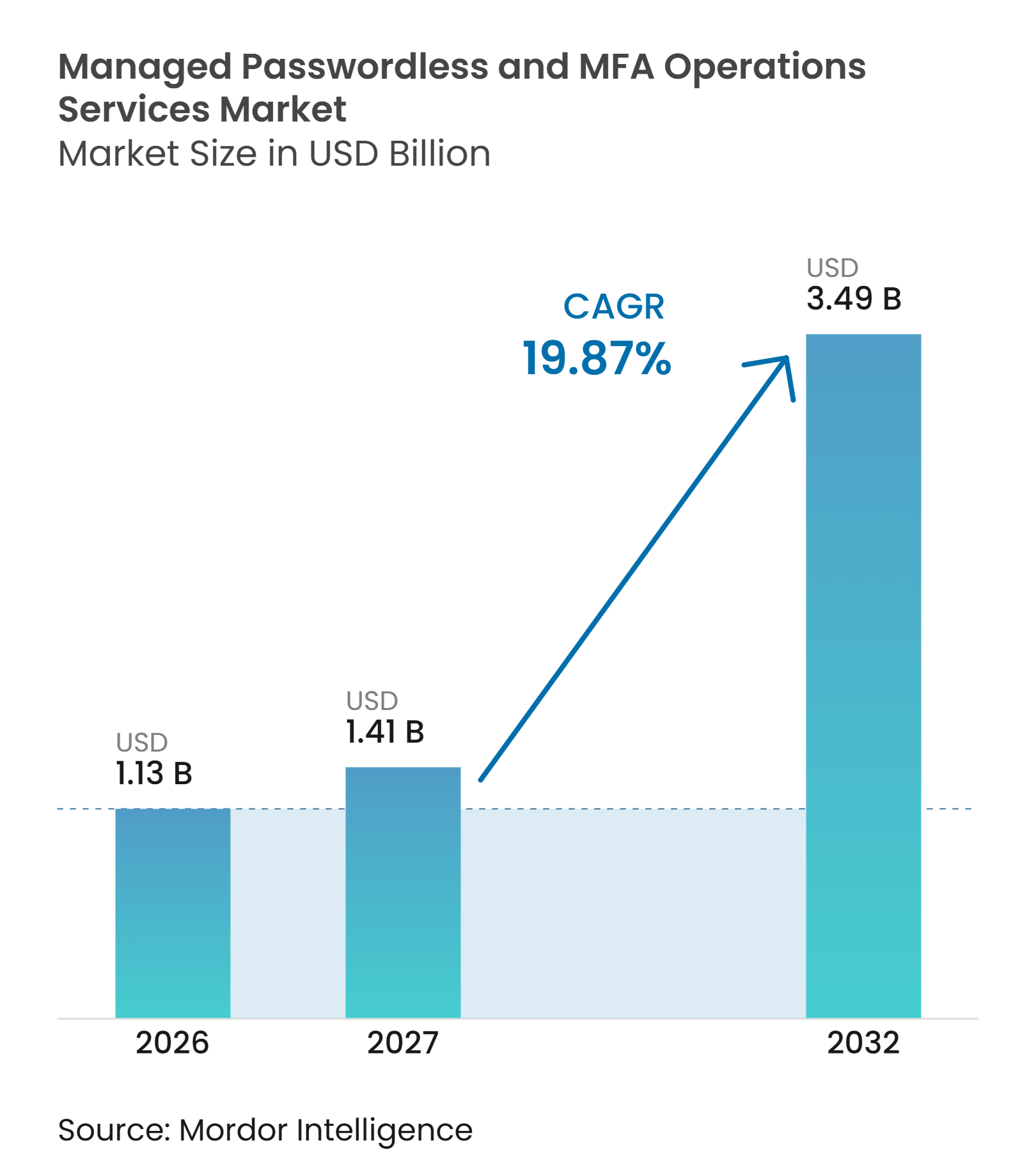
| Market Size (2027) | USD 1.41 Billion |
| Market Size (2032) | USD 3.49 Billion |
| Growth Rate (2027 - 2032) | 19.87 % |
| Fastest Growing Market | Asia-Pacific |
| Largest Market | North America |
| Market Concentration | Medium |
Major Players *Disclaimer: Major Players sorted in no particular order Image © Mordor Intelligence. Reuse requires attribution under CC BY 4.0. | |
Managed Passwordless and MFA Operations Services Market Analysis by Mordor Intelligence
The managed passwordless and MFA operations services market size is expected to increase from USD 1.13 billion in 2026 to USD 1.41 billion in 2027 and reach USD 3.49 billion by 2032, growing at a CAGR of 19.87% over 2027-2032. The managed passwordless and MFA operations services market is expanding as organizations shift complex authentication work from internal teams to specialized providers. Cloud migration, phishing-resistant access requirements, and shortages of identity and access management professionals support this shift. Buyers increasingly need services that can handle enrollment, credential recovery, policy enforcement, and continuous review without disrupting daily operations. These needs favor providers that combine operational depth, compliance support, and multi-environment delivery. The managed passwordless and MFA operations services market also benefits when organizations face identity risks that internal teams cannot address while maintaining routine authentication services.
Key Report Takeaways
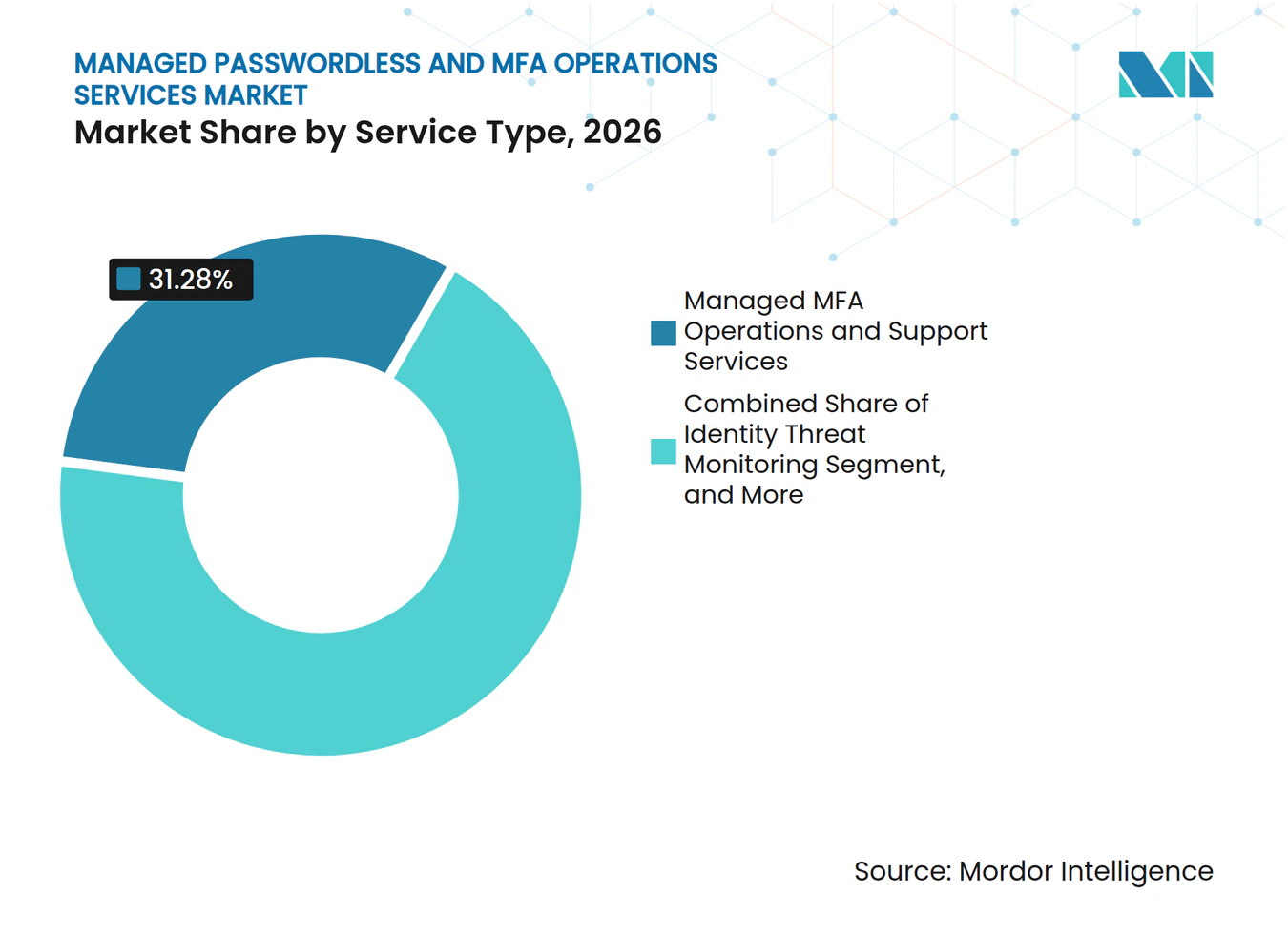
- By service type, managed MFA operations and support services held 31.28% of the managed passwordless and MFA operations services market share in 2026, while identity threat monitoring and response services are projected to expand at a 21.73% CAGR through 2032.
- By authentication operations scope, workforce authentication operations held 46.32% of revenue in 2026, while AI-agent authentication is projected to expand at a 22.61% CAGR through 2032.
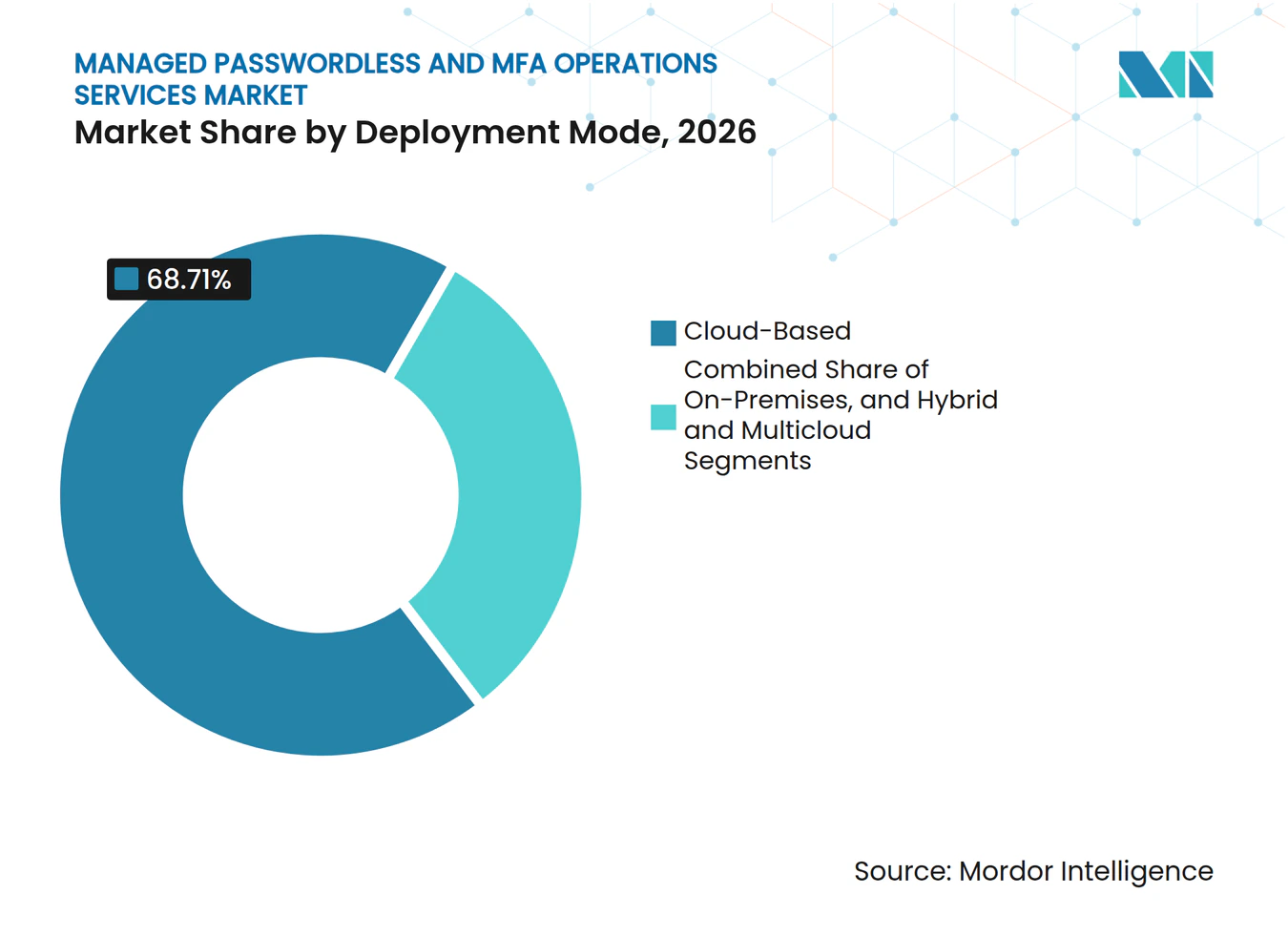
- By deployment mode, cloud-based delivery accounted for 68.71% of revenue in 2026 and is projected to expand at a 21.92% CAGR through 2032.
- By organization size, large enterprises held 71.54% of the managed passwordless and MFA operations services market revenue in 2026, while SMEs are projected to expand at a 21.82% CAGR through 2032.
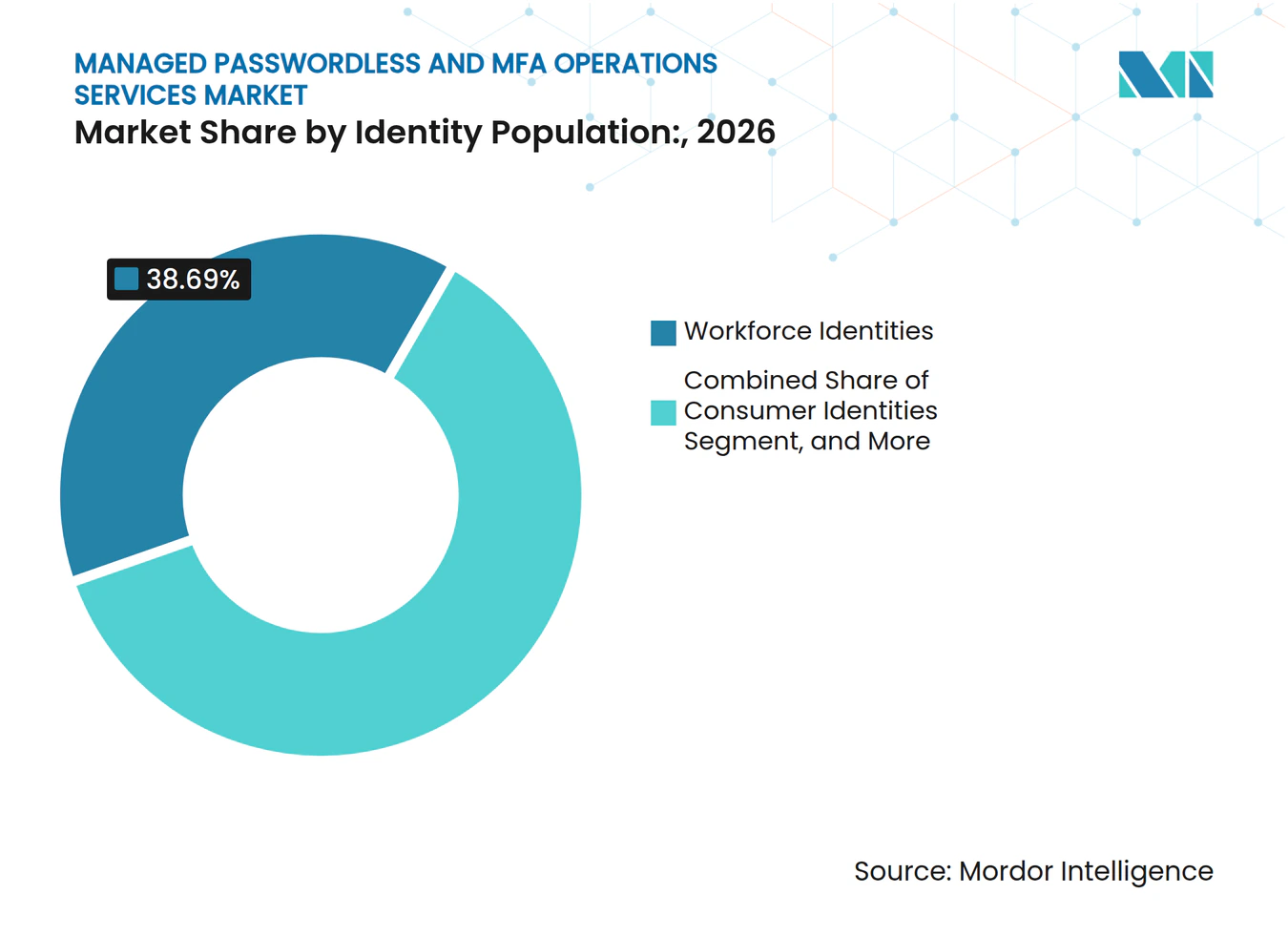
- By identity population, workforce identities held 38.69% of revenue in 2026, while AI-agent identities are projected to expand at a 22.54% CAGR through 2032.
- By end-user industry, BFSI held 26.69% of revenue in 2026, while IT and telecommunications is projected to expand at a 22.54% CAGR through 2032.
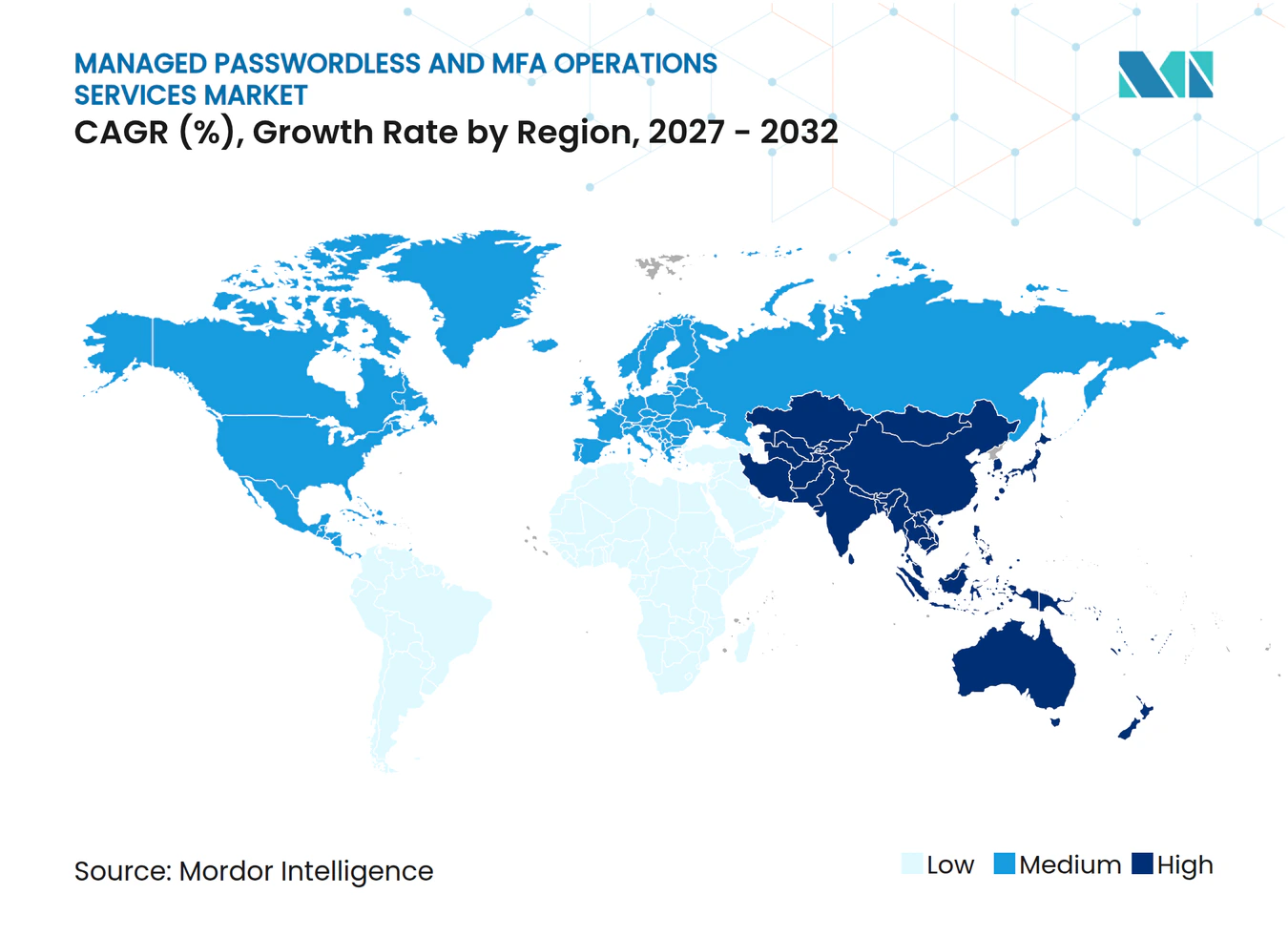
- By geography, North America held 41.64% of the managed passwordless and MFA operations services market revenue in 2026, while Asia-Pacific is projected to expand at a 23.86% CAGR through 2032.
Note: Market numbers in this report are based on Mordor Intelligence's proprietary estimation framework, which combines nine months of actuals with Q4 projections for base year 2026.
Market Trends and Insights
Drivers Impact Analysis of Managed Passwordless and MFA Operations Services Market*
| Driver | (~) % Impact on CAGR Forecast | Geographic Relevance | Impact Timeline |
|---|---|---|---|
| Rising Phishing-Resistant Authentication Mandates | +3.5% | North America and Europe | Short term (≤ 2 years) |
| Escalating Identity-Centric Breach Exposure | +3.2% | Global | Short term (≤ 2 years) |
| Cloud and Hybrid Identity Sprawl | +2.8% | Global, Asia-Pacific core, spillover to Middle East and Africa | Medium term (2-4 years) |
| Shortage of Specialized IAM Operations Talent | +2.4% | North America and Europe, spillover to Asia-Pacific | Medium term (2-4 years) |
| Passkey Lifecycle Complexity After Initial Deployment | +2.1% | North America and Europe | Medium term (2-4 years) |
| Expansion of Non-Human and AI-Agent Identities | +2.6% | Global | Long term (≥ 4 years) |
| Source: Mordor Intelligence | |||
Rising Phishing-Resistant Authentication Mandates
The January 2025 federal cybersecurity order made phishing-resistant authentication a requirement for federal systems and expressly referenced WebAuthn.[1] CMS CISO Memo 26-05 set a March 31, 2027, deadline for federal FISMA systems to meet phishing-resistant access requirements. NIST SP 800-63B-4 provides the federal guidance that supports authenticator management and stronger authentication decisions. These measures give the managed passwordless and MFA operations services market a defined compliance use case across government, contractors, healthcare, and financial services. Providers that can manage FIDO2 enrollment, recovery, and audit evidence can help customers shorten compliance preparation.
Escalating Identity-Centric Breach Exposure
The Identity Theft Resource Center recorded 3,322 data compromises in 2025, which represented a 79% increase over 5 years. It also recorded 1,803 compromises in the first 6 months of 2026, sustaining urgency around identity controls. RSA reported that 45% of surveyed organizations incurred identity-related breach costs above the IBM average benchmark, and 24% reported costs above USD 10 million. The same research identified help desk bypass attacks as a serious concern for 65% of respondents. The managed passwordless and MFA operations services market benefits when buyers need stronger identity verification and event response alongside standard authentication operations.
Cloud and Hybrid Identity Sprawl
Cloud and hybrid environments create separate identity stores, tokens, credentials, and logging practices that are difficult to govern consistently. CISA identified token management, secrets rotation, and inconsistent logging as persistent risks in cloud identity infrastructure.[2] The SANS survey found that 76% of organizations reported growth in non-human identities and 74% operated AI agents that required credentials. These conditions expand the operational scope that providers must monitor across cloud, on-premises, and mixed deployments. The managed passwordless and MFA operations services market gains from services that centralize policy enforcement, credential rotation, and audit records across these environments.
Shortage of Specialized IAM Operations Talent
The SANS 2026 workforce research found that 60% of organizations identified the skills gap as their leading workforce challenge, compared with 52% in 2025. The U.S. Bureau of Labor Statistics projects 32% employment growth for information security analysts from 2022 to 2032. ISACA reported that 27% of organizations experienced a breach attributable to cybersecurity skills gaps. Managed delivery gives customers access to specialists without building a full internal operating team, which supports the managed passwordless and MFA operations services market. This shortage supports the managed passwordless and MFA operations services market because customers still need continuity for enrollment, access recovery, policy changes, and compliance
Restraints Impact Analysis of Managed Passwordless and MFA Operations Services Market*
| Restraint | (~) % Impact on CAGR Forecast | Geographic Relevance | Impact Timeline |
|---|---|---|---|
| High Transition and Integration Costs | -3.2% | Global, especially SMEs | Short term (≤ 2 years) |
| Legacy Application and Federation Remediation | -2.5% | North America and Europe | Medium term (2-4 years) |
| Recovery and Fallback-Factor Edge Cases | -1.5% | Global | Short term (≤ 2 years) |
| Fragmented Ownership of Identity Assurance Operations | -1.2% | Global | Medium term (2-4 years) |
| Source: Mordor Intelligence | |||
High Transition and Integration Costs
Authentication outsourcing can require platform integration, professional services, user re-enrollment, and baseline service-level agreements before operations move to a provider. RSA found that 90% of respondents faced challenges in moving toward passwordless authentication, with cost and integration complexity among the common barriers. These costs are more difficult for SMEs to absorb because each integration can take up a larger share of the security budget. Data residency and privacy rules can add design and review work for customers operating in multiple jurisdictions. This restraint can slow conversion even where the managed passwordless and MFA operations services market has a strong security case.
Legacy Application and Federation Remediation
Older application portfolios may rely on Active Directory Federation Services, SAML 1.x, Kerberos, or proprietary integrations that do not migrate easily to modern phishing-resistant authentication. The FIDO Alliance identified legacy system compatibility as one of the common barriers to enterprise passkey deployment. A managed provider must often operate alongside legacy controls until applications and connectors are remediated. Parallel controls complicate service-level agreements, accountability, and consistent user experience. The issue is especially relevant in North America and Europe, where many large organizations retain long-established on-premises identity platforms.
*Our forecasts treat driver/restraint impacts as directional, not additive. The impact forecasts reflect baseline growth, mix effects, and variable interactions.
Managed Passwordless and MFA Operations Services Market Segment Analysis
By Service Type:
MFA Support Anchors Revenue While Threat Monitoring AcceleratesManaged MFA operations and support services, held 31.28% of service-type revenue in 2026. This part of the managed passwordless and MFA operations services market covers enrollment, credential lifecycle work, policy enforcement, and end-user support. These recurring activities require consistent operational staffing that many internal teams cannot maintain. Identity threat monitoring and response services are projected to expand at a 21.73% CAGR from 2027 to 2032. This service type adds continuous review of authentication events for account takeover, credential stuffing, and session hijacking. It shifts the service discussion from routine access administration to active detection and response. The managed authentication services industry is therefore moving toward contracts that pair daily operations with ongoing security oversight.
Managed passwordless operations and support services from a related growth category. The FIDO Alliance reported that 87% of surveyed enterprises were deploying or actively deploying passkeys in 2026. Cross-platform enrollment, device binding, and account recovery remain practical operating needs after a passkey program begins. Authentication policy design and optimization services translate standards into access rules that vary by risk signal and identity population. Enrollment, migration, lifecycle, recovery, and help desk services address processes that are often underestimated during early planning. Providers can differentiate by linking these services to documented controls that support NIST guidance and FIDO-aligned authentication practices. This combination makes service integration depth an important purchasing factor.



By Authentication Operations Scope:
Workforce Leads While AI-Agent Authentication Sets New RequirementsWorkforce authentication operations held 46.32% of revenue in 2026. Workforce systems have been central to enterprise identity investment for many years, supporting employee credentials, access policies, and application sign-on. Privileged access authentication is also important because it requires session management and just-in-time access. Customer and consumer authentication focuses on low-friction access while maintaining assurance. Business-to-business and partner authentication is expanding as organizations extend stronger controls to third-party identities. CISA supply-chain guidance supports more disciplined protection of access paths that reach beyond the enterprise boundary.
AI-agent authentication is projected to expand at a 22.61% CAGR from 2027 to 2032. The SANS survey reported that 74% of organizations already operate AI agents that need credentials.[3] The Internet Engineering Task Force is developing work on authentication and authorization practices for AI agent interactions. This leaves providers with an early opportunity to build governance, audit, and least-privilege controls before standards are fully settled. Machine, API, and service-account authentication remain related needs because each identity requires defined access and credential oversight. Providers that unite human and non-human authentication operations can present a broader service model. This expansion changes the skills, monitoring, and lifecycle controls needed in the managed passwordless and MFA operations services market.
By Deployment Mode:
Cloud Delivery Leads Across Operating EnvironmentsCloud-based delivery accounted for 68.71% of revenue in 2026 and is projected to expand at a 21.92% CAGR through 2032. The cloud-based managed passwordless and MFA operations services market size reflects the alignment between multi-tenant operating models and high-volume authentication workloads. A provider can manage authentication events across many customers without reproducing a separate on-premises environment for each client. Cloud platforms can also make phishing-resistant authentication capabilities available as standard features. This can reduce custom implementation work during a service engagement. The resulting scale supports more consistent monitoring, reporting, and policy updates.
On-premises deployment remains important for defense contractors, classified government systems, and financial institutions that have strict residency or isolation requirements. Hybrid and multicloud configurations are common during migration because organizations operate parallel authentication stacks before legacy applications are remediated. CISA stated that cloud identity infrastructure can be exposed by weak token management, poor secret rotation, and inconsistent logging. Managed providers can address these gaps through centralized policy enforcement and audit telemetry. Deployment choices therefore depend on the customer’s regulatory duties, application architecture, and migration stage. The managed authentication services industry must maintain delivery flexibility rather than assume a single environment fits all buyers.

By Organization Size:
Large Enterprises Lead Spending While SMEs Gain AccessLarge enterprises held 71.54% of revenue in 2026. Their authentication environments often span multiple cloud platforms, privileged accounts, business units, and geographic locations. These organizations also face stronger demands for documented governance from regulators, boards, and customers. The revenue share held by large enterprises reflects both operating complexity and established use of external service partners. Large customers often need providers to coordinate several technology platforms under one operating model. This need rewards suppliers with broad integration experience and dependable support capacity in the managed passwordless and MFA operations services market.
SMEs are projected to expand at a 21.82% CAGR from 2027 to 2032. Subscription pricing can give smaller organizations access to authentication capabilities that they may not be able to operate independently. SailPoint expanded its managed service provider program in March 2025 to help partners deliver its Identity Security Cloud to smaller enterprises. Cisco also expanded Duo availability through its Secure MSP Center in November 2025, supporting managed MFA delivery through channel partners. These channel models can reduce the operational barrier for small customers that need recurring security support. The managed passwordless and MFA operations services market can therefore broaden as providers package services in simpler commercial and delivery models.
By Identity Population:
Workforce Identities Lead While AI Agents Redefine ScopeWorkforce identities held 38.69% of revenue in 2026. Employee credentials, device certificates, and single sign-on policies remain the established foundation of managed authentication demand. Consumer and privileged identities form the next important groups. Privileged identity management needs session monitoring and just-in-time access controls in addition to standard MFA. The revenue contribution from workforce identities reflects the long-standing need to administer employee access across business systems. Providers must still support workforce populations while broadening their controls for other identity types.
AI-agent identities are projected to expand at a 22.54% CAGR from 2027 to 2032. The SANS survey found that 15% of security leaders did not know whether agentic AI was active in their environment, and 59% rotated fewer than half of non-human credentials each quarter. This weak visibility creates demand for automated credential rotation, least-privilege enforcement, and behavioral monitoring. The Internet Engineering Task Force’s work on AI-agent authentication shows that the technical approach is still developing. Providers that define repeatable governance services can address a population that traditional IAM and PAM tools were not designed to manage at scale. This creates a broader operational remit for the managed passwordless and MFA operations services market.
By End-User Industry:
BFSI Leads Revenue While IT and Telecommunications AccelerateBFSI held 26.69% of end-user revenue in 2026. Financial institutions manage high-value transactions, significant fraud exposure, and customer expectations for quick access. New York’s cybersecurity regulation requires covered entities to maintain written policies and controls, including identity and access management measures. These demands make external authentication operations attractive when internal resources are limited. The managed authentication services industry can support financial institutions with stronger help desk verification, event monitoring, and auditable access processes. This sector remains important because authentication failures can carry operational, regulatory, and customer consequences.
The IT and telecommunications industry is projected to expand at a 22.54% CAGR from 2027 to 2032. These businesses are large consumers of internal identity services and also provide digital infrastructure to other sectors. Healthcare and life sciences need authentication controls for users and connected clinical devices under HIPAA security requirements.[4] Government demand is shaped by federal phishing-resistant access rules, while manufacturing needs authentication that works across converging operational technology and IT environments. Retail and e-commerce use risk-based step-up authentication for high-value transactions. The managed passwordless and MFA operations services market can serve these varied needs when providers adapt operations to each sector’s access patterns and compliance duties.
Geography Analysis
North America Managed Passwordless and MFA Operations Services Market
North America held 41.64% of the managed passwordless and MFA operations services market share in 2026. U.S. federal phishing-resistant authentication requirements and the March 31, 2027, FISMA deadline create a clear procurement driver for agencies and contractors. The United States leads regional demand, while Canada and Mexico gain from cross-border supply-chain security requirements. The Identity Theft Resource Center reported 1,803 data compromises and 471 million victim notices during the first 6 months of 2026. Financial services and healthcare buyers also face sector-specific compliance duties that reinforce authentication spending.
APAC Managed Passwordless and MFA Operations Services Market
Asia-Pacific is projected to expand at a 23.86% CAGR from 2027 to 2032. Japan’s enterprise interest in IDaaS, including a reported 90.4% that had deployed or considered IDaaS, supports a sizable opportunity for managed delivery. India’s Aadhaar-linked identity frameworks and financial sector requirements encourage investment in identity and access management. South Korea and Singapore add demand through government cybersecurity standards and digital service programs. The managed passwordless and MFA operations services market offers broad regional opportunities because cloud adoption and regulatory requirements vary substantially by country. Providers need country-specific delivery, partner networks, and controls for local data practices.
EMEA and South America Managed Passwordless and MFA Operations Services Market
Europe is supported by GDPR and eIDAS 2.0, which make strong authentication important for many consumer-facing and regulated services. South America is at an earlier stage, with Brazil supported by LGPD requirements and expanding fintech activity. The Middle East gains demand from government digitization programs in the United Arab Emirates and Saudi Arabia. Africa remains smaller, with adoption concentrated in BFSI and telecommunications, although mobile-first services can support wider access as consumption-based delivery matures.
Competitive Landscape
Market Concentration
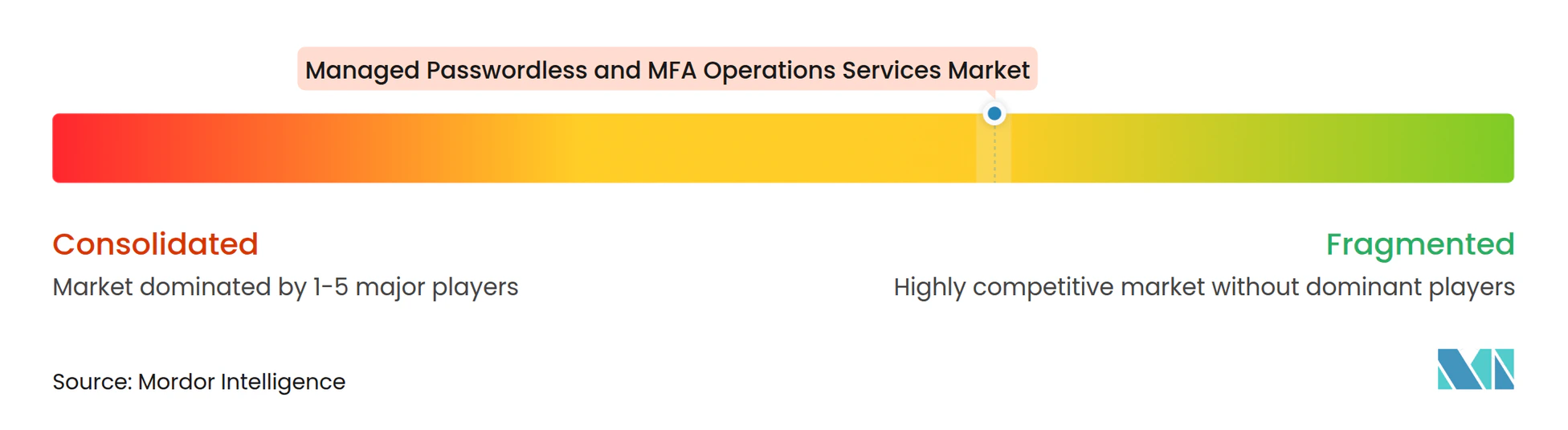
The managed passwordless and MFA operations services market is moderately fragmented, with hyperscalers, IAM platforms, global systems integrators, and specialist managed identity firms competing across service categories. Accenture, IBM, Deloitte, and Tata Consultancy Services compete on their ability to implement and operate multi-vendor identity environments. Okta and SailPoint extend their ecosystem reach through managed service provider programs. The managed passwordless and MFA operations services market is not dominated by a single provider type because buyers often require multiple technologies and local operational support. Integration depth, compliance delivery, and available IAM talent are important competitive attributes. These factors make a service provider’s operating model as important as its authentication technology.
Palo Alto Networks announced a definitive agreement to acquire CyberArk for an equity value of USD 25 billion in July 2025. The transaction positioned identity security as a core element of a larger security platform. IBM made AskIAM generally available in June 2025 to automate IAM provisioning, access requests, and identity protection workflows through its consulting platform. SailPoint launched Unified Platform Access in June 2026, enabling technology alliance partners and systems integrators to build native applications on its Atlas foundation. These actions show that leading firms are building partner ecosystems and assisting operations alongside their core platforms. The managed passwordless and MFA operations services market rewards companies that can connect technology, implementation, and sustained operations.
AI-agent identity governance remains an open field because repeatable managed offerings at production scale are still limited. Entersekt launched Orkestrate in November 2025 with more than 150 pre-orchestrated authentication journeys for digital banking. Specialist firms such as Simeio Solutions can appeal to customers who need multi-vendor operating expertise without selecting a platform-led service model. NIST guidance and FIDO-aligned requirements raise the value of providers that can demonstrate documented compliance controls. Competition will depend on whether providers can govern human, machine, and AI-agent identities while keeping integration and migration work manageable.
Managed Passwordless and MFA Operations Services Industry Leaders
-
Accenture plc
-
Amazon Web Services, Inc.
-
BeyondTrust Corporation
-
Broadcom Inc.
-
Cisco Systems, Inc.
- *Disclaimer: Major Players sorted in no particular order
Managed Passwordless and MFA Operations Services Market Companies Covered in this Report
- Accenture plc
- Amazon Web Services, Inc.
- BeyondTrust Corporation
- Broadcom Inc.
- Cisco Systems, Inc.
- CyberArk Software Ltd.
- Deloitte Touche Tohmatsu Limited
- Ernst and Young Global Limited
- Entrust Corporation
- Google LLC
- HCLTech
- HID Global Corporation
- International Business Machines Corporation
- Kyndryl Holdings, Inc.
- Microsoft Corporation
- NTT DATA Group Corporation
- Okta, Inc.
- OneSpan Inc.
- Palo Alto Networks, Inc.
- Ping Identity Corporation
- PricewaterhouseCoopers International Limited
- SailPoint, Inc.
- Saviynt, Inc.
- Simeio Solutions
- Tata Consultancy Services Limited
Recent Industry Developments in Managed Passwordless and MFA Operations Services Market
- June 2026: SailPoint launched its Unified Platform Access program, enabling technology alliance partners and systems integrators to build native applications on the SailPoint Atlas foundation through a tiered membership and shared-revenue commercial model, directly targeting integration complexity, the top cited barrier to identity security maturity among enterprise buyers.
- February 2026: HCLTech and SailPoint formalized an alliance to deliver AI-led identity security managed services to Indian enterprises, embedding SailPoint's identity governance platform into HCLTech's MiDaaS managed services framework to support scalable identity lifecycle management for domestic and multinational clients in Asia-Pacific.
- October 2025: Nomios, a pan-European managed cybersecurity services group, acquired Intragen, an IAM specialist with over 250 identity experts across the United Kingdom, Germany, Finland, the Netherlands, Sweden, and Greece, expanding managed identity and privileged access management capabilities across the EMEA region.
- September 2025: CyberArk was included in the Microsoft Security Store Partner Ecosystem, providing pre-validated integration with Microsoft Security technologies and certified AI agents integrating with Microsoft Security products, enabling faster discovery and deployment of managed identity security for enterprise buyers.
Global Managed Passwordless and MFA Operations Services Market Report Scope
Managed passwordless and MFA operations services market includes third-party services that design, deploy, administer, monitor, and support modern authentication controls, including multi-factor authentication, passkeys, biometrics, hardware tokens, and passwordless sign-in. The market focuses on strengthening identity security, reducing credential-based attacks, and improving user access experience across enterprise applications and infrastructure.
The Managed Passwordless And MFA Operations Services Market Report is Segmented by Service Type (Managed Passwordless Operations and Support Services, Managed MFA Operations and Support Services, Authentication Policy Design and Optimization Services, Enrollment, Migration, and Credential Lifecycle Services, Recovery, Help Desk, and User Support Services, Identity Threat Monitoring and Response Services, and Other Service Types), Authentication Operations Scope (Workforce Authentication Operations, Privileged Access Authentication, Customer and Consumer Authentication, Business-to-Business and Partner Authentication, Machine, API, and Service-Account Authentication, and AI-Agent Authentication), Deployment Mode (Cloud-Based, On-Premises, and Hybrid and Multicloud), Organization Size (Large Enterprises, and Small and Medium-Sized Enterprises), Identity Population (Workforce Identities, Consumer Identities, Privileged Identities, Non-Human Identities, and AI-Agent Identities), End User Industry (Banking, Financial Services and Insurance (BFSI), IT and Telecommunications, Healthcare and Life Sciences, Government and Public Sector, Industrial Manufacturing, Retail and E-Commerce, and Other End-User Industries), and Geography (North America, South America, Europe, Asia-Pacific, Middle East, and Africa). The Market Forecasts are Provided in Terms of Value (USD).
Segmentation Overview
| Managed Passwordless Operations and Support Services |
| Managed MFA Operations and Support Services |
| Authentication Policy Design and Optimization Services |
| Enrollment, Migration, and Credential Lifecycle Services |
| Recovery, Help Desk, and User Support Services |
| Identity Threat Monitoring and Response Services |
| Other Service Types |
| Workforce Authentication Operations |
| Privileged Access Authentication |
| Customer and Consumer Authentication |
| Business-to-Business and Partner Authentication |
| Machine, API, and Service-Account Authentication |
| AI-Agent Authentication |
| Cloud-Based |
| On-Premises |
| Hybrid and Multicloud |
| Large Enterprises |
| Small and Medium-Sized Enterprises |
| Workforce Identities |
| Consumer Identities |
| Privileged Identities |
| Non-Human Identities |
| AI-Agent Identities |
| Banking, Financial Services and Insurance (BFSI) |
| IT and Telecommunications |
| Healthcare and Life Sciences |
| Government and Public Sector |
| Industrial Manufacturing |
| Retail and E-Commerce |
| Other End-User Industries |
| North America | United States |
| Canada | |
| Mexico | |
| South America | Brazil |
| Argentina | |
| Rest of South America | |
| Europe | United Kingdom |
| Germany | |
| France | |
| Italy | |
| Rest of Europe | |
| Asia-Pacific | China |
| Japan | |
| India | |
| South Korea | |
| Rest of Asia-Pacific | |
| Middle East | United Arab Emirates |
| Saudi Arabia | |
| Rest of Middle East | |
| Africa | South Africa |
| Nigeria | |
| Rest of Africa |
| By Service Type | Managed Passwordless Operations and Support Services | |
| Managed MFA Operations and Support Services | ||
| Authentication Policy Design and Optimization Services | ||
| Enrollment, Migration, and Credential Lifecycle Services | ||
| Recovery, Help Desk, and User Support Services | ||
| Identity Threat Monitoring and Response Services | ||
| Other Service Types | ||
| By Authentication Operations Scope | Workforce Authentication Operations | |
| Privileged Access Authentication | ||
| Customer and Consumer Authentication | ||
| Business-to-Business and Partner Authentication | ||
| Machine, API, and Service-Account Authentication | ||
| AI-Agent Authentication | ||
| By Deployment Mode | Cloud-Based | |
| On-Premises | ||
| Hybrid and Multicloud | ||
| By Organization Size | Large Enterprises | |
| Small and Medium-Sized Enterprises | ||
| By Identity Population | Workforce Identities | |
| Consumer Identities | ||
| Privileged Identities | ||
| Non-Human Identities | ||
| AI-Agent Identities | ||
| By End-User Industry | Banking, Financial Services and Insurance (BFSI) | |
| IT and Telecommunications | ||
| Healthcare and Life Sciences | ||
| Government and Public Sector | ||
| Industrial Manufacturing | ||
| Retail and E-Commerce | ||
| Other End-User Industries | ||
| By Geography | North America | United States |
| Canada | ||
| Mexico | ||
| South America | Brazil | |
| Argentina | ||
| Rest of South America | ||
| Europe | United Kingdom | |
| Germany | ||
| France | ||
| Italy | ||
| Rest of Europe | ||
| Asia-Pacific | China | |
| Japan | ||
| India | ||
| South Korea | ||
| Rest of Asia-Pacific | ||
| Middle East | United Arab Emirates | |
| Saudi Arabia | ||
| Rest of Middle East | ||
| Africa | South Africa | |
| Nigeria | ||
| Rest of Africa | ||
Key Questions Answered in the Report
What is the managed passwordless and MFA operations services market size?
The managed passwordless and MFA operations services market size is expected to increase from USD 1.13 billion in 2026 to USD 1.41 billion in 2027 and reach USD 3.49 billion by 2032, growing at a CAGR of 19.87% over 2027-2032.
What is driving demand for managed authentication services?
Federal phishing-resistant authentication requirements, rising identity compromise exposure, cloud identity complexity, and scarce IAM skills are supporting demand.
Which service type leads managed authentication spending?
Managed MFA operations and support services led with a 31.28% share of service-type revenue in 2026.
Which deployment model is expanding fastest?
Cloud-based delivery held 68.71% of revenue in 2026 and is projected to expand at a 21.92% CAGR through 2032.
Which region is projected to expand fastest?
Asia-Pacific is projected to expand at a 23.86% CAGR from 2027 to 2032.
Why are AI-agent identities important for providers?
AI-agent identities are projected to expand at a 22.54% CAGR, increasing demand for credential governance, monitoring, and least-privilege controls.