
Magic Link Authentication Market Size and Share
Market Overview
| Study Period | 2021 - 2032 |
|---|---|
| Market Size (2027) | USD 0.49 Billion |
| Market Size (2032) | USD 1.08 Billion |
| Growth Rate (2027 - 2032) | 17.03 % |
| Fastest Growing Market | Asia-Pacific |
| Largest Market | North America |
| Market Concentration | Medium |
Major Players *Disclaimer: Major Players sorted in no particular order Image © Mordor Intelligence. Reuse requires attribution under CC BY 4.0. | |
Magic Link Authentication Market Analysis by Mordor Intelligence
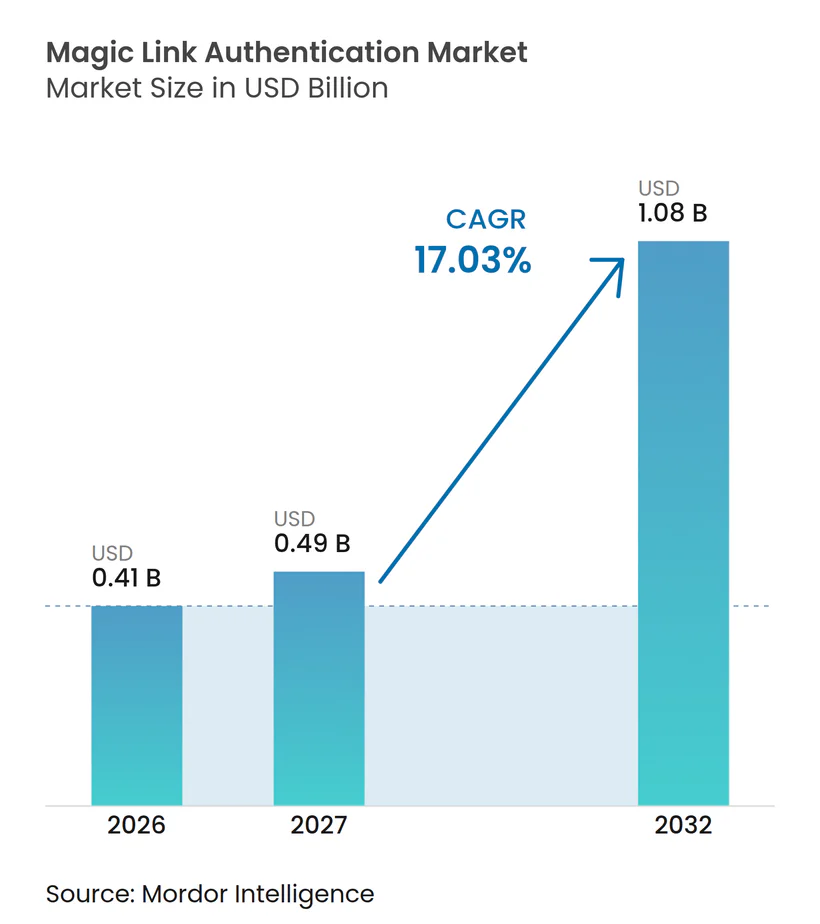
The Magic Link Authentication Market size is projected to expand from USD 0.41 billion in 2026 to USD 0.49 billion in 2027, and to USD 1.08 billion by 2032, registering a CAGR of 17.03% between 2027 and 2032. The category is benefiting from the combined need to reduce credential theft and remove unnecessary friction from digital access. Enterprises are placing more weight on authentication designs that do not depend on reusable passwords. The Magic Link Authentication Market also benefits when product teams can add identity functions without building a separate login system. Delivery reliability, session continuity, and protection against email security scanners will shape vendor selection. Providers that combine several delivery channels with stronger session controls can address the practical weaknesses of email-based access.
Key Report Takeaways
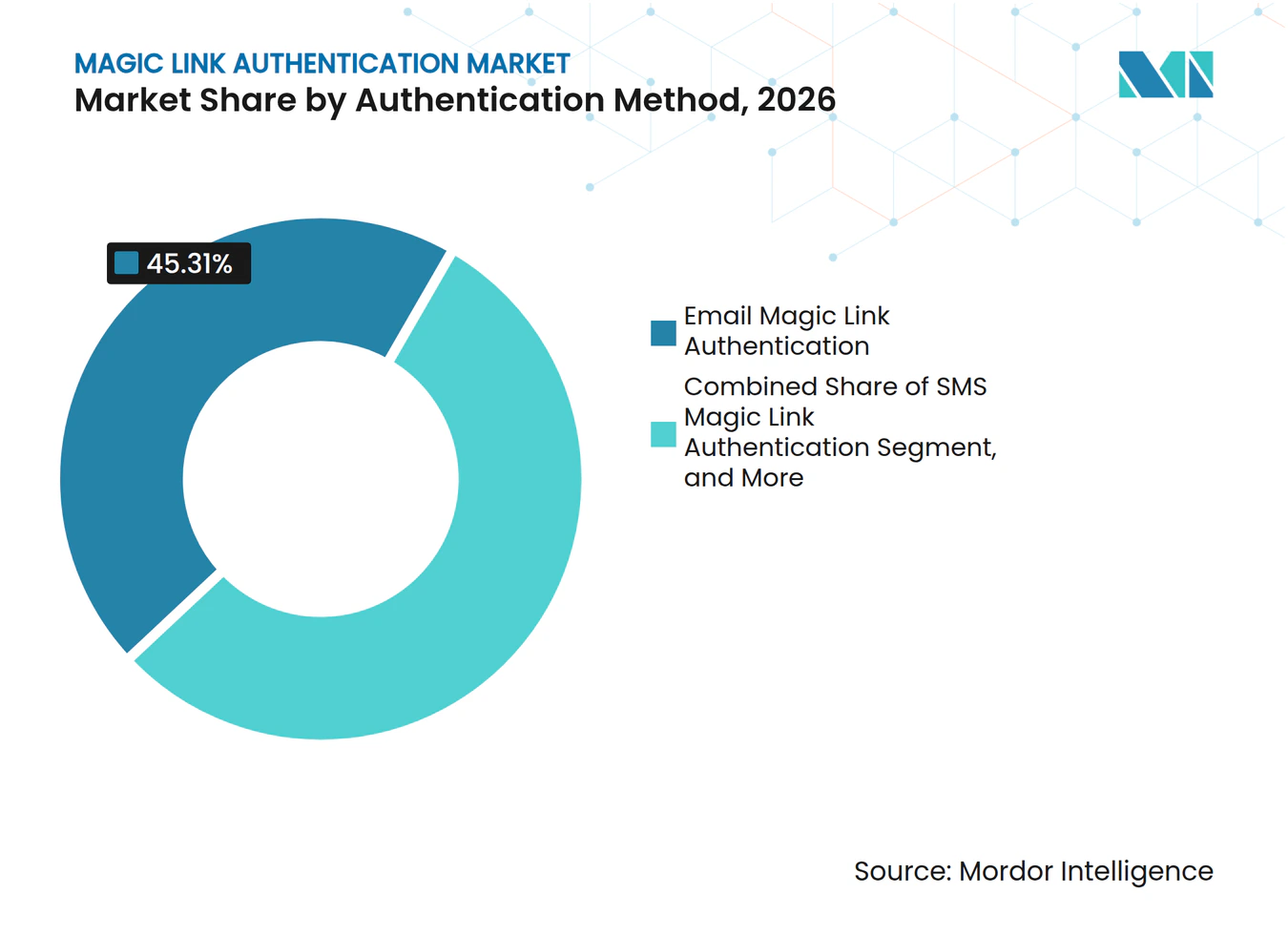
- By authentication method, email-based flows held 45.31% of the Magic Link Authentication Market share in 2026, while embedded and transactional magic links are projected to expand at 18.03% CAGR through 2032.
- By deployment mode, cloud held 70.12% revenue share in 2026 and is projected to expand at 17.62% CAGR through 2032.
- By organization size, large enterprises held 57.23% revenue share in 2026, while SMEs are projected to expand at 17.42% CAGR through 2032.
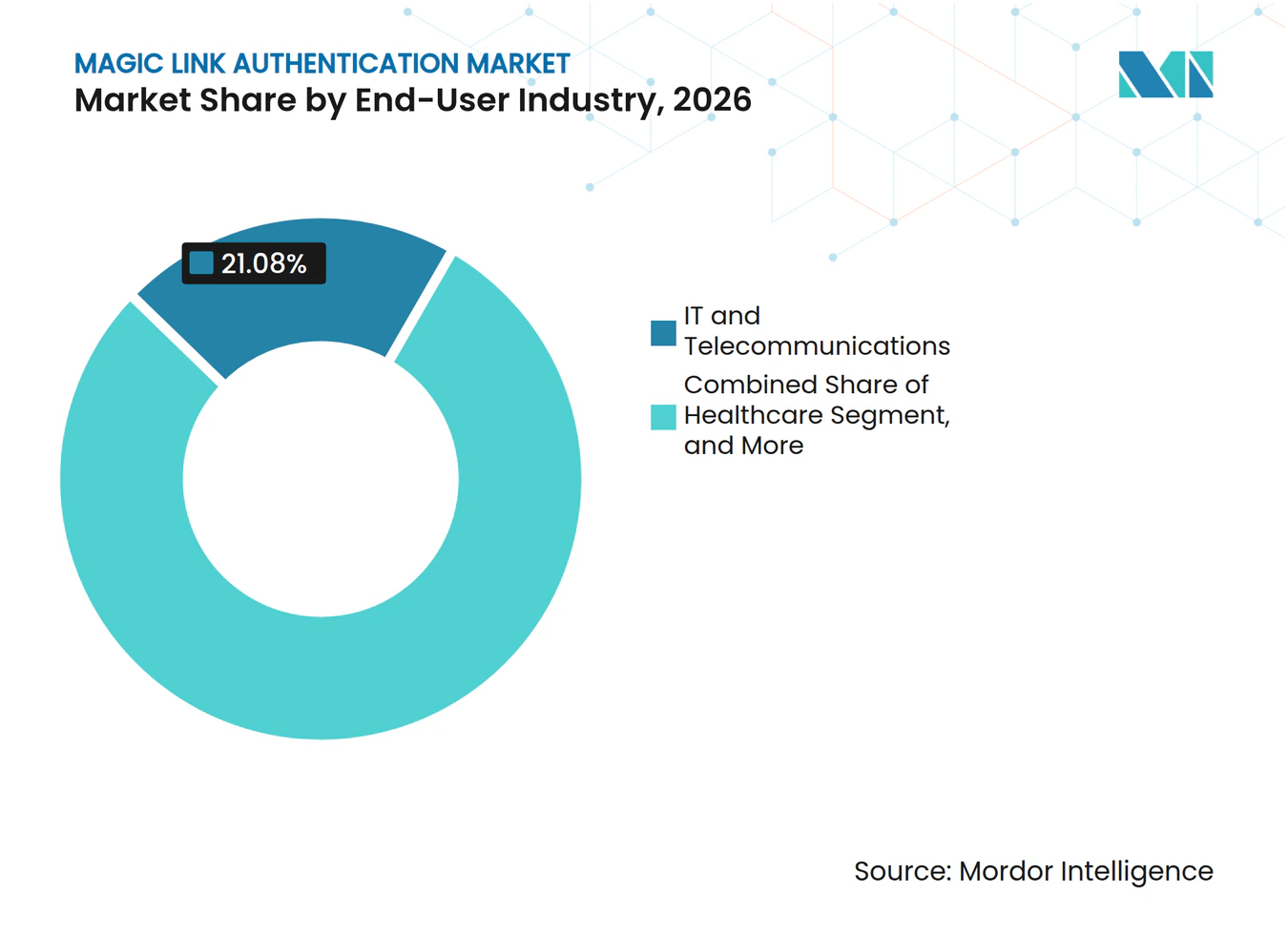
- By end-user industry, IT and telecommunications held 21.08% revenue share in 2026, while healthcare is projected to expand at 18.44% CAGR through 2032.
- By component, solutions held 63.41% revenue share in 2026, while developer tools and SDKs are projected to expand at 17.79% CAGR through 2032.
- By geography, North America held 39.44% revenue share in 2026, while Asia-Pacific is projected to expand at 18.04% CAGR through 2032.
Note: Market numbers in this report are based on Mordor Intelligence's proprietary estimation framework, which combines nine months of actuals with Q4 projections for base year 2026.
Market Trends and Insights
Drivers Impact Analysis of Magic Link Authentication Market*
| Driver | (~) % Impact on CAGR Forecast | Geographic Relevance | Impact Timeline |
|---|---|---|---|
| Rising Credential Theft and Account-Takeover Exposure | +4.5% | Global | Short term (≤ 2 years) |
| Demand for Frictionless Signup and Login Journeys | +3.8% | Global | Short term (≤ 2 years) |
| Lower Password Reset and Helpdesk Operating Costs | +2.9% | North America and Europe | Medium term (2-4 years) |
| Expansion of Embedded Authentication APIs in Digital Products | +2.3% | Global, early strength in North America and Asia-Pacific | Medium term (2-4 years) |
| Mobile-First Access and Universal Email Reach | +1.8% | Asia-Pacific core, spill-over to Middle East and South America | Medium term (2-4 years) |
| Email-Security-Scanner-Aware Link Delivery | +0.7% | North America and Europe | Long term (≥ 4 years) |
| Source: Mordor Intelligence | |||
Rising Credential Theft and Account-Takeover Exposure
Credential theft has made password-dependent login systems a more visible security exposure for enterprise buyers. IBM reported that credential theft featured in nearly 1 in 3 enterprise incidents examined during 2024, while phishing emails distributing infostealers rose 180% from 2023 levels.[1] TransUnion reported that digital account takeover volume increased by 141% between H1 2021 and H1 2025, and U.S. businesses identified it as their most damaging type of fraud. A magic link removes the reusable password that credential-stealing campaigns seek. This design gives security teams a direct reason to assess the Magic Link Authentication Market alongside broader passwordless programs. It also makes account recovery and transaction controls more important, where email access itself may be compromised.
Demand for Frictionless Signup and Login Journeys
Login friction can interrupt signups, purchases, and account access before users reach the intended service. MojoAuth reported that passwordless deployments improved average conversion by 28.3% across 523.7 million authentication events, while e-commerce checkout conversion improved 31.4%. The same research reported an average magic link authentication time of 1.4 seconds, compared with 8.7 seconds for traditional MFA flows. These results explain why commercial teams increasingly participate in authentication decisions. A short, familiar email-based flow can reduce the burden of remembering a password. The Magic Link Authentication Market is therefore supported by both security requirements and conversion-focused product design.
Lower Password Reset and Helpdesk Operating Costs
Password resets create recurring service desk work that increases with workforce and customer account volumes. Removing password reset workflows can lower operational pressure for organizations that process large numbers of access requests. The Magic Link Authentication Market is particularly relevant to companies that want to limit routine support tasks without requiring a new hardware credential. The FIDO Alliance reported that 89% of new enterprise deployments in 2025 selected passwordless-first strategies. This direction indicates that passwordless access is being treated as an operating model decision, not only as a security upgrade. Savings depend on implementation quality, as account recovery and exception handling still require supporting processes.
Expansion of Embedded Authentication APIs in Digital Products
Embedded authentication APIs are moving the access decision into the product flow rather than isolating it on a login page. Short-lived links can support invoice approvals, SaaS provisioning confirmations, and controlled actions in AI-agent workflows. Descope introduced Agentic Identity Hub in 2025 and updated the platform in 2026 to support identity functions for AI agents and MCP server environments. WorkOS raised USD 100 million in Series C financing in March 2026 and identified authentication and permissions for AI-native software as a central focus. This shift broadens the role of the Magic Link Authentication Market beyond consumer login. It also increases the need for controls that bind a token to the intended workflow and recipient.
Restraints Impact Analysis of Magic Link Authentication Market*
| Restraint | (~) % Impact on CAGR Forecast | Geographic Relevance | Impact Timeline |
|---|---|---|---|
| Email Delivery Latency and Inbox Placement Variability | -1.4% | Global | Short term (≤ 2 years) |
| Cross-Device and Cross-Browser Session Breakage | -1.0% | Global | Medium term (2-4 years) |
| Link Interception and Phishing Exposure Without Step-Up Controls | -0.8% | North America and Europe | Medium term (2-4 years) |
| Email Security Gateway Token Consumption | -0.4% | North America and Europe | Long term (≥ 4 years) |
| Source: Mordor Intelligence | |||
Email Delivery Latency and Inbox Placement Variability
Email delivery is a basic dependency for many magic link implementations. Delays from shared queues, greylisting, and spam controls can make a time-limited token unavailable when the recipient tries to use it. Strong sender-domain settings and reliable transactional delivery infrastructure are therefore product requirements rather than back-office details. The Magic Link Authentication Market faces a clear performance gap between providers that offer managed delivery options and those that rely on basic application SMTP. Gmail and Yahoo bulk-sender requirements also make SPF, DKIM, and DMARC configuration important for uninterrupted delivery. Multi-channel fallback can reduce the impact when an email is delayed or rejected.
Cross-Device and Cross-Browser Session Breakage
A session can fail when a user requests a link on one device and opens it on another device. The same issue can occur when the email client launches a browser that differs from the one used to initiate the request. Imprivata found that 41% of healthcare institutions reported that authentication friction delayed patient care, while 46% reported unsafe workarounds by staff.[2] This problem is important in the Magic Link Authentication Market because a convenient email flow can become confusing when the session context is lost. Device-aware confirmation pages and secure session-binding methods can improve recovery without requiring users to return to a password. Regulated sectors are likely to place a heavy weight on these controls during procurement.
*Our forecasts treat driver/restraint impacts as directional, not additive. The impact forecasts reflect baseline growth, mix effects, and variable interactions.
Magic Link Authentication Market Segment Analysis
By Authentication Method:
Email-Based Flows Lead While Embedded Use Cases ExpandEmail-based flows held 45.31% of the Magic Link Authentication Market share in 2026, making them the leading authentication method. Their position reflects universal email availability and a familiar user journey. MojoAuth reported that magic links accounted for 41% of passwordless implementations in its 2026 analysis. Organizations can use email links without asking users to install a new app or enroll a device. SMS-based links serve as a fallback where email engagement is lower. However, messaging cost and SIM-swap risk can limit the appeal of SMS as a primary method. Hybrid flows combine a simple initial link with biometric confirmation or a one-time passcode for higher-risk actions. This approach is useful in BFSI, where user convenience must coexist with transaction-level security. The Magic Link Authentication Market supports these varied approaches because each can be adjusted to the risk of the interaction.
Embedded and transactional magic links are projected to expand at 18.03% CAGR through 2032. These links place an authorization decision inside a product event, such as an invoice approval or a provisioning confirmation. The approach reduces the need to redirect the user to a separate login page. Descope updated the Agentic Identity Hub in January 2026 to support identity provider functions for AI agents and related MCP server workflows. These environments require short-lived permissions that are specific to a task. The method can also support AI-agent authorization handshakes where identity and authorization occur together. Product teams must still make sure that each token is restricted to the correct action. As AI-native applications become more common



By Deployment Mode:
Cloud Leads While Hybrid Addresses Regulated NeedsCloud deployment accounted for 70.12% of the Magic Link Authentication Market in 2026 and is projected to expand at a 17.62% CAGR through 2032. SaaS-delivered identity services are well-suited to developer teams that need quick integration and regular feature updates. Stytch, Descope, Clerk, and WorkOS represent the developer-first approach that has strengthened cloud adoption. Cloud delivery also reduces the effort needed to operate the authentication infrastructure internally. This model is well-suited to digital products with changing user volumes. On-premises deployment remains relevant for government, defense, and critical infrastructure users. These buyers may require stronger control over authentication data and local operating environments. The Magic Link Authentication Market, therefore, retains room for multiple deployment approaches rather than a single architecture.
Hybrid deployment is gaining attention among financial institutions that need cloud orchestration with local data controls. European digital identity requirements are increasing interest in systems that can combine modern identity services with jurisdiction-specific handling practices. A hybrid model can keep selected data or controls in a local environment while using cloud tools for orchestration. It can also support staged migration from older identity systems. This creates an opening for vendors that can operate across both environments. Providers must show that their integration model is manageable for security teams. The value of hybrid deployment will be highest where regulatory and operational requirements are both demanding.
By Organization Size:
Enterprises Lead Spending While SMEs Add Adoption VelocityLarge enterprises held 57.23% of the Magic Link Authentication Market in 2026. They adopted earlier because they manage larger user volumes and face formal security requirements. IT, telecommunications, and BFSI buyers also often require audit records, compliance materials, and service-level commitments. These needs favor providers with established enterprise support models. Large deployments can justify investment in integration and governance work. They also create recurring demand for advanced access policies and recovery processes. Enterprise customers are likely to assess token delivery reliability alongside core security controls. Their purchasing decisions can influence the product road maps of leading providers. This revenue base gives large organizations a continuing role in the Magic Link Authentication Market.
SMEs are projected to expand at a 17.42% CAGR through 2032, the fastest rate among organization sizes. Free and low-cost usage tiers reduce the initial barrier for smaller product teams. MojoAuth reported an average production deployment time of 1.3 days for AI application developers using email magic links. Smaller firms can often deploy a service without a lengthy procurement cycle. This lets teams test a passwordless flow as part of a broader product launch. As customer bases grow, early deployments can lead to higher authentication volumes. The provider relationship can then develop from a small implementation into an enterprise-grade account. This pattern makes SME adoption strategically important despite lower initial contract values.
By End-User Industry:
IT and Telecommunications Anchor Revenue While Healthcare Advances FastestIT and telecommunications accounted for 21.08% of revenue in 2026. The sector is both a major buyer and a builder of digital identity infrastructure. Its teams tend to prioritize application programming interfaces, implementation speed, and uptime. BFSI users apply hybrid login designs to balance access convenience with added checks for sensitive transactions. Retailers are also interested in reducing checkout friction, as supported by MojoAuth findings showing that passwordless flows improved e-commerce checkout conversion by 31.4%. Government and defense adoption has been more measured because interoperability and procurement requirements are demanding. Descope achieved FedRAMP High Authorization in July 2025, which expanded opportunities for developer-first identity platforms in federal procurement. The Magic Link Authentication Market remains relevant across these sectors because each needs to balance security, usability, and operational control.
Healthcare is projected to expand at 18.44% CAGR through 2032. Imprivata found that only 7% of surveyed healthcare organizations had fully implemented passwordless workflows in 2026, while 60% continued to rely extensively on passwords. This shows a wide gap between modernization plans and current practice. Clinical teams need access systems that do not delay care or encourage unsafe workarounds. Link-based access can simplify patient portal use and selected staff workflows when recovery routes are clear. Healthcare buyers must also apply stronger controls for high-risk activities and protected information. HIPAA technical safeguards reinforce the importance of phishing-resistant access methods for electronic health record environments. This setting creates a large opportunity for vendors that can demonstrate usability and governance together.

By Component:
Solutions Hold Revenue While Developer Tools and SDKs AdvanceSolutions held 63.41% of the Magic Link Authentication Market in 2026. Pre-built packages are valuable in regulated settings that require audit logs, support commitments, and compliance-ready configurations. They can shorten deployment work for buyers who do not want to assemble every identity function internally. Managed and professional services complement these offerings during integration with older applications. Buyers often need help mapping existing user journeys to a new authentication flow. This demand makes solutions important for organizations with complex legacy environments. Vendors can use packaged offerings to make security controls more consistent across clients. The solutions category also reflects the continuing need for accountable operating support. These factors support its leading position within the Magic Link Authentication Market.
Developer tools and SDKs are projected to expand at 17.79% CAGR through 2032. Stytch introduced an MCP Server for authentication in 2025, allowing teams to configure enterprise authentication flows from AI coding tools such as Cursor and GitHub Copilot. These tools reduce the time from proof of concept to production deployment. They also let development teams handle identity functions through familiar workflows. Good documentation, stable APIs, and test environments are important when a buyer selects a developer platform. SDKs can make it easier to adopt link-based flows across web and mobile applications. This supports broader use among smaller teams and fast-moving digital products. Providers still need to supply enterprise controls when a developer-led deployment expands. The category benefits when ease of use is matched with governance capabilities.
Geography Analysis
North America Magic Link Authentication Market
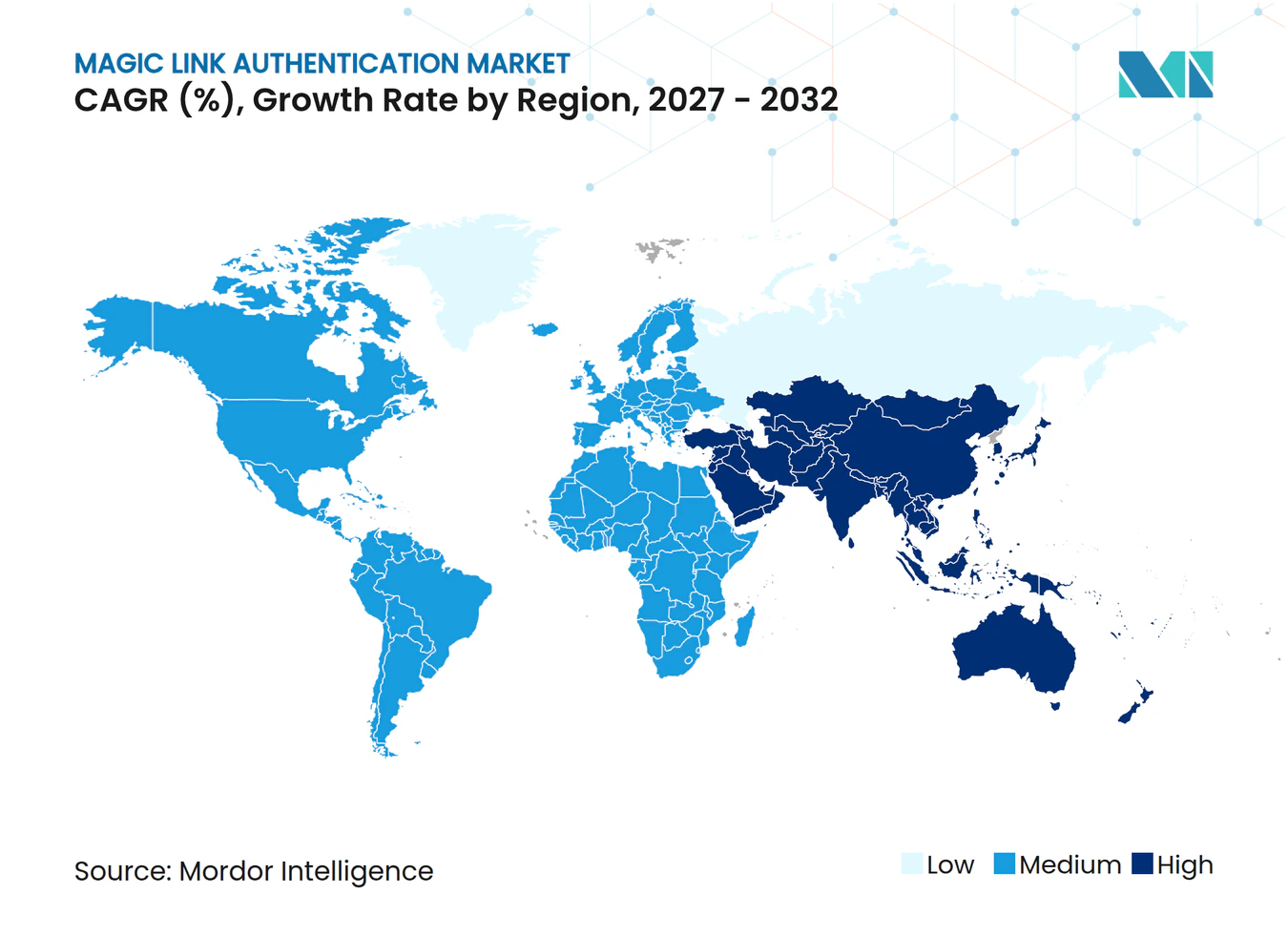
North America accounted for 39.44% of revenue in 2026. Federal cybersecurity directives, strong security budgets, and a mature developer-first identity ecosystem support regional demand. TransUnion reported average fraud losses of 9.8% of annual revenue among U.S. businesses in its 2025 research, while account takeover accounted for nearly 1/3 of reported U.S. fraud losses. These pressures encourage investment in methods that reduce dependence on reusable credentials. The region also contains established buyers that can evaluate delivery, recovery, and session-control capabilities.
EMEA and South America Magic Link Authentication Market
Europe is the second-largest region in the Magic Link Authentication Market. GDPR data-minimization principles and CNIL’s May 2025 recommendation on multifactor authentication affect how providers handle tokens and related user information. These conditions favor suppliers that combine simple access journeys with transparent controls. South America, the Middle East, and Africa remain in earlier stages.
APAC Magic Link Authentication Market
Asia-Pacific is projected to expand at 18.04% CAGR through 2032, the fastest regional rate. Government digital identity programs, India’s Aadhaar-linked e-KYC fintech onboarding, mobile-first behavior, and large e-commerce activity support this outlook. Mastercard stated in 2025 that it aims to make online shopping in Asia-Pacific password-free and number-free by 2030, with planned deployment in Singapore, Malaysia, and Vietnam by 2027.[3] Japan, South Korea, and Singapore show strong adoption of passkeys while retaining a role for magic links in consumer access. The Magic Link Authentication Market has scope to expand with digital commerce, mobile access, and public identity programs across the region
Competitive Landscape
Market Concentration
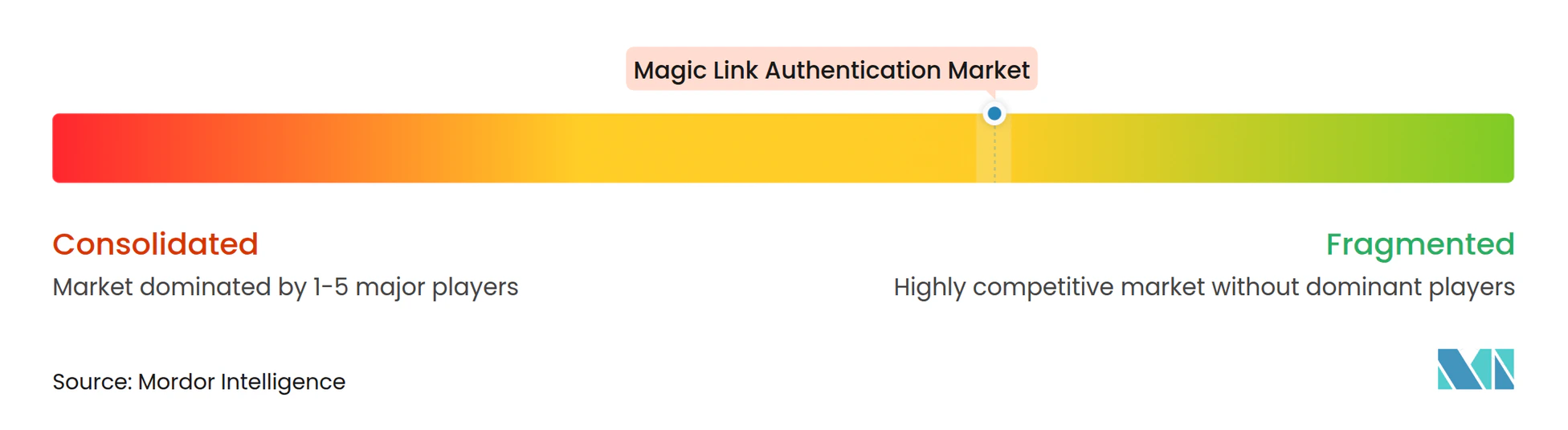
The Magic Link Authentication Market is moderately fragmented. Developer-first customer identity and access management platforms compete on API quality, deployment speed, orchestration, and controls for AI-agent identity. Large enterprise identity suppliers also compete where buyers want mature governance and compliance options. Twilio’s acquisition of Stytch was announced in October 2025 and completed on November 14, 2025. The transaction combined Stytch’s composable identity platform with Twilio’s email, SMS, and voice infrastructure.
WorkOS raised USD 100 million in Series C financing at a USD 2 billion valuation in March 2026. Its customer list included OpenAI, Anthropic, Perplexity, Cursor, and Vercel at the time of the announcement. Descope achieved FedRAMP High Authorization in July 2025, providing a route into US government procurement. These moves raise competitive pressure on vendors that cannot combine developer convenience with documented enterprise assurance.
The market is moving toward authentication and authorization for AI agents acting on behalf of human users. Descope released the Agentic Identity Control Plane in August 2025 and continued developing its agent-focused capabilities in 2026. Stytch launched Connected Apps in September 2025 to extend OAuth and AI-agent support to teams using third-party identity providers. The W3C published its WebAuthn Level 3 Candidate Recommendation Snapshot in May 2026. The Magic Link Authentication Market will favor platforms that make phishing-resistant step-up controls easy to deploy and manage identity across people, applications, and AI agents.
Magic Link Authentication Industry Leaders
-
Stytch, Inc.
-
Descope, Inc.
-
Magic Labs, Inc
-
FusionAuth, LLC
-
MojoAuth Inc
- *Disclaimer: Major Players sorted in no particular order
Magic Link Authentication Market Companies Covered in this Report
- Stytch, Inc.
- Descope, Inc.
- Magic Labs, Inc.
- MojoAuth Inc.
- FusionAuth, LLC
- Ory Corp.
- SuperTokens, Inc.
- Clerk, Inc.
- WorkOS, Inc.
- Hanko GmbH
- Corbado GmbH
- Frontegg Ltd.
- Beyond Identity, Inc.
- HYPR Corp.
- Secret Double Octopus Ltd.
- Trusona, Inc.
- Hawcx, Inc.
- Transmit Security, Inc.
- LoginRadius Inc.
- SAASPASS, Inc.
- Authgear Pte. Ltd.
- Passage Identity, Inc.
Recent Industry Developments in Magic Link Authentication Market
- October 2026: WorkOS achieved PCI DSS certification and released a Rust SDK, extending its enterprise authentication platform's compliance footprint into payment-adjacent industries and broadening developer language support. This positions WorkOS to pursue financial services and regulated retail verticals following its USD 100 million Series C.
- March 2026: WorkOS raised USD 100 million in Series C financing at a USD 2 billion valuation, led by Meritech and Sapphire, with customers including OpenAI, Anthropic, Perplexity, Cursor, and Vercel, underscoring the platform's positioning as the authentication and permissions layer for AI-native software.
- January 2026: Descope released Agentic Identity Hub 2.0, enabling organizations to use Descope as a dedicated identity provider for AI agents and extending magic-link-style short-lived token flows to non-human identities across AI-agent and MCP server ecosystems.
- November 2025: Twilio completed its acquisition of Stytch on November 14, 2025, creating an integrated authentication and communications platform with channel-aware token delivery across email, SMS, and voice, directly addressing magic link delivery fallback gaps in enterprise deployments.
Global Magic Link Authentication Market Report Scope
The Magic Link Authentication Market refers to the global market for authentication solutions, services, and developer tools that enable users to securely access digital platforms through passwordless or password-light authentication links delivered via email, SMS, or other digital channels. These solutions generate unique, time-sensitive, and often single-use URLs that verify a user’s identity and grant access to applications, websites, or specific transactions without requiring conventional passwords. The market includes software solutions, managed services, professional services, and developer tools and software development kits (SDKs) for implementing, integrating, managing, and optimizing magic link authentication across cloud, on-premises, and hybrid environments.
The Magic Link Authentication Market Report is Segmented by Authentication Method (Email Magic Link Authentication, SMS Magic Link Authentication, Embedded and Transactional Magic Links, Hybrid Magic Link With Step-Up Authentication, and Rest of Authentication Methods), Deployment Mode (Cloud, On-Premises, and Hybrid), Organization Size (Large Enterprises and Small and Medium Enterprises), End-User Industry (BFSI, IT and Telecommunications, Retail and E-Commerce, Healthcare, Media and Entertainment, Government and Defense, and Other End-User Industries), Component (Solutions, Managed Services, Professional Services, and Developer Tools and SDKs), and Geography (North America, South America, Europe, Asia-Pacific, Middle East, and Africa). The Market Forecasts are Provided in Terms of Value (USD).
Segmentation Overview
| Email Magic Link Authentication |
| SMS Magic Link Authentication |
| Embedded and Transactional Magic Links |
| Hybrid Magic Link With Step-Up Authentication |
| Rest of Authentication Methods |
| Cloud |
| On-Premises |
| Hybrid |
| Large Enterprises |
| Small and Medium Enterprises |
| BFSI |
| IT and Telecommunications |
| Retail and E-Commerce |
| Healthcare |
| Media and Entertainment |
| Government and Defense |
| Other End-User Industries |
| Solutions |
| Managed Services |
| Professional Services |
| Developer Tools and SDKs |
| North America | United States |
| Canada | |
| Mexico | |
| South America | Brazil |
| Argentina | |
| Rest of South America | |
| Europe | United Kingdom |
| Germany | |
| France | |
| Italy | |
| Spain | |
| Rest of Europe | |
| Asia-Pacific | China |
| Japan | |
| India | |
| South Korea | |
| Australia | |
| Rest of Asia-Pacific | |
| Middle East | Saudi Arabia |
| United Arab Emirates | |
| Turkey | |
| Rest of Middle East | |
| Africa | South Africa |
| Egypt | |
| Rest of Africa |
| By Authentication Method | Email Magic Link Authentication | |
| SMS Magic Link Authentication | ||
| Embedded and Transactional Magic Links | ||
| Hybrid Magic Link With Step-Up Authentication | ||
| Rest of Authentication Methods | ||
| By Deployment Mode | Cloud | |
| On-Premises | ||
| Hybrid | ||
| By Organization Size | Large Enterprises | |
| Small and Medium Enterprises | ||
| By End-User Industry | BFSI | |
| IT and Telecommunications | ||
| Retail and E-Commerce | ||
| Healthcare | ||
| Media and Entertainment | ||
| Government and Defense | ||
| Other End-User Industries | ||
| By Component | Solutions | |
| Managed Services | ||
| Professional Services | ||
| Developer Tools and SDKs | ||
| By Geography | North America | United States |
| Canada | ||
| Mexico | ||
| South America | Brazil | |
| Argentina | ||
| Rest of South America | ||
| Europe | United Kingdom | |
| Germany | ||
| France | ||
| Italy | ||
| Spain | ||
| Rest of Europe | ||
| Asia-Pacific | China | |
| Japan | ||
| India | ||
| South Korea | ||
| Australia | ||
| Rest of Asia-Pacific | ||
| Middle East | Saudi Arabia | |
| United Arab Emirates | ||
| Turkey | ||
| Rest of Middle East | ||
| Africa | South Africa | |
| Egypt | ||
| Rest of Africa | ||
Key Questions Answered in the Report
What is the size of the Magic Link Authentication Market?
The Magic Link Authentication Market is projected to expand from USD 0.41 billion in 2026 and USD 0.49 billion in 2027 to USD 1.08 billion by 2032, at a 17.03% CAGR.
What is driving adoption of magic link authentication?
Rising credential theft, account takeover risk, login friction, and password reset costs are supporting adoption of passwordless access methods.
Which authentication method has the largest revenue share?
Email-based flows held 45.31% revenue share in 2026 because email has broad reach and creates a familiar login experience.
Which deployment model leads adoption?
Cloud deployment held 70.12% revenue share in 2026, supported by SaaS-delivered identity platforms and faster integration.
Which end-user area is expected to expand fastest?
Healthcare is projected to expand at 18.44% CAGR through 2032 as providers address password dependence and authentication friction in care delivery.
Which region is projected to expand fastest?
Asia-Pacific is projected to expand at 18.04% CAGR through 2032, supported by digital identity programs, mobile access, and e-commerce activity.