
Passkey Management Platform Market Size and Share
Market Overview
| Study Period | 2020 - 2031 |
|---|---|
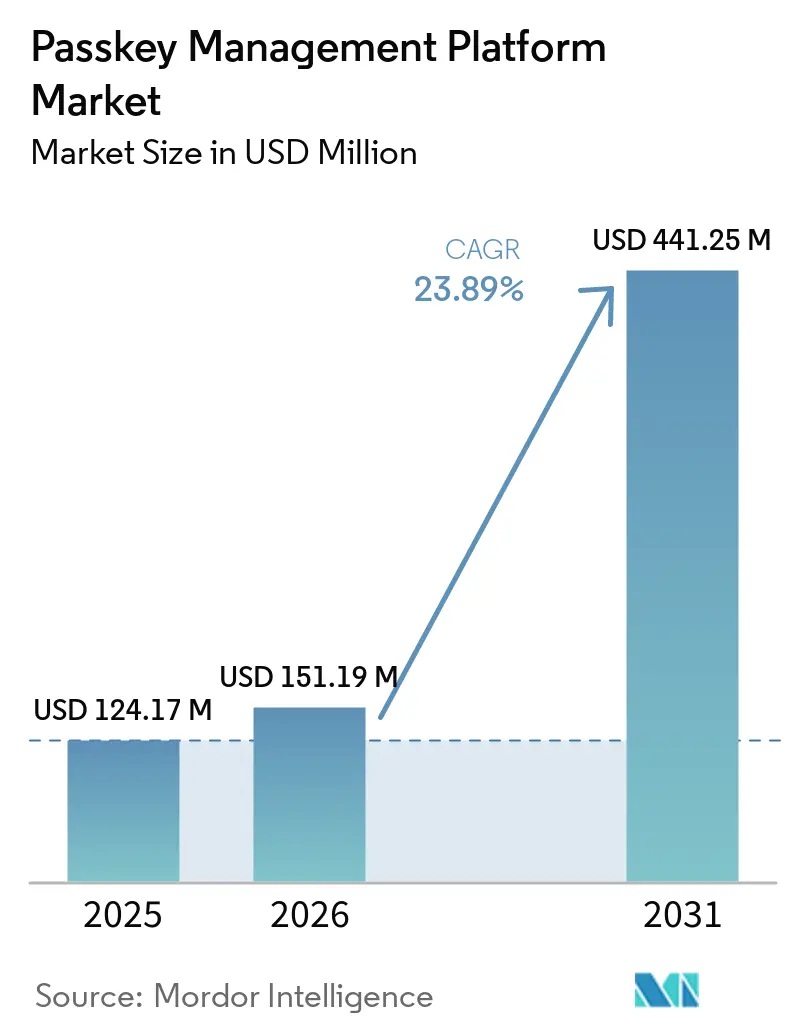
| Market Size (2026) | USD 151.19 Million |
| Market Size (2031) | USD 441.25 Million |
| Growth Rate (2026 - 2031) | 23.89 % |
| Fastest Growing Market | Asia-Pacific |
| Largest Market | North America |
| Market Concentration | Medium |
Major Players *Disclaimer: Major Players sorted in no particular order Image © Mordor Intelligence. Reuse requires attribution under CC BY 4.0. | |
Passkey Management Platform Market Analysis by Mordor Intelligence
The passkey management platform market size is projected to expand from USD 124.17 million in 2025 to USD 151.19 million in 2026, and to USD 441.25 million by 2031, registering a CAGR of 23.89% between 2026 and 2031. Regulatory requirements, lower authentication support costs, and broader FIDO2 adoption are expanding demand for centralized credential management. Major consumer and workforce platforms have made passkeys more familiar to users and strengthened adoption conditions across the passkey management platform market. This change allows vendors to serve both workforce and customer identity programs through a common management layer. Competition is shifting toward integration quality, lifecycle controls, and visibility into authentication activity. Legacy directory connections and credential recovery remain practical constraints on the pace of wider deployment.
Key Report Takeaways
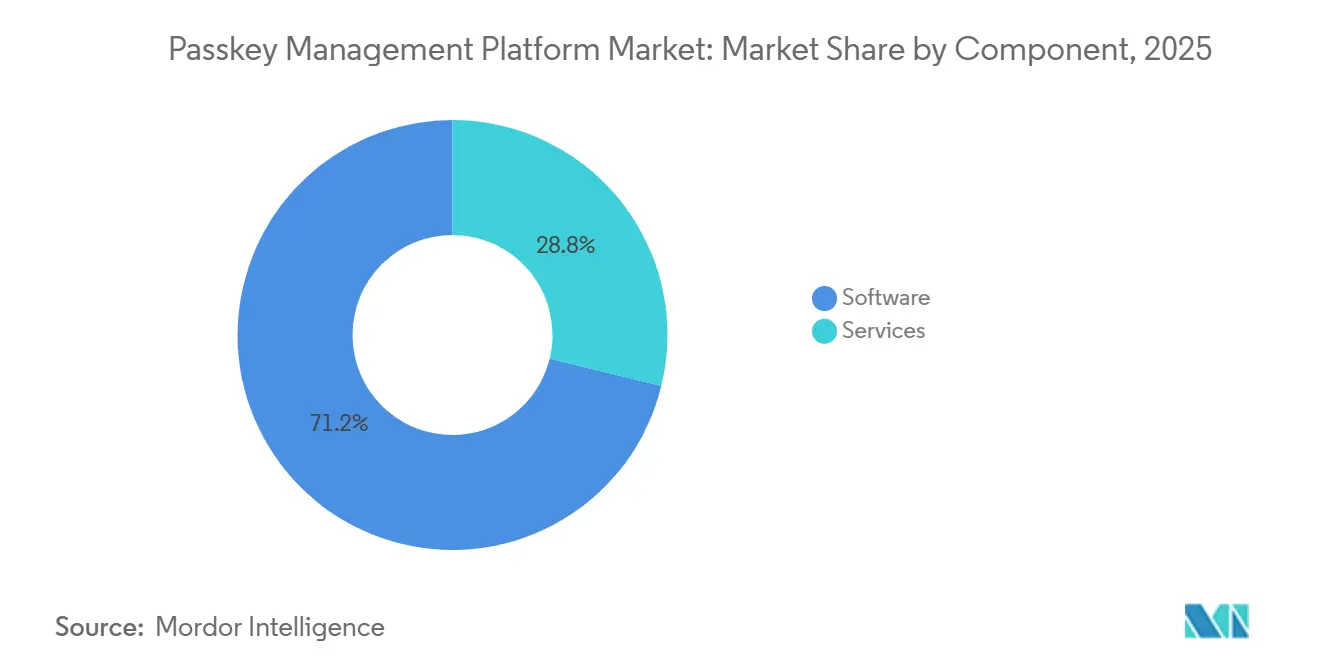
- By component, software held 71.18% of the passkey management platform market share in 2025, while services are projected to expand at a 25.09% CAGR through 2031.
- By deployment mode, cloud accounted for 62.41% of the passkey management platform market revenue in 2025, while hybrid deployment is projected to expand at a 24.87% CAGR through 2031.
- By organization size, large enterprises accounted for 68.19% of the passkey management platform market revenue in 2025, while SMEs are projected to expand at a 25.38% CAGR through 2031.
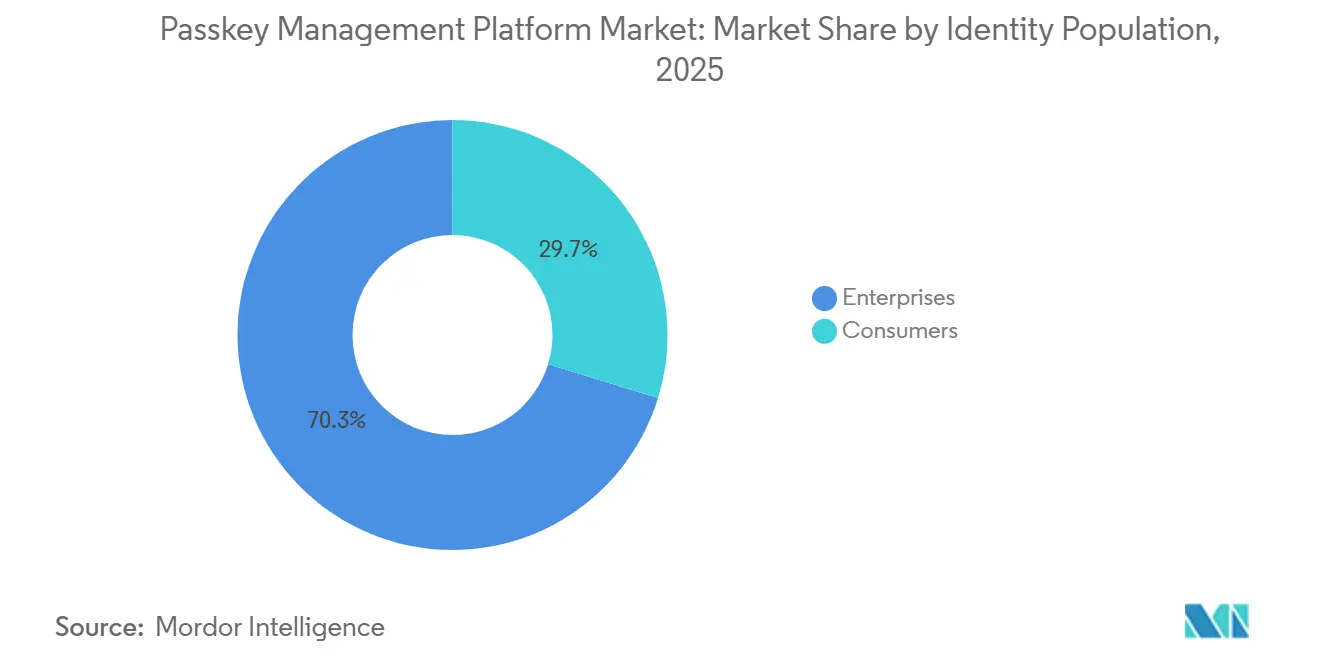
- By identity population, enterprise identities held 70.26% of the passkey management platform market revenue in 2025, while consumer identities are projected to expand at a 25.76% CAGR through 2031.
- By industry vertical, BFSI accounted for 23.16% of the passkey management platform market revenue in 2025, while healthcare and life sciences are projected to expand at a 24.15% CAGR through 2031.
- By geography, North America held 35.68% of revenue in 2025, while Asia-Pacific is projected to expand at a 24.44% CAGR through 2031.
Note: Market size and forecast figures in this report are generated using Mordor Intelligence’s proprietary estimation framework, updated with the latest available data and insights as of January 2026.
Global Passkey Management Platform Market Trends and Insights
Drivers Impact Analysis*
| Driver | (~) % Impact on CAGR Forecast | Geographic Relevance | Impact Timeline |
|---|---|---|---|
| Expansion of Phishing-Resistant Authentication Mandates | +5.8% | Global, with concentrated near-term effect in North America and Europe | Short term (≤ 2 years) |
| Enterprise Password-Reset Cost Reduction | +4.6% | Global, strongest in North America and Western Europe | Medium term (2-4 years) |
| Passkey Support Across Major Consumer Platforms | +3.9% | Global | Short term (≤ 2 years) |
| Growth of Customer Identity and Embedded Authentication | +3.1% | Global, with early gains in North America and core Asia-Pacific markets | Medium term (2-4 years) |
| Device-Bound Credential Demand in Regulated Workloads | +2.3% | North America and Europe, with spillover to the Middle East and Africa and Asia-Pacific | Medium term (2-4 years) |
| Authentication-Funnel Observability as a New Buying Criterion | +1.6% | North America and Europe, with early gains in Australia and Singapore | Long term (≥ 4 years) |
| Source: Mordor Intelligence | |||
Expansion of Phishing-Resistant Authentication Mandates
Government and regulatory mandates are creating a durable source of demand for the passkey management platform market. They turn phishing-resistant authentication from a security preference into a documented compliance requirement. A January 2025 U.S. executive order directed federal civilian agencies to advance phishing-resistant authentication. CISA's fiscal 2026 FISMA metrics also track FIDO2 and PIV implementation at the system level. These requirements create a clearer procurement path for agencies and their contractors. NIST finalized SP 800-63-4 in July 2025 and recognized synced passkeys within the digital identity framework, which supports AAL2 use when they are properly implemented.
Enterprise Password-Reset Cost Reduction
Password reset activity remains a material operating cost for large organizations. The passkey management platform market benefits when security teams can present reduced helpdesk demand as part of the purchasing case. Research by the FIDO Alliance and HID Global found that 35% of surveyed organizations cited fewer password-reset tickets as a direct benefit of passkey deployment. The same research reported average annual savings of USD 594,000 from reduced authentication overhead. 45% of organizations reported faster logins, while 43% reported better employee satisfaction with IT systems. Yubico reported USD 476,000 in helpdesk savings and USD 321,000 in retired legacy MFA costs for a composite organization in its economic study.
Passkey Support Across Major Consumer Platforms
Native support from Apple, Google, and Microsoft has reduced the client-side work needed for consumer passkey deployment. This platform support makes the passkey management platform market more relevant for organizations with large customer populations. Amazon reported that 465 million customers used passkeys in May 2026. The company also reported 75% year-on-year growth and described passkeys as the default sign-up method across its marketplace platforms. FIDO Alliance research recorded 90% global consumer awareness in 2026, compared with 75% in the equivalent 2025 survey. The FIDO Passkey Index reported a 30% improvement in conversion success rates among high-adoption organizations, bringing commercial value to customer authentication decisions.
Growth of Customer Identity and Embedded Authentication
Customer identity use cases are extending passkey deployment beyond workforce identity programs. This development broadens the passkey management platform market toward retail, payments, and other high-volume services. Banesco Banco Universal reported 12 million passwordless transactions in 2026. The bank also reported a 92% passkey enrollment rate among 2.2 million targeted users. These deployments require lifecycle management, recovery processes, and fraud-signal integration at a consumer scale. They also place greater emphasis on transaction completion and customer retention. Vendors that provide authentication telemetry can support both security oversight and compliance reporting.
Restraints Impact Analysis*
| Restraint | (~) % Impact on CAGR Forecast | Geographic Relevance | Impact Timeline |
|---|---|---|---|
| Legacy Application and Directory Integration Complexity | -3.5% | Global, most acute in North America and Europe where on-premises directory estates are deepest | Medium term (2-4 years) |
| Recovery and Account-Reinstatement Risk | -2.8% | Global | Medium term (2-4 years) |
| Cross-Device Enrollment and Credential Portability Friction | -2.1% | Global, more pronounced in Asia-Pacific and the Middle East and Africa | Short term (≤ 2 years) |
| Fragmented Relying-Party Ownership and Consent Workflows | -1.5% | Europe and regulated North American verticals | Long term (≥ 4 years) |
| Source: Mordor Intelligence | |||
Legacy Application and Directory Integration Complexity
Integration complexity remains a central restraint for the passkey management platform market. Enterprise applications often use different identity protocols and do not always support WebAuthn relying-party functions. FIDO Alliance and HID Global reported that 93% of organizations were on the path to passkey adoption, while only 13% had deployed at scale. Legacy SAML flows, custom login pages, and on-premises LDAP directories can require adapters or changes before enrollment begins. The European Commission's DORA technical standards require financial entities to document account lifecycle processes.[1]European Commission, “Commission Delegated Regulation EU 2024/1532,” European Commission, europa.eu Vendors with established connectors for Active Directory, LDAP, and SAP can reduce the time and risk involved in these deployments.
Recovery and Account-Reinstatement Risk
Recovery procedures can slow adoption when organizations cannot maintain security after a device is lost, stolen, or wiped. The passkey management platform market, therefore, requires reliable controls for re-verification and credential re-issuance. Recovery channels cannot simply restore the SMS or email one-time password processes that passkeys are intended to reduce. Organizations also need clear evidence that recovery actions are controlled and auditable. FIDO Alliance research found that 89% of organizations were confident in their ability to recover employee access. The figure was 86% in Asia-Pacific, indicating that confidence is not yet universal. More demanding identity checks can improve control, but they may also recreate some of the friction that passkeys seek to remove.
*Our forecasts treat driver/restraint impacts as directional, not additive. The impact forecasts reflect baseline growth, mix effects, and variable interactions.
Segment Analysis
By Component: Software Leads Revenue While Services Grow Fastest
Software accounted for 71.18% of 2025 revenue, giving it the leading position in the passkey management platform market share. The segment includes server-side relying-party libraries, credential lifecycle consoles, and policy enforcement functions. Organizations use these tools to register, manage, revoke, and govern passkey credentials across their identity environments. Subscription licensing also aligns software spending with established enterprise identity budgets. Software providers benefit when buyers prefer a common administrative layer rather than separate credential tools. This position supports recurring revenue through policy management and ongoing platform administration.
Services are projected to grow at a 25.09% CAGR through 2031, the highest rate among components. Implementation work remains necessary when organizations connect legacy applications, directories, and authentication policies. This need creates demand for integration, managed services, change management, and governance support. The gap between pilot activity and scaled deployment should sustain a backlog of services. Microsoft expanded passkey profiles and synced passkey support in Microsoft Entra ID during 2026.[2]Microsoft, “What’s New in Microsoft Entra: June 2026,” Microsoft Tech Community, microsoft.com The update simplified some configuration work but also increased the need for organizations to review profile and group-policy assignments.


By Deployment Mode: Cloud Holds the Largest Position While Hybrid Gains Ground
Cloud deployment accounted for 62.41% of 2025 revenue in the passkey management platform market. Cloud-hosted systems support relying-party endpoints, credential registries, and attestation verification services. They can also accommodate spikes in consumer authentication traffic. This flexibility fits organizations that use cloud identity platforms and software-as-a-service applications. Centralized cloud operations may reduce the burden of maintaining authentication infrastructure. The model is particularly relevant for businesses that need broad geographic coverage and frequent feature updates.
Hybrid deployment is projected to grow at a 24.87% CAGR through 2031. It serves organizations that need FIDO2 support but cannot move all identity data or directories to the cloud. Data-residency requirements, air-gapped networks, and on-premises directory dependencies can preserve this need. Hybrid systems can connect cloud applications with local Active Directory environments. On-premises deployment remains a smaller but stable option for defense, critical infrastructure, and classified workloads. In these settings, device-bound credentials and hardware attestation may be required by internal policy.
By Organization Size: Large Enterprises Lead While SMEs Expand Faster
Large enterprises accounted for 68.19% of 2025 revenue, representing the largest organization-size share. Their identity environments often include large workforces, contractors, mobile users, and shared workstations. These organizations also face wider regulatory and security obligations. The passkey management platform market size for large enterprises is supported by the need to coordinate credential policy across many applications. Large deployments require directory connections, hardware-attestation controls, audit records, and lifecycle workflows. Enterprises are better positioned to fund the integration work needed to extend passkeys across complex systems.
SMEs are projected to expand at a 25.38% CAGR through 2031. Cloud-native tools can reduce the specialized identity resources required to start a program. NIST's treatment of synced passkeys within AAL2 removes a hardware-key requirement in some properly implemented use cases. This can lower costs and administrative barriers for smaller organizations. NIS2 obligations apply to important entities in certain critical sectors, including organizations with as few as 50 employees. Platforms that combine setup, reporting, and enrollment functions can be more accessible to these buyers.
By Identity Population: Enterprise Identities Lead While Consumer Use Cases Accelerate
Enterprise identities accounted for 70.26% of 2025 revenue and led the passkey management platform market share. This group includes employees, privileged users, and contractors. Workforce deployments prioritize credential policy enforcement, hardware attestation checks, and audit log connections to security information and event management systems. These functions support accountability across managed corporate identities. Enterprise requirements are usually tied to access governance and risk control. They remain the foundation of many vendors' product designs and existing customer relationships.
Consumer identities are projected to grow at a 25.76% CAGR through 2031. Consumer deployments can involve authentication volumes that are much larger than workforce deployments. Amazon's May 2026 disclosure of 465 million customer passkey users illustrates this scale. These programs require low-latency, region-wide credential services. They also need risk signals, device reputation checks, and behavioral anomaly controls. The design needs of consumer systems are creating a clearer distinction from workforce-focused platforms.
By Industry Vertical: BFSI Leads While Healthcare and Life Sciences Grow Fastest
BFSI held 23.16% of 2025 revenue, making it the leading vertical in the passkey management platform market. Financial institutions must manage strong customer authentication, access controls, and exposure to fraud. DORA requires financial entities to maintain documented ICT risk-management processes. Passkeys can reduce phishing risk while reducing reliance on SMS one-time passwords. Banesco Banco Universal reported 12 million passwordless transactions in 2026 and 92% enrollment among 2.2 million targeted users.
Healthcare and life sciences are projected to expand at a 24.15% CAGR through 2031. These organizations manage sensitive health data and face high requirements for secure interactive access. Government and public administration also offer sustained demand, as public-sector authentication requirements become more stringent. Retail and e-commerce have distinct commercial needs to reduce sign-in friction. FIDO Alliance research found that 47% of consumers were likely to abandon a purchase when they could not remember a password. IT and telecommunications, manufacturing, energy, transportation, media, education, and research institutions are at earlier stages of adoption.
Geography Analysis
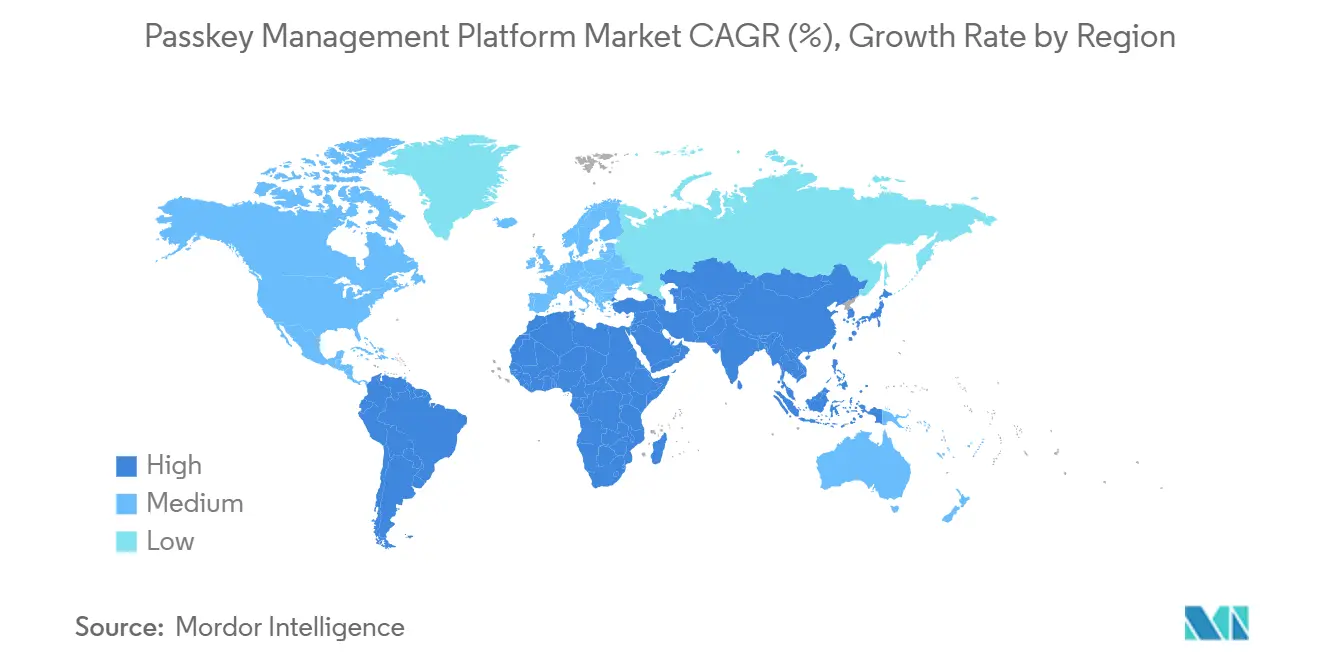
North America accounted for 35.68% of 2025 revenue and led the passkey management platform market by region. The region combines federal authentication requirements with a large base of enterprise identity buyers. A January 2025 U.S. executive order directed federal agencies to advance commercial phishing-resistant authentication. CISA's fiscal 2026 FISMA metrics reinforce this direction through system-level measurement of FIDO2 and PIV deployment.[3]Cybersecurity and Infrastructure Security Agency, “FY2026 and FY2027 CIO FISMA Metrics,” CISA, cisa.gov This approach creates demand that can extend from federal agencies to contractor ecosystems.
North American buyers also have mature budgets for identity and cybersecurity programs. Financial-sector firms face security and disclosure obligations that support the use of phishing-resistant credentials. Canada and Mexico are moving in a similar direction, although their requirements are not yet as specific. These conditions can shorten purchasing decisions compared with regions that have less established identity budgets. The passkey management platform market consequently benefits from a substantial installed base of large organizations. These buyers often have the scale and complexity that justify centralized credential management.
Asia-Pacific is projected to grow at a 24.44% CAGR through 2031, the highest regional rate. China and India each recorded consumer passkey adoption of 88% in 2026, compared with 74% in the United States. NTT Data launched a FIDO2-compliant passkey authentication service for Japan's financial sector in April 2026. SMBC Nikko Securities deployed passkey biometric authentication for retail clients in January 2026. South Korea and Australia are also advancing digital identity programs, while South America, the Middle East, and Africa show earlier-stage adoption centered on financial services and digital government activities.

Competitive Landscape
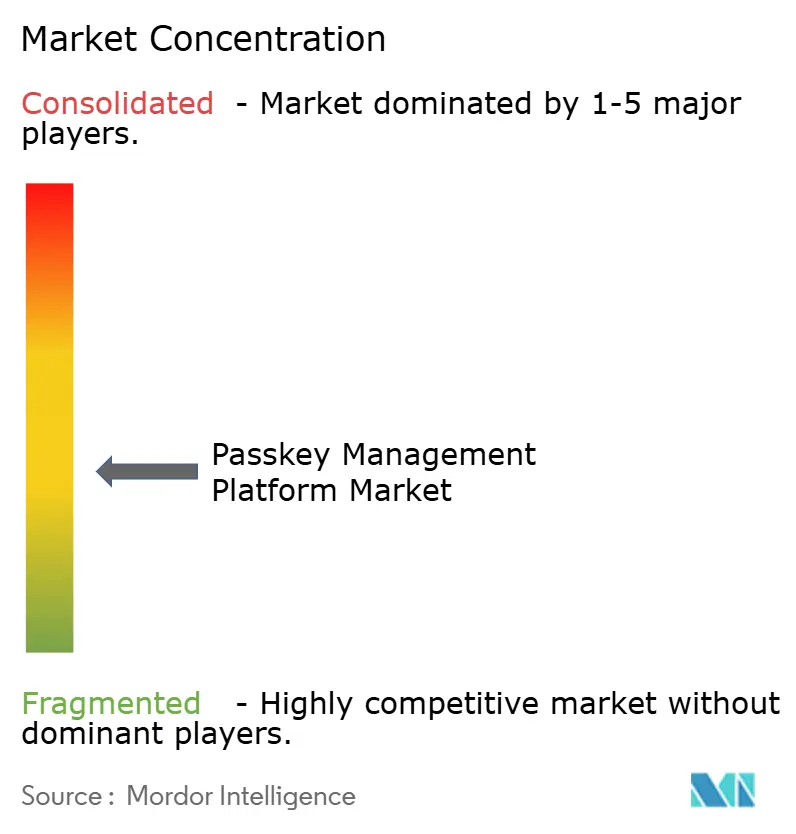
The passkey management platform market is moderately fragmented. Large identity-platform providers include Microsoft, Okta, CyberArk, Ping Identity, and Thales. These companies add passkey capability to established enterprise identity systems. Their strengths include directory integrations, compliance tools, and long-standing customer relationships. Passkey-focused specialists include HYPR Corp., Corbado, Stytch, Descope, and Hanko. These providers compete on the depth of FIDO2 implementation, developer usability, and integration speed.
Incumbents can bundle passkey management with broader identity contracts. Specialized providers can address deployments that need a lighter connection model or a faster production rollout. Both groups need to demonstrate reliable credential lifecycle controls and usable recovery processes. Ping Identity completed its acquisition of Keyless in January 2026.[4]Ping Identity, “Ping Identity Marks Digital Trust Milestone with Zero-Knowledge Biometrics in the Age of AI,” Ping Identity, pingidentity.com The acquisition added zero-knowledge biometrics and strengthened its continuous identity assurance capabilities. Microsoft expanded passkey profiles and synced passkeys in Microsoft Entra ID during 2026, which increased configuration options for tenants.
HID Global launched an enterprise passkey management solution with next-generation FIDO hardware credentials in August 2025. Thales launched OneWelcome FIDO Key Lifecycle Management in February 2025 for pre-registration and lifecycle administration of security keys. The FIDO Alliance Passkey Pledge has more than 200 signatories and provides a practical interoperability signal for enterprise requests for proposal. Managed services for SMEs, consumer authentication telemetry, and hardware-attested credentials for regulated workloads remain areas of competition. The passkey management platform market will favor vendors that can support both integration depth and operational transparency.
Passkey Management Platform Industry Leaders
Okta, Inc.
Ping Identity Corporation
BIO-key International, Inc.
Intercede Group plc
Microsoft Corporation
- *Disclaimer: Major Players sorted in no particular order

Recent Industry Developments
- September 2026: Microsoft began rolling out passkeys as the default authentication experience in Microsoft Entra ID for users enabled for SMS or voice authentication on September 1, 2026. SMS and voice telephony delivery is scheduled for retirement from Entra as a native capability by February 2027, effectively mandating passkey migration across enrolled tenants.
- August 2026: Microsoft released a general availability update to passkey registration optimizations across Entra ID, improving compliance between Registration Campaigns, Authentication Strengths, and My Sign-Ins flows, and prioritizing device-native passkey registration across AAGUID-restricted profiles, with rollout expected to complete by mid-September 2026.
- May 2026: Amazon disclosed that 465 million customers actively used passkeys as of May 2026, representing 75% year-on-year growth, with passkeys adopted as the default sign-up authentication method across Amazon's marketplace platforms.
- April 2026: NTT Data Group launched a passkey authentication service for the financial sector in Japan under its OpenCanvas Atelier platform in April 2026, targeting FIDO2-compliant 3-D Secure authentication for credit card transactions and broader e-commerce use cases.


Global Passkey Management Platform Market Report Scope
The Passkey Management Platform Market comprises software platforms and associated services that enable organizations to create, manage, orchestrate, secure, and govern passkey-based authentication credentials across consumer and enterprise identity populations. These platforms provide capabilities such as passkey lifecycle management, credential synchronization, authentication policy enforcement, device registration, account recovery, identity orchestration, compliance management, and integration with broader identity and access management (IAM) ecosystems to support passwordless authentication initiatives.
The Passkey Management Platform Market Report is Segmented by Component (Software and Services), Deployment Mode (Cloud, On-Premises, and Hybrid), Organization Size (Large Enterprises and Small and Medium-Sized Enterprises), Identity Population (Consumers and Enterprises), Industry Vertical (Government and Public Administration, Industrial Manufacturing, Retail and E-Commerce, Transportation and Logistics, Energy and Utilities, Oil and Gas, IT and Telecommunication, Media and Entertainment, Education and Research Institutions, Healthcare and Life Sciences, Banking, Financial Services, and Insurance [BFSI], and Other Industry Verticals), and Geography (North America, South America, Europe, Asia-Pacific, and Middle East and Africa). The Market Forecasts are Provided in Terms of Value (USD).
| Software |
| Services |
| Cloud |
| On-Premises |
| Hybrid |
| Large Enterprises |
| Small and Medium-Sized Enterprises |
| Consumers |
| Enterprises |
| Government and Public Administration |
| Retail and E-Commerce |
| Transportation and Logistics |
| Energy and Utilities |
| IT and Telecommunication |
| Media and Entertainment |
| Healthcare and Life Sciences |
| Banking, Financial Services, and Insurance (BFSI) |
| Other Industry Verticals |
| North America | United States | |
| Canada | ||
| Mexico | ||
| South America | Brazil | |
| Argentina | ||
| Rest of South America | ||
| Europe | Germany | |
| United Kingdom | ||
| France | ||
| Italy | ||
| BENELUX | ||
| Rest of Europe | ||
| Asia-Pacific | China | |
| Japan | ||
| India | ||
| South Korea | ||
| Australia | ||
| Rest of Asia-Pacific | ||
| Middle East and Africa | Middle East | United Arab Emirates |
| Saudi Arabia | ||
| Rest of Middle East | ||
| Africa | South Africa | |
| Nigeria | ||
| Egypt | ||
| Rest of Africa | ||
| By Component | Software | ||
| Services | |||
| By Deployment Mode | Cloud | ||
| On-Premises | |||
| Hybrid | |||
| By Organization Size | Large Enterprises | ||
| Small and Medium-Sized Enterprises | |||
| By Identity Population | Consumers | ||
| Enterprises | |||
| By Industry Vertical | Government and Public Administration | ||
| Retail and E-Commerce | |||
| Transportation and Logistics | |||
| Energy and Utilities | |||
| IT and Telecommunication | |||
| Media and Entertainment | |||
| Healthcare and Life Sciences | |||
| Banking, Financial Services, and Insurance (BFSI) | |||
| Other Industry Verticals | |||
| By Geography | North America | United States | |
| Canada | |||
| Mexico | |||
| South America | Brazil | ||
| Argentina | |||
| Rest of South America | |||
| Europe | Germany | ||
| United Kingdom | |||
| France | |||
| Italy | |||
| BENELUX | |||
| Rest of Europe | |||
| Asia-Pacific | China | ||
| Japan | |||
| India | |||
| South Korea | |||
| Australia | |||
| Rest of Asia-Pacific | |||
| Middle East and Africa | Middle East | United Arab Emirates | |
| Saudi Arabia | |||
| Rest of Middle East | |||
| Africa | South Africa | ||
| Nigeria | |||
| Egypt | |||
| Rest of Africa | |||


Key Questions Answered in the Report
What is the passkey management platform market size?
The passkey management platform market was USD 151.19 million in 2026 and is forecast to reach USD 441.25 million by 2031 at a 23.89% CAGR.
What is driving adoption of passkey management platforms?
Phishing-resistant authentication requirements, lower password-reset costs, consumer platform support, and growth in customer identity deployments are supporting adoption.
Which component leads passkey platform spending?
Software led with 71.18% of 2025 revenue, while services are projected to grow fastest at a 25.09% CAGR through 2031.
Which deployment model is most widely used for passkey platforms?
Cloud deployment held 62.41% of 2025 revenue because it supports scalable credential infrastructure and consumer authentication demand.
Which region is growing fastest for passkey management platforms?
Asia-Pacific is projected to grow at a 24.44% CAGR through 2031, supported by strong consumer adoption and financial-sector deployments.
Which vertical has the largest passkey management platform demand?
BFSI held 23.16% of 2025 revenue, while healthcare and life sciences are projected to grow fastest at a 24.15% CAGR through 2031.
Page last updated on:


 Your data is secure and never sold or shared.


