
Passkey Deployment Services Market Size and Share
Market Overview
| Study Period | 2020 - 2031 |
|---|---|
| Market Size (2026) | USD 289.02 Million |
| Market Size (2031) | USD 850.34 Million |
| Growth Rate (2026 - 2031) | 24.09 % |
| Fastest Growing Market | Asia-Pacific |
| Largest Market | North America |
| Market Concentration | Medium |
Major Players *Disclaimer: Major Players sorted in no particular order Image © Mordor Intelligence. Reuse requires attribution under CC BY 4.0. | |
Passkey Deployment Services Market Analysis by Mordor Intelligence
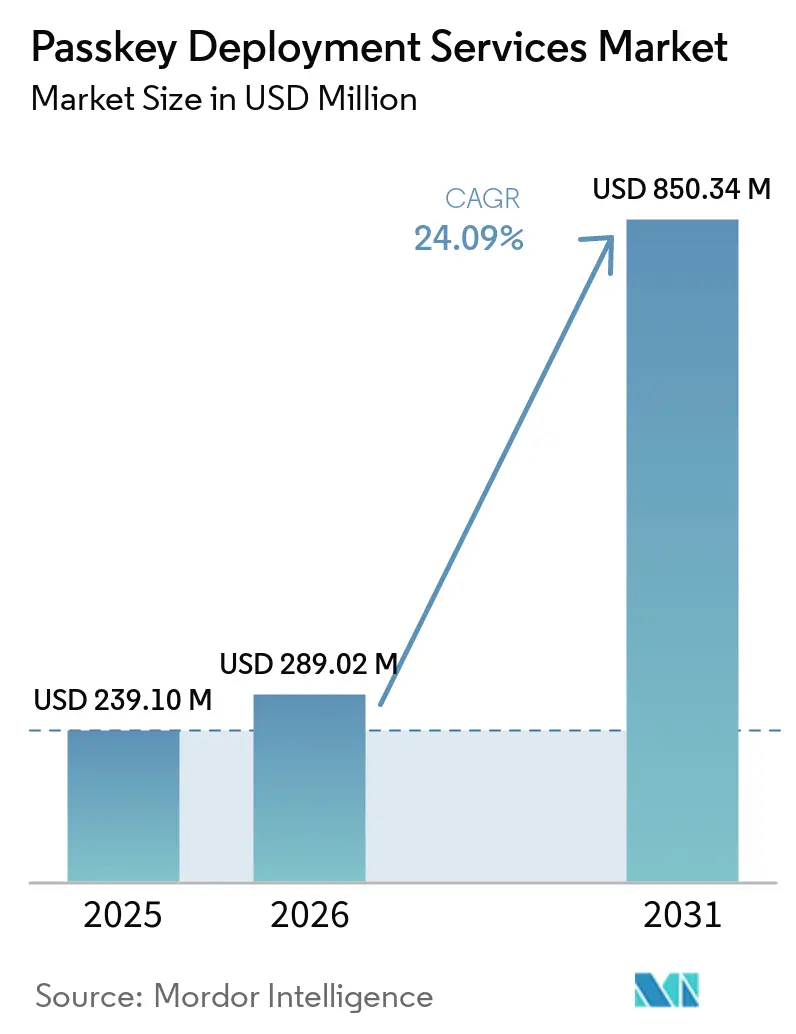
The Passkey Deployment Services Market size is expected to increase from USD 239.10 million in 2025 to USD 289.02 million in 2026 and reach USD 850.34 million by 2031, growing at a CAGR of 24.09% over 2026-2031. The gap between organizational interest and scaled implementation continues to create demand for consulting, integration, and managed operations services. Many organizations are progressing toward passkeys but still need support with enrollment, recovery, policy design, and ongoing credential administration. Platform defaults and authentication retirement plans are moving passkey planning from a long-term security objective to an immediate operating requirement. Providers that combine identity expertise with practical rollout support can address needs across cloud, hybrid, and regulated settings. The Passkey Deployment Services Market also has room to expand as customers move from initial programs into recurring lifecycle and support engagements.
Key Report Takeaways
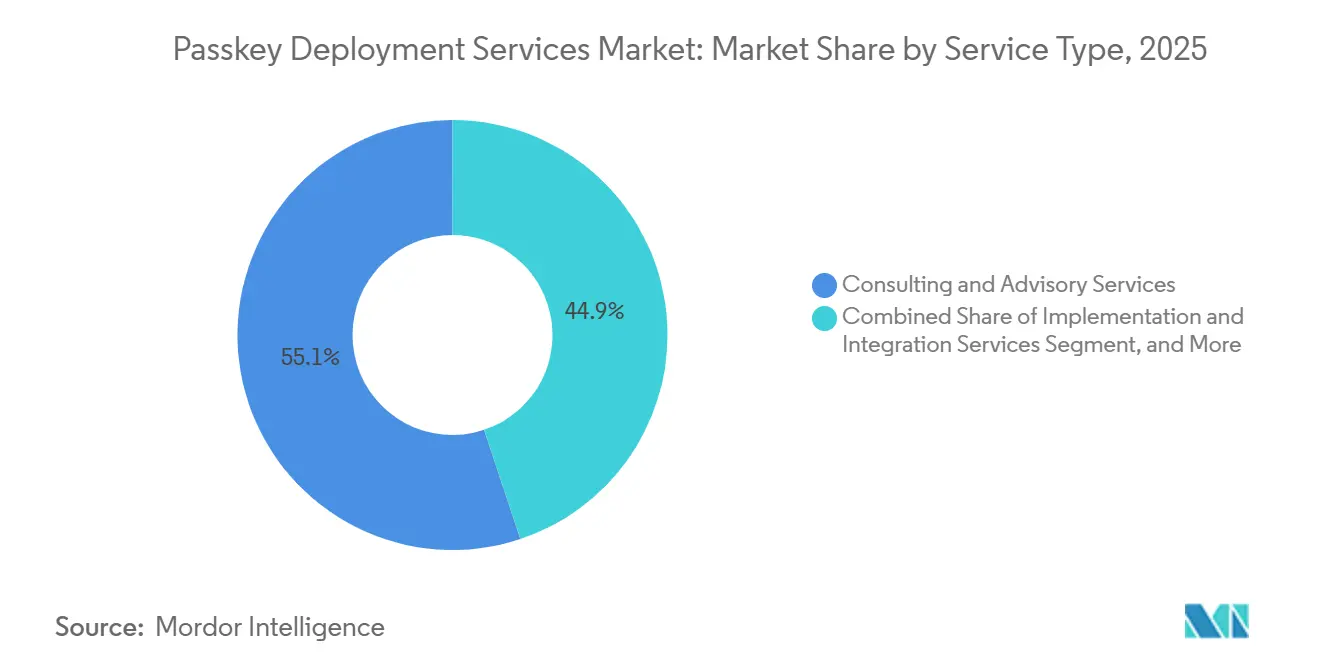
- By service type, Consulting and Advisory Services held 55.12% of the Passkey Deployment Services Market share in 2025, while Managed Passkey Operations and Support Services is projected to expand at a CAGR of 25.19% through 2031.
- By target authentication environment, cloud-based environments accounted for 67.89% of the Passkey Deployment Services Market share in 2025, while hybrid environments are projected to expand at a CAGR of 25.50% through 2031.
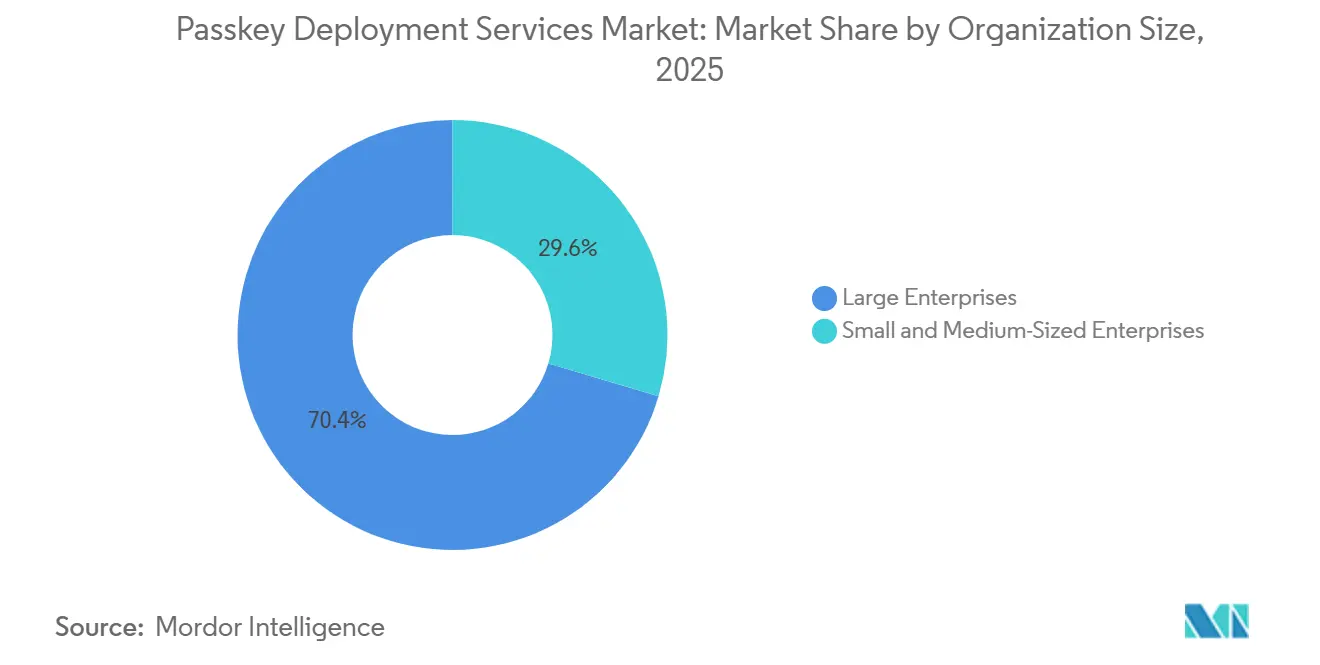
- By organization size, large enterprises held 70.41% of the Passkey Deployment Services Market share in 2025, while small and medium-sized enterprises are projected to expand at a CAGR of 25.79% through 2031.
- By industry vertical, BFSI accounted for 22.41% of the Passkey Deployment Services Market share in 2025, while government and public administration are projected to expand at a CAGR of 24.56% through 2031.
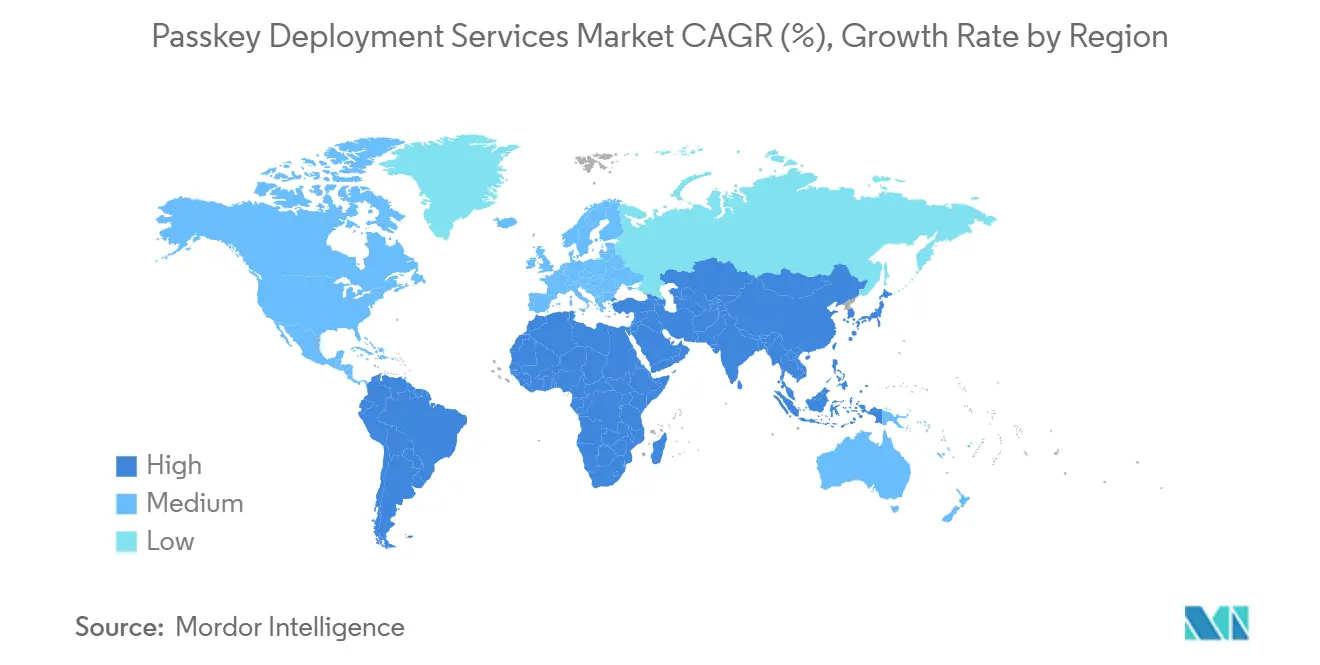
- By geography, North America held 38.71% of the Passkey Deployment Services Market in 2025, while Asia-Pacific is projected to expand at a 24.88% CAGR through 2031.
Note: Market size and forecast figures in this report are generated using Mordor Intelligence’s proprietary estimation framework, updated with the latest available data and insights as of January 2026.
Global Passkey Deployment Services Market Trends and Insights
Drivers Impact Analysis*
| Driver | (~) % Impact on CAGR Forecast | Geographic Relevance | Impact Timeline |
|---|---|---|---|
| Enterprise Passkey Adoption and Phishing-Resistant MFA Mandates | +7.5% | Global, with concentrated near-term demand in North America and Western Europe | Short term (≤ 2 years) |
| Cloud and Hybrid IAM Modernization | +5.8% | North America and Europe core, Asia-Pacific growing rapidly | Medium term (2-4 years) |
| Application and Workforce Integration Complexity | +4.2% | Global, most pronounced in large enterprise-dense geographies across all regions | Medium term (2-4 years) |
| Regulated-Industry Demand for Audit-Ready Authentication | +3.5% | North America, EU, Asia-Pacific, India, and Philippines, with spillover to Middle East and Africa | Short term (≤ 2 years) |
| Passkey Recovery, Lifecycle, and Device-Fleet Operations | +1.8% | Global, with intensity in large-fleet enterprise environments and high-turnover workforces | Medium term (2-4 years) |
| Passkey Rollouts in Offline and Air-Gapped Environments | +0.8% | Defense-aligned nations, United States, United Kingdom, Germany, and Australia | Long term (≥ 4 years) |
| Source: Mordor Intelligence | |||
Enterprise Passkey Adoption and Phishing-Resistant MFA Mandates
A clear gap between adoption planning and broad implementation supports the Passkey Deployment Services Market. Research from the FIDO Alliance and HID, released in June 2026, found that 93% of organizations were on the passkey adoption path, but only 13% had deployed passkeys at scale. The same research found that 57% still used phishable methods for employees’ primary sign-in. This gap drives organizations to seek external support for enrollment, recovery, lifecycle management, and WebAuthn operations. Microsoft made passkeys the default experience for relevant Entra ID tenants in September 2026 and plans to retire its SMS and voice delivery in February 2027. FIDO Alliance research also reported greater security confidence, faster employee sign-ins, fewer password reset tickets, and fewer phishing incidents among organizations that deploy passkeys.
Cloud and Hybrid IAM Modernization
Cloud IAM modernization remains a primary driver of demand for the Passkey Deployment Services Market. Cloud-based environments accounted for 67.89% of service delivery in 2025 because major identity platforms natively support FIDO2 passkeys. Hybrid settings are growing faster because many enterprises retain on-premises systems while adding cloud workloads. These settings require identity orchestration, API-based provisioning, and aligned entitlement processes across environments. Microsoft made passkey profiles and synced passkeys generally available in Entra ID during March 2026, adding group-based configurations and a passkeyType property for policy control.[1]Microsoft, “Passkeys by Default and Retirement of Microsoft-Provided Telecom Delivery for SMS and Voice,” Microsoft Learn, learn.microsoft.com Organizations without dedicated FIDO2 teams often need service providers to design and run these cross-environment configurations.
Application and Workforce Integration Complexity
Application and workforce integration work increases the scope of the Passkey Deployment Services Market. A typical enterprise rollout combines IAM configuration, device checks, enrollment planning, and legacy coexistence work. Applications using SAML, RADIUS, or Kerberos often require a passkey-enabled identity provider and single sign-on layer rather than direct WebAuthn support. A FIDO Alliance webinar described a European bank deployment covering 1.5 million users that added passkeys without changing the banking application’s source code. Shared devices in hospitals, factories, and logistics operations need different enrollment and session designs. An IEEE TrustCom study published in 2025 identified differences in credential management, consent handling, and error reporting across major browsers.
Regulated-Industry Demand for Audit-Ready Authentication
Regulated buyers bring a distinct source of demand to the Passkey Deployment Services Market. They need passkey systems that meet technical, documentation, and evidence-retention requirements. PCI DSS version 4.0 became mandatory on March 31, 2025, and its MFA requirements apply to cardholder data environments. The PCI Security Standards Council recognizes properly implemented FIDO2 and WebAuthn passkeys as phishing-resistant authentication for these requirements. This supports deployment work in financial services, retail, and hospitality. ENISA’s June 2025 NIS2 implementation guidance placed passkeys in the strongest phishing-resistant MFA tier within its framework. Deployment programs, therefore, need enrollment logs, attestation evidence, and recovery records that can withstand review.
Restraints Impact Analysis*
| Restraint | (~) % Impact on CAGR Forecast | Geographic Relevance | Impact Timeline |
|---|---|---|---|
| Cross-Platform and Credential-Manager Variability | -2.8% | Global, most acute in multi-platform enterprise and BYOD-heavy environments | Medium term (2-4 years) |
| Legacy Application and Federation Remediation Burden | -2.1% | Global, most pronounced in regulated industries with long application lifecycles | Long term (≥ 4 years) |
| User Recovery, Guest Access, and Account-Change Edge Cases | -1.4% | Global, most severe in high-turnover and distributed-workforce environments | Medium term (2-4 years) |
| Shortage of Specialized WebAuthn and FIDO Operations Talent | -0.9% | Global, most critical in North America and Western Europe | Medium term (2-4 years) |
| Source: Mordor Intelligence | |||
Cross-Platform and Credential-Manager Variability
Credential manager variation remains a continuing restraint for the Passkey Deployment Services Market. Apple iCloud Keychain, Google Password Manager, and Windows Hello have distinct storage and synchronization models. The 2025 IEEE TrustCom study also documented browser-level variation in passkey credential management, consent, and error reporting. FIDO Alliance draft specifications for the Credential Exchange Protocol and Credential Exchange Format address cross-platform transfer, but broad platform implementation remained incomplete in 2026. Users moving between Apple and Android ecosystems may still need to register credentials separately for each service. Providers must therefore design recovery and policy workflows for mixed-device fleets. Different revocation paths and management interfaces add work after the initial deployment, which can delay renewals for managed operations services.
Legacy Application and Federation Remediation Burden
Many healthcare, financial services, and government applications were built around SAML, RADIUS, or Kerberos. These applications do not expose WebAuthn relying-party interfaces and need a proxy or access-management gateway before passkeys can be used. Daily events such as device replacement, browser migration, and helpdesk recovery can delay production programs by 3 to 6 months when operating procedures are not ready. VPN and RADIUS access usually require WebAuthn to terminate at an identity provider or authentication portal. Linux, macOS, virtual desktop infrastructure, and air-gapped support continue to mature more slowly than Windows and mobile support. These conditions can require parallel methods during a 12- to 18-month transition and can narrow the scope of mid-sized customer engagements.
*Our forecasts treat driver/restraint impacts as directional, not additive. The impact forecasts reflect baseline growth, mix effects, and variable interactions.
Segment Analysis
By Service Type: Advisory Work Leads While Managed Operations Accelerate
Consulting and Advisory Services held 55.12% of the Passkey Deployment Services Market share in 2025. This position reflected the number of enterprises still assessing IAM readiness, regulatory requirements, and rollout sequencing. Advisory teams help customers form roadmaps, assess risks, and prepare documentation for regulated reviews. The FIDO Alliance reported in 2026 that only 13% of organizations had deployed passkeys at scale, despite broad adoption activity. That position supports continued demand for early-stage program design. Implementation and Integration Services follow this work with platform configuration, single sign-on bridging, and device testing. Training, Adoption, and Change-Management Services address user behavior and rollout readiness. FIDO Alliance research found that 53% of organizations considered user behavior a minor but persistent concern during passkey deployment.
Managed Passkey Operations and Support Services is projected to expand at a CAGR of 25.19% through 2031. This progression supports recurring revenue in the Passkey Deployment Services Market. Organizations completing initial deployments in 2024 and 2025 need recurring support for lifecycle management, device updates, credential revocation, and recovery. A February 2025 FIDO Alliance survey found that 87% of surveyed U.S. and U.K. companies were deploying or had deployed passkeys for employee sign-ins. Partial deployments can include device-bound and synced credentials for different workforce groups. These designs need continued policy checks as devices and employees change. Microsoft’s Entra ID registration campaigns in 2026 nudge enrolled users to create passkeys during MFA sign-in. These campaigns can create post-deployment support needs that providers can address through recurring contracts.



By Target Authentication Environment: Cloud Delivery Leads as Hybrid Requirements Grow
Cloud-based environments accounted for 67.89% of the Passkey Deployment Services Market share in 2025. Microsoft Entra ID, Okta, and Ping Identity support FIDO2 passkeys in cloud IAM deployments. This reduces some client-side integration work and can make advisory-to-implementation projects more predictable. Cloud deployments can use standardized configurations for enrollment and policy management. On-premises deployments remain relevant in settings with data-sovereignty requirements. Government organizations and regulated buyers may require authentication events to remain within their own boundaries. These needs preserve demand for air-gapped and network-isolated deployment advice. The Passkey Deployment Services Market size for cloud work remains supported by the continuing shift toward cloud-native IAM architectures.
Hybrid environments are projected to expand at a CAGR of 25.50% through 2031. Large enterprises are unlikely to remove all on-premises infrastructure during the forecast period. Hybrid programs need orchestration between cloud IAM platforms and on-premises LDAP or Active Directory systems. Device-attestation rules also need to remain consistent across both environments. Microsoft made Entra passkeys on Windows generally available in April 2026. The feature enables passwordless sign-in to Entra-protected resources from corporate, personal, and shared Windows devices. Lower client configuration needs can allow organizations with on-premises dependencies to proceed. The remaining identity configuration work continues to require experienced deployment teams.
By Organization Size: Large Enterprise Contracts Lead While SMEs Add Volume
Large enterprises accounted for 70.41% of the Passkey Deployment Services Market share in 2025. Their authentication estates often include several IAM platforms, legacy applications, varied device fleets, and distributed employees. These conditions lead to lengthy advisory and implementation engagements. Initial planning usually transitions to a phased technical rollout and then to managed operations. The European bank example described by the FIDO Alliance covered 1.5 million users and introduced passkeys without changing core banking application code. This reflects the scale and duration associated with many enterprise assignments. Large providers compete for IAM renewals by combining passkey services with broader identity operations. Their ability to support multiyear contracts remains important for the largest buyers.
Small and medium-sized enterprises are projected to expand at a CAGR of 25.79% through 2031. Platform-driven defaults can remove the initial barrier to passkey adoption for smaller organizations. They also expose an operating gap when internal IT teams are not prepared for user prompts, recovery, and controlled enrollment. Microsoft’s September 2026 Entra ID changes made passkeys the default authentication experience for tenants using SMS or voice MFA. This creates demand for rollout support before users experience the new prompts. Managed service providers and regional consultancies are positioned to serve these customers. SMEs generally do not use global IT services firms for smaller identity projects. This results in a fragmented yet high-volume client base for specialized providers.
By Industry Vertical: BFSI Leads Revenue While Government Use Expands
BFSI held 22.41% of the Passkey Deployment Services Market share in 2025. PCI DSS 4.0 requirements and fraud-control priorities have accelerated passkey planning in this vertical. The PCI Security Standards Council recognizes FIDO2 and WebAuthn passkeys as phishing-resistant authentication when they are properly implemented. Financial institutions need deployment teams that understand authentication architecture, assurance documentation, and fraud-monitoring integration. The FIDO Alliance documented Banesco Banco Universal’s passkey deployment for 2.2 million users across high-value transactions and fraud-flag resolution. Healthcare and life sciences, IT and telecommunications, retail and e-commerce, and energy and utilities are also meaningful customer areas. Shared terminals and patient or clinician identity governance add complexity in healthcare settings.
Government and Public Administration is projected to expand at a CAGR of 24.56% through 2031. National digital identity programs are adding passkeys to citizen and workforce identity infrastructure. Singapore’s GovTech deployed passkeys in Singpass, which supports 5.5 million users and more than 1,400 government and private-sector services. The service extended availability from iOS to Android in September 2026 and planned desktop support by the end of 2026.[2]Government Technology Agency of Singapore, “Singpass Launches Passkeys: A Safer Login Method,” Government Technology Agency of Singapore, tech.gov.sg Sovereign use cases often favor device-bound credentials rather than synced credentials stored by third-party cloud providers. This creates a continuing lifecycle and device-fleet work for service providers. Transportation and logistics, industrial manufacturing, oil and gas, media and entertainment, and education and research institutions are additional verticals. Manufacturing and energy customers are considering FIDO2 authentication for privileged access to industrial control systems.
Geography Analysis
North America held 38.71% of the Passkey Deployment Services Market share in 2025. The region benefits from a high concentration of regulated enterprises and federal requirements for phishing-resistant authentication. NIST finalized SP 800-63B-4 in July 2025 for digital identity authentication and authenticator management.[3]National Institute of Standards and Technology, “NIST SP 800-63B-4: Digital Identity Guidelines Authentication and Authenticator Management,” National Institute of Standards and Technology, nist.gov The United States generated most regional demand, with BFSI, healthcare, and technology deployments shaping project pipelines. Microsoft’s September 2026 Entra ID default enablement also supported consulting needs among smaller U.S. and Canadian tenants. Accenture acquired Canadian IAM specialist IAMConcepts in September 2025 to expand its cybersecurity footprint in critical infrastructure sectors. Mexico’s uptake is mainly tied to multinational organizations standardizing authentication across North American operations.
Europe was the second-largest regional area for the Passkey Deployment Services Market. NIS2 requirements and ENISA’s 2025 technical guidance supported demand among essential entities. ENISA’s framework identifies passkeys as the strongest phishing-resistant MFA tier. Germany, France, the United Kingdom, Italy, and BENELUX are established demand centers. Manufacturing, energy, government, and financial institutions need regional integration and compliance support. PSD3 and PSR1 are expected to sustain BFSI demand beyond the initial NIS2 compliance wave. Financial institutions need multi-authenticator designs rather than a single-method deployment. South America is an emerging area, with Brazil leading adoption through multinational standardization and early interest in authentication modernization.
Asia-Pacific is projected to expand at a CAGR of 24.88% through 2031. India’s RBI directions became effective on April 1, 2026, and strengthened MFA expectations for digital payment transactions. Visa launched Payment Passkey in India with IDFC FIRST Bank as its first issuer partner. Razorpay partnered with Mastercard and Visa to launch an RBI-compliant biometric passkey solution in March 2026. IBM reported that Asia-Pacific accounted for 34% of global cybersecurity incidents in 2024, with valid-account abuse the leading entry vector. Japan and South Korea also show demand in financial services and e-government. The Middle East, Africa, and South America remain earlier-stage markets, with demand concentrated in the UAE, Saudi Arabia, South Africa, and Brazil.

Competitive Landscape
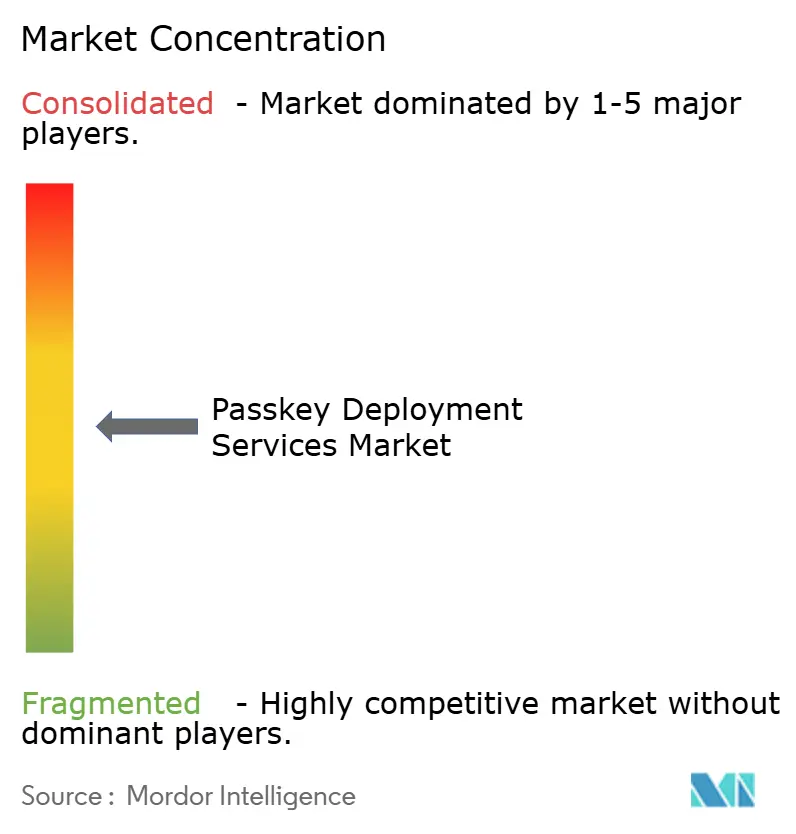
The Passkey Deployment Services Market is moderately fragmented. Large IT services firms compete on deployment breadth, account scale, and managed-service capacity. Specialist providers compete on FIDO2 expertise, certification experience, and faster deployment methods. Accenture, Capgemini, Deloitte, EY, HCLTech, IBM, TCS, and Wipro have established broad IAM portfolios. These portfolios cover identity governance, access management, and privileged identity management. Providers increasingly combine passkey delivery with identity monitoring, access reviews, and automated response capabilities. This approach supports multiyear contracts that include both passkey operations and wider identity lifecycle services.
Large firms are also building vertical-specific delivery frameworks for BFSI, government, and healthcare within the Passkey Deployment Services Market. These frameworks address compliance documentation, deployment sequencing, and operational handover. Accenture acquired IAMConcepts in September 2025 to expand cybersecurity and IAM capabilities in Canada. The transaction reflected the use of acquisitions to expand specialized expertise in regulated markets. IBM launched its Identity Threat Detection and Remediation Service in March 2026.[4]IBM, “From Identity Signals to Decisive Action: Introducing IBM Identity Threat Detection and Remediation Service,” IBM Newsroom, ibm.com The service added continuous identity monitoring and automated remediation workflows that can operate alongside authentication infrastructure. These moves strengthen large providers' ability to retain existing IAM customers.
Yubico, HYPR, Beyond Identity, Nok Nok Labs, Corbado, and Axiad use more specialized deployment models. Yubico and HYPR expanded their partnership in November 2025 to combine identity verification orchestration with YubiKey provisioning. The offering supports remote, verified, hardware-backed passkey issuance without IT intermediaries. Thales launched OneWelcome FIDO Key Lifecycle Management in February 2025 for enterprise enrollment, administration, and revocation of FIDO security keys. W3C WebAuthn Level 3 provides a common technical baseline, so certification alone is not enough to differentiate providers. Recovery automation, credential-event monitoring, and air-gapped delivery remain areas where providers seek differentiation.
Passkey Deployment Services Industry Leaders
Microsoft Corporation
Ping Identity Corporation
Okta, Inc.
BIO-key International, Inc.
Intercede Group plc
- *Disclaimer: Major Players sorted in no particular order

Recent Industry Developments
- September 2026: Microsoft made passkeys the default authentication experience in Microsoft Entra ID, automatically enabling passkey registration nudges for all tenants with users enrolled in SMS or voice MFA. The company confirmed that Microsoft-provided SMS and voice authentication delivery will be retired in February 2027, compelling enterprise tenants across all size segments to complete passkey enrollment planning and driving demand for managed passkey transition services throughout the Microsoft 365 and Azure ecosystem.
- September 2026: Singapore’s Government Technology Agency extended Singpass passkey authentication to Android users, following the initial iOS rollout earlier in 2026. Singpass supports 5.5 million users and is integrated with more than 1,400 government agencies and private-sector services. GovTech announced that desktop support will be extended by the end of 2026, making this expansion a reference model for government deployments across Asia-Pacific.
- July 2026: Visa expanded its payment passkey program across Asia-Pacific, India, and Europe, with Thales providing deployment infrastructure through its D1 card-issuing platform to support issuer-side passkey rollouts. Visa’s Payment Passkey went live in India with IDFC FIRST Bank as the first issuer partner, enabling cardholders to authenticate card transactions biometrically at merchants and with fintech payment processors, including Juspay, Wibmo, Razorpay, PayU, and Pine Labs.
- March 2026: Microsoft released passkey profiles and synced passkeys in Microsoft Entra ID to general availability, introducing group-based passkey configurations and a passkeyType property. The property enables administrators to enforce device-bound or synced passkey policies at the organizational unit level. The rollout was completed across public cloud and GCC environments by late March 2026, with GCC High and DoD environments following on a phased schedule through October 2026.


Global Passkey Deployment Services Market Report Scope
The Passkey Deployment Services Market comprises consulting, implementation, integration, training, adoption, change-management, managed operations, and support services that assist organizations in planning, deploying, managing, and optimizing passkey-based authentication environments. These services help enterprises transition from traditional password-based authentication to phishing-resistant passwordless authentication frameworks based on FIDO2, WebAuthn, and passkey technologies while ensuring interoperability across cloud, on-premises, and hybrid identity environments.
The Passkey Deployment Services Market Report is Segmented by Service Type (Consulting and Advisory Services, Implementation and Integration Services, Training, Adoption, and Change-Management Services, and Managed Passkey Operations and Support Services), Target Authentication Environment (Cloud-Based Environments, On-Premises Environments, and Hybrid Environments), Organization Size (Large Enterprises and Small and Medium-Sized Enterprises), Industry Vertical (Government and Public Administration, Industrial Manufacturing, Retail and E-Commerce, Transportation and Logistics, Energy and Utilities, Oil and Gas, IT and Telecommunication, Media and Entertainment, Education and Research Institutions, Healthcare and Life Sciences, Banking, Financial Services, and Insurance [BFSI], and Other Industry Verticals), and Geography (North America, South America, Europe, Asia-Pacific, and Middle East and Africa). The Market Forecasts are Provided in Terms of Value (USD).
| Consulting and Advisory Services |
| Implementation and Integration Services |
| Training, Adoption, and Change-Management Services |
| Managed Passkey Operations and Support Services |
| Cloud-Based Environments |
| On-Premises Environments |
| Hybrid Environments |
| Large Enterprises |
| Small and Medium-Sized Enterprises |
| Government and Public Administration |
| Retail and E-Commerce |
| Transportation and Logistics |
| Energy and Utilities |
| IT and Telecommunication |
| Media and Entertainment |
| Healthcare and Life Sciences |
| Banking, Financial Services, and Insurance (BFSI) |
| Other Industry Verticals |
| North America | United States | |
| Canada | ||
| Mexico | ||
| South America | Brazil | |
| Argentina | ||
| Rest of South America | ||
| Europe | Germany | |
| United Kingdom | ||
| France | ||
| Italy | ||
| BENELUX | ||
| Rest of Europe | ||
| Asia-Pacific | China | |
| Japan | ||
| India | ||
| South Korea | ||
| Australia | ||
| Rest of Asia-Pacific | ||
| Middle East and Africa | Middle East | United Arab Emirates |
| Saudi Arabia | ||
| Rest of Middle East | ||
| Africa | South Africa | |
| Nigeria | ||
| Egypt | ||
| Rest of Africa | ||
| By Service Type | Consulting and Advisory Services | ||
| Implementation and Integration Services | |||
| Training, Adoption, and Change-Management Services | |||
| Managed Passkey Operations and Support Services | |||
| By Target Authentication Environment | Cloud-Based Environments | ||
| On-Premises Environments | |||
| Hybrid Environments | |||
| By Organization Size | Large Enterprises | ||
| Small and Medium-Sized Enterprises | |||
| By Industry Vertical | Government and Public Administration | ||
| Retail and E-Commerce | |||
| Transportation and Logistics | |||
| Energy and Utilities | |||
| IT and Telecommunication | |||
| Media and Entertainment | |||
| Healthcare and Life Sciences | |||
| Banking, Financial Services, and Insurance (BFSI) | |||
| Other Industry Verticals | |||
| By Geography | North America | United States | |
| Canada | |||
| Mexico | |||
| South America | Brazil | ||
| Argentina | |||
| Rest of South America | |||
| Europe | Germany | ||
| United Kingdom | |||
| France | |||
| Italy | |||
| BENELUX | |||
| Rest of Europe | |||
| Asia-Pacific | China | ||
| Japan | |||
| India | |||
| South Korea | |||
| Australia | |||
| Rest of Asia-Pacific | |||
| Middle East and Africa | Middle East | United Arab Emirates | |
| Saudi Arabia | |||
| Rest of Middle East | |||
| Africa | South Africa | ||
| Nigeria | |||
| Egypt | |||
| Rest of Africa | |||


Key Questions Answered in the Report
What is the Passkey Deployment Services Market size?
The Passkey Deployment Services Market is expected to increase from USD 239.10 million in 2025 to USD 289.02 million in 2026 and reach USD 850.34 million by 2031, at a CAGR of 24.09%.
What is driving adoption of passkey deployment services?
Organizations need help moving from passkey planning to scaled enrollment, recovery, lifecycle management, and policy administration.
Which service type leads demand for passkey deployment?
Consulting and Advisory Services held 55.12% share in 2025, while Managed Passkey Operations and Support Services is projected to grow fastest at a 25.19% CAGR through 2031.
Why are hybrid authentication environments important?
Hybrid environments connect cloud IAM platforms with on-premises systems and are projected to expand at a 25.50% CAGR through 2031.
Which customer group is growing fastest for these services?
Small and medium-sized enterprises are projected to expand at a 25.79% CAGR through 2031 as platform defaults increase rollout and support needs.
Which region is expected to grow fastest?
Asia-Pacific is projected to expand at a 24.88% CAGR through 2031, supported by payment authentication requirements and national digital identity activity.
Page last updated on:


 Your data is secure and never sold or shared.


