
Passkey Authentication Market Size and Share
Market Overview
| Study Period | 2021 - 2032 |
|---|---|
| Market Size (2027) | USD 1.59 Billion |
| Market Size (2032) | USD 5.06 Billion |
| Growth Rate (2027 - 2032) | 26.05 % |
| Fastest Growing Market | Asia-Pacific |
| Largest Market | North America |
| Market Concentration | Medium |
Major Players *Disclaimer: Major Players sorted in no particular order Image © Mordor Intelligence. Reuse requires attribution under CC BY 4.0. | |
Passkey Authentication Market Analysis by Mordor Intelligence
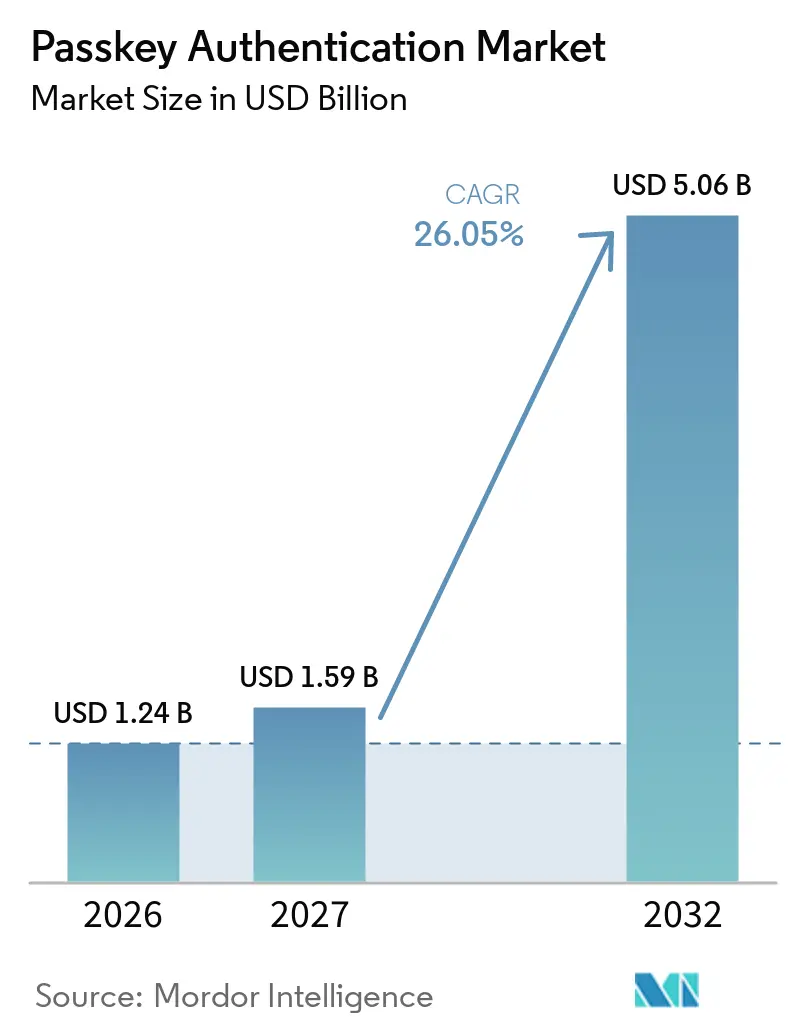
The Passkey Authentication Market size is projected to expand from USD 1.24 billion in 2026 and USD 1.59 billion in 2027 to USD 5.06 billion by 2032, registering a CAGR of 26.05% between 2027 and 2032. The passkey authentication market is gaining support as phishing-resistant sign-in becomes a compliance priority for public agencies, financial institutions, and operators of critical services. Platform support from Apple, Google, and Microsoft has made passkeys available across more devices, which reduces the compatibility concerns that once limited adoption. The passkey authentication market also benefits when organizations connect password removal with lower help-desk workload, faster employee access, and lower exposure to credential theft. Integration work remains important because large organizations often need to connect older applications and directories to modern identity platforms. The passkey authentication market offers a clear opening for software providers, specialist integrators, and identity verification vendors that can provide secure enrollment, recovery, and lifecycle management.
Key Report Takeaways
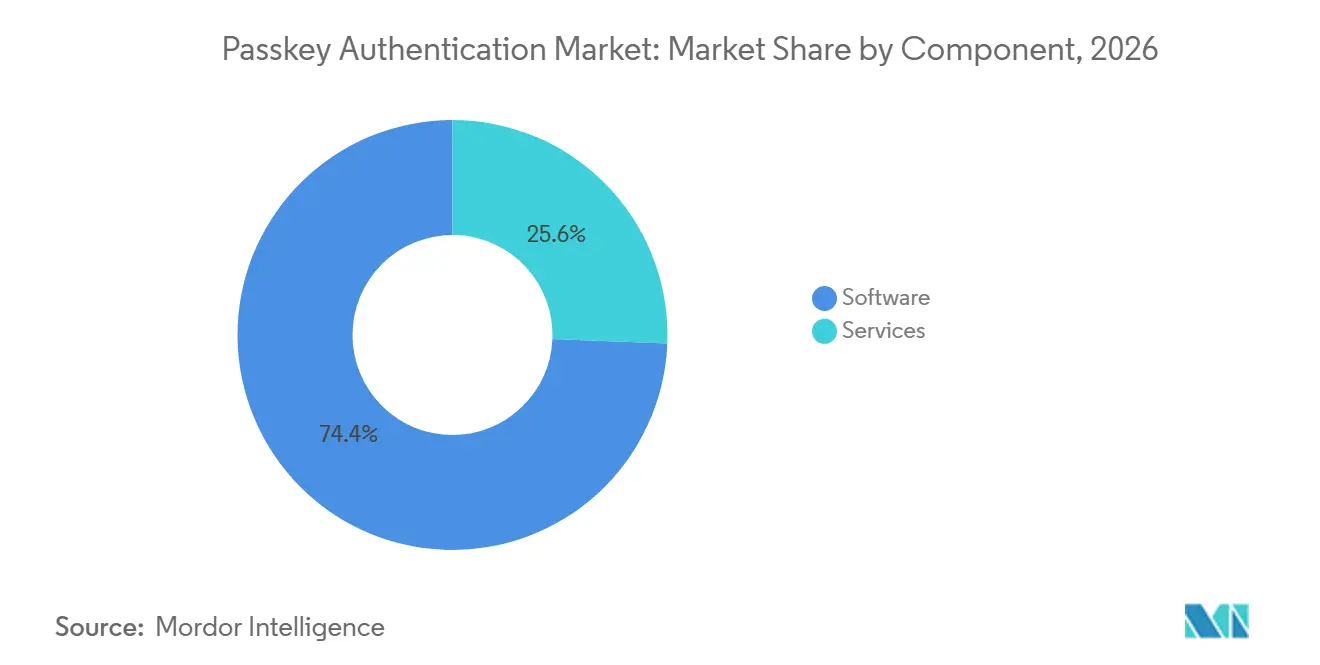
- By component, software led the passkey authentication market with 74.37% in 2026, while services are projected to expand at a 28.11% CAGR through 2032.
- By deployment, cloud led the passkey authentication market with 60.57% in 2026 and is projected to expand at a 28.73% CAGR through 2032.
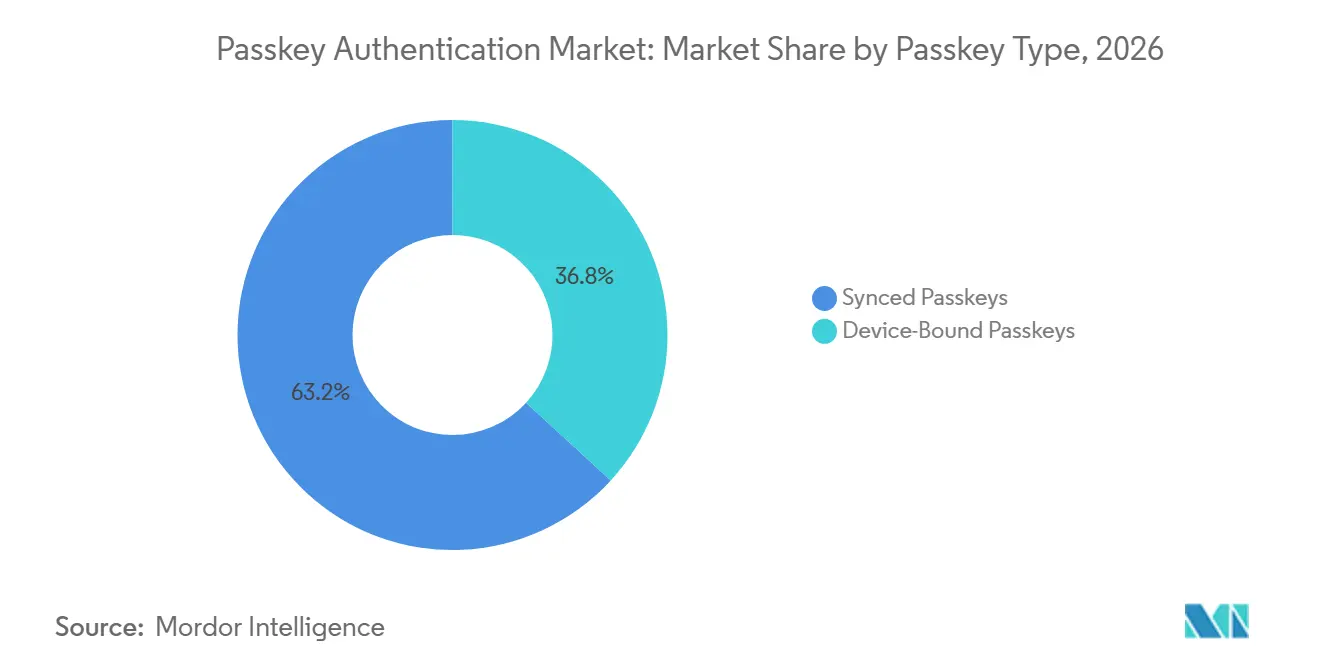
- By passkey type, synced passkeys led the passkey authentication market with 63.17% in 2026, while device-bound passkeys are projected to expand at a 27.31% CAGR through 2032.
- By organization size, large enterprises led the passkey authentication market with 72.28% in 2026, while SMEs are projected to expand at a 29.27% CAGR through 2032.
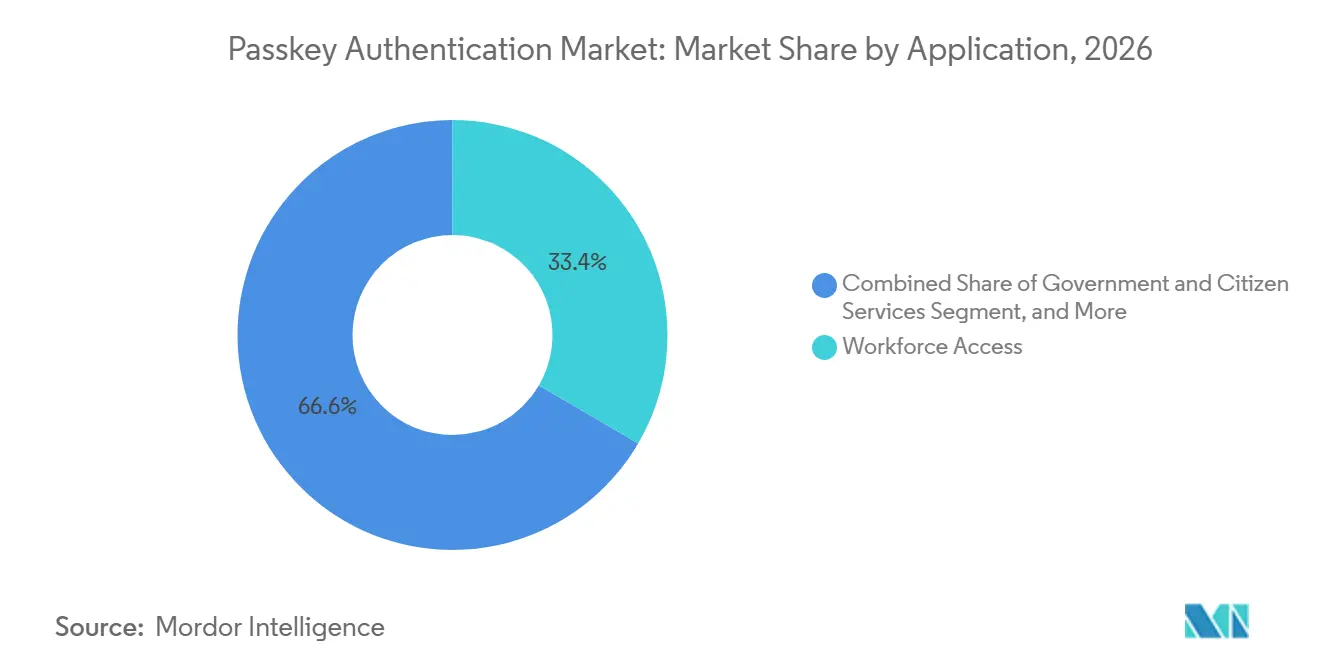
- By application, workforce access held 33.41% of the market share in 2026, while government and citizen services are projected to expand at a 29.17% CAGR through 2032.
- By industry vertical, BFSI held 23.19% of the market share in 2026, while government and public administration is projected to expand at a 27.93% CAGR through 2032.
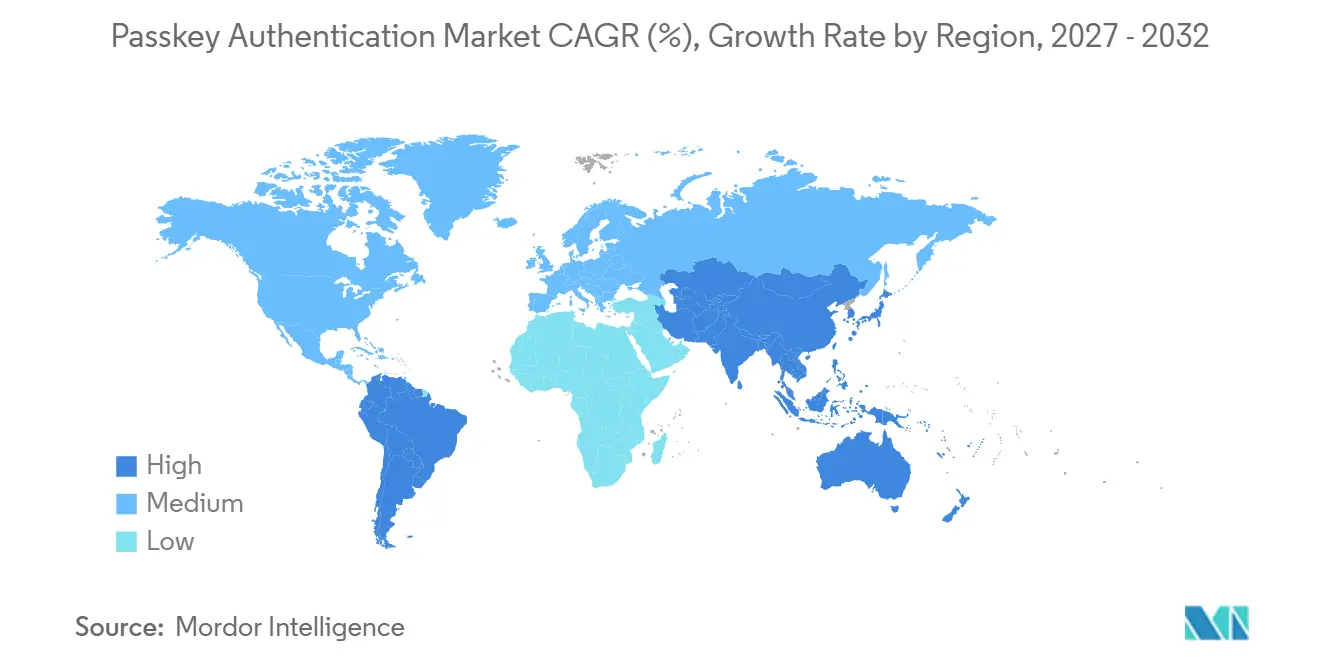
- By geography, North America held 37.23% of the market share in 2026, while Asia-Pacific is projected to expand at a 29.23% CAGR through 2032.
Note: Market numbers in this report are based on Mordor Intelligence's proprietary estimation framework, which combines nine months of actuals with Q4 projections for base year 2026.
Global Passkey Authentication Market Trends and Insights
Drivers Impact Analysis*
| Driver | (~) % Impact on CAGR Forecast | Geographic Relevance | Impact Timeline |
|---|---|---|---|
| Expansion of Phishing-Resistant Authentication Mandates | +4.5% | Global, concentrated in North America and the EU | Short term (≤ 2 years) |
| Enterprise Password-Reset Cost Reduction | +3.8% | Global | Short term (≤ 2 years) |
| Passkey Support Across Major Consumer Platforms | +3.5% | Global, led by North America and Asia-Pacific | Medium term (2-4 years) |
| Growth of Customer Identity and Embedded Authentication | +3.2% | North America, Europe, and Asia-Pacific core markets | Medium term (2-4 years) |
| Offline and Air-Gapped Workforce Authentication Demand | +2.8% | North America, Europe, spill-over to Middle East | Long term (≥ 4 years) |
| Passkey Observability and Conversion Analytics | +2.1% | North America and Europe | Long term (≥ 4 years) |
| Source: Mordor Intelligence | |||
Expansion of Phishing-Resistant Authentication Mandates
Regulatory requirements are moving passkey programs from optional technology projects into compliance work. Executive Order 14144 directed U.S. federal civilian agencies to pilot commercial WebAuthn-based authentication in January 2025. NIST SP 800-63B-4 established a phishing-resistant authentication option at Authentication Assurance Level 2 in August 2025.[1] The passkey authentication market gains from shorter buying cycles when organizations use mandatory budget authority to meet these requirements. eIDAS 2.0 and NIS 2 guidance also increase the focus on stronger authentication for European digital identity and essential service environments. This policy direction makes implementation quality, auditability, and recovery controls central selection factors.
Enterprise Password-Reset Cost Reduction
Password reset work gives security teams a practical financial reason to replace older sign-in methods. The FIDO Alliance reported that 35% of organizations using passkeys recorded fewer password-reset tickets in 2026. The same research found that 45% of deploying organizations reported faster employee logins. These results make the passkey authentication market relevant to IT operations leaders as well as security leaders. Smaller firms can use cloud identity services to avoid building a separate FIDO2 environment. This change supports wider adoption among SMEs, which need simple enrollment and support processes.
Passkey Support Across Major Consumer Platforms
Broader support across operating systems and browsers removes a major obstacle to enterprise rollout. Apple introduced passkey account creation, automatic upgrades, and secure import and export improvements at WWDC25. Microsoft announced the general availability of Entra passkeys for Windows in May 2026. When employees already have a compatible authenticator, organizations can treat rollout as an identity configuration project rather than a hardware deployment. The FIDO Alliance reported that 75% of respondents in 10 countries had enabled a passkey for at least 1 account in 2026. This consumer familiarity can make workforce enrollment easier and can reduce reluctance toward new sign-in methods.
Growth of Customer Identity and Embedded Authentication
Customer identity is becoming an important area for passkey adoption because password friction can affect conversion and service costs. The FIDO Alliance stated that 47% of consumers would likely abandon a purchase or sign-in when they could not remember a password. Banesco Banco Universal deployed passkeys for 2.2 million users, illustrating how a financial institution can apply the technology to high-value transfers and fraud-alert self-service. The passkey authentication market benefits when organizations use login conversion, device distribution, and fallback activity to improve customer journeys. India’s digital payment authentication directions add another demand source for stronger credentials in payment flows. Customer deployments also require reliable identity checks at enrollment and recovery, which broadens demand beyond the sign-in prompt itself.
Restraints Impact Analysis*
| Restraint | (~) % Impact on CAGR Forecast | Geographic Relevance | Impact Timeline |
|---|---|---|---|
| Legacy Application and Directory Integration Complexity | -3.2% | Global, most acute in North America and Europe | Medium term (2-4 years) |
| Recovery and Account-Reinstatement Risk | -2.5% | Global | Short term (≤ 2 years) |
| Cross-Device Enrollment and Credential Portability Friction | -2.1% | Asia-Pacific core, spill-over to Middle East and Africa | Medium term (2-4 years) |
| Fragmented Relying-Party Ownership and Consent Workflows | -1.8% | Europe, eIDAS 2.0 context, and North America | Long term (≥ 4 years) |
| Source: Mordor Intelligence | |||
Legacy Application and Directory Integration Complexity
Older application estates remain a substantial challenge for the passkey authentication market. Thick-client software, older directory services, and systems that use earlier authentication protocols often cannot process FIDO2 assertions directly. Organizations may need an identity-aware proxy that accepts the passkey and then federates identity through SAML or OpenID Connect. This adds design work, integration testing, and ongoing operational responsibility. The FIDO Alliance found that 57% of organizations continued to use a phishable primary sign-in method despite active passkey programs in 2026. This gap helps explain why services can advance faster than software, as enterprises need specialist assistance to connect platforms to older systems.
Recovery and Account-Reinstatement Risk
Recovery design can undermine passkey security if an organization retains weak SMS or email fallback routes. An attacker who cannot obtain a passkey may instead try to compromise the recovery process. Peer-reviewed research presented at the 2026 USENIX Security Symposium found that participants did not consistently secure accounts after passkey-related compromise events. Microsoft has advised organizations to treat high-assurance recovery as part of authentication design rather than an afterthought. The passkey authentication market, therefore, has room for identity verification and re-enrollment orchestration. Providers that link credential issuance to verified identity can address a weakness that basic sign-in replacement does not solve.
*Our forecasts treat driver/restraint impacts as directional, not additive. The impact forecasts reflect baseline growth, mix effects, and variable interactions.
Segment Analysis
By Component: Services Growth Reflects Integration-Led Adoption
Software accounted for 74.37% of the passkey authentication market size in 2026. Cloud identity platforms increasingly include passkey functions within existing subscriptions, which lowers the apparent incremental cost for customers. Microsoft confirmed in July 2026 that passkey support in Entra ID does not carry a separate licensing charge. This practice supports customer retention and makes passkey capability a standard part of broader identity offerings. Software vendors compete on policy controls, device coverage, administration, and integration with existing enterprise directories. They also need to make enrollment and recovery understandable for administrators and end users.
Services are projected to expand at a 28.11% CAGR through 2032 within the passkey authentication market. Demand comes from organizations that have access to modern identity platforms but lack a practical path for enterprise-wide deployment. The continued use of phishable sign-in methods across active programs shows that technical availability does not automatically lead to full adoption. Large IT service providers benefit from established customer relationships, while specialist firms can distinguish themselves through FIDO2 experience. Financial services and public-sector users often need help connecting old protocols with current identity systems. The segment also relies on change management, user support, testing, and lifecycle operations after deployment.
By Deployment: Cloud Architecture Dominates Enterprise Deployments
Cloud represented 60.57% of the passkey authentication market size in 2026 and is projected to expand at a 28.73% CAGR through 2032. SaaS-based identity platforms use API-first delivery models that can provide passkey functions without a dedicated on-premises deployment. This approach can remove hardware procurement delays and can simplify policy updates. Cloud tools also give organizations current data on enrollment, sign-in completion, and fallback use. These capabilities support observability programs that identify where users stop or abandon an authentication journey. For many organizations, cloud deployment offers the most direct route to broader use of strong authentication.
Cloud is also the fastest-growing deployment model in the supplied outlook. It suits enterprises that want to deploy common policies across a distributed workforce and use current identity platform features as they become available. On-premises installations remain important for government, defense, and critical infrastructure users with data sovereignty requirements. Hybrid architecture can support organizations that are moving applications in stages rather than replacing their installed base at once. Intercede launched MyID Authenticate in October 2026 with support for cloud and on-premises authentication from 1 management plane.[2] This offering reflects the continued need to coordinate different deployment environments during transition periods.
By Passkey Type: Device-Bound Credentials Expand Beyond Authentication
Synced passkeys held 63.17% of the passkey authentication market share in 2026. They are widely suited to consumer and SME use cases where credential portability across devices is important. A user can move between supported devices without completing a separate hardware credential enrollment each time. This convenience supports broad adoption when service providers want to reduce password use at scale. Synced credentials also benefit from platform ecosystem support that users encounter in everyday digital services. Organizations still need to align the credential model with the assurance level required for each application.
Device-bound passkeys are projected to expand at a 27.31% CAGR through 2032. Government, financial services, and critical infrastructure operators value hardware attestation and non-exportable credentials for high-assurance access. Yubico introduced YubiKey 5.8 in July 2026 with CTAP 2.3 support, hardware-backed digital signatures, identity wallet credentials, and Secure Payment Confirmation. These functions extend the use of hardware-backed credentials into authorization and signing workflows. Organizations that must meet FIPS 140-3 requirements can retain device-bound credentials as their compliant path. This concentrates demand among a specialized vendor group and keeps assurance requirements central to product selection.
By Organization Size: SME Adoption Accelerates as Economics Shift
Large enterprises held 72.28% of the passkey authentication market share in 2026. Their early position reflects larger budgets for integration, stronger exposure to phishing-related risk, and more established identity teams. These organizations often manage large application portfolios, which makes a phased deployment approach necessary. They can justify work on legacy connections, detailed policy design, and high-assurance recovery. Their deployments also create reference cases that help validate passkeys for regulated peers. The segment will continue to require managed rollout plans because global workforces use many device types and applications.
SMEs are projected to expand at a 29.27% CAGR through 2032 in the passkey authentication market. Cloud-native providers can now offer passkey capability to smaller organizations without requiring dedicated FIDO2 infrastructure. Okta released a general availability passkey enrollment promotion feature in October 2026 that can display non-blocking registration prompts during existing sign-in activity. This type of feature can help smaller organizations build registration without a separate campaign. Simpler tools do not remove the need for recovery controls, but they can reduce enrollment friction. Lower deployment complexity makes passkey adoption more reachable for organizations with limited security staff.
By Application: Mandate-Driven Government Services Segment Accelerates
Workforce access accounted for 33.41% of the market size in 2026. Employers are prioritizing stronger employee sign-in because credential theft is becoming more automated and more convincing. The FIDO Alliance reported that 82% of organizations saw fully passwordless authentication as an ultimate goal in 2026. It also reported that 28% of organizations had achieved that goal. Workforce use requires support for managed and unmanaged devices, contractor access, and role-based controls. These needs keep identity administration and access recovery important alongside the authenticator itself.
Government and citizen services are projected to expand at a 29.17% CAGR through 2032. Digital government programs need secure access to tax, health, benefits, and other citizen-facing services. The passkey authentication market can serve this need when credential enrollment links clearly to verified identity and when recovery does not reduce the assurance level. India’s payment authentication directions, which became effective in April 2026, created demand for phishing-resistant credentials in domestic payment flows. Developer and API authentication is also gaining attention as autonomous agents require stronger authorization to perform sensitive user-delegated tasks. Application providers will need clear consent, authentication, and audit records as these use cases develop.

By Industry Vertical: BFSI Leads While Public Administration Accelerates
BFSI held 23.19% of the market share in 2026. Banks and insurers already operate substantial multifactor authentication environments and face direct pressure to reduce fraud. SMS one-time passwords present a risk where attackers can exploit SIM swaps or social engineering. The FIDO Alliance asked the European Commission for clarification on how passkeys can meet PSD2 regulatory technical standards in April 2025.[3] Regulatory clarity can help financial institutions decide where passkeys fit into strong customer authentication programs. Payment, account access, and high-value transaction flows remain relevant entry points for adoption.
Government and public administration are projected to expand at a 27.93% CAGR through 2032. National digital identity programs and defense requirements make phishing-resistant access particularly important in this vertical. Public organizations often operate older technology estates, which can raise the need for federation and phased implementation. IT and telecommunications providers also manage large user populations that attract phishing attempts. Retail and e-commerce organizations can use payment passkeys to reduce fraud at checkout. Healthcare and life sciences organizations must combine stringent access assurance with the practical limits of shared clinical workstations. These varied requirements keep vertical-specific workflow design important for passkey providers.
Geography Analysis
North America held 37.23% of the market share in 2026. Federal activity has supported adoption by making phishing-resistant access a clear policy priority. Executive Order 14144 directed federal civilian agencies to pilot commercial WebAuthn-based authentication. NIST SP 800-63B-4 later established phishing-resistant authentication requirements at the relevant assurance level. Microsoft began a phased move toward passkeys as the default Entra ID experience in September 2026. The change can influence a large installed base of enterprise users as SMS and voice MFA are scheduled for retirement in 2027.
Europe has a distinct compliance setting shaped by eIDAS 2.0, NIS 2, and national technical direction. Germany’s BSI issued TR-03188 in June 2026 as a national technical guideline for passkey server configuration. The guidance gives website operators security recommendations and integration options for FIDO2 server implementation. Essential service operators face added pressure to use stronger authentication under the NIS 2 context. European organizations also need to manage relying-party ownership and consent processes across complex digital identity environments. These needs favor providers that can pair authentication controls with clear governance and server configuration support.
Asia-Pacific is projected to expand at a 29.23% CAGR through 2032, the fastest pace among geographic regions. The market size in the region is supported by digital banking, national identity programs, and large consumer platform use. South Korea received a clarification that FIDO on-device biometric authentication does not require separate user consent under its privacy framework.[4] In South America, Mastercard and Yuno launched the Mastercard Payment Passkey Service in Brazil, Argentina, and Chile during February 2025. The Middle East is progressing through Saudi Arabian and UAE digital identity programs, with government and financial services leading early adoption. Africa remains the smallest region, though banking compliance supports early deployments in South Africa and Nigeria, while Egypt is developing an opportunity around national digital identity investment.
Competitive Landscape
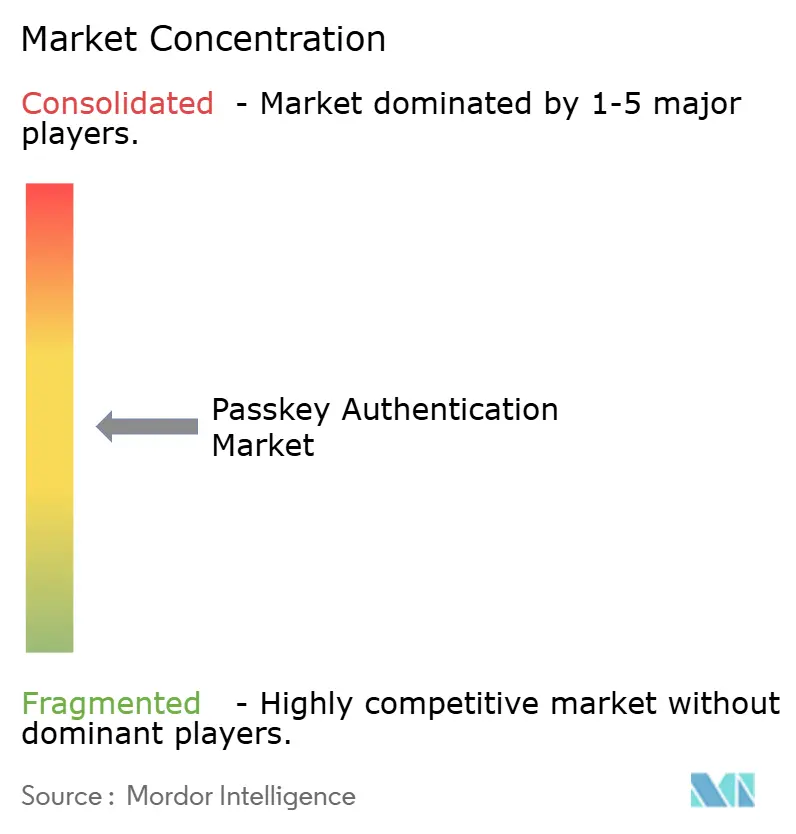
The passkey authentication market has a moderately fragmented structure. Microsoft, Apple, and Google influence credential ecosystem defaults through operating system and platform implementations. Specialist identity and access management vendors compete by providing deployment depth, administration tools, and support for older systems. Hardware-focused providers can compete on device-bound credentials and high-assurance controls. These different routes to market mean that no single business model serves every buyer's requirement. The passkey authentication market is therefore competitive in software and more fragmented in implementation and lifecycle services.
Yubico broadened its hardware-backed offering with YubiKey 5.8 in July 2026. The product supports CTAP 2.3, hardware-backed digital signatures, identity wallet credentials, and Secure Payment Confirmation. The move connects passkeys with authorization and signing tasks that require higher assurance. BIO-key received FIDO Alliance Full Certification for Passkey: YOU in September 2026 and positioned the product for agentic AI authentication workflows. These steps show how certification and hardware assurance can help specialized vendors address focused use cases. Providers serving regulated buyers must also demonstrate interoperability with established enterprise identity platforms.
Pure-play providers can differentiate through identity verification at credential issuance and re-enrollment. HYPR integrated its Affirm identity verification with Yubico provisioning in November 2025 to bind hardware FIDO2 credentials to verified employees before devices ship. Corbado and Beyond Identity target developer and customer identity use cases with API-oriented passkey tools, according to the supplied research. The services layer remains relevant because passkey availability does not resolve complex integration, recovery, policy, and user adoption questions. Companies that combine product capability with operational deployment support can compete effectively in enterprise accounts. The passkey authentication industry continues to offer room for platform vendors, specialists, and integrators because assurance requirements and existing technology environments differ widely.
Passkey Authentication Industry Leaders
-
Microsoft Corporation
-
Apple Inc.
-
Thales S.A.
-
HID Global Corporation
-
Amazon.com, Inc.
- *Disclaimer: Major Players sorted in no particular order
Recent Industry Developments
- October 2026: Intercede launched MyID Authenticate, a FIDO passkey solution enabling phishing-resistant sign-in to Windows desktops, cloud services, and on-premises applications from a single platform, with a European public-sector digital services organization as its lead customer. The product made its international debut at GovWare 2026 in Singapore .
- September 2026: BIO-key International received FIDO Alliance Full Certification for its Passkey:YOU authenticator, achieving interoperability across Entra ID, Okta, Ping Identity, and Duo, and positioning the product for agentic AI authentication workflows.
- July 2026: Yubico announced general availability of YubiKey 5.8, extending hardware-backed passkeys from authentication into verifiable authorization. The firmware added CTAP 2.3 support, hardware-backed digital signatures, identity wallet credentials, and Secure Payment Confirmation, shipping across all major YubiKey product lineups.
- November 2025: HYPR and Yubico deepened their partnership by integrating HYPR Affirm identity verification with Yubico's YubiKey provisioning, enabling enterprises to cryptographically bind hardware FIDO2 credentials to verified employee identities before devices ship to distributed workforces.
Global Passkey Authentication Market Report Scope
Passkey authentication refers to a secure, passwordless authentication method that utilizes public-key cryptography to replace traditional passwords with device-based cryptographic credentials. By securely storing a private key on the user's device and a public key on the service provider's server, it significantly eliminates the risks of phishing, credential stuffing, and data breaches.
The Passkey Authentication Market Report is Segmented by Component (Software and Services), Deployment (Cloud, On-Premises, and Hybrid), Passkey Type (Synced Passkeys and Device-Bound Passkeys), Organization Size (Large Enterprises and Small and Medium-Sized Enterprises), Application (Workforce Access, Customer Identity and Access, Financial Transactions and Payments, Government and Citizen Services, Developer and API Authentication, and Other Applications), Industry Vertical (BFSI, Government and Public Administration, IT and Telecommunication, Retail and E-Commerce, Healthcare and Life Sciences, Media and Entertainment, and Other Industry Verticals), and Geography (North America, South America, Europe, Asia-Pacific, Middle East, and Africa). The Market Forecasts are Provided in Terms of Value (USD).
| Software |
| Services |
| Cloud |
| On-Premises |
| Hybrid |
| Synced Passkeys |
| Device-Bound Passkeys |
| Large Enterprises |
| Small and Medium-Sized Enterprises |
| Workforce Access |
| Customer Identity and Access |
| Financial Transactions and Payments |
| Government and Citizen Services |
| Developer and API Authentication |
| Other Applications |
| BFSI |
| Government and Public Administration |
| IT and Telecommunication |
| Retail and E-Commerce |
| Healthcare and Life Sciences |
| Media and Entertainment |
| Other Industry Verticals |
| North America | United States |
| Canada | |
| Mexico | |
| South America | Brazil |
| Argentina | |
| Rest of South America | |
| Europe | United Kingdom |
| Germany | |
| France | |
| Italy | |
| Spain | |
| Rest of Europe | |
| Asia-Pacific | China |
| Japan | |
| India | |
| South Korea | |
| Australia | |
| Rest of Asia-Pacific | |
| Middle East | United Arab Emirates |
| Saudi Arabia | |
| Turkey | |
| Rest of Middle East | |
| Africa | South Africa |
| Nigeria | |
| Egypt | |
| Rest of Africa |
| By Component | Software | |
| Services | ||
| By Deployment | Cloud | |
| On-Premises | ||
| Hybrid | ||
| By Passkey Type | Synced Passkeys | |
| Device-Bound Passkeys | ||
| By Organization Size | Large Enterprises | |
| Small and Medium-Sized Enterprises | ||
| By Application | Workforce Access | |
| Customer Identity and Access | ||
| Financial Transactions and Payments | ||
| Government and Citizen Services | ||
| Developer and API Authentication | ||
| Other Applications | ||
| By Industry Vertical | BFSI | |
| Government and Public Administration | ||
| IT and Telecommunication | ||
| Retail and E-Commerce | ||
| Healthcare and Life Sciences | ||
| Media and Entertainment | ||
| Other Industry Verticals | ||
| By Geography | North America | United States |
| Canada | ||
| Mexico | ||
| South America | Brazil | |
| Argentina | ||
| Rest of South America | ||
| Europe | United Kingdom | |
| Germany | ||
| France | ||
| Italy | ||
| Spain | ||
| Rest of Europe | ||
| Asia-Pacific | China | |
| Japan | ||
| India | ||
| South Korea | ||
| Australia | ||
| Rest of Asia-Pacific | ||
| Middle East | United Arab Emirates | |
| Saudi Arabia | ||
| Turkey | ||
| Rest of Middle East | ||
| Africa | South Africa | |
| Nigeria | ||
| Egypt | ||
| Rest of Africa | ||
Key Questions Answered in the Report
What is the size of the passkey authentication market?
The passkey authentication market is projected to increase from USD 1.24 billion in 2026 and USD 1.59 billion in 2027 to USD 5.06 billion by 2032, at a 26.05% CAGR.
What is driving adoption of passkey authentication?
Phishing-resistant authentication requirements, broader device support, and reduced password-reset activity are supporting adoption.
Which component leads passkey authentication spending?
Software held 74.37% share in 2026, while services is projected to expand at a 28.11% CAGR through 2032.
Why are device-bound passkeys important?
They provide non-exportable credentials and hardware attestation, which supports high-assurance use cases in government, financial services, and critical infrastructure.
Which region is advancing the fastest?
Asia-Pacific is projected to expand at a 29.23% CAGR through 2032, supported by digital banking, payment authentication, and national identity programs.
What are the main barriers to enterprise deployment?
Legacy application integration and secure account recovery remain major issues because weak fallback methods can reintroduce phishing exposure.