
Passenger Service System Market Size and Share
Market Overview
| Study Period | 2020 - 2031 |
|---|---|
| Market Size (2026) | USD 14.01 Billion |
| Market Size (2031) | USD 30.46 Billion |
| Growth Rate (2026 - 2031) | 16.83 % |
| Fastest Growing Market | Asia Pacific |
| Largest Market | North America |
| Market Concentration | Medium |
Major Players *Disclaimer: Major Players sorted in no particular order Image © Mordor Intelligence. Reuse requires attribution under CC BY 4.0. | |
Passenger Service System Market Analysis by Mordor Intelligence
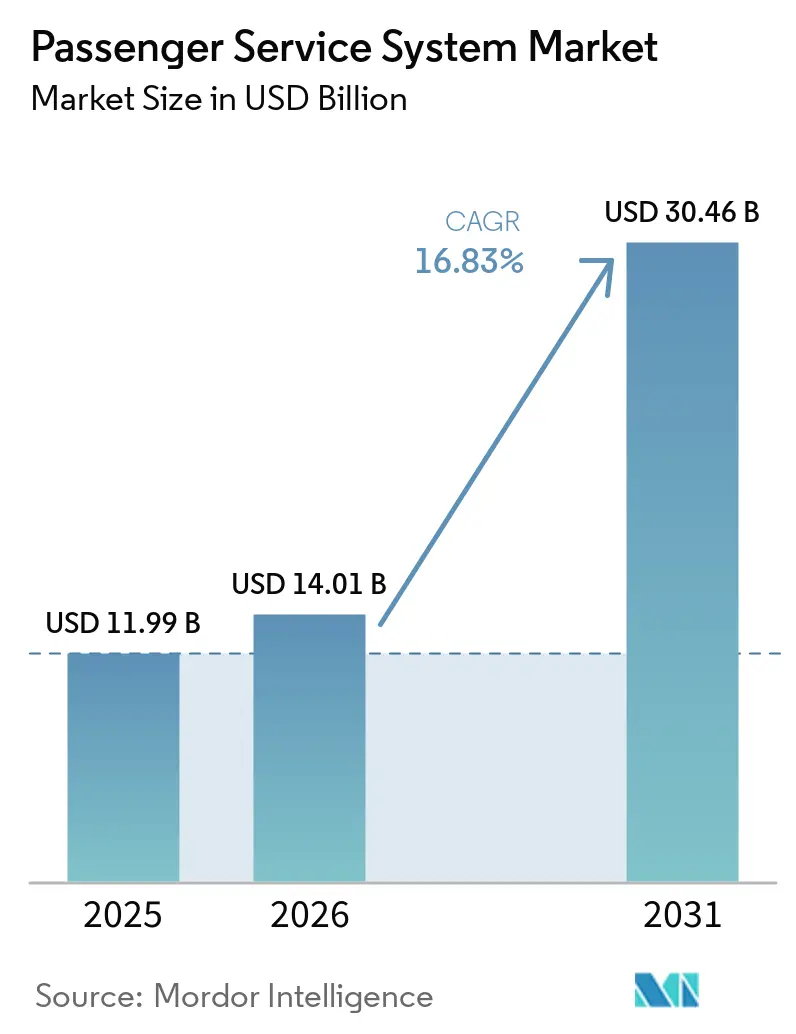
The Passenger Service System market size was valued at USD 11.99 billion in 2025 and estimated to grow from USD 14.01 billion in 2026 to reach USD 30.46 billion by 2031, at a CAGR of 16.83% during the forecast period (2026-2031). This vigorous expansion reflects airlines’ accelerated shift toward cloud-native architectures, AI-driven retailing and offer-and-order management platforms. Airlines are routing part of the USD 37 billion technology budget released in 2024 toward next-generation Passenger Service System market upgrades that cut legacy infrastructure outlays and unlock dynamic revenue streams. Full-service carriers rely on large-scale migrations to modernize mainframe-bound applications, while low-cost carriers spearhead agile roll-outs that shorten time-to-market for new ancillary products. Regionally, North American incumbents continue to lead standardization around IATA ONE Order, yet Asia-Pacific airlines supply the strongest volume uplift and the highest rate of new system adoptions. Competitive intensity rises as cloud-born specialists integrate modular APIs into existing Passenger Service System market deployments, pushing traditional vendors to invest heavily in R&D and strategic partnerships with hyperscale providers.
Key Report Takeaways
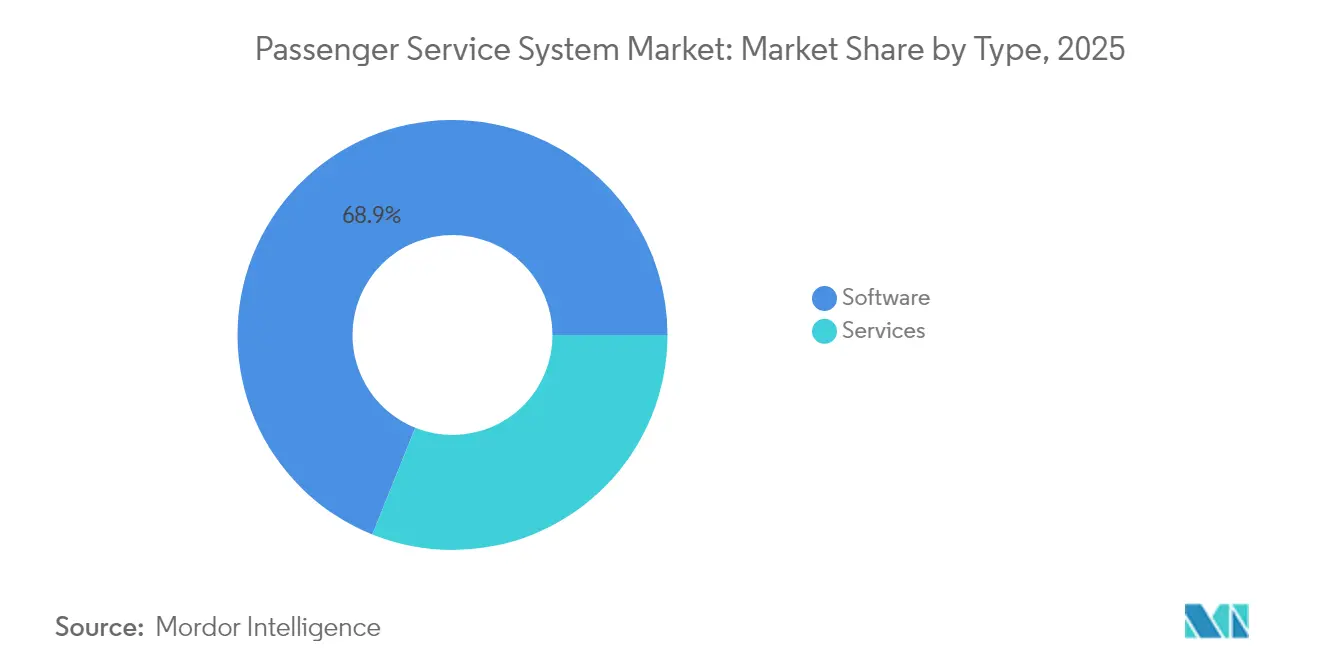
- By type, software held 68.92% of Passenger Service System market share in 2025 while services are projected to grow at an 17.98% CAGR to 2031.
- By deployment, cloud models accounted for 52.88% of the Passenger Service System market size in 2025 and are set to expand at an 18.35% CAGR through 2031.
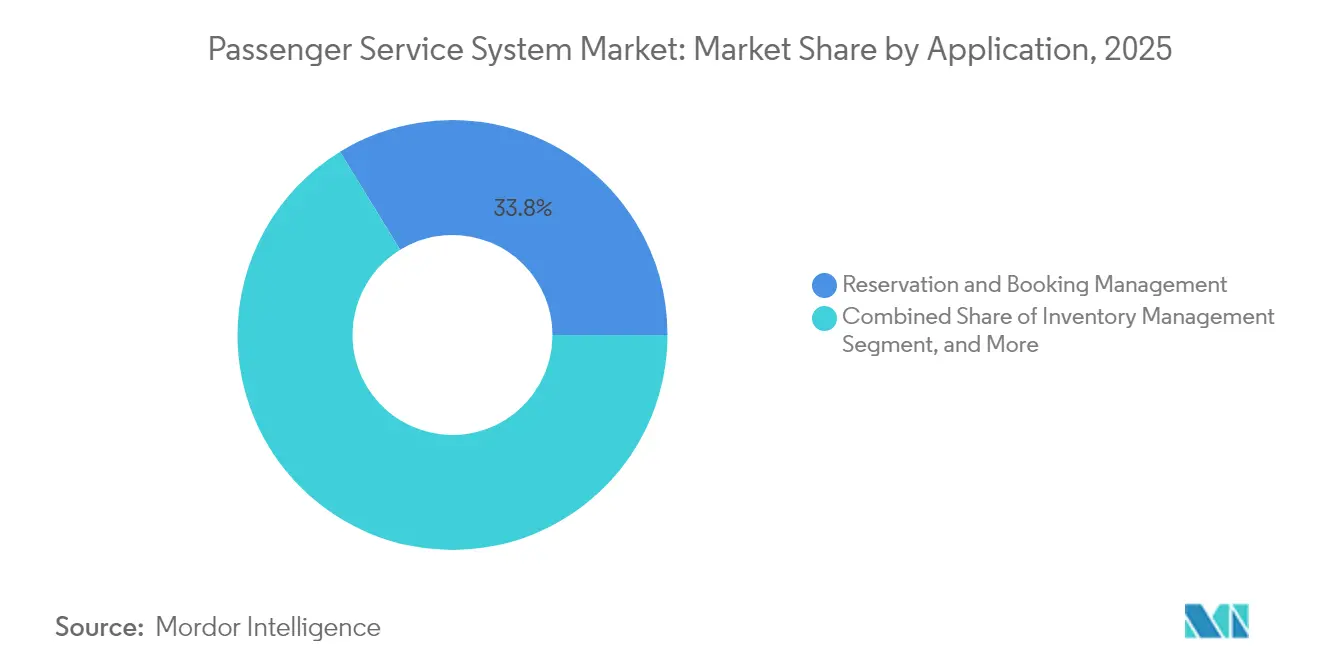
- By application, reservation and booking management captured 33.76% of Passenger Service System market share in 2025; loyalty management is forecast to rise at an 17.71% CAGR over the same period.
- By airline type, full-service carriers dominated with 39.88% revenue share in 2025, whereas low-cost carriers are advancing at a 19.42% CAGR to 2031.
- By geography, North America commanded 33.15% of 2025 revenue, but Asia-Pacific is growing the fastest at a 18.97% CAGR through 2031.
Note: Market size and forecast figures in this report are generated using Mordor Intelligence’s proprietary estimation framework, updated with the latest available data and insights as of 2026.
Market Trends and Insights
Drivers Impact Analysis of Passenger Service System Market*
| Driver | (~) % Impact on CAGR Forecast | Geographic Relevance | Impact Timeline |
|---|---|---|---|
| Rise in air-travel passengers | +4.2% | Global – Asia-Pacific leads | Medium term (2-4 years) |
| Rapid cloud adoption across airline IT stacks | +3.8% | North America and EU, Asia-Pacific catching up | Short term (≤ 2 years) |
| Growing appetite for ancillary-revenue merchandising | +3.1% | Global – led by LCCs | Medium term (2-4 years) |
| Mandates for seamless omni-channel passenger experience | +2.7% | EU spearheads, worldwide uptake | Long term (≥ 4 years) |
| IATA ONE Order accelerating end-to-end PSS upgrades | +2.4% | Global – early adopters in Middle East | Long term (≥ 4 years) |
| Airport CUTE/CUPPS sunset pushing modern PSS APIs | +1.0% | Asia-Pacific airports | Short term (≤ 2 years) |
| Source: Mordor Intelligence | |||
Rise in Air-Travel Passengers
Global passenger numbers are projected to reach 5.2 billion in 2025, placing unprecedented load on legacy reservation architectures. United Airlines’ migration from 50-year-old mainframes to an Amazon Bedrock-enabled stack shows how carriers now translate complex passenger name records into plain-language objects that scale elastically [1]. Asia-Pacific airports such as Bangkok’s Suvarnabhumi and Phuket are targeting over 130 million passengers, prompting USD 18 billion in PSS-aligned infrastructure programs. Larger trip volumes multiply transaction requests, forcing airlines to adopt cloud-native Passenger Service System market deployments capable of real-time inventory orchestration and dynamic pricing.
Rapid Cloud Adoption Across Airline IT Stacks
Ninety-five percent of airlines list cloud migration as a top CIO priority, citing 40% cuts in total cost of ownership and faster release cycles once mainframe dependencies disappear. Sabre completed retirement of its proprietary mainframe in favor of Google Cloud, removing USD 100 million in annual operational costs while unlocking micro-services for personalized offers Delta Air Lines’ AWS partnership equips its revenue-management algorithms with on-demand compute power for seat-level pricing decisions. Together, these moves confirm that airlines embracing cloud-native Passenger Service System market frameworks gain measurable agility and margin upside.
Growing Appetite for Ancillary-Revenue Merchandising
Ancillary revenue topped USD 118 billion in 2024. Carriers such as Ryanair generate more than 30% of total income from paid add-ons, necessitating Passenger Service System market upgrades to support AI-powered bundling and real-time upselling. AirBaltic recorded a 6% rise in seat revenue after implementing machine-learning-driven dynamic ancillary pricing. Virgin Atlantic subsequently selected FLYR’s revenue operating system to extend personalized offers across mobile, kiosk and agent channels [2]. Modern PSS modules now integrate recommendation engines and granular customer segmentation, allowing airlines to fine-tune margins on luggage, seats and priority services without disrupting the core booking flow.
IATA ONE Order Accelerating End-to-End PSS Upgrades
ONE Order replaces fragmented PNR-based processes with single-record orders, simplifying settlement, servicing and analytics. Riyadh Air is launching operations directly on SabreMosaic, avoiding legacy complexity and achieving traveler-centric retailing from day one. British Airways is rolling out Amadeus Nevio to convert flight-centric workflows into modular offers linked to unified order management. Early adopters report shorter servicing times, cleaner revenue accounting and lower middleware costs, pushing many network carriers toward comprehensive Passenger Service System market realignments.
Restraints Impact Analysis of Passenger Service System Market*
| Restraint | (~) % Impact on CAGR Forecast | Geographic Relevance | Impact Timeline |
|---|---|---|---|
| High upfront licence and migration costs | -2.1% | Global – smaller carriers hardest hit | Medium term (2-4 years) |
| Legacy mainframe lock-in among Tier-1 carriers | -1.8% | North America and EU | Long term (≥ 4 years) |
| Growing data-sovereignty rules | -1.3% | China, EU GDPR zones | Medium term (2-4 years) |
| Talent shortage in NDC integration | -0.9% | Global STEM shortfall | Long term (≥ 4 years) |
| Source: Mordor Intelligence | |||
High Upfront Licence and Migration Costs
Comprehensive PSS modernization can exceed USD 100 million for a major carrier, discouraging many regionals from abandoning legacy contracts. Airlines often phase migrations over 3–5 years to contain cash-flow shocks, yet still face dual-run expenses during cut-over periods. Smaller operators struggle to negotiate favorable terms with dominant vendors, perpetuating vendor lock-in across the Passenger Service System market. Cloud OPEX models offset some capital burden, but licence fees for sophisticated offer-and-order modules remain a hurdle until transaction volumes scale sufficiently.
Legacy Mainframe Lock-in Among Tier-1 Carriers
Large carriers rely on codebases written in COBOL and TPF during the 1960s, with 30% of their support engineers expected to retire within this decade. Re-platforming carries operational risk: downtime can strand millions of passengers and cost carriers USD multi-million in penalties. Consequently, some airlines postpone upgrades, ceding agility to newer rivals that deploy cloud-first Passenger Service System market solutions. Market momentum still favors modernization, but mainframe lock-in slows the overall adoption curve and suppresses short-term ROI for digital initiatives.
*Our forecasts treat driver/restraint impacts as directional, not additive. The impact forecasts reflect baseline growth, mix effects, and variable interactions.
Passenger Service System Market Segment Analysis
By Type:
Services Unlock Rapid ModernizationPassenger Service System market size figures underline software’s 68.92% revenue contribution in 2025. Airlines continue renewing core licences for platforms such as Amadeus Altéa and SabreSonic, yet they increasingly bundle consulting and migration assistance in multi-year service engagements. The services segment’s 17.98% CAGR stems from carriers demanding cloud architecture design, NDC schema mapping and AI model training beyond mere implementation. Tier-one carriers now structure partnerships that combine shared code-bases with DevOps squads from suppliers, transferring knowledge that accelerates feature releases.
The changing procurement mix highlights a pivot to outcome-based contracts measurable by ancillary revenue uplift or downtime reduction. Vendors respond by packaging managed services with uptime SLAs and continuous optimization cycles. As a result, software revenues grow steadily, but service-driven differentiation sets the competitive tempo. Airlines that secure high-quality integration support compress migration timelines and unlock early mover gains in dynamic retailing—advantages that ripple through the wider Passenger Service System market.

By Deployment:
Cloud Models Dominate New ContractsCloud deployments claimed 52.88% of the Passenger Service System market share in 2025 and they lead with an 18.35% CAGR. Carriers prefer OPEX-aligned subscription models that scale with ticket volumes and sidestep capital-heavy data-center upgrades. Sabre’s strategic partnership with Google Cloud allows airlines to plug into natural-language AI APIs without provisioning on-prem infrastructure. United Airlines reports sub-second response times for complex itinerary searches after refactoring its shopping engine on AWS, demonstrating operational upside accessible only via hyperscale resources.
On-premise installations persist mainly among transatlantic legacy carriers bound by historical investments and strict data-residency rules. Even here, hybrid deployments emerge: transactional cores stay local for latency, while forecasting and personalization run in the cloud. The growing proportion of cloud contracts signals that future Passenger Service System market upgrades will default to micro-service architectures, allowing airlines to activate new modules—loyalty, disruption management, sustainability reporting—through simple API toggles rather than extensive code rewrites.
By Application:
Loyalty Management Accelerates Revenue DiversificationReservation and booking management accounted for 33.76% of 2025 revenue, yet loyalty systems register the fastest 17.71% CAGR as airlines pivot from transactional fares toward relationship-driven monetization. Philippine Airlines adopted Amadeus Loyalty Management to deliver targeted offers that extend beyond flights into hotels, ground transport and financial partnerships. Full integration enables redemption and accrual in real time, elevating customer lifetime value and strengthening direct-channel sales.
Check-in, boarding and inventory applications mature incrementally, incorporating biometrics and AI allocation algorithms. Emerging modules track sustainable aviation fuel consumption to meet ESG reporting obligations. Within this diversified suite, loyalty management is positioned to command a larger slice of the Passenger Service System market size as carriers mine granular behavioral data for hyper-personalized bundles—bundles that outrun basic seat-and-bag merchandising in profitability.
By Airline Type:
Low-Cost Carriers Set the Agility BenchmarkFull-service carriers held 39.88% of global revenue in 2025, leveraging scale to fund multi-cloud deployments. Yet low-cost carriers register a 19.42% CAGR because their lean structures embrace greenfield deployments free of technical debt. Vendors like Radixx and Hitit supply turnkey solutions that can be configured in months, enabling LCCs to launch premium ancillaries such as priority security or lounge day-passes.
Hybrid models blur traditional labels: Gulf carriers mix unbundled fares with luxury add-ons, demanding PSS flexibility to switch between bundled and à-la-carte merchandising. Charter and regional operators rely on shared platforms to spread costs, often outsourcing completely to managed-service specialists. This convergence in service propositions forces the Passenger Service System market to deliver configurable rule engines that let an airline toggle between LCC and FSC characteristics without disrupting reservations integrity.
Geography Analysis
North America Passenger Service System Market
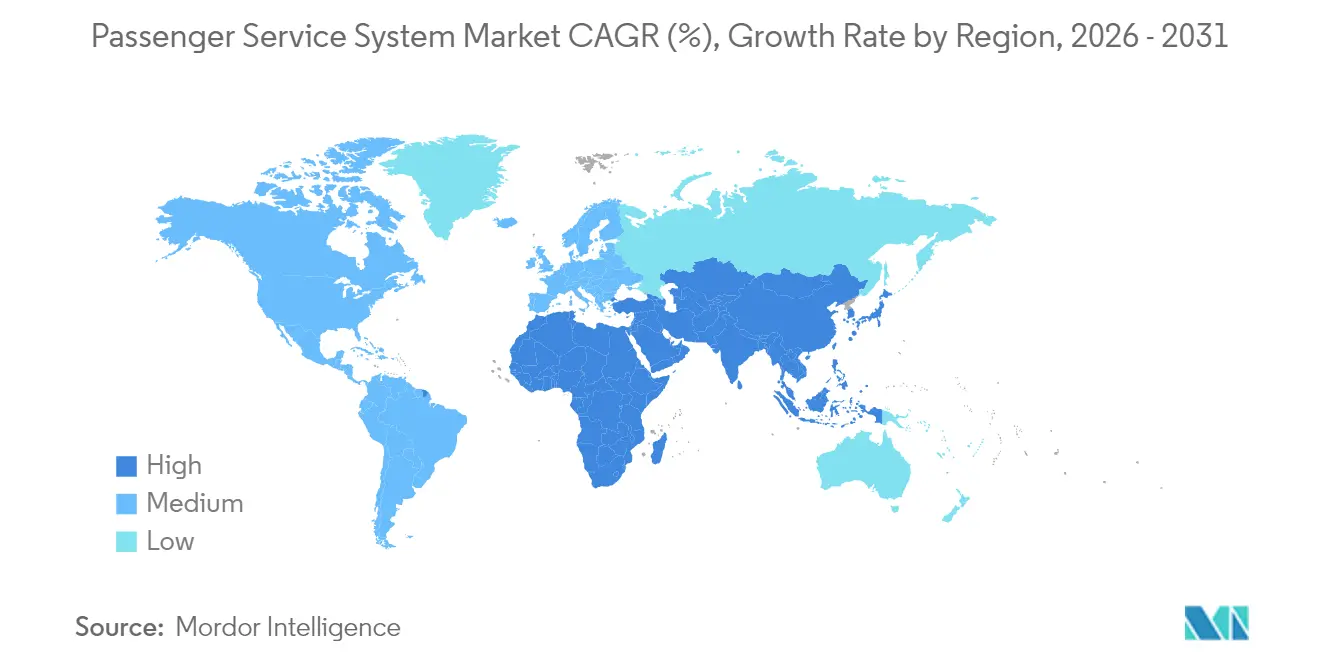
North America controlled 33.15% of global revenue in 2025, propelled by early adoption of cloud-native stacks and sustained investment programs such as Southwest’s USD 1.7 billion modernization roadmap. Carriers exploit robust regional hyperscale infrastructure to deploy AI-enhanced disruption management, dynamic pricing and biometric boarding across extensive domestic networks. However, deep customization around mainframe remnants slows down full adoption of ONE Order, requiring phased migration strategies that temper short-term agility gains. The Passenger Service System market now experiences a dual-speed trajectory in the region: legacy majors inch toward modular architectures while newer entrants leapfrog directly to offer-and-order models.
APAC Passenger Service System Market
Asia-Pacific is the fastest-growing theatre, posting a 18.97% CAGR as governments pour over USD 18 billion into airport upgrades that embed standardized CUPPS and CUSS interfaces. Rising middle-class leisure demand and aggressive fleet expansion create fertile ground for greenfield digital stacks. Airlines such as Riyadh Air, Vietravel and Akasa opt for cloud-native platforms from inception, avoiding the mainframe drag faced elsewhere. The region’s surge in low-cost travel also encourages sophisticated ancillary merchandising, channeling more transactions into the Passenger Service System market than seat growth alone would indicate.
EMEA Passenger Service System Market
Europe remains a critical innovation lab thanks to stringent data-protection and passenger-rights frameworks driving omni-channel and ESG functionality. British Airways’ Nevio adoption highlights a continent-wide emphasis on offer and order convergence, while Air France-KLM’s planned majority stake in SAS signals further consolidation and platform harmonization . Meanwhile, the Middle East and parts of Africa attract attention for state-led airline launches equipped with brand-new cloud platforms that sidestep legacy hurdles. Collectively, these dynamics reinforce a multipolar Passenger Service System market in which regulatory maturity, investment cycles and passenger demographics shape adoption speed and functionality focus.
Regulatory Landscape
Passenger Service System (PSS) providers and airlines work within a compliance framework spanning passenger data privacy, border-security data exchange, and distribution and consumer-information rules. In the European Union, GDPR enforcement and guidance on Passenger Name Record (PNR) processing influence how PSS platforms collect, store, and reuse traveler data; in March 2025, the European Data Protection Board issued Statement 2/2025 on implementing the PNR Directive following the CJEU judgment (C-817/19), emphasizing strict necessity assessments (including for intra-EU flights). Enforcement has also become a tangible risk for large travel technology vendors: Spain's Agencia Española de Protección de Datos (AEPD) issued a final decision in May 2026 that fined Amadeus IT Group EUR 18 million (net payment referenced as EUR 14.4 million) related to secondary use of traveler data, strengthening the need for explicit consent management, purpose limitation controls, and audit-ready data governance inside PSS architectures.
On the operational side, airlines must meet API and PNR reporting obligations for facilitation and security, anchored by ICAO facilitation guidance and IATA standards (including PNRGOV) that support interoperable messaging between airline systems and government agencies. In the United States and Canada, requirements governing airline information systems and computer reservation systems (for example, U.S. DOT rules including 14 CFR Part 256 and Transport Canada's CRS Regulations) influence display, reporting, and system practices, while customs and border programs shape the technical data exchange with agencies. Industry-managed standards continue to evolve for airline retailing, including the IATA Passenger Services Conference Resolution Manual (46th edition, 2026), which updated Resolution 1730 to clarify tariff-resolution handling in offer-and-order management environments and affect how PSS platforms implement modern retail workflows while maintaining compliant fare and servicing processes.
Value Chain Analysis
The PSS value chain begins with core platform engineering and hosting, then moves through implementation, integration, and ongoing operations. Technology providers supply foundational modules, typically a central reservation system (inventory, availability, fares), inventory control, and a departure control system for airport operations, increasingly bundled with loyalty management and retailing capabilities. Airlines procure these platforms directly from major vendors (such as Amadeus for Altéa, Sabre for SabreSonic and Radixx, and other specialists including Lufthansa Systems, IBS Software, Hitit, InteliSys Aviation, and Bravo Passenger Solutions), then rely on system integrators and managed services teams to handle NDC mapping, data migration, testing, and cutover. Hyperscale cloud infrastructure is a key upstream dependency for carriers pursuing elastic scaling and API-first architectures, with cloud deployment accounting for 52.88% of the market in 2025.
Downstream, PSS platforms connect to a broader set of distribution and servicing participants: GDS, OTAs, metasearch, payment providers, identity and biometric layers, and airport common-use environments. Integration typically relies on APIs and message standards, and the largest bottlenecks remain migration and runtime resilience. Many cutovers run dual systems for extended periods, and downtime can strand passengers and drive immediate revenue loss, which makes reliability engineering, observability, and incident response central to delivered value. As airlines shift toward offer-and-order and AI-driven retailing, middleware and orchestration layers that bridge legacy PNR flows with modular order management increasingly sit between the core PSS and the broader commerce stack, raising integration complexity and reinforcing demand for vendor ecosystems with stable APIs and established partner networks.
Competitive Landscape
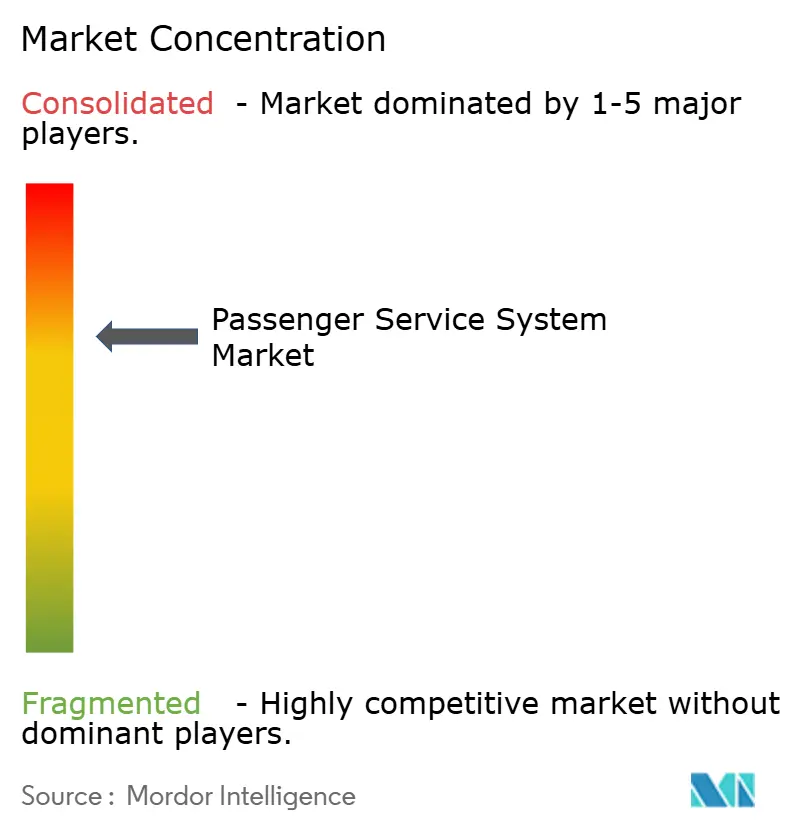
The Passenger Service System market exhibits moderate consolidation: Amadeus, Sabre and SITA collectively account for roughly 70% of global revenue, benefiting from deep integration footprints and long-term contracts. Each pours significant sums into R&D—Amadeus alone allocated EUR 1.4 billion in 2024—to pivot monolithic code toward modular cloud services. Sabre’s joint development with Google Cloud embeds generative AI into retailing workflows, allowing carriers to script bespoke micro-services on secure multi-tenant foundations[5].
Competition intensifies as venture-backed entrants offer specialized modules that plug into existing PSS via open APIs. FLYR secured USD 30 million to commercialize an AI revenue-operating system that optimizes ancillaries and fares in real time . Fetcherr’s generative-AI pricing engine helps carriers elevate Revenue per Available Seat Kilometre by constantly recalibrating fares based on live demand signals. Such niche leaders focus narrowly on value-added domains where they can outperform broadly scoped incumbents, forcing larger vendors to open their ecosystems or risk share erosion.
Strategic alliances multiply: SITA collaborates with airports on biometrics, while Hitit partners regionals that require low-footprint deployments. Airlines increasingly adopt multi-vendor strategies—core PSS from a major, revenue-management from a niche player, payment orchestration from a fintech—to avoid lock-in and accelerate innovation. This mix raises switching flexibility but also amplifies integration-management complexity, thus reinforcing demand for orchestrators capable of stitching disparate services into cohesive traveler experiences across the expanding Passenger Service System market.
Passenger Service System Industry Leaders
-
Amadeus IT Group SA
-
Sabre Corporation
-
Société Internationale de Télécommunications Aéronautiques (SITA) N.V.
-
Hitit Bilgisayar Hizmetleri A.Ş.
-
Lufthansa Systems GmbH & Co. KG
- *Disclaimer: Major Players sorted in no particular order
Passenger Service System Market Companies Covered in this Report
- Amadeus IT Group SA
- Sabre Corporation
- Societe Internationale de Telecommunications Aeronautiques (SITA) N.V.
- Hitit Bilgisayar Hizmetleri A.?.
- Radixx International Inc.
- Takeflite Solutions Limited
- Bravo Passenger Solutions Pte. Limited
- Collins Aerospace (Raytheon Technologies)
- Enoyaone Ltd.
- InteliSys Aviation Systems Inc.
- Unisys Corporation
- Videcom International Limited
- Lufthansa Systems GmbH & Co. KG
- Travel Technology Interactive S.A.
- Navitaire LLC
- Mercator Solutions FZE
- IBS Software Services Pvt. Ltd.
- AeroCRS Ltd.
- TravelSky Technology Limited
- WorldTicket A/S
Market Opportunities and Future Outlook
Airline retail transformation is creating whitespace for PSS suppliers that can operationalize offer-and-order workflows while preserving robust legacy servicing. Activity around IATA standards and modular order constructs supports this direction: in January 2026, Lufthansa Group and Amadeus announced a partnership to implement Order ID technology, a step toward replacing traditional booking and ticket number constructs with consolidated order components and more unified servicing. Modernization is also visible in NDC adoption and orchestration, where airlines and intermediaries face schema fragmentation and multi-version compatibility, driving demand for adapter layers, testing frameworks, and governance tooling alongside core PSS to speed commercial rollout without full-stack replacement.
Cloud-first operating models and AI-enabled retailing are also pulling spend toward platforms that can scale transaction peaks, support rapid product iteration, and activate personalization across channels. In May 2026, Air India highlighted completion of modernization across more than 140 enterprise systems with a full migration to a cloud-native infrastructure, reflecting how broad airline IT stack change can coincide with PSS and commerce modernization. Distribution and servicing intermediaries are productizing API orchestration, including Travelport's TripServices launch in June 2026 as a cloud-native API platform with embedded machine learning, which reinforces the opportunity for PSS vendors to differentiate through open interfaces, servicing automation, and partner-friendly ecosystems. Separately, production adoption of newer NDC standards adds concrete implementation pull, with EGYPTAIR deploying IATA NDC 24.4 in production through the Astra platform in July 2026, pointing to near-term demand for compliant NDC tooling, order-aware servicing, and data controls that can operate across multiple retail and fulfillment touchpoints.
Recent Industry Developments in Passenger Service System Market
- February 2026: Sabre and WestJet Airlines extended their technology partnership via a multi-year SabreSonic Passenger Service System agreement, with a pathway that includes transitioning to SabreMosaic retailing capabilities. The renewal ties core operational stability to modular offer and ancillary tools, supporting airlines that want retail modernization without destabilizing mission-critical reservations and servicing.
- July 2025: Amadeus renewed and expanded its collaboration with Luxair, combining Passenger Service System continuity with broader content and technology alignment. The deal shows how carriers use long-term vendor relationships to standardize retailing, distribution, and servicing capabilities across networks while reducing integration fragmentation.
- June 2024: Vietnam Airlines implemented the Amadeus Altéa Passenger Service System, advancing modernization of its passenger operations stack on a globally deployed platform. The implementation reinforces the role of tier-one PSS migrations in enabling scalable reservation, inventory, and departure control processes, while also creating a foundation for additional modules such as loyalty and retailing.
Passenger Service System Market Report Scope and Research Methodology
Market Definition and Coverage
This market covers passenger service system (PSS) software and related services used by airlines to manage passenger journeys from shopping and booking through check-in, boarding, and post-flight processes.
Scope exclusions: Cargo management systems, airport-owned common-use passenger processing systems, and pure travel agency booking tools are not counted unless they are sold as part of an airline PSS contract.
Segments Covered in This Report
- By Type
- Software
- Services
- By Deployment
- On-premise
- Cloud
- By Application
- Reservation and Booking Management
- Inventory Management
- Check-in and Boarding
- Loyalty Management
- Others
- By Airline Type
- Full-Service Carrier
- Low-Cost Carrier
- Hybrid Carrier
- Charter and Regional Operator
- By Geography
- North America
- United States
- Canada
- Mexico
- South America
- Brazil
- Argentina
- Rest of South America
- Europe
- Germany
- United Kingdom
- France
- Italy
- Spain
- Russia
- Rest of Europe
- Asia-Pacific
- China
- Japan
- India
- South Korea
- Australia and New Zealand
- Rest of Asia-Pacific
- Middle East and Africa
- Middle East
- Saudi Arabia
- United Arab Emirates
- Turkey
- Rest of Middle East
- Africa
- South Africa
- Nigeria
- Egypt
- Rest of Africa
- Middle East
- North America
Data Sources, Market Sizing, and Validation
Desk Research
Desk research is used to build the first version of the market model and to set practical boundaries for what should be counted as PSS revenue. We typically refer to public aviation traffic series such as IATA air passenger demand indicators, ICAO traffic statistics, and World Bank air transport data, and then connect those demand signals to IT spend signals seen in company filings, annual reports, and investor presentations.
To keep assumptions grounded, we also review sources such as US DOT air travel and airline data, Eurostat air transport statistics, and FAA aviation activity publications for demand and capacity context. We scan peer-reviewed articles and patent databases for shift signals like cloud migration and airline retailing modernization. A paid subscription is used selectively for company financials and intelligence, and another is used for news and financials to track major contracts, partnerships, and platform migrations. This list is illustrative only, and many other public sources were used for data collection, validation, and clarification.
Primary Interviews and Surveys
Primary work is carried out through expert interviews and structured surveys with PSS buyers and suppliers, including airline IT leaders, operations teams, and implementation partners who see pricing, migration timing, and module-level adoption firsthand. For a global market like this, inputs are balanced across APAC, EMEA, and the Americas so regional fleet growth, airline business models, and procurement cycles are reflected before final numbers are signed off.
Distribution of primary research fieldwork respondents
| Company type | Respondent position | Region |
|---|---|---|
| Top tier: 32% | CXOs: 14% | APAC: 43% |
| Mid tier: 50% | Functional/Unit leaders: 28% | EMEA: 37% |
| Smaller Players: 18% | Managers: 58% | Americas: 20% |
Market-Sizing & Forecasting
Sizing starts with a top-down reconstruction where airline demand signals are converted into a PSS addressable spend pool using adoption and replacement patterns for core modules, and then mapped to deployment mix by region. The model is then checked with selective bottom-up approximations, such as sampled contract values, module bundling logic, and ASP ranges multiplied by plausible airline counts, which helps adjust totals when outliers appear.
Inputs used in the model include global and regional passenger traffic growth, active airline counts and fleet utilization signals, cloud migration pace for mission-critical airline IT, typical implementation and renewal cycles, and the share of carriers modernizing reservation and departure control functions. When a data point is missing for a smaller geography, we use proxy indicators like traffic share and airline density, and then re-validate the implied spend with interview feedback.
For forecasting, scenario analysis is used with a base case anchored to expected passenger demand and airline IT modernization plans, and then stress-tested for slower migrations or delayed procurement. Assumptions on pricing progression are kept simple and transparent, and they are updated when interviews indicate changes in contract structures or module scope.
Data Validation & Update Cycle
Validation is done through cross-checks across independent signals so that one data series does not drive the outcome. We review model outputs against aviation traffic trends, known platform migrations, and the implied spend per airline, and then investigate unusual jumps that do not match procurement reality.
Before sign-off, the work goes through multi-step analyst reviews, and respondents may be re-contacted when a key assumption moves meaningfully or a large contract event changes the outlook. Reports are refreshed annually, and interim updates are made when material events occur. Right before delivery, a fresh review pass is completed so clients receive the latest updated view.
Mordor Intelligence's Passenger Service System Market Size Measured Against Other Published Estimates
Published market sizes for passenger service systems often vary because firms do not count the same revenue lines, and they also pick different base years and forecast horizons. Differences also come from how each study treats legacy upgrades versus full platform migrations, and how aggressively cloud adoption is assumed to ramp.
Air passenger traffic trends, airline fleet activity signals, and confirmed PSS migration announcements are the checks that keep Mordor Intelligence's estimate tied to an airline demand pool that is actually addressable during 2026 to 2031. When other figures lean more on supplier-side revenue rollups or broader airline IT definitions, the resulting totals can move lower or higher depending on what adjacent software categories get included.
Benchmark comparison
| Source | Market Size | Gaps in Research Methodology |
|---|---|---|
| Mordor Intelligence | USD 14.01 B (2026) | |
| Global Research Publisher A | USD 10.05 B (2024) | Uses an earlier base year and a broader, slower-growth long-range view through 2035, and the scope signals suggest a wider PSS perimeter that can dilute the near-term platform migration uplift. |
| Industry Research Firm B | USD 10.93 B (2025) | Anchors the market in 2025 with a different cut of what counts as PSS revenue, and the growth path appears more influenced by high-level digitization expectations than by module-level replacement cycles and contract timing. |
Taken together, the spread is mainly explained by base-year selection, how tightly PSS is separated from adjacent airline IT spend, and how migration timing is handled. By tying the model to repeatable demand indicators and then sanity-checking totals with contract and pricing feedback, we keep the estimate practical to interpret and easier to reconcile across regions and airline types.
Key Questions Answered in the Report
What is the projected value of the Passenger Service System market by 2031?
The market is expected to reach USD 30.46 billion by 2031 on the back of a 16.83% CAGR.
Which deployment model is expanding the fastest?
Cloud deployment leads with an 18.35% CAGR as airlines migrate away from capital-intensive on-premise infrastructures.
Why are low-cost carriers important to market growth?
Low-cost carriers adopt cloud-native platforms without legacy constraints, driving a 19.42% CAGR and pushing vendors to deliver agile, modular functionality.
How does loyalty management impact airline profitability?
Advanced loyalty platforms enable real-time personalization, boosting ancillary sales and supporting the fastest 17.71% CAGR within application segments.