
Orthopedic Prosthetics Market Size and Share
Market Overview
| Study Period | 2020 - 2031 |
|---|---|
| Market Size (2026) | USD 4.28 Billion |
| Market Size (2031) | USD 5.77 Billion |
| Growth Rate (2026 - 2031) | 6.17 % |
| Fastest Growing Market | Asia-Pacific |
| Largest Market | North America |
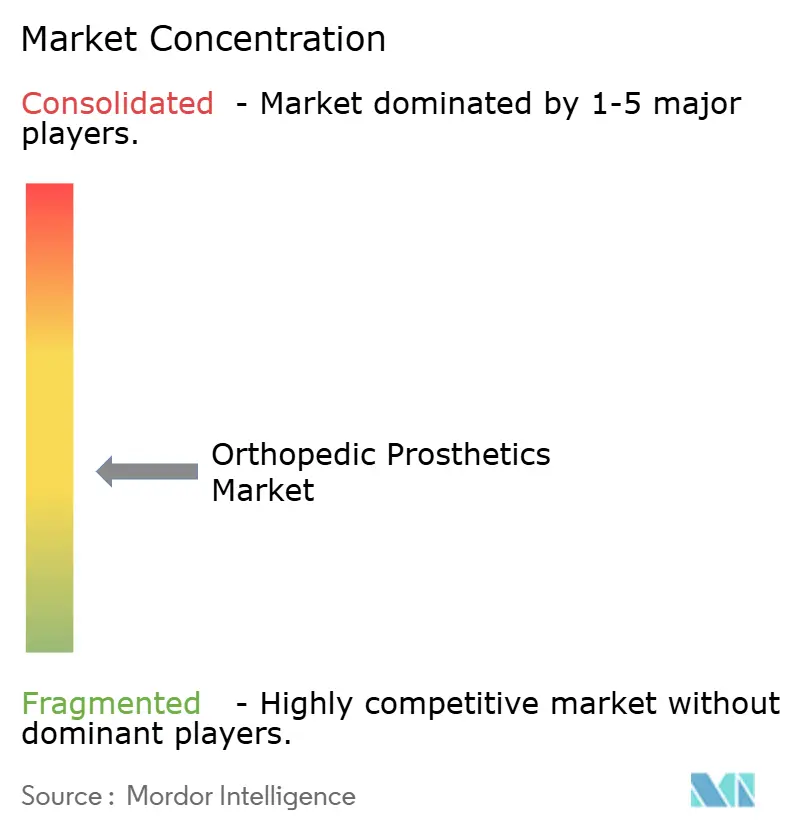
| Market Concentration | Medium |
Major Players *Disclaimer: Major Players sorted in no particular order Image © Mordor Intelligence. Reuse requires attribution under CC BY 4.0. | |
Orthopedic Prosthetics Market Analysis by Mordor Intelligence
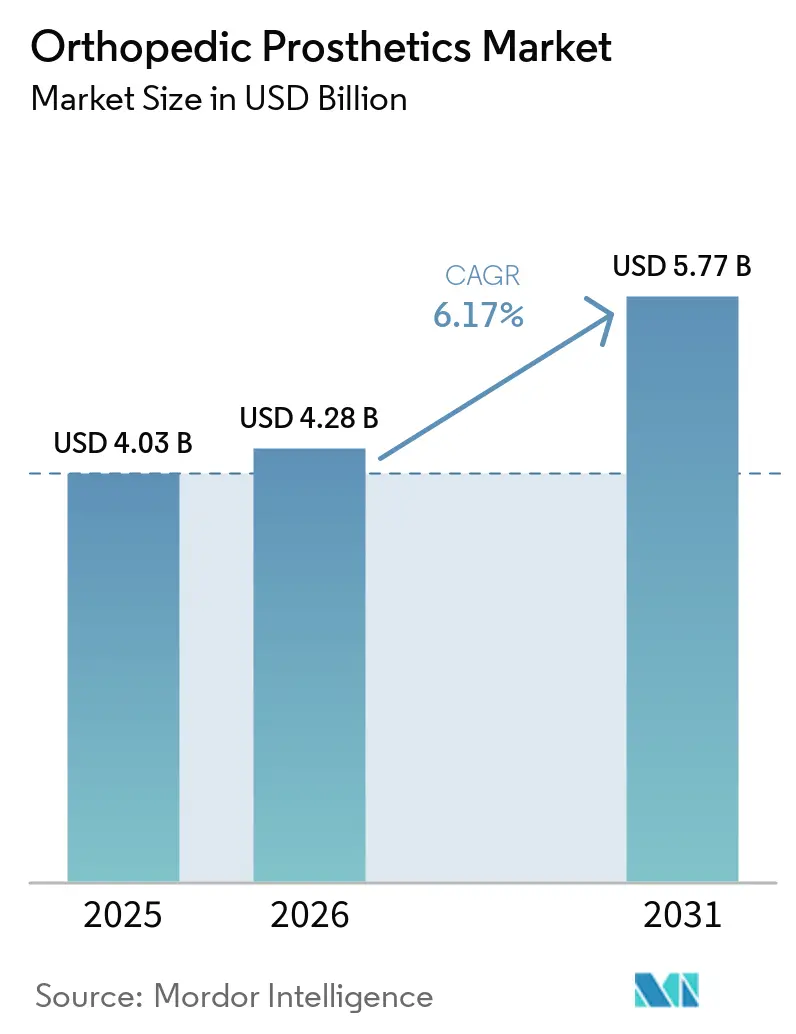
Orthopedic Prosthetics market size in 2026 is estimated at USD 4.28 billion, growing from 2025 value of USD 4.03 billion with 2031 projections showing USD 5.77 billion, growing at 6.17% CAGR over 2026-2031.
Continuous growth is supported by rising diabetes-linked amputations, breakthrough neural-interface limbs, and widening access to lower-cost 3-D printing capabilities that shorten production cycles and improve customization. Demographic aging, coupled with osteoarthritis prevalence, enlarges the addressable user base, while defense-veteran rehabilitation programs in Asia-Pacific accelerate technology diffusion across emerging economies. Competitive differentiation now pivots on real-time sensory feedback, carbon-fiber alternatives, and cybersecurity readiness for connected devices, creating a dynamic landscape in which incumbents and start-ups pursue vertical integration and niche specialization. Tight reimbursement environments and titanium supply shortages temper near-term margins but also motivate manufacturers to streamline supply chains and localize additive manufacturing hubs.
Key Report Takeaways
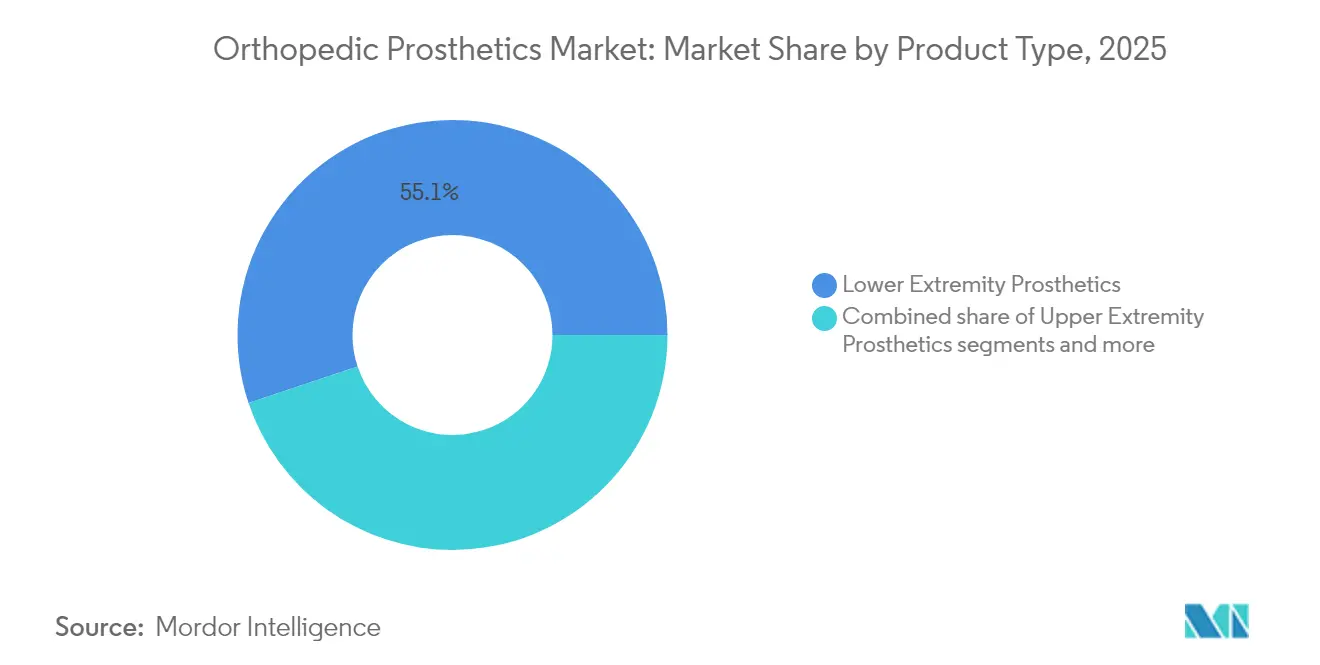
- By product category, lower-extremity prosthetics held 55.12% of the orthopedic prosthetics market share in 2025; liners are projected to post the fastest 9.52% CAGR through 2031.
- By technology, conventional systems led with 45.10% revenue share in 2025, while robotic and microprocessor-controlled devices are forecast to expand at a 9.91% CAGR to 2031.
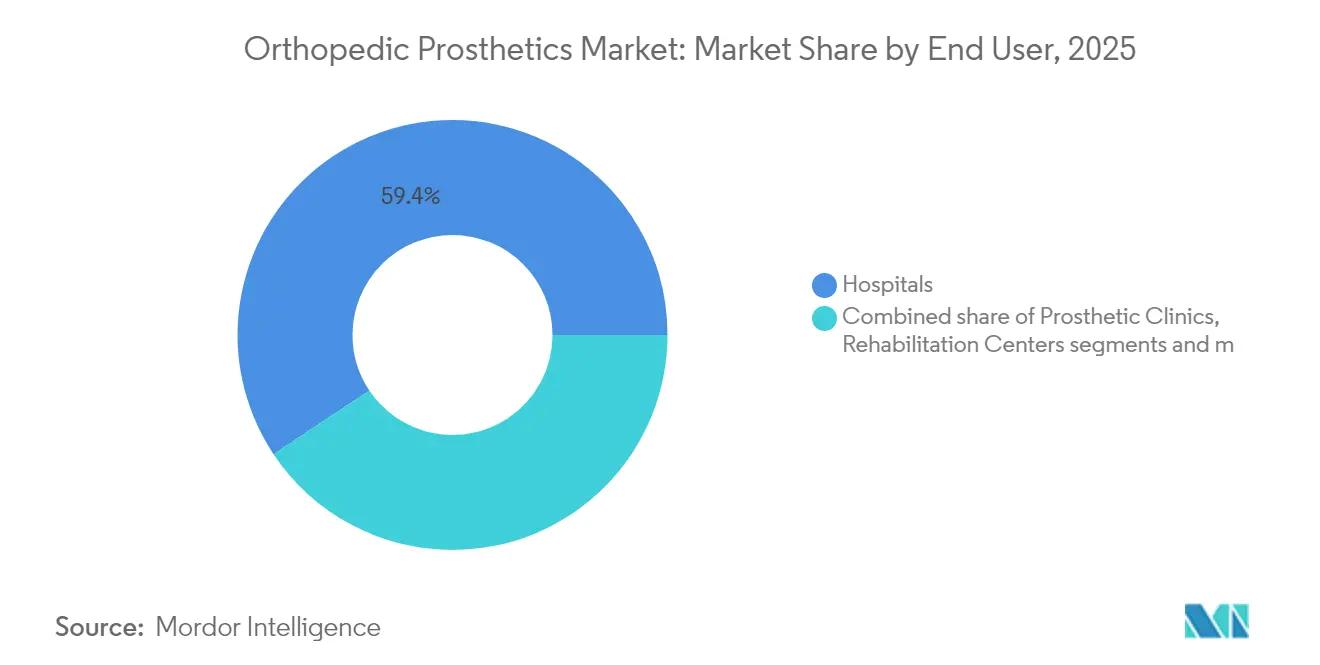
- By end user, hospitals commanded 59.35% of the orthopedic prosthetics market size in 2025, whereas home-care settings will grow the fastest at a 10.32% CAGR between 2026 and 2031.
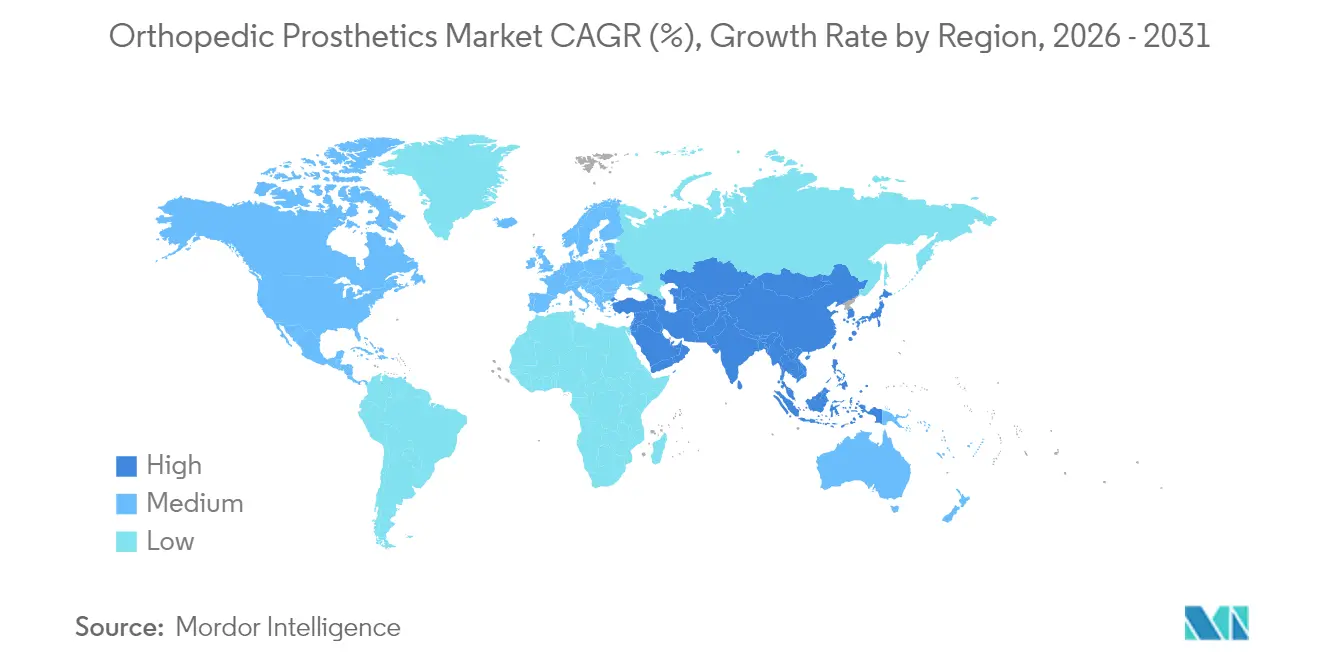
- By geography, North America accounted for 41.88% regional share in 2025; Asia-Pacific is set to record a 10.71% CAGR through 2031.
Note: Market size and forecast figures in this report are generated using Mordor Intelligence’s proprietary estimation framework, updated with the latest available data and insights as of 2026.
Market Trends and Insights
Drivers Impact Analysis of Orthopedic Prosthetics Market*
| Driver | (~) % Impact on CAGR Forecast | Geographic Relevance | Impact Timeline |
|---|---|---|---|
| Rising diabetes-linked amputations | +2.1% | Global, with highest impact in North America and Asia-Pacific | Medium term (2-4 years) |
| Ageing population & osteoarthritis prevalence | +1.8% | Global, particularly developed markets | Long term (≥ 4 years) |
| Advancements in microprocessor & myoelectric limbs | +1.5% | North America, Europe, Asia-Pacific core markets | Medium term (2-4 years) |
| Expansion of 3-D printing service hubs in emerging markets | +1.2% | Asia-Pacific, Latin America, Middle East and Africa | Short term (≤ 2 years) |
| Defence-veteran rehab funding surge in Asia-Pacific | +0.9% | Asia-Pacific, with spillover to other regions | Short term (≤ 2 years) |
| E-commerce aftermarket component sales growth | +0.7% | Global, with early adoption in North America and Europe | Short term (≤ 2 years) |
| Source: Mordor Intelligence | |||
Rising Diabetes-Linked Amputations Drive Market Expansion
More than 1 million diabetes-related lower-limb amputations occur yearly, sharply lifting demand for sophisticated socket designs that reduce shear forces and improve infection control for fragile skin surfaces. Specialized foot-care pathways in the United States, China, and India now funnel patients toward earlier prosthetic intervention, bringing forward replacement cycles and expanding recurring component sales. Manufacturers responding to this volume uptick are investing in lighter carbon-composite pylons that accommodate neuropathic gait patterns and reduce energy expenditure. The phenomenon is particularly acute in urban Asia-Pacific where rapid lifestyle changes drive higher diabetes prevalence, aligning regional market expansion with public-health priorities and donor-funded limb-loss initiatives.
Ageing Population Amplifies Osteoarthritis-Related Demand
Median ages are climbing above 40 years in Northern Europe, Japan, and Australia, widening the pool of seniors requiring joint replacements and, in revision scenarios, partial limb prostheses. Baby-boomer cohorts differ from earlier generations by insisting on high-activity prosthetic knees that support golfing, hiking, and light-jogging. Consequently, design priorities have shifted toward adaptive damping microprocessor units that modulate swing phase in real time. Payers increasingly reimburse for such higher-end devices when linked to fall-reduction evidence, reinforcing the upgrade cycle for elderly athletes. Hospitals have introduced geriatric-orthopedics programs integrating bone-density screening with prosthetic selection, further supporting sustained device turnover.
Microprocessor and Myoelectric Technology Breakthrough
The MIT agonist–antagonist myoneural interface (AMI) surgery enables 41% faster ambulation, signaling a paradigm shift where brain-computer interfaces deliver proprioceptive feedback unmatched by legacy mechanical limbs. Start-ups are embedding AI classifiers that predict stride intent milliseconds ahead, smoothing transitions on uneven ground. Pilot reimbursement codes for powered knees, such as HCPCS L5827, establish clearer payment pathways and encourage supplier adoption. As algorithmic tuning occurs over the cloud, cybersecurity resilience becomes mandatory; the FDA’s 2025 guidance now treats threat-modelling documentation as a gating item for pre-market approval.
3-D Printing Democratizes Access in Emerging Markets
Low-cost additive manufacturing reduces socket production times from weeks to hours, enabling rural clinics to stock digital design libraries instead of physical inventories. Community fabrication labs in Vietnam and Indonesia utilize low-cost prosthetic fabrication workflows that achieve comfort outcomes comparable to those of overseas imports. Latin American municipalities now procure pediatric hands for USD 50 to USD 500, replacing legacy donations that once exceeded USD 50,000. Multinational vendors are partnering with local bureaus to validate polymer strength and create last-mile distribution networks, thereby embedding themselves inside nascent value chains long before income thresholds justify premium imports.
Restraints Impact Analysis of Orthopedic Prosthetics Market*
| Restraint | (~) % Impact on CAGR Forecast | Geographic Relevance | Impact Timeline |
|---|---|---|---|
| High device cost & inconsistent reimbursement | -1.4% | Global, with highest impact in emerging markets | Medium term (2-4 years) |
| Shortage of certified prosthetists in developing nations | -0.8% | Asia-Pacific, Latin America, Middle East and Africa | Long term (≥ 4 years) |
| Titanium & carbon-fibre supply bottlenecks | -0.6% | Global, with particular impact on North America and Europe | Short term (≤ 2 years) |
| Cyber-security scrutiny of smart prosthetics | -0.4% | North America, Europe, Asia-Pacific core markets | Medium term (2-4 years) |
| Source: Mordor Intelligence | |||
Reimbursement Inconsistencies Constrain Market Access
Medicare beneficiaries in the United States still pay USD 3,580 out-of-pocket per limb despite insurance, a barrier prompting device abandonment that reduces replacement cycles and aftermarket sales. France’s 25% reimbursement cut in 2025 led to supplier exits and sporadic implant shortages, underscoring how policy swings reshape supply availability. Start-ups counteract margin pressure by leasing rather than selling microprocessor knees, bundling software updates and maintenance into subscription plans aligned with payer budget cycles.
Workforce Shortages Limit Service Delivery Capacity
Australia records only 1.62 prosthetists per 100,000 inhabitants, a ratio even lower across Southeast Asia and sub-Saharan Africa, thereby capping procedural throughput regardless of device stock. Tele-fitting platforms using 3-D limb scanners mitigate rural gaps, yet regulatory frameworks for remote alignment remain immature. Government scholarships and fast-track certification modules are being piloted in Indonesia and Kenya, but impact will materialize over the long term. Vendors are therefore embedding clinician-guided video tutorials and AI-driven pressure-map analytics into their service offerings to de-skill certain adjustment tasks for community health workers.
*Our forecasts treat driver/restraint impacts as directional, not additive. The impact forecasts reflect baseline growth, mix effects, and variable interactions.
Orthopedic Prosthetics Market Segment Analysis
By Product Type:
Lower-Extremity Dominance Faces Liner InnovationLower-extremity solutions represented 55.12% of the orthopedic prosthetics market size in 2025, anchored by high-incidence transtibial and transfemoral procedures. Demand concentration creates scale economies that manufacturers leverage to fund R&D for next-generation rotary adapters that tolerate higher torsional loads during sports. Liners, while a smaller revenue pool, deliver 9.52% CAGR through 2031 by addressing skin-sweat management and residual-limb volume fluctuation, two factors strongly correlated with device abandonment. New thermoplastic elastomer gels infused with antimicrobial nanoparticles extend liner replacement intervals, generating recurring sales with minimal clinical oversight. Specialty-sports prosthetics, though niche, attract premium pricing and act as branding showcases that inspire mainstream upper-limb upgrades. The orthopedic prosthetics market share for sockets climbs gradually as custom 3-D printed lattices displace hand-laminated fiberglass shells, reducing weight by 30% and improving airflow for marathon runners.

By Technology:
Conventional Systems Yield to Robotic InnovationConventional passive limbs kept 45.10% revenue share in 2025 because of affordability and long-proven reliability in low-mobility users. Nonetheless, robotic and microprocessor-controlled platforms are accelerating at a 9.91% CAGR, expanding the orthopedic prosthetics market size for high-performance devices. Algorithmic knees such as BionicM’s unit, retailing near USD 51,000, integrate cloud-updateable firmware, allowing functionality enhancements without hardware swaps. Hybrid constructs merge myoelectric wrists with passive elbow locks to tailor value-to-cost ratios by activity class, supporting broader adoption of robotic prosthetics. Meanwhile, additive manufacturing slashes bill-of-materials by up to 40% for entry-level feet, enabling regional distributors to price aggressively while protecting margins through local resin sourcing.
Sensor miniaturization and low-power Bluetooth mesh further embed limbs inside hospital IoT ecosystems, enabling remote gait analytics yet also raising vulnerability to cyber intrusions addressed in the latest FDA guidance.
By End User:
Hospital Dominance Shifts Toward Home CareHospitals and pharma-biotech research units held 59.35% of end-user revenues in 2025, reflecting concentration of surgical expertise and grant-funded clinical trials. However, home-care settings will capture disproportionate incremental growth at a 10.32% CAGR as tele-rehab software unlocks remote physiotherapy sessions and cloud-based gait tuning. Prosthetic clinics remain pivotal for custom fittings, yet their service mix adds subscription sensor-calibration packages that push recurring revenue.
Rehabilitation centers differentiate via VR-enabled balance-training modules that shorten inpatient stays. Ambulatory surgical centers expand revision capacity in urban belts, helping decongest tertiary hospitals. Military and veteran agencies continue to pour R&D funds—USD 150 million approved for FY 2025—directly shaping component specifications for harsh-terrain operability and waterproofing.
Geography Analysis
North America Orthopedic Prosthetics Market
North America retained 41.88% regional revenue share in 2025, powered by insurance coverage that reimburses high-end microprocessor knees and arms, as well as dense networks of certified practitioners. The United States drives regional innovation, hosting landmark AMI and OMP research that secures technology-leadership halo effects across the orthopedic prosthetics market. Canada leverages cross-provincial tele-orthotics platforms to extend access to northern communities, whereas Mexico integrates maquiladora clusters to co-manufacture lightweight pylons for export.
APAC Orthopedic Prosthetics Market
Asia-Pacific, forecast to rise at a 10.71% CAGR, combines outsized diabetes prevalence with ambitious universal-health coverage rollouts. China’s local innovators accelerate low-cost 3-D printed sockets that undercut imports by 35%. India’s public procurement of modular feet for district-level trauma centers further lifts volume. Japan and South Korea push the frontier in sensory feedback, driving regional demand for advanced firmware upgrades. Australia, despite practitioner scarcity, maintains high adoption of AI-guided alignment tools that compensate for workforce gaps. Regional humanitarian projects, such as remote prosthetic aid in conflict zones, illustrate cross-border dissemination of design files over satellite networks. Europe presents a mature, regulation-intensive environment where price caps squeeze margins yet clinical practice standards remain rigorous. Germany pioneers carbon-fiber recycling initiatives to mitigate material scarcity, while the United Kingdom fast-tracks digital orthopedics pilots under the NHS Long-Term Plan. France’s reimbursement cuts create localized shortages, prompting parallel-import channels and sparking debate on sustainable pricing. South America, Middle East, and Africa collectively account for modest share today yet post high single-digit growth as 3-D printing hubs emerge in Brazil and the UAE, gradually reducing lead times for culturally attuned cosmetic covers and shock-absorbing feet.
Regulatory Landscape
Regulation for orthopedic prosthetics spans device classification, conformity assessment, and performance and materials standards. In the United States, external assembled lower-limb prostheses fall under 21 CFR 890.3500 (Class II), and connected or higher-risk systems can bring tighter expectations around software documentation and post-market controls. In March 2026, the FDA recorded a PMA supplement approval (P190009/S010) for Integrum ABs OPRA Implant System, with labeling changes tied to its Post-Approval Study.
Standards updates also affect design verification and supplier qualification globally. ISO 22675:2024 (published December 2024) updated cyclic and static testing for prosthetic ankle-foot devices. ISO/DIS 22523.2 completed its enquiry/voting phase on April 24, 2026, advancing requirements and test methods for external limb prostheses and orthoses, which raises the bar for mechanical integrity evidence and can increase documentation load under the EU Medical Device Regulation (MDR 2017/745) conformity assessment pathway.
Value Chain Analysis
The value chain starts with inputs such as carbon fiber, silicone and elastomers, and metals. It then moves through component manufacturing (machining, injection molding, and electronics and sensors for microprocessor units) and into assembly into feet, knees, sockets, liners, and modular components. Final value creation tends to concentrate downstream in patient-specific fitting, alignment, and rehabilitation delivered through hospitals, prosthetic clinics, and rehabilitation centers, where certified prosthetists translate clinical gait goals into device configuration, software tuning, and ongoing maintenance.
Commercial flow to clinics uses a mix of direct-to-clinic sales, wholesale distribution via regional warehouses, and consignment models for higher-value configurations that need availability across multiple sizes for timely fitting. The chain is splitting between mass-produced value-tier components, supported by global sourcing and bulk shipping, and premium or customized devices where additive manufacturing supports regionalized fabrication and shorter lead times. Ottobocks June 2026 launch of iconiq, a 3D-printed silicone liner, is one example of customization moving closer to the point of care, while increasing emphasis on digital design control, materials validation, and clinician training.
Competitive Landscape
The orthopedic prosthetics market remains moderately fragmented, with regional specialists addressing local preferences. Össur posted 9% organic prosthetics growth in Q4 2023, boosted by its acquisition of neuro-orthotics firm FIOR & GENTZ, which expands vertical integration into peripheral-nerve stimulation accessories[1]. Ottobock deepened its robotics pipeline by acquiring minority stakes in exoskeleton start-ups, aligning its limb and support-wear portfolios for bundled tenders. Zimmer Biomet secured FDA approval for its cementless partial knee, validating porous-titanium additive processes that may later migrate to transfemoral stems[2]. Stryker opened an expanded Global Technology Centre in India to co-design cost-down microprocessor ankles aimed at ASEAN insurance formularies. Cybersecurity has emerged as the new battleground: vendors partner with SaaS providers to embed zero-trust architectures before regulators formalize software-bill-of-materials mandates.
Smaller entrants exploit white spaces: Japanese firm BionicM commercializes robotic knees at premium price points for active amputees, while a US-based company, Unlimited Tomorrow, crowd-funds low-cost 3-D printed arms personalized via smartphone scans. Component suppliers diversify alloys away from titanium toward high-manganese steels to mitigate geopolitical supply shocks. Across all tiers, strategic acquisitions remain the vehicle of choice for portfolio extension, illustrated by Stryker’s buyout of Artelon to gain exposure to soft-tissue augments that stabilize prosthetic limb integration.
Orthopedic Prosthetics Industry Leaders
-
Blatchford Ltd
-
Fillauer LLC
-
Willow Wood Global LLC
-
Ossur
-
Mobius Bionics
- *Disclaimer: Major Players sorted in no particular order
Orthopedic Prosthetics Market Companies Covered in this Report
- Ossur
- Ottobock
- Zimmer Biomet
- Stryker
- Smiths Group
- DePuy Synthes (J&J)
- Medtronic
- Enovis (DJO)
- Blatchford
- Willow Wood
- Freedom Innovations
- Touch Bionics
- Steeper Group
- College Park Industries
- Ultraflex Systems
- Fillauer
- SHL Medical
- ReWalk Robotics
- Proteor
- Ability Dynamics
- Mobius Bionics, LLC
Market Opportunities and Future Outlook
One near-term opportunity is the shift from mechanically separate devices toward anatomically integrated, neurally informed systems, where clinical evidence and R&D activity are converging on osseointegration, neural control, and sensory feedback. Peer-reviewed 2026 work (Journal of NeuroEngineering and Rehabilitation) comparing a bone-anchored, neurally controlled knee prosthesis against conventional microprocessor-controlled knees highlights differentiation tied to volitional control and embodiment, creating space for manufacturers and care networks to bundle therapy and device offerings. This framing links hardware selection, software tuning, and rehab protocols into a more integrated service line.
Access and affordability gaps are another area for investment, especially where clinician shortages and fragmented service models restrict throughput and device continuity. 3D printing and new materials support lower-cost customization and faster replacement cycles, and 2025 3D printing research on prosthetic hands discusses TPU-based soft-joint approaches. At the same time, 2026 position work in the Journal of Prosthetics and Orthotics points to fragmentation and regulatory barriers as constraints in resource-constrained settings, supporting scalable approaches such as digital scan-to-fit workflows, standardized liner and socket platforms, and clinic enablement partnerships that reduce fitting variability without requiring premium hardware at every step.
Recent Industry Developments in Orthopedic Prosthetics Market
- June 2026: CVC Catalyst III agreed to acquire a majority stake in WillowWood Holdings Inc. from Blue Sea Capital, the Arbogast family, and management, with closing communicated for Q3 2026. The transaction supports continued platform investment in sockets, liners, and component systems and adds financial capacity for manufacturing and R&D scale across the United States.
- May 2026: Blatchford sold its Norwegian patient care business, including Blatchford Ortopedi and Ortopro, to Ottobock as part of Ottobocks expansion of its patient care network. The deal tightens integration between care delivery and product portfolios and strengthens Ottobocks clinic footprint in Scandinavia, which can influence product pull-through and service standardization.
- February 2024: Hanger Inc. completed the acquisition of Fillauer. Combining a large care network with a prosthetics component manufacturer strengthens vertical integration and can accelerate distribution of upper- and lower-limb components through Hangers clinic channel.
Orthopedic Prosthetics Market Report Scope and Research Methodology
Market Definition and Coverage
This market covers revenue generated from orthopedic prosthetic devices and related components used to replace a missing limb and restore basic mobility and function, across clinical fitting and long term use. We size the market at the point where prosthetic systems and key consumables are sold into patient care channels.
Scope exclusions: Excludes orthotic braces and supports, wheelchair and general mobility aids, and purely surgical implants that do not form part of an external prosthetic limb system.
Segments Covered in This Report
- By Product Type
- Upper Extremity Prosthetics
- Lower Extremity Prosthetics
- Liners
- Sockets
- Modular Components
- Specialty & Sports Prosthetics
- By Technology
- Conventional
- Electric Powered / Myoelectric
- Hybrid
- 3-D Printed / Additively Manufactured
- Robotic / Microprocessor Controlled
- By End-User
- Hospitals
- Prosthetic Clinics
- Rehabilitation Centers
- Ambulatory Surgical Centers
- Home-care Settings
- By Geography
- North America
- United States
- Canada
- Mexico
- Europe
- Germany
- United Kingdom
- France
- Italy
- Spain
- Rest of Europe
- Asia-Pacific
- China
- India
- Japan
- South Korea
- Australia
- Rest of Asia-Pacific
- South America
- Brazil
- Argentina
- Rest of South America
- Middle East and Africa
- GCC
- South Africa
- Rest of Middle East and Africa
- North America
Data Sources, Market Sizing, and Validation
Desk Research
Desk research starts by building the demand pool and care pathway, then matching it to the device categories and replacement cycles observed in practice. We rely on public sources such as the World Health Organization, CDC, and National Health Service publications for epidemiology and amputation drivers, and sources such as the World Bank and OECD for health spending and demographic indicators.
To ground volumes and pricing, we also review sources such as the US FDA device databases and safety notices, UN Comtrade trade statistics for relevant device flows, and peer reviewed journals that report prosthetic utilization and outcomes. Company annual reports, investor presentations, and trusted medical association websites help validate channel structure and typical product mix. We also use a paid subscription for company financials and news to cross check revenue ranges and corporate actions. These examples are not exhaustive, and other public and paid sources were also used to collect data, validate assumptions, and clarify gaps.
Primary Interviews and Surveys
Primary work is used to pressure test the demand build, confirm realistic replacement intervals, and align pricing to what is actually billed through clinics and hospitals. We spoke with a mix of prosthetic clinics, rehabilitation stakeholders, distributors, and manufacturing side experts across APAC, EMEA, and the Americas, which helped us correct outlier assumptions and finalize the forecast story we present.
Distribution of primary research fieldwork respondents
| Company type | Respondent position | Region |
|---|---|---|
| Top tier: 33% | CXOs: 15% | APAC: 38% |
| Mid tier: 50% | Functional/Unit leaders: 40% | EMEA: 36% |
| Smaller Players: 17% | Managers: 45% | Americas: 26% |
Market-Sizing & Forecasting
Sizing is built using a top-down demand pool reconstruction that starts from country level amputee prevalence and annual incidence, then applies an addressable treatment rate to reflect access to prosthetic care. From there, the model is translated into annual unit demand by combining fitting rates with average replacement cycles for sockets, liners, and complete systems, followed by an average selling price stack that reflects product mix and reimbursement reality.
To keep the numbers practical, we use a few market fingerprints as core inputs, such as lower limb versus upper limb mix, share of conventional versus electric powered systems, component replacement timing, average clinic throughput, and regional reimbursement coverage direction. Forecasting is run through scenario analysis supported by expert views on how quickly advanced technologies and 3D printed components penetrate, and it is then sanity checked against trend smoothing on historical adoption signals.
Results are corroborated with selective bottom-up approximations, like sampled ASP times volume checks in key countries and revenue consistency checks using public financial disclosures. Where country level data is thin, proxy ratios from similar health systems are used, then adjusted after interviews to avoid over extending a single reference market.
Data Validation & Update Cycle
Validation is done through triangulation across the demand build, pricing stack, and independent signals such as procedure trends, trade movement where relevant, and care access indicators. If large variances appear, the drivers are isolated, assumptions are rechecked, and experts are recontacted when a single input is responsible for a material swing.
Before sign off, the model and narrative go through multiple analyst reviews so unit logic, currency handling, and regional rollups stay consistent. Reports are refreshed annually, and interim updates are made when material events occur, such as reimbursement changes, major product launches, or regulatory actions, then a final freshness pass is completed just before delivery.
Mordor Intelligence's Orthopedic Prosthetics Market Estimate Compared With Other Published Estimates
Published market sizes for orthopedic prosthetics can look far apart because sources often do not line up on what is being counted, or which year is used as the reference point. Differences usually come from category inclusion, how pricing is averaged across basic and advanced devices, and whether the estimate is anchored to patient demand signals or supplier side revenue patterns.
Orthotics and bracing are common add-ons in some published totals, but they sit outside Mordor Intelligence's scope for this orthopedic prosthetics market, which keeps the value tied to external limb prosthetic systems and their key components. The spread also gets wider when one estimate uses an aggressive technology mix shift for electric powered devices, or when currency conversion timing is not aligned to the same calendar year average.
Benchmark comparison
| Source | Market Size | Gaps in Research Methodology |
|---|---|---|
| Mordor Intelligence | USD 4.28 B (2026) | |
| Industry Publisher A | USD 2.51 B (2024) | Uses an earlier base year and may apply narrower channel capture, which can miss replacement driven component revenue and understate markets with stronger clinic penetration. |
| Market Tracker B | USD 1.60 B (2024) | Often reported as a smaller revenue pool with limited clarity on whether liners, sockets, and modular components are fully included, and the shorter horizon can also mute technology mix effects. |
Overall, the differences in the table are mostly explained by what is included, the year chosen for sizing, and how replacement cycles and product mix are translated into revenue. By keeping assumptions traceable to patient volumes, replacement timing, and realistic pricing bands, we can offer a market view that is easier to reconcile and update when inputs change.
Key Questions Answered in the Report
What is the value of the orthopedic prosthetics market in 2026 and how fast is it expanding?
The orthopedic prosthetics market is projected to reach approximately USD 4.28 billion by 2026, and is projected to expand at a CAGR of 6.17% by 2031.
Which region grows the fastest for orthopedic prosthetics market?
Asia-Pacific, with a projected CAGR of 10.71%, grapples with a high diabetes prevalence while ambitiously pursuing universal health coverage.
What is the value in share of the orthopedic prosthetics market in north america in 2026?
The North American share of the orthopedic prosthetics market is expected to be approximately 41.88% of the global market.
What key restraint may slow market expansion?
Reimbursement inconsistencies constrain market access in the orthopedic prosthetics market