Ortho-Pediatric Devices Market Size and Share
Market Overview
| Study Period | 2020 - 2031 |
|---|---|
| Market Size (2026) | USD 5.2 Billion |
| Market Size (2031) | USD 7.21 Billion |
| Growth Rate (2026 - 2031) | 6.74 % CAGR |
| Fastest Growing Market | Asia-Pacific |
| Largest Market | North America |
| Market Concentration | Medium |
Major Players *Disclaimer: Major Players sorted in no particular order. Image © Mordor Intelligence. Reuse requires attribution under CC BY 4.0. |

Ortho-Pediatric Devices Market Analysis by Mordor Intelligence
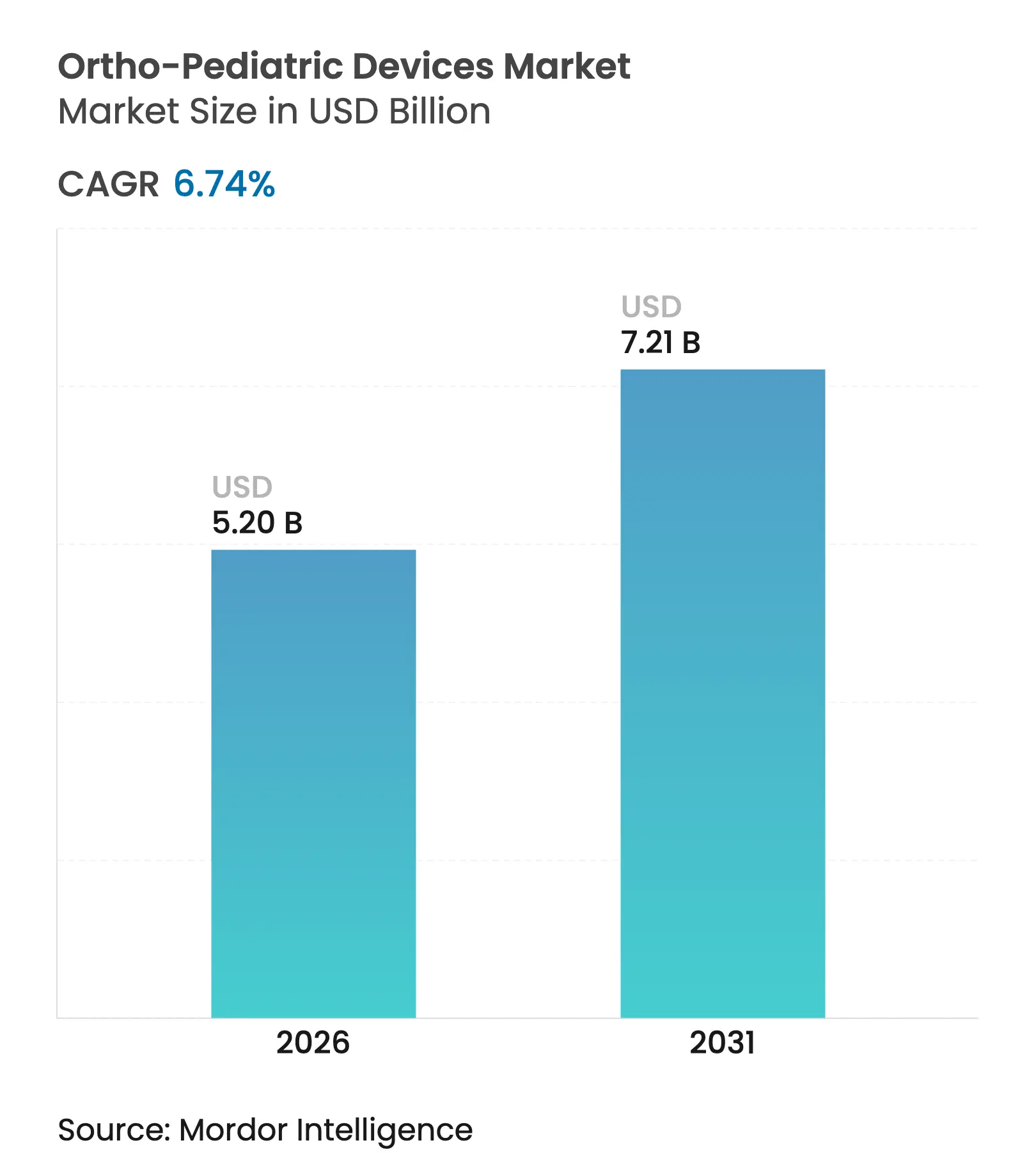
The ortho-pediatric devices market size is expected to grow from USD 4.87 billion in 2025 to USD 5.2 billion in 2026 and is forecast to reach USD 7.21 billion by 2031 at 6.74% CAGR over 2026-2031. Demand gains stem from a rising caseload of childhood fractures and congenital deformities, wider availability of age-adjustable implants, and rapid capacity‐building in emerging surgical hubs. Custom design requirements for growing skeletons yield higher entry barriers than adult orthopedics, helping manufacturers sustain pricing power. Momentum also comes from an 11.23% CAGR shift toward minimally invasive techniques, improving recovery times and lowering revision risks. In parallel, expanding 3D-printing capabilities and supportive reimbursement schemes in mature economies catalyze innovation cycles and bolster global device adoption.
Key Report Takeaways
- By product type, Trauma & Deformity Systems led with 35.68% revenue share in 2025, while Sports-Medicine Implants are forecast to grow at a 9.45% CAGR to 2031.
- By application, Trauma retained 39.05% of the ortho-pediatric devices market share in 2025; Sports Injuries show the fastest expansion at 10.12% CAGR through 2031.
- By material, Titanium accounted for 43.90% of the ortho-pediatric devices market size in 2025; Bio-absorbable Polymers are projected to advance at 10.68% CAGR between 2026-2031.
- By surgical approach, Open Surgery dominated with 60.47% revenue share in 2025, whereas Minimally Invasive Surgery is growing at 10.77% CAGR through 2031.
- By end user, Hospitals commanded 50.60% share in 2025, while Ambulatory Surgical Centres are poised for a 8.72% CAGR to 2031.
- By geography, North America held 43.85% market share in 2025; Asia Pacific is projected to climb at a 9.21% CAGR through 2031.
Note: Market size and forecast figures in this report are generated using Mordor Intelligence's proprietary estimation framework, updated with the latest available data and insights as of 2026.
Global Ortho-Pediatric Devices Market Trends and Insights
Drivers Impact Analysis
| Driver | (~) % Impact on CAGR Forecast | Geographic Relevance | Impact Timeline |
|---|---|---|---|
Rising incidence of pediatric
musculoskeletal trauma & congenital deformities
|
+1.8%
|
Global ; higher in developing
regions
|
Medium term (2-4 years)
|
Technological advancements in pediatric-specific
implants & 3-D printing
| +1.5% | North America & EU lead ; APAC accelerating | Long term (≥ 4 years) |
Increasing youth sport-related
injuries
| +1.2% | North America, Europe, urban APAC | Short term (≤ 2 years) |
Favourable reimbursement in
developed economies
| +0.9% | North America, Western Europe, select APAC | Medium term (2-4 years) |
Age-adjustable implant systems
reducing revision surgeries
| +0.8% | Global ; premium markets first | Long term (≥ 4 years) |
Philanthropic ortho-surgical
outreach in low-income nations
| +0.6% | Sub-Saharan Africa, South Asia, Latin America | Long term (≥ 4 years) |
| Source: Mordor Intelligence | |||
Rising Incidence of Pediatric Musculoskeletal Trauma & Congenital Deformities
Pediatric trauma cases require more complex fixation than adult injuries, and patients under 16 record higher revision rates than older adolescents.[1] Clubfoot affects 7.2 per 1,000 children in Ethiopia, underscoring unmet demand in low-resource environments. Early intervention protocols have lifted device utilization, and 28% of rural Indian children still present late because of access barriers, further elevating implant volumes when surgery finally occurs.[2] These demographic pressures give the ortho-pediatric devices market consistent growth across economic cycles.
Technological Advancements in Pediatric-Specific Implants & 3-D Printing
Point-of-care 3D printing lets surgeons build patient-specific plates that cut operative time and enhance anatomical fit.[3] Material breakthroughs such as PLGA nails remove the need for secondary extraction surgery, lowering complication risks. Artificial-intelligence planning tools already achieve >90% accuracy for sizing pediatric implants.[4] Collectively, these advances tighten procedure workflows, improve outcomes, and strengthen device differentiation in the ortho-pediatric devices market.
Increasing Youth Sport-Related Injuries
Roughly 3 million U.S. children visit emergency rooms each year for sports injuries. Early specialization boosts overuse lesions, prompting demand for implants tailored to repetitive-stress conditions rather than acute trauma. Sports-related lower-extremity injuries in U.S. youth soccer have declined, reflecting better protective gear, yet device design now must address evolving injury patterns. Pediatric ACL reconstructions continue to rise despite high revision odds, driving innovation in smaller, growth-friendly fixation hardware.
Favourable Reimbursement in Developed Economies
Medicaid and CHIP insure 81.5 million Americans, nearly half of whom are children; this guarantees payment for complex orthopedic procedures. The FDA’s Total Product Life Cycle Advisory Program added orthopedics in 2025, shortening review times for pediatric systems. European payers mirror these models, though local rules vary. Stable reimbursement underpins device adoption, particularly for minimally invasive techniques that command premium tariffs, bolstering the ortho-pediatric devices market.
Restraints Impact Analysis
| Restraint | (~) % Impact on CAGR Forecast | Geographic Relevance | Impact Timeline |
|---|---|---|---|
Scarcity of specialised paediatric
orthopaedic surgeons
|
–1.4%
|
Global ; acute in rural &
developing regions
|
Medium term (2-4 years)
|
High device costs versus adult implants
| –1.1% | Price-sensitive & emerging markets | Short term (≤ 2 years) |
Stringent paediatric trial
requirements & small cohorts
| –0.8% | Global regulatory markets | Long term (≥ 4 years) |
Custom-implant supply-chain
fragility
| –0.5% | Global ; concentrated manufacturing hubs | Medium term (2-4 years) |
| Source: Mordor Intelligence | |||
Scarcity of Specialised Paediatric Orthopaedic Surgeons
Rural regions worldwide experience persistent workforce gaps; the U.S. alone reports uneven distribution despite overall surgeon numbers. Fellowship grads often cluster in urban centers, leaving vast catchment areas underserved. Administrative burdens tied to electronic medical records further depress productivity, constraining the ortho-pediatric devices market even where devices are stocked.
High Device Costs Versus Adult Implants
Smaller production runs, tight tolerances, and extra regulatory steps keep pediatric implants priced higher than adult equivalents. China’s volume-based procurement cut hip-arthroplasty prices by 50%, hinting at cost-containment models that could spill into pediatrics. Until then, budget pressures in emerging markets slow uptake of premium technologies, moderating ortho-pediatric devices market growth.
Segment Analysis
By Product Type: Trauma Systems Drive Innovation
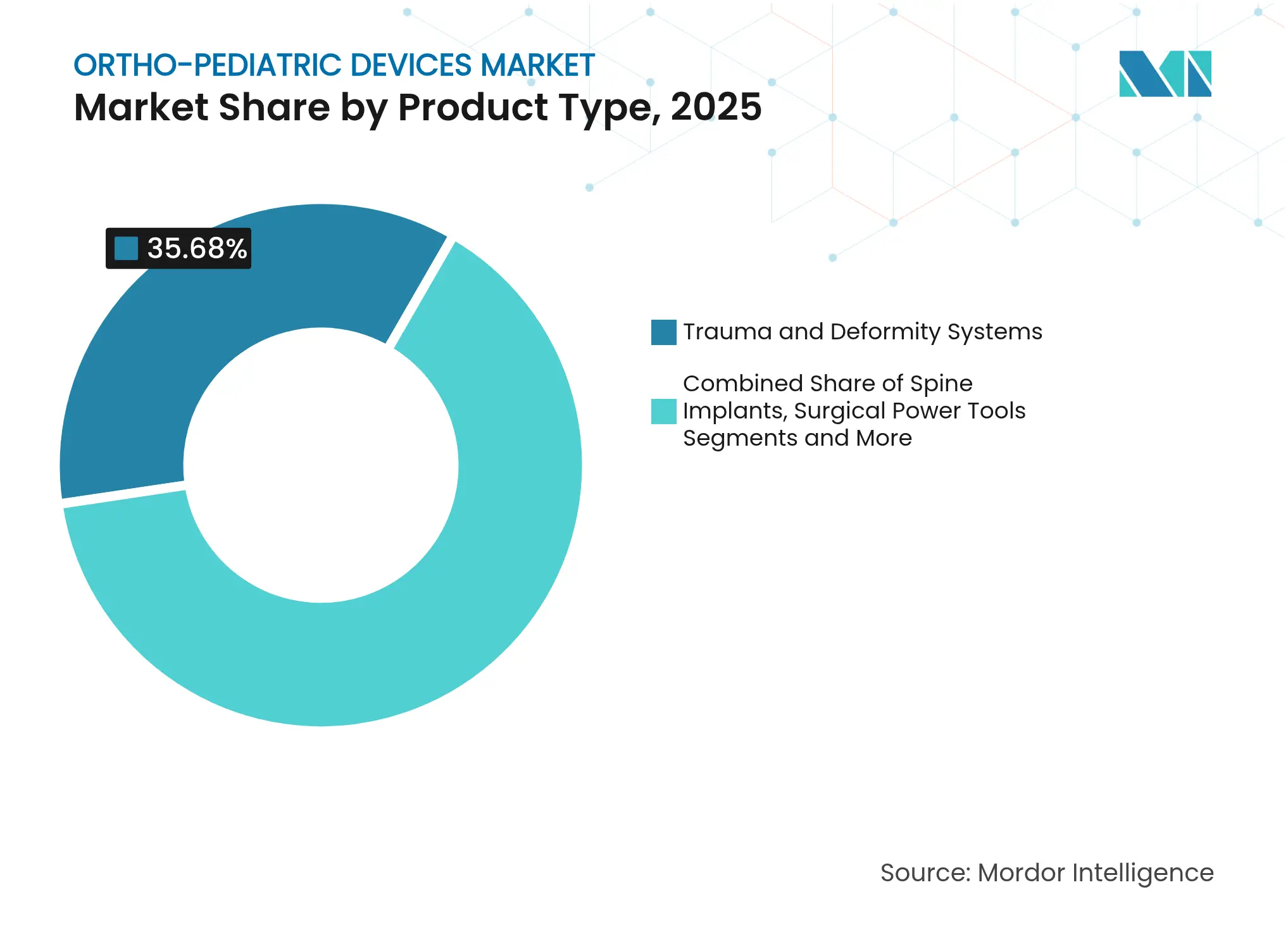
Trauma & Deformity Systems captured 35.68% of 2025 revenue, reflecting universal fracture and angular-correction needs across age groups. Elastic stable intramedullary nailing achieved 100% union in pediatric forearm fractures, reinforcing clinical trust. Sports-Medicine Implants, projected at 9.45% CAGR, ride the youth-sports wave and subspecialty surgeon focus. Spine Implants benefit from magnetically controlled lengthening technologies that enable non-invasive post-operative adjustments.
Cross-fertilization of design principles speeds innovation across categories. For instance, low-profile plates first proven in trauma are now adopted in deformity correction. Biologics & Bone Grafts gain ground as adjuncts that cut healing time, while bioexpandable prostheses address oncologic limb-sparing cases. Overall, technological convergence keeps the ortho-pediatric devices market dynamic and competitive.
Note: Segment shares of all individual segments available upon report purchase
By Application: Sports Injuries Reshape Market Dynamics
Trauma remains the backbone at 39.05% share, yet Sports Injuries lead growth at 10.12% CAGR as young athletes pursue year-round training. Late-presenting trauma cases, common in underserved regions, often entail multi-stage surgery, boosting implant volume. Deformity Correction thrives on improved guided-growth techniques such as eight-plate hemiepiphysiodesis, offering minimally invasive solutions.
Limb Lengthening, though niche, attracts attention through magnetically driven intramedullary nails that lower complication rates. The remaining “Others” segment addresses congenital anomalies and tumor reconstructions, demanding highly bespoke devices. Diversifying applications reinforce resilience in the ortho-pediatric devices market.
By Material: Bio-absorbable Polymers Challenge Titanium Dominance
Titanium kept 43.90% share in 2025 thanks to superior strength and osseointegration. Bio-absorbable Polymers surge at 10.68% CAGR because they obviate second surgeries for hardware removal, a critical advantage for children. Stainless Steel remains useful for temporary fixation, but composite materials like CFR-PEEK add imaging transparency that eases follow-up.
Research into tri-element-doped hydroxyapatite composites merges structural and therapeutic roles, pointing to next-gen constructs capable of both load bearing and antimicrobial delivery. Material breakthroughs therefore continue to expand functionality within the ortho-pediatric devices market.

Recognized by Experts. Trusted by Leaders.
A trusted intelligence partner to global decision-makers across 90+ countries.







By Surgical Approach: Minimally Invasive Techniques Gain Momentum
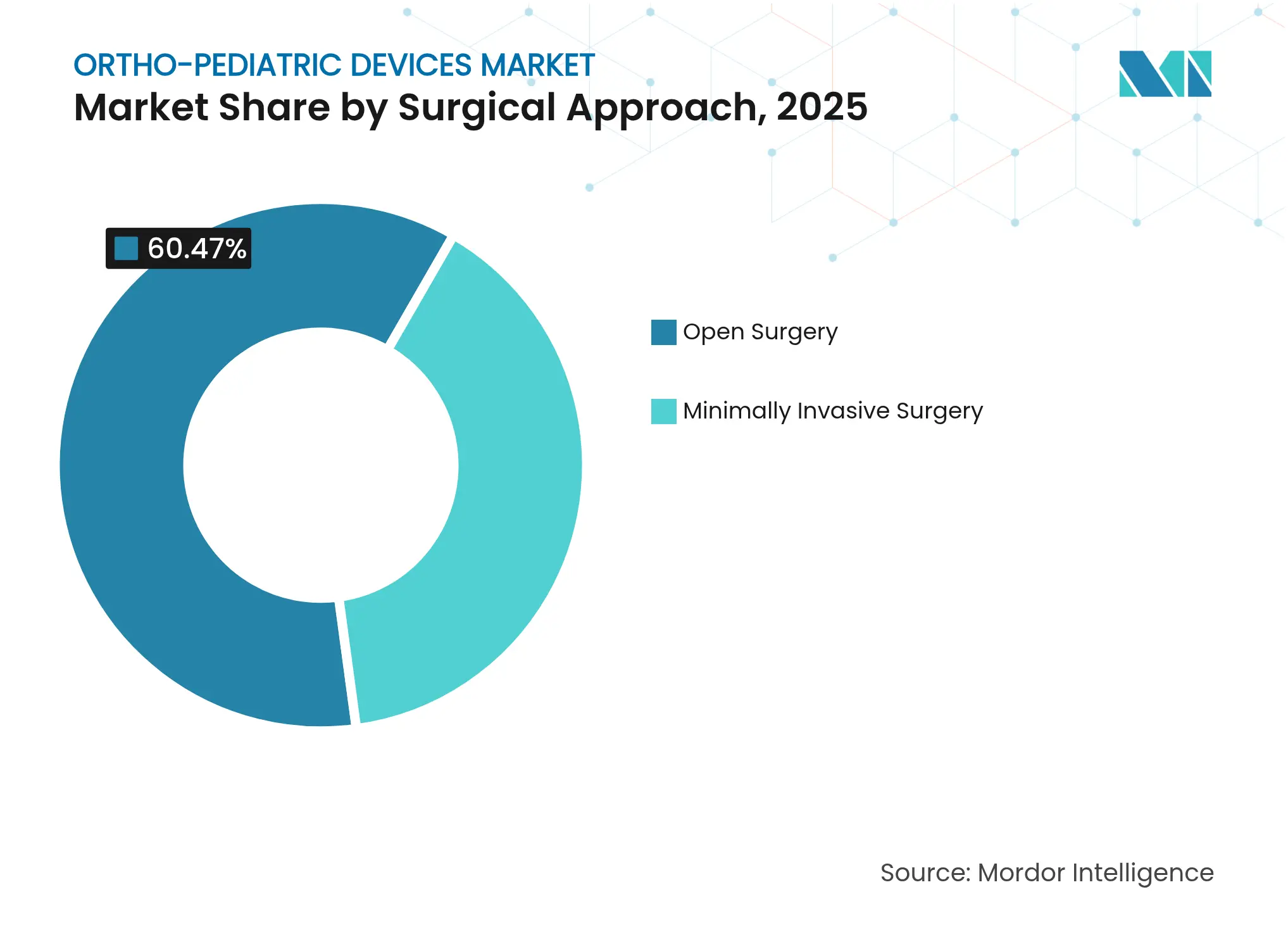
Open Surgery still represented 60.47% of procedures in 2025 because complex pediatric anatomy often demands direct access. Yet Minimally Invasive Surgery is rising at 10.77% CAGR, aided by 8 mm-incision hemiepiphysiodesis that matches correction rates of open 24 mm cuts. Robotics platforms such as VELYS elevate precision while lowering surgeon fatigue.
Enhanced recovery after surgery protocols, emphasizing reduced tissue trauma, reinforce institutional incentives to adopt minimally invasive approaches. Expanding surgeon training is expected to narrow the skill gap and amplify growth in the ortho-pediatric devices market.
Note: Segment shares of all individual segments available upon report purchase
By End User: Ambulatory Centers Transform Care Delivery
Hospitals held 50.60% share during 2025, reflecting their broader infrastructure and trauma readiness. Ambulatory Surgical Centres, advancing at 8.72% CAGR, leverage cost efficiency and same-day discharge protocols. Specialty Clinics manage routine follow-ups and minor interventions, while tele-orthopedics supports remote rehabilitation—an especially valuable service for families distant from tertiary centers.
The COVID-19 era normalized outpatient care where safe, and 3D-printed casts now facilitate quick, customised bracing outside the hospital. These shifts broaden access and bolster the ortho-pediatric devices market across care settings.
Geography Analysis
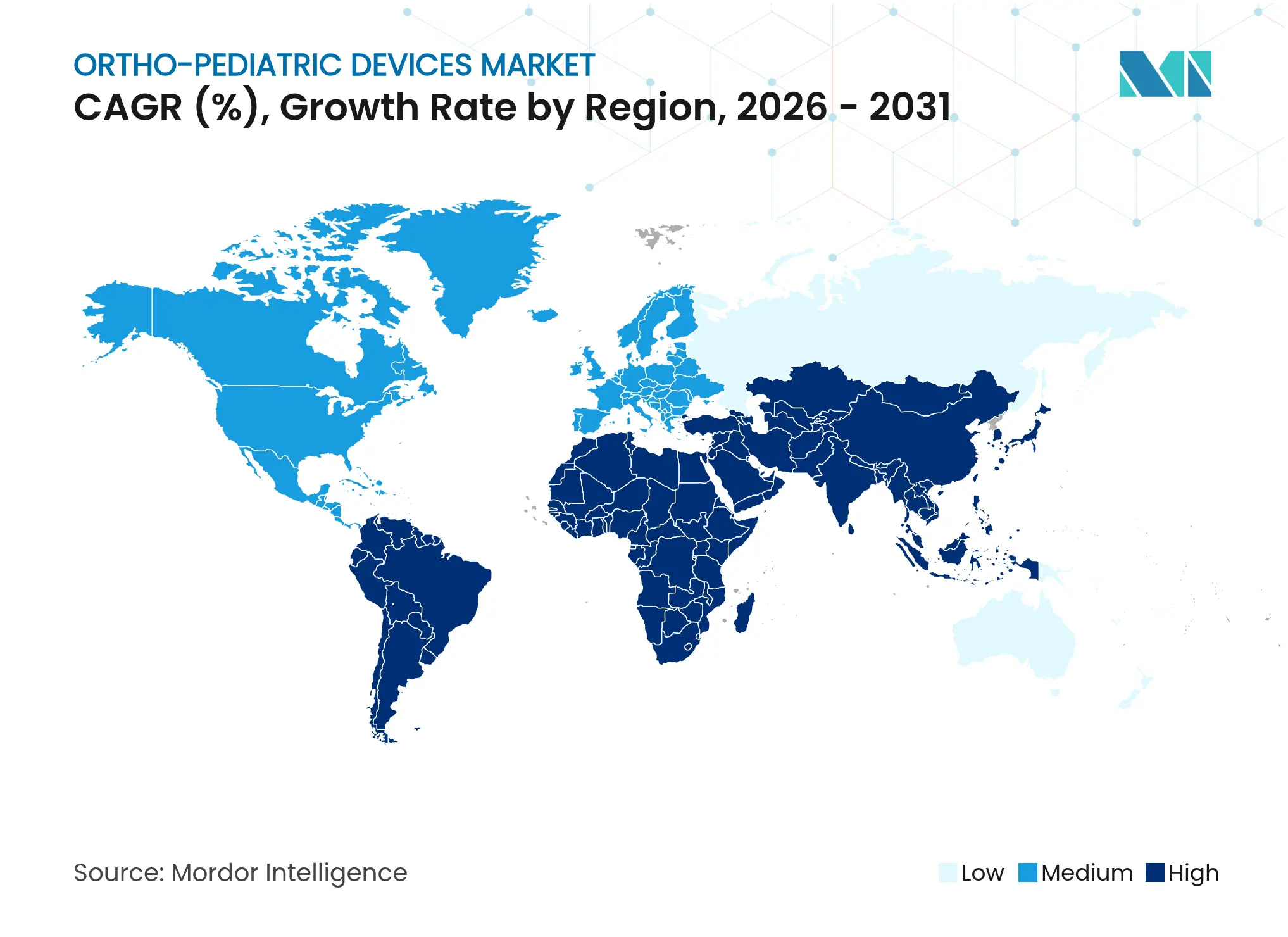
North America preserved 43.85% share in 2025, underpinned by robust reimbursement, a mature surgeon workforce, and FDA programs that accelerate device approvals. Medicaid and CHIP collectively guarantee coverage for a vast pediatric cohort, ensuring predictable demand. Nonetheless, rural shortages of specialists create localised gaps, signaling white-space opportunities for tele-consultation and outreach.
Asia Pacific is the growth pacesetter at a 9.21% CAGR through 2031. China’s procurement reforms cut implant prices by 50%, reshaping global price floors, while a burgeoning private-hospital sector expands premium procedure volumes. India benefits from medical tourism inflows and expanding metropolitan health networks, though infrastructural deficits persist in rural districts. Japan and South Korea exhibit low-single-digit growth on high bases, driven by rapid adoption of minimally invasive and robotic techniques. Europe sustains steady progress through coordinated research frameworks, with Germany and the U.K. spearheading clinical trials on bio-absorbable materials. Latin America shows promise as Brazil and Mexico upgrade pediatric trauma centers amid economic volatility. The Middle East and Africa remain early-stage markets where philanthropy and public-private partnerships seed initial uptake, positioning the ortho-pediatric devices market for gradual expansion as training pipelines mature.

Competitive Landscape
Market Concentration

The ortho-pediatric devices market is moderately fragmented. OrthoPediatrics, the only pure-play pediatric company, posted USD 204.7 million revenue in 2024, up 38% year-on-year. Its USD 22 million takeover of Boston Orthotics & Prosthetics broadened its reach into the USD 500 million bracing niche, signalling a platform strategy around full-spectrum pediatric care.
Industry majors pursue pediatric adjacencies via their adult portfolios. Johnson & Johnson integrates digital planning and robotic arms to capture complex deformity cases. Stryker’s bid for soft-tissue repair firm Artelon underscores interest in sports medicine, a high-growth subsegment. Zimmer Biomet sharpened its extremities offering with the Paragon 28 acquisition, chasing limb lengthening and deformity workups.
Supply-chain resilience emerges as a new battleground: OEMs now invest 3–5% of revenue to diversify raw material sources and digitize logistics in response to geopolitical risks. Collectively, these strategies elevate entry barriers and increase the strategic value of specialized pediatric know-how.
Ortho-Pediatric Devices Industry Leaders

*Disclaimer: Major Players sorted in no particular order
Recent Industry Developments
- April 2025: OrthoPediatrics launched the FDA-cleared VerteGlide Spinal Growth Guidance System for early-onset scoliosis treatment.
- March 2025: OrthoPediatrics partnered with the Crossroads Pediatric Device Consortium to accelerate commercialization of novel pediatric implants.
Table of Contents for Ortho-Pediatric Devices Industry Report
1. Introduction
- 1.1 Study Assumptions and Market Definition
- 1.2 Scope of the Study
2. Research Methodology
3. Executive Summary
4. Market Landscape
- 4.1 Market Overview
- 4.2 Market Drivers
- 4.2.1 Rising Incidence Of Pediatric Musculoskeletal Trauma & Congenital Deformities
- 4.2.2 Technological Advancements In Pediatric-Specific Implants & 3-D Printing
- 4.2.3 Increasing Youth Sport-Related Injuries
- 4.2.4 Favourable Reimbursement In Developed Economies
- 4.2.5 Age-Adjustable Implant Systems Reducing Revision Surgeries
- 4.2.6 Philanthropic Ortho-Surgical Outreach In Low-Income Nations
- 4.3 Market Restraints
- 4.3.1 Scarcity Of Specialised Paediatric Orthopaedic Surgeons
- 4.3.2 High Device Costs Vs. Adult Implants
- 4.3.3 Stringent Paediatric Trial Requirements & Small Cohorts
- 4.3.4 Custom-Implant Supply-Chain Fragility
- 4.4 Value / Supply-Chain Analysis
- 4.5 Regulatory Landscape
- 4.6 Technology Outlook
- 4.7 Porter’s Five Forces Analysis
- 4.7.1 Bargaining Power of Suppliers
- 4.7.2 Bargaining Power of Buyers
- 4.7.3 Threat of New Entrants
- 4.7.4 Threat of Substitutes
- 4.7.5 Intensity of Competitive Rivalry
5. Market Size and Growth Forecasts (Value-USD)
- 5.1 By Product Type
- 5.1.1 Trauma & Deformity Systems
- 5.1.2 Spine Implants
- 5.1.3 Surgical Power Tools
- 5.1.4 Sports-Medicine Implants
- 5.1.5 Biologics & Bone Grafts
- 5.1.6 Others
- 5.2 By Application
- 5.2.1 Trauma
- 5.2.2 Deformity Correction
- 5.2.3 Sports Injuries
- 5.2.4 Limb Lengthening
- 5.2.5 Others
- 5.3 By Material
- 5.3.1 Stainless Steel
- 5.3.2 Titanium
- 5.3.3 Bio-absorbable Polymers
- 5.3.4 Composite Materials
- 5.3.5 Others
- 5.4 By Surgical Approach
- 5.4.1 Open Surgery
- 5.4.2 Minimally Invasive Surgery
- 5.5 By End User
- 5.5.1 Hospitals
- 5.5.2 Specialty Clinics
- 5.5.3 Ambulatory Surgical Centres
- 5.5.4 Others
- 5.6 By Geography
- 5.6.1 North America
- 5.6.1.1 United States
- 5.6.1.2 Canada
- 5.6.1.3 Mexico
- 5.6.2 Europe
- 5.6.2.1 Germany
- 5.6.2.2 United Kingdom
- 5.6.2.3 France
- 5.6.2.4 Italy
- 5.6.2.5 Spain
- 5.6.2.6 Rest of Europe
- 5.6.3 Asia-Pacific
- 5.6.3.1 China
- 5.6.3.2 Japan
- 5.6.3.3 India
- 5.6.3.4 Australia
- 5.6.3.5 South Korea
- 5.6.3.6 Rest of Asia-Pacific
- 5.6.4 Middle East and Africa
- 5.6.4.1 GCC
- 5.6.4.2 South Africa
- 5.6.4.3 Rest of Middle East and Africa
- 5.6.5 South America
- 5.6.5.1 Brazil
- 5.6.5.2 Argentina
- 5.6.5.3 Rest of South America
6. Competitive Landscape
- 6.1 Market Concentration
- 6.2 Market Share Analysis
- 6.3 Company profiles (includes Global level Overview, Market level overview, Core Segments, Financials as available, Strategic Information, Market Rank/Share for key companies, Products and Services, and Recent Developments)
- 6.3.1 OrthoPediatrics Corp.
- 6.3.2 Johnson & Johnson
- 6.3.3 Stryker
- 6.3.4 Arthrex Inc.
- 6.3.5 Zimmer Biomet
- 6.3.6 Smith & Nephew
- 6.3.7 Orthofix US LLC
- 6.3.8 WishBone Medical
- 6.3.9 Merete GmbH
- 6.3.10 Samay Surgical
- 6.3.11 NuVasive
- 6.3.12 Medtronic plc
- 6.3.13 Globus Medical
- 6.3.14 Pega Medical
- 6.3.15 KLS Martin Group
- 6.3.16 Acumed LLC
- 6.3.17 Medartis AG
- 6.3.18 EOS Imaging
- 6.3.19 Invibio Biomaterial Solutions
- 6.3.20 B. Braun Melsungen AG
- 6.3.21 Ortho Solutions
- 6.3.22 Orthomed SAS
7. Market Opportunities & Future Outlook
- 7.1 White-space & Unmet-Need Assessment
Global Ortho-Pediatric Devices Market Report Scope
As per the scope of the report, pediatric orthopedics is defined as a branch of medicine that treats children’s muscles, joints, and bones. Similarly, ortho-pediatric devices are the devices used for treating children who have bone deformities and get their skeletal systems injured.
The ortho-pediatric devices market is segmented by application and geography. By application, the market is segmented into trauma, deformity correction, external fixation, sports, and other applications. By geography, the market is segmented into North America, Europe, Asia-Pacific, Middle East and Africa, and South America. The market report also covers the estimated market sizes and trends for 17 different countries across major regions globally. The report offers the value (USD) for the above segments.
| By Product Type | Trauma & Deformity Systems | |
| Spine Implants | ||
| Surgical Power Tools | ||
| Sports-Medicine Implants | ||
| Biologics & Bone Grafts | ||
| Others | ||
| By Application | Trauma | |
| Deformity Correction | ||
| Sports Injuries | ||
| Limb Lengthening | ||
| Others | ||
| By Material | Stainless Steel | |
| Titanium | ||
| Bio-absorbable Polymers | ||
| Composite Materials | ||
| Others | ||
| By Surgical Approach | Open Surgery | |
| Minimally Invasive Surgery | ||
| By End User | Hospitals | |
| Specialty Clinics | ||
| Ambulatory Surgical Centres | ||
| Others | ||
| By Geography | North America | United States |
| Canada | ||
| Mexico | ||
| Europe | Germany | |
| United Kingdom | ||
| France | ||
| Italy | ||
| Spain | ||
| Rest of Europe | ||
| Asia-Pacific | China | |
| Japan | ||
| India | ||
| Australia | ||
| South Korea | ||
| Rest of Asia-Pacific | ||
| Middle East and Africa | GCC | |
| South Africa | ||
| Rest of Middle East and Africa | ||
| South America | Brazil | |
| Argentina | ||
| Rest of South America | ||

