
Oral Transmucosal Drugs Market Size and Share
Market Overview
| Study Period | 2020 - 2031 |
|---|---|
| Market Size (2026) | USD 18.87 Billion |
| Market Size (2031) | USD 26.05 Billion |
| Growth Rate (2026 - 2031) | 6.66 % |
| Fastest Growing Market | Asia-Pacific |
| Largest Market | North America |
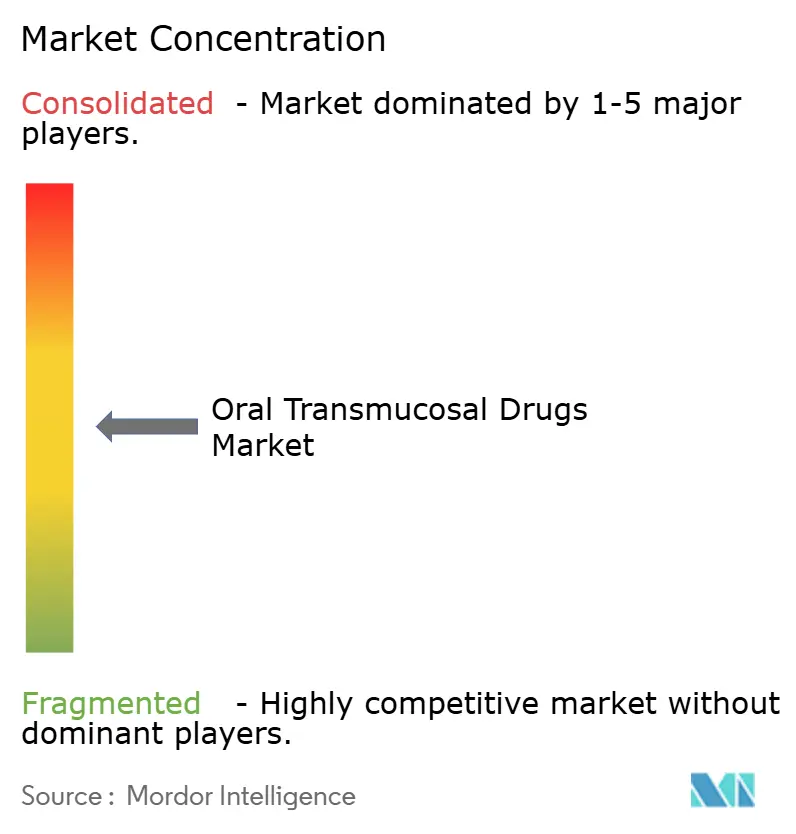
| Market Concentration | Medium |
Major Players *Disclaimer: Major Players sorted in no particular order Image © Mordor Intelligence. Reuse requires attribution under CC BY 4.0. | |
Oral Transmucosal Drugs Market Analysis by Mordor Intelligence
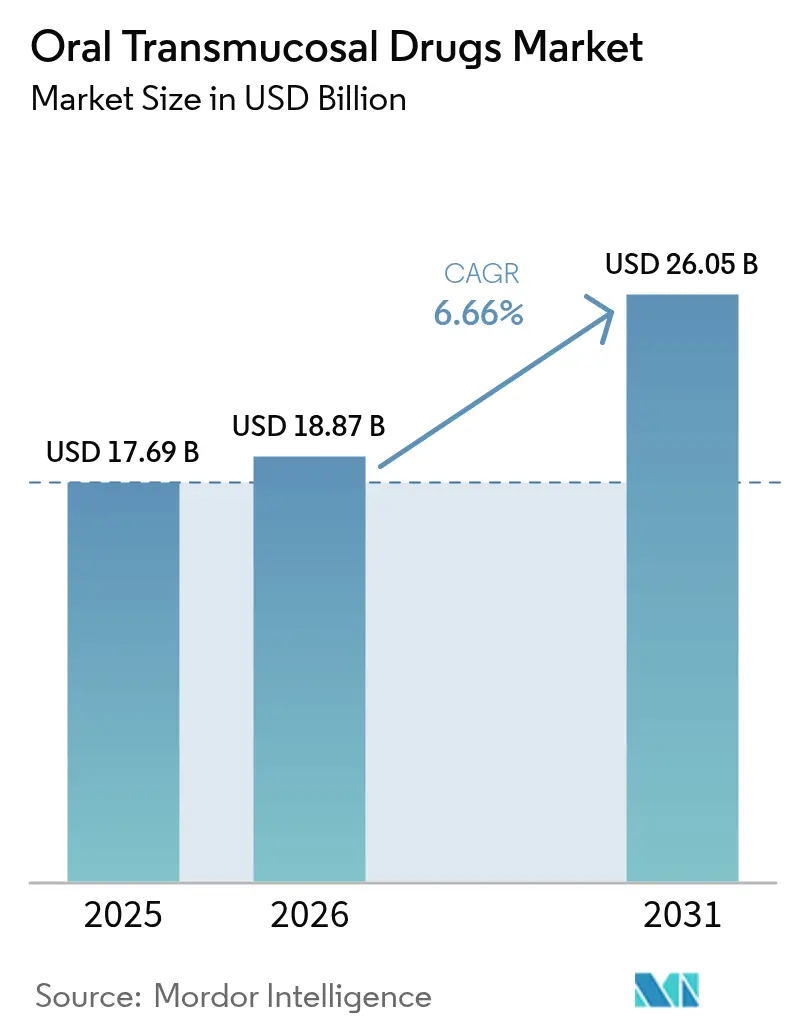
The oral transmucosal drugs market size was valued at USD 17.69 billion in 2025 and estimated to grow from USD 18.87 billion in 2026 to reach USD 26.05 billion by 2031, at a CAGR of 6.66% during the forecast period (2026-2031). Sustained growth comes from established use in opioid dependence treatment, rapid adoption in seizure rescue, and expanding applications in pain and psychedelic therapies. Continuous advances in sublingual and buccal film technologies shorten onset times and improve bioavailability, while the preference for needle-free, swallow-free dosing boosts uptake among pediatric and geriatric patients. Regulatory agencies in the United States, Europe, and China have accelerated reviews for innovative formulations, encouraging pipelines that target high-value CNS indications. Competitive intensity has risen as large pharmaceutical companies license specialty film platforms and as intellectual-property cliffs for first-generation buprenorphine products open the door to generics and next-generation designs.
Key Report Takeaways
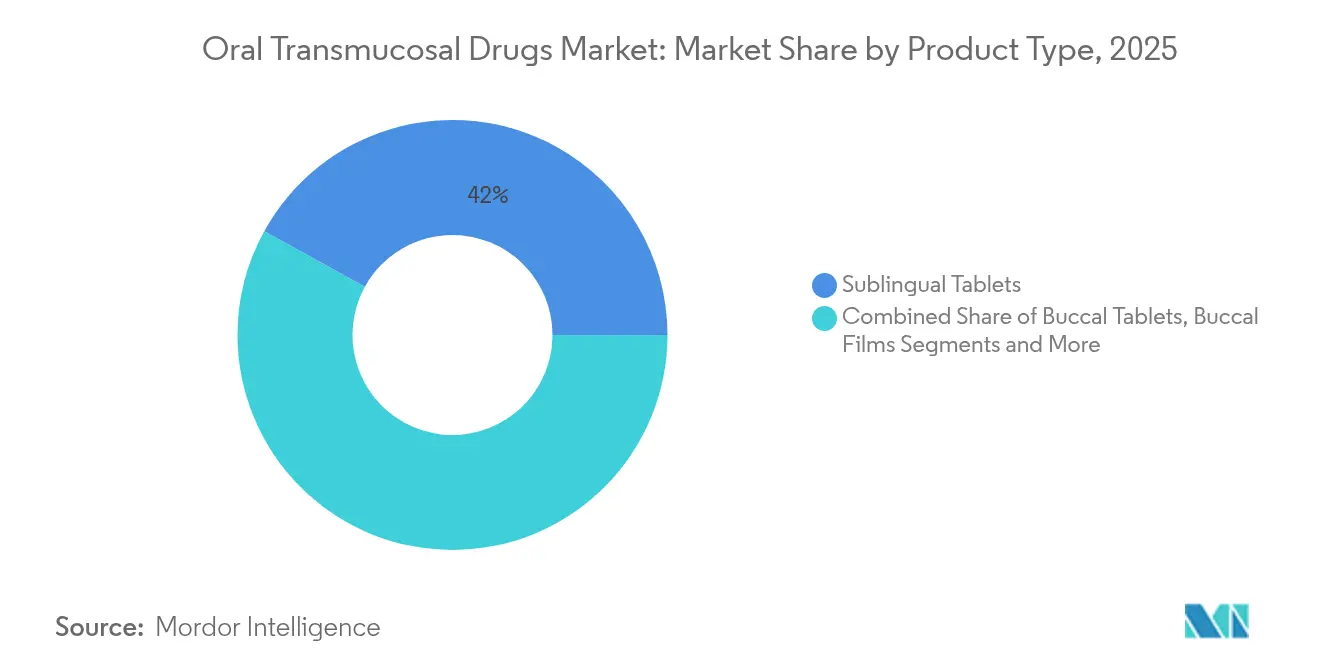
- By product type: Sublingual tablets led with 41.98% revenue share in 2025, while buccal tablets are projected to expand at a 7.12% CAGR to 2031.
- By route of administration: The sublingual mucosa route held 35.22% of oral transmucosal drugs market share in 2025, whereas buccal mucosa delivery is advancing at a 7.70% CAGR through 2031.
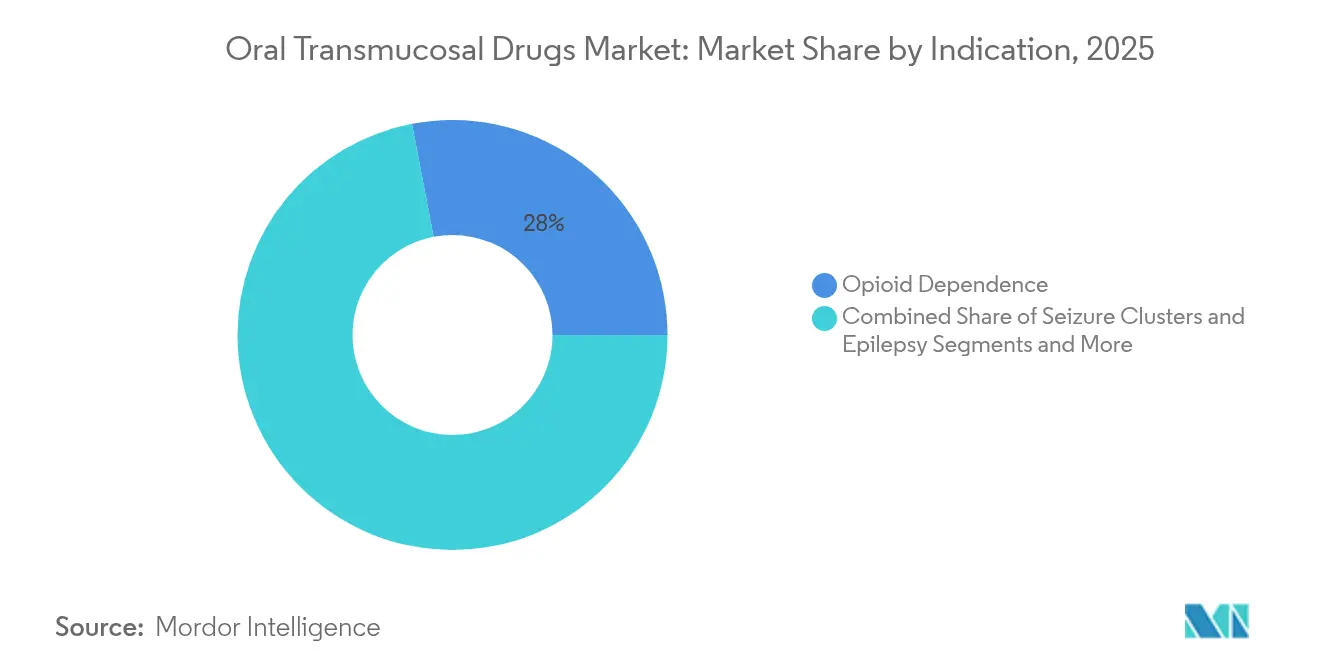
- By indication: Opioid dependence accounted for 28.02% share of the oral transmucosal drugs market size in 2025, with seizure-cluster therapies forecast to grow at 7.47% CAGR between 2026-2031.
- By distribution channel: Hospital pharmacies maintained 46.05% share in 2025; online and specialty pharmacies record the highest projected CAGR at 8.11% through 2031.
- By geography: North America captured 42.10% share in 2025, while Asia-Pacific is poised for the fastest growth at an 8.52% CAGR to 2031.
Note: Market size and forecast figures in this report are generated using Mordor Intelligence’s proprietary estimation framework, updated with the latest available data and insights as of 2026.
Market Trends and Insights
Drivers Impact Analysis of Oral Transmucosal Drugs Market*
| Driver | (~) % Impact on CAGR Forecast | Geographic Relevance | Impact Timeline |
|---|---|---|---|
| Growing burden of target CNS and pain disorders | +1.2% | Global, with concentration in North America & Europe | Long term (≥ 4 years) |
| Surge in R&D pipelines & regulatory approvals post-2023 | +0.9% | North America & EU regulatory jurisdictions | Medium term (2-4 years) |
| Preference for needle-free, swallow-free dosage forms among geriatrics & pediatrics | +0.8% | Global, particularly aging populations in developed markets | Medium term (2-4 years) |
| Rapid take-up of transmucosal rescue therapies in community EMS protocols | +0.6% | North America & EU emergency medical systems | Short term (≤ 2 years) |
| Micro-dose psychedelic & cannabinoid films entering Phase-II pipelines | +0.4% | North America & select EU markets with regulatory pathways | Long term (≥ 4 years) |
| Temperature-stable film formulations supporting low-cold-chain markets | +0.3% | APAC, MEA, and Latin America emerging markets | Medium term (2-4 years) |
| Source: Mordor Intelligence | |||
Growing burden of CNS and pain disorders
Rising prevalence of opioid use disorder, epilepsy, and breakthrough cancer pain sustains demand for fast-acting transmucosal options. The FDA approval of buccal non-opioid pain drug suzetrigine in 2025 signals regulator support for safer pain alternatives [1]. Pediatric seizure-cluster needs were addressed when Libervant received pediatric approval, broadening age coverage for rapid benzodiazepine rescue. Aging populations with dysphagia further tilt prescribing toward films and sprays that dissolve without water. Together, epidemiology and usability reinforce the long-run trajectory of the oral transmucosal drugs market.
Post-2023 surge in R&D pipelines and approvals
Expanded breakthrough and orphan-drug designations after 2023 shortened review cycles. Examples include RizaFilm for migraine and the re-scoped buprenorphine dosing guidance that cleared higher-strength products. Psychedelic candidates such as atai Life Sciences’ DMT buccal film advanced to Phase 2, pointing to novel CNS indications entering late-stage development. Faster approvals encourage investment, lifting the market growth curve.
Patient preference for needle-free, swallow-free dosing
Geriatric and pediatric adherence improves with dissolving films that avoid swallowing difficulties. Taste-masking advances using cyclodextrins and sweetening agents raise acceptance among children [2]. Rescue therapies under development—for example, anaphylaxis epinephrine OTFs—illustrate how convenience can outweigh legacy injection routes in emergency care. Consistent consumer preference adds steady volume to the oral transmucosal drugs market.
Rapid adoption of transmucosal rescue in EMS protocols
Emergency medical systems now stock buccal diazepam rather than rectal gels, delivering faster seizure-cluster relief. Clinical data show median time to next seizure expands from 0.8 days when untreated to 4.9 days when buccal solutions are used. Training modules that emphasize ease of film application shorten response times, bolstering usage in ambulances and at-home care settings.
Restraints Impact Analysis of Oral Transmucosal Drugs Market*
| Restraint | I~) % Impact on CAGR Forecast | Geographic Relevance | Impact Timeline |
|---|---|---|---|
| Limited drug-load & taste-masking challenges | -0.7% | Global, particularly affecting pediatric formulations | Medium term (2-4 years) |
| Patent cliffs for first-generation opioid dependence films | -0.5% | North America & EU markets with established generic pathways | Short term (≤ 2 years) |
| Emerging competition from intranasal powder auto-injectors | -0.4% | Global, with concentration in emergency medicine applications | Medium term (2-4 years) |
| Persistent FDA concerns on pediatric dosing uniformity for high-potency APIs | -0.3% | North America, with spillover effects to other regulatory jurisdictions | Long term (≥ 4 years) |
| Source: Mordor Intelligence | |||
Limited drug-load and taste-masking challenges
Films rarely exceed a few milligrams of active ingredient without compromising dissolution, restricting the modality to potent molecules. Bitter APIs such as buprenorphine demand sophisticated flavor-blocking that lengthens development and raises cost [3]. Formulators are evaluating permeation enhancers, yet every new excipient faces toxicology hurdles that may delay approvals and weigh on near-term market growth.
Patent cliffs for first-generation opioid-dependence films
Key buprenorphine film patents begin expiring in 2027, inviting generic entrants that could erode branded revenue. Innovators are mitigating risk by launching long-acting injections and higher-dose films under fresh intellectual-property umbrellas. The transition phase may compress margins, moderating CAGR in mature indications of the oral transmucosal drugs market.
*Our forecasts treat driver/restraint impacts as directional, not additive. The impact forecasts reflect baseline growth, mix effects, and variable interactions.
Oral Transmucosal Drugs Market Segment Analysis
By Product Type:
Leadership of Sublingual Tablets and Rising Buccal TabletsSublingual tablets held 41.98% share of oral transmucosal drugs market size in 2025 on the strength of established prescribing habits and broad reimbursement. Continuous film innovation, however, allows buccal tablets to register a 7.12% CAGR to 2031, propelled by pediatric formulations that dissolve slowly and reduce dosing frequency. Oro-dispersible films benefit from PharmFilm technology, giving poorly soluble molecules higher bioavailability in migraine and psychiatric pipelines. Liquids and sprays carve out rescue niches for anaphylaxis and neonatal seizures, while medicated confectionaries improve compliance in chronic settings. Temperature-stable tablet formats targeting 40°C ambient storage broaden access in tropical regions.
Although tablets dominate, manufacturers integrate mucoadhesive polymers to extend retention time and enhance permeation. Films deliver rapid relief—often within two minutes—making them strategic for breakthrough pain episodes. Elevated demand in emerging markets encourages investment in ambient-stable blister packs that reduce cold-chain burden. Collectively, product diversity maintains growth momentum across the oral transmucosal drugs market.

By Route of Administration:
Sustained Growth of Buccal PathwayThe sublingual pathway commanded 35.22% oral transmucosal drugs market share in 2025 thanks to rich vascularization that speeds systemic uptake. Buccal delivery grows 7.70% annually through 2031 by catering to therapies that require longer contact time, such as mood stabilizers and analgesics. Lingual and gingival routes remain specialized, addressing localized periodontal pain or targeted hormone therapy.
Permeation enhancers such as bile-salt derivatives improve buccal absorption of peptides that previously required injection. Mucoadhesive patches anchored to the cheek maintain plasma levels over eight hours, reducing rescue-dose frequency. As bioavailability data build, formularies are widening coverage, reinforcing the upward path for buccal applications in the oral transmucosal drugs market.
By Indication:
Seizure Management Sets the PaceOpioid-dependence therapy constituted 28.02% of oral transmucosal drugs market share in 2025, underpinned by mandated medication-assisted-treatment programs. Seizure-cluster interventions expand fastest at 7.47% CAGR, aided by pediatric approval of Libervant and broader age labeling for Valtoco. Breakthrough cancer pain demands ultra-rapid fentanyl films, while non-opioid options such as suzetrigine reshape pain protocols.
Psychedelic micro-dose films move through Phase 2 trials in treatment-resistant depression, hinting at additional growth layers beyond conventional CNS segments.Commercial focus is now shifting toward high-value indications where transmucosal delivery provides clear clinical advantage, fostering diversified pipelines. This breadth supports a resilient outlook for the oral transmucosal drugs market.
By Distribution Channel:
Shift Toward Specialty and Online DispensingHospital pharmacies represented 46.05% sales in 2025 because many rescue therapies initiate in acute settings. Online and specialty channels post an 8.11% CAGR, driven by direct-to-patient shipments of chronic therapies and expanded telehealth. Retail chains remain relevant for maintenance buprenorphine scripts, but specialty outlets lead on adherence programs and pharmacovigilance.
Specialty pharmacists provide education on film placement and manage insurance authorizations, improving persistence rates. Digital tracking tools alert clinicians to missed doses, integrating outcome metrics favored under value-based reimbursement. As these services proliferate, specialty channels will capture a larger slice of the oral transmucosal drugs market.
Geography Analysis
The Americas, APAC and EMEA Oral Transmucosal Drugs Market
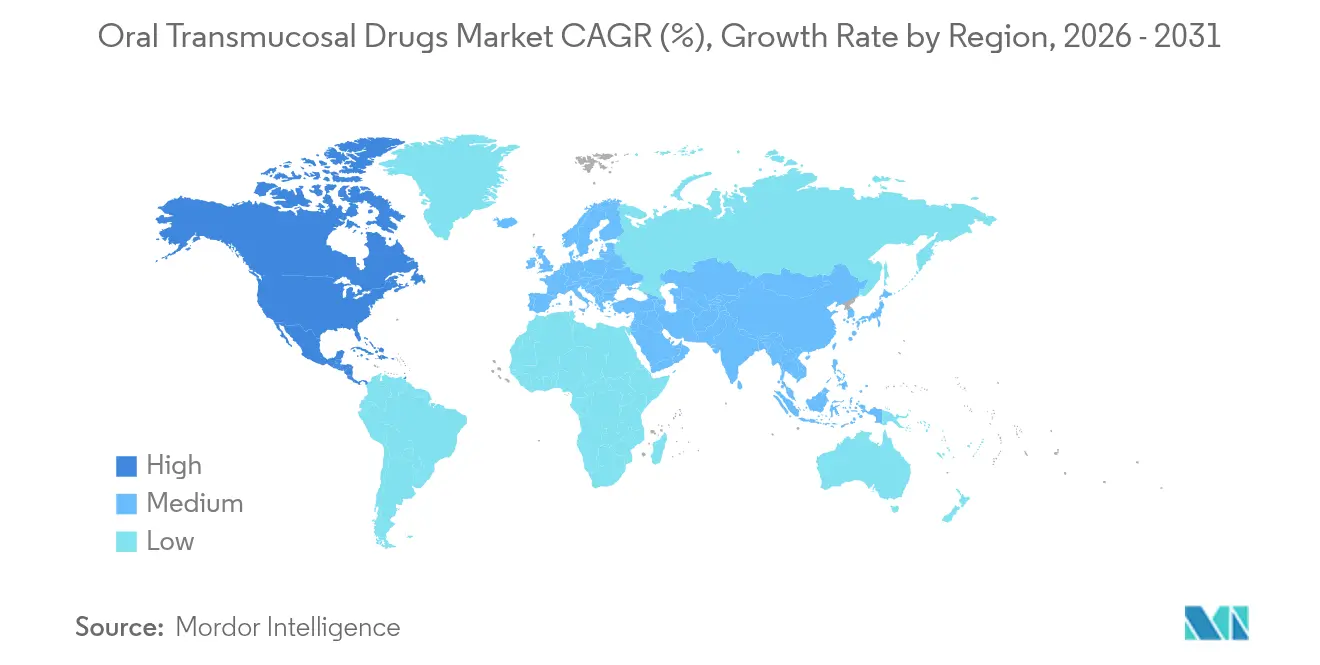
North America contributed 42.10% revenue in 2025, benefiting from breakthrough-therapy pathways and wide insurance coverage. The FDA’s 2024 update removing buprenorphine dose ceilings has encouraged higher-strength films that enhance retention in opioid-use-disorder programs. Academic-industry collaborations at leading U.S. epilepsy centers speed recruitment for pediatric trials, consolidating the region’s leadership.Asia-Pacific registers the fastest 8.52% CAGR through 2031. China’s National Medical Products Administration implemented accelerated reviews that cleared more than 60 innovative drugs in 2024, including transmucosal formulations for pain and oncology. Investment in peptide and high-potency-film production by contract manufacturer WuXi STA underscores the region’s scale advantage. Regulatory harmonization initiatives in ASEAN facilitate cross-border market entry, expanding total addressable patients.Europe maintains steady growth on the back of the European Medicines Agency Pediatric-Use Marketing Authorization, which encourages child-friendly formulations. Recent approval of Buprenorphine Neuraxpharm illustrates ongoing innovation within mature indications . National health systems increasingly reimburse films that demonstrate superior adherence over oral tablets.Middle East & Africa and South America deliver incremental volume where temperature-stable films bypass cold-chain gaps. Humanitarian programs that stock oral transmucosal naloxone films for opioid toxicity build early market presence, offering future upside once economic conditions improve. Combined, geographic diversification supports sustained expansion of the oral transmucosal drugs market.
Regulatory Landscape
Oral transmucosal drugs are regulated through standard prescription-drug pathways, with product submissions primarily handled via the US FDA New Drug Application (NDA) process and the Abbreviated New Drug Application (ANDA) route for generics (21 CFR 314.105). For film and related delivery systems, US FDA guidance emphasizes product development and quality considerations, including limiting residual drug at the end of use to reduce safety risk, a key design and controls requirement for reservoir-like systems and high-potency APIs.
In Europe, the European Medicines Agency (EMA) guidance for pharmaceutical development highlights patient-centric requirements for oromucosal products intended for pediatric and older populations. The focus includes adhesion behavior, risk of accidental swallowing, and salivation effects on dissolution, which raises the bar for early formulation justification and for dose-uniformity controls supporting age-expanded labeling in indications such as seizure rescue and opioid dependence.
Value Chain Analysis
The value chain starts with API sourcing, often centered on high-potency CNS molecules, and then moves into specialized excipients and components. These include mucoadhesive polymers, taste-masking systems, and packaging engineered for moisture and temperature protection. Formulation and process development, covering content uniformity, dissolution, adhesion, and stability, is frequently supported by contract development and manufacturing organizations (CDMOs) with oral thin film and oromucosal manufacturing know-how, analytics, and regulated quality systems.
Scale-up and commercial production depend on technology transfer into FDA-approved or EU-GMP facilities, supported by partner networks that can handle film casting, converting, and blistering at volume. Recent collaborations, including the Spektus Pharma-Recipharm Flexitab technology transfer to FDA/EU-approved sites and the LTS LOHMANN Therapie-Systeme AG cooperation with Nualtis to expand oral thin film manufacturing capacity, show how platform owners and CDMOs are used to compress timelines, de-risk regulatory execution, and support resilient supply across hospital, retail, and specialty/online pharmacy channels.
Competitive Landscape
The market shows moderate concentration. Aquestive Therapeutics leverages its PharmFilm platform both for partnered products such as Suboxone and for proprietary candidates including Libervant and Anaphylm. Indivior expanded into long-acting injections but continues to develop higher-dose films with rapid induction profiles to prolong exclusivity. Large pharmaceutical groups pursue licensing deals: a 2025 Merck agreement valued at USD 493 million secured oral peptide rights, illustrating big-pharma interest in transmucosal technologies (Merck press release).
Generic entrants prepare to capitalize on buprenorphine patent expiries after 2027, which may compress branded margins yet broaden patient access. Meanwhile, disruptors target psychedelic and cannabinoid indications with proprietary buccal films, forging a frontier largely untouched by incumbents. Manufacturing alliances with contract development organizations enable smaller firms to launch without owning capital-intensive facilities.
Strategically, leaders emphasize heat-stable formulations to penetrate emerging markets and invest in taste-masking science to secure pediatric labels. Competitive differentiation increasingly rests on formulation science and regulatory execution rather than molecule ownership alone, shaping the evolution of the oral transmucosal drugs market.
Oral Transmucosal Drugs Industry Leaders
-
ZIM Laboratories Limited
-
Aquestive Therapeutics, Inc.
-
IntelGenx Corp.
-
Novartis AG
-
Sunovion Pharmaceuticals, Inc.
- *Disclaimer: Major Players sorted in no particular order
Oral Transmucosal Drugs Market Companies Covered in this Report
- Aquestive Therapeutics
- Intelgenx
- ZIM Laboratories
- C.L. Pharm Co., Ltd.
- Novartis
- Sunovion Pharmaceuticals
- Pfizer
- GW Pharmaceuticals (Jazz)
- Seoul Pharmaceuticals
- Shilpa Therapeutics
- Indivior
- Cure Pharmaceutical
- Catalent
- Takeda Pharmaceuticals
- Dr. Reddy’s Laboratories
- Glenmark Pharmaceuticals
- AdhexPharma
- Astellas Pharma
- BioDelivery Sciences (Collegium)
- Johnson & Johnson
Market Opportunities and Future Outlook
Patient-centric formulation requirements across the FDA and EMA, particularly for pediatric and older populations, continue to broaden the practical use cases for swallow-free, needle-free dosing. That creates whitespace for products that can demonstrate reliable adhesion, rapid onset, and consistent dosing under real-world use. Seizure rescue programs, including pediatric label expansion, and opioid dependence also provide a commercial template that can extend to additional CNS and pain indications where time-to-effect and adherence influence prescribing and payer acceptance.
Technology advances further support differentiated opportunity in higher-precision oromucosal platforms, especially where earlier formats faced constraints such as limited drug load, taste, and short residence time. Ongoing development in advanced polymer systems, including chitosan, HPMC, and Eudragit-based approaches, and scalable manufacturing methods such as hot-melt extrusion and 3D printing support more differentiated buccal and sublingual products, including exploration of peptide and other hard-to-deliver molecules. Manufacturing collaborations for oral thin films, combined with branded-to-generic transitions in buprenorphine films after patents begin expiring in 2027, create room for both cost-optimized generics and next-generation, platform-enabled formulations.
Recent Industry Developments in Oral Transmucosal Drugs Market
- February 2026: Aquestive Therapeutics announced it received a Complete Response Letter from the US FDA for the New Drug Application for Anaphylm (dibutepinephrine) Sublingual Film. The action highlights the scrutiny applied to film-based emergency therapies on quality and/or clinical requirements, affecting timelines and investment priorities across thin-film rescue pipelines.
- June 2025: Nualtis (formerly IntelGenx) and LTS LOHMANN Therapie-Systeme AG announced a strategic cooperation to expand global manufacturing capabilities for oral thin film products. The collaboration strengthens access to commercial-scale capacity and regulated production infrastructure, which can accelerate technology transfer and improve supply reliability for film-based products.
- April 2024: IntelGenx reported that its co-developer Xiromed received a Complete Response Letter from the US FDA for the resubmitted ANDA for Buprenorphine Buccal Film. The setback underscores ongoing bioequivalence and CMC execution risk for generic entry in high-value opioid-dependence films, shaping competitive timing and portfolio planning.
Oral Transmucosal Drugs Market Report Scope and Research Methodology
Market Definition and Coverage
For this report, the oral transmucosal drugs market covers medicines that are designed to deliver an active ingredient through the oral mucosa (such as sublingual and buccal routes) for local or systemic effect, and it is sized in revenue terms across geographies.
Scope exclusions: We exclude oral care products, confectionery style mouth fresheners, and dietary supplements where systemic drug delivery is not the main regulated purpose.
Segments Covered in This Report
- By Product Type
- Sublingual Tablets
- Buccal Tablets
- Oro-dispersible Films
- Buccal Films
- Liquids & Sprays
- Medicated Confectionaries (Lozenges, Lollipops, Gums)
- Others (Patches, Gels)
- By Route of Administration
- Sublingual Mucosa
- Buccal Mucosa
- Lingual
- Gingival
- By Indication
- Opioid Dependence
- Seizure Clusters & Epilepsy
- Pain / Oncology Pain
- Nausea & Vomiting
- Erectile Dysfunction
- Others
- By Distribution Channel
- Hospital Pharmacies
- Retail Pharmacies
- Online & Specialty Pharmacies
- By Geography
- North America
- United States
- Canada
- Mexico
- Europe
- Germany
- United Kingdom
- France
- Italy
- Spain
- Rest of Europe
- Asia-Pacific
- China
- Japan
- India
- Australia
- South Korea
- Rest of Asia-Pacific
- Middle East & Africa
- GCC
- South Africa
- Rest of Middle East & Africa
- South America
- Brazil
- Argentina
- Rest of South America
- North America
Data Sources, Market Sizing, and Validation
Desk Research
Desk research started with building a clear list of marketed transmucosal dosage forms and the therapy areas where they are commonly used, and then mapping where demand is coming from. Public sources helped with this, such as the FDA drug databases and labeling, the FDA Orange Book for approvals and exclusivity checks, the NIH clinical trials registry for pipeline direction, and the CDC plus WHO for disease burden context in the major patient pools.
We also used annual reports, investor presentations, reputable medical journals, and press releases to validate launch timing, formulation changes, and geographic expansion patterns. Where financial disclosure was limited, we used a paid subscription focused on company financials and another covering patent databases to cross-check product positioning and formulation innovation signals. These sources are not exhaustive, and we also relied on additional public and paid references to collect, validate, and clarify the final assumptions.
Primary Interviews and Surveys
Primary work was used to pressure test what we saw in public data, especially around uptake speed, channel mix, and how prescribers switch between oral transmucosal options and traditional oral or injectable routes. We spoke with a mix of formulation experts, commercial leaders, and managers across key regions so that pricing logic, availability, and patient adherence factors could be checked before finalizing the model.
Distribution of primary research fieldwork respondents
| Company type | Respondent position | Region |
|---|---|---|
| Top tier: 37% | CXOs: 14% | APAC: 46% |
| Mid tier: 43% | Functional/Unit leaders: 34% | EMEA: 30% |
| Smaller Players: 20% | Managers: 52% | Americas: 24% |
Market-Sizing & Forecasting
Sizing was built using a top-down and bottom-up approach, where the top-down view reconstructs revenue pools by therapeutic use, route adoption, and region, and then allocates them to oral transmucosal dosage forms based on observed prescribing and availability patterns. To keep the totals realistic, we then corroborated the results using selective bottom-up checks, such as sampled product revenue where disclosed, a volume-by-average selling price logic for common formats (films, sprays, lozenges), and channel checks on how products flow through hospital and retail settings.
A few practical inputs that mattered in this market were the number of marketed products by route, new approvals and line extensions, the share of eligible patients who are treated with fast onset or swallowing-friendly formats, typical dosing frequency by indication, and country level pricing and reimbursement tendencies. When a product did not have clear regional split data, gaps were handled by using proxy splits from similar therapy categories and then refining them using expert feedback on where uptake is actually concentrated.
For forecasting, we relied on scenario analysis supported by variable level expectations shared by interviewees, and then converted those views into year-by-year growth assumptions. Key forward drivers included pipeline timing, expected competition from alternative delivery routes, pricing pressure after exclusivity changes, and regional expansion in Asia-Pacific where access can change quickly.
Data Validation & Update Cycle
Outputs were checked against independent signals like approval timelines, therapy area growth, and the implied price and volume mix, and then large variances were reviewed again before sign-off. We also run basic anomaly checks at region and route level so that growth does not jump without a real trigger, and if it does, we rework the underlying assumption.
Reviews happen in steps, with cross-checks by another analyst and a final pass for consistency across definitions, currency handling, and time series logic. The report is refreshed annually, with interim updates when a material event occurs (such as a major approval, safety restriction, or pricing change). Before delivery, we do a quick re-check so clients receive the most current view possible.
Mordor Intelligence's Oral Transmucosal Drugs Market Estimate Compared With Other Published Estimates
Published market values for oral transmucosal drugs can look far apart because the market boundary is not always treated the same way, and the year chosen for the headline number also varies. Differences in what gets counted as transmucosal, how pricing is averaged across countries, and how pipeline timing is converted into revenue can each move the total by a noticeable amount.
By tracking route specific inclusion rules and refreshing currency timing, Mordor Intelligence keeps the total focused on regulated transmucosal drug revenues while adjacent oral care and non-drug products remain outside the calculation, which avoids mixing demand pools that behave differently. Some sources also use more aggressive adoption curves for new formats, while others bake in broad premium pricing without verifying reimbursement and generic entry timing, and those two choices can widen the spread quickly.
Benchmark comparison
| Source | Market Size | Gaps in Research Methodology |
|---|---|---|
| Mordor Intelligence | USD 18.87 B (2026) | |
| Trade Journal A | USD 39.70 B (2024) | Uses a broader oral transmucosal definition that can pull in wider delivery products and applies a higher near term growth rate, with limited clarity on pricing normalization across countries and channels. |
| Newswire Study B | USD 33.20 B (2023) | Anchors the model on an earlier base year and reports a larger revenue pool that appears to include adjacent oral delivery and OTC style products, while assumptions on therapy mix and reimbursement impact are not clearly validated. |
Taken together, the table shows that scope boundaries and year selection create most of the gap, and then pricing and adoption assumptions decide the direction of the difference. Our approach is meant to be repeatable, since each step ties back to route eligibility, therapy demand signals, and simple price-volume checks that can be re-tested when conditions change.
Key Questions Answered in the Report
How big is the Oral Transmucosal Drugs Market?
The Oral Transmucosal Drugs Market size is expected to reach USD 18.87 billion in 2026 and grow at a CAGR of 6.66% to reach USD 26.05 billion by 2031.
Which product segment holds the largest share today?
Sublingual tablets dominate with 41.98% revenue share as of 2025.
Who are the key players in Oral Transmucosal Drugs Market?
ZIM Laboratories Limited, Aquestive Therapeutics, Inc., IntelGenx Corp., Novartis AG and Sunovion Pharmaceuticals, Inc. are the major companies operating in the Oral Transmucosal Drugs Market.
Which is the fastest growing region in Oral Transmucosal Drugs Market?
Asia-Pacific, supported by regulatory reforms and manufacturing expansion, is forecast to grow at 8.52% CAGR to 2031.
Which region has the biggest share in Oral Transmucosal Drugs Market?
In 2026, the North America accounts for the largest market share in Oral Transmucosal Drugs Market.