
Ophthalmic Knives Market Size and Share
Market Overview
| Study Period | 2020 - 2031 |
|---|---|
| Market Size (2026) | USD 1.89 Billion |
| Market Size (2031) | USD 2.32 Billion |
| Growth Rate (2026 - 2031) | 4.06 % |
| Fastest Growing Market | Asia Pacific |
| Largest Market | North America |
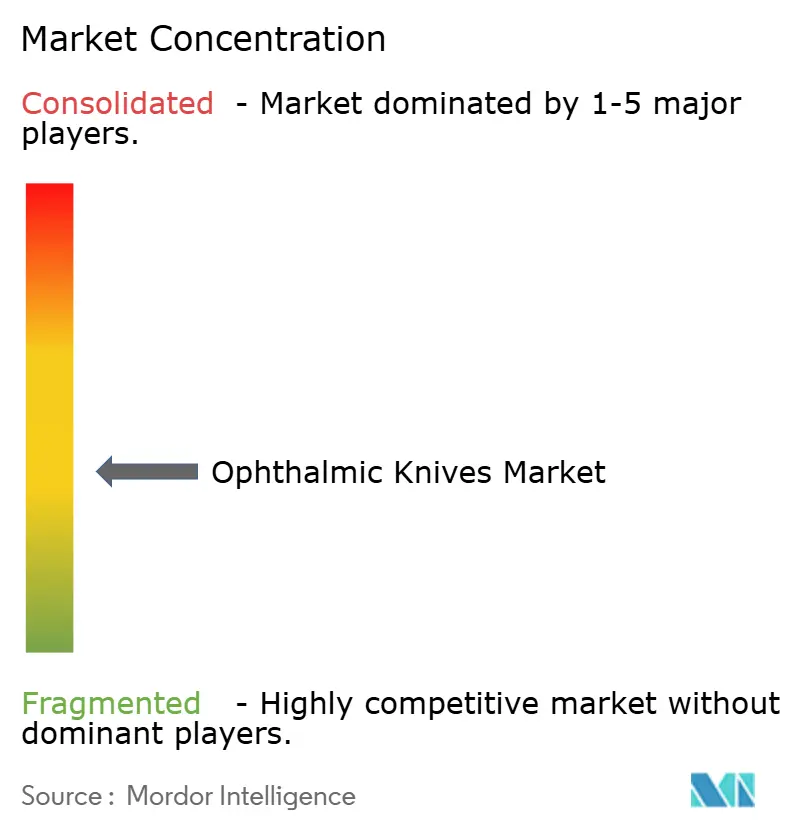
| Market Concentration | Medium |
Major Players *Disclaimer: Major Players sorted in no particular order Image © Mordor Intelligence. Reuse requires attribution under CC BY 4.0. | |
Ophthalmic Knives Market Analysis by Mordor Intelligence
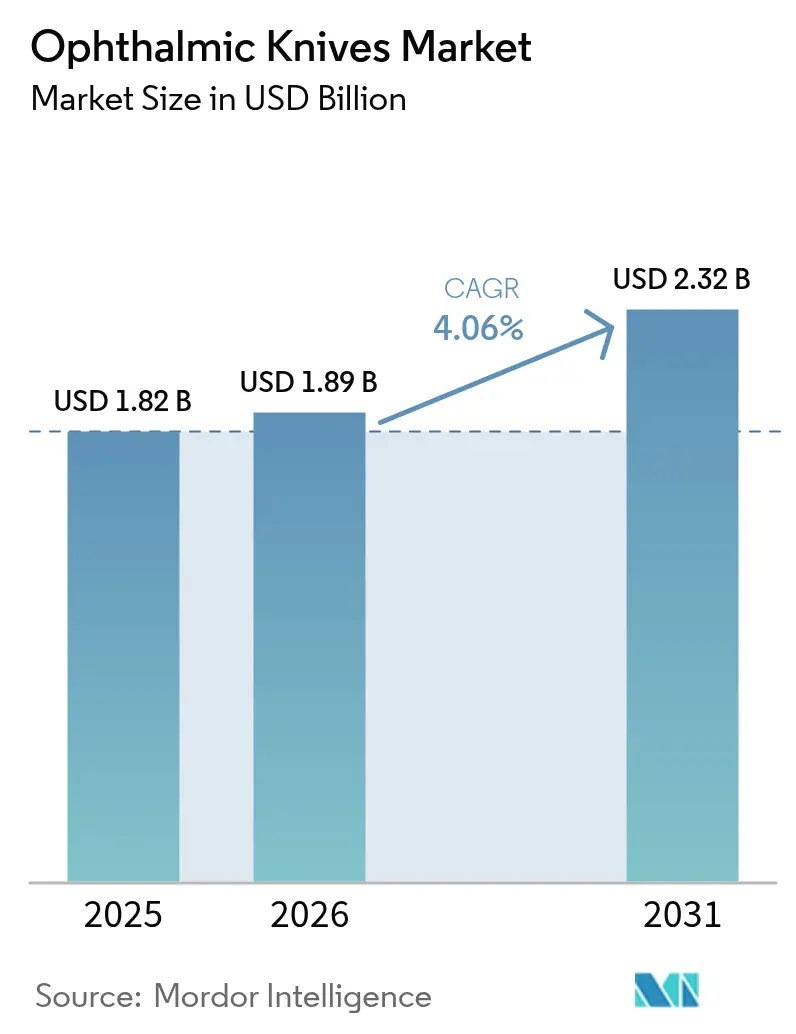
The Ophthalmic Knives Market size was valued at USD 1.82 billion in 2025 and estimated to grow from USD 1.89 billion in 2026 to reach USD 2.32 billion by 2031, at a CAGR of 4.06% during the forecast period (2026-2031).
Demand holds steady because cataract surgery volumes keep rising, even as femtosecond laser platforms sharply reduce effective phacoemulsification time and begin to displace manual blades. Growth also reflects greater procedure throughput at outpatient facilities, ongoing material innovations such as diamond-like carbon coatings, and the push for infection-free single-use kits. At the same time, sustainability mandates complicate disposable adoption, and price pressure from declining reimbursement nudges many facilities toward reuse schemes. Consolidation among suppliers accelerates, with leading players pairing blade portfolios with laser technology and digital workflow tools to protect share in an environment of rapid technology substitution.
Key Report Takeaways
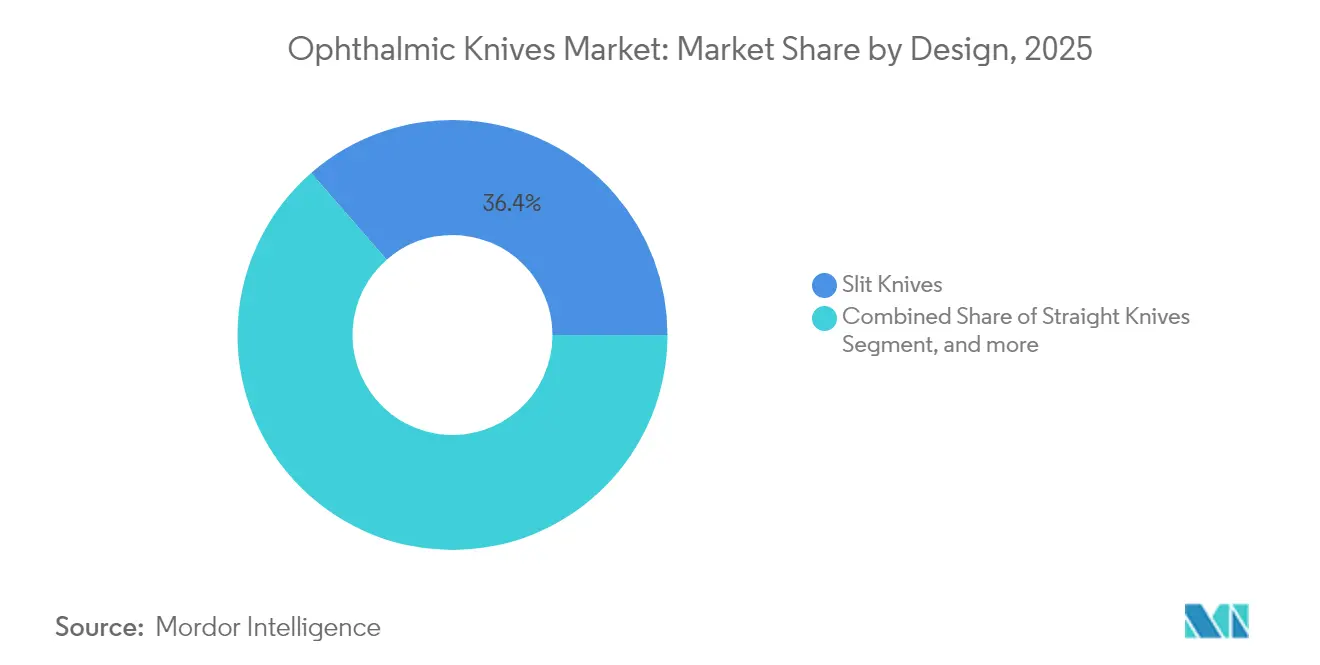
- By design, slit knives held 36.42% of ophthalmic knives market share in 2025, while MVR knives are projected to expand at a 5.71% CAGR to 2031.
- By product, reusable blades accounted for 63.38% of the ophthalmic knives market size in 2025, whereas single-use options are growing at a 7.26% CAGR.
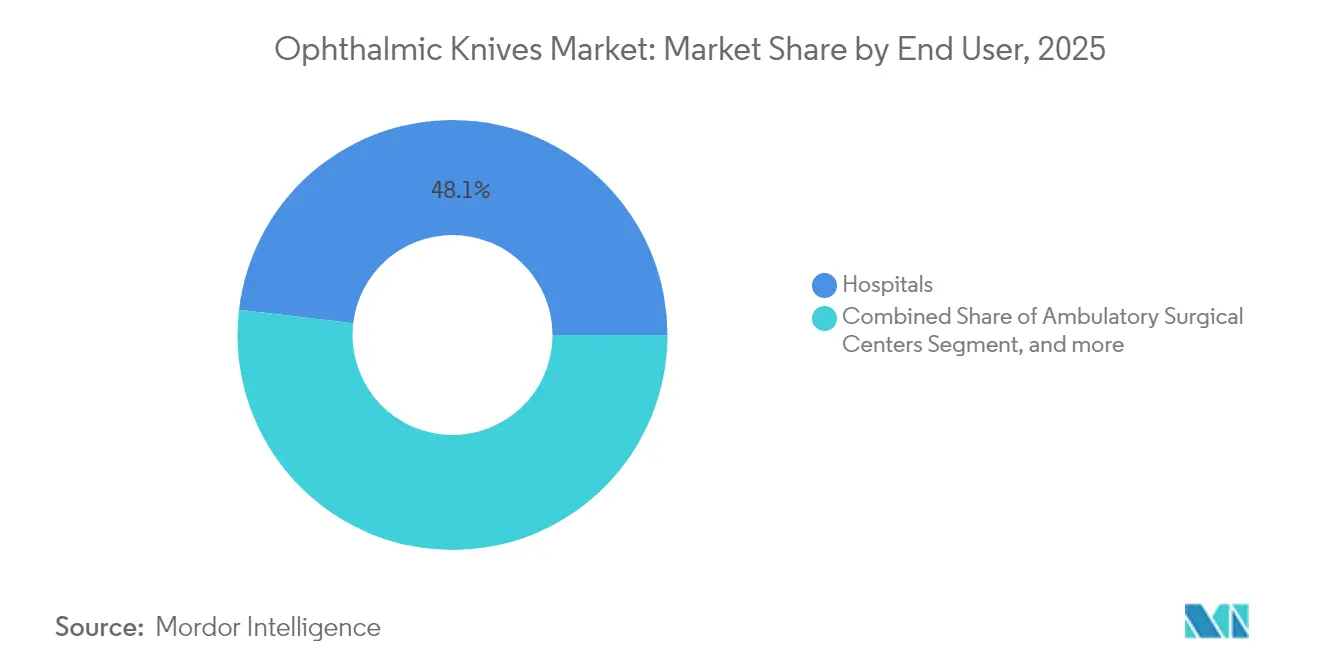
- By end-user, hospitals led with 48.12% revenue share in 2025; ambulatory surgical centers (ASCs) post the fastest growth at 8.21% through 2031.
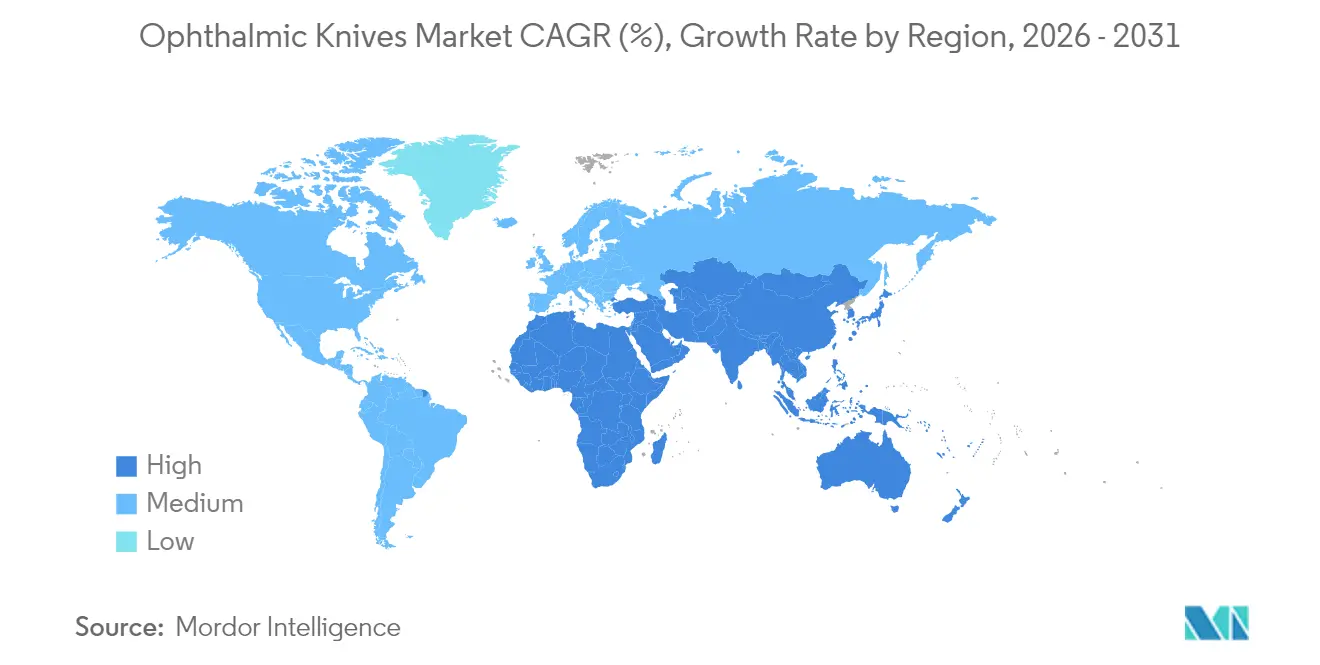
- By geography, North America captured 36.02% of 2025 revenue, while Asia-Pacific is advancing at a 5.28% CAGR to 2031.
Note: Market size and forecast figures in this report are generated using Mordor Intelligence’s proprietary estimation framework, updated with the latest available data and insights as of 2026.
Market Trends and Insights
Drivers Impact Analysis of Ophthalmic Knives Market*
| Driver | (~) % Impact on CAGR Forecast | Geographic Relevance | Impact Timeline |
|---|---|---|---|
| Increasing Incidence of Ophthalmic Diseases | +1.2% | Global, with higher impact in Asia-Pacific and MEA | Long term (≥ 4 years) |
| Aging Population & Cataract Prevalence | +1.8% | Global, concentrated in developed markets | Long term (≥ 4 years) |
| Technological Advances in Blade Materials | +0.7% | North America & EU leading, expanding to APAC | Medium term (2-4 years) |
| Shift Toward Day-Care / Minimally-Invasive Cataract Surgery | +1.1% | North America & EU, spillover to emerging markets | Medium term (2-4 years) |
| Rise of Mobile Eye-Care Camps in Emerging Markets | +0.4% | APAC core, expansion to MEA and Latin America | Short term (≤ 2 years) |
| Additive-Manufactured Custom Geometries Enabling Niche Procedures | +0.3% | North America & EU, selective adoption in APAC | Long term (≥ 4 years) |
| Source: Mordor Intelligence | |||
Increasing Incidence of Ophthalmic Diseases
Cataract remains the principal cause of avoidable blindness, and disability-adjusted life years linked to lens opacity continue to rise in low-sociodemographic regions. Mobile surgical camps in India now deliver more than 10 000 cataract procedures annually, achieving 79.3% rates of 6/9 visual acuity or better.[1]Indian Journal of Ophthalmology, “Performance Metrics of Mobile Eye Surgical Units,” ijo.in China’s registry shows phacoemulsification in 94.93% of cataract operations, underscoring the continuing need for high-precision incision tools. This sustained disease burden anchors baseline demand for every major blade design even as femtosecond systems gain ground.
Aging Population & Cataract Prevalence
Global demographic shifts add millions of procedures each year; by 2050 annual cataract surgeries are projected to reach 50 million. Office-based centers in the United States now exceed 150 locations and help alleviate hospital capacity constraints without compromising safety standards. Although Medicare payments have fallen 51% in real terms since 1982, procedure volumes tied to an older patient pool keep overall blade consumption trending upward.
Technological Advances in Blade Materials
Researchers have produced diamond knife tips below 60 nanometers using low-energy oxygen ion beam machining, enabling cleaner corneal entry and faster wound sealing.[2]Journal of the European Optical Society, “Nanometric Diamond Knife Tip Fabrication,” jeos.org Ultra-thin 100-micrometer crescent blades improve control in glaucoma flap creation. Disposable silicon blades tested ex-vivo now deliver cutting performance similar to diamond, adding options for cost-sensitive markets.
Shift Toward Day-Care / Minimally-Invasive Cataract Surgery
ASCs gain share because they match hospital quality while lowering overhead for payers and providers. Disposable kits that remove sterilization steps dovetail with fast-turnover schedules, reinforcing the 7.72% growth trajectory for single-use blades. Microincisional techniques rely on sub-2 mm trapezoidal designs to maintain wound integrity, further stimulating demand for specialty geometries.
Restraints Impact Analysis of Ophthalmic Knives Market*
| Restraint | (~) % Impact on CAGR Forecast | Geographic Relevance | Impact Timeline |
|---|---|---|---|
| High Unit Cost of Premium Knives | -0.8% | Global, acute impact in emerging markets | Medium term (2-4 years) |
| Reimbursement Pressure on Ambulatory Surgery Centers | -1.2% | North America & EU, expanding globally | Short term (≤ 2 years) |
| Regulatory Sustainability Rules Restricting Single-Use Plastics | -0.6% | EU leading, adoption in other regions | Medium term (2-4 years) |
| Rapid Adoption of Femtosecond Lasers Displacing Manual Knives | -1.4% | North America & EU, selective APAC adoption | Long term (≥ 4 years) |
| Source: Mordor Intelligence | |||
High Unit Cost of Premium Knives
Multi-layer diamond coatings push individual blade prices well above stainless-steel alternatives, straining budgets in markets where reimbursement is flat or declining. Facilities in Latin America and parts of Southeast Asia often reuse premium knives beyond manufacturer guidance to amortize costs, a practice that heightens sterilization risk and tempers replacement demand.
Rapid Adoption of Femtosecond Lasers
More than 950 LenSx systems are installed worldwide, and surgeons report capsulotomy satisfaction scores above 9 on a 10-point scale. In controlled studies effective phaco time drops by 83.6% when lasers replace manual incisions.[3]American Academy of Ophthalmology, “Femtosecond Laser–Assisted Cataract Surgery Outcomes,” aao.org Alcon’s USD 430 million LENSAR acquisition signals deeper integration of laser workstations into the mainstream surgical suite. As capital costs fall and throughput rises, manual blade volumes risk erosion, particularly in high-income regions.
*Our forecasts treat driver/restraint impacts as directional, not additive. The impact forecasts reflect baseline growth, mix effects, and variable interactions.
Ophthalmic Knives Market Segment Analysis
By Design:
MVR Knives Lead Specialty GrowthMVR knives posted the fastest 5.71% CAGR and benefit from surging vitreoretinal procedure complexity linked to diabetes and age-related macular degeneration. Slit knives still command the largest slice of ophthalmic knives market share at 36.42% in 2025, reflecting their utility in both primary and secondary cataract incisions. Crescent and straight blades serve niche anterior applications, but additive manufacturing is beginning to deliver bespoke angles and shaft lengths that broaden surgeon choice. Diamond-like carbon coatings lengthen edge life and improve tissue glide, encouraging uptake for multi-procedure packs in teaching hospitals. Yet femtosecond adoption tempers volume expectations beyond 2028 as laser capsulotomy reduces reliance on manual entry for routine cataract surgery. To offset the shift, suppliers emphasize ultra-high-precision MVR variants and hybrid packages that bundle vitreoretinal blades with disposable cannulas.
The design segment shows resilience because not all health systems can finance lasers, and because certain glaucoma, pediatric, and trauma cases still demand tactile feedback unavailable in robotic or laser platforms. Furthermore, custom 3D-printed trial blades let innovators explore asymmetric bevels suited to irregular corneas, opening incremental revenue channels. Slit knife suppliers are integrating radio-frequency identification tags to track sterile reprocessing cycles, a move that aligns with hospital quality metrics while locking customers into proprietary asset-management software, thereby stabilizing their foothold in the ophthalmic knives market.



By Product:
Single-Use Gains Despite Reusable DominanceReusable instruments accounted for 63.38% of the ophthalmic knives market size in 2025 because budget-pressed centers spread acquisition cost across dozens of cycles. High-volume Indian and Brazilian state programs commonly sterilize stainless blades more than 40 times, underscoring this economic logic. Disposable kits, however, are growing 7.26% annually, propelled by more stringent infection control rules after widely publicized endophthalmitis clusters in 2024. The FDA’s revised Quality Management System Regulation, effective February 2026, requires documented risk mitigation, making single-use pathways attractive for facilities unwilling to invest in automated tracking of reprocessing.
Sustainability rules complicate this trajectory. The EU Packaging and Packaging Waste Regulation, active from August 2026, caps landfill waste and restricts virgin plastics, spurring research into bio-based handles and recyclable blister packs. Manufacturers now pilot mechanical recycling loops in Germany, where ground polymer from single-use handles reenters non-clinical products. While surgeons favor the sharpness consistency of disposables, survey data show 79% perceive operating-room waste as excessive, foreshadowing a gradual migration toward hybrid portfolios that mix reusable shafts with modular, minimally-wasteful cutting tips.
By End-User:
ASCs Drive Market EvolutionHospitals retained 48.12% revenue in 2025 owing to complex case referral patterns and embedded procurement agreements. Nonetheless, ambulatory surgical centers exhibit an 8.21% CAGR through 2031, boosted by same-day discharge convenience, tighter case scheduling, and the elimination of overnight nursing costs. Medicare’s site-neutral reimbursement framework pays ASCs roughly USD 1 329 for cataract surgery in 2025, making outpatient settings financially compelling despite a concurrent 2.8% physician fee cut. Specialty eye clinics lie between the two extremes, thriving on patient-centric branding but facing higher per-unit supply costs due to lower throughput.
Mobile surgical units expand reach in densely populated developing regions. India’s flagship program now fields buses equipped with laminar-flow theatres, completing cataract rounds in under 20 minutes and generating fresh demand for portable single-use blade packs. In the United States, office-based suites inside group practices perform more than 50 000 cataract cases annually, an evolution that favors compact disposable kits to simplify logistics and comply with state sterilization statutes. Together, these patterns reshape procurement priorities and keep the ophthalmic knives market firmly oriented toward highly efficient, procedure-ready solutions.
Geography Analysis
North America Ophthalmic Knives Market
North America commanded 36.02% of 2025 revenue thanks to roughly 4 million cataract procedures, fast adoption of premium coatings, and widespread use of ASCs. Femtosecond penetration exceeds 40% of cataract theaters, yet manual blades remain indispensable for backup and for surgeons who favor tactile feedback. Ongoing cuts to the Medicare conversion factor exert margin pressure, pushing providers toward blended reusable–disposable models that safeguard cash flow while meeting Centers for Medicare & Medicaid Services infection benchmarks.
APAC Ophthalmic Knives Market
Asia-Pacific is the fastest-growing territory at a 5.28% CAGR. China alone anticipates a 223.54% jump in cataract prevalence through 2030, and national surgical registries confirm that phacoemulsification dominates 94.93% of cases, anchoring demand for compatible incision blades. India’s mobile eye camps demonstrate cost-effective outreach, with favorable visual outcomes sustaining steady inventory turnover for single-use packs. Mature markets such as Japan and Australia pursue premium diamond blades for microincisional glaucoma surgery, while Indonesia and Vietnam purchase cost-optimized steel sets to fit public-sector budgets.
Europe Ophthalmic Knives Market
Europe follows closely, driven by Germany, United Kingdom, France, and Italy. The EU Medical Device Regulation 2017/745 imposes rigorous post-market surveillance, favoring suppliers with strong quality systems. Simultaneously, the bloc’s waste-reduction law compels design shifts toward recyclable or reusable components, reinforcing innovation in low-waste blade handles. Eastern European modernization programs attract vendors with mid-price stainless products, keeping growth momentum intact despite reimbursement ceilings. Overall, environmental compliance and high clinical standards give Europe an outsized influence on the next generation of blade technology in the ophthalmic knives market.

Regulatory Landscape
Ophthalmic knives are regulated primarily as medical devices, with classification and quality-system requirements shaping market access and reprocessing practices. In the United States, manual ophthalmic surgical instruments such as ophthalmic knives fall under FDA 21 CFR Part 886 and are commonly Class I devices subject to general controls, while reprocessed ophthalmic knives (product code NLA) require a 510(k) with reprocessing validation. Compliance emphasis increasingly extends beyond basic classification to process control and postmarket actions, highlighted by Alcon actions in 2024 involving sharpness-related issues in certain ophthalmic knife lots.
Internationally, manufacturers align design verification and risk management with recognized standards used for conformity and procurement. ISO 15004-1:2020 provides general safety and test methods for ophthalmic instruments, and ISO 15004-2:2024 updates optical radiation safety requirements for relevant ophthalmic instruments. These frameworks, together with region-specific environmental and waste rules that affect single-use packaging choices, reinforce the need for documented quality systems, traceability, and validated sterilization and reprocessing pathways across global supply chains.
Competitive Landscape
Competition remains moderately fragmented. Alcon leads after reporting USD 9.8 billion in surgical revenue for 2024 and deepening its vertical stack with the USD 430 million LENSAR laser deal. Bausch + Lomb, Mani, and Microsurgical Technology follow, each refining proprietary edge geometries and launching mobile-friendly disposable lines to address outreach programs in Asia and Africa. Large players emphasize closed-loop supply, bundling blades with viscoelastics, drapes, and in-theatre analytics to secure multi-year tenders.
Material innovation fuels differentiation. One supplier now coats stainless blades with a 7.8 GPa soft diamond-like carbon layer that preserves biocompatibility yet withstands 40 autoclave cycles without edge rounding. Another is trialing nitinol shafts that flex to accommodate deep-set orbits, lowering incision stress in paediatric cases. Additive manufacturing lets small entrants carve niche positions by offering surgeon-specific bevels delivered within days, a capability that integrated multinationals are beginning to replicate through on-demand printing hubs.
Regulation shapes the field. The FDA’s enhanced Quality Management System Regulation arriving in 2026 rewards companies with real-time complaint handling and unique device identification pathways embedded in enterprise resource planning platforms fda.gov. Firms unable to absorb compliance costs may exit or sell portfolios, setting the stage for further consolidation. Conversely, sustainability mandates open white space for newcomers marketing recyclable handles or take-back schemes. As strategic alliances form between laser platform owners and blade makers, competition tilts toward ecosystem control rather than stand-alone instrument excellence, a trend expected to accelerate through 2030 in the ophthalmic knives market.
Ophthalmic Knives Industry Leaders
Optiedge, India
Paramount Surgimed Ltd
Surgistar
Alcon
Ophtechnics Unlimited
- *Disclaimer: Major Players sorted in no particular order
Ophthalmic Knives Market Companies Covered in this Report
- Alcon
- Bausch Health
- Surgical Specialties
- Beaver-Visitec International
- Mani Inc.
- Katena Products
- Diamatrix
- Surgistar Inc.
- Sidapharm
- Ophtechnics
- Optiedge
- Paramount Surgimed
- GEUDER
- Millennium Surgical
- HOYA
- Carl Zeiss
- EyeKon Medical
- New World Medical
- MedXL
- Huaiyin Medical Instruments

Market Opportunities and Future Outlook
Procedure migration toward high-throughput outpatient settings and tighter infection-control requirements continues to create whitespace for standardized, procedure-ready knife assortments and single-use kits that reduce sterilization steps for ASCs and office-based suites. At the same time, growth is concentrating around vitreoretinal and minimally invasive posterior-segment workflows. Smaller-gauge access and fluidics performance are driving demand for complementary micro-incision tools, including precise MVR-related entry blades and pack-level integration with cannulas and trocar systems.
An April 2026 FDA 510(k) clearance for Bausch + Lombs Bi-Blade+ dual-port vitrectomy cutter and an Adaptive Fluidics update for Stellaris Elite point to ongoing investment in posterior-segment platforms. This supports adjacent opportunities for blade suppliers to bundle compatible entry knives, trocar access tools, and single-use packs into vitreoretinal consumable ecosystems. Technology development is also creating room for new knife geometries and accessory concepts aligned with ultra-miniaturized surgical access. Peer-reviewed work published in May 2026 described design and miniaturization guidelines for a 0.7 mm outer-diameter, multi-degree-of-freedom robotic instrument for ophthalmic minimally invasive microsurgery, reinforcing demand drivers around smaller working channels and higher precision for knife makers. For ophthalmic knife makers, that shift favors R&D in ultra-thin profiles, consistent edge performance across micro-incisions, and packaging formats that integrate with device- and platform-specific workflows, while meeting evolving documentation and validation expectations for sterilization, labeling, and traceability in major regulated markets.
Recent Industry Developments in Ophthalmic Knives Market
- April 2026: Halma PLC announced the acquisition of Surgistar, Inc. for USD 90 million on a cash and debt-free basis, positioning the business as a bolt-on addition to MicroSurgical Technology (MST) within Halmas Healthcare sector. Surgistar manufactures ophthalmic blades, cannulas, and trephines, expanding MSTs routine cataract instrument breadth and adding manufacturing capability that can support tighter integration of blades into broader surgical consumable packs.
- February 2025: McKesson Corporation agreed to acquire an 80% controlling interest in PRISM Vision Holdings for approximately USD 850 million, expanding its footprint in ophthalmology services across 91 locations and seven ambulatory surgery centers. Greater scale in provider networks can shift procurement toward standardized instrument sets and higher-volume contracts, influencing how blade suppliers package offerings for multi-site platforms.
- June 2024: HumanOptics expanded its product offerings by adding new disposable surgical knives, including phaco knives (slit knives) with its Smart Shape design, alongside instruments extending beyond standard cataract procedures. The portfolio move broadens competitive choice in single-use knives and supports procedure-specific assortment strategies for clinics seeking faster turnover and reduced reprocessing steps.


Ophthalmic Knives Market Report Scope and Research Methodology
Market Definition and Coverage
This market covers revenue earned from ophthalmic knives used in eye surgeries, where a blade creates a controlled incision in corneal or scleral tissue. The value is counted at the point of sale of the knife (reusable or single-use) across major regions.
Scope exclusions: Excludes femtosecond laser equipment and non-knife ophthalmic handheld instruments (such as forceps) even when they are used in the same surgical workflow.
Segments Covered in This Report
- By Design
- Straight Knives
- Crescent Knives
- Slit Knives
- MVR Knives
- Others
- By Product
- Reusable Ophthalmic Knives
- Single-Use Ophthalmic Knives
- By End User
- Hospitals
- Specialty Clinics
- Ambulatory Surgical Centers
- By Geography
- North America
- United States
- Canada
- Mexico
- Europe
- Germany
- United Kingdom
- France
- Italy
- Spain
- Rest of Europe
- Asia-Pacific
- China
- Japan
- India
- Australia
- South Korea
- Rest of Asia-Pacific
- Middle East & Africa
- GCC
- South Africa
- Rest of Middle East & Africa
- South America
- Brazil
- Argentina
- Rest of South America
- North America
Data Sources, Market Sizing, and Validation
Desk Research
Desk research starts by mapping the real demand pool for ophthalmic knives, which is mainly tied to surgical procedure volumes and care access. We referenced public sources such as the World Health Organization, the OECD health statistics series, the US CDC data releases, and National Institutes of Health and PubMed-indexed papers to triangulate procedure patterns and disease burden signals.
To connect demand to purchasing, we also reviewed trade inputs such as import and export statistics where relevant, and we checked medical device regulatory listings and recalls (for example, US FDA public databases). In parallel, we used company annual reports, investor decks, and credible medical association websites that discuss cataract and glaucoma surgery activity. A paid subscription for company financials and a patent database were used selectively to confirm active product families and assess the direction of price and mix changes. These examples are not exhaustive, and additional public references were used to collect, cross-check, and clarify data points.
Primary Interviews and Surveys
Primary work focused on validating what gets purchased, how often knives are replaced, and how pricing shifts by procedure type and care setting. We spoke with manufacturers and distributors, along with hospital and ambulatory surgery center procurement contacts and clinical users across APAC, EMEA, and the Americas, which helped close gaps left by public procedure statistics.
Distribution of primary research fieldwork respondents
| Company type | Respondent position | Region |
|---|---|---|
| Top tier: 33% | CXOs: 18% | APAC: 47% |
| Mid tier: 46% | Functional/Unit leaders: 22% | EMEA: 30% |
| Smaller Players: 21% | Managers: 60% | Americas: 23% |
Market-Sizing & Forecasting
Sizing was built using a top-down demand reconstruction, where cataract, glaucoma, refractive, and vitreoretinal procedure volumes by region were converted into knife consumption using typical knives-per-case norms, then normalized into USD. To keep the model grounded, we ran selective bottom-up checks using sampled price lists, distributor feedback on shipment mix (single-use versus reusable), and manufacturer revenue shares for the knife portfolio. Where the two views did not reconcile, totals were adjusted to reflect the better-aligned evidence.
Key inputs that shaped the model included annual cataract surgery counts, ambulatory surgery center adoption, the split of procedures using clear corneal incision techniques, replacement cycles for reusable knives, and ASP movement driven by disposables mix and specialty designs (such as MVR and crescent patterns). Forecasting used scenario analysis supported by primary feedback, where procedure growth, care access expansion, and price progression were varied within practical ranges. The final path was selected when it aligned with regional health spending direction and observed surgery throughput constraints. Where bottom-up signals were thin in smaller countries, we used regional proxy ratios tied to procedure volume and rechecked them during expert follow-ups.
Data Validation & Update Cycle
Validation is handled through multiple checks that compare model outputs with independent signals such as procedure growth, device recall trends, and regional procurement behavior. When the gaps look too wide, we revisit assumptions that drive consumption and price. Before sign-off, the work is reviewed in steps, including a second-analyst pass on formulas, unit consistency, currency timing, and outlier years where utilization or pricing appears unusual.
Reports are refreshed annually, and interim updates are made when material events occur, such as regulatory actions, notable pricing shifts, or sudden changes in surgery volumes. Right before delivery, we run a final scan so the client receives the most current view that can be supported with traceable inputs.
Mordor Intelligence's Ophthalmic Knives Market Sizing Compared With Other Published Estimates
Published market sizes for ophthalmic knives can look far apart because the scope line is drawn differently, and the demand math is not always anchored to the same procedure and usage assumptions. Differences also show up when one estimate uses list prices, another uses blended selling prices, or when currency conversion timing is not aligned to the stated base year.
Laser-based cataract platforms sit outside Mordor Intelligence's scope for this market, which narrows the total compared with studies that combine knives with broader ophthalmic surgical equipment revenue. Another frequent gap comes from how reusable knives are treated, since some sources assume a faster replacement cycle without validating it with procurement behavior, which can lift annual consumption. Finally, refresh cadence matters in this category because procedure backlogs and elective surgery normalization can shift year-to-year volumes and pricing pressure.
Benchmark comparison
| Source | Market Size | Gaps in Research Methodology |
|---|---|---|
| Mordor Intelligence | USD 1.89 B (2026) | |
| Industry Research Publisher A | USD 1.00 B (2025) | Uses an earlier base year and a longer forecast window, and the published snapshot does not clearly show how procedure volume is converted into knives-per-case and blended ASP, which can compress the current-year total. |
| Market Analytics Firm B | USD 1.80 B (2025) | Appears to align closely on product list, but differences can come from price basis (list versus realized), the assumed disposable mix by region, and how reusable knife replacement frequency is applied across hospitals and ambulatory centers. |
Overall, the spread is explained more by scope and conversion assumptions than by disagreement on the direction of growth. When procedure-linked demand, reuse cycles, and ASP logic are stated clearly and checked with field feedback, the resulting market value becomes easier to reproduce and track over time.


Key Questions Answered in the Report
What is the current size of the ophthalmic knives market?
The Ophthalmic Knives Market is valued at USD 1.89 billion in 2026 and is forecast to grow to USD 2.32 billion by 2031.
Which end-user segment is expanding the fastest?
Ambulatory surgical centers are growing at an 8.21% CAGR through 2031, outpacing hospitals and specialty clinics.
How are femtosecond lasers influencing demand for manual blades?
Laser systems reduce effective phacoemulsification time by up to 83.6%, gradually displacing manual knives in high-income regions while leaving a large residual need in cost-sensitive markets.
Why are single-use ophthalmic knives gaining ground despite higher waste?
Infection-control protocols and the FDA’s 2026 Quality Management System Regulation favor disposables, driving a 7.26% CAGR even as EU waste rules prompt recyclable designs.
Which geographic region shows the strongest growth through 2031?
Asia-Pacific leads with a 5.28% CAGR, boosted by China’s expanding cataract caseload and India’s mobile surgical programs.
What materials innovations are improving blade performance?
Diamond-like carbon coatings and sub-60 nm diamond tips deliver cleaner cuts and longer edge life, enhancing surgical precision and supporting premium pricing.
Page last updated on:


 Your data is secure and never sold or shared.


