
Operating Room Integration Market Size and Share
Market Overview
| Study Period | 2020 - 2031 |
|---|---|
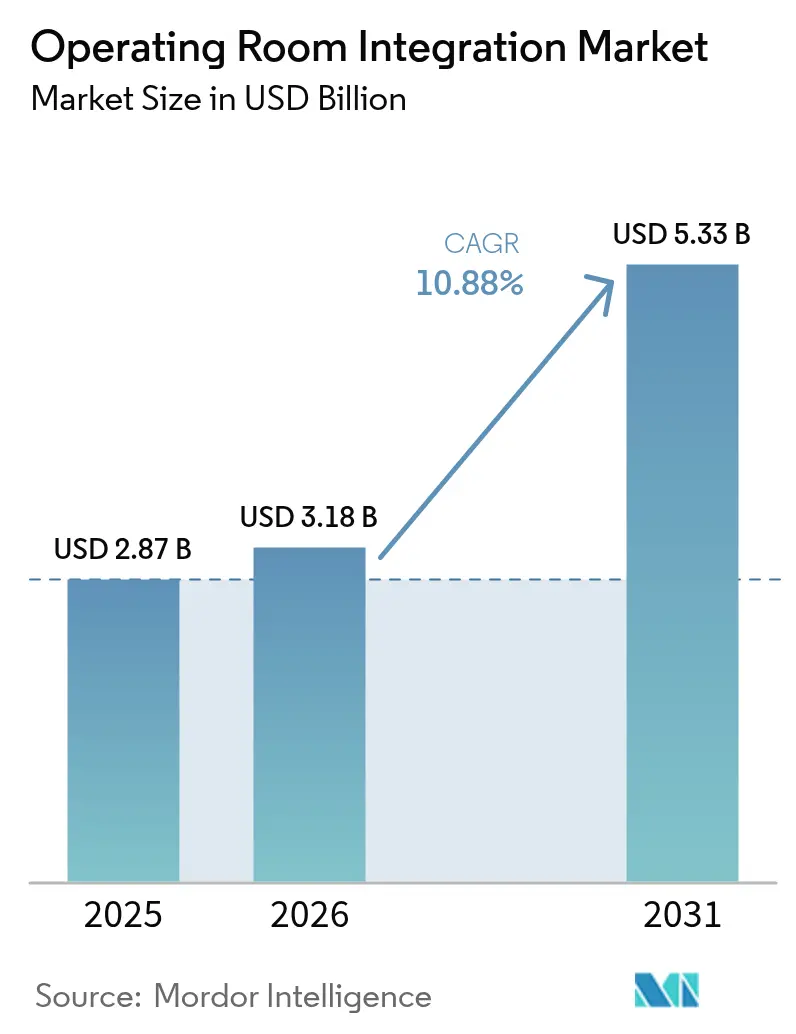
| Market Size (2026) | USD 3.18 Billion |
| Market Size (2031) | USD 5.33 Billion |
| Growth Rate (2026 - 2031) | 10.88 % |
| Fastest Growing Market | Asia-Pacific |
| Largest Market | North America |
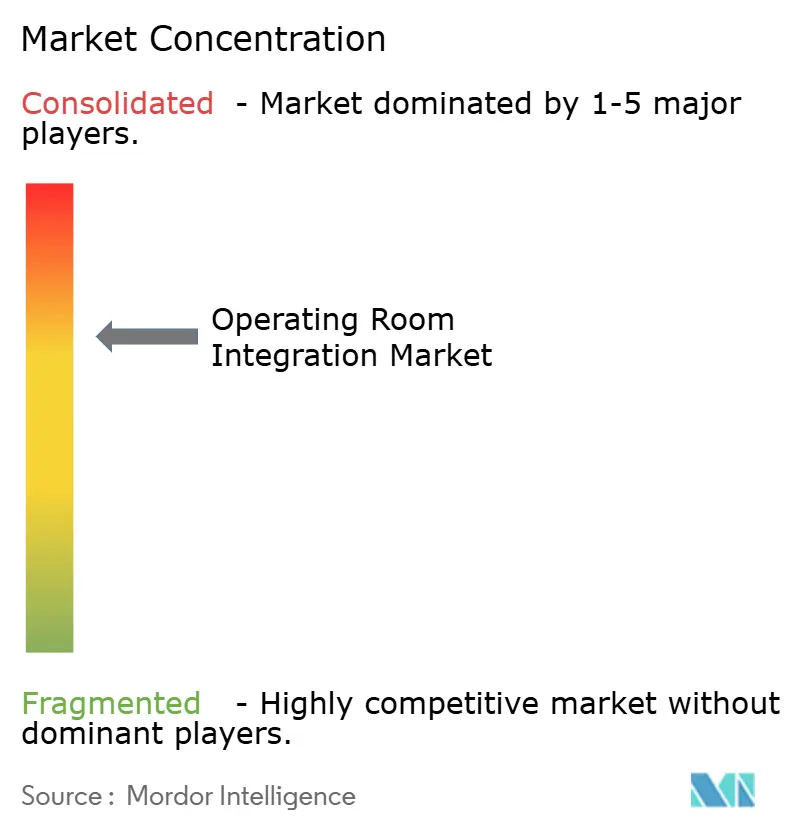
| Market Concentration | Medium |
Major Players *Disclaimer: Major Players sorted in no particular order Image © Mordor Intelligence. Reuse requires attribution under CC BY 4.0. | |
Operating Room Integration Market Analysis by Mordor Intelligence
The operating room integration market size is expected to grow from USD 2.87 billion in 2025 to USD 3.18 billion in 2026 and is forecast to reach USD 5.33 billion by 2031 at 10.88% CAGR over 2026-2031. The growth reflects hospitals’ shift from isolated device purchases toward fully connected surgical suites that orchestrate imaging, video, robotics, and data analytics in real time.[1]American Hospital Association, “Tackling the Surgical Backlog,” aha.org Fast-tracked recovery plans for elective procedures, rising adoption of minimally invasive surgery, and the push to eliminate avoidable delays in the peri-operative pathway underpin the expansion trajectory. Software platforms now eclipse hardware as the value driver, while hybrid operating rooms gain favor for accommodating complex therapies in a single setting. Simultaneously, Asia-Pacific’s modernization programs position the region as the fastest riser, even as North America maintains the largest installed base. Amid these dynamics, vendors pivot from selling standalone equipment to delivering outcome-oriented digital partnerships that blend software, services, and AI.
Key Report Takeaways
- By component, software solutions led with a 44.12% revenue share in 2025; services are projected to post the highest 14.57% CAGR through 2031.
- By application, general surgery commanded 36.25% of the operating room integration market share in 2025, while neurosurgery is set to advance at a 13.22% CAGR to 2031.
- By end-user, large hospitals held 57.92% share of the operating room integration market size in 2025; ambulatory surgical centers (ASCs) will expand fastest at a 13.98% CAGR.
- By OR type, hybrid rooms accounted for 50.86% of 2025 revenue and are poised to grow at a 15.02% CAGR.
- By geography, North America retained 39.12% market share in 2025; Asia-Pacific is projected to register a 13.94% CAGR through 2031.
Note: Market size and forecast figures in this report are generated using Mordor Intelligence’s proprietary estimation framework, updated with the latest available data and insights as of 2026.
Market Trends and Insights
Drivers Impact Analysis of Operating Room Integration Market*
| Driver | (~) % Impact on CAGR Forecast | Geographic Relevance | Impact Timeline |
|---|---|---|---|
| Rise in number of surgical procedures | +2.8% | Global (notably NA & APAC) | Medium term (2-4 years) |
| Uptake of minimally invasive & image-guided surgery | +2.1% | North America & Europe; expanding in APAC | Short term (≤ 2 years) |
| Hospital investments in digital/IoT-enabled ORs | +1.9% | Global; led by North America & Europe | Medium term (2-4 years) |
| Post-pandemic backlog reduction programs | +1.6% | North America & Europe | Short term (≤ 2 years) |
| IP-based 4K/8K video routing for collaboration | +1.4% | Early uptake in developed markets | Long term (≥ 4 years) |
| ESG-driven demand for energy-efficient ORs | +1.0% | Europe & North America; emerging in APAC | Long term (≥ 4 years) |
| Source: Mordor Intelligence | |||
Rise in Number of Surgical Procedures
Hospitals worldwide are booking fuller operating schedules as aging populations and chronic conditions fuel procedure demand. Integrated workflow software helps teams turn over theatres faster, allocate instruments efficiently, and shorten anesthesia times. The payoff is clearest in robot-assisted cases where platforms such as da Vinci Xi achieve accuracy above 90%, sharply reducing costly revisions and freeing capacity for additional patients.[2]Luthfi Gatam et al., “Robotic Pedicle Screw Placement for Minimal Invasive Thoracolumbar Spine Surgery,” Frontiers in Surgery, frontiersin.org These throughput gains make operating room integration market implementations financially attractive, particularly for systems facing strained staffing and reimbursement pressures.
Rapid Uptake of Minimally Invasive & Image-Guided Surgeries
Laparoscopic and endovascular techniques require simultaneous visualization of high-resolution video, fluoroscopy, and navigation data. Augmented-reality overlays have improved precision in microsurgical fields and neurosurgery, streamlining complex instrument maneuvers.[3]James Zhang et al., “The Impact of Extended Reality on Surgery: A Scoping Review,” Springer, springer.comHospitals therefore prioritize interoperable video routing, low-latency image processing, and sterile touch interfaces, all of which propel the operating room integration market.
Hospital Investments in Digital/IoT-Enabled OR Platforms
Three-quarters of executives label OR digitization “critical,” yet many still underfund it. Systems now monitor device usage and environmental variables, generating analytics that flag idle assets or abnormal workflow bottlenecks. Cybersecurity spending has risen to as much as 10% of IT budgets as ransomware attacks highlight risks to connected theatres. The drive to safeguard data while unlocking predictive insights strengthens demand for integrated, standards-based architectures.
Post-Pandemic Backlog Reduction Programs
North American and European health networks extended OR hours, created high-intensity theatre lists, and redirected lower-risk cases to ASCs. Reinforcement-learning scheduling engines outperformed manual block-allocation methods in clearing backlogs efficiently.[4]Sam M. Wiseman and Jason M. Sutherland, “Improving the Quality of Care of Canadians Waiting for Elective Surgery,” Canadian Journal of Surgery, canjsurg.ca These experiences cemented the role of centralized scheduling dashboards and digital case carts, further lifting the operating room integration market.
Restraints Impact Analysis of Operating Room Integration Market*
| Restraint | (~) % Impact on CAGR Forecast | Geographic Relevance | Impact Timeline |
|---|---|---|---|
| High capital & lifecycle maintenance costs | -1.8% | Global; acutely felt by smaller hospitals | Medium term (2-4 years) |
| Lengthy procurement cycles & budget freezes | -1.2% | Europe & Canada; select US public systems | Short term (≤ 2 years) |
| Shortage of biomedical IT personnel | -0.9% | Global; severe in rural areas | Long term (≥ 4 years) |
| Cybersecurity & data-privacy risks | -0.7% | Global; regulation varies | Medium term (2-4 years) |
| Source: Mordor Intelligence | |||
High Capital & Lifecycle Maintenance Cost of OR Integration
Beyond initial hardware, hospitals must fund software licenses, patch management, and staff retraining, often surpassing upfront spend over a decade. Smaller campuses with limited surgical throughput struggle to clear return-on-investment thresholds, slowing penetration in community settings.
Lengthy Procurement Cycles & Budget Freezes in Public Hospitals
Compliance with multi-year capital plans and competitive tender laws can push installations 18–24 months beyond initial scope. European facilities face additional scrutiny on interoperability and sustainability, prolonging bid evaluations.
*Our forecasts treat driver/restraint impacts as directional, not additive. The impact forecasts reflect baseline growth, mix effects, and variable interactions.
Operating Room Integration Market Segment Analysis
By Component:
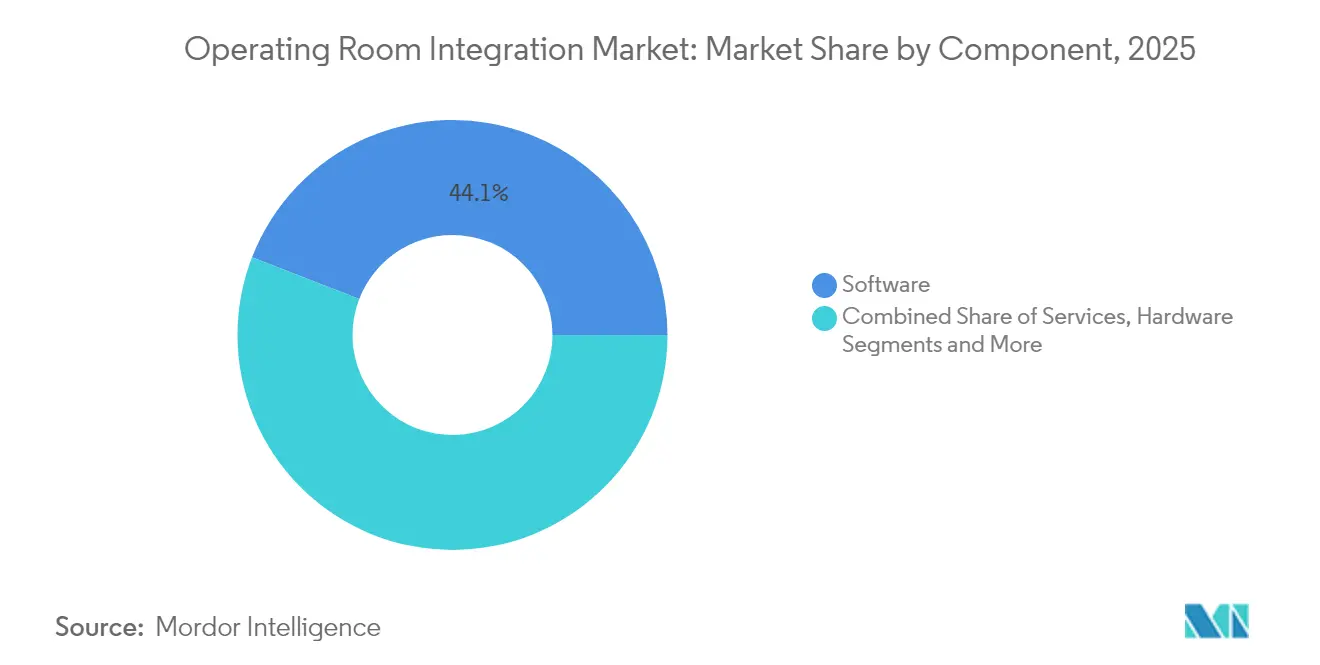
Software Leads an Analytics RevolutionSoftware accounted for 44.12% of 2025 revenue, underscoring the migration from cabling and routers toward data orchestration, workflow guidance, and AI-based predictive alerts. Service contracts are forecast to rise at a 14.57% CAGR as customers recognize that every upgrade introduces change-management and cybersecurity tasks best handled by specialists. In contrast, commoditized hardware such as ceiling booms and monitor arms delivers solid but slower growth. The operating room integration market size for services is projected to expand from USD 1.28 billion in 2025 to USD 2.9 billion by 2031, mirroring the industry’s pivot to recurring revenue. AI-enabled platforms, including KARL STORZ’s Artisight collaboration, reveal how real-time analytics lower turnover times and elevate staff satisfaction.
Purpose-built middleware integrates multi-vendor imaging, anesthesia records, and pathology reports into a unified timeline that surgeons can query intra-operatively. Hospitals cite automated preference-card management and predictive device servicing as the top two software benefits. These capabilities reinforce the view that the operating room integration market will reward vendors that deliver open APIs, granular cybersecurity controls, and intuitive dashboards rather than isolated display routers.



By Application:
Neurosurgery Complexity Drives DemandGeneral surgery commanded 36.25% revenue share in 2025 due to sheer case volume, yet neurosurgery will grow fastest at a 13.22% CAGR as frameless navigation, robotic scaffolds, and intra-operative CT imaging become routine. The operating room integration market size associated with neurosurgery is projected to nearly double by 2031. Integrated guidance systems have already pushed pedicle-screw placement accuracy to 99% in hybrid rooms, slashing revision operations and radiation exposure.
Cardiovascular, orthopedics, and urology maintain healthy shares, but their growth hinges on procedure migration to outpatient and catheter-based labs. Neurosurgery’s insistence on zero-latency imaging, redundant power, and vibration control makes it the bellwether for next-generation suite specifications. Hospitals aligning early with this trajectory future-proof their investment and solidify referral pipelines, supporting wider growth in the operating room integration market.
By End-User:
ASCs Accelerate Outpatient IntegrationLarge tertiary hospitals held 57.92% of revenue in 2025, but ASCs represent the fastest 13.98% CAGR as policymakers lift inpatient-only restrictions on joint arthroplasty and other high-value procedures. The operating room integration market share for ASCs is set to climb steadily as outpatient volumes approach 44 million cases by 2034.
ASCs demand compact, cloud-managed consoles that minimize floor space and simplify infection control. Vendors that package video routing, anesthesia charting, and remote proctoring into subscription bundles gain traction by lowering upfront capital. For small hospitals, managed-service contracts that outsource IT maintenance become the entry point to advanced integration, broadening the operating room integration market footprint.
By OR Type:
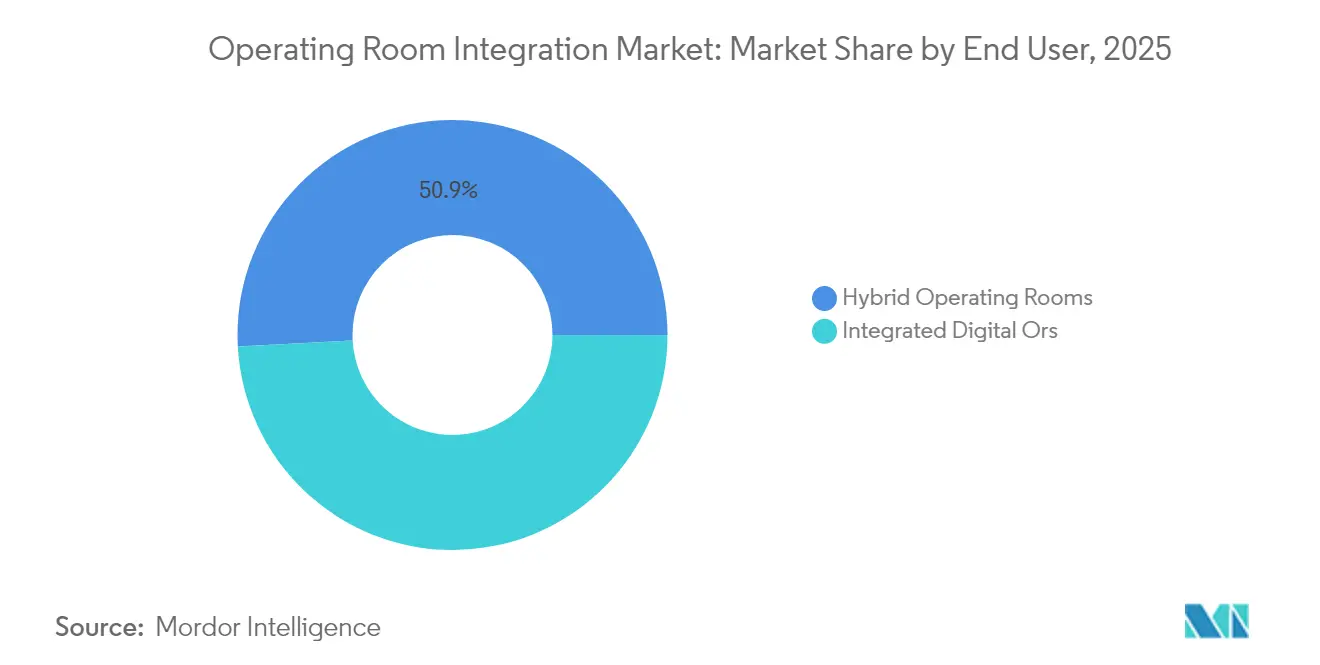
Hybrid Rooms Lead InnovationHybrid theatres combined interventional radiology, CT, or angiography with open surgery tools to capture 50.86% revenue in 2025 and to log the strongest 15.02% CAGR. The operating room integration market size for hybrid rooms benefits from their ability to support stroke thrombectomy, endovascular aortic repair, and complex spine fusion in a single session. Sites in challenging geographies, such as Tibet, report meaningful reductions in complication rates after installing hybrid suites equipped with robot-assisted positioning and real-time fluoroscopy.
While classic integrated digital ORs suffice for high-volume general surgery, forward-looking hospitals view hybrid configurations as an essential hedge against case-mix shifts. The higher ticket size also attracts vendors eager to bundle software, imaging, and robotics, further concentrating the operating room integration market opportunity.
Geography Analysis
North America Operating Room Integration Market
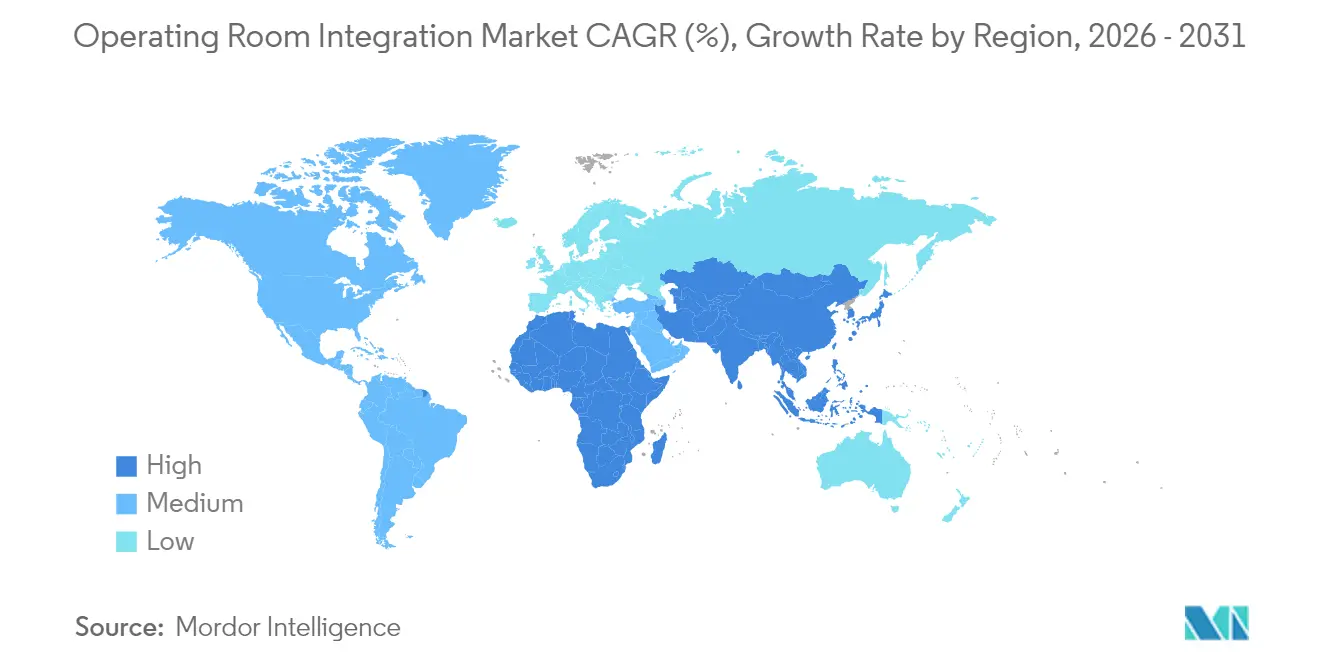
North America retained 39.12% of 2025 revenue on the back of entrenched hospital networks, reimbursement clarity, and early adoption of digital health mandates. Systems leverage predictive scheduling tools to recapture elective volumes that fell during the pandemic. The operating room integration market size in the United States alone surpassed USD 1.1 billion in 2025. Canada’s publicly funded model adds momentum through national backlog-reduction funds that earmark capital for integrated theatres.
Europe Operating Room Integration Market
Europe remains a mature yet innovative cluster. Sustainability directives spur replacement of legacy halogen lighting with LED arrays and demand life-cycle assessments for every large capital project. High-profile programs such as Germany’s Hospital Future Act disburse grants for interoperability upgrades, sustaining steady adoption. Meanwhile, stringent procurement laws lengthen decision cycles, tempering the operating room integration market’s growth rate relative to North America.
APAC Operating Room Integration Market
Asia-Pacific represents the breakout region with a forecast 13.94% CAGR. China’s public hospitals scale AI-enabled smart wards and adopt hybrid theatres to handle rising vascular and oncology caseloads. Japan advances showcase projects like Sapporo Kashiwabakai Hospital, where Siemens Healthineers engineered a fully digital, patient-centric “Smart‐OR” that shortens emergency transfer times. India and Southeast Asia emphasize modular, cost-optimized suites suited to constrained budgets but high procedure growth, broadening the operating room integration market.
LATAM and MEA Operating Room Integration Market
Latin America and the Middle East & Africa post modest uptake impeded by currency volatility and infrastructure gaps. Nonetheless, selected private groups invest strategically to attract medical tourism and retain top surgical talent, laying the groundwork for future expansion.

Regulatory Landscape
Operating room integration solutions that include device control, imaging/video routing, and embedded software are typically handled under medical device oversight, with US products frequently classified under 21 CFR Part 878 depending on intended use and function, which can trigger FDA Class II requirements and 510(k) premarket notification pathways. In the European Union, the Medical Device Regulation (EU MDR 2017/745) raises expectations for medical device software validation and quality management, including lifecycle processes aligned with IEC 62304, which affects how vendors document cybersecurity, software updates, and interoperability claims for integrated OR platforms.
Two 2026 updates sharpen compliance expectations for integrated, software-heavy OR environments. In July 2026, the IEC published IEC 60601-1:2026 series updates for medical electrical equipment safety and essential performance, reinforcing test and documentation needs across integrated OR electrical systems. Separately in 2026, EU MDR Annex XVI provisions moved further into enforcement for certain products without an intended medical purpose that can be used in surgical environments, increasing scrutiny on embedded software and control functions used in equipment such as surgical lights, cameras, and digital tables when software functions influence clinical use or safety, pushing manufacturers toward more formal certification and post-market controls.
Value Chain Analysis
The operating room integration value chain starts with upstream component suppliers and platform enablers, including medical-grade displays, cameras, lighting, booms, and network infrastructure, plus cybersecurity and cloud or edge compute building blocks. Midstream, OEMs and software vendors, including Stryker, KARL STORZ, STERIS, Getinge, and EHR providers such as Oracle Health, assemble integration suites that combine video management, device control, workflow orchestration, and data capture, then map those functions to standards-based connectivity and hospital IT requirements. Downstream, channel partners and system integrators deliver design, installation, validation, and training, followed by recurring services for software updates, cybersecurity hardening, and uptime support across multi-vendor environments.
Value capture is increasingly concentrated in software, implementation services, and ongoing optimization rather than one-time hardware sales, reflecting hospitals' shift from isolated device procurement to connected suites. Recent ecosystem moves illustrate this direction. In June 2026, Oracle Health partnered with Theator to embed AI-powered surgical intelligence into Oracle Health workflows, tying OR video and analytics to documentation and EHR processes. In May 2026, Johnson and Johnson partnered with the Department of Health - Abu Dhabi to stand up an intelligent surgical network using its Polyphonic ecosystem across multiple provider groups. Bottlenecks remain around interoperability across scheduling, sterile processing, and implant inventory systems, alongside on-site constraints such as OR space, network readiness, and the availability of biomedical IT staff to maintain secure, low-latency environments.
Competitive Landscape
The operating room integration industry is moderately fragmented. Legacy device makers such as Stryker, KARL STORZ, and STERIS pivot toward platform-centric portfolios combining software orchestration, managed services, and cybersecurity. Stryker bundles its iSuite offering with voice-activated control, AI-enhanced surgical video analytics, and robotics to reinforce account stickiness. KARL STORZ’s alliance with NVIDIA and Artisight exemplifies the shift from proprietary hardware toward cloud-native AI ecosystems.
Emerging software specialists emphasize vendor-agnostic connectivity, offering lightweight subscription models that appeal to ASCs and mid-tier hospitals. Olympus teamed with Proximie to deliver secure, real-time video collaboration, extending its presence beyond endoscopes to encompass virtual mentoring and digital asset management. Brainlab’s planned Frankfurt IPO aims to finance expansion of its digital surgery platform across orthopedics and cardiovascular applications, signaling investor confidence in service-heavy revenue streams.
Partnerships predominate as firms recognize that no single vendor can supply imaging, navigation, robotics, cybersecurity, and analytics at scale. The resulting ecosystem approach nurtures cross-licensing and white-label arrangements, progressively tightening interoperability standards and accelerating consolidation within the operating room integration market.
Operating Room Integration Industry Leaders
Stryker Corporation
Olympus Corporation
KARL STORZ SE & Co. KG
STERIS plc
Getinge AB
- *Disclaimer: Major Players sorted in no particular order
Operating Room Integration Market Companies Covered in this Report
- Stryker
- Karl Storz
- STERIS
- Olympus
- Getinge
- Brain Lab
- Canon
- Merivaara
- Skytron
- Doricon Medical Systems
- Barco NV
- Sony Medical Solutions
- EIZO Corp.
- Baxter
- Richard Wolf
- Koninklijke Philips
- Siemens Healthineers
- Conmed
- B. Braun
- Zimmer Biomet

Market Opportunities and Future Outlook
One whitespace is the operationalization of AI and ambient intelligence as core layers of OR integration, rather than standalone pilots, particularly when platforms connect video, device telemetry, and documentation into the EHR. The shift is supported by evidence such as Oracle Health's June 2026 partnership with Theator to bring AI-powered surgical intelligence and automation into Oracle Health customer workflows, and Ambient's July 2026 expansion of its ambient AI platform, reported as active in 450 procedural rooms across North America and Europe. Vendors that package governance, cybersecurity controls, and workflow change management alongside AI can address demand in both large hospitals and fast-growing ASC environments where staffing constraints and turnover-time variability remain pain points.
Another opportunity is standards-based interoperability and multi-site surgical networks that connect multiple hospitals and procedural rooms under shared operating models. In May 2026, the Department of Health - Abu Dhabi and Johnson and Johnson established an emirate-wide intelligent surgical network using the Polyphonic digital ecosystem, linking providers such as Cleveland Clinic Abu Dhabi and NMC Healthcare, and reflecting buyer preference for scalable, vendor-agnostic connectivity and centralized analytics. On the technical side, ISO/IEEE 11073-10700:2024 (Service-oriented Device Connectivity, SDC) and the IHE SDPi profile provide concrete frameworks for plug-and-play device-to-IT connectivity, creating room for integration vendors that can certify interoperability, reduce custom interface work, and simplify validation for hybrid rooms and digitally integrated ORs.
Recent Industry Developments in Operating Room Integration Market
- June 2026: Oracle Health and Theator announced a collaboration to extend AI into the operating room, integrating surgical intelligence and video analytics with Oracle Health workflows using Oracle Cloud Infrastructure. The effort links intraoperative content to documentation and EHR processes, strengthening the role of EHR platforms as hubs for OR integration and analytics-driven services.
- July 2025: Brainlab AG filed for a Frankfurt Stock Exchange IPO to fund expansion of its digital surgery and integrated OR platform footprint. The filing highlighted investor interest in software- and service-led surgical workflows and supports competitive momentum among platform vendors targeting multi-specialty integration.
- April 2024: LEM Surgical obtained FDA 510(k) clearance for its Dynamis Robotic Surgical System, expanding regulated robotic options for hard-tissue procedures. Clearance supports broader integration of robotics into connected surgical suites, increasing demand for interoperable device control, visualization, and workflow coordination.


Operating Room Integration Market Report Scope and Research Methodology
Market Definition and Coverage
For this report, the operating room integration market is defined as the revenue earned from solutions that connect OR devices, video, audio, imaging, and workflow tools into a centrally managed surgical environment used during procedures.
Scope exclusions: Standalone OR equipment purchases and general hospital IT systems are excluded when they are not sold or deployed as part of an integrated OR solution.
Segments Covered in This Report
- By Component
- Software
- Services
- Hardware (AV management, surgical displays, OR booms, lights)
- By Application
- General Surgery
- Orthopedic Surgery
- Cardiovascular Surgery
- Neurosurgery
- Urology & Gynecology
- By End-User
- Large Hospitals (≥500 beds)
- Small & Mid-size Hospitals (<500 beds)
- Ambulatory Surgical Centers (ASCs)
- By OR Type
- Hybrid Operating Rooms
- Integrated Digital ORs (non-hybrid)
- By Geography
- North America
- United States
- Canada
- Mexico
- Europe
- Germany
- United Kingdom
- France
- Italy
- Spain
- Rest of Europe
- Asia-Pacific
- China
- Japan
- India
- Australia
- South Korea
- Rest of Asia-Pacific
- Middle East and Africa
- GCC
- South Africa
- Rest of Middle East and Africa
- South America
- Brazil
- Argentina
- Rest of South America
- North America
Data Sources, Market Sizing, and Validation
Desk Research
Desk research helped us set the practical market boundary and build the first set of assumptions on procedure volumes, hospital capacity, and tech adoption in surgical suites. We referred to public healthcare system statistics and hospital utilization releases, such as CDC and CMS datasets, OECD health statistics, and WHO health expenditure indicators. When we needed context on surgery backlogs and capacity plans, sources such as AHA updates and selected peer-reviewed clinical and health IT journals were used to align demand-side signals.
On the supply side, we reviewed company filings, annual reports, investor decks, and press releases to map product positioning and typical selling models (capital sale, software, and services). Patent databases were used in a light way to track where integration functions were trending, which then guided the questions used in primary calls. We also used paid subscriptions for company financials and news to improve coverage for private or less transparent suppliers and to validate timelines for major contracts and product launches. These are illustrative sources only, and we used additional references for data collection, validation, and clarification during the study.
Primary Interviews and Surveys
Primary interviews and surveys were used to pressure test adoption rates, typical project sizes, and pricing progression for OR integration across different hospital tiers and ambulatory surgery settings. We spoke with a mix of OEM-side leaders, system integrators, distributors, clinical engineering, and OR managers so gaps from desk research could be filled with real procurement and deployment patterns. Because this is a global title, feedback was balanced across APAC, EMEA, and the Americas to avoid overfitting the model to one reimbursement or capital budgeting cycle.
Distribution of primary research fieldwork respondents
| Company type | Respondent position | Region |
|---|---|---|
| Top tier: 30% | CXOs: 13% | APAC: 41% |
| Mid tier: 56% | Functional/Unit leaders: 34% | EMEA: 35% |
| Smaller Players: 14% | Managers: 53% | Americas: 24% |
Market-Sizing & Forecasting
Market sizing started with a top-down build that reconstructs the demand pool from hospital and ASC procedure volumes, the share of surgeries occurring in equipped OR suites, and the penetration of integrated digital or hybrid OR setups across regions. To keep the model grounded, we corroborated the results using selective bottom-up approximations, such as sampled project pricing for integration platforms, software, and services, followed by channel checks on typical multi-room rollout patterns.
Key inputs used in the model included elective and complex surgery growth, hybrid OR build-outs linked to imaging and cardiovascular procedures, hospital capex cycles, the mix shift between hardware, software, and services, and replacement or upgrade timing for installed AV and visualization systems. Where direct volume signals were missing, for example limited visibility on smaller hospital refresh cadence, we used conservative adoption bands and then adjusted them based on repeated interview feedback from clinical engineering and procurement roles. Forecasting relied mainly on scenario analysis so that near-term capital budgeting shifts, procedure backlog normalization, and technology refresh cycles could be reflected without forcing a single smooth growth line.
Data Validation & Update Cycle
Validation was done through triangulation across independent demand signals and supply indicators, and then through cross-checks that flag unusual jumps in ASPs, adoption, or regional splits. When an outlier appeared, we reopened the assumptions, rechecked supporting documents, and triggered expert follow-ups to confirm what changed on the ground. Before sign-off, the model and outputs were reviewed in multiple analyst passes so that unit logic, currency conversions, and time-series consistency were aligned.
Reports are refreshed annually, and interim updates are made when material events occur, such as large hospital modernization programs, policy shifts affecting capital spending, or major platform releases that change typical pricing. Right before delivery, we run a final update pass so clients receive the latest view tied to the same repeatable steps.
Mordor Intelligence's Operating Room Integration Market Size Compared With Other Published Estimates
Published market sizes for operating room integration can differ because each publisher makes its own choices on what to count as integration revenue and how to treat multi-year hospital projects. Timing also affects the reported number, since currency conversion year, procurement delays, and software subscription recognition can shift results even when underlying demand stays similar.
Some estimates expand the scope to include broader operating room equipment or general surgical IT that sits near the OR but is not sold as an integrated suite. In Mordor Intelligence, revenues are counted only when hardware, software, or services are delivered as part of an OR integration program (including hybrid and integrated digital OR types), and standalone device sales are not added into the total.
Benchmark comparison
| Source | Market Size | Gaps in Research Methodology |
|---|---|---|
| Mordor Intelligence | USD 3.18 B (2026) | |
| Global Consultancy A | USD 3.60 B (2026) | Uses a wider bundle that can fold in adjacent OR hardware and broader digital surgery infrastructure, and it often applies higher attach rates per OR without consistent checks against suite-level rollout patterns. |
| Industry Association B | USD 2.70 B (2025) | Represents a conservative view anchored to reported projects and member visibility, which can undercount smaller tenders and service renewals, and it may not normalize currency timing consistently across regions. |
The comparison shows that the spread comes mostly from scope and revenue recognition choices, not from a disagreement that integration is growing. By tying the total to procedure-linked demand, OR type adoption, and realistic project pricing bands that are rechecked in interviews, the estimate stays traceable and repeatable for planning decisions.


Key Questions Answered in the Report
What is the current operating room integration market size?
The operating room integration market size reached USD 3.18 billion in 2026.
How fast is the operating room integration market expected to grow?
It is forecast to register a 10.88% CAGR, climbing to USD 5.33 billion by 2031.
Which component segment is expanding the quickest?
Services are projected to rise at a 14.57% CAGR because hospitals seek ongoing optimization and support for integrated suites.
Why are hybrid operating rooms gaining momentum?
Hybrid rooms combine surgical and interventional capabilities, capturing 50.86% revenue in 2025 and growing fastest at 15.02% CAGR due to their versatility in complex procedures.
Which region presents the highest growth potential?
Asia-Pacific is poised for a 13.94% CAGR as governments invest in healthcare modernization and procedure volumes climb.
Page last updated on:





