
Market Overview
| Study Period | 2020 - 2031 |
|---|---|
| Forecast Data Period | 2026 - 2031 |
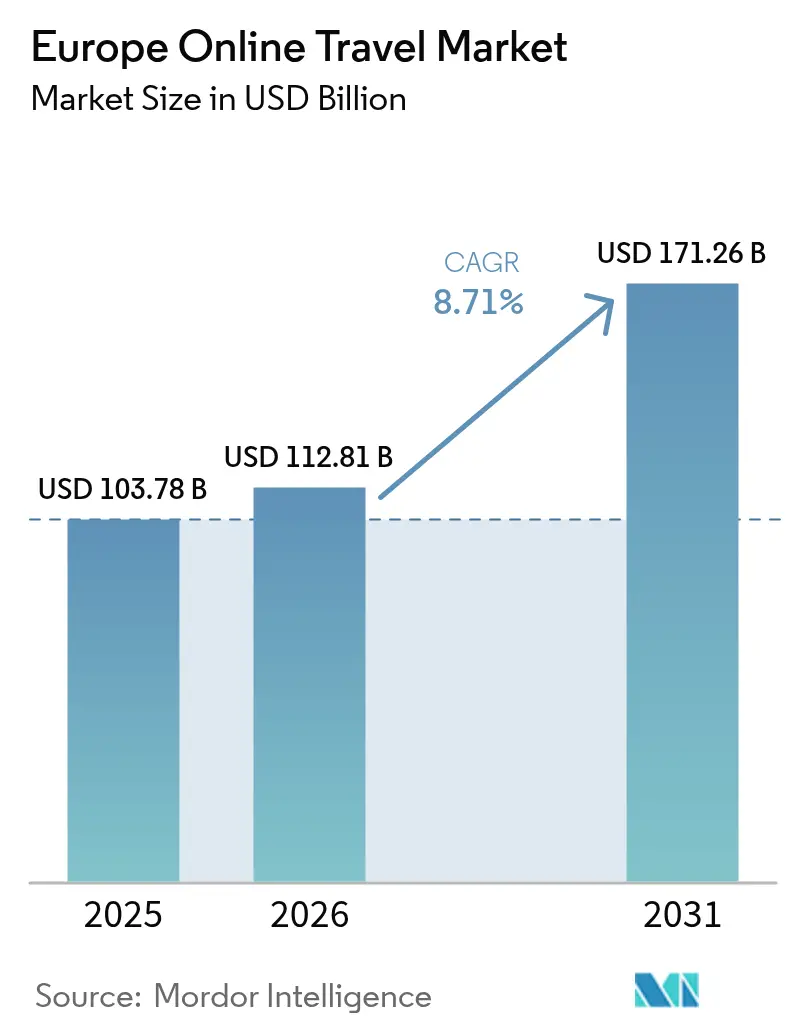
| Base Year Market Size (2025) | USD 103.78 Billion |
| Market Size (2026) | USD 112.81 Billion |
| Market Size (2031) | USD 171.26 Billion |
| Growth Rate (2026 - 2031) | 8.71 % |
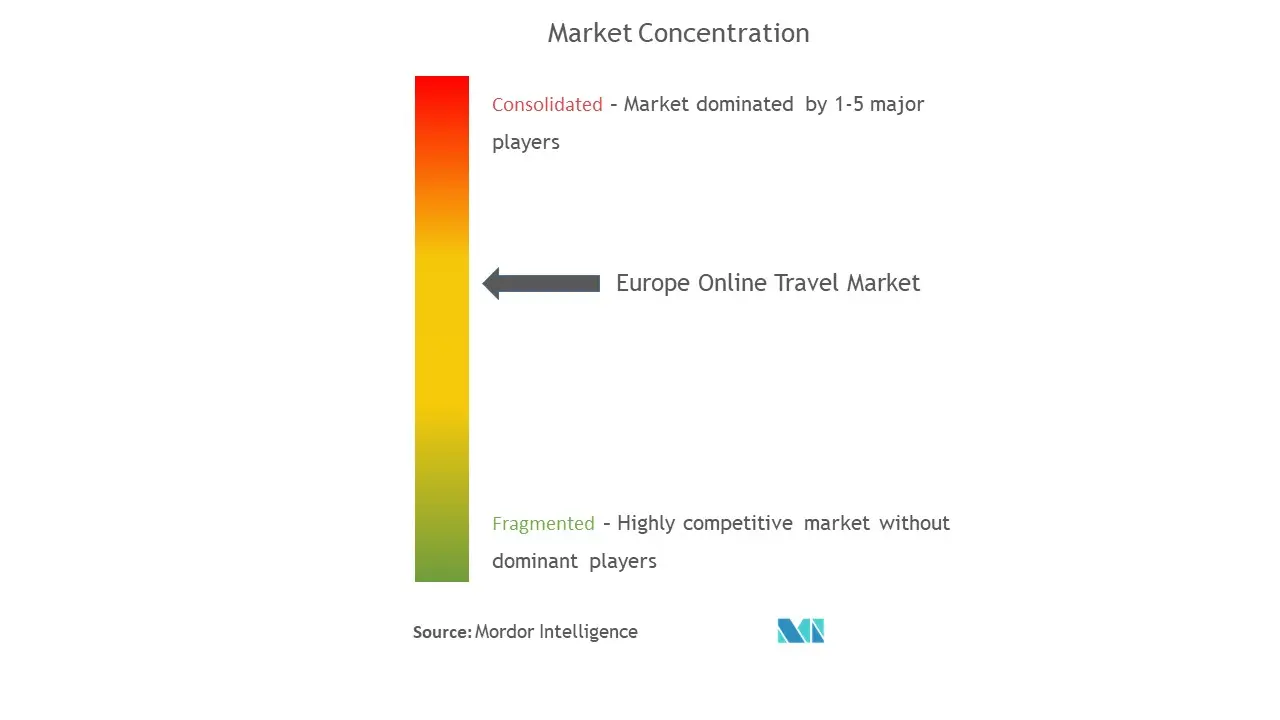
| Market Concentration | Medium |
Major Players *Disclaimer: Major Players sorted in no particular order Image © Mordor Intelligence. Reuse requires attribution under CC BY 4.0. | |
Europe Online Travel Market Analysis by Mordor Intelligence
The Europe online travel market size was valued at USD 103.78 billion in 2025 and estimated to grow from USD 112.81 billion in 2026 to reach USD 171.26 billion by 2031, at a CAGR of 8.71% during the forecast period (2026-2031). This expansion is powered by post-pandemic rebound in intra-European and long-haul tourism, intensifying mobile-first booking behaviours, and regulatory catalysts such as the forthcoming EU Digital Identity Wallet that promises one-click authentication across borders. Heightened airline adoption of New Distribution Capability (NDC) protocols is redistributing pricing power toward carriers, while generative-AI trip-planning tools funnel search intent directly into bookable inventory, shortening the booking funnel for both consumers and suppliers. Competitive dynamics remain moderate because the top five companies hold just 48.9% of revenue, leaving ample space for differentiated entrants specializing in sustainable travel, multimodal transport, and hyper-localized experiences. Meanwhile, spiralling traffic-acquisition costs driven by the Digital Markets Act force leading OTAs to rethink marketing mixes, emphasizing loyalty ecosystems and subscription programs over purely search-driven growth. Taken together, these macro forces establish a resilient demand base for the Europe online travel market despite regulatory headwinds and intensifying supplier-direct campaigns.
Key Report Takeaways
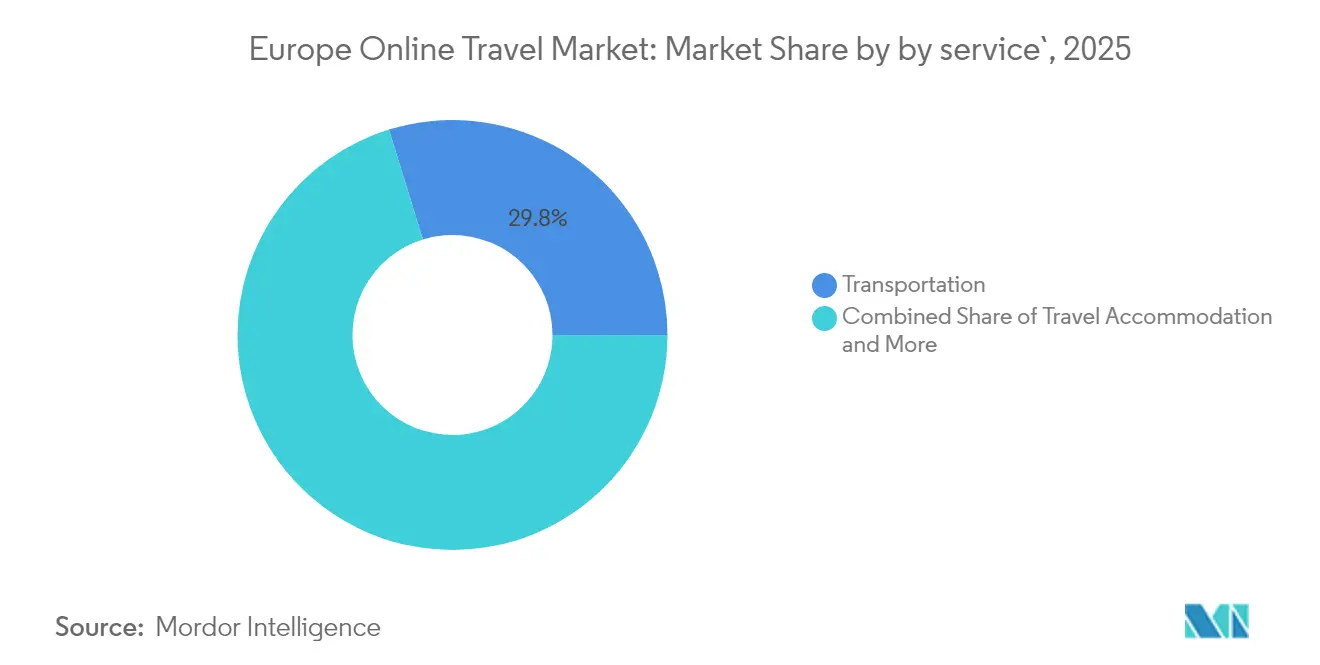
- By service type, transportation captured 29.78% of Europe online travel market share in 2025, whereas vacation packages are on track for the fastest 11.86% CAGR through 2031.
- By booking type, direct suppliers commanded 54.02% share of the Europe online travel market size in 2025, but OTAs are forecast to expand at a 9.05% CAGR between 2026 and 2031.
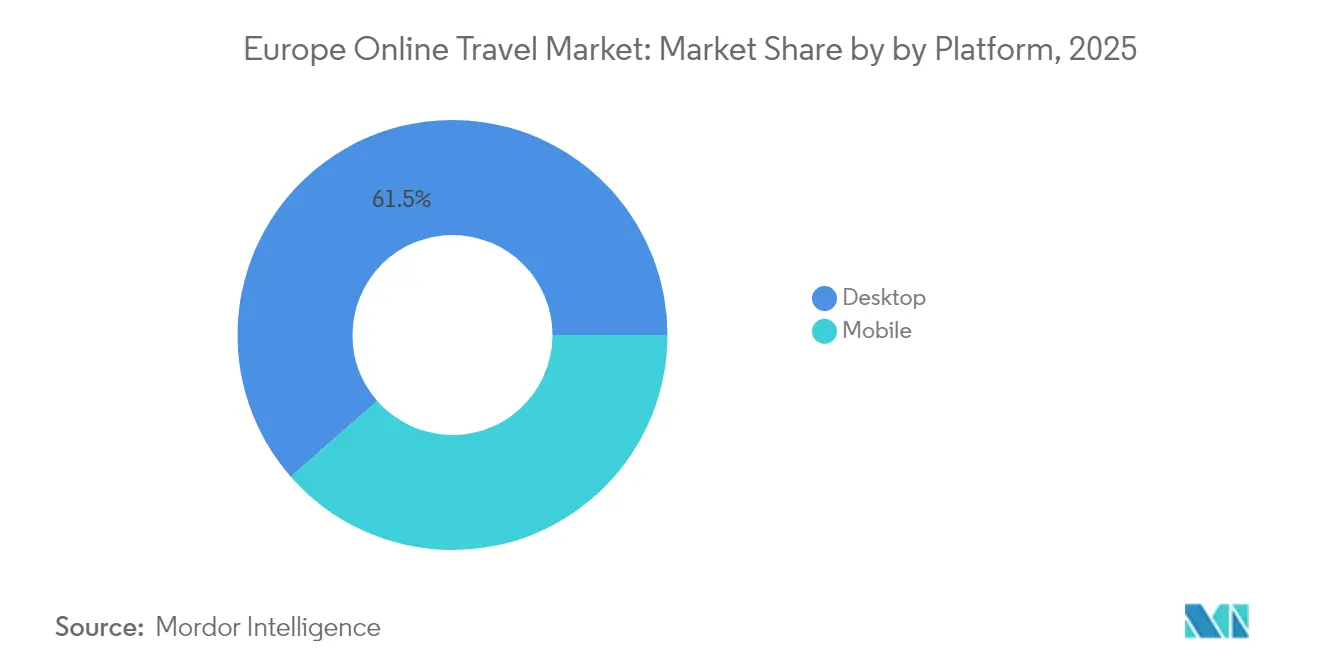
- By platform, desktop bookings led with 61.45% share of the Europe online travel market size in 2025, while mobile is projected to post the highest 13.12% CAGR through 2031.
- By geography, the United Kingdom held the largest 21.05% contribution to the Europe online travel market in 2025, whereas Spain is primed for the strongest 11.58% CAGR to 2031.
Note: Market size and forecast figures in this report are generated using Mordor Intelligence’s proprietary estimation framework, updated with the latest available data and insights as of 2026.
Market Trends and Insights
Drivers Impact Analysis of Europe Online Travel Market*
| Driver | (~) % Impact on CAGR Forecast | Geographic Relevance | Impact Timeline |
|---|---|---|---|
| Post-pandemic rebound in intra-European and long-haul tourism | +2.1% | UK, Germany, France, Spain | Short term (≤ 2 years) |
| Surge in mobile booking penetration and in-app payments | +1.8% | Europe-wide; Nordic and BENELUX hot spots | Medium term (2 – 4 years) |
| EU Digital Identity Wallet enabling one-click checkout | +1.2% | EU-27 pilot markets first | Medium term (2 – 4 years) |
| Generative-AI trip-planning bots accelerating conversion | +1.5% | Germany, UK, Netherlands | Long term (≥ 4 years) |
| Liberalised high-speed rail & multimodal ticketing APIs widen online transport inventory | +1.3% | France, Germany, Spain, cross-border EU | Medium to Long term (2–5 years) |
| Lifestyle & hybrid hotel formats using API-first distribution | +1.0% | Urban hubs across Western & Central Europe | Medium term (2–4 years) |
| Source: Mordor Intelligence | |||
Post-pandemic tourism rebound
France welcomed more than 100 million international visitors in 2024, surpassing pre-crisis highs and setting a benchmark for the Europe online travel market[1]. Spain followed suit with 94 million foreign arrivals, a surge that lifted travel receipts and fueled online booking demand, particularly for higher-yield long-haul segments originating in North America. UK-bound inbound tourism reached record spending levels, reinforcing demand for dynamic packaging services that combine flights, hotels, and rail. Long-haul markets such as China demonstrated 40% growth in nights spent in France, signalling renewed appetite for European itineraries despite revenue remaining below 2019 benchmarks. Business travel remains subdued, but hybrid leisure-business (bleisure) itineraries are rising, causing suppliers to revamp loyalty programs around extended-stay rewards. The rebound underscores a structural pivot toward flexible digital channels as travelers prioritize real-time availability over traditional agency visits.
Mobile booking penetration
Mobile devices manage a growing share of transactions as European consumers integrate digital wallets and contactless payments into everyday life. Nordic countries, where mobile wallet usage exceeds 75%, illustrate how seamless payments accelerate app conversion rates. Booking Holdings reported double-digit mobile booking growth after deploying micro-personalization features that adjust inventory display to user context. Rail-first app Trainline now accounts for most European rail bookings, demonstrating how frictionless mobile UX can unlock highly fragmented transport markets. App-first challenger Omio launched Flex across continental markets, allowing travelers to change itineraries post-purchase, reinforcing the appeal of mobile-centric flexibility. Payment-method diversity from Apple Pay in Germany to Bizum in Spain compels platforms to localize checkout, driving further investment into payment orchestration middleware.
EU Digital Identity Wallet
The EU Digital Identity Wallet scheduled for 2026 rollout will store government-verified credentials, enabling instant passenger identity verification during booking and check-in[2]. Early pilots in Belgium and Estonia reduced check-in times by 35%, illustrating clear value in complex cross-border travel. OTAs integrating the wallet can skip repetitive KYC checks, lowering abandonment rates and fraud costs. Hotels expect smoother compliance with Schengen guest registration laws once digital IDs replace manual passport scans. Large tech suppliers, notably Amadeus, already invest in single-API frameworks for wallet integration, signalling industry-wide readiness. Over time, one-click identity is likely to become table stakes for the Europe online travel market, resetting customer expectations around speed and privacy.
Generative-AI trip-planning bots
Conversational AI systems that transform open-ended inspiration into bookable itineraries shorten the discovery funnel and may reorganize search economics. Google’s AI Overviews now surface fully priced itineraries in SERPs, reducing traffic volume to traditional comparison sites. Leading OTAs respond by deploying proprietary large-language models to personalize suggestions and auto-bundle ancillaries that push average booking value upward. Airlines feed real-time fares and seat-map APIs into chatbots to upsell preferred seating and carbon-offset options, proving AI’s monetization potential on supplier-direct channels. Early adopters in Germany and the Netherlands witness higher cross-sell rates for rail-hotel combos generated by AI. While data privacy regulation remains stringent, clear commercial upside is accelerating investment in generative-AI through 2030.
Restraints Impact Analysis of Europe Online Travel Market*
| Restraint | (~) % Impact on CAGR Forecast | Geographic Relevance | Impact Timeline |
|---|---|---|---|
| Digital Markets Act inflates OTA traffic-acquisition costs | –1.4% | EU-27 | Short term (≤ 2 years) |
| Supplier-direct campaigns compress OTA commission rates | –0.9% | Europe-wide | Medium term (2 – 4 years) |
| Consumer privacy push limits personalization and retargeting effectiveness | –0.8% | Europe-wide, especially Germany & France | Medium term (2–4 years) |
| Slow adoption of NDC standards delays flight content parity | –0.6% | EU major airline markets | Short to Medium term (1–3 years) |
| Source: Mordor Intelligence | |||
Digital Markets Act costs
The Digital Markets Act designates major OTAs as “gatekeepers,” subjecting them to new self-preferencing and data-sharing rules that diminish organic search visibility and raise paid marketing costs [3]. Booking.com’s removal of rate-parity clauses exemplifies shifts hitting commission models and net margins. Meta-search engines like Skyscanner gain short-term advantage because diversified traffic sources dilute dependence on Google. Yet compliance complexity may entrench larger incumbents that can absorb additional legal and technical overhead, raising barriers for smaller rivals. Across Europe, class-action litigation against OTA pricing practices intensifies, adding incremental risk. Higher CAC pressures force OTAs to deepen loyalty programs, invest in brand media, and experiment with membership plans to stabilize repeat bookings.
Supplier-direct campaigns
Airlines and hotel chains leverage NDC plumbing to enforce content differentiation in their own channels, often adding GDS surcharges that push corporate buyers toward direct booking. Lufthansa Group, British Airways, and Air France-KLM now reserve key ancillaries such as seat selection and free rebooking for direct customers, cutting OTA attach-rate potential. Hotel majors expand “book direct” campaigns that bundle Wi-Fi upgrades and member-only rates unavailable in public feeds. The net effect compresses OTA commission pools, prompting them to diversify into fintech products like deferred payment and dynamic currency conversion. At the same time, suppliers face higher technology costs to maintain modern e-commerce stacks, prompting selective partnerships with tech-savvy aggregators. Direct-vs-indirect channel tension will stay central to competitive strategy in the Europe online travel market through the next five years.
*Our forecasts treat driver/restraint impacts as directional, not additive. The impact forecasts reflect baseline growth, mix effects, and variable interactions.
Europe Online Travel Market Segment Analysis
By Service Type:
Transportation Dominance Faces Package SurgeTransportation ranked first with 29.78% Europe online travel market share in 2025 as rail, aviation, and intercity bus operators scaled API connectivity and dynamic pricing engines. Vacation packages, although smaller, are predicted to deliver a 11.86% CAGR, signalling consumer appetite for curated, hassle-free experiences that bundle mobility with lodging and activities. The Europe online travel market size for transportation continues to benefit from continent-wide rail liberalization and highway toll digitization that unlock real-time inventory for third-party platforms. Meanwhile, the package segment attracts funding for software-defined tour operators able to compose flights, hotels, and experiences in milliseconds. Suppliers capitalize on this growth by integrating channel-agnostic APIs, enabling OTAs to sell dynamically priced packages complete with flexible cancellation policies. Overall, service-type diversification mitigates risk against cyclicality in any single travel vertical and encourages cross-sell strategies that boost contribution margins. Over the forecast window, experiences and ancillaries are expected to lift share within “Other Service Types,” leveraging hotel concierges equipped with in-destination activity platforms like Turneo.
The transportation segment’s primacy reflects Europe’s dense multimodal infrastructure, but vacation packages’ superior growth trajectory points to rising demand for convenience amid complex itineraries. Consumers increasingly value one-stop shopping that simplifies visa checks, seat assignments, and travel insurance, propelling conversion rates on OTA “packages tabs.” Airlines partner with rail operators through initiatives like Eurostar’s SkyTeam membership to extend network breadth without fleet expansion, thus supporting seamless ground-air itineraries. API-first property managers such as limehome expand across secondary cities, supplying inventory that feeds into dynamic packages and increasing geographic coverage for non-urban tourism. Technology vendors upgrade orchestration layers to assemble multi-sector bookings in real time, lowering package creation time from minutes to milliseconds. Consequently, platforms that master automated bundling gain a defensible moat as they cut complexity for both traveler and supplier. These shifts collectively reinforce the package category’s rapid expansion in the Europe online travel market.

By Booking Type:
Direct Suppliers Lead but OTA Growth AcceleratesDirect travel suppliers held 54.02% of revenue in 2025, underscoring their success in steering customers toward proprietary channels with tailored rewards and exclusive fare classes. The Europe online travel market size for direct channels is projected to rise steadily but at a slower pace than OTA revenue, which will log the fastest 9.05% CAGR to 2031. Suppliers maintain the edge by integrating loyalty points, wallet credits, and personalized offers visible only within logged-in ecosystems. Airlines deepen NDC distribution, highlighting richer content such as bundled carbon offsets and ancillary seat packages unavailable through global distribution systems. Major hotel chains invest in mobile apps that serve as in-stay companions, further anchoring the direct relationship. Despite these tactics, OTAs leverage breadth of choice, price transparency, and multilanguage customer support to poach undecided travelers. Over time, the interplay between channel control and consumer convenience will dictate share shifts across the Europe online travel market.
Competition between channels catalyzes technological arms races as each side seeks differentiation. OTAs push deeper personalization through AI-driven recommendations that stitch together disparate inventory sources into coherent trips. Suppliers, in turn, harness first-party data to deliver contextual offers like seat upgrades at check-in nudges. Commission compression pressures OTAs to launch fintech-adjacent products such as “book now, pay later,” mitigating sticker shock and stalling direct defection. Corporates increasingly adopt direct-booking tools embedded with duty-of-care features, dragging managed travel away from legacy TMCs and into supplier ecosystems. Regulators scrutinize parity clauses, potentially leveling the playing field between direct and indirect options. The outcome will be a coexistence where suppliers dominate repeat, identity-attached travelers, while OTAs remain gateways for discovery and complex multi-provider itineraries across the Europe online travel market.
By Platform:
Desktop Resilience Meets Mobile MomentumDesktop retained 61.45% of bookings in 2025, reflecting the complexity of multi-component trips that drive travelers to larger screens for research and price comparison. Still, mobile channels are set to achieve a 13.12% CAGR, outpacing every other platform thanks to improving UX and digital wallet penetration. Younger cohorts born into smartphone ecosystems convert at higher rates on apps featuring biometric logins and one-tap payments. The Europe online travel market size derived from mobile will surpass desktop for last-minute and low-consideration purchases such as single-city hotel nights and intercity bus tickets within the forecast period. Desktop will remain relevant for lengthy itineraries where multiple tabs and advanced fare calendars aid decision making. However, cross-device journeys blur traditional boundaries as users begin research on a laptop and finish purchases on a phone after price alerts trigger push notifications.
App-first companies demonstrate how native mobile can outperform responsive web builds by embedding device features like GPS and push messaging into the booking flow. Flix SE leverages real-time location data to suggest the nearest bus stop, elevating user satisfaction. Meanwhile, established OTAs rebuild their web stacks into progressive web apps offering near-native performance on mobile browsers, closing the experience gap. As Apple Pay and Google Pay enrolments climb across Europe, payment friction further declines, benefitting impulse bookings. The rise of camera-enabled passport scanning and forthcoming digital identity wallets will eliminate form-fill friction, leading to higher funnel throughput on smartphones. Collectively, these advances ensure mobile’s share will steadily erode desktop dominance in the Europe online travel market.
Geography Analysis
United Kingdom Online Travel Market
The United Kingdom contributed 21.05% of revenue in 2025, reinforcing its status as the largest national slice of the Europe online travel market. British consumers embrace online booking across flights, rail, and short-term rentals, aided by widespread card-payment acceptance and a mature fintech landscape. UK-based suppliers capitalize on post-Brexit demand for mainland Europe leisure travel by bundling eSIMs and insurance into packages to offset passport-control uncertainty. Regulatory separation compels UK OTAs to manage duplicate compliance frameworks, raising operating costs but also fostering innovation in flexible ticketing and dynamic currency conversion. Domestic tourism rebounds as weak sterling makes staycations cost-competitive, leading to robust performance among cottage-rental platforms. Investment into sustainable rail infrastructure increases share of rail bookings to continental Europe, supporting Eurostar’s network expansion.
Spain Online Travel Market
Spain, while smaller in absolute size, posts the fastest 11.58% CAGR to 2031 owing to record inbound tourism, rising household e-commerce adoption, and a strategic pivot toward digital nomads via new visa categories. The Europe online travel market size tied to Spanish travelers is set to grow as digital wallet usage tops 60% and broadband penetration deepen. Andalusia, Catalonia, and Madrid capture the bulk of spending, but secondary regions leverage EU recovery funds to digitalize tourism SMEs, widening geographic dispersion of online bookings. Robust collaboration between airports and low-cost carriers powers direct connectivity to tier-2 European cities, diversifying inbound profiles. Spanish OTA startups innovate with bilingual interfaces targeting Latin-American visitors, further reinforcing growth.
Broader European Markets
Germany and France round out the top tier, each contributing sizable, stable volumes driven by strong middle-class travel demand and advanced payment ecosystems. Germans display a cultural preference for rail and road transport, benefitting platforms that aggregate intermodal itineraries. France’s push for USD 108 billion (EUR 100 billion) in tourism receipts by 2030 stimulates hotel upgrade programs that rely heavily on digital distribution. Nordic and BENELUX markets provide early-adopter sandboxes for sustainable travel and identity wallet pilots, often exporting best practices continent-wide. Rest-of-Europe markets from Portugal to the Balkans offer green-field opportunities for specialized platforms that localize language, currency, and payment methods to capture first-time online bookers. Taken together, geographic variance underlines the need for flexible, localized strategies within the Europe online travel market.
Regulatory Landscape
EU-level regulation is tightening around platform conduct, consumer protection, and tourism data transparency, directly shaping how OTAs, metasearch engines, and suppliers merchandise and distribute inventory. The Digital Markets Act (DMA) adds obligations for designated gatekeepers that affect ranking, data use, and parity-style restrictions, while the EU Digital Identity Wallet program, scheduled for a 2026 rollout, supports cross-border authentication and identity verification across travel journeys.
In 2026, two policy tracks introduce concrete compliance change for online travel sellers and marketplaces. Directive (EU) 2026/1024 (adopted 29 April 2026) amends the Package Travel Directive (EU) 2015/2302 by simplifying elements of the package travel framework, altering how platforms structure and disclose bundled offers. In parallel, Regulation (EU) 2024/1028 sets requirements for data collection and sharing for short-term accommodation rentals, with a May 2026 member-state adoption and publication milestone that increases reporting and data-handling obligations for platforms listing short-term stays. Marketing and merchandising practices also face higher substantiation needs under Directive (EU) 2024/825 (effective September 2026) for sustainability claims, which affects how travel platforms present green labels and environmental benefits in ads and product pages.
Value Chain Analysis
The Europe online travel value chain connects travel suppliers (airlines, rail operators, coach operators, hotels, short-term rentals, tour operators, and destination experiences) with demand through distribution and technology layers that include OTAs, metasearch engines, global distribution systems and aggregators, channel managers, property management systems (PMS), payment orchestration, and customer service and fraud stacks. Content and pricing are increasingly delivered via APIs (for example, airline NDC feeds and rail inventory connections), while travel sellers compete on packaging, merchandising, post-booking servicing, and localized payments across desktop and mobile.
Key friction points sit at the integration and data layers, especially for fragmented accommodation supply where disconnected systems raise onboarding and servicing costs and reduce the ability to cross-sell ancillaries. EU policy initiatives reinforce interoperability and neutral access to mobility content: the European Commission proposal COM/2026/231 on multimodal digital mobility services frames rules around data access and presentation neutrality in multimodal search and booking, affecting how intermediaries combine rail, air, and other modes in a single flow. On the consumer side of the chain, Directive (EU) 2026/1024 reshapes how packages are defined and sold, influencing platform workflows for bundling, disclosures, and after-sales support, while short-term rental data-sharing requirements under Regulation (EU) 2024/1028 add compliance work to listing platforms and channel partners.
Competitive Landscape
The Europe online travel market is moderately concentrated, with the top five players Booking Holdings, Expedia Group, Trip.com Group, Trivago, and Lastminute.com controlling a massive portion of overall revenue. This concentration still leaves considerable room for regional specialists and emerging platforms to gain traction. The market leader, Booking Holdings, maintains its position through Booking.com’s extensive hotel inventory and global reach. Expedia Group follows, leveraging a diverse brand ecosystem that includes vacation rentals via Vrbo. Despite the dominance of these key players, the market remains open to innovation and disruption, particularly from agile local operators and tech-enabled newcomers. Market leaders are investing in AI-powered personalization, loyalty subscriptions, and fintech add-ons to elevate customer lifetime value. Meanwhile, supplier-owned platforms like Ryanair.com and Hilton.com gain traction by funnelling exclusive content through loyalty ecosystems, demonstrating channel contestation in the Europe online travel market. Regulatory scrutiny under the Digital Markets Act forces gatekeepers to share data and cease self-preferencing, potentially redistributing traffic toward smaller entrants that excel in niche verticals such as wellness retreats or adventure travel. Intermodal aggregators, namely Trainline and Omio, expand across borders, capturing travelers seeking sustainable alternatives to short-haul flights.
Strategic partnerships and M&A shape competitive positioning. Air France-KLM’s planned 60.5% stake in SAS extends SkyTeam reach into Scandinavia, promising bundled air-rail itineraries once Eurostar’s SkyTeam partnership becomes operational. TUI Group’s equity swap with Bentour Reisen underscores a hybrid strategy: leveraging OTA reach while strengthening direct supplier relationships in the Nordics. Trip.com Group’s elevation of Skyscanner’s leadership aims to cross-pollinate metasearch capabilities with OTA full-stack services, intensifying competition for European traffic. Technology giants Amadeus and Sabre partner with Google Cloud and hotel groups to embed AI into core reservation systems, raising the table stakes for smaller technology vendors.
Barriers to entry hinge on data scale, brand trust, supplier relations, payment orchestration, and regulatory compliance. OTAs with global footprints possess marketing scale to navigate rising customer-acquisition costs, yet their need to show incremental value over supplier direct channels becomes more acute. Niche entrants position themselves on sustainability filters, flexible subscription travel passes, or localized payment methods that incumbents may overlook. Startups exploiting narrow but deep verticals such as luxury rail excursions or digital nomad housing often win through superior UX and curated inventory rather than pricing alone. Competitive intensity will spur further consolidation, especially among midsize OTAs pressured by margin squeeze from both supplier surcharges and regulatory compliance. Overall, flexibility, technological agility, and regulatory foresight will define winning playbooks across the Europe online travel market.
Europe Online Travel Industry Leaders
-
Booking Holdings Inc.
-
Expedia Group Inc.
-
Trip.com Group Ltd.
-
eDreams ODIGEO
-
lastminute.com Group
- *Disclaimer: Major Players sorted in no particular order
Europe Online Travel Market Companies Covered in this Report
- Booking Holdings Inc.
- Expedia Group Inc.
- Trip.com Group Ltd.
- eDreams ODIGEO
- lastminute.com Group
- TUI Group
- Airbnb Inc.
- Trivago N.V.
- Trainline PLC
- Flix SE (FlixBus/FlixTrain)
- Hostelworld Group PLC
- Skyscanner Ltd.
- Ryanair Holdings PLC
- easyJet PLC
- Deutsche Lufthansa AG
- Eurostar Group
- HRS Group
- Amadeus IT Group SA
- Sabre Corp.
- Travelport Worldwide Ltd.
Market Opportunities and Future Outlook
Frictionless cross-border checkout and identity verification is a conversion uplift opportunity as the EU Digital Identity Wallet moves toward a 2026 rollout, with early pilots in Belgium and Estonia showing faster check-ins. Travel platforms and enabling technology providers that integrate digital ID, biometrics, and compliant credential exchange into booking, check-in, and customer support can reduce repetitive KYC steps across multi-country itineraries, especially for dynamic packages and multi-provider trips.
Regulatory-driven changes to distribution conduct and data access create openings for new merchandising, pricing, and inventory strategies. The DMA enforcement cycle in 2026, including scrutiny around parity-style restrictions, supports experimentation by hotels and other suppliers with differentiated direct-channel pricing and member-only bundles. That dynamic also raises the bar for intermediaries to articulate value, with loyalty ecosystems and flexible servicing (for example, change-friendly products like Omio Flex) and higher-attach ancillaries. At the same time, EU initiatives around multimodal digital mobility services (COM/2026/231) and tourism sustainability programs and funding (for example, EISMEA SMP-COSME-2026-TOURSME-01 and EU-funded circular-tourism projects like VERNE launched in 2026) expand the addressable set of bookable routes, themed itineraries, and sustainability-led experiences that can be packaged and sold online, provided platforms can meet stricter evidence requirements for green claims that become effective in 2026.
Recent Industry Developments in Europe Online Travel Market
- July 2026: Omio Group entered an agreement to acquire Rail Europe, a distributor of European rail tickets, with the transaction anticipated to close in September 2026. The deal strengthens Omio's position in rail content aggregation and can widen its ability to sell cross-border ground transport within multimodal itineraries.
- July 2026: eDreams ODIGEO announced an integration with Visa Trusted Agent Protocol and the Agentic Directory to enable secure AI-initiated travel bookings across brands including eDreams, Opodo, GO Voyages, and Travellink. This supports agentic commerce use cases where conversational or automated assistants can complete bookings with stronger controls over identity and payment.
- June 2025: TUI Group acquired a 20% stake in Bentour Reisen, while Bentour Reisen received a reciprocal 20% stake in Nazar Nordic AB. The equity partnership deepens TUI's Nordic exposure and signals continued consolidation and collaboration between tour operators and distribution players in Europe.
Europe Online Travel Market Report Scope and Research Methodology
Market Definition and Coverage
This market covers the value of travel services that are searched, compared, and booked through online channels in Europe, across consumer and business use. It includes online bookings for transportation, lodging, packages, and related add-on services where the transaction is completed digitally.
Scope exclusions: Offline-only travel sales and travel that is researched online but paid fully in-person are excluded when the online portion cannot be reliably attributed to online booking revenue.
Segments Covered in This Report
- By Service Type
- Transportation
- Travel Accommodation
- Vacation Packages
- Other Service Types
- By Booking Type
- Online Travel Agencies
- Direct Travel Suppliers
- By Platform
- Desktop
- Mobile
- By Geography
- United Kingdom
- Germany
- France
- Spain
- Italy
- BENELUX (Belgium, Netherlands, Luxembourg)
- NORDICS (Denmark, Finland, Iceland, Norway, Sweden)
- Rest of Europe
Data Sources, Market Sizing, and Validation
Desk Research
Desk research was used to set the demand context and to align the definition of an online booking in travel. We reviewed public datasets and publications such as Eurostat tourism statistics, UN Tourism releases, IATA and airport traffic statistics, and national statistics offices for travel and accommodation activity indicators. Along with this, central bank and official FX time series were used to keep currency conversions consistent.
To link travel activity to online booking value, we also used company annual reports, 10-K style filings where available, investor presentations, and reputable press interviews that discuss booking mix, channel shift, and take-rate trends. Selected paid subscriptions supporting company financials, news and financials, and patent databases were used to cross-check company disclosures and track product and payment feature changes that can influence conversion. The sources listed here are illustrative only, and we relied on additional public and paid references for data collection, validation, and clarification.
Primary Interviews and Surveys
Primary work focused on validating what is counted as online travel revenue in Europe and how booking flows are split between OTAs and direct supplier channels. We spoke with travel suppliers, intermediaries, payment and technology enablers, and industry specialists across major European markets to test assumptions on booking volumes, mobile share, cancellation patterns, and pricing behavior. We then used these inputs to adjust the final model when the desk inputs were not sufficiently precise.
Distribution of primary research fieldwork respondents
| Company type | Respondent position |
|---|---|
| Top tier: 28% | CXOs: 18% |
| Mid tier: 54% | Functional/Unit leaders: 39% |
| Smaller Players: 18% | Managers: 43% |
Market-Sizing & Forecasting
The core sizing logic uses a top-down build where country travel activity indicators are converted into an addressable online booking value pool, and then split by service type and booking channel to match how online travel is actually purchased. For example, air passenger volumes, room nights and occupancy signals, and package booking mix are translated into online-booked transactions using penetration rates that are reviewed with industry inputs.
To keep totals realistic, we corroborate outputs using selective bottom-up approximations, such as sampled average booking values by service, OTA and supplier revenue disclosures, and channel checks on take rates and commission ranges. Where data is missing for smaller countries, we handle the gap through proxying from comparable markets based on income levels, travel intensity, and online adoption, and then apply a reasonableness check against regional totals.
For forecasting, we use scenario analysis to reflect different paths for demand and channel shift, anchored on a set of practical drivers that can be updated each year. Key inputs include outbound and intra-Europe travel volumes, share of bookings on mobile, cancellation and rebooking rates, accommodation ADR trends, and the pace of direct booking adoption among major suppliers. Assumptions are reviewed with experts so the forward view remains tied to what operators are seeing on the ground.
Data Validation & Update Cycle
Validation is done through multiple checks so that one data point does not overdrive the outcome. Model outputs are compared with independent signals such as reported online booking shares, tourism receipts direction, air and lodging activity, and major platform revenue trends, and then variances are investigated until the drivers are clearly explained.
Before sign-off, anomalies are flagged and reviewed across analysts, and follow-up outreach is triggered when a country or service line moves outside expected ranges without a clear demand or pricing reason. The report is refreshed annually, and interim updates are made when material events occur, such as sudden demand shocks, major regulatory changes, or noticeable shifts in cancellation policies. Right before delivery, a final analyst pass is completed so clients receive the most current version available.
Mordor Intelligence's Europe Online Travel Market Size Compared Against Other Published Estimates
Published market sizes for Europe online travel often vary because the boundary of what is counted as online travel is not consistent. Differences also come from the chosen base year, whether results are reported as gross booking value versus net revenue, and how currency timing is handled when countries are aggregated.
By tracking booking-channel splits, service-type coverage, and yearly FX refresh points, Mordor Intelligence keeps the estimate tied to online completed bookings in Europe, rather than blending in broader travel spend or mixing gross and net measures. Some estimates expand scope by including wider travel expenditure items, or they apply a more aggressive growth path without clearly linking it to adoption, pricing, and cancellation behavior that can be checked with public indicators.
Benchmark comparison
| Source | Market Size | Gaps in Research Methodology |
|---|---|---|
| Mordor Intelligence | USD 112.81 B (2026) | |
| Regional Consultancy A | USD 89.20 B (2024) | Uses an earlier base year and a study window that can understate the post-rebound travel demand level, and the scope description suggests a broad online travel definition where revenue versus booking value treatment is not clearly separated. |
| Publisher Brief B | USD 215.05 B (2024) | Likely reflects a wider spend pool and can include gross travel expenditure items beyond online bookings, which inflates the total when compared with a model that counts only online completed booking value within a defined service basket. |
The spread in the table is mainly explained by what is being measured and when, not by a simple math error. When the same scope is applied consistently, and the model is anchored to observable travel activity and channel adoption signals, the resulting market size becomes easier to reproduce and to use for planning across countries and service lines.
Key Questions Answered in the Report
How large is the Europe online travel market in 2026?
It is valued at USD 112.81 billion, with a forecast to hit USD 171.26 billion by 2031 at an 8.71% CAGR.
Which segment grows fastest by 2031?
Vacation packages lead growth, posting a 11.86% CAGR through 2031.
Why does mobile booking matter for European travel firms?
Mobile is forecast to grow 13.12% annually, propelled by digital wallets and app-centric loyalty features, steadily shifting share from desktop.
How will the EU Digital Identity Wallet influence bookings?
It will allow one-click ID verification, reduce checkout friction, and boost cross-border sales once launched in 2026.
What regulatory headwinds impact OTAs most?
The Digital Markets Act raises customer-acquisition costs and imposes data-sharing rules, pressing OTAs to diversify marketing and deepen loyalty programs.