
Oil and Gas Corrosion Protection Market Size and Share
Market Overview
| Study Period | 2021 - 2031 |
|---|---|
| Market Size (2026) | USD 12.01 Billion |
| Market Size (2031) | USD 14.64 Billion |
| Growth Rate (2026 - 2031) | 4.05 % |
| Fastest Growing Market | Asia-Pacific |
| Largest Market | Middle East and Africa |
| Market Concentration | Medium |
Major Players *Disclaimer: Major Players sorted in no particular order Image © Mordor Intelligence. Reuse requires attribution under CC BY 4.0. | |
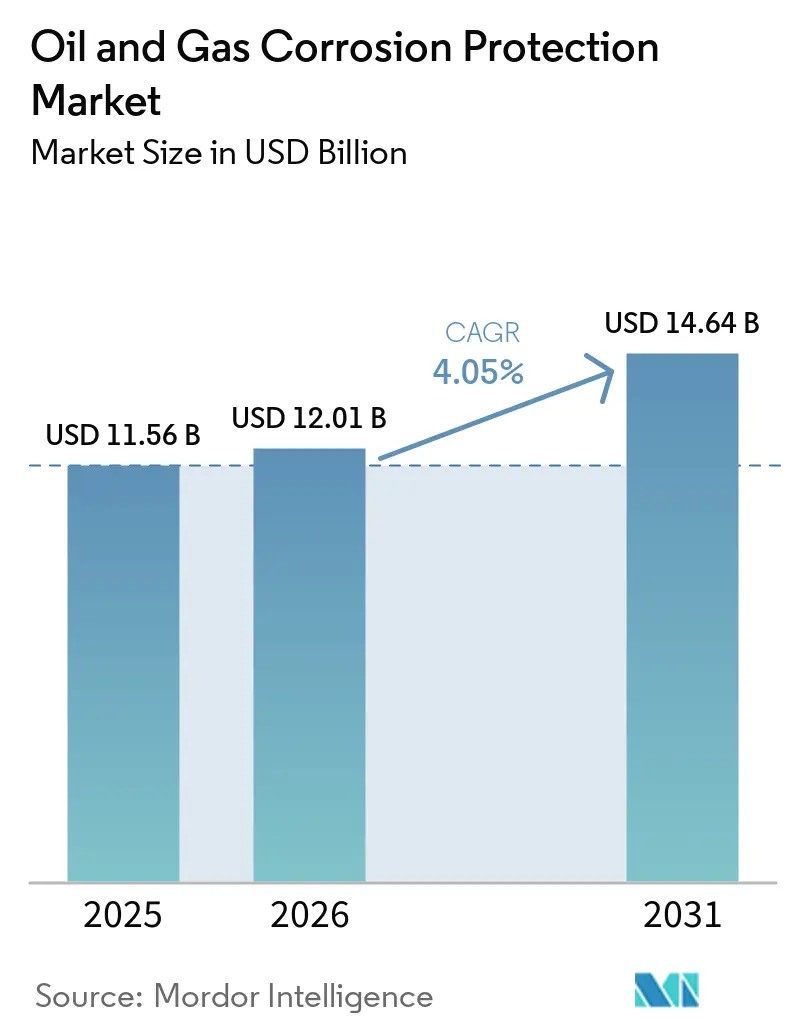
Oil and Gas Corrosion Protection Market Analysis by Mordor Intelligence
The oil and gas corrosion protection market size was valued at USD 11.56 billion in 2025 and is estimated to grow from USD 12.01 billion in 2026 to reach USD 14.64 billion by 2031, at a CAGR of 4.05% during the forecast period 2026-2031. The oil and gas corrosion protection market is supported by aging pipelines, platforms, refineries, and storage assets that require regular integrity work. Corrosion accounted for more than 25% of US pipeline incidents in 2024, compared with a historical average of 18%. Continuous monitoring influences procurement decisions, as operators identify deterioration earlier and plan interventions before wall loss becomes severe. Spending on corrosion protection is treated as an operating requirement rather than a discretionary capital purchase, particularly where safety regulations and insurance obligations make delays costly. Competition is shaped by product performance, field service capability, and the ability to combine physical protection with monitoring data. This favors suppliers that support the full lifecycle from product specification through application, inspection, and maintenance, and gives operators a stronger basis for selecting protection systems based on lifecycle needs rather than initial product price alone.
Key Report Takeaways
- By type, coatings held 38.47% of the oil and gas corrosion protection market share in 2025, while corrosion inhibitors are projected to grow at a CAGR of 4.24% through 2031.
- By location, offshore held 55.56% of the oil and gas corrosion protection market share in 2025 and is projected to grow at a 4.67% CAGR through 2031.
- By application, pipelines accounted for 34.25% of the total in 2025 and are forecast to expand at a 4.78% CAGR through 2031.
- By end-user industry, upstream operations held a 39.13% share in 2025, while downstream refining and petrochemical processing are projected to grow at a CAGR of 5.12% through 2031.
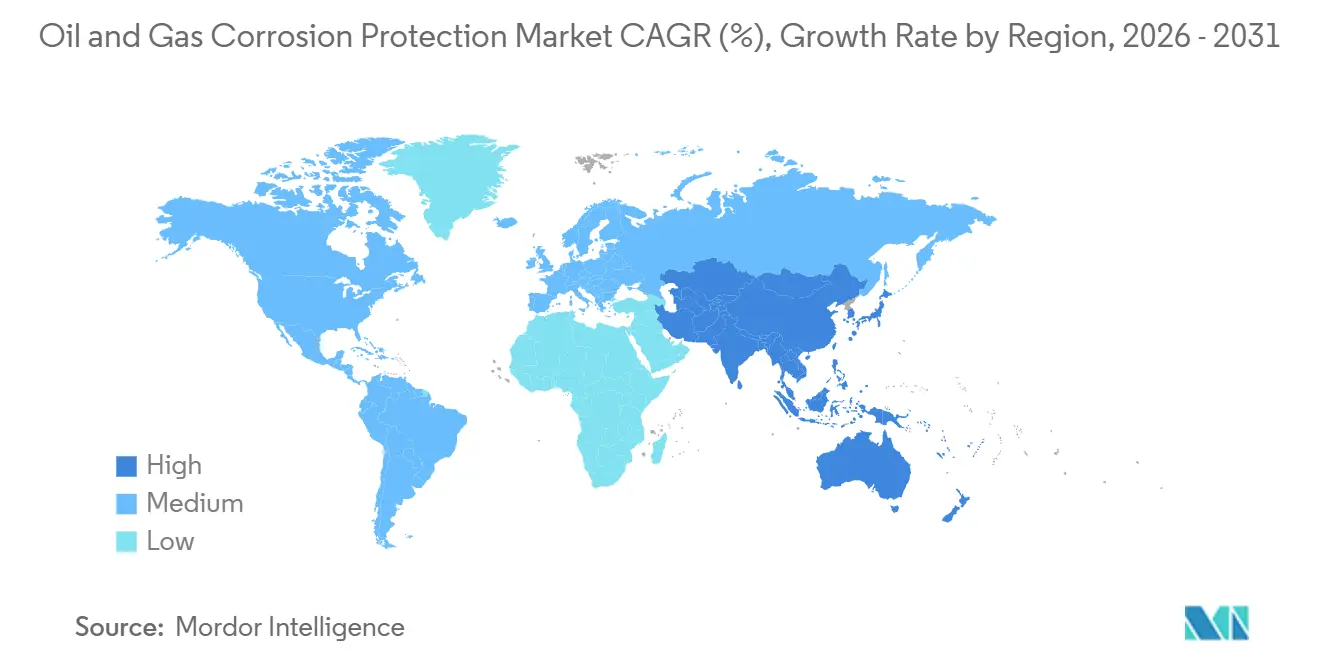
- By geography, the Middle East and Africa held a 35.82% share in 2025, while Asia-Pacific is forecast to grow at a 4.43% CAGR through 2031.
Note: Market size and forecast figures in this report are generated using Mordor Intelligence’s proprietary estimation framework, updated with the latest available data and insights as of January 2026.
Market Trends and Insights
Drivers Impact Analysis of Oil and Gas Corrosion Protection Market*
| Drivers | (~) % Impact on CAGR Forecast | Geographic Relevance | Impact Timeline |
|---|---|---|---|
| Aging Pipelines, Platforms, Refineries, and Storage Assets | +1.1% | Global | Medium term (2-4 years) |
| Expansion of Offshore, Deepwater, and Sour-Gas Operations | +0.9% | Middle East and Africa, Asia-Pacific, South America | Long term (≥ 4 years) |
| Stricter Pipeline Safety and Environmental Compliance | +0.7% | North America and Europe | Medium term (2-4 years) |
| Digital Corrosion Monitoring and Predictive Integrity Management | +0.6% | Global, led by the Middle East and Asia-Pacific | Medium term (2-4 years) |
| Corrosion Under Insulation and Hidden-Damage Detection | +0.4% | Global | Short term (≤ 2 years) |
| Source: Mordor Intelligence | |||
Aging Pipelines, Platforms, Refineries, and Storage Assets
Much of the oil and gas infrastructure currently in service was installed between the 1960s and the 1980s. Over time, protective coatings can thin, cathodic protection can drift, and small cracks can develop undetected under older inspection schedules. As a result, the oil and gas corrosion protection market has a recurring maintenance base rather than a demand profile driven solely by new construction. The Association for Materials Protection and Performance (AMPP) reported that corrosion accounted for more than 25% of U.S. pipeline incidents in 2024, compared with a historical average of 18%. This pattern makes continued reliance on inspection methods designed for younger assets less viable. Replacement work supports demand for coatings, inhibitors, and cathodic protection, as the safety and regulatory consequences of inaction can exceed the savings from postponement. Global oil infrastructure activity included 15,000 km of crude oil and natural gas liquids pipelines under construction in 2025, with a further 27,000 km proposed. Some of this work replaces degraded sections, reinforcing the recurring nature of protection demand.
Expansion of Offshore, Deepwater, and Sour-Gas Operations
Deepwater and sour-gas operations expose equipment to combined hydrogen sulfide and carbon dioxide attack. These environments require more specialized alloys, coatings, cathodic protection, and chemical dosing than conventional onshore operations. Research on superduplex stainless steel under combined exposure to carbon dioxide and hydrogen sulfide revealed distinct corrosion behavior that cannot be captured by single-gas data alone. The oil and gas corrosion protection market is supported by gas developments with high sour-gas content, including Saudi Arabia's Jafurah development and Qatar's North Field expansion. These projects require protection systems that manage demanding fluid chemistry over long asset lives. Their production mix also creates sustained demand for sour-service chemistry and corrosion-resistant alloy tubulars after initial project construction is complete. Combined exposure makes material selection more consequential, as a system that performs well under one corrosive gas may not meet the requirements of a mixed-gas environment. Protection suppliers must demonstrate performance across the actual operating conditions expected at each field.
Digital Corrosion Monitoring and Predictive Integrity Management
Real-time sensors and predictive models allow operators to assess corrosion conditions between physical inspections. These systems combine wall-thickness readings, operating conditions, and fluid data to identify when an intervention is needed. The oil and gas corrosion protection market is gaining a digital service layer, as monitoring helps prioritize chemical dosing, inspection, and repair activities. A review of corrosion monitoring and prediction methods highlighted the importance of continuous data and predictive approaches for integrity decisions. In May 2026, Saudi Aramco and Emerson entered a research and development collaboration to develop corrosion-management solutions using ultrasonic online monitoring and wireless connectivity. However, fragmented instrumentation at older facilities can reduce data quality, while corrosion under insulation and other hidden damage may still require specialized detection methods. Incomplete data can create false confidence if a predictive model does not capture the condition of a critical area. Operators need to connect digital monitoring with inspection practices that verify the condition of equipment not directly visible to sensors.
Stricter Pipeline Safety and Environmental Compliance
In April 2026, the U.S. Pipeline and Hazardous Materials Safety Administration issued a direct final rule incorporating the 2025 edition of the National Association of Corrosion Engineers (NACE) SP0502 into federal pipeline regulations, effective January 1, 2027[1]U.S. Pipeline and Hazardous Materials Safety Administration, “Pipeline Safety: Standards Update, NACE SP0502,” Federal Register, phmsa.dot.gov. The same regulatory cycle included an update covering NACE SP0206 for the direct assessment of internal corrosion in dry natural gas pipelines. These updates require operators to review assessment practices and create work for inspection providers, engineering teams, and corrosion specialists. The oil and gas corrosion protection market has a more stable demand floor when assessment work must follow regulatory deadlines. In Europe, tighter industrial emissions and hazardous-substance rules also encourage lower-Volatile Organic Compound (VOC) coating formulations. Smaller suppliers can face greater reformulation costs due to fewer research and development resources. Compliance spending is less sensitive to budget pressure when assessments are mandatory and have defined implementation dates. This provides a more stable base for engineering, inspection, and protective-product demand than discretionary project spending alone.
Restraints Impact Analysis of Oil and Gas Corrosion Protection Market*
| Restraints | (~) % Impact on CAGR Forecast | Geographic Relevance | Impact Timeline |
|---|---|---|---|
| High Capital Cost and Deferred Maintenance Budgets | -0.5% | Global, most acute among independent exploration and production operators | Short term (≤ 2 years) |
| Skilled Corrosion-Engineering and Application Workforce Shortage | -0.4% | Global, most severe in Asia-Pacific and Middle East, and Africa emerging markets | Medium term (2-4 years) |
| Sensor Reliability, Data Quality, and Legacy-System Integration | -0.3% | Global, most pronounced in mature onshore producing regions | Medium term (2-4 years) |
| Source: Mordor Intelligence | |||
High Capital Cost and Deferred Maintenance Budgets
Advanced protection systems require operators to commit funds before an asset's condition becomes critical. Continuous monitoring, digital integration, premium coatings, and corrosion-resistant alloys are difficult to fund when margins are under pressure. Deepwater cathodic protection costs 2-3 times as much per unit as comparable onshore installations. A full coating replacement on a large offshore platform can require tens of millions of dollars. The oil and gas corrosion protection market faces temporary delays when smaller upstream operators defer projects. Delayed maintenance increases remediation needs later because coating damage becomes harder and more expensive to correct after missed maintenance windows. The financial effect is not linear because damage that remains localized at an early stage can spread over a wider area or reach the underlying substrate. Procurement uncertainty can also arise when operators merge and temporarily pause maintenance plans while vendor lists and operating budgets are reviewed.
Skilled Corrosion-Engineering and Application Workforce Shortage
The Association for Materials Protection and Performance (AMPP) launched TalentForce in March 2026 to address a widening workforce shortage in corrosion-related roles. More than 40% of the current corrosion workforce is eligible to retire within 10 years, while more than 70% of employers in corrosion-intensive sectors report skills gaps. The constraint involves both staffing levels and the transfer of field knowledge. Applying protective coatings requires 3-5 years of field experience for technicians to reach full competency, and cathodic protection design requires more specialized experience. This shortage limits the pace of project execution in the oil and gas corrosion protection market, particularly in the Gulf Cooperation Council and Southeast Asia, where local training capacity remains below demand. Experienced personnel are needed to prepare surfaces, apply coatings in accordance with specifications, interpret inspection results, and design cathodic protection systems. Training can expand capacity, but it cannot quickly replace experience gained under field conditions.
*Our forecasts treat driver/restraint impacts as directional, not additive. The impact forecasts reflect baseline growth, mix effects, and variable interactions.
Oil and Gas Corrosion Protection Market Segment Analysis
By Type:
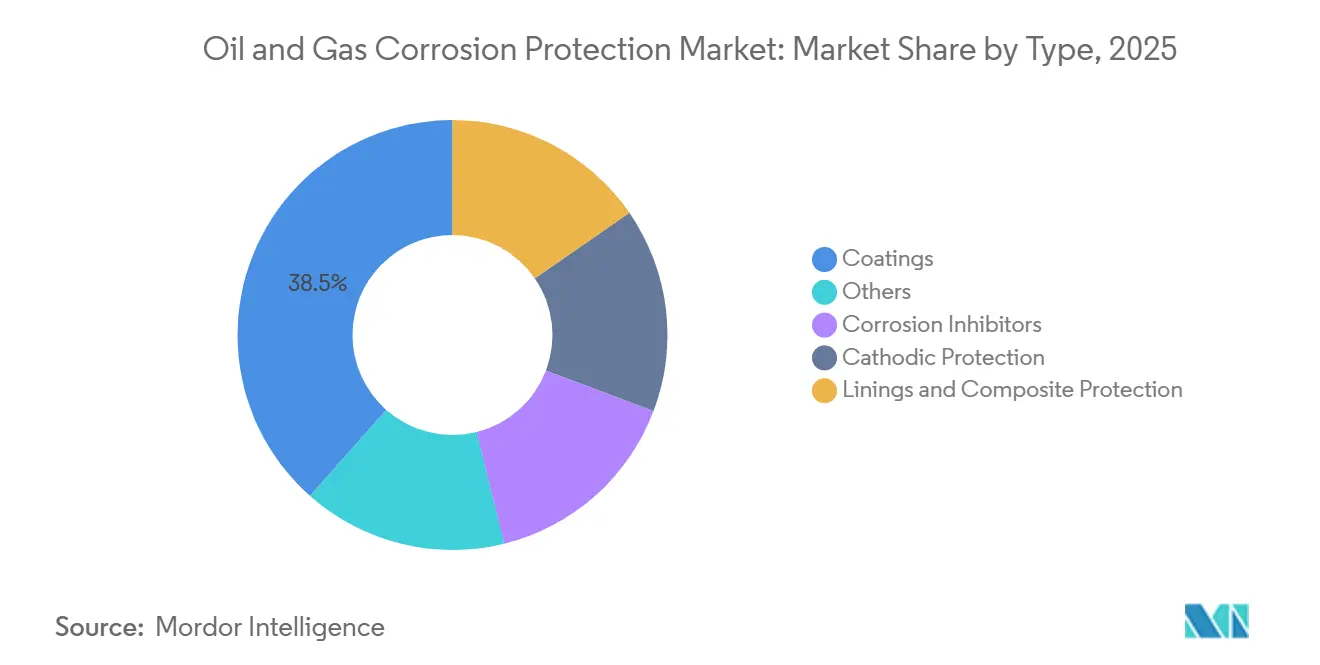
Coatings Retain Dominance as Inhibitors AccelerateCoatings held 38.47% of the product total in 2025. Their share reflects their widespread use on pipeline exteriors, offshore structures, storage tanks, and process equipment. Coatings provide broad protection across onshore and offshore environments by separating metal surfaces from moisture, salts, and other corrosive exposures. The category is used in both new construction and maintenance projects, giving suppliers access to a large installed base. High-performance formulations can extend recoating intervals and improve lifecycle cost outcomes, supporting premium product selection where access and shutdown costs are high. Operators typically assess coating performance based on surface preparation quality, application conditions, durability, and the expected timing of future maintenance. Coatings remain relevant even when cathodic protection or chemical treatment is used alongside them.
Corrosion inhibitors are projected to record a 4.24% CAGR between 2026 and 2031. They are suited to deepwater and sour-service settings because injection rates can be adjusted without direct physical intervention. This flexibility is important when process conditions vary, and equipment intervention would require a costly shutdown or offshore vessel support. A 2026 scientific review found that inhibitor systems in controlled conditions can achieve efficiencies above 95%. Cathodic protection, linings, and composite protection remain essential for subsea and buried assets, where a single product class cannot meet the full protection requirement. Saudi Aramco has deployed more than 19,000 km of non-metallic piping as an alternative to conventional steel in selected applications. This material approach may gradually shift the balance among product categories over the later forecast period. The oil and gas corrosion protection market therefore includes both established coating demand and product choices shaped by fluid chemistry and asset design. Suppliers must demonstrate how different products work together, as operators typically apply multiple layers of protection on demanding assets.



By Location:
Offshore Commands Both Scale and MomentumOffshore applications accounted for 55.56% of the oil and gas corrosion protection market in 2025. The segment has higher value density because assets are exposed to seawater, hydrostatic pressure, dynamic loading, and elevated concentrations of hydrogen sulfide and carbon dioxide. These conditions can accelerate deterioration beyond the rates experienced by many onshore assets. Offshore projects often require several protection systems operating together rather than a single protective layer. Typical systems include external coatings, cathodic protection, continuous chemical injection, and inspection programs planned around restricted access. Operators must also account for the practical difficulty of inspecting, repairing, or replacing equipment once it is installed underwater or on a remote platform.
The offshore segment is also projected to grow at a 4.67% CAGR from 2026 to 2031. Brazil's pre-salt basin, the Gulf of Mexico, and Southeast Asia support demand from new deepwater and ultra-deepwater developments. Each project can require specialized anode alloys, subsea engineering, and long-term inhibitor supply arrangements. A 2026 Offshore Technology Conference paper described automated corrosion modeling that captures short-duration subsea operating changes missed by static assessments. This information can help operators adjust inhibitor dosing before a short operating change results in material wall loss. The cost of remotely operated vehicles and diving support vessels contributes to the price premium for offshore work. DNV-RP-F103 provides a technical basis for cathodic protection design on submarine pipelines. The combination of saltwater immersion, challenging fluids, and restricted access for maintenance means that prevention can be less costly than reactive repair. It also supports long-term service arrangements covering monitoring, chemical treatment, and equipment condition assessment.
By Application:
Pipelines Drive Demand Through Scale and Regulatory PressurePipelines accounted for 34.25% of the application total in 2025. Their share reflects the size of transmission, gathering, and distribution networks that require both external and internal protection. Pipeline operators use coatings for external protection and inhibitors for internal fluid-facing surfaces. External exposure to soil or water and internal fluid composition create different corrosion mechanisms. Coating systems can reduce corrosion rates by more than 90% when correctly applied, while inhibitor systems can achieve efficiency above 95% in controlled settings. Pipeline integrity, therefore, remains a core driver of recurring protection spending, particularly when inspection results identify deterioration before failure occurs.
Pipelines are forecast to register a 4.78% CAGR from 2026 to 2031. Regulatory requirements, aging systems, and the commercial cost of failures combine to support this rate. Offshore platforms and subsea structures represent the next major application group and require multi-layered protection. Refineries and petrochemical plants need specialized linings, higher-alloy components, and inhibitor programs because process streams can contain sulfur and naphthenic compounds. Storage tanks, drilling equipment, and liquefied natural gas (LNG) receiving terminals add steady demand as safety and environmental review expands. DNV noted that improved inspection methods and detection technology can support better management of corrosion under insulation. The shift toward more targeted assessment can also drive investment in launcher and receiver systems, pigging compatibility, and other inspection-enabling equipment.
By End-User Industry:
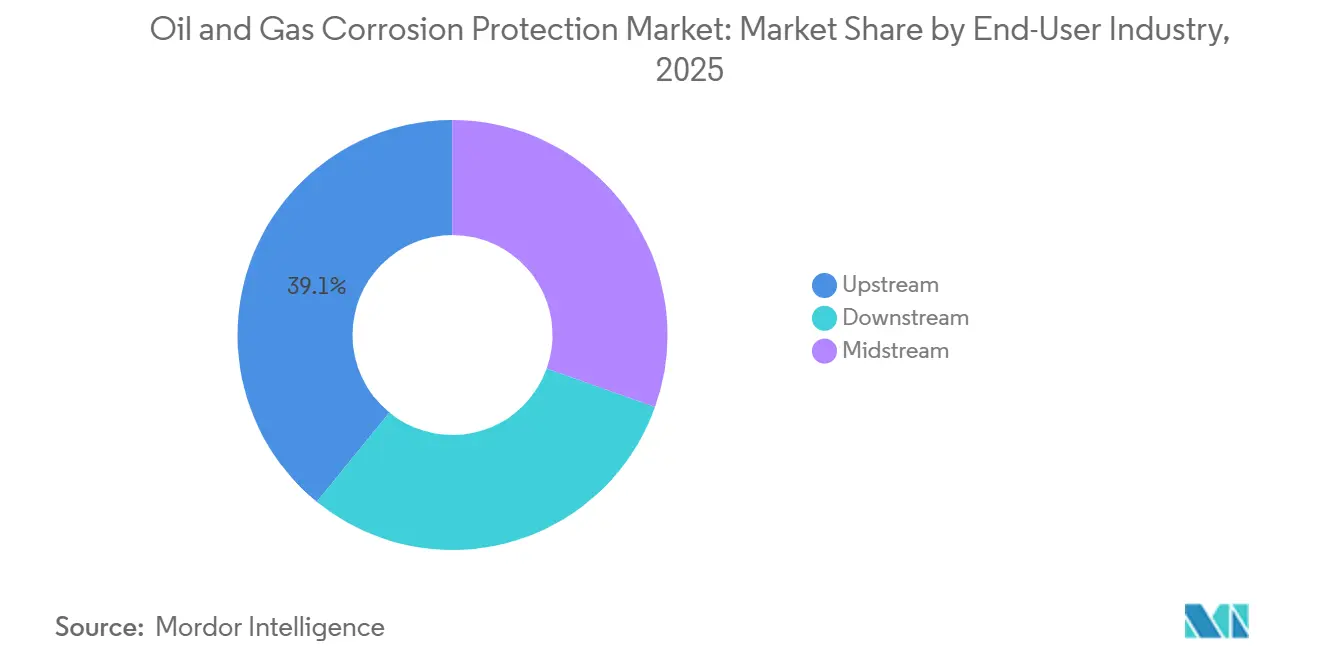
Upstream Scale Masks Downstream MomentumUpstream operations accounted for 39.13% of the oil and gas corrosion protection market in 2025. Wellheads, risers, flowlines, and subsea equipment require strong protection in deepwater and sour-gas fields. Corrosion failures at these assets can have severe safety and financial consequences. Upstream operators therefore use coatings, inhibitors, cathodic protection, and corrosion-resistant materials in combination. The protection approach depends on the production fluid, pressure, temperature, water exposure, and ability to access the asset for maintenance. Maintenance decisions are often integrated with routine operating plans rather than made only during major capital projects.
Downstream refining and petrochemical processing are expected to grow at a 5.12% CAGR from 2026 to 2031. New Asian refinery capacity and heavier, more corrosive crude feedstocks support demand for linings, inhibitors, and alloy cladding. Carbon steel in high-acid crude distillation units can experience corrosion rates of 2–8 mm per year without adequate protection. Refinery equipment operates under combinations of heat, process chemicals, and changing feedstock quality, requiring site-specific protection choices. Midstream operators face aging networks while also evaluating systems for hydrogen-blended and carbon dioxide carrier service. NORSOK M501 continues to influence protective coating specifications in European process facilities. Upstream spending centers on field conditions and access, midstream spending is tied to network integrity, and downstream spending responds to process conditions and feedstock selection. Suppliers serving all three groups require product portfolios and technical support suited to each operating context.
Geography Analysis
MEA Oil and Gas Corrosion Protection Market
The Middle East and Africa accounted for 35.82% of the regional total in 2025. The region's position reflects Gulf Cooperation Council production, gas processing, downstream capacity, and export infrastructure. Saudi Arabia and the United Arab Emirates are primary sources of regional demand, with large asset bases requiring protection across upstream, midstream, and downstream operations. Sour-gas developments such as Jafurah and Qatar's North Field expansion require corrosion inhibitors, corrosion-resistant alloy tubulars, protective coatings, and long-term integrity planning. West African offshore projects and East African LNG projects add demand from newer asset development. The regional project base supports both new-build protection and life-extension work, driven by mature facilities, gas expansion, and offshore activity.
APAC and South America Oil and Gas Corrosion Protection Market
Asia-Pacific is projected to record the fastest regional CAGR at 4.43% through 2031. China, India, and Southeast Asia account for most of the region's incremental requirements. Chinese national oil companies invest across upstream production, pipelines, and refinery systems. India's gas grid expansion and refinery additions support demand for pipeline coatings and integrity-management programs. Southeast Asian LNG terminals and petrochemical complexes provide initial specification opportunities for regional coating suppliers. A 2026 study of high-hydrogen-sulfide, high-carbon-dioxide, and high-pressure gas wells in China found that nickel-tungsten alloy coatings achieved a uniform corrosion rate of 0.004 mm per year under 122°C and 85 MPa conditions[2]Yaolin Zhao et al., “Corrosion Behavior and Mitigation Strategy for ‘Three-Highs’ Gas Wells: A Case Study of Marine Carbonate Reservoirs in Sichuan-Chongqing, China,” Coatings, mdpi.com. South America remains a secondary growth area, led by Brazil's pre-salt development and Argentina's Vaca Muerta expansion.
North America and Europe Oil and Gas Corrosion Protection Market
North America and Europe are mature markets, sustained by replacement cycles, integrity requirements, and life-extension work. U.S. federal grants supported corrosion control and steel-line upgrades across 19 states in 2025. North Sea operators invest in marine coatings, cathodic protection, and subsea monitoring to extend production from mature fields. Germany's hydrogen pipeline initiative creates product qualification requirements for materials and inhibitors used in hydrogen service. U.S. gas and liquid transmission networks remain subject to inspection and integrity-management requirements under the Pipeline and Hazardous Materials Safety Administration (PHMSA) framework, making maintenance and assessment a continuing component of regional demand. The market in North America and Europe is sustained by both asset preservation and new qualification requirements.

Competitive Landscape
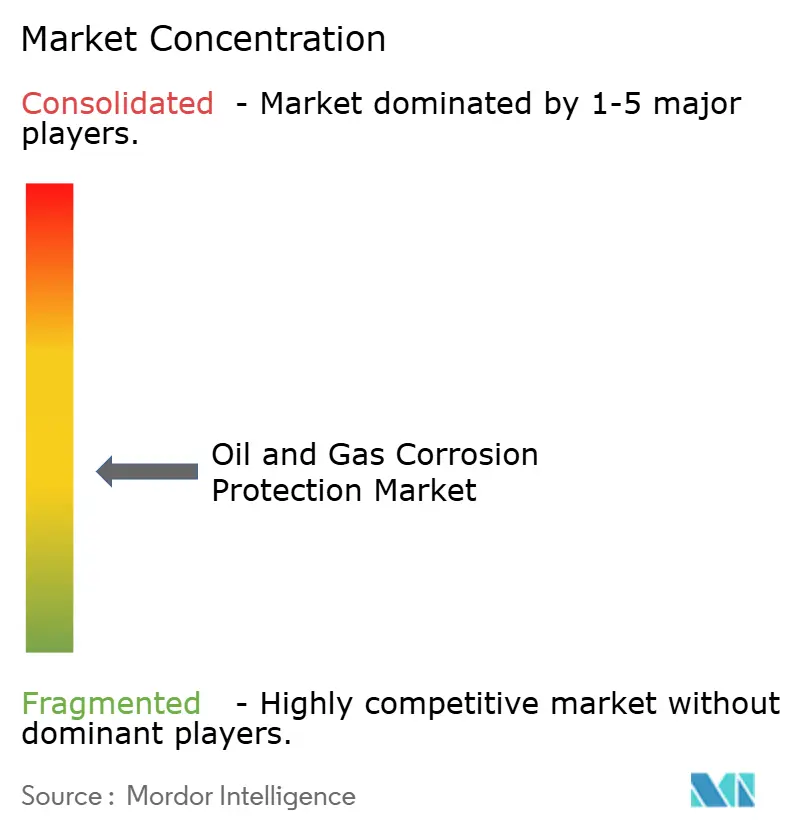
The oil and gas corrosion protection market is moderately fragmented. Sherwin-Williams, Hempel, Jotun, and PPG hold positions across multiple product categories and regions. Technical performance and the ability to meet project specifications are key competitive factors. Operators also evaluate product reliability, application support, expected service life, and the ability to supply across multiple countries. Niche suppliers can retain pricing power when their products address specific operating challenges that standard products do not. Physical protection products are increasingly evaluated alongside monitoring and integrity services, which creates a competitive advantage for suppliers that can combine materials expertise with data-driven asset support.
Hempel launched Avantguard 750 Pro in January 2025, targeting structural protection exceeding 35 years. The product is designed to challenge conventional 15-25-year recoating assumptions and support higher initial spending where lifecycle savings are demonstrable. A longer protection period is particularly valuable in environments where shutdowns, access, and labor are costly. In November 2025, AkzoNobel and Axalta announced an all-stock merger of equals, with the proposed combined company carrying an enterprise value of USD 25 billion. The merger combines portfolios across offshore, marine, industrial, and powder coatings. The scale of the combined entity could increase competitive pressure on mid-tier and regional competitors through greater procurement reach, distribution capacity, and research resources. These developments indicate that lifecycle performance and portfolio scale are both significant factors shaping competition in this market.
Cortec Corporation and Belzona International compete in select niches through vapor corrosion-inhibitor chemistry and rapid-cure polymer repair systems. Their offerings align with operator interest in shorter turnaround periods and lower-toxicity solutions. Rapid repair capabilities are relevant where extended asset unavailability would increase operating costs. Aramco's work with Corrosion RADAR and Emerson illustrates the value operators place on continuous monitoring linked to physical protection decisions. Sensor-integrated inhibitor dosing and machine-learning-based corrosion prediction are emerging areas of technical differentiation. Providers with substantial operating data may be better positioned to refine predictive services over time. Patent activity in these areas reflects the growing importance of protected technical capability. The market is likely to favor providers that can support both product deployment and data-informed integrity management, with long datasets from installed systems potentially enabling stronger predictive tools as service relationships develop.
Oil and Gas Corrosion Protection Industry Leaders
AkzoNobel N.V.
The Sherwin-Williams Company
PPG Industries, Inc.
Hempel A/S
Jotun
- *Disclaimer: Major Players sorted in no particular order
Oil and Gas Corrosion Protection Market Companies Covered in this Report
- 3M
- AkzoNobel N.V.
- Axalta Coating Systems
- BASF
- Belzona International Ltd.
- Carboline Company
- Chase Corporation
- Cortec Corporation
- Hempel A/S
- Jotun
- Kansai Paint Co.,Ltd.
- Nippon Paint Holdings Co., Ltd.
- PPG Industries, Inc.
- The Sherwin-Williams Company
- Tnemec

Recent Industry Developments in Oil and Gas Corrosion Protection Market
- August 2026: Axalta and AkzoNobel shareholders voted to approve an all-stock merger of equals at simultaneous extraordinary general meetings, creating a combined coatings company with an enterprise value of USD 25 billion. Completion is expected between late 2026 and early 2027, subject to regulatory approvals. The combined company will hold positions in marine, protective, and industrial coatings serving the oil and gas sector across more than 150 countries.
- May 2026: Emerson signed a research and development collaboration agreement with Aramco to co-develop corrosion management solutions. The collaboration combines Aramco's domain expertise with Emerson's ultrasonic online corrosion-monitoring technology and wireless connectivity capabilities to enable continuous, real-time pipeline wall-thickness measurement.


Global Oil and Gas Corrosion Protection Market Report Scope
Oil and gas corrosion protection refers to the methods, materials, and chemical treatments used to prevent metal degradation in energy infrastructure. Oil, gas, and water naturally contain highly reactive chemicals, which cause steel pipelines, drilling rigs, and storage tanks to rust and weaken without active protection.
The oil and gas corrosion protection market is segmented by type, location, application, end-user industry, and geography. By type, the market is segmented into coatings, corrosion inhibitors, cathodic protection, linings and composite protection, and others. By location, the market is segmented into offshore and onshore. By application, the market is segmented into pipelines, offshore platforms, and subsea structures, refineries and petrochemical processing facilities, and others. By end-user industry, the market is segmented into upstream, midstream, and downstream. The report also covers market size and forecasts for the oil and gas corrosion protection across 15 countries in major regions. The market sizes and forecasts are provided in terms of value (USD).
| Coatings |
| Corrosion Inhibitors |
| Cathodic Protection |
| Linings and Composite Protection |
| Others |
| Offshore |
| Onshore |
| Pipelines |
| Offshore Platforms and Subsea Structures |
| Refineries and Petrochemical Processing Facilities |
| Others |
| Upstream |
| Midstream |
| Downstream |
| Asia-Pacific | China |
| India | |
| Japan | |
| South Korea | |
| ASEAN Countries | |
| Rest of Asia-Pacific | |
| North America | United States |
| Canada | |
| Mexico | |
| Europe | Germany |
| United Kingdom | |
| France | |
| Italy | |
| NORDIC Countries | |
| Rest of Europe | |
| South America | Brazil |
| Argentina | |
| Rest of South America | |
| Middle East and Africa | Saudi Arabia |
| South Africa | |
| Rest of Middle East and Africa |
| By Type | Coatings | |
| Corrosion Inhibitors | ||
| Cathodic Protection | ||
| Linings and Composite Protection | ||
| Others | ||
| By Location | Offshore | |
| Onshore | ||
| By Application | Pipelines | |
| Offshore Platforms and Subsea Structures | ||
| Refineries and Petrochemical Processing Facilities | ||
| Others | ||
| By End-User Industry | Upstream | |
| Midstream | ||
| Downstream | ||
| By Geography | Asia-Pacific | China |
| India | ||
| Japan | ||
| South Korea | ||
| ASEAN Countries | ||
| Rest of Asia-Pacific | ||
| North America | United States | |
| Canada | ||
| Mexico | ||
| Europe | Germany | |
| United Kingdom | ||
| France | ||
| Italy | ||
| NORDIC Countries | ||
| Rest of Europe | ||
| South America | Brazil | |
| Argentina | ||
| Rest of South America | ||
| Middle East and Africa | Saudi Arabia | |
| South Africa | ||
| Rest of Middle East and Africa | ||


Key Questions Answered in the Report
What is current market size of Oil and Gas Corrosion Protection Market?
The oil and gas corrosion protection market size was valued at USD 11.56 billion in 2025 and is estimated to grow from USD 12.01 billion in 2026 to reach USD 14.64 billion by 2031, at a CAGR of 4.05% during the forecast period 2026-2031.
Which product category leads to demand for oil and gas corrosion protection?
Coatings lead product demand with a 38.47% share in 2025 because they are used across pipelines, offshore assets, tanks, and process equipment. Their wide use in both new construction and maintenance provides a large installed base for suppliers.
Which application is expected to grow fastest through 2031?
Pipelines are expected to grow at a 4.78% CAGR through 2031, supported by aging networks, regulatory requirements, and the high cost of failures. They also require recurring protection and inspection work across both internal and external surfaces.
Which region has the strongest growth outlook for corrosion protection?
Asia-Pacific is forecast to expand at a 4.43% CAGR through 2031, supported by investments in China, India, and Southeast Asia. Pipeline construction, refinery additions, Liquefied Natural Gas (LNG) terminals, and complex gas wells all add to regional requirements.
Page last updated on:





