
Market Overview
| Study Period | 2021 - 2031 |
|---|---|
| Forecast Data Period | 2026 - 2031 |
| Historical Data Period | 2021 - 2024 |
| Growth Rate | 8.49 % |
Major Players *Disclaimer: Major Players sorted in no particular order Image © Mordor Intelligence. Reuse requires attribution under CC BY 4.0. | |
Europe Consumer Battery Market Analysis by Mordor Intelligence
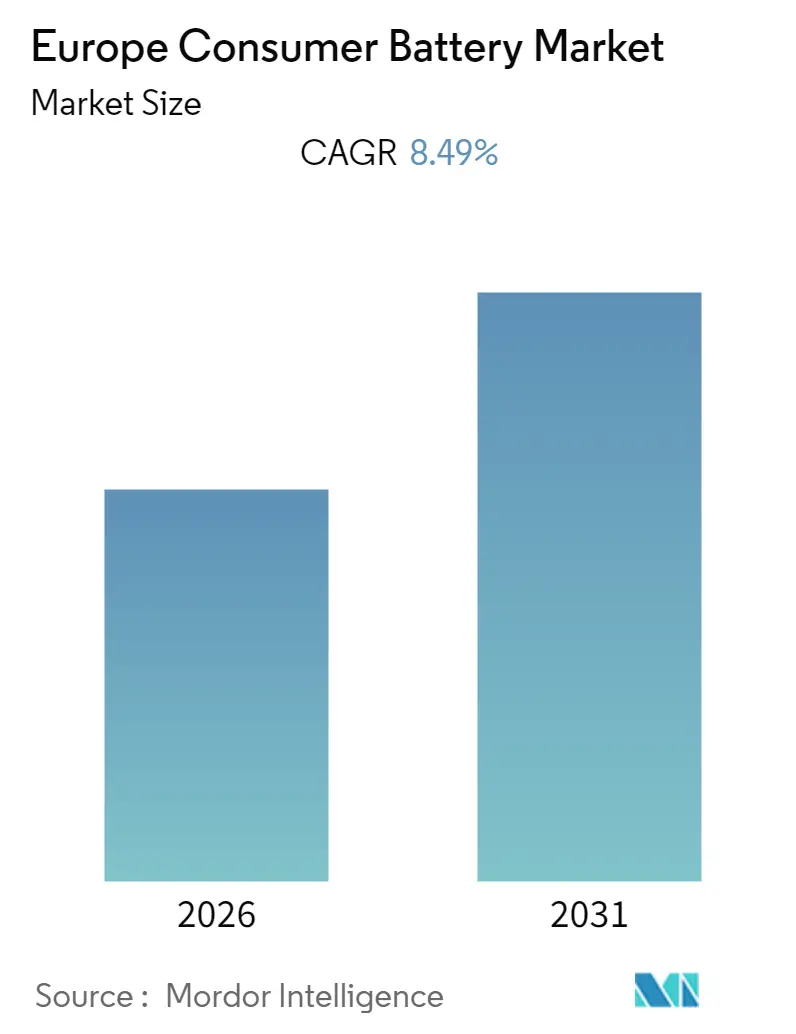
The Europe Consumer Battery Market size is expected to register a CAGR of greater than 8.49% during the forecast period.
- The lithium-ion battery is expected to witness significant growth in the market due to its high electrode potential, high charge, and favourable capacity-to-weight ratio during the forecast period.
- The increasing popularity of portable medical devices offers a significant growth opportunity for the consumer battery market.
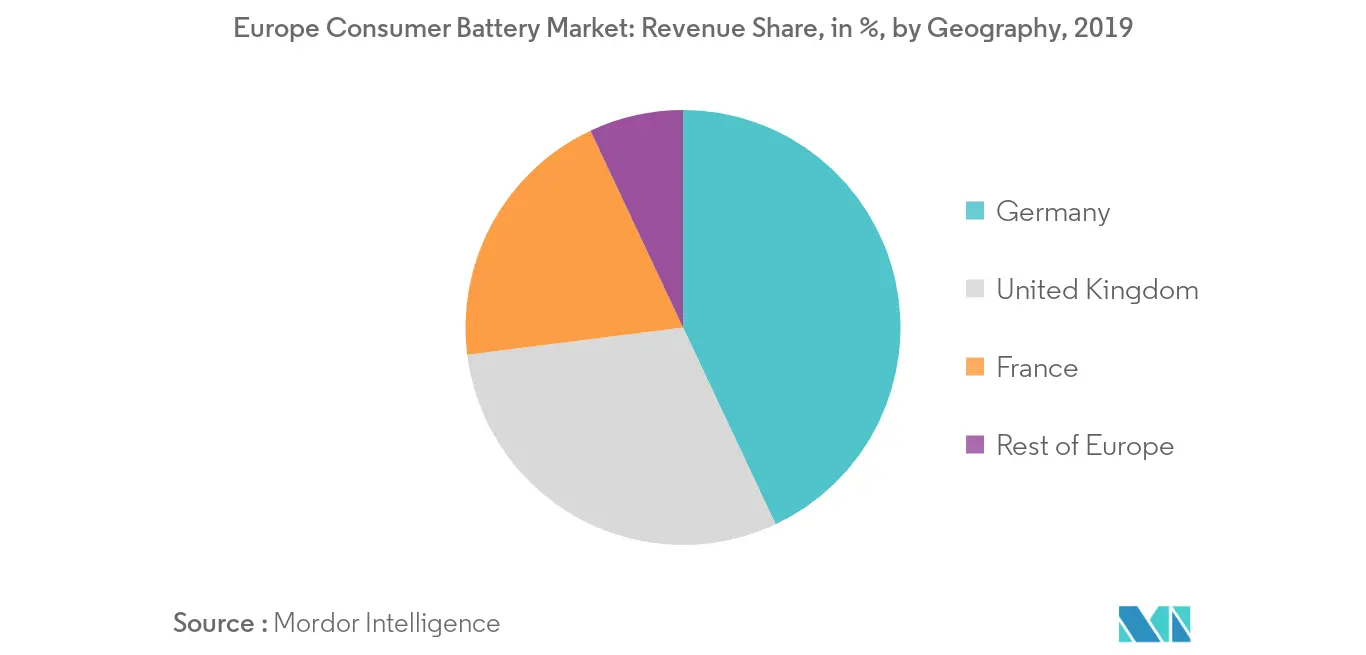
- Germany is expected to witness significant growth during the forecast years due to the increasing sales of consumer electronics and home appliances during the forecast period.
Note: Market size and forecast figures in this report are generated using Mordor Intelligence’s proprietary estimation framework, updated with the latest available data and insights as of 2026.
Europe Consumer Battery Market Trends and Insights
Lithium-ion Battery to Witness Significant Growth
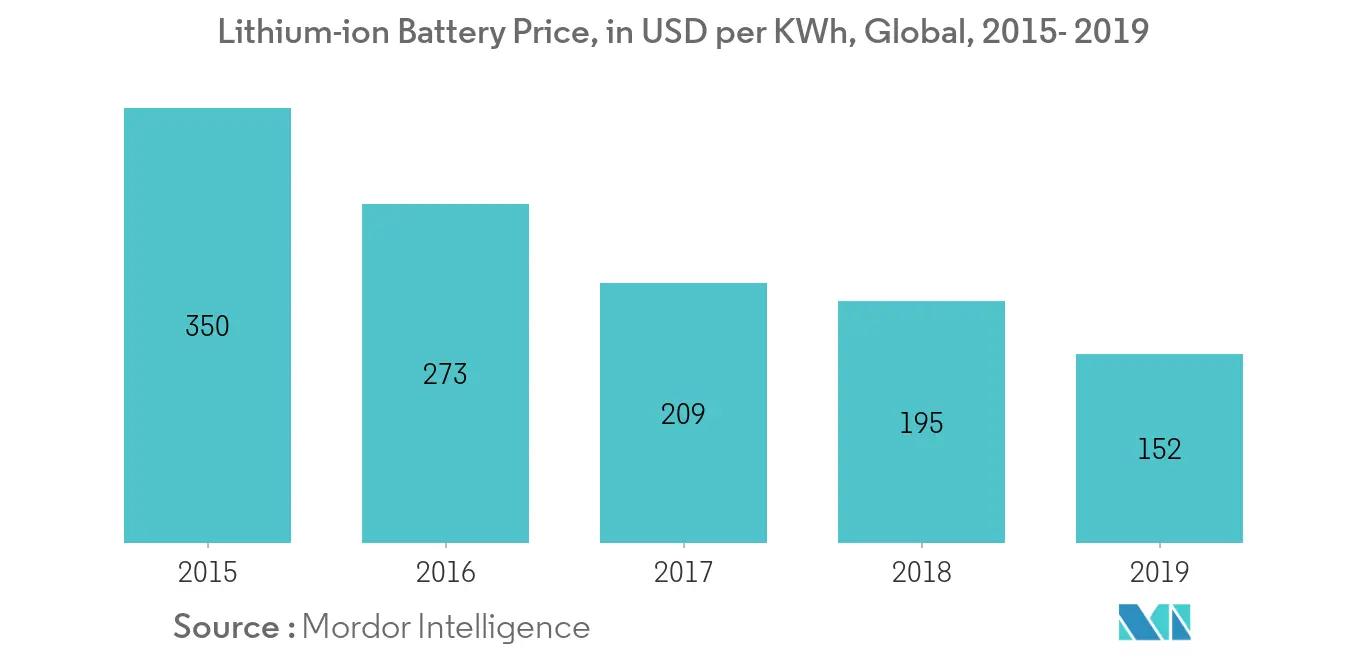
- Among different types of battery technology, lithium-ion battery (LIB) is expected to dominate the consumer battery market majorly due to its capacity-to-weight ratio and other factors like better performance, high energy density, and decreasing price.
- Lithium-ion batteries are commonly used in electronic devices, such as smartphones, laptops, clocks, watches, and remote controls. Sales of consumer electronics are very much dependent on the population and disposable income.
- The increasing disposable income of the region has led to rising living standards, in turn, driving the demand for consumer electronics.
- Apart from this, the availability of the internet at extremely cheaper rates has also increased smartphone penetration drastically in this region.
- Therefore, owing to a better wide-scale application, performance, and decreasing battery prices, the lithium-ion battery segment is expected to witness the highest growth rate during the forecast period.
Germany to Dominate the Market
- As of 2019, the German economy ranks as the world's fourth-largest and accounts for more than one-fifth of the European Union's GDP. Germany remains the largest consumer market in the European Union (EU) region, with an approximate population of 86.8 million as of March 2019.
- Furthermore, Germany has remained one of the leading markets for consumer batteries across Europe.
- In Germany, more than 80% of the companies are estimated to witness a high level of digitization along their value chain by 2025. In addition, 20% of companies already consider themselves to be highly digitized. Among the leaders in digitization in the automotive industry, which helps to increase the use of electronic devices like laptops, remote control systems, and etc.
- Further, the rising demand for portable medical equipment and household medical goods is expected to increase the demand for primary batteries during the forecast period.
- Therefore, the above-mentioned factors are expected to drive the consumer battery market in Europe region during the forecast period.
Regulatory Landscape
The Europe consumer battery market operates under the EU Batteries Regulation (Regulation (EU) 2023/1542), which replaces the earlier Batteries Directive framework and introduces lifecycle obligations spanning design, labeling, collection, and end-of-life treatment. A key product-design anchor is the 18 February 2027 requirement for portable and light means of transport (LMT) batteries to be designed for end-user removability and replaceability, subject to defined derogations. Additional obligations including carbon footprint declarations, recycled content requirements, and the battery passport framework raise documentation and traceability expectations across the supply chain.
In 2025-2026, the European Commission clarified and adjusted implementation timelines and product scope through secondary legislation and guidance. Regulation (EU) 2025/1561 postponed specific due diligence obligations until 26 July 2026, extending compliance lead time for economic operators handling upstream materials. In April 2026, the Commission opened a consultation on additional exemptions for portable battery removability, followed by July 2026 delegated acts and updated guidelines (C(2026) 5031 final and C(2026) 5032 final) that expanded and clarified exemptions and harmonized application across Member States, shaping device and pack design choices for small form-factor electronics and other covered product categories.
Value Chain Analysis
The Europe consumer battery value chain runs from raw material supply and refining (lithium, nickel, cobalt, graphite and additives), to active material processing (cathode and anode materials), cell manufacturing, and pack integration (including battery management systems), before distribution through OEM electronics channels and retail. Across Europe, upstream and midstream participants such as Umicore and Volkswagen PowerCo sit alongside downstream demand pulls from consumer electronics and portable medical devices, with adjacent battery uses drawing on similar manufacturing assets and materials. Industry and policy sources also point to a minority share of global battery production capacity in Europe (roughly 7% to 14%), with a continued reliance on imports for refined materials and cells, which makes energy costs, permitting, and access to refining capacity central constraints for local competitiveness.
End-of-life and circular flows have gained importance under EU requirements in Regulation (EU) 2023/1542 and the region-wide push to keep black mass and recoverable materials within Europe. Recycling and recovery feed back into the materials stage, while compliance needs including labeling, traceability, and the due diligence timing revised by Regulation (EU) 2025/1561 add operational steps for manufacturers and importers. Evidence from IPCEI battery market analysis (Q4 2024) and reported pressure on German battery volumes in 2024, including industry calls for lower energy costs and streamlined permitting, indicates utilization and cost challenges that move through the chain from cell manufacturing to materials suppliers and recyclers, reinforcing the importance of stable demand planning and local processing capacity.
Competitive Landscape
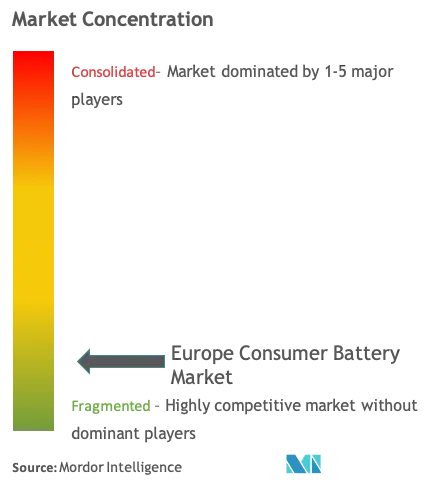
The Europe consumer battery market is fragmented. Some of the key players in this market include VARTA Consumer Batteries GmbH & Co. KGaA, Duracell Inc., PolyPlus Battery Company Inc, LG Chem Ltd, Samsung SDI Co. Ltd.
Europe Consumer Battery Industry Leaders
-
VARTA Consumer Batteries GmbH & Co. KGaA
-
Duracell Inc.
-
PolyPlus Battery Company Inc
-
LG Chem Ltd
-
Samsung SDI Co. Ltd
- *Disclaimer: Major Players sorted in no particular order
Market Opportunities and Future Outlook
Implementation milestones under the EU Batteries Regulation (Regulation (EU) 2023/1542) create a clearer near-term window for compliant consumer battery offerings and supporting services, particularly around labeling and traceability, including the shift toward QR-enabled information flows and battery passport readiness. The European Commission also refined the removability and replaceability regime in 2026 through consultation and delegated acts, which reduces uncertainty for device makers and battery suppliers by clarifying where end-user removability is required versus where exemptions apply. That guidance helps device makers plan for compact electronics such as wearables and other exempted categories.
Industrial investments and facility actions across Europe also point to ongoing localization and technology upgrading that can spill over into broader consumer formats and supply availability. For example, LG Energy Solution is advancing the 46inEU project in Poland to mass-produce 46-series cylindrical cells (12 GWh annual capacity target), and Volkswagen Group (PowerCo) is commissioning initial Unified Cell production at Salzgitter (20 GWh initial capacity). Gotion High-Tech has also confirmed plans for a Valladolid complex including recycling and cathode material production. Together, these moves support opportunities for European consumer-battery supply chains to align sourcing, documentation, and end-of-life pathways with the EU rulebook, and for battery-intensive device categories such as portable medical devices, where reliability, safety documentation, and standardized form factors influence supplier selection.
Recent Industry Developments
- July 2026: The European Commission adopted a delegated act adding additional product categories to portable battery removability exemptions and published updated guidelines to harmonize how removability and replaceability rules are applied. This affects battery and device design decisions ahead of the 18 February 2027 removability deadline, particularly for small form-factor products such as wearables and other exempted categories.
- February 2026: LG Energy Solution advanced implementation of the 46inEU project at Biskupice Podgornee (near Wroclaw), Poland, aimed at mass-producing 46-series cylindrical lithium-ion cells with an annual capacity target of about 12 GWh. The step strengthens local cell availability in Europe and supports OEM and device makers seeking shorter supply chains and better alignment with EU documentation and traceability requirements.
- July 2025: The European Commission introduced new EU-level rules for calculating and verifying recycling efficiency and material recovery rates for batteries. The change increases measurement and reporting rigor for recyclers and compliant producers, reinforcing investment incentives in higher-yield recovery processes and more auditable end-of-life supply chains.
Research Methodology Framework and Report Scope
Market Definition and Coverage
For this study, we define the Europe consumer battery market as the revenue earned from batteries mainly bought for everyday household and personal devices across European countries, covering both rechargeable and non-rechargeable chemistries used in common consumer applications.
Scope exclusions: We exclude batteries primarily meant for automotive traction, large industrial backup systems, and utility scale storage, even if similar cell formats are used.
Segmentation Overview
- Technology Type
- Lithium-ion
- Zinc-Carbon
- Alkaline
- Nickel Metal Hydride
- Nickel Cadmium
- Others
- Geography
- The United Kingdom
- Germany
- France
- Rest of Europe
Data Sources, Market Sizing, and Validation
Desk Research
Desk research starts with building a clear demand context for consumer batteries in Europe and mapping what drives replacement and new use cases. We rely on public sources such as Eurostat for trade and production signals, the European Commission for regulation and compliance direction, and national statistics offices for macro indicators that influence household device ownership.
To keep the model grounded, we also refer to sources such as the International Energy Agency for broader battery trends, European Environment Agency publications for recycling and collection context, and peer-reviewed journals that help confirm typical chemistry shifts and performance trends. Company annual reports, investor presentations, and reputable press are used to cross-check product focus and channel moves, and a paid subscription for company financials, patents, and shipment level import-export checks is used selectively where public data is thin. The desk research sources listed here are illustrative only, and many other public documents and datasets were reviewed for data collection, clarification, and validation.
Primary Interviews and Surveys
Primary work was used to pressure-test the desk assumptions and to correct the split between rechargeable and primary consumer cells where public reporting is not consistent. We spoke with a mix of manufacturers, distributors, retailers, and large-volume institutional buyers, and then used respondent input to refine key inputs like price direction, channel mix, and chemistry substitution across major European markets.
Distribution of primary research fieldwork respondents
| Company type | Respondent position |
|---|---|
| Top tier: 35% | CXOs: 17% |
| Mid tier: 47% | Functional/Unit leaders: 40% |
| Smaller Players: 18% | Managers: 43% |
Market-Sizing & Forecasting
The market is sized using a top-down build that reconstructs consumer battery demand from device and usage signals, followed by chemistry and channel allocation based on observed Europe patterns. In practice, we start with the installed base and replacement intensity of common battery-using devices, and then translate that into battery volumes by chemistry, which are subsequently converted to value using average selling prices that reflect retail and distributor markups.
To keep the totals realistic, we corroborate the result with selective bottom-up checks, such as sampled price-by-pack tracking, channel checks with distributors, and high-level supplier revenue roll-ups where reporting allows it. Key inputs used in the model include rechargeable versus primary penetration, typical replacement cycles for household devices, chemistry mix shifts (for example, alkaline versus lithium-ion), retail price progression by pack size, and country-level demand weights across the United Kingdom, Germany, France, and the rest of Europe.
For forecasting, scenario analysis is used because the market is sensitive to compliance costs, retail pricing, and substitution between chemistries. Assumptions for each scenario are reviewed with industry participants so the final outlook reflects what is happening in promotions, shelf space allocation, and consumer spending. When a bottom-up check has gaps, we apply conservative ranges and then reconcile back to the top-down totals before finalizing the year-by-year series.
Data Validation & Update Cycle
Outputs are validated through several checks so the final number is not driven by one data series. We compare modeled totals against independent signals like trade direction, price movement patterns, and country-level consumption indicators, and then investigate any large variance before sign-off.
A second analyst reviews the logic, inputs, and arithmetic. If a strong outlier assumption appears, we trigger a follow-up with sources when feasible. Reports are refreshed annually, and interim updates are made when material events change pricing, regulation, or supply. Before delivery, an analyst performs a fresh pass across key variables so clients receive the most current view.
Mordor Intelligence's Europe Consumer Battery Market Size Compared Against Other Published Estimates
Published market sizes for Europe consumer batteries can look far apart, even when they seem to describe the same space, because the boundaries and conversion steps differ. The biggest swings usually come from what is counted as consumer use, which geographies are actually included, and how prices are normalized across countries and channels.
By tracking the rechargeable versus primary mix, refreshing country-level price points, and checking scope boundaries in the same pass, Mordor Intelligence reduces double counting between portable consumer demand and adjacent battery use cases that are sometimes grouped together.
Benchmark comparison
| Source | Market Size | Gaps in Research Methodology |
|---|---|---|
| Mordor Intelligence | USD 8.49 B (2026) | |
| Regional Consultancy A | USD 19.64 B (2026) | This estimate appears to use a broader definition that can roll in a wider set of portable battery use cases and channel markups, and it may treat rechargeable packs and related accessories as part of the same revenue pool. |
| Trade Journal B | USD 28.91 B (2025) | The figure likely reflects an expanded battery scope, where non-consumer demand and wider battery categories can be included, and where currency timing and aggressive price assumptions inflate the value when compared on a like-for-like consumer boundary. |
The table shows that the spread is mainly explained by scope and price construction choices, rather than small differences in growth rates. When the market is kept to true consumer purchase behavior and then built up with clear device and replacement signals, the result becomes easier to audit and to replicate each year with the same steps.
Key Questions Answered in the Report
What is the current Europe Consumer Battery Market size?
The Europe Consumer Battery Market is projected to register a CAGR of greater than 8.49% during the forecast period (2026-2031)
Who are the key players in Europe Consumer Battery Market?
VARTA Consumer Batteries GmbH & Co. KGaA, Duracell Inc., PolyPlus Battery Company Inc, LG Chem Ltd and Samsung SDI Co. Ltd are the major companies operating in the Europe Consumer Battery Market.
What years does this Europe Consumer Battery Market cover?
The report covers the Europe Consumer Battery Market historical market size for years: 2020, 2021, 2022, 2023 and 2024. The report also forecasts the Europe Consumer Battery Market size for years: 2025, 2026, 2027, 2028, 2029 and 2030.