
North America Solid Waste Management Market Size and Share
Market Overview
| Study Period | 2020 - 2031 |
|---|---|
| Forecast Data Period | 2026 - 2031 |
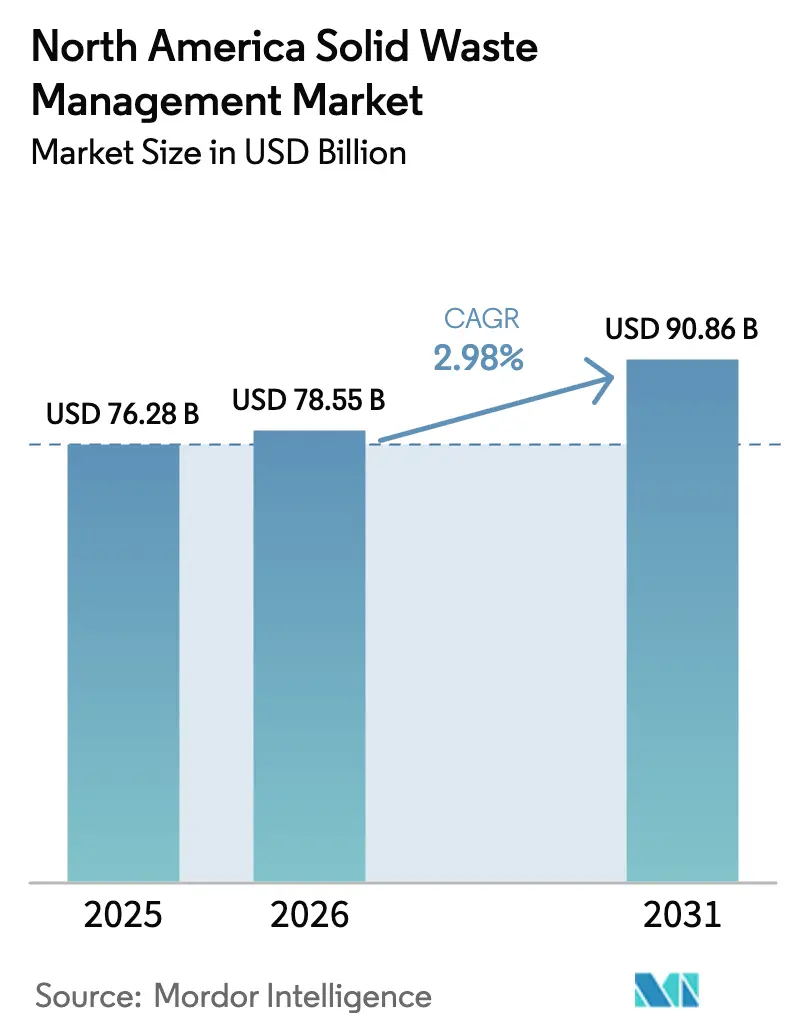
| Base Year Market Size (2025) | USD 76.28 Billion |
| Market Size (2026) | USD 78.55 Billion |
| Market Size (2031) | USD 90.86 Billion |
| Growth Rate (2026 - 2031) | 2.98 % |
| Market Concentration | Medium |
Major Players *Disclaimer: Major Players sorted in no particular order Image © Mordor Intelligence. Reuse requires attribution under CC BY 4.0. | |
North America Solid Waste Management Market Analysis by Mordor Intelligence
The North America Solid Waste Management Market size was valued at USD 76.28 billion in 2025 and estimated to grow from USD 78.55 billion in 2026 to reach USD 90.86 billion by 2031, at a CAGR of 2.98% during the forecast period (2026-2031). Rising landfill-gas–to-renewable-natural-gas (RNG) investments, corporate ESG mandates, and extended producer responsibility (EPR) regulations are shifting growth from pure volume expansion toward higher-margin recycling, energy recovery, and compliance services. Waste-to-energy contracts and closed-loop material recovery now command premium fees that insulate operators from fluctuations in recycled-commodity prices. As a result, the North America solid waste management market is becoming a platform for energy, data, and sustainability services that improve revenue quality even while overall volumes stabilize. Competitive intensity is rising in hazardous waste, healthcare waste, and RNG project finance, where regulatory complexity keeps barriers to entry high.
Key Report Takeaways
- By product type, waste disposal equipment led with 59.85% revenue share in 2025; waste recycling and sorting equipment is projected to expand at a 3.47% CAGR through 2031.
- By waste type, non-hazardous waste held a 77.65% share of the North America solid waste management market size in 2025, while hazardous waste is expected to advance at a 3.22% CAGR to 2031.
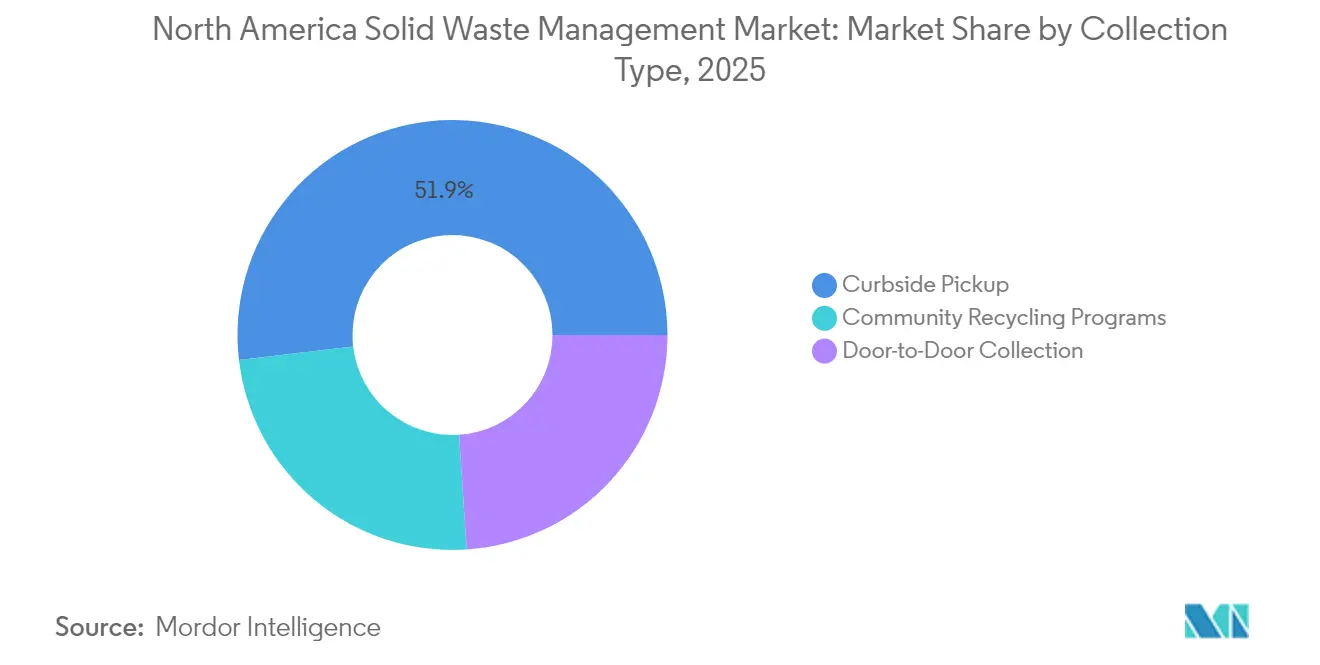
- By collection type, curbside pickup accounted for a 51.85% share of the North America solid waste management market size in 2025, and community recycling programs are projected to progress at a 3.44% CAGR through 2031.
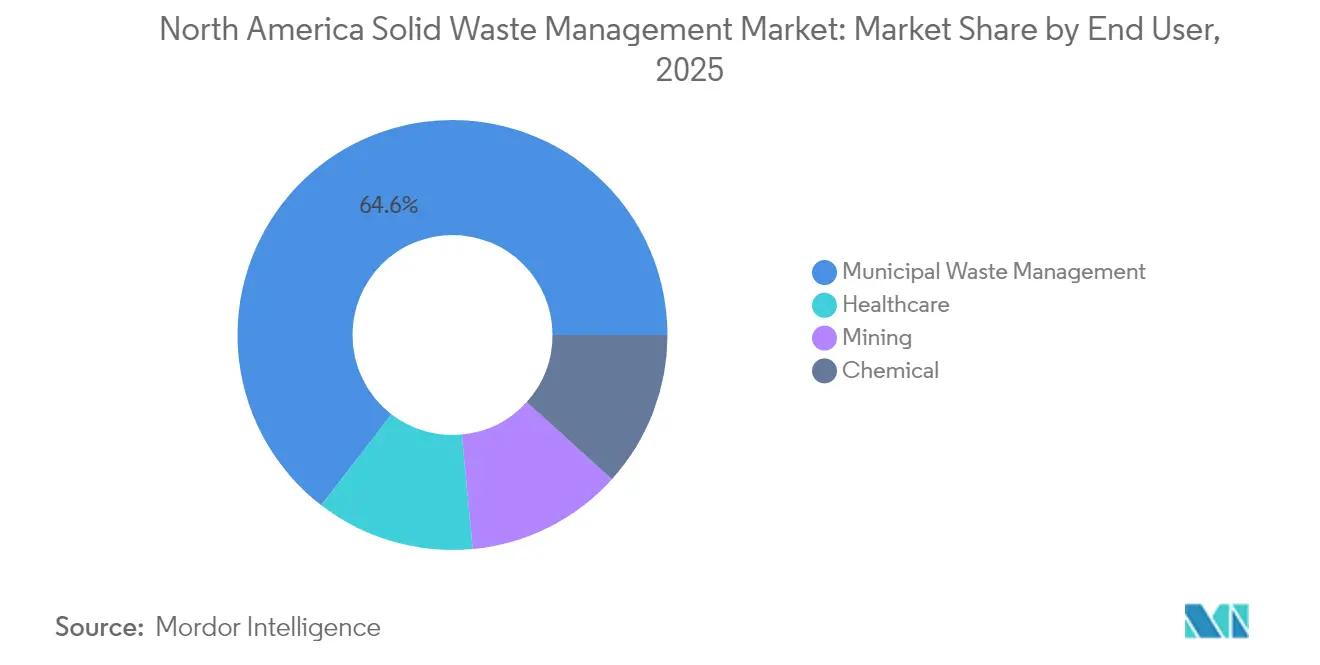
- By end user, municipal services accounted for 64.55% of the North America solid waste management market share in 2025, whereas healthcare waste services were projected to post the highest CAGR of 3.33% until 2031.
- By geography, the United States captured 79.60% revenue share in 2025; Mexico is expected to record the fastest growth at a 3.29% CAGR to 2031.
Note: Market size and forecast figures in this report are generated using Mordor Intelligence’s proprietary estimation framework, updated with the latest available data and insights as of 2026.
Market Trends and Insights
Drivers Impact Analysis of North America Solid Waste Management Market*
| Drivers | (~) % Impact on CAGR Forecast | Geographic Relevance | Impact Timeline |
|---|---|---|---|
| Circular-economy and recycling mandates accelerate infrastructure investment | +0.8% | United States and Canada, limited Mexico adoption | Medium term (2-4 years) |
| Corporate ESG targets boost demand for closed-loop services | +0.6% | Global, concentrated in urban centers | Short term (≤ 2 years) |
| Landfill-gas-to-RNG projects surge under RFS, LCFS and IRA incentives | +0.7% | United States primary, Canada secondary | Long term (≥ 4 years) |
| Ontario landfill-capacity crisis and U.S. export fees trigger regional build-outs | +0.4% | Ontario and Northeast U.S., spillover to adjacent states | Medium term (2-4 years) |
| Smart collection and AI sorting slash OPEX, enable PAYT pricing | +0.5% | North America urban markets, gradual rural penetration | Medium term (2-4 years) |
| Source: Mordor Intelligence | |||
Circular-Economy and Recycling Mandates Accelerate Infrastructure Investment
EPR statutes, such as California's SB 54 and Canada’s federal single-use plastic ban, obligate producers to finance sorting and processing upgrades, creating predictable fee income for operators in the North American solid waste management market[1]Environment and Climate Change Canada, “Government of Canada Delivers on Commitment to Ban Harmful Single-Use Plastics,” canada.ca. Republic Services has earmarked USD 200 million for optical-sorting retrofits in 2024 that meet contamination thresholds under state rules. Mandatory compliance structures convert recycling from a discretionary expense into an embedded cost of doing business, allowing contracts that guarantee minimum tonnage regardless of resin price cycles. As a result, capital flows toward robotic sorters, chemical recycling, and advanced material recovery facilities are accelerating, positioning the North American solid waste management market for sustained infrastructure build-out.
Corporate ESG Targets Boost Demand for Closed-Loop Services
Fortune 500 procurement programs now require verifiable waste diversion metrics, prompting suppliers to invest in integrated collection, recycling, and reporting solutions. Waste Management’s acquisition of Stericycle gives the combined entity an end-to-end healthcare waste platform that supports pharmaceutical take-back, packaging recovery, and digital tracking. Outcome-based contracts, anchored in diversion and carbon reduction, enable premium pricing and long-term renewals, reinforcing the value-over-volume shift inside the North America solid waste management market.
Landfill-Gas-to-RNG Projects Surge Under RFS, LCFS and IRA Incentives
Federal production tax credits and California LCFS credits combine to generate USD 15–25 per MMBtu for qualifying RNG, transforming landfills from cost centers into profit pools. Private-equity funds are now underwriting landfill acquisitions based on gas potential, reshaping valuation models and driving consolidation momentum across the North America solid waste management market.
Ontario Landfill-Capacity Crisis and U.S. Export Fees Trigger Regional Build-Outs
Ontario faces a 20-year disposal deficit starting in 2028. Waste Connections’ CAD 2.1 billion purchase of Canadian assets positions the firm for premium pricing once regional capacity tightens. Emerging thermal-treatment and waste-to-energy proposals seek to fill the impending gap, injecting fresh capital into the North America solid waste management market.
Restraints Impact Analysis of North America Solid Waste Management Market*
| Restraints | (~) % Impact on CAGR Forecast | Geographic Relevance | Impact Timeline |
|---|---|---|---|
| Recycled-commodity price volatility undermines revenue stability | -0.4% | Global, amplified in export-dependent regions | Short term (≤ 2 years) |
| Chronic labor shortages and work stoppages disrupt collection | -0.3% | North America urban centers, acute in Canada | Medium term (2-4 years) |
| CERCLA listing of PFAS heightens landfill liability exposure | -0.2% | United States primary, regulatory spillover expected | Long term (≥ 4 years) |
| Source: Mordor Intelligence | |||
Recycled-Commodity Price Volatility Undermines Revenue Stability
Mixed-paper prices plunged in 2024, while recycled-polymer values swung 40% quarter-to-quarter, complicating payback models for robotic sorters. Operators now write price-adjustment clauses into municipal contracts, shifting risk to cities that lack hedging tools. This uncertainty delays investment in next-generation recovery technology, tempering near-term revenue growth inside the North America solid waste management market.
Chronic Labor Shortages and Work Stoppages Disrupt Collection
The American Trucking Association estimates a 78,000-driver shortfall in the collection fleet, with annual turnover topping 95% at some firms[2]American Trucking Association, “Driver Shortage Report,” trucking.org . Wage inflation and sporadic work stoppages increase operating costs and service risk, prompting accelerated trials of autonomous side-loading trucks and AI route optimization. Until regulatory frameworks permit commercial deployment, labor scarcity will limit margin expansion in the North America solid waste management market.
*Our forecasts treat driver/restraint impacts as directional, not additive. The impact forecasts reflect baseline growth, mix effects, and variable interactions.
North America Solid Waste Management Market Segment Analysis
By Product Type:
Equipment Modernization Drives Recycling GrowthWaste disposal equipment retained a commanding 59.85% share of the North America solid waste management market size in 2025, reflecting entrenched landfill and transfer-station infrastructure across the region. However, revenue growth is shifting toward high-tech recycling and sorting systems, which are projected to post a 3.47% CAGR through 2031, underpinned by EPR mandates and purity standards that manual sorting cannot meet. AI-guided optical scanners now recover 95% of target plastics and metals, unlocking premium offtake pricing and reducing contamination penalties.
The equipment refresh cycle is blurring boundaries between disposal and recovery assets. Autonomous side-loading trucks piloted by Waste Management in Phoenix reduced fuel use by 12% and increased route capacity without requiring additional labor. Smart compactors equipped with Internet-of-Things sensors generate real-time fullness data, triggering dynamic collection schedules that slash empty-run miles and extend container life. Manufacturers increasingly bundle predictive-maintenance analytics with hardware sales, creating sticky service revenues that enrich the North America solid waste management industry’s aftermarket ecosystem.




By Waste Type:
Hazardous Streams Command Premium GrowthNon-hazardous streams account for 77.65% of 2025 volume, but hazardous waste revenue is expanding at a 3.22% CAGR as PFAS, pharmaceutical, and semiconductor effluent regulations tighten. The North American solid waste management market size for hazardous materials continues to rise, even as overall tonnage remains modest, due to specialized transport, treatment, and liability-coverage fees that can reach eight times the standard tipping rates. Healthcare and electronics manufacturers now contract with multi-state treatment networks to ensure compliance across jurisdictions, reinforcing the value proposition of integrated players in the North America solid waste management market.
Organic waste, while classified as non-hazardous, is emerging as the feedstock of choice for RNG facilities tied to state Low-Carbon Fuel Standards. Anaerobic digestion units co-located at landfills or dairy farms convert food waste into pipeline-quality gas, diversifying revenue streams. As RNG yields increase, non-hazardous waste contracts are being rewritten to share energy credit proceeds, adding a financial incentive that counterbalances waste-reduction policies within the broader North America solid waste management industry.
By Collection Type:
Community Programs Reshape Municipal ServicesCurbside pickup accounted for 51.85% of 2025 revenue, yet community recycling programs are forecasted to grow 3.44% annually as suburban and rural municipalities adopt drop-off depots and neighborhood hubs. These decentralized models reduce route mileage and driver hours, resulting in service-cost savings that appeal to cash-strapped local governments. Smart-bin sensors support hybrid scheduling, which pairs baseline weekly pickup with on-demand overflow service, thereby enhancing customer satisfaction while optimizing fleet utilization in the North American solid waste management market.
Pay-as-you-throw (PAYT) billing, enabled by RFID-tagged carts, is encouraging households to limit residual disposal and sort recyclables more diligently. Adoption remains uneven due to upfront technology investment, but early successes are prompting regional consortiums to pool procurement and spread fixed costs, reinforcing the viability of community programs across the North America solid waste management market.
By End User:
Healthcare Waste Accelerates Post-PandemicMunicipal accounts accounted for 64.55% of 2025 revenue, while healthcare clients are expected to drive growth with a 3.33% CAGR through 2031. Aging demographics and the outpatient-care boom lift regulated medical waste volumes, while DEA drug-take-back mandates fuel demand for secure pharmaceutical destruction. Waste Management’s USD 7.2 billion acquisition of Stericycle created the region’s largest integrated healthcare platform, capable of tracking sharps, chemotherapy, and controlled-substance streams from cradle to grave. These capabilities justify premium contract rates and long tenures, raising switching costs within the North America solid waste management market.
Chemical and mining sectors are generating more hazardous by-products as reshoring trends revive domestic production, particularly in battery materials and semiconductor fabs in Texas and Arizona. Operators with multi-jurisdiction treatment footprints capture these accounts, underscoring the competitive advantage of scale. Meanwhile, retailers leverage take-back programs to satisfy ESG scorecards, adding a consumer-facing dimension to demand patterns in the broader North America solid waste management industry.
Geography Analysis
United States Solid Waste Management Market
The United States accounts for 79.60% of the 2025 value, reflecting mature infrastructure, favorable RNG incentives, and a dense network of transfer stations that lower logistics costs. Federal production tax credits under the Inflation Reduction Act continue to funnel capital into landfill gas capture and organics digestion, supporting steady expansion even as per-capita waste generation levels off. Growth in the U.S. segment, therefore, hinges on value-added services—such as digital tracking, energy recovery, and ESG reporting—that deepen wallet share within existing accounts, sustaining momentum for the North American solid waste management market.
Canada Solid Waste Management Market
Canada remains a significant market, though disposal capacity gaps in Ontario force costly exports to U.S. landfills. Provincial EPR schemes and the federal single-use plastic ban are catalyzing investments in chemical recycling and thermal treatment facilities, while cross-border trade friction is spurring domestic solutions. Western provinces benefit from construction debris tied to LNG terminal build-outs, yet also confront landfill methane regulations that resemble U.S. rules, aligning the two markets’ policy trajectories and reinforcing cross-border best-practice sharing in the North America solid waste management market.
Mexico Solid Waste Management Market
Mexico, advancing at a 3.29% CAGR, is the growth frontier as urbanization, industrial corridors, and evolving environmental statutes stimulate private-sector participation. Municipal concessions in Mexico City and Monterrey include waste-to-energy clauses that guarantee feedstock volumes, creating bankable revenue streams for foreign investors. Informal sector competition and uneven enforcement still pose challenges, but ongoing NAFTA supply-chain integration encourages multinationals to replicate U.S. compliance protocols, accelerating professionalization across the North America solid waste management market.
Regulatory Landscape
In the United States, solid and hazardous waste handling is governed primarily through EPA programs under RCRA, with compliance increasingly digitized via the national e-Manifest system and related hazardous-waste information tools. In March 2026, the EPA finalized updated emission guidelines and new source performance standards for large municipal waste combustors, tightening requirements for pollutants such as mercury, lead, cadmium, and nitrogen oxides. This increases compliance and monitoring intensity for waste-to-energy assets and their upstream waste acceptance protocols.
PFAS remains a major focus for landfill and industrial-waste risk management. During 2026, EPA actions included updated interim guidance for PFAS destruction and disposal and additional engagement on managing PFAS-impacted soils. These steps push generators and waste operators to tighten characterization, transport documentation, and treatment and disposal selection across RCRA-adjacent programs, including TSCA and CWA interfaces. In parallel, packaging and materials policy continues to advance through state and provincial extended producer responsibility structures, including California SB 54 and Canadian EPR frameworks referenced in the report context. That shift increases demand for audited recycling outcomes and documentation that can support compliance reporting.
Value Chain Analysis
The value chain starts with waste generation (municipal, commercial, industrial, and healthcare), followed by collection and hauling (curbside, door-to-door, and depot or community programs). Transfer and consolidation lead into downstream processing, including material recovery facilities (MRFs), organics processing (composting and depackaging), specialized hazardous and regulated medical waste treatment, and final disposal (landfills) or energy recovery (waste-to-energy and landfill-gas-to-RNG). Data and compliance layers run across the chain, covering route optimization, contamination monitoring, and hazardous-waste tracking through EPA platforms and e-manifest workflows.
Integration is tightening through co-located and multi-output sites that convert one waste shed into multiple revenue streams. WM positioned this model with its July 2026 opening of a USD 110 million recycling facility and hauling site in the Denver area, linking collection logistics more closely to high-throughput processing. Republic Services is also extending downstream optionality by developing the San Bernardino Sustainability Park, designed for large-scale organics processing and focused on value-added soil products and diversion compliance for municipalities and commercial generators. Together, these investments support a value-over-volume chain where operators monetize compliance services, higher-quality recovered commodities, and energy products alongside traditional tipping fees.
Competitive Landscape
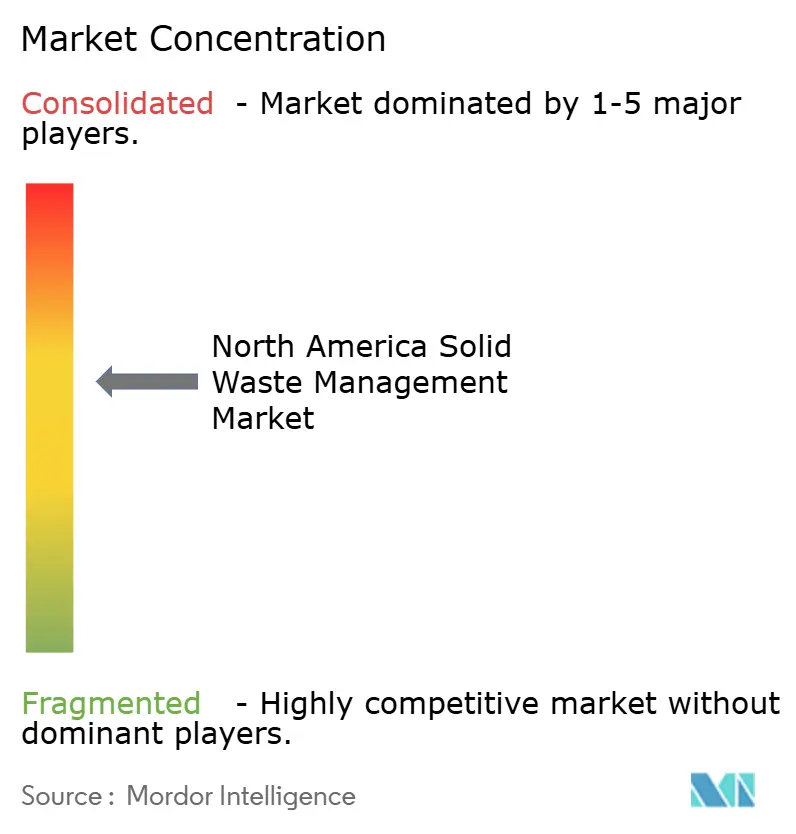
The North America solid waste management market is moderately fragmented. The consolidation has accelerated following Waste Management’s acquisition of Stericycle, as peers have rushed to fortify vertical niches such as healthcare waste, hazardous materials, and recycling MRFs. Strategic partnerships with OEMs and energy firms are proliferating. White-space opportunities reside in PFAS remediation, battery-recycling logistics, and organics processing. Clean Harbors and specialized boutique firms pursue high-margin niche markets for hazardous waste, while municipal agencies issue long-term build-own-operate contracts for food waste digestion. As ESG disclosures become mandatory, investors reward operators that demonstrate quantifiable environmental benefits, reinforcing consolidation around firms with integrated, tech-enabled service portfolios.
North America Solid Waste Management Industry Leaders
Waste Management Inc.
Republic Services
GFL Environmental Inc.
Waste Connections
Clean Harbors
- *Disclaimer: Major Players sorted in no particular order
North America Solid Waste Management Market Companies Covered in this Report
- Casella Waste Systems
- Clean Harbors
- Covanta Holdings Corporation
- Darling Ingredients.
- GFL Environmental Inc.
- Kinder Morgan
- Montauk Renewables, Inc
- Recology
- Republic Services
- Rubicon Technologies, Inc.
- Stericycle
- US Ecology
- Veolia
- Waste Connections
- Waste Management Inc.
- Waste Pro USA
- WM Intellectual Property Holdings, L.L.C.
Read Analysis of North America Solid Waste Management Companies

Market Opportunities and Future Outlook
Near-term opportunities concentrate where regulation and customer requirements drive contracted infrastructure spend rather than discretionary recycling. Organics diversion and processing is one of the clearest whitespace areas because it depends on dedicated depackaging, composting, and feedstock logistics at scale, and it is increasingly embedded in local and state compliance programs. Republic Services broke ground in June 2026 on its San Bernardino Sustainability Park, a 140-acre development designed for 300,000 to 600,000 tons of annual organics processing capacity, reinforcing how large purpose-built assets are being used to secure municipal and commercial organics flows and diversify revenues beyond landfill disposal.
A second opportunity set sits in integrated recycling and upgrade cycles aligned with producer responsibility and higher purity thresholds, particularly where operators can bundle hauling, MRF processing, and verified reporting. WM continued to add processing capacity with its July 2026 USD 110 million Denver-area recycling facility and hauling site, and its broader multi-year recycling investment program referenced in the evidence pack (2022-2027) points to sustained capital allocation for modernized MRF networks. On the energy side, landfill-gas-to-RNG development remains a monetization lever linked to existing disposal footprints and credit frameworks, supported by GFL Environmental advancing new RNG projects with OPAL Fuels in Alabama and Georgia. Finally, hazardous-waste and emerging contaminant management, including PFAS-related handling and documentation, creates service-line whitespace for operators with permitted treatment networks and strong compliance tooling. This is reinforced by 2026 EPA actions around PFAS disposal guidance and by tightening air rules for large municipal waste combustors.
Recent Industry Developments in North America Solid Waste Management Market
- July 2026: Waste Management, Inc. opened the Denver East Recycling Facility and Hauling Site (Aurora, CO) with a $110 million facility. The opening expands recycling and hauling capacity in a key market and strengthens WM's ability to capture municipal and commercial streams, improving diversion metrics.
- July 2026: Waste Management, Inc. acquired residential and commercial operations of HBS Trash Services in Colorado. The acquisition expands WM's geographic footprint and service lines in residential and commercial waste, with potential cross-sell opportunities.
- July 2026: Philadelphia Department of Sanitation (with WM, Republic Services, ReWorld) announced plans to award new solid waste disposal contracts to WM, Republic Services, and Reworld. The municipal award signals revenue opportunities for leading operators and reinforces competitive dynamics for long-term municipal waste contracts.


North America Solid Waste Management Market Report Scope and Research Methodology
Market Definition and Coverage
This market covers the revenues earned from managing non-hazardous solid waste across North America, including collection, hauling, transfer, sorting, recycling, composting, landfill disposal, and waste-to-energy services billed to residential, commercial, industrial, and municipal customers.
Scope exclusions: It excludes liquid wastewater services and the handling of regulated hazardous waste streams that follow separate permitting and pricing structures.
Segments Covered in This Report
- By Product Type
- Waste Disposal Equipment
- Waste Recycling and Sorting Equipment
- By Waste Type
- Hazardous Waste
- Non-hazardous Waste
- By Collection Type
- Curbside Pickup
- Door-to-Door Collection
- Community Recycling Programs
- By End User
- Municipal Waste Management
- Healthcare
- Chemical
- Mining
- By Geography
- United States
- Canada
- Mexico
Data Sources, Market Sizing, and Validation
Desk Research
Desk research is used to set the core boundary of the market and to build realistic demand anchors before modeling starts. We use public waste generation and disposal statistics, policy signals, and infrastructure indicators so the model reflects activity that is visible and measurable.
Typical sources include government publications such as the US EPA (municipal solid waste and recycling rates), Statistics Canada, and Mexico's INEGI, along with operating benchmarks and guidance from groups such as SWANA and the US EIA for landfill gas and waste-to-energy context. Company annual reports, investor presentations, and local authority procurement documents help clarify the service mix and how pricing behaves. Paid subscriptions are used selectively for company financials, shipment-level trade checks on recyclables, and patent lookups tied to sorting and processing equipment. These desk sources are illustrative and not exhaustive, and other public datasets and documents are also referenced for data collection, validation, and clarification.
Primary Interviews and Surveys
Primary interviews and surveys are used to validate scope, understand local pricing mechanics, and stress-test assumptions that are difficult to observe in public datasets. We speak with operators, municipal and commercial buyers, facility managers, and industry experts across the United States, Canada, and Mexico so the totals reflect regional tipping fee patterns, contract structures, and recycling economics.
Distribution of primary research fieldwork respondents
| Company type | Respondent position |
|---|---|
| Top tier: 29% | CXOs: 19% |
| Mid tier: 49% | Functional/Unit leaders: 37% |
| Smaller Players: 22% | Managers: 44% |
Market-Sizing & Forecasting
Sizing starts with a top-down build where waste generation, collection coverage, landfill and transfer throughput, and recycling and organics diversion rates are converted into a payable service pool by applying observed fee structures. Those totals are then checked with selective bottom-up approximations, such as sampled price per ton or price per pickup multiplied by volumes from major municipalities, transfer stations, material recovery facilities, and landfill networks, which helps adjust for outliers and data gaps.
Key model inputs include municipal solid waste generation and per-capita trends, landfill tipping fees and transfer station charges, recycling commodity price cycles that influence processing economics, organics program rollout and participation levels, and capacity additions in MRFs, composting sites, landfills, and waste-to-energy facilities. For forecasting, scenario analysis is used to reflect fee escalation clauses, policy-driven diversion shifts, and commodity price sensitivity, and then the trajectory is aligned to what interviewees indicate is achievable under typical contract renewal and permitting timelines. When a bottom-up datapoint is missing for a country or service pocket, we fill it using proxy fee benchmarks and facility density, and then re-check the implied revenue per ton against the broader regional range.
Data Validation & Update Cycle
Validation is done through multiple cross-checks so the final numbers do not rely on a single dataset. We compare modeled revenues against independent signals such as reported disposal volumes, facility utilization, announced capacity expansions, and observed fee ranges from public procurement and permitting records, and then investigate any large variances.
Before sign-off, the model goes through stepwise analyst reviews, and respondents are re-contacted when pricing, diversion, or facility assumptions fall outside the expected band. Reports are refreshed annually, with interim updates triggered by material events such as major regulatory changes, mergers, or sharp movements in recycling commodity prices, and a final pre-delivery pass is completed so clients receive the latest view.
Mordor Intelligence's North America Solid Waste Management Market Size Versus Other Published Estimates
Published market sizes for solid waste management can look far apart even when they cover the same region, because the boundary between non-hazardous solid waste services and broader waste and environmental categories is not applied consistently. Differences also come from how firms time currency conversion, handle fee escalators, and decide whether recycling revenues linked to commodity prices are smoothed or treated closer to spot levels.
When price benchmarks and escalation clauses are refreshed and then tested against disposal volumes and facility throughput, the result tends to sit lower than broader roll-ups that blend in industrial or hazardous streams. That refresh-and-check discipline is one reason the 2025 value lands at USD 76.28 B for Mordor Intelligence.
Benchmark comparison
| Source | Market Size | Gaps in Research Methodology |
|---|---|---|
| Mordor Intelligence | USD 76.28 B (2025) | |
| Industry Newsletter A | USD 215.00 B (2024) | This figure appears to use a wider waste management perimeter that can bundle solid waste with adjacent service lines, which inflates totals versus a solid-waste-only view. The year basis differs and may reflect earlier fee levels and a different currency timing convention. |
| Market Compendium B | USD 813.58 B (2022) | The estimate looks like an industry-revenue aggregation across a broader NAFTA-style definition and may include additional waste categories beyond non-hazardous solid waste services. Using an older base year can also shift the result because tipping fees, hauling rates, and recycling revenue treatment have changed since then. |
Overall, the spread is mainly explained by scope and timing differences rather than a single calculation step. Our method stays traceable to visible demand signals and repeatable pricing logic, which makes the market size easier to reconcile with facility activity and public fee benchmarks over time.


Key Questions Answered in the Report
How large is the North America solid waste management market in 2026?
The market stands at USD 78.55 billion in 2026 and is forecast to reach USD 90.86 billion by 2031.
What is the expected CAGR for solid waste management services in North America?
The market is projected to register a 2.98% CAGR during 2026-2031.
Which product category leads revenue in regional waste management?
Waste disposal equipment accounts for 59.85% of 2025 revenue, supported by established landfill and transfer-station infrastructure.
Which waste stream is growing fastest across North America?
Hazardous waste services are projected to post the strongest growth at a 3.22% CAGR due to stricter regulations for PFAS and pharmaceuticals.
Which country is the fastest-growing market within North America?
Mexico is forecast to expand at a 3.29% CAGR through 2031, driven by urbanization and new environmental policies.
What factor is driving investment in landfill gas projects?
Layered incentives under the Inflation Reduction Act, the Renewable Fuel Standard, and the Low Carbon Fuel Standard make RNG yields financially attractive.
Page last updated on:





