
Market Overview
| Study Period | 2022 - 2031 |
|---|---|
| Forecast Data Period | 2026 - 2031 |
| Historical Data Period | 2022 - 2024 |
| Growth Rate | 9.08 % |
| Market Concentration | Medium |
Major Players *Disclaimer: Major Players sorted in no particular order Image © Mordor Intelligence. Reuse requires attribution under CC BY 4.0. | |
North America Nuclear Decommissioning Market Analysis by Mordor Intelligence
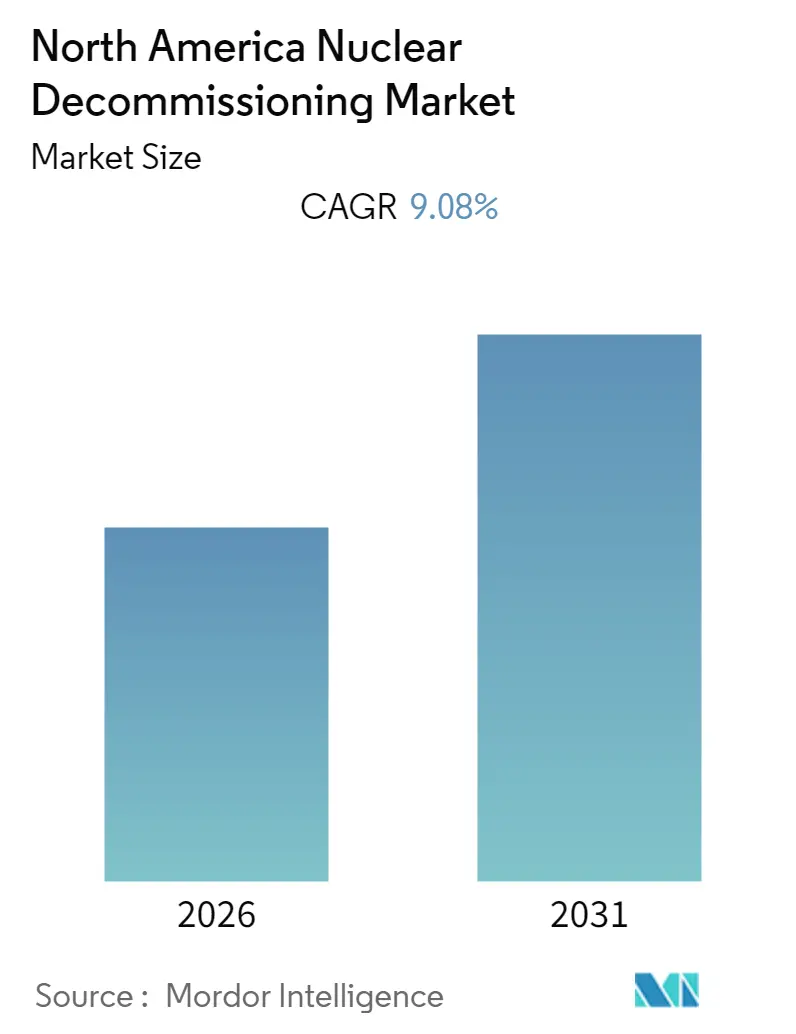
The North America Nuclear Decommissioning Market size is expected to register a CAGR of 9.08% during the forecast period.
The market was negatively impacted by the COVID-19 pandemic in 2020. Presently, the market has reached pre-pandemic levels.
- Over the medium term, an increasing number of nuclear reactors reaching operational retirement is expected to drive the growth of the nuclear power reactor decommissioning market in North America.
- On the other hand, technical drawbacks of string inverters are expected to hamper the growth of the market during the forecast period.
- Nuclear phase-out policies in countries such as the United States and Canada will likely create lucrative growth opportunities for the North American nuclear power reactor decommissioning market during the forecast period.
- The United States dominates the market and is likely to witness the highest CAGR during the forecast period. This growth is attributed to the increasing decommissioning of its old nuclear plants.
Note: Market size and forecast figures in this report are generated using Mordor Intelligence’s proprietary estimation framework, updated with the latest available data and insights as of 2026.
North America Nuclear Decommissioning Market Trends and Insights
Commercial Power Reactor Expected to Dominate the Market
- Commercial power reactors are nuclear reactors mainly used for generating electricity. Most of these reactors are being installed in nuclear power plants. Renewable energy from solar and wind is much cheaper and cleaner, thus increasing the demand for installing these reactors.
- The countries in the region, such as the United States and Canada, are decommissioning their old and outdated nuclear power plants, which may drive the North American nuclear power reactor decommissioning market during the forecast period.
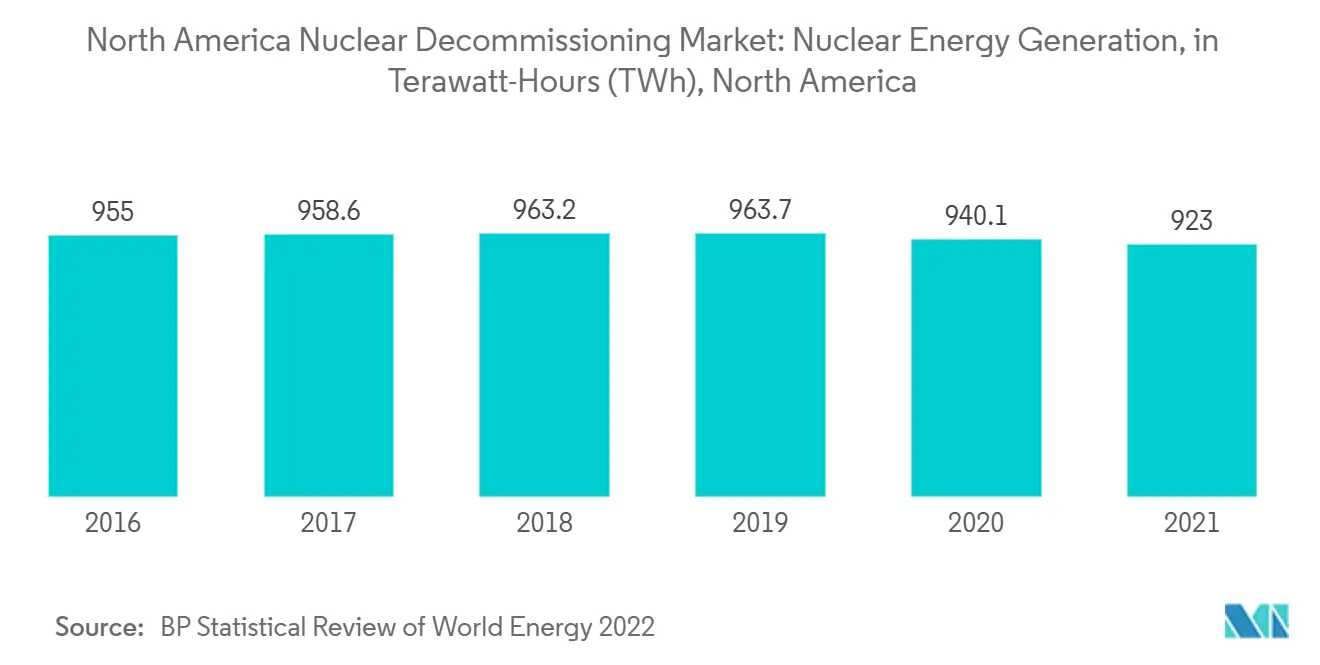
- In 2021, North America's total electricity produced by nuclear energy was 923.0 terawatt-hours (TWh), almost the same as in 2020, i.e., 940.1 TWh. The slow-growing or flatness of the nuclear energy curve in the region shows that the nuclear power reactors' decommissioning will surpass the installation of new nuclear plants in the region.
- In May 2022, Entergy Corporation shut down its Palisades nuclear plant on Lake Michigan. The nuclear power plant had an 800 MW power generation capacity. The fuel was removed from the reactor's vessel and placed in the spent fuel pool to cool. After the cooling process, the fuel will be transported to the secured Independent Spent Fuel Storage Facility on the station property. The company also aims to complete the decommissioning of the nuclear plant by 2041.
- Hence, due to such factors, the commercial power reactor sector may dominate the North American nuclear power reactor decommissioning market during the forecast period.


United States Expected to Dominate the Market
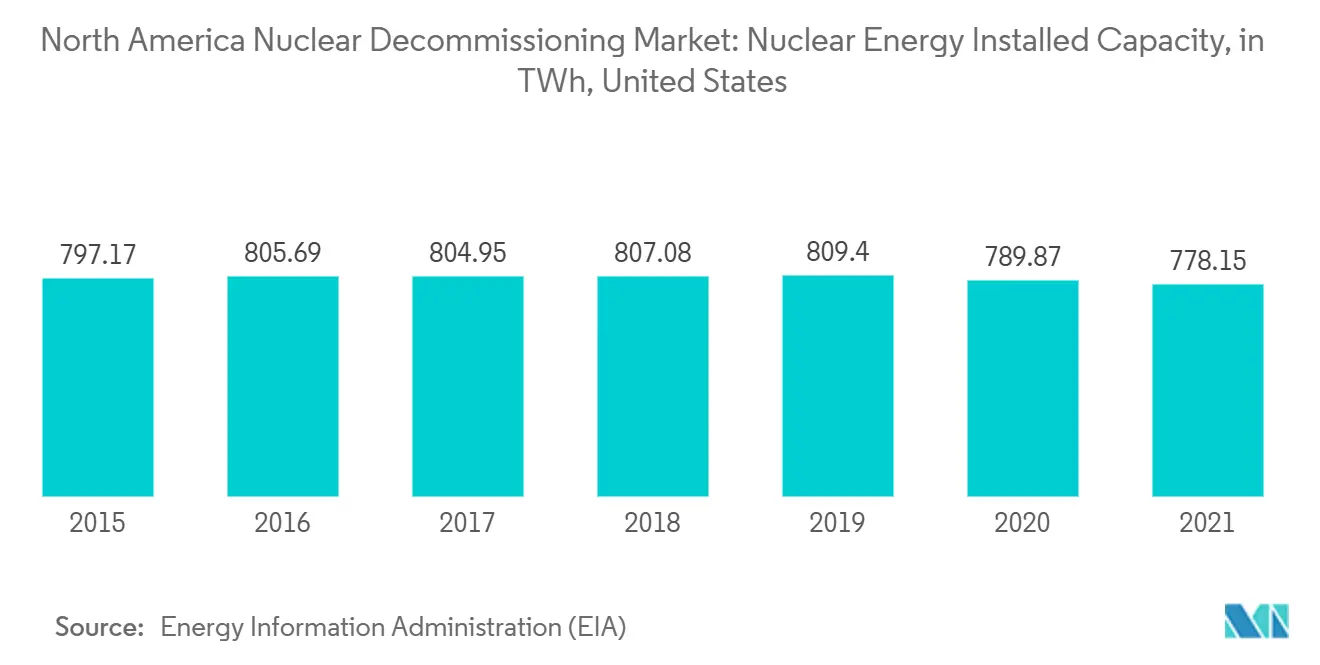
- The United States is one of the largest nuclear power producers globally, accounting for almost 30% of the global nuclear power generated in 2021. The country's nuclear reactors produced 778.15 terawatt hours (TWh) of electricity in 2021, representing a slight increase of 0.35% over the previous year's value. The ready-to-retire old nuclear plants are likely to drive the nuclear power reactor decommissioning market.
- In 2021, nuclear power plants in the United States generated around 778.15 terawatt hours of electricity, the lowest output recorded in one decade. The number of nuclear power reactors has been decreasing since 1990, when it peaked at 112 units.
- Over the past decade, intense competition from electricity generation using low-cost shale gas has hurt the competitiveness of the country's nuclear power industry. Record low wholesale electricity prices and the high cost of life extension (PLEX) upgrades have also led to early nuclear plant retirements.
- As the era of nuclear power in the United States comes to an end, the decommissioning of nuclear power plants is becoming a significant industry. Private companies are acquiring these plants, taking over their licenses, liability, decommissioning funds, and waste contracts. Around 41 reactors with a combined capacity of 19.97 GWe were shut down, with the latest being the Palisades nuclear plant in Michigan, which shut down in May 2022. In December 2021, HoltecInternational received approval from the Nuclear Regulatory Commission to acquire the Palisades plant in Covert, Michigan, to decommission and dismantle the plant. An additional 198 reactors are expected to shut down by 2030.
- The nuclear reactor fleet of the United States is now aging. The US Nuclear Regulatory Commission (NRC) is considering applications for extending operating licenses beyond 60-80 years with its subsequent license renewal (SLR) program. However, some plant owners recently opted for early retirements of their nuclear units at 45-50 years.
- Hence, due to such factors, the United States is expected to dominate the North American nuclear power reactor decommissioning market during the forecast period.
Regulatory Landscape
In the United States, nuclear plant decommissioning is overseen by the U.S. Nuclear Regulatory Commission (NRC) under 10 CFR requirements that cover planning, timelines, and funding. NRC process guidance requires a Post-Shutdown Decommissioning Activities Report (PSDAR) to be submitted within two years of permanent cessation of operations, and licensees must also develop a license termination plan that addresses site characterization and remediation; 10 CFR 50.75 sets financial assurance obligations for decommissioning cost coverage.
In Canada, the Canadian Nuclear Safety Commission (CNSC) regulates decommissioning through lifecycle planning and acceptance of formal decommissioning documentation. Licensees maintain a Preliminary Decommissioning Plan (PDP) over the facility lifecycle and submit a Detailed Decommissioning Plan (DDP) for CNSC acceptance before execution, supported by financial guarantees sufficient to cover decommissioning liabilities.
Value Chain Analysis
The North American nuclear decommissioning value chain starts with regulatory-driven planning and project definition (site characterization, radiological surveys, and decommissioning execution planning). It then moves into engineering and dismantlement (segmentation, decontamination, and demolition) using specialized tooling, robotics, and certified labor such as health physics technicians. From there, work extends to waste packaging, transport logistics, and disposal, alongside spent fuel management steps such as movement to and operation of independent spent fuel storage installations (ISFSIs), before final status surveys and license termination or site release.
On the supply side, engineering and consulting providers contribute decommissioning planning and waste management capabilities. Nuclear component and materials suppliers and waste logistics specialists also support execution. Project financing and dedicated decommissioning entities are shaped by NRC fund adequacy expectations and decommissioning trust mechanisms, while a recurring execution bottleneck is access to licensed low-level radioactive waste disposal pathways. This can constrain schedules and increases the value of integrated, turnkey decommissioning offerings that bundle dismantlement with waste routing and compliance management.
Competitive Landscape
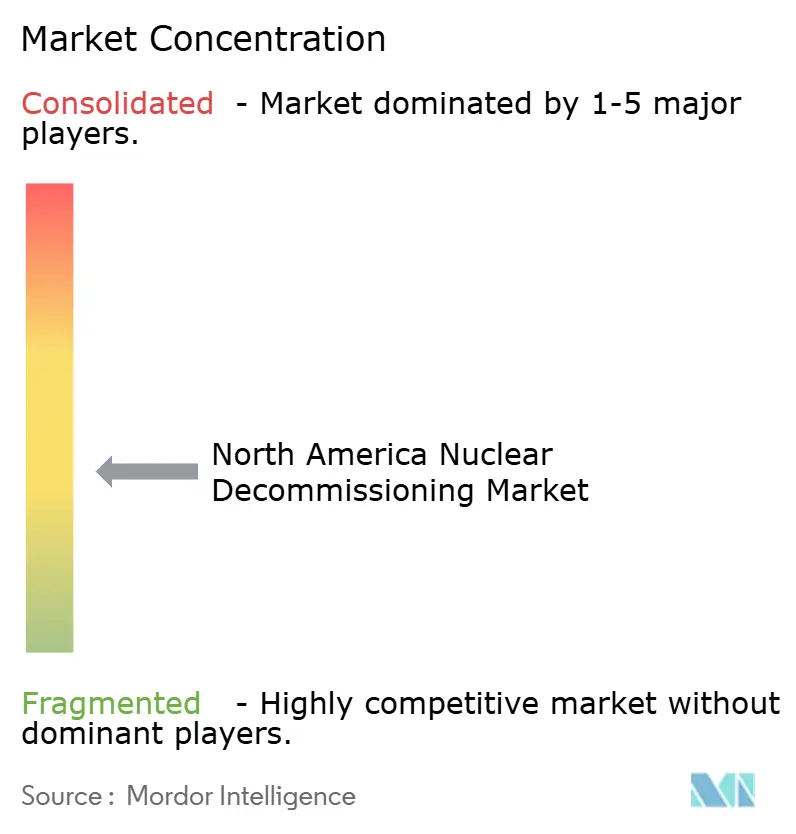
The North American nuclear decommissioning market is moderately fragmented in nature. Some of the major players in the market (in no particular order) include Babcock International Group PLC, NorthStar Group Services Inc., James Fisher & Sons PLC, Fluor Corporation, and Enercon Services Inc.
North America Nuclear Decommissioning Industry Leaders
Babcock International Group PLC
NorthStar Group Services, Inc.
James Fisher & Sons PLC
Fluor Corporation
Enercon Services Inc.
- *Disclaimer: Major Players sorted in no particular order

Market Opportunities and Future Outlook
A clear opportunity area is specialized services that help licensees manage schedule and funding constraints under NRC oversight. In February 2026, the NRC granted Constellation Energy Generation, LLC a one-time exemption allowing an alternative decommissioning schedule for Dresden Nuclear Power Station Unit 1 under SAFSTOR beyond the standard 60-year completion framework, which points to ongoing demand for regulatory-grade technical justifications, licensing support, and program controls for multi-unit and legacy sites.
There is also actionable scope in characterization, measurement, and testbed-driven technology adoption for complex deactivation and decommissioning (D&D) work, particularly tied to DOE legacy facilities. DOE Office of Environmental Management and United Cleanup Oak Ridge (UCOR) have implemented a Technology Development Facility (TDF) at the Oak Ridge Reservation to test D&D technologies, while DOE-facing work highlights issues such as non-destructive assay (NDA) of large legacy components (including piping galleys and valve assemblies). These conditions support demand for in-situ radiological characterization solutions, advanced segmentation approaches, and integrated waste-disposition planning to reduce uncertainty in packaging and disposal pathways.
Recent Industry Developments
- July 2026: James Fisher and Sons PLC launched a global decommissioning alliance with Aquaterra Energy to support decommissioning projects. The partnership combines complementary engineering and offshore capabilities, strengthening bid credentials for complex decommissioning scopes that span planning, execution support, and marine interfaces.
- March 2025: NorthStar Group Services, Inc. closed the acquisition of the Vallecitos Nuclear Center in California from GE Vernova and GE-Hitachi Nuclear Energy Americas to carry out decommissioning and site restoration. Taking control of the site underpins NorthStar's model of owning and executing the full decommissioning lifecycle, from planning through remediation and end-state delivery.
- November 2024: NorthStar Group Services, Inc. and Modern American Recycling and Radiological Services (MARRS) formed a team to pursue dismantlement of the US Navy's defueled ex-Enterprise in Mobile, Alabama. Positioning work at the Port of Mobile expands nuclear decommissioning participation into maritime asset dismantling and creates a pathway to compete for additional nuclear-powered vessel recycling scopes.


Research Methodology Framework and Report Scope
Market Definition and Coverage
This market covers spending tied to taking nuclear reactors and related plant areas out of service in North America, including planning, dismantling, decontamination, and site restoration work up to regulatory closure.
Scope exclusions: New reactor construction, routine operations and maintenance, and fuel-cycle activities that are not part of decommissioning work are excluded.
Segmentation Overview
- Reactor Type
- Pressurized Water Reactor
- Pressurized Heavy Water Reactor
- Boiling Water Reactor
- High-temperature Gas-cooled Reactor
- Liquid Metal Fast Breeder Reactor
- Other Reactor Types
- Applications
- Commercial Power Reactor
- Prototype Power Reactor
- Research Reactor
- Capacity
- Below 100 MW
- 100-1000 MW
- Above 1000 MW
- Geography
- United States
- Canada
- Rest of North America
Data Sources, Market Sizing, and Validation
Desk Research
Desk work starts by building the facility and policy context, since decommissioning is shaped by licenses, timelines, and compliance steps. We primarily rely on public and official sources such as the U.S. Nuclear Regulatory Commission (reactor status and filings), the U.S. Energy Information Administration (nuclear generation and fleet information), Natural Resources Canada and the Canadian Nuclear Safety Commission (Canadian plant and licensing updates), and International Atomic Energy Agency reference material for standard decommissioning stages.
After that base is set, we check price and activity assumptions using company annual reports and project updates, and we review environmental impact documents when available. We also use reputable press coverage of contract awards and schedule changes. Patent databases and a news and financials subscription are used selectively to track technology adoption signals and project milestones that may not be visible in summary statistics. The source list above is illustrative, and many other public references are reviewed for cross-checking and clarification during the study.
Primary Interviews and Surveys
Primary work is used to validate how projects are staffed and budgeted across phases, and to confirm what typically drives change orders, schedule slippage, and risk buffers. We interview utility-side program teams, decommissioning contractors, engineering specialists, and waste-handling stakeholders across the United States and Canada, and we then align secondary signals with what is being executed at the project level.
Distribution of primary research fieldwork respondents
| Company type | Respondent position |
|---|---|
| Top tier: 36% | CXOs: 12% |
| Mid tier: 47% | Functional/Unit leaders: 37% |
| Smaller Players: 17% | Managers: 51% |
Market-Sizing & Forecasting
The sizing model is built using a top-down approach where reactor retirement schedules, licensing status, and decommissioning timelines are translated into an annual demand pool for decommissioning activity in North America. To keep it practical, the model uses a small set of repeatable inputs such as the count of units in permanent shutdown, expected phase timing (pre-decommissioning planning, active dismantling, and site restoration), the mix of reactor capacity bands, and typical cost intensity patterns seen by project stage.
Those totals are then corroborated through selective bottom-up approximations, where sampled project budgets and contractor revenue exposure are used as reasonableness checks. When project cost disclosures are limited, gaps are handled by applying stage-based cost ranges informed by interviews, and then reconciling results against public filings and visible milestones. Forecasting is run through scenario analysis, because timing can move with regulatory reviews, waste pathway availability, and funding release cadence, and these drivers were also validated through expert feedback before finalizing the outlook.
Data Validation & Update Cycle
Validation is done through multiple checks so unusual spikes do not pass through without explanation. Model outputs are compared against independent signals such as the number of reactors transitioning between license states, major schedule announcements, and publicly reported contract activity, and then variances are reviewed in an internal analyst pass before sign-off.
The report is refreshed annually, and interim updates are triggered when there are material events such as an unexpected shutdown, a large decommissioning contract award, or a regulatory milestone that shifts the phase timeline. Before delivery, we do a final review cycle to ensure the latest public updates and interview learnings are reflected in the numbers and commentary.
Mordor Intelligence's North America Nuclear Decommissioning Market Size Measured Against Other Published Estimates
Published market sizes for North America nuclear decommissioning can vary a lot, even when they describe the same activity. The gaps usually come from what is counted as decommissioning spend, which years are treated as the current base, and how schedule risk is handled in the forecast.
Spent fuel storage and long-term waste disposal spend often get blended into some totals, but it sits outside Mordor Intelligence's scope here, which keeps the value focused on decommissioning project work tied to shutdown reactors. In other cases, estimates can be inflated when aggressive phase timing is assumed across multiple units at once, or when cost escalation is applied without checking against license status changes, funding release constraints, and the practical sequencing of dismantling work.
Benchmark comparison
| Source | Market Size | Gaps in Research Methodology |
|---|---|---|
| Mordor Intelligence | USD 1.16 B (2024) | |
| Industry Publisher A | USD 1.22 B (2025) | Uses a later base year and appears to include broader decommissioning strategies and related activities, which can shift annual timing and lift the near-term total versus a reactor shutdown and phase-timing driven view. |
| Global Consultancy B | USD 6.33 B (2023) | Defines the market around nuclear power reactor decommissioning services with a wider cost bundle and different project accounting, which can pull in adjacent waste management and technology spend not consistently tied to decommissioning phase execution. |
The spread in published numbers is mainly explained by what cost buckets are counted and how quickly activity is assumed to move from planning into dismantling across the fleet. By keeping the demand pool anchored to shutdown units, license and schedule signals, and interview-checked phase timing, our estimate stays traceable to clear inputs that can be revisited when new project milestones are announced.


Key Questions Answered in the Report
What is the current North America Nuclear Power Reactor Decommissioning Market size?
The North America Nuclear Power Reactor Decommissioning Market is projected to register a CAGR of 9.08% during the forecast period (2026-2031)
Who are the key players in North America Nuclear Power Reactor Decommissioning Market?
Babcock International Group PLC, NorthStar Group Services, Inc., James Fisher & Sons PLC, Fluor Corporation and Enercon Services Inc. are the major companies operating in the North America Nuclear Power Reactor Decommissioning Market.
What years does this North America Nuclear Power Reactor Decommissioning Market cover?
The report covers the North America Nuclear Power Reactor Decommissioning Market historical market size for years: 2021, 2022, 2023 and 2024. The report also forecasts the North America Nuclear Power Reactor Decommissioning Market size for years: 2026, 2027, 2028, 2029, 2030 and 2031.
Page last updated on:





