
Gulf Of Mexico Offshore Decommissioning Market Size and Share
Market Overview
| Study Period | 2021 - 2031 |
|---|---|
| Forecast Data Period | 2026 - 2031 |
| Historical Data Period | 2021 - 2024 |
| Growth Rate | 6.80 % |
| Market Concentration | Low |
Major Players *Disclaimer: Major Players sorted in no particular order Image © Mordor Intelligence. Reuse requires attribution under CC BY 4.0. | |
Gulf Of Mexico Offshore Decommissioning Market Analysis by Mordor Intelligence
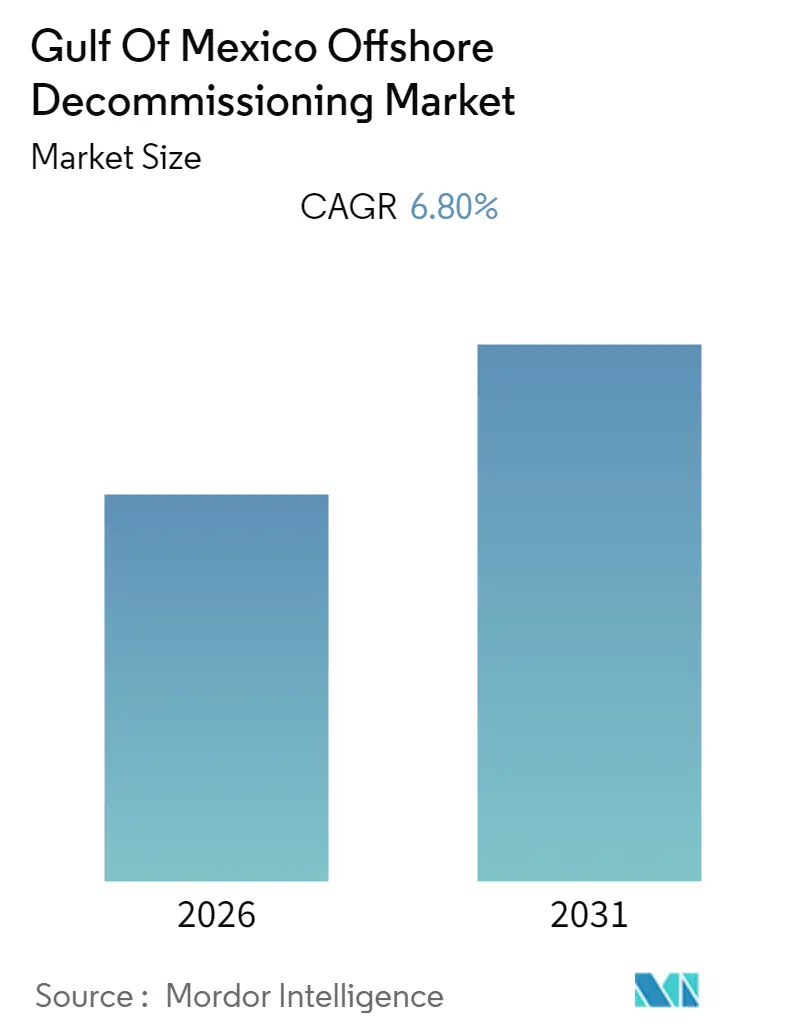
The Gulf of Mexico Offshore Decommissioning Market size was valued at USD 1.77 billion in 2025 and estimated to grow from USD 1.89 billion in 2026 to reach USD 2.62 billion by 2031, at a CAGR of 6.80% during the forecast period (2026-2031).
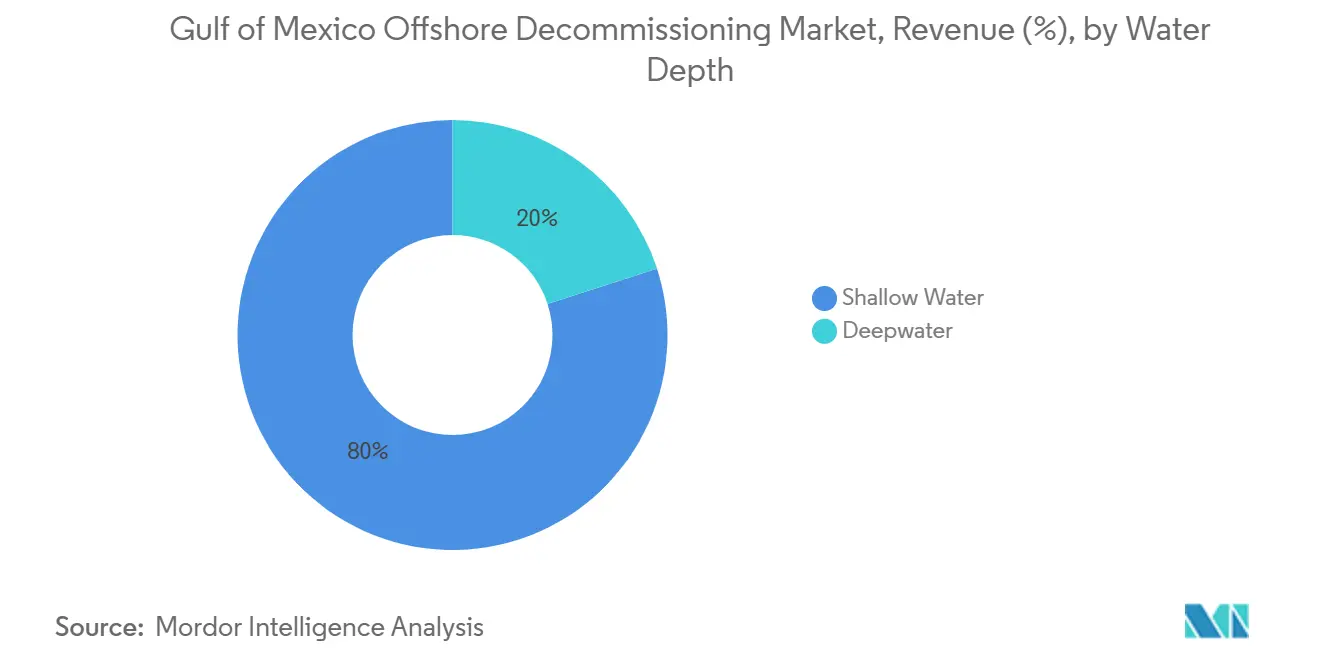
- The decommissioning market in shallow waters holds the largest market in recent years. But, the deepwater regions is expected to grow faster during 2020-2025, as the number of potential projects available in shallow waters is drying up.
- Deepwater projects are subject to greater levels of regulatory scrutiny and require specialized heavy-lift vessels to remove topsides. The unit cost to decommission deepwater projects is much greater, due to operational complexity and increased spread rates for marine vessels. The shift toward decommissioning deepwater facilities will present a range of new opportunities, as well as challenges for companies.
Note: Market size and forecast figures in this report are generated using Mordor Intelligence’s proprietary estimation framework, updated with the latest available data and insights as of 2026.
Gulf Of Mexico Offshore Decommissioning Market Trends and Insights
Deepwater to Register Highest Growth Rate
- The deepwater decommissioning segment is in better shape, significant growth of decommissioning in these waters remains unlikely in the foreseeable future.
- Deepwater projects require adherence to more stringent safety regulations and more investment in the form of purpose-built vessels. The equipment typically used for shallow water operations cannot be transferred for use in a deepwater environment. With the development of the deepwater market, the demand for new technologies, which reduce costs and provide better safety, is expected to grow exponentially.
- Therefore, deepwater decommissioning has better prospects during the forecast period, with the increase in oil prices and the development of affordable technologies, crucial to enabling the next phase in offshore removals and abandonment in the United States.
Regulatory Landscape
Offshore decommissioning in US federal waters in the Gulf of Mexico is governed by the Bureau of Safety and Environmental Enforcement (BSEE) under 30 CFR Part 250, Subpart Q. This framework requires operators to secure approvals for plugging and abandonment, platform and facility removals, and seafloor/site clearance, with platform removal application requirements set out in 30 CFR 250.1727.
The BSEE "Idle Iron" policy drives retirement of nonproducing infrastructure. Compliance includes verifying site clearance and submitting post-decommissioning reporting, along with certified summaries of expenditures for plugging, removals, and clearance. GAO-24-106229 underscores the enforcement focus, noting that as of June 2023 more than 2,700 wells and 500 platforms in the Gulf of Mexico were overdue for decommissioning, which keeps attention on schedules, liability, and documentation quality.
Value Chain Analysis
The Gulf of Mexico offshore decommissioning value chain runs from late-life planning and regulatory approvals (BSEE/BOEM) through engineering, well P&A, pipeline and subsea decommissioning (flush/clean, isolate, cut), topsides and jacket removals, transportation, recycling or disposal, and final site clearance verification. Operators typically contract specialist or integrated service providers for discrete scopes or campaign programs, combining subsea inspection and intervention (ROVs and tooling), pipeline cleaning and hydrocarbon management, heavy marine construction (derrick/heavy-lift vessels and barges), and environmental survey and clearance.
Project execution is shaped by vessel availability and weather windows, with heavy-lift spreads and specialized equipment often gating schedules. This is especially relevant for deepwater removals where spread rates and operational complexity are higher. Work such as EnerMech completing pipeline flushing and cleaning for Subsea7 in a US Gulf decommissioning program (June 2026) shows how niche subsea and pipeline services feed into larger multi-contractor campaigns. At the same time, BSEE Rigs-to-Reefs pathways can change removal, towing, and disposal steps when structures are converted to artificial reefs under state coordination.
Competitive Landscape
The Gulf of Mexico Offshore Decommissioning Market is fragmented. The major companies include Proserv Group Inc., Ramboll Group, Ardent, and TETRA Technologies, Inc.
Gulf Of Mexico Offshore Decommissioning Industry Leaders
-
Proserv Group Inc.
-
Ramboll Group
-
TETRA Technologies, Inc.
-
Ardent Global LLC
- *Disclaimer: Major Players sorted in no particular order

Market Opportunities and Future Outlook
A large inventory of idle and delinquent infrastructure creates a multi-year pipeline of work that favors contractors able to bundle subsea, well, and removal scopes into coordinated campaigns under 30 CFR 250 Subpart Q requirements. GAO-24-106229 highlighted the scale of the backlog as of June 2023, with more than 2,700 wells and 500 platforms overdue for decommissioning. That context supports opportunities in planning, permitting documentation, and execution capacity, which in turn can reduce operator liability exposure.
Service gaps are most visible in deepwater and subsea-intensive scopes where specialized capabilities are required, including long-distance flowline and pipeline decommissioning, hydrocarbon flushing and cleaning, and non-explosive cutting combined with clearance verification. Market activity provides more direct anchors than general forecasts: EnerMech secured ExxonMobil work for the Hoover-Diana deepwater development (June 2025) and later completed pipeline flushing and cleaning for Subsea7 as part of a Gulf decommissioning program (June 2026). In parallel, BOEM filings such as W&T Offshore decommissioning plans for Platforms A, F, E, and C in South Timbalier Block 41 (March 2026) and Greyhound Energy applications (March 2026) indicate ongoing project flow where integrated execution, documentation, and marine logistics can differentiate providers.
Recent Industry Developments
- June 2026: EnerMech completed a pipeline flushing and cleaning workscope for Subsea7 as part of an offshore field decommissioning program in the US Gulf of Mexico. The project points to growing demand for specialized pipeline and flowline decommissioning services that feed into removals and site-clearance activities.
- August 2025: C-Innovation completed the decommissioning of the Jolliet tension leg platform (TLP) in the US Gulf of Mexico, including detaching 12 mooring tendons and cutting flexible risers. Completing a complex floating facility removal reinforces the need for deepwater-capable subsea intervention, cutting, and heavy marine coordination in the region.
- April 2024: Operators in the US Gulf continued shifting decommissioning execution toward integrated, campaign-based programs rather than isolated one-off projects. This approach consolidates vessel time, engineering, and permitting effort across multiple assets, shaping how service companies package offerings across P&A, subsea, removals, and clearance scopes.
Research Methodology Framework and Report Scope
Market Definition and Coverage
For this study, the market is defined as spending on offshore oil and gas asset retirement work in the Gulf of Mexico, covering planning and execution work to safely plug wells and remove or make safe offshore facilities.
Scope exclusions: Onshore decommissioning and unrelated late life production services are excluded from this sizing.
Segmentation Overview
- Water Depth
- Shallow Water
- Deepwater
Data Sources, Market Sizing, and Validation
Desk Research
Desk work started by mapping the Gulf of Mexico regulatory and activity picture, since offshore retirement timing is strongly shaped by compliance milestones and the operator asset inventory. Public materials were reviewed from sources such as BSEE and BOEM releases, EIA offshore production statistics, US Coast Guard notices where relevant, and NOAA ocean and weather data that can affect work windows and cost assumptions.
We also relied on company filings, investor presentations, port and vessel operator announcements, and reputable energy press coverage to build a grounded view of project starts, typical job scopes, and equipment constraints. In parallel, our analysts used a paid subscription for company financials and news to track contract wins, backlog commentary, and changes in service mix. A patent database was also checked to understand which cutting, lifting, and P&A methods were showing more activity. The examples of sources listed here are not exhaustive, and many other public references were used for cross-checking, filling gaps, and clarifying assumptions.
Primary Interviews and Surveys
Primary work was used to convert public activity signals into a workable cost and volume model that matches what operators and service providers are seeing in the Gulf. We spoke with project managers, marine operations teams, and commercial leaders across the main Gulf hubs, and then re-checked key assumptions with technical respondents tied to well P&A, structure removal, and support services in both shallow water and deepwater.
Respondent input was used to validate typical scope per project, the split between labor, vessel time, and equipment days, and how seasonality and permitting can shift schedules and pricing.
Distribution of primary research fieldwork respondents
| Company type | Respondent position |
|---|---|
| Top tier: 38% | CXOs: 14% |
| Mid tier: 44% | Functional/Unit leaders: 37% |
| Smaller Players: 18% | Managers: 49% |
Market-Sizing & Forecasting
Sizing was built using a top-down approach that reconstructs the annual decommissioning demand pool from the known Gulf offshore asset base and expected retirement activity, and then converts that activity into spend using practical cost drivers. To keep the model grounded, totals were corroborated with selective bottom-up checks, such as sampled project budgets and typical day-rate and duration assumptions for key vessel classes, followed by supplier and channel feedback.
Key inputs used in the model included the count and type of assets expected to be retired, the expected mix of shallow water versus deepwater work, typical well P&A intensity (for example, well count per facility and average days per well), heavy-lift and support vessel availability, and seasonal downtime tied to Gulf weather windows. Cost inflation assumptions were kept transparent by tying labor and marine cost movement to observed contract and bid behavior discussed by respondents, and then stress-testing the effect on total spend.
Forecasting relied mainly on scenario analysis, because timing changes are common when permits, weather, and vessel scheduling shift. A base case was built from expected project pacing and compliance schedules, and then adjustment cases were applied for faster or slower execution, which were reviewed with interviewees before the final forecast was locked.
Data Validation & Update Cycle
Model outputs were validated in multiple steps so that outliers were visible early. Analysts compared the implied spend against independent signals such as announced project awards, observed offshore activity levels, and the realistic capacity of marine spreads needed to execute removals and P&A work.
When large variances showed up, assumptions were revisited, and targeted re-contacts were triggered to re-check job duration, day-rate ranges, and the likely share of deepwater work. Before sign-off, another analyst reviews the build, followed by a final pass to ensure the numbers are consistent across years. Reports are refreshed annually, and interim updates are made when a material event changes the near-term pipeline.
Mordor Intelligence's Gulf of Mexico Offshore Decommissioning Market Size Compared Against Other Published Estimates
Published market values for offshore decommissioning can look far apart, even when they are trying to describe similar activity, because the boundaries are not always aligned. Differences usually come from what geography is counted, whether the estimate is for annual spending or a multi-year cost pool, and how project timing is treated.
For this market, the biggest gap drivers are depth coverage and what gets included beyond the offshore execution scope. Some estimates focus only on US deepwater and report a cumulative value around a point in time, and others mix in adjacent items such as waste management or shoreline related work that is not always part of offshore retirement spending. Currency timing and refresh cadence also matter, because contract costs and vessel pricing can shift within a single year, which then changes the implied spend even if the asset count is unchanged.
Benchmark comparison
| Source | Market Size | Gaps in Research Methodology |
|---|---|---|
| Mordor Intelligence | USD 1.77 B (2025) | |
| Trade Journal A | USD 24.30 B (2022) | This figure reflects a US Gulf deepwater cost pool around 2022 rather than an annual market value, and it is limited to deepwater scope with cost-category rollups that do not map cleanly to year-by-year spending. |
| Industry Publisher B | USD 2.80 B (2026) | The scope appears broader in service coverage and uses a different forecast window, which can lift the 2026 value when additional activities and longer-cycle timing assumptions are included. |
Observed deepwater cost category splits and the documented pace of Gulf retirements are the checks that keep Mordor Intelligence tied to an annual spending view for the Gulf of Mexico offshore scope. Taken together, the table shows that most of the spread is explained by time basis (annual versus cumulative) and by what sits inside the service boundary, which are differences a buyer should confirm before using any single number in planning.
Key Questions Answered in the Report
What is the current Gulf of Mexico Oil & Gas Decommissioning Market size?
The Gulf of Mexico Oil & Gas Decommissioning Market is projected to register a CAGR of 6.80% during the forecast period (2026-2031)
Who are the key players in Gulf of Mexico Oil & Gas Decommissioning Market?
Proserv Group Inc., Ramboll Group, TETRA Technologies, Inc. and Ardent Global LLC are the major companies operating in the Gulf of Mexico Oil & Gas Decommissioning Market.
What years does this Gulf of Mexico Oil & Gas Decommissioning Market cover?
The report covers the Gulf of Mexico Oil & Gas Decommissioning Market historical market size for years: 2021, 2022, 2023, 2024 and 2025. The report also forecasts the Gulf of Mexico Oil & Gas Decommissioning Market size for years: 2026, 2027, 2028, 2029, 2030 and 2031.