
Europe Nuclear Decommissioning Market Size and Share
Market Overview
| Study Period | 2021 - 2031 |
|---|---|
| Forecast Data Period | 2026 - 2031 |
| Historical Data Period | 2021 - 2024 |
| Growth Rate | 10.18 % |
| Market Concentration | Medium |
Major Players *Disclaimer: Major Players sorted in no particular order Image © Mordor Intelligence. Reuse requires attribution under CC BY 4.0. | |
Europe Nuclear Decommissioning Market Analysis by Mordor Intelligence
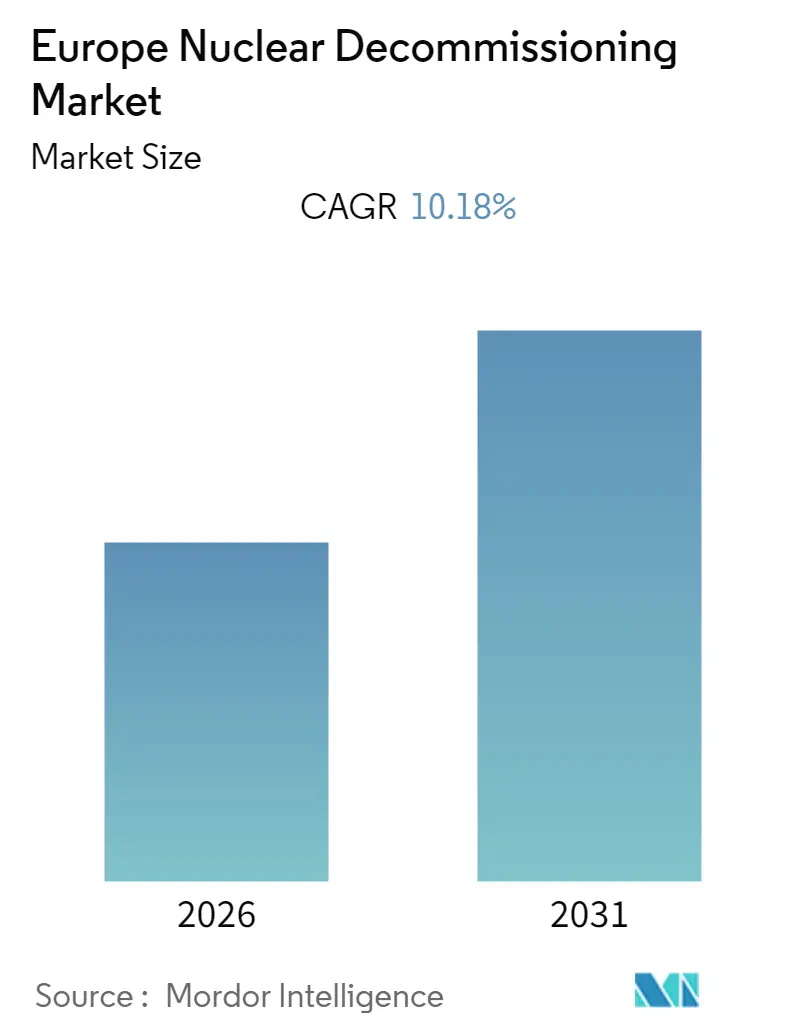
The Europe Nuclear Decommissioning Market size is expected to register a CAGR of 10.18% during the forecast period.
The market was moderately impacted by COVID-19 in 2020. Presently, the market has reached pre-pandemic levels.
- Over the medium term, the increasing number of nuclear reactors reaching operational retirement plants is expected to drive the market's growth.
- On the flip side, the lifetime extension of nuclear power plants with favorable government policies is expected to hinder the market growth.
- Nuclear phase-out policies in several countries, such as Germany and the United Kingdom, are expected to create several opportunities for foreign and domestic players to provide the necessary expertise that the countries need to develop their decommissioning market.
- France, one of the major decommissioning hotspots, is expected to be the fastest-growing nuclear power reactor decommissioning market.
Note: Market size and forecast figures in this report are generated using Mordor Intelligence’s proprietary estimation framework, updated with the latest available data and insights as of 2026.
Europe Nuclear Decommissioning Market Trends and Insights
Research Reactors to Dominate the Market
- The decommissioning of research reactors is in a phase where it's growing due to the reduced requirement of research reactors. The shifting focus from nuclear power has led to a reduction in research activities associated with nuclear technology.
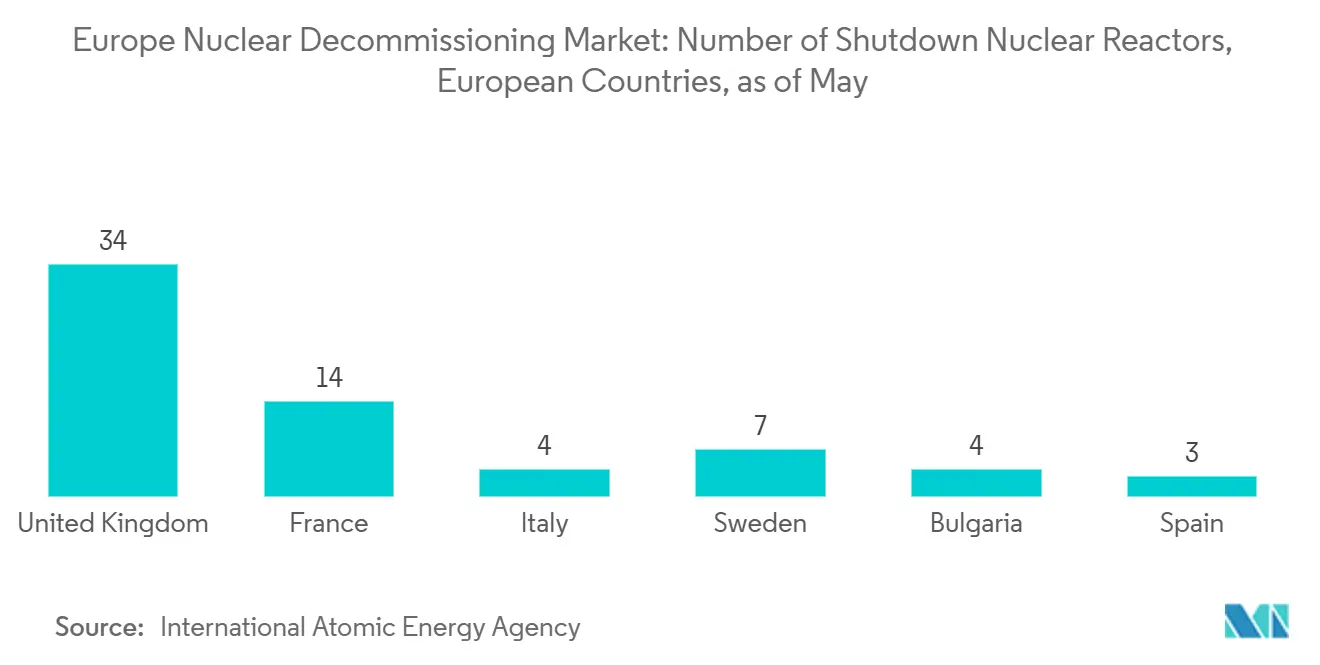
- As of May 2022, there were 172 operational nuclear reactors in Europe. France has by far the most operational reactors, at 56 units. In contrast, the United Kingdom has the most significant number of permanently shut-down reactors, at 34 units.
- The decommissioning activities of several research reactors have been initiated because of the higher costs associated with regulatory compliances over time. Moreover, sometimes the cost of maintaining research reactors can be more than the decommissioning cost, and hence, the market for such reactors is likely to grow during the forecast period.
- Further, in early 2020, French multinational electric utility company ENGIE expanded its partnership on research & development of nuclear technologies with the French Alternative Energies and Atomic Energy Commission, CEA. The two partners are expected to focus on several aspects of nuclear energy, including decommissioning, dismantling, and decontamination of nuclear installations, control of radiation protection, and management of radioactive releases and waste.
- Moreover, the policy to curtail nuclear power generation in European countries will decimate the requirement for research reactors, which is expected to drive the decommissioning market in the near future.
France to Witness Significant Growth
- France is heavily dependent on nuclear power for its electricity generation, and the country has about 58 nuclear power reactors whose infrastructure's overall average age is 30 years.
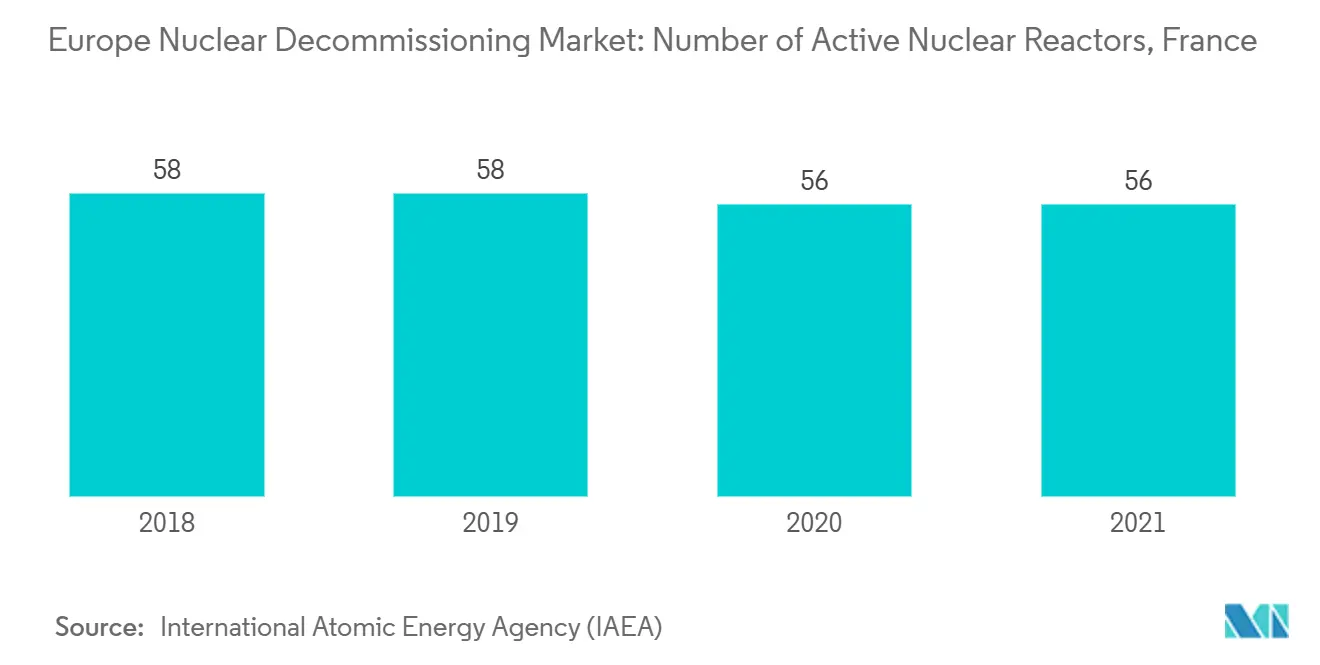
- In 2021, France had 56 active nuclear reactors. The number of nuclear reactors in France peaked from 2000 to 2005, with 59 nuclear reactors actively generating electricity.
- The country aims to diversify its energy mix by lowering nuclear energy generation from 75% to 50% of the total electricity generation by 2025. As a result, the country's nuclear decommissioning market is expected to grow.
- Moreover, the French government is aiming at nuclear decommissioning in its Multiannual Energy Programme, which aims to reduce the contribution of nuclear power in the French energy mix by 25% by 2035. As a part of the program, 14 power reactors will be shut down by 2035.
- In February 2020, the country began gradually shutting its aging Fessenheim plant. The removal of the fuel is expected to be completed by the summer of 2023, and the complete decommissioning is expected to be completed by 2040 at the earliest. The move fits into the government's broader energy strategy to reduce French dependence on nuclear energy from supplying 75% of its electricity to about 50% by 2035.
- Furthermore, in September 2021, Electricité de France's (EDF) Decommissioning and Waste Management Directorate and International Atomic Energy Agency agreed to work together to help countries to strengthen technology and human resources development for decommissioning nuclear power reactors.
- Decommissioning is projected to become an increasingly important part of the nuclear sector activity in the coming decades as many reactors are expected to reach their technical lifetime very soon, increasing the demand for decommissioning and dismantling services.
Regulatory Landscape
The regulatory backbone for nuclear decommissioning in Europe is anchored by Council Directive 2011/70/Euratom, which requires EU Member States to maintain national legislative, regulatory, and organizational frameworks for the safe management of spent fuel and radioactive waste, including decommissioning. Alongside this, the European Commission provides policy guidance and monitoring through its nuclear decommissioning and waste management work, while IAEA decommissioning safety standards are used as reference points when developing or assessing national requirements.
For funding and implementation, the 2021-2027 EU framework includes dedicated Euratom assistance instruments, notably Council Regulation (Euratom) 2021/100 and Council Regulation (EU) 2021/101. These support decommissioning and waste management at specific legacy sites, including in Bulgaria, Slovakia, Lithuania, and European Commission Joint Research Centre facilities. The European Commission JRC also runs its Decommissioning and Waste Management programme across sites in Geel, Karlsruhe, Ispra, and Petten, linking regulatory compliance to multi-year dismantling, waste handling, and site remediation work.
Value Chain Analysis
The Europe nuclear decommissioning value chain begins with national authorities and plant owners defining end-state and licensing pathways under frameworks aligned to Euratom obligations (including Directive 2011/70/Euratom) and harmonization efforts such as WENRA safety reference levels for decommissioning. Early activities cover characterization, radiological surveying, engineering design, and work planning. Execution then covers decontamination, dismantling, segmentation, packaging, and site remediation, followed by downstream logistics for interim storage, transport, and final disposal routes where available.
Execution services are delivered by a mix of utilities, prime contractors, and specialized dismantling and waste-management firms, supported by equipment and technology vendors (including remote handling, cutting tools, containment, and measurement). Industry coordination and supplier discovery are supported by bodies and platforms such as nucleareurope, with a supply chain database spanning thousands of firms, and by collaboration networks such as the Coordination Network on Decommissioning, which help standardize practices and share lessons learned. Program structures increasingly reflect multi-decade management and complex tendering, illustrated by large-site transitions and major tenders such as Ignalina core dismantling in Lithuania and long-duration UK hazard-reduction frameworks at sites such as Sellafield.
Competitive Landscape
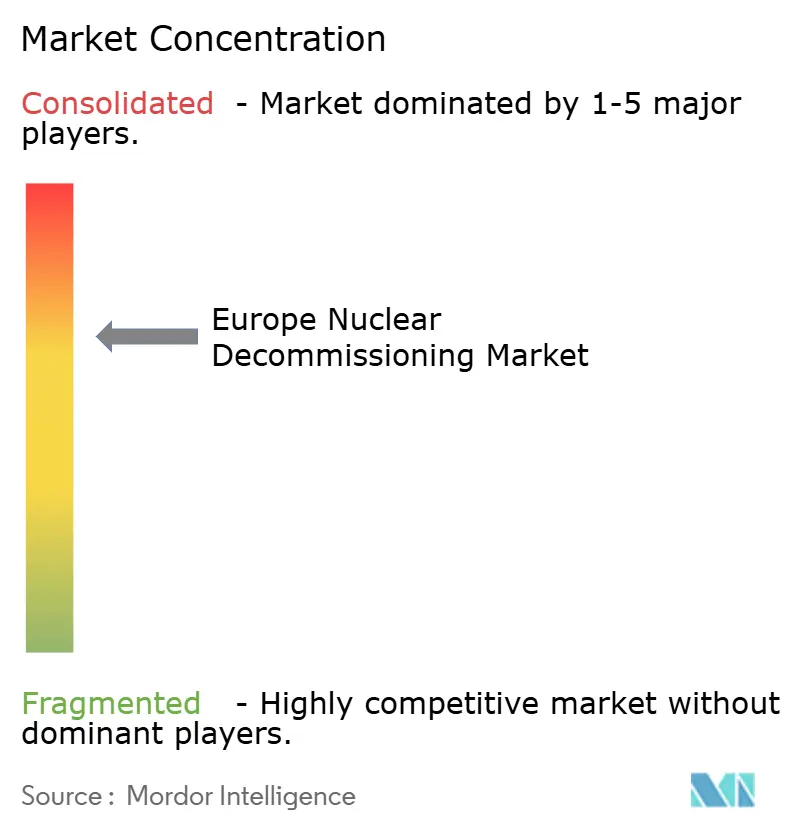
The European nuclear decommissioning market is moderately consolidated in nature. Some of the major players in the market (in no particular order) include Cavendish Nuclear Ltd, Fluor Corporation, GE Hitachi Nuclear Services, James Fisher and Sons PLC, and Electricite de France SA.
Europe Nuclear Decommissioning Industry Leaders
-
Cavendish Nuclear Ltd
-
Fluor Corporation
-
GE Hitachi Nuclear Services
-
James Fisher and Sons PLC
-
Electricite de France SA
- *Disclaimer: Major Players sorted in no particular order
Market Opportunities and Future Outlook
A key near-term opportunity is the shift of major sites from post-shutdown preparation into full-scale, regulator-authorized execution, which increases demand for integrated services across dismantling, waste conditioning, and long-horizon program management. One example is France, where a government decree dated 3 May 2026 authorized the start of the full decommissioning phase for EDF's two 900 MW Fessenheim reactors, anchoring decades of contracted work through the stated end date.
Technology-led gaps also show up in first-of-a-kind dismantling scopes and hard-to-access components that require bespoke tooling and robotics rather than standard construction methods. In Lithuania, the Ignalina program, through Altra, launched an international tender on 10 July 2026 for the design and dismantling of RBMK-1500 reactor cores, pointing to demand for specialized remote cutting, characterization, and waste-packaging solutions that can be reused across other complex legacy assets. In parallel, the EU-level 2021-2027 decommissioning assistance framework for select Member State sites and European Commission JRC facilities continues to support engineering, waste-management, and compliance work tied to defined programmes and milestones.
Recent Industry Developments
- April 2026: Hunterston B formally transferred from EDF to the UK Nuclear Decommissioning Authority and its subsidiary Nuclear Restoration Services (NRS) on 1 April 2026, marking the start of the site's decommissioning phase. The changeover operationalizes a new customer and contracting model for the site, with NRS taking long-term responsibility for restoration and hazard reduction.
- November 2025: Nuclear Decommissioning Solutions (a joint venture of Altrad, Cavendish Nuclear, and Shepley Engineers) secured a place on Sellafield Ltd's multi-year decommissioning and high-hazard risk reduction framework with a reported value of GBP 4.6 billion across the program. The award reinforces the role of joint ventures in packaging specialist capabilities and capacity for complex, long-duration UK decommissioning scopes.
- June 2025: Cavendish Nuclear won a contract from NRS Dounreay to provide project management support services for the Shaft and Silo Project, with an initial two-year term and a one-year extension option. The work underlines continued demand for program controls, planning, and delivery support on legacy waste and high-hazard packages alongside reactor dismantling.
Research Methodology Framework and Report Scope
Market Definition and Coverage
For this methodology, the Europe nuclear decommissioning market is defined as the revenue linked to planning, dismantling, decontamination, waste handling, and site restoration activities carried out to safely retire nuclear reactors and related reactor-site systems across European countries.
Scope exclusions: We exclude ongoing electricity generation operations, new-build nuclear construction, and routine plant maintenance that is not part of a defined decommissioning project.
Segmentation Overview
- By Reactor Type
- Pressurized Water Reactor
- Boiling Water Reactor
- Gas Cooled Reactor
- Other Reactor Types
- By Application
- Commercial Power Reactor
- Prototype Power Reactor
- Research Reactor
- By Capacity
- Below 100 MW
- Between 100 - 1000 MW
- Above 1000 MW
- By Geography
- France
- Germany
- United Kingdom
- Ukraine
- Rest of Europe
Data Sources, Market Sizing, and Validation
Desk Research
Desk research started with public signals that show how large the active decommissioning pipeline is and how it changes over time. We mainly referred to sources such as the IAEA PRIS reactor database, OECD-NEA publications, European Commission energy and nuclear policy material, and national nuclear regulators and waste agencies that publish shutdown schedules, licensing steps, and waste plans.
To translate project activity into market value, we also reviewed tender notices and contract awards on public procurement portals, along with utility annual reports, project updates, and audited financial statements where decommissioning provisions and spend are discussed. Peer reviewed papers and technical proceedings were used to sanity check typical work packages such as segmentation of dismantling, waste conditioning, and site remediation. Where needed, paid database subscriptions were used for company financials and patent lookups to support mapping of which vendors supply specific scopes and how capability is expanding by geography. The desk sources listed here are illustrative only, and many other public documents were also used to collect data, validate assumptions, and close definition gaps.
Primary Interviews and Surveys
Primary work focused on interviews and short surveys with project managers, engineering and safety leads, procurement teams, and advisors involved in reactor shutdown and dismantling programs across key European markets. We used these discussions to confirm what is counted as decommissioning scope, validate typical timelines by reactor type, and test assumptions on waste pathways and the share of work that is outsourced versus delivered in-house.
Distribution of primary research fieldwork respondents
| Company type | Respondent position |
|---|---|
| Top tier: 28% | CXOs: 15% |
| Mid tier: 55% | Functional/Unit leaders: 28% |
| Smaller Players: 17% | Managers: 57% |
Market-Sizing & Forecasting
Sizing used a top-down and bottom-up mix, where reactor shutdown schedules, known unit counts, and expected decommissioning phase timing were used to reconstruct an annual demand pool for services and work packages. The totals were then corroborated using selective bottom-up checks, such as sampled project budgets, observed tender values, and a volume-times-average-cost build-up for repeatable tasks, before adjusting for gaps.
Key inputs that influenced the model included the number of reactors entering defueling, safe enclosure, dismantling, and site release phases, the typical duration of each phase by reactor design, the assumed pace of waste packaging and disposal readiness, and the split between labor-heavy dismantling versus waste management spend. We also used indicators such as announced national phase-out milestones, permitting lead times, and inflation in specialist engineering rates to keep the annual profile realistic.
Forecasting was done using scenario analysis, because policy timing and repository readiness can shift project calendars even when the long-term need is clear. Base, conservative, and accelerated cases were built around changes in shutdown dates, licensing progress, and waste route constraints, and then aligned back to expert feedback from primary calls.
Data Validation & Update Cycle
Outputs were checked against independent signals such as reactor status trackers, major contract announcements, and publicly disclosed decommissioning provisions to confirm whether annual market values were within a believable range. When a country-level estimate looked out of line with known project timing, we rechecked assumptions around phase start dates, cost curves, and outsourcing shares, followed by a second analyst review before sign-off.
The report is refreshed annually, and interim updates are triggered when material events occur, including major policy change, reactor shutdown acceleration, or a large waste pathway decision. Before delivery, we run a final pass on key inputs so clients receive the most current view available at that time.
Mordor Intelligence's Europe Nuclear Decommissioning Market Size Measured Against Other Published Estimates
Published market sizes for Europe nuclear decommissioning can differ even when they describe similar themes, because the counted activities and timing assumptions are not always the same. The biggest differences usually come from what is treated as decommissioning revenue versus adjacent nuclear services, and from whether the estimate follows the actual project phase calendar or uses a smoother spend curve.
Some sources emphasize services only, which can undercount owner-led work and multi-year dismantling budgets, while others blend reactor decommissioning with broader nuclear waste management that is not tied to a specific site. Differences also show up when currency timing, inflation uplifts, and the assumed start of major dismantling are not refreshed after schedule changes. This gap is reduced by linking reactor status and tender-backed checks to the annual model near the end of each update cycle, as done by Mordor Intelligence.
Benchmark comparison
| Source | Market Size | Gaps in Research Methodology |
|---|---|---|
| Mordor Intelligence | USD 2.04 B (2024) | |
| Trade Journal A | USD 1.84 B (2024) | This figure is commonly presented as services-only, which can exclude owner-executed work and certain reactor-site work packages that are budgeted within plant owners and public programs. |
| Regional Consultancy B | USD 2.04 B (2024) | The estimate is described alongside a multi-year increase, which can make it unclear whether the number represents a single-year market value or a growth amount across the forecast window. |
The spread is mainly explained by definition clarity and whether the number represents a single-year spend versus a multi-year change. By keeping the count tied to reactor-site decommissioning work packages and by aligning timing to phase start dates that are cross-checked in interviews, the final value stays traceable to practical inputs and can be repeated in updates.
Key Questions Answered in the Report
What is the current Europe Nuclear Reactor Decommissioning Market size?
The Europe Nuclear Reactor Decommissioning Market is projected to register a CAGR of 10.18% during the forecast period (2026-2031)
Who are the key players in Europe Nuclear Reactor Decommissioning Market?
Cavendish Nuclear Ltd, Fluor Corporation, GE Hitachi Nuclear Services, James Fisher and Sons PLC and Electricite de France SA are the major companies operating in the Europe Nuclear Reactor Decommissioning Market.
What years does this Europe Nuclear Reactor Decommissioning Market cover?
The report covers the Europe Nuclear Reactor Decommissioning Market historical market size for years: 2020, 2021, 2022, 2023 and 2024. The report also forecasts the Europe Nuclear Reactor Decommissioning Market size for years: 2026, 2027, 2028, 2029, 2030 and 2031.