Consumer Goods and Services
29th JulyUnlocking Growth in India’s Luxury Beauty & Skincare Market
3 Min Read
The North America Hair Conditioner Market is Segmented by End User (Adults and Kids/Children), Category (Premium Products and Mass Products), Ingredients (Natural/Organic and Conventional/Synthetic), Distribution Channel (Supermarkets/Hypermarkets, Specialist Stores, Online Retail Stores, and Others), and Geography (United States, Canada, Mexico, and Rest of North America). The Market Forecasts are Provided in Terms of Value (USD).
Market Overview
| Study Period | 2021 - 2031 |
|---|---|
| Base Year For Estimation | 2025 |
| Forecast Data Period | 2026 - 2031 |
| Market Size (2026) | USD 4.5 Billion |
| Market Size (2031) | USD 5.38 Billion |
| Growth Rate (2026 - 2031) | 3.63 % CAGR |
| Market Concentration | Medium |
Major Players *Disclaimer: Major Players sorted in no particular order. Image © Mordor Intelligence. Reuse requires attribution under CC BY 4.0. |
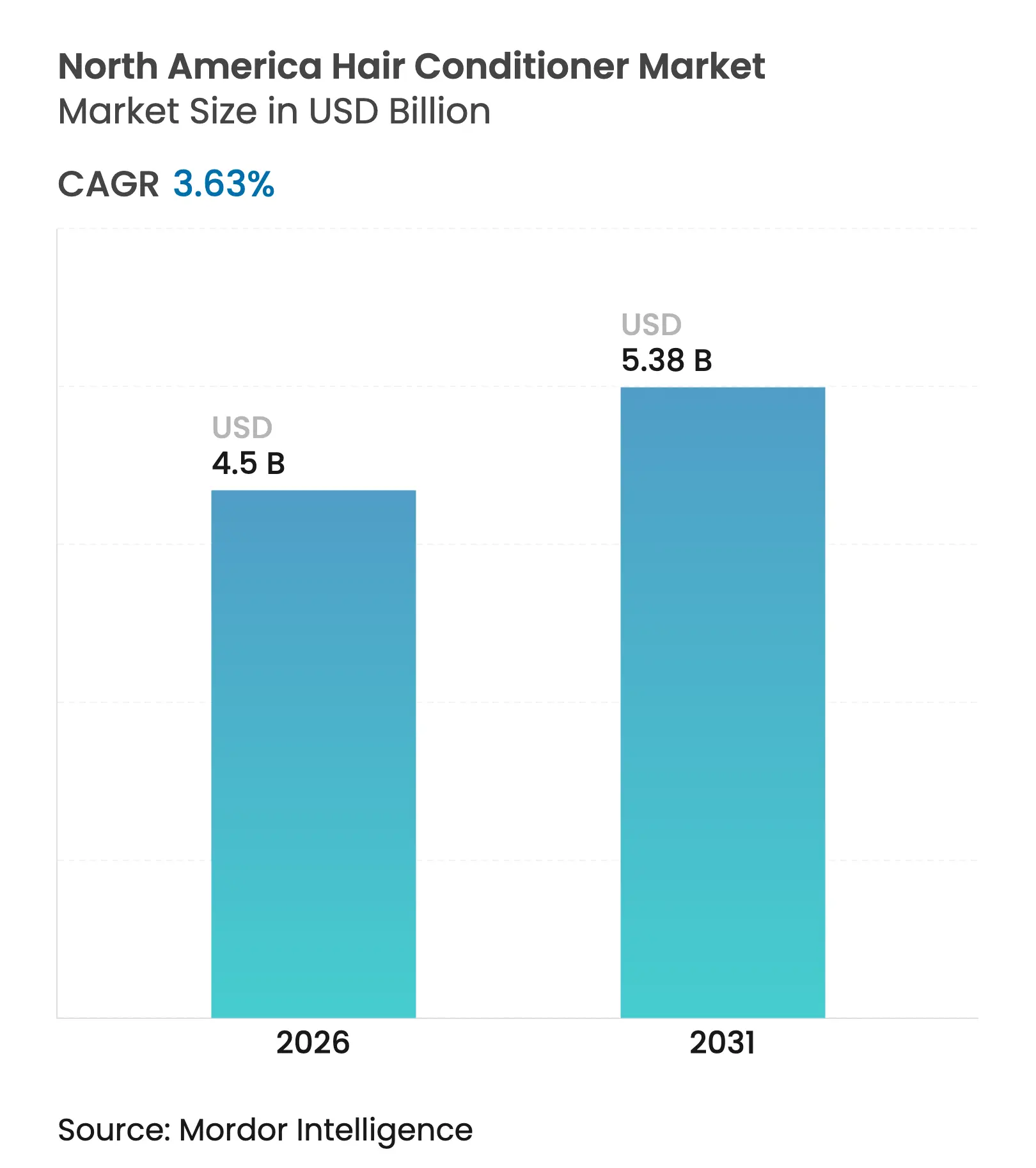

The North America hair conditioner market size was valued at USD 4.34 billion in 2025 and estimated to grow from USD 4.5 billion in 2026 to reach USD 5.38 billion by 2031, at a CAGR of 3.63% during the forecast period (2026-2031). The hair conditioner market in North America is witnessing consistent growth, driven by increasing consumer preference for natural, sulfate-free formulations and semi-solid, leave-in conditioning products designed to address diverse hair types and styling requirements. Also, premium products, clean-label claims, and algorithm-driven personalization are capturing an increasing share of discretionary spending. Meanwhile, mass-market offerings reliant on volume are depending heavily on promotions to maintain shelf presence. Consumer purchasing decisions are increasingly influenced by ingredient transparency and proven product efficacy. This shift has allowed smaller, science-driven brands to gain market share in the North American hair conditioner market, even with limited advertising budgets. While the United States remains the primary driver of demand, Mexico's rapid adoption of salon culture and Canada's strong preference for eco-certified products are prompting suppliers to reassess regional production and inventory strategies.
Key Report Takeaways
Note: Market size and forecast figures in this report are generated using Mordor Intelligence's proprietary estimation framework, updated with the latest available data and insights as of 2026.
Drivers Impact Analysis
| Driver | (~) % Impact On CAGR Forecast | Geographic Relevance | Impact Timeline |
|---|---|---|---|
Strong demand for products formulated with clean label ingredients | +1.2% | United States and Canada; early uptake in Mexico’s premium tier | Medium term (2–4 years) |
Influence of social media and celebrity endorsement | +1.0% | United States; momentum spreading into Mexico and Canada | Short term (≤ 2 years) |
Consumers' inclination towards natural and organic products | +1.5% | Canada and United States coastal states; rising in Mexico metro areas | Medium term (2–4 years) |
Consumer demand for multicultural hair conditioners | +0.9% | Diverse urban centres in the United States and Canada; emerging in Mexico | Medium term (2–4 years) |
Increasing popularity of customized hair care solutions | +0.8% | United States premium e-commerce; pilot rollouts in Canada | Long term (≥ 4 years) |
Advancements in hair care product formulations | +0.6% | United States research hubs with adoption across Canada and Mexico | Long term (≥ 4 years) |
| Source: Mordor Intelligence | |||
Strong Demand For Products Formulated With Clean Label Ingredients
Consumers are increasingly prioritizing health, sustainability, and transparency, driving a significant shift in purchasing behavior. They now demand products that are not only safe and effective but also environmentally responsible and ethically sourced. This evolution has elevated "clean label" from a marketing term to a baseline expectation, compelling formulators to replace controversial surfactants and preservatives with plant-based alternatives. Heightened regulatory focus has driven the advancement of innovative natural alternatives. For instance, in April 2025, BASF introduced two new personal care ingredients: Verdessence Maize, a biodegradable styling polymer, and Dehyton PK45 GA/RA, a betaine derived from Rainforest Alliance Certified coconut oil. Additionally, products formulated without sulfates, silicones, and parabens, and enhanced with natural oils such as argan and coconut, are rapidly gaining market share. A prominent example is Pantene's "Hair Volume Multiplier" conditioner, which utilizes plant-derived actives to comply with clean-beauty standards. Also, formulated without sulfates, silicones, parabens, dyes, phthalates, or mineral oil, this hair conditioner provides targeted nourishment and strengthens hair to minimize damage.
Influence Of Social Media And Celebrity Endorsement
Social media platforms such as TikTok and Instagram have transformed from simple promotional tools into highly interactive ecosystems where consumers engage with influencers to co-create products. The rise of viral product-testing videos has not only driven substantial growth in online sales but has also provided research and development teams with valuable, real-time feedback on critical product attributes, including scent, texture, and packaging. Influencer promotions have a measurable impact on consumer behavior, with consumers purchasing beauty products after encountering such endorsements. Moreover, in North America, data-driven consumer insights are increasingly influencing celebrity-led product launches in the hair conditioner market. This approach enables faster formulation adjustments based on real-time feedback. For instance, Pattern Beauty, led by Tracee Ellis Ross, leverages consumer input to refine products designed for textured hair. This democratization of product development gives digitally native, influencer-driven brands a competitive edge over traditional players. Consequently, major corporations like P&G Company and Unilever are adopting more agile, consumer-centric innovation strategies within their hair care portfolios.
Consumers' Inclination Towards Natural And Organic Products
With a growing preference for botanical oils, vegan proteins, and fermentation-derived actives, consumers are driving the industry toward sustainability and ethical narratives. For instance, the demand for plant-based hair conditioner products and cruelty-free cosmetics has surged, reflecting a broader shift in consumer priorities. These consumers are willing to pay a premium for products they perceive as safer for both personal use and the environment, a trend that helps offset inflation-related cost increases and supports brands in maintaining profitability. This consumer-driven shift has accelerated the development of plant-based intellectual property. For example, brands are increasingly collaborating with agricultural startups to innovate and secure exclusive access to plant-based ingredients. These product launches are strategically aligned with harvest cycles, minimizing supply chain disruptions. For instance, in November 2024, Fiore debuted its inaugural hair care line, featuring a nourishing conditioner. Established in March 2024, Fiore champions vegan and cruelty-free products, with a focus on natural, plant-derived ingredients. In today's competitive landscape, the ability to secure a consistent supply of essential crops through advanced agronomic practices, such as precision farming and sustainable cultivation methods, is as critical as marketing expertise in maintaining a competitive edge.
Consumer Demand For Multicultural Hair Conditioners
The textured hair care market has transitioned from being a niche segment to becoming a significant and mainstream category, propelled by strong consumer demand, particularly across North America. As per the Bureau of Labor Statistics, in Q3 2023, Hispanic consumers accounted for 17.8% of the United States population aged 16 and older, with nearly 60% of this group being of Mexican origin [1]. This demographic shift has significantly impacted the demand for multicultural hair conditioners. Companies are increasingly developing products designed to address the specific hair textures and care practices prevalent within Hispanic communities, focusing on hydration-centric and curl-enhancing formulations. Moreover, companies that previously neglected the needs of consumers with coils and curls are now prioritizing the development of innovative products. These include emollient-rich, pH-balanced conditioners specifically designed to detangle textured hair while maintaining its natural oils, addressing a critical consumer need. Recognizing this shift, salon chains are allocating greater shelf space to textured hair care products, emphasizing the growing importance of professional endorsements in driving retail sales and market penetration.
Restraints Impact Analysis
| Restraint | (~) % Impact On CAGR Forecast | Geographic Relevance | Impact Timeline |
|---|---|---|---|
Consumer concerns over product safety and ingredients | –0.7% | United States (California-led regulation) and Canada | Medium term (2–4 years) |
Counterfeit products affecting brand reputation | –0.5% | United States online marketplaces; cross-border trade with Mexico | Short term (≤ 2 years) |
High competition among established players | –0.6% | United States and Canada mass and premium segments | Medium term (2–4 years) |
Fluctuations in raw material prices impacting profit margins | –0.4% | North America | Medium term (2–4 years) |
| Source: Mordor Intelligence | |||
Consumer Concerns Over Product Safety And Ingredients
In North America, the intensification of regulatory scrutiny surrounding hair care product safety is significantly transforming the operational and strategic approaches of manufacturers. The California Toxic-Free Cosmetics Act, which prohibits the use of several harmful chemicals, has necessitated comprehensive product reformulations. Simultaneously, the FDA's ongoing investigation into adverse events associated with hair cleansing products has heightened consumer awareness and concern regarding potential health risks, further influencing purchasing decisions. These evolving safety concerns have far-reaching implications across the entire supply chain. Manufacturers are now tasked with the critical responsibility of balancing product efficacy with stringent safety standards. Additionally, there is a growing demand for enhanced transparency in ingredient sourcing and testing protocols, as consumers and regulatory bodies alike seek greater accountability. The Board of Barbering and Cosmetology has identified specific chemicals in hair conditioners that pose risks such as skin irritation, respiratory complications, and potential long-term health effects, reinforcing the urgency for the development of safer alternatives.
Counterfeit Products Affecting Brand Reputation
Digital marketplaces are increasingly being infiltrated by grey-market and counterfeit conditioners, which are eroding brand credibility and posing significant safety risks to consumers. In April 2025, the United States government introduced a baseline 10% tariff on key inputs, leading to higher production costs for legitimate manufacturers. This policy has inadvertently widened the price gap that counterfeiters exploit to attract cost-sensitive buyers. To mitigate these challenges, established brands are adopting advanced strategies, including the use of tamper-evident closures, blockchain-based authentication systems, and direct-to-consumer distribution channels. These measures aim to minimize reliance on intermediaries, who are often susceptible to introducing counterfeit products into the supply chain. Consequently, the role of packaging engineers has become increasingly strategic, as the integration of anti-counterfeit features in packaging now significantly influences consumer purchasing decisions, alongside traditional factors such as product fragrance and performance.
By End User: Adults Dominate While Kids Segment Accelerates
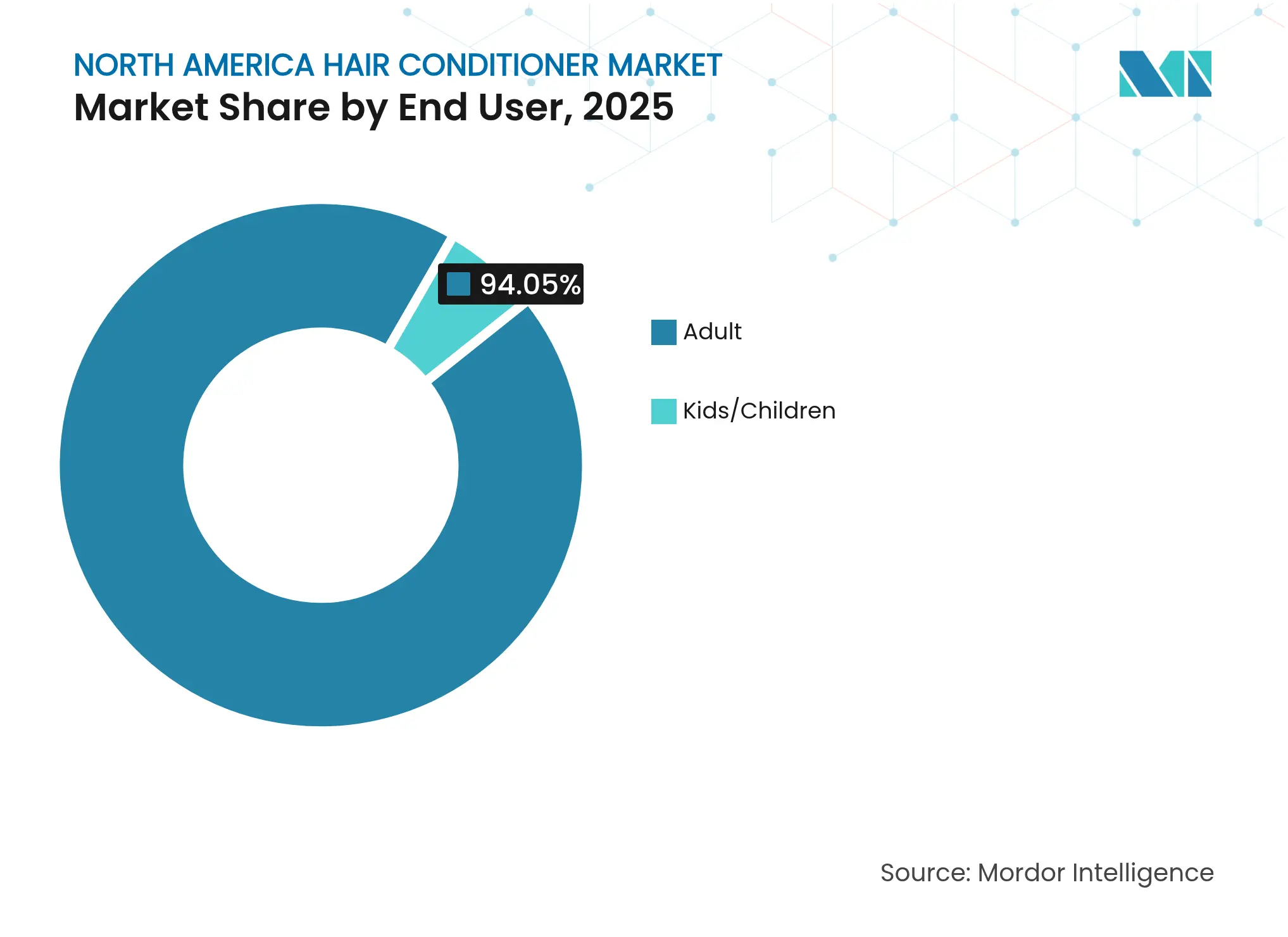
In 2025, the adult segment dominates the North American hair conditioner market, accounting for 94.05% of the market share. This leadership reflects its well-established consumer base and extensive product portfolio, catering to various price ranges and formulations. The segment's dominance is further bolstered by the increasing demand for specialized treatments targeting specific hair concerns. On the other hand, the kids/children segment, though currently smaller, is anticipated to grow at a faster CAGR of 4.12% during the forecast period of 2026-2031. This growth is driven by rising parental demand for gentle, tailored formulations, fueled by heightened awareness of early hair care practices. Additionally, the introduction of child-specific products addressing needs such as detangling and scalp sensitivity is contributing to this upward trend.
The rising focus on preventative hair care, mirroring trends in the hair conditioner industry, presents a significant growth opportunity for both segments. For instance, Croda Beauty's launch of FibraShield C in March 2025 highlights this shift. This innovative protective multi-peptide, derived from chickpea extract, reduces reactive oxygen species by 95% and reverses UV-induced cuticle damage, emphasizing a proactive approach to hair protection over reactive treatments.
Note: Segment shares of all individual segments available upon report purchase
By Category: Mass Products Maintain Volume While Premium Accelerates
Mass products account for 71.60% of the North American hair conditioner market in 2025, maintaining their dominant position through wide distribution networks and accessible price points. Mass-market conditioners continue to hold the largest share of the North American hair conditioner market in volume terms, driven by extensive distribution across supermarkets and value chains. Promotional pricing strategies and family-sized packaging appeal to cost-conscious consumers, while impulse purchases increase when mass brands introduce naturally-derived fragrances or limited-edition variants. Retail data indicates that multi-packs achieve the highest sales velocity when supported by social media tutorials, highlighting the growing impact of digital storytelling on value-tier products.
Premium and prestige conditioners are anticipated to achieve 4.49% CAGR (2026-2031) growth, supported by salon-quality positioning, sulfate-free formulations, and premium sensorial experiences. Consumers who previously prioritized professional salon services are reallocating portions of their budgets toward high-end at-home treatments, a behavioral shift further accelerated by inflationary pressures on service costs. The premium segment frequently combines conditioners with complementary scalp serums, driving higher average order values in online channels. Consequently, mid-tier brands must strategically decide whether to expand upward with premium sub-lines or focus on defending core price points through packaging innovation.
By Distribution Channel: Online Retail Leads Growth and Innovation
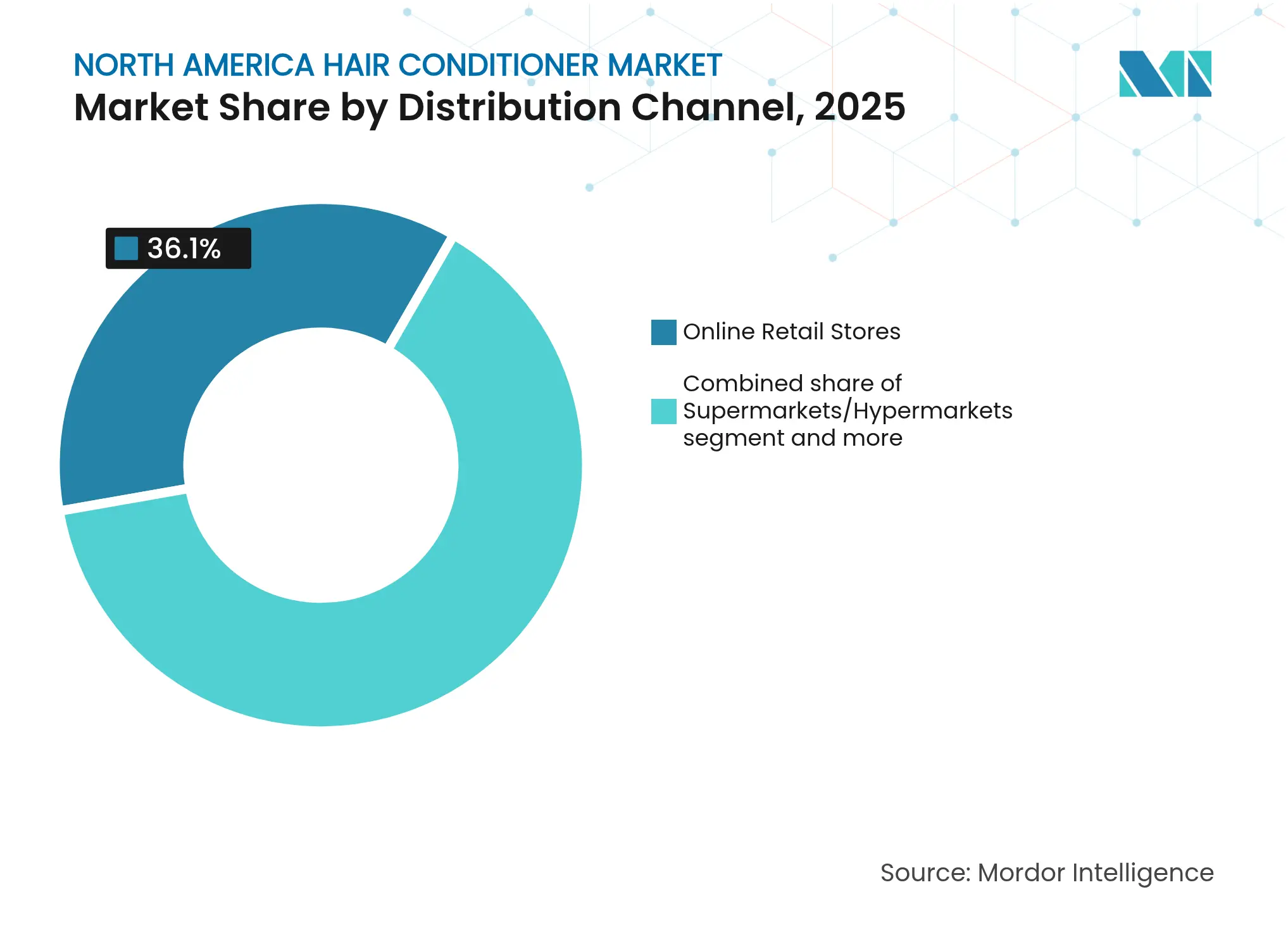
Online retail stores lead the North American hair conditioner market with 36.10% share in 2025 and are projected to maintain the fastest growth rate at 5.41% CAGR through 2031. Online channels hold the largest share of the North American hair conditioner market in value terms and demonstrate the highest growth potential during the forecast period. E-commerce platforms leverage personalization engines to analyze hair types and environmental factors, enabling tailored conditioner recommendations. This approach enhances conversion rates while reducing product returns caused by trial-and-error purchases. According to the US Census Bureau, e-commerce sales constituted 16.2% of total sales in the United States in Q1 2025, demonstrating a transition toward online purchasing . This trend drives the increased implementation of subscription models, as consumers utilize automated systems for product replenishment and inventory control. These models enhance operational efficiency and customer retention in categories like hair conditioner.
Brick-and-mortar supermarkets maintain their scale by offering immediate product availability and capitalizing on impulse purchases. However, they are increasingly incorporating digital tools such as QR codes and shelf-edge screens to connect in-store shoppers with online content. Specialist beauty retailers differentiate themselves by curating product assortments based on ingredient philosophies, such as vegan, dermatologist-tested, or multicultural options. They also provide experiential testing stations, allowing customers to sample product viscosity and scent. This integration of online discovery and in-store engagement highlights the emergence of an "omni-learning" purchasing journey, where consumers seamlessly navigate between digital and physical channels before finalizing their purchase.
Note: Segment shares of all individual segments available upon report purchase
By Ingredients: Natural/Organic Outpacing Conventional Formulations
While conventional/synthetic ingredients maintain 69.85% market share in 2025, the natural/organic segment is growing at a faster 4.95% CAGR (2026-2031), reflecting shifting consumer preferences toward cleaner formulations. This growth is driven by increasing consumer awareness regarding ingredient safety and environmental sustainability. For manufacturers, the strategic takeaway is clear: innovation in natural ingredients is evolving into a critical competitive advantage rather than a niche offering.
Moreover, as per NSF, 74% of consumers prioritize organic ingredients in personal care products in 2024 . This market trend toward clean beauty products influences hair care, particularly conditioners, increasing the demand for certified organic and toxin-free formulations across North America. Market analysis indicates consumers select conditioners without sulfates, parabens, silicones, and harsh chemicals, opting for products containing botanical extracts and certified organic ingredients.
In 2025, the United States accounts for 78.12% of the North American hair conditioner market, supported by its extensive consumer base, advanced retail infrastructure, and continuous product innovation. In North America, the United States serves as the foundation of the hair conditioner market, driven by an established salon culture, a well-developed retail network, and the rapid dissemination of trends through social media. Coastal metropolitan areas often act as launchpads for new products, where early adopters influence nationwide trends through digital platforms. The increasing adoption of male grooming products supports market growth, while the aging population sustains demand for conditioners addressing hair thinning and greying. United States formulators frequently set regional standards for texture and fragrance, indirectly shaping product assortments in Canada and Mexico.
Mexico is anticipated to be the fastest-growing market in North America, with a projected CAGR of 5.90% during the forecast period of 2026-2031, supported by the expansion of salon chains, rising disposable incomes, and the normalization of conditioner use among men due to the growing barber-shop culture, as highlighted by the International Trade Administration. Domestic brands are leveraging competitive pricing and culturally relevant marketing strategies to challenge multinational players, creating a market where local botanical ingredients, such as agave and avocado oil, play a significant role. Recent customs reforms have reduced lead times for imported goods, enabling foreign brands to target premium and professional segments. Mexico's rapid shift toward premiumization is likely to influence regional supply chains, encouraging brands to establish filling operations closer to high-demand areas in the south.
Canada, while smaller in market size, has one of the highest per-capita expenditures on personal care in North America, driven by consumer preferences for cruelty-free and eco-certified products. Specialty retailers emphasize Canadian-sourced botanical ingredients, such as maple-derived polyphenols, to promote national pride and reduce transportation emissions. E-commerce continues to grow steadily, supported by widespread broadband access in both urban and rural regions, which helps bridge gaps in product availability. Sustainability-focused procurement policies at major pharmacy chains are prompting suppliers to adopt recyclable packaging formats tailored to Canadian regulatory labelling requirements, often necessitating the development of distinct SKUs.

Reports are available across multiple geographies.
Gain in-depth market insights across regions to support informed decisions.
Market Concentration
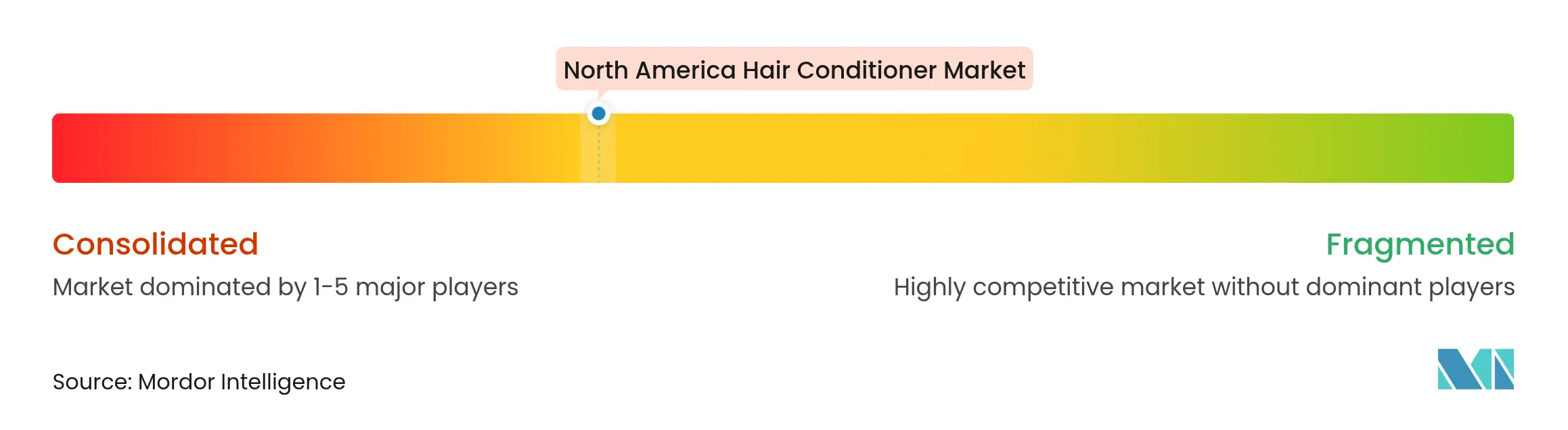
North America hair conditioner market is moderately consolidated, with companies competing across diverse price segments and distribution channels. Prominent multinational corporations such as Procter and Gamble Company, LOréal SA, Unilever Plc, The Estée Lauder Companies Inc., and Henkel continue to dominate the market by capitalizing on their extensive distribution networks and strategically curated brand portfolios that cater to both mass-market and premium consumers. However, the competitive dynamics are undergoing significant transformation as celebrity-endorsed brands, including Rihanna's Fenty Hair and Beyoncé's Cécred, introduce innovative approaches that challenge traditional market structures and redefine consumer expectations.
Technological advancements, such as AI-powered product recommendations and IoT-enabled devices for monitoring hair health, are emerging as critical tools for differentiation in this evolving market. Additionally, the increasing prevalence of direct-to-consumer brands, particularly within the premium segment, is reshaping market dynamics by offering highly personalized hair care solutions. This shift reflects a growing consumer inclination to invest in customized formulations that address individual needs and preferences.
Significant growth opportunities exist in areas such as personalized product offerings, solutions tailored to multicultural demographics, and innovations focused on preventive hair health, which are expected to drive further market expansion. In January 2025, Nutrire launched its product line, featuring algorithm-driven scalp serums, shampoos, and conditioners customized through an eight-factor diagnostic process. These innovations, while requiring strong data governance and flexible supply chains, provide a competitive edge by reducing the risk of commoditization.

*Disclaimer: Major Players sorted in no particular order
1. INTRODUCTION
2. RESEARCH METHODOLOGY
3. EXECUTIVE SUMMARY
4. MARKET LANDSCAPE
5. MARKET SIZE AND GROWTH FORECASTS (VALUE)
6. COMPETITIVE LANDSCAPE
7. MARKET OPPORTUNITIES AND FUTURE OUTLOOK
Hair conditioners are a key segment within the hair care market, formulated with moisturizing agents such as emollients, humectants, oils, butters, and silicones. These components create a protective layer on the hair cuticles, enhancing hydration and softness after shampoo use. This functionality reduces friction and mitigates hair breakage, addressing consumer demand for effective hair care solutions.
The North American hair conditioner market is segmented by end user, category, ingredients, distribution channels, and geography. Based on end user, the market is segmented into adults and kids/children. Based on category, the market is segmented into premium products and mass products. Based on ingredients, the market is segmented into natural/organic and conventional/synthetic. Based on distribution channels, the market is segmented into supermarkets/hypermarkets, specialty stores, online retail stores, and other distribution channels. Based on geography, the market is segmented into North America, Europe, Asia-Pacific, South America, the Middle East, and Africa. The market sizing has been done in value terms in USD for all the abovementioned segments.
| By End User | Adults |
| Kids/Children | |
| By Category | Premium Products |
| Mass Products | |
| By Ingredients | Natural/Organic |
| Conventional/Synthetic | |
| By Distribution Channel | Specialist Stores |
| Supermarkets/Hypermarkets | |
| Online Retail Stores | |
| Other Distribution Channels | |
| By Geography | United States |
| Canada | |
| Mexico | |
| Rest of North America |
Unlocking Growth in India’s Luxury Beauty & Skincare Market
3 Min Read
Unlocking Opportunities in the Headwear Market
3 Min Read
When decisions matter, industry leaders turn to our analysts. Let’s talk.

