
Market Overview
| Study Period | 2019 - 2031 |
|---|---|
| Forecast Data Period | 2026 - 2031 |
| Base Year Market Size (2025) | USD 26.76 Billion |
| Market Size (2026) | USD 27.88 Billion |
| Market Size (2031) | USD 33.94 Billion |
| Growth Rate (2026 - 2031) | 4.01 % |
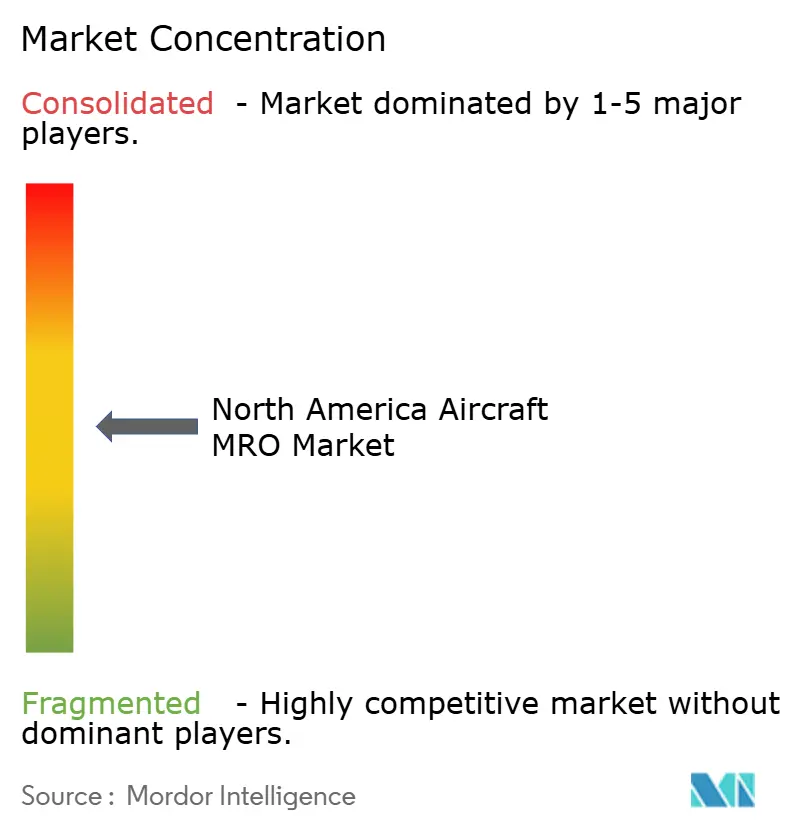
| Market Concentration | Medium |
Major Players *Disclaimer: Major Players sorted in no particular order Image © Mordor Intelligence. Reuse requires attribution under CC BY 4.0. | |
North America Aircraft MRO Market Analysis by Mordor Intelligence
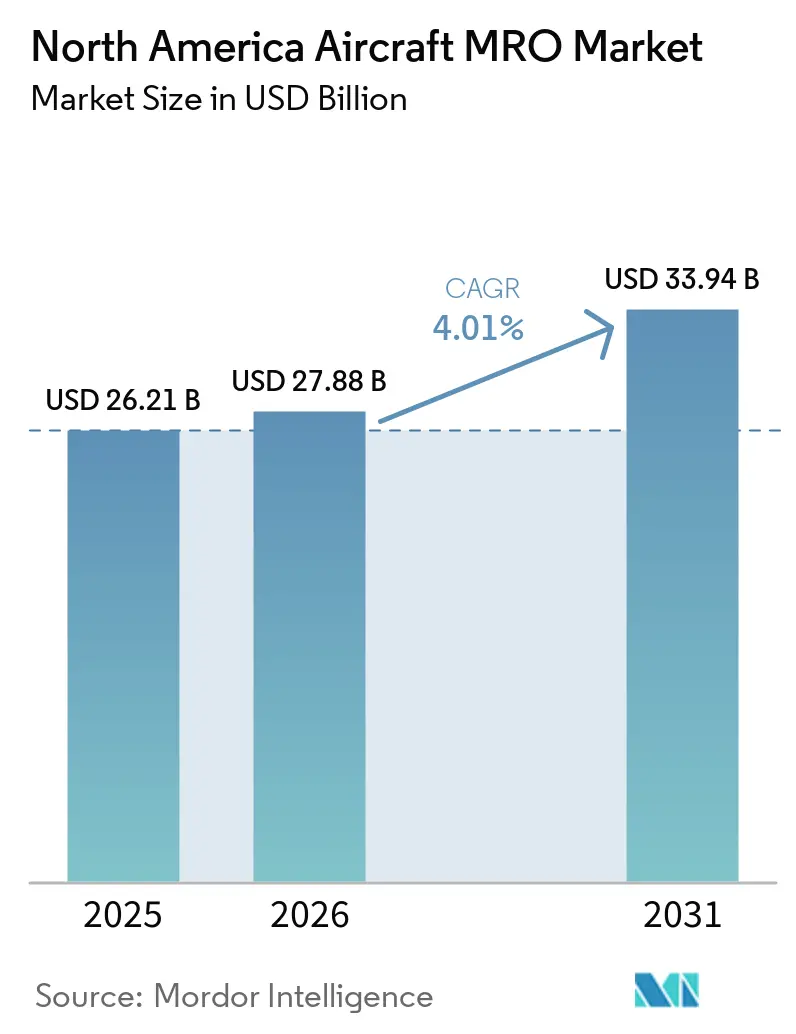
The North America Aircraft MRO Market size was valued at USD 26.76 billion in 2025, and is forecast to grow from USD 27.88 billion in 2026 to USD 33.94 billion in 2031, registering a 4.01% CAGR during the forecast period (2026-2031). This measured expansion comes as airlines and cargo operators intensify engine-shop demand even as labor and tooling capacity tighten, pushing more work to independent shops and spurring wider use of certified used serviceable material (USM) to shorten turnaround times. Military life-extension programs for the F-16V, C-130H, UH-60 Black Hawk, and AH-64 Apache inject multi-year depot workloads into the same technician pool, resulting in wage inflation and extended lead times. OEM-captive providers are leveraging 15-year service contracts to lock in 43.21% of 2025 revenue, while independents are growing at a 5.01% CAGR by offering flexible slot access and multi-platform capabilities. Concurrently, rising avionics obsolescence, landing-gear fatigue, and auxiliary power unit overhauls on aging B737NG and A320ceo fleets fuel the fastest growth in component work.
Key Report Takeaways
- By MRO type, engine MRO held 42.43% revenue share in 2025, whereas component repairs are forecast to expand at a 5.25% CAGR through 2031.
- By aircraft type, fixed-wing platforms accounted for 64.22% of 2025 revenue, and rotary-wing work is forecast to grow at a 4.87% CAGR to 2031.
- By application, commercial aviation accounted for 40.14% of 2025 demand, while military programs are forecast to grow at a 5.72% CAGR through 2031.
- By service provider, OEM-captive networks commanded a 43.21% share in 2025, and independent third-party shops are forecast to grow at a 5.01% CAGR through 2031.
- By country, the United States led with 42.67% of 2025 revenue, whereas Canada is projected to grow at a 4.52% CAGR to 2031.
Note: Market size and forecast figures in this report are generated using Mordor Intelligence’s proprietary estimation framework, updated with the latest available data and insights as of January 2026.
Market Trends and Insights
Drivers Impact Analysis of North America Aircraft MRO Market*
| Driver | (~) % Impact on CAGR Forecast | Geographic Relevance | Impact Timeline |
|---|---|---|---|
| Aging commercial fleet requiring life-extension MRO | +1.2% | United States, Canada | Long term (≥ 4 years) |
| Rebound in passenger and cargo traffic boosting flight hours | +0.9% | United States, Mexico | Medium term (2-4 years) |
| OEM long-term service agreements expanding aftermarket capture | +0.7% | United States, Canada | Long term (≥ 4 years) |
| Engine-shop capacity crunch inflating US in-region demand | +0.6% | United States | Short term (≤ 2 years) |
| Surge in Used Serviceable Material (USM) adoption to cut TAT | +0.4% | North America | Medium term (2-4 years) |
| Military life-extension programs for legacy fleets | +0.5% | United States | Long term (≥ 4 years) |
| Source: Mordor Intelligence | |||
Aging Commercial Fleet Requiring Life-Extension MRO
The average age of the commercial jet fleet in the region increased to 12.8 years in 2025, with narrowbody aircraft averaging 14.1 years and widebody aircraft averaging 11.3 years.[1] Airlines are targeting 25- to 30-year life cycles for B737NG and A320ceo airframes, putting upward pressure on heavy D-check activity and corrosion remediation. Supplemental inspection mandates under FAA Part 26 are adding 15%-20% extra labor hours per event as cracks appear in wing root attachments and lap joints.[2] OEMs increasingly bundle winglet retrofits and cabin reconfigurations with scheduled checks, locking customers into multi-year service packages that dampen price competition. These actions ensure the North America aircraft MRO market maintains a dependable structural backlog while intensifying the scramble for skilled technicians.
Rebound in Passenger and Cargo Traffic Boosting Flight Hours
Revenue departures increased 7.3% year-over-year in 2024 to 11.2 million, and total flight hours are expected to reach 28.5 million in 2026, surpassing pre-pandemic levels for the first time. A narrowbody flying 11 hours per day reaches its next engine shop visit roughly 18 months sooner than one flying 9 hours, bringing forward CFM56 and LEAP cycles. FedEx and UPS each reported double-digit block-hour growth in 2024, accelerating the overhaul of landing gear and APU. The engine overhaul turnaround has widened to 120-150 days by 2026, compared with 90 days two years earlier, forcing operators to lease spare engines and thereby inflating near-term spending. Consequently, the North America aircraft MRO market is experiencing demand peaks in line and engine services despite capacity headwinds.
OEM Long-Term Service Agreements Expanding Aftermarket Capture
CFM International enrolled 3,200 LEAP engines under 15-year flight-hour deals in 2024-2025, while Pratt & Whitney added 1,800 GTF powerplants to its EngineWise program. These agreements shift cost risk to OEMs but limit the airline's ability to shop independently, consolidating revenue within captive networks. GE Aerospace backed this strategy with a USD 1 billion capacity expansion announced in 2024 to double narrowbody engine throughput. Independent shops, therefore, pivot toward maturing platforms such as the CFM56, V2500, and CF6, where OEM focus is waning. Combined, these activities reinforce the market power of OEMs while spurring niche opportunities elsewhere in the North America aircraft MRO market.
Engine-Shop Capacity Crunch Inflating US In-Region Demand
Annual narrowbody engine shop-visit demand is expected to peak in 2026 at approximately 4,200 events, exceeding installed capacity by around 15%, according to industry estimates. The shortfall stems from accelerated LEAP repair cycles, a backlog of GTF combustor inspections, and pandemic-era under-investment in test cells. Delta TechOps opened a dedicated GTF line in May 2024, and StandardAero added LEAP-1A capability in San Antonio. Spot-market CFM56 overhaul pricing rose to USD 1.8-2.1 million in 2025, up from USD 1.5 million in 2023, as shops prioritize multi-engine commitments. These pressures keep North America aircraft MRO market participants focused on throughput and tooling investment.
Restraints Impact Analysis of North America Aircraft MRO Market*
| Restraint | (~) % Impact on CAGR Forecast | Geographic Relevance | Impact Timeline |
|---|---|---|---|
| Acute skilled-technician shortage | -0.8% | United States, Canada | Long term (≥ 4 years) |
| Persistent parts and supply-chain bottlenecks | -0.6% | North America | Medium term (2-4 years) |
| Tightening hazardous-chemicals and waste-disposal regulations | -0.2% | United States | Medium term (2-4 years) |
| Longer maintenance intervals on new-gen aircraft | -0.5% | United States, Canada | Long term (≥ 4 years) |
| Source: Mordor Intelligence | |||
Acute Skilled-Technician Shortage
Around 30% of certificated mechanics will reach retirement eligibility within five years, while US aviation schools graduated only 3,200 technicians in 2024, against an industry demand of roughly 5,000. Starting pay at Delta TechOps reached USD 72,000 in 2025, and sign-on bonuses of USD 10,000 to USD 15,000 became common at independent shops. Throughput fell 10% to 15% in 2025 compared to 2023, as facilities struggled to staff second shifts, forcing airlines to lease additional aircraft to protect their schedules. Automation, such as robotic paint stripping and automated non-destructive testing, offers relief but requires three to five years to scale. Until then, the labor gap will continue to weigh on the North America aircraft MRO market.
Persistent Parts and Supply Chain Bottlenecks
Lead times for titanium castings and nickel-alloy forgings used in engine hot sections stretched to 12-18 months in 2025, double pre-pandemic levels.[3] The National Association of Manufacturers found that 78% of suppliers are confronting raw-material shortages, while tariffs reinstated in 2024 add up to 25% in cost premiums. Smaller repair stations, lacking the bulk-buying power, absorb the steepest hit, which can prompt them to defer tooling upgrades or exit the field. Consequently, USM, consignment pools, and operator part cannibalization form growing elements of the North America aircraft MRO market supply response.
*Our forecasts treat driver/restraint impacts as directional, not additive. The impact forecasts reflect baseline growth, mix effects, and variable interactions.
North America Aircraft MRO Market Segment Analysis
By MRO Type:
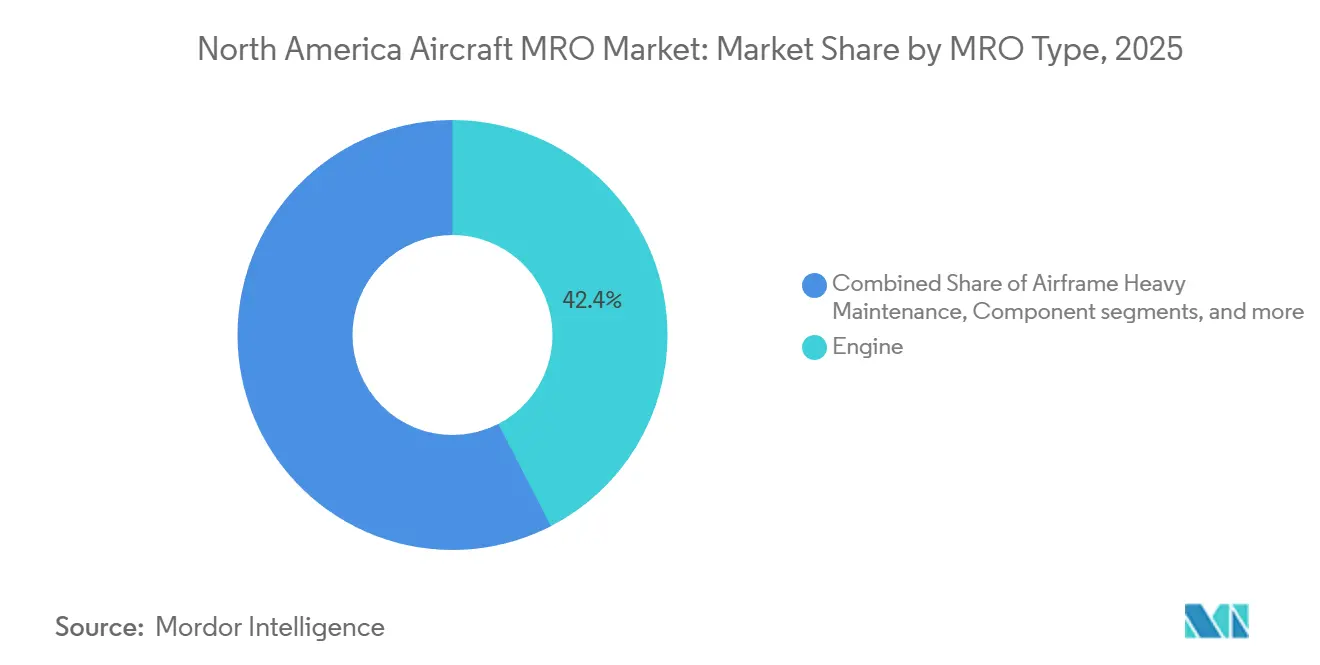
Engine Services Dominate Amid Component GrowthEngine activity generated 42.43% of 2025 revenue, as 18,000 active commercial turbofans produced a steady cadence of first-run removals. Each overhaul averaged USD 1.8 million for narrowbody units and USD 4.5 million for widebody engines. This sub-segment anchors relationships because high-value workscopes frequently cascade into accessory, fuel-nozzle, and gearbox repairs. Component shops, however, expand at a 5.25% CAGR through 2031 as avionics mandates, landing-gear fatigue, and APU renewals rise in tandem with fleet age. Because component visits require lower capital expenditure than engine test cells, they enable independents to enter the North America aircraft MRO market rapidly.
Line-maintenance providers continue to supply a base-load of walk-around checks, minor defect rectification, and A-checks at outstations, sustaining employment across regional airports. Heavy airframe work grows more slowly due to extended structural intervals on next-generation jets, although the United States airframe MRO segment continues to benefit from aging aircraft fleets and demand for structural inspections, repairs, and life-extension services. Yet, schedules remain full as operators retrofit cabin Wi-Fi, winglets, and weight-saving composite panels. Modifications and upgrades offer margin upside because engineering services add billable design hours alongside hands-on labor. Combined, these diverse service lines keep the North America aircraft MRO market resilient to cyclical swings.

By Aircraft Type:
Fixed-Wing Dominance with Rotary Wing AccelerationFixed-wing fleets delivered 64.22% of 2025 MRO revenue, reflecting 7,800 active narrowbodies, 1,200 widebodies, and more than 15,000 business jets and turboprops registered in North America. Their high utilization and established maintenance planning documents provide predictable shop scheduling. Rotary-wing demand, although smaller in absolute value, grows at a 4.87% CAGR as military UH-60 and AH-64 upgrades and offshore oil-and-gas fleet renewals drive transmission overhaul and composite rotor-blade replacement work.
Rotary-wing MRO requires specialized tooling for dynamic components and hot-section inspections of turboshaft engines, creating entry barriers that favor niche providers. Firms such as StandardAero and ST Engineering have established rotary-wing centers of excellence, positioning them to capitalize on depot overflow and to supply composite repair know-how. Consequently, rotary-wing programs add a differentiated growth vector to the North America aircraft MRO market.
By Application:
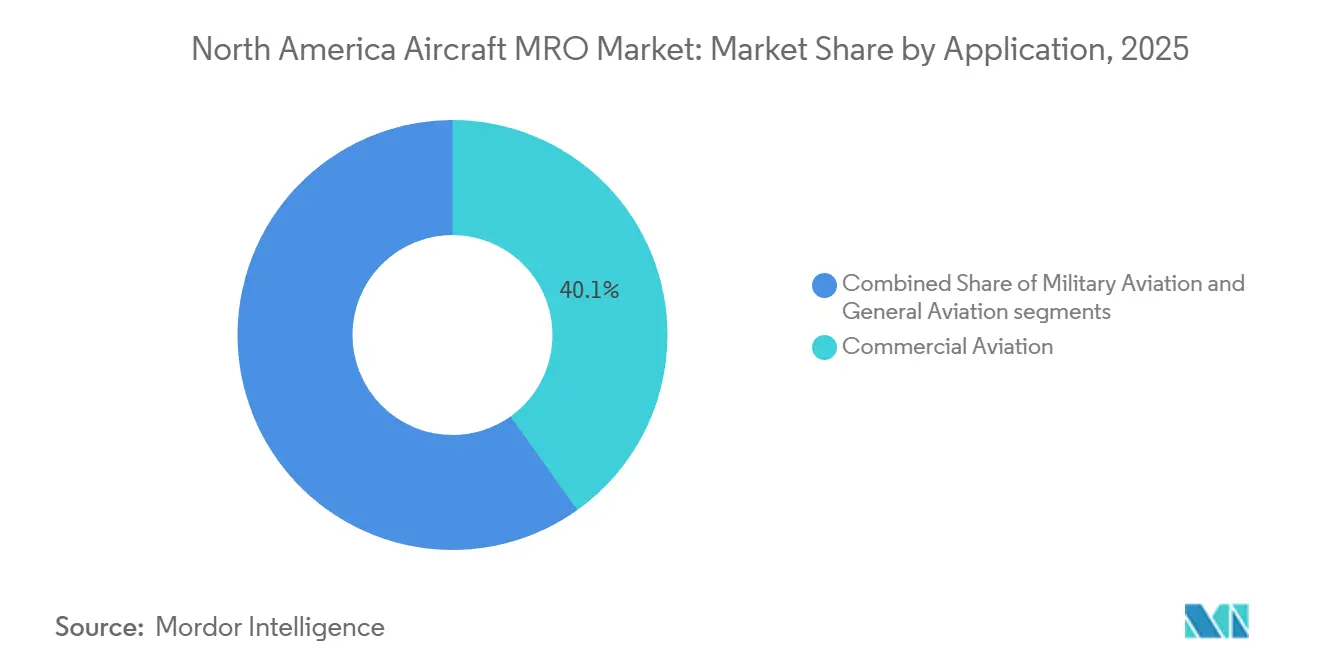
Commercial Passenger Base with Cargo AccelerationCommercial aviation accounted for 40.14% of 2025 demand, with the freighter segment driven by e-commerce firms prioritizing same-day delivery. Boeing supplied 50 B737-800BCF conversions in 2024 and continues to ramp up B767-300BCF output, with each project involving structural reinforcements, cargo door installation, and re-certified maintenance programs. Amazon Air, FedEx, and UPS all expanded their narrowbody freighter fleets, resulting in incremental line checks, structural modifications, and engine events that are contributing to the growth of the North America aircraft MRO market for freighter operations.
Military aviation, expected to advance at a 5.72% CAGR through 2031, remains a consistent revenue source through multi-year depot contracts, although budget allocations tend to tilt toward new-platform procurement. General aviation repairs form a fragmented yet critical layer, supporting business jet reliability through cabin refurbishments, ADS-B Out upgrades, and Wi-Fi retrofits. These combined applications deliver a balanced, multi-segment demand profile for the North America aircraft MRO market.
By Service Provider:
OEM Captive Leadership with Independent GrowthOEM-captive networks claimed 43.21% of 2025 revenue by bundling spares, warranties, and financing into long-term agreements that tether operators to factory facilities. Nevertheless, independents are scaling at a 5.01% CAGR as they offer multi-platform coverage, price transparency, and faster slot access, winning business from low-cost carriers and cargo operators that prioritize operating cost certainty. AAR grew MRO revenue 37.60% year on year in Q2 FY 2025 after securing new Embraer E-Jet landing-gear and Rockwell Collins avionics programs.[4]
Airline-affiliated shops, such as Delta TechOps, utilize surplus hangar capacity to serve third parties, thereby cushioning internal workload fluctuations. Digital collaboration intensifies competition, with Honeywell Forge and other analytics suites providing predictive insights that enable providers to advertise evidence-based turnaround commitments. These innovations reshape the competitive landscape within the North America aircraft MRO market.
Geography Analysis
United States Aircraft MRO Market
The United States captured 42.67% of the 2025 revenue, underpinned by major hubs in Atlanta, Dallas, and Chicago, as well as Air Force and Navy depots that sustain fighter, tanker, and rotorcraft fleets. Delta TechOps’ dedicated Pratt & Whitney GTF line opened in 2024, targeting 200 annual engines by 2027, while GE Aerospace committed USD 1 billion to double LEAP capacity. The North America aircraft MRO market share, attributed to the US, benefits from a deep supplier base but must confront rising labor costs and environmental compliance obligations.
Canada Aircraft MRO Market
Canada is projected to grow at a 4.52% CAGR through 2031, driven by the opening of Lufthansa Technik AG and WestJet’s CAD 120 million (USD 87.13 million) LEAP-1B shop in Calgary in 2027, as well as government incentives through the Strategic Innovation Fund. StandardAero’s Winnipeg and Vancouver sites broaden engine and component capacity, while Air Canada Technical Services modernizes Montreal and Toronto facilities. Transport Canada’s bilateral approvals with the FAA and EASA enable Canadian shops to capture overflow demand, thereby strengthening their position within the broader North America aircraft MRO market.
Mexico Aircraft MRO Market
Mexico attracts cost-sensitive projects due to labor rates averaging USD 18,000-25,000 per mechanic and tariff-free trade under USMCA. Safran’s USD 80 million LEAP center in Querétaro opens in 2026, and Viva Aerobus plans a USD 235 million base in the same state for 2027. Customs and certification procedures add two to three days to typical turnarounds, but economic advantages compensate, ensuring Mexico’s footprint within the North America aircraft MRO market continues to grow.
Regulatory Landscape
Aircraft maintenance activities in North America are primarily governed by the FAA in the US (including Part 145 repair station requirements and airworthiness directives) and by Transport Canada Civil Aviation (TCCA) through the Canadian Aviation Regulations (CARs) and associated standards such as Standard 726 for air operator maintenance. In May 2024, the FAA Reauthorization Act of 2024 (Pub. L. 118-53) directed the creation of an Aviation Rulemaking Committee focused on maintenance data access and Instructions for Continued Airworthiness, reinforcing the role of OEM technical data governance in MRO planning and compliance.
Cross-border oversight and acceptance mechanisms remain central to the regional MRO operating model. In January 2026, Revision 2 of the Maintenance Implementation Procedures between the US and Canada took effect, supporting the reciprocal acceptance of maintenance and surveillance activities between the FAA and TCCA. TCCA also implemented updates effective April 2026, affecting CARs Subpart 706 and Standard 726, tightening expectations for evaluation programs, facilities, and personnel control, while the FAA initiated 2026 rulemaking actions related to recognition pathways for non-US maintenance organization certificates through bilateral arrangements. These changes can influence where heavy work is placed across the US, Canada, and Mexico.
Value Chain Analysis
The North America aircraft MRO value chain starts with maintenance planning and compliance (airline and military engineering organizations, CAMO-like functions for operators, and airworthiness management), then moves to execution through airline-affiliated MROs, independent third-party repair stations, OEM-captive networks, and military depots. Workscopes draw on OEM technical publications and service bulletins, specialized labor, tooling and test cells (especially for engines), and a parts ecosystem spanning OEM new spares, PMA where permitted, and certified used serviceable material (USM) channels that help offset long lead times for titanium castings and nickel-alloy forgings.
Parts provisioning, material management, and logistics are key pinch points, with aftermarket inventories and repair-cycle delays adding to higher aircraft-on-ground pressure in 2026, particularly for narrowbody engine components. To secure slots and stabilize supply, the chain increasingly relies on multi-year capacity agreements and consolidation: AAR expanded heavy maintenance scale by acquiring HAECO Americas in November 2025, while capability build-outs for next-generation engines (for example, Delta TechOps reaching full CFM LEAP-1A and LEAP-1B overhaul capability in March 2026 and StandardAero signing a services framework with AviLease in March 2026) show how licensing, MRO network footprint, and parts access are being used together to protect turnaround time and margin.
Competitive Landscape
The competitive landscape exhibits medium concentration. OEM groups, including GE Aerospace, RTX Corporation, Rolls-Royce plc, Safran SA, and Honeywell International Inc., collectively held more than 40% of 2025 revenue through proprietary tooling, engineering data, and flight-hour agreements. Independent majors AAR CORP., StandardAero Aviation Holdings, Inc., and Singapore Technologies Engineering Ltd. increase penetration by offering multi-platform coverage, transparent pricing, and faster shop slots for CFM56, V2500, and mature widebody engines. Airline-affiliated entities, such as Delta TechOps and Air Canada Technical Services, leverage existing infrastructure to win third-party contracts and mitigate fleet utilization cycles, thereby strengthening their contribution to the North America aircraft MRO market.
Digital capabilities now form a decisive differentiator. Honeywell Forge predicts component failures 30 days in advance across more than 1,200 aircraft, resulting in an 18% reduction in auxiliary power unit removals and a 12% reduction in landing gear overhauls. Collins Aerospace applies similar analytics to 1,200 aircraft, demonstrating consistent savings in unscheduled maintenance events. Meanwhile, USM aggregators such as AerSale achieve rapid growth by curating certified parts pools with full traceability, a capability prized amid enduring raw material shortages. Niche opportunities persist in rotary-wing, freighter conversion, and composite repair, allowing specialized firms to capture profitable pockets within the broader North America aircraft MRO market.
North America Aircraft MRO Industry Leaders
-
Delta TechOps (Delta Air Lines Inc.)
-
AAR CORP.
-
Lufthansa Technik AG
-
StandardAero Aviation Holdings, Inc.
-
RTX Corporation
- *Disclaimer: Major Players sorted in no particular order
North America Aircraft MRO Market Companies Covered in this Report
- Delta TechOps (Delta Air Lines Inc.)
- AAR CORP.
- StandardAero Aviation Holdings, Inc.
- Lufthansa Technik AG
- RTX Corporation
- General Electric Company
- Safran SA
- Singapore Technologies Engineering Ltd.
- Hong Kong Aircraft Engineering Company Limited
- Rolls-Royce Holdings plc
- Honeywell International Inc.
- The Boeing Company
- Lockheed Martin Corporation
- Textron Aviation Inc.
- IAG Aero Group
- Spirit AeroSystems Inc.
- Air Canada Group
- Aeroman (MROH Group)
- WestJet Technics
Market Opportunities and Future Outlook
Near-term whitespace is centered on easing the narrowbody engine-shop bottleneck and related material constraints, where operators are paying for spare engine leasing and accelerating USM adoption to keep fleets flying. The most actionable capacity responses in 2026 highlight where incremental demand can be absorbed: Pratt and Whitney announced more than USD 100 million of investment across Irving (Texas), West Palm Beach (Florida), and Springdale (Arkansas) in April 2026 to expand GTF MRO capacity, while MTU Maintenance opened a modernized 43,000 square-meter facility in Fort Worth, Texas in July 2026 after a USD 120 million investment and inducted its first LEAP-1B engine. Together, these moves point to opportunities for providers with test-cell access, next-gen engine capability approvals, and faster material pathways, especially as engine turnaround times widened to 120-150 days by 2026.
Airframe heavy maintenance and component repair also offer room where slot availability, engineering authorization, and proximity to operating fleets reduce downtime. AAR reported substantial completion of an 80,000 square-foot airframe MRO expansion in Oklahoma City in January 2026, adding three bays for 737 variants, supporting incremental narrowbody check capacity during high utilization cycles. In parallel, regulatory alignment via FAA-TCCA Maintenance Implementation Procedures effective January 2026 supports cross-border work allocation, enabling Canadian and Mexican facilities with the right approvals to capture overflow. Digital recordkeeping and predictive maintenance platforms (for example, Honeywell Forge and similar suites) further shape differentiation by reliability outcomes and inventory positioning, not only labor-hours throughput.
Recent Industry Developments in North America Aircraft MRO Market
- April 2026: RTX (Pratt and Whitney) announced more than USD 100 million of investment across Irving, Texas; West Palm Beach, Florida; and Springdale, Arkansas to expand its GTF engine MRO footprint in the United States. The funding targets additional capacity and throughput improvements across multiple sites, supporting faster turnaround on a heavily utilized engine family. This raises competitive pressure on both OEM-captive and independent networks to secure tooling, labor, and material access for next-generation propulsion work.
- November 2025: AAR CORP. announced the USD 78 million acquisition of HAECO Americas from HAECO Group in an all-cash transaction. The deal expands AAR's heavy maintenance footprint and supports its Repair and Engineering growth agenda by adding facilities and capabilities that can be scaled through multi-year customer programs. With engine and airframe slots constrained, the acquisition strengthens AAR's ability to offer bundled capacity and manage backlog risk across multiple sites.
- August 2024: StandardAero secured a USD 315.70 million contract to maintain the US Navys T56-A-427A engines that power the E-2D Advanced Hawkeye fleet. The award locks in depot-style engine workload and reinforces specialized capability requirements such as test-cell access, component repair depth, and long-term parts support planning. It also ties up skilled labor in a market already facing technician shortages, influencing scheduling and pricing across adjacent commercial engine programs.
North America Aircraft MRO Market Report Scope and Research Methodology
Market Definition and Coverage
In this methodology, the North America aircraft MRO market refers to the value of maintenance, repair, and overhaul services performed to keep aircraft airworthy across the United States, Canada, and Mexico, including routine checks, heavy maintenance, component repair, and engine work.
Scope exclusions: Manufacturing of new parts and tools, new aircraft production, and non-aviation maintenance spending are excluded from this market sizing.
Segments Covered in This Report
- By MRO Type
- Engine
- Airframe Heavy Maintenance
- Component
- Line and Routine Checks
- Modifications and Upgrades
- By Aircraft Type
- Fixed Wing
- Rotary Wing
- By Application
- Commercial Aviation
- Passenger
- Cargo/Freighter
- Military Aviation
- General Aviation
- Commercial Aviation
- By Service Provider
- Airline-affiliated MRO
- Independent Third-party MRO
- OEM-Captive MRO
- Military Depots
- By Geography
- United States
- Canada
- Mexico
Data Sources, Market Sizing, and Validation
Desk Research
Desk research started with public aviation activity and fleet indicators that explain how much maintenance demand exists, and how that demand shifts with utilization and fleet age. We referenced non-paywalled sources such as FAA regulations and airworthiness guidance, Bureau of Transportation Statistics traffic and fleet series, Transport Canada civil aviation publications, and ICAO statistical and definition references to keep terms and activity measures consistent.
To add supply-side context, we also reviewed government and official trade data that can signal parts flows (such as US Census trade statistics) and aerospace manufacturing context (such as US BEA industry accounts), along with company annual reports, investor presentations, and reputable press coverage on shop capacity and labor conditions. Paid database subscriptions were used selectively for company financials and news tracking, and for aircraft and engine level fleet details to cross-check installed base and expected maintenance events. The desk sources mentioned here are illustrative only, and many other references were also used for data collection, validation, and research clarification.
Primary Interviews and Surveys
Primary work focused on validating how MRO revenue is recognized and billed in North America, and where demand is shifting between line maintenance, heavy checks, engines, and components. We spoke with a mix of airline maintenance leaders, independent repair stations, parts and component specialists, and engineering and planning roles, with coverage across the United States, Canada, and Mexico so cross-border maintenance flows were reflected in assumptions.
Distribution of primary research fieldwork respondents
| Company type | Respondent position |
|---|---|
| Top tier: 29% | CXOs: 19% |
| Mid tier: 51% | Functional/Unit leaders: 26% |
| Smaller Players: 20% | Managers: 55% |
Market-Sizing & Forecasting
Sizing was built using a top-down and bottom-up blend, where fleet size, utilization (flight hours and cycles), and maintenance check frequency were used to reconstruct the annual demand pool for North America, which was then converted to value using service mix and typical pricing ranges. The totals were then corroborated with selective bottom-up approximations, such as sampling revenue ranges for major MRO categories, applying observed labor rate bands, and using channel checks on parts and component repair intensity.
Key inputs used in the model included the active fleet by major aircraft categories, aircraft age profile, flight cycle growth, heavy check intervals, engine shop visit drivers, and labor availability constraints that impact throughput and pricing. Where data gaps appeared, proxy assumptions were applied at the sub-service level and then pressure-tested in interviews before being rolled back into the total. Forecasting leaned on scenario analysis supported by expert views on traffic growth, retirements, and expected shop capacity additions, which helped keep the outlook realistic rather than purely trend-based.
Data Validation & Update Cycle
Validation was done by triangulating the model output against independent signals, including fleet trends, airline capacity plans, and known maintenance event cycles, followed by checks for abnormal jumps in implied spend per aircraft. Outliers were reviewed in a second analyst pass, and assumptions were revisited when primary feedback or public indicators suggested a mismatch.
This report is refreshed annually, and interim updates are made when material events occur, such as sharp shifts in traffic, changes in maintenance regulations, or sudden capacity constraints in engine shops. Before publication, a final review is completed so the delivered figures reflect the latest available data and the most current set of verified assumptions.
Mordor Intelligence's North America Aircraft MRO Market Size Compared With Other Published Estimates
Published values for aircraft MRO in North America often vary because the underlying scope is not consistent, and the same term is used to cover different service baskets and customer groups. Differences also come from how firms treat outsourced versus in-house maintenance, how they handle parts versus labor, and whether values are stated using current pricing or older average price levels.
Training, flight operations support, and cabin enhancement services are frequently bundled into broader aviation services totals, and those items sit outside Mordor Intelligence's scope for this North America aircraft MRO estimate, which can push other published figures higher even when fleet and utilization assumptions look similar. Gaps also show up when a study applies a single spend-per-aircraft factor across aircraft types, uses aggressive traffic recovery paths, or does not refresh labor rate and engine shop capacity assumptions after major market changes.
Benchmark comparison
| Source | Market Size | Gaps in Research Methodology |
|---|---|---|
| Mordor Intelligence | USD 27.88 B (2026) | |
| Trade Journal A | USD 30.50 B (2026) | Often presented as a broader aviation services total where MRO is not separated cleanly from training, operations, or enhancements, and pricing is applied using blended averages that can overstate spend in lower-utilization pockets. |
| Regional Consultancy B | USD 25.90 B (2026) | Commonly assumes slower labor rate escalation and conservative shop visit rates, and may undercount component repair and line maintenance captured through mixed in-house and contracted arrangements. |
Overall, the spread across the table is mainly explained by scope mixing and by how utilization and price progression are treated year to year. By keeping the demand pool tied to fleet activity and maintenance event cycles, and then cross-checking the implied spend against capacity and rate signals, the final number stays traceable to clear inputs and repeatable steps.
Key Questions Answered in the Report
What is the current value and CAGR outlook for the North America aircraft MRO market?
The North America aircraft MRO market stands at USD 27.88 billion in 2026 and is projected to reach USD 33.94 billion by 2031, reflecting a 4.01% CAGR.
Which service line is expanding fastest within North American MRO?
Component repair and overhaul is projected to grow at about 5.25% CAGR through 2031, propelled by avionics obsolescence and landing-gear fatigue on aging narrowbody fleets.
How is the technician shortage influencing maintenance turnaround time?
A shortfall of 20,000-25,000 certificated mechanics is extending engine-shop TAT to 120-150 days and prompting airlines to lease spare engines or increase USM purchases to keep aircraft flying.
Why is Canada becoming a prominent MRO growth hub?
Government incentives and new LEAP-1B engine capacity in Calgary, plus established StandardAero and Air Canada facilities, are driving a forecast 4.52% CAGR for Canadian MRO revenue through 2031.
In what way are OEM long-term service agreements reshaping competition?
Fifteen-year, rate-per-flight-hour contracts for LEAP and GTF engines shift cost risk to manufacturers but lock airlines into captive networks, prompting independents to focus on mature engine families where OEM support is waning.
What role do long-term service agreements play in the industry?
OEM-backed agreements provide airlines with cost predictability while enabling manufacturers to secure recurring aftermarket revenue and data access.